by The East High Alumni Page
February 24, 2017-  Lischa T. Barrett Brooks ('91)
is the new "executive principal" of East High School, having been
appointed to lead the 68 year old school into a new era as a T-STEM
(Transportation oriented Science, Technology, Engineering, and Math)
optional only (magnet) school. The appointment was made February 20 and
was effective immediately.
Lischa T. Barrett Brooks ('91)
is the new "executive principal" of East High School, having been
appointed to lead the 68 year old school into a new era as a T-STEM
(Transportation oriented Science, Technology, Engineering, and Math)
optional only (magnet) school. The appointment was made February 20 and
was effective immediately.
Ms. Brooks, known then by her maden name Lischa Barrett, is a 1991 graduate of East High School.
Immediately prior to her appointment to the East
High assignment the 44-year old was principal of the Maxine Smith STEAM
Academy, an optional only middle school (grades 6-8) at what used to be
known as Fairview Junior High. STEAM stands for Science, Technology,
Engineering, Arts, and Math. The Smith STEAM Academy is seen as a
likely feeder of students into the East High School T-STEM program.
Ms. Brooks is a graduate of Dartmouth College
and began her teaching career with Latin classes at Central High School
in Memphis. She then became a technology coordinator at Ridgeway Middle
School while also teaching computer technology. She moved into
administrative work as assistant principal of Ridgeway High School
where she was instrumental in the development of the successful
application for Ridgeway to become part of the International
Baccalaureate Organization. She has also served as a regional
coordinator in the northeast region of Memphis City Schools and as the
GEAR UP Coordinator (Gaining Early Awareness and Readiness for
Undergraduate Programs).
The East High T-STEM program begins for
students in August with all the ninth grade members being admitted to
either the T-STEM or the pre-existing Engineering optional programs.
About 125 students are expected in that class. The tenth, eleventh, and
twelfth grades will continue with a traditional curriculum for the
2017-2018 school year. For 2018-2019, both the ninth and tenth grades
will be all optional students, the following year will add the eleventh
grade. Next year's ninth graders will become the first twelfth graders
in the T-STEM program and will be graduated in 2021.
Ms. Brooks is author of the book The Prayer Manifesto for the Globally Conscious: How to Develop a Heart to Pray for Others (iUniverse, 2013).
Dr. Marilyn Hilliard, East High's interim
principal will continue in that role, reporting to the executive
principal. An interim principal has been named for the Maxine Smith
STEAM Academy to take over the duties Ms. Brooks vacates there.
East High will also undergo a restart for all
faculty members. For the 2017-2018 school year all faculty positions
are open and will require teachers, including those currently at East,
to apply for a teaching position there.
You can see a Shelby County Schools produced video of Ms. Brooks
talking about her new role at East High on YouTube.
The East High Alumni Page will continue to bring
you details of the East High transition to a T-STEM optional school as
well as other news of importance to alumni.
Read all our significant East High STEM stories on our
East STEM page.
If you wish to read the
credential news media coverage of this appointment you may do so at:
Chalkbeat Feb. 24, 2017, The Commercial Appeal
Feb. 28, 2017, Memphis Daily News,
Feb. 28, 2017
by The East High Alumni Page
January 19, 2017 - While indicating plans are still flexible, Shelby
County Schools (SCS) has revealed the most about the forthcoming T-STEM
(Transportation oriented Science, Technical, Engineering, Math)
optional school to which East High is to be transitioned beginning with
the fall semester this year.
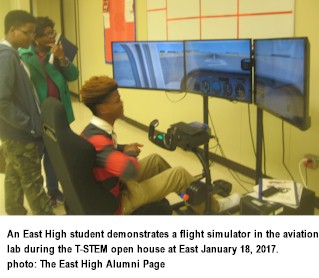
An open house for parents and others interested
in the East High T-STEM optional school was held January 18. Guests
were ushered through three technical laboratory classrooms to meet
teachers and hear brief explanations of the programs. An additional
presentation gave an overview of the initial curriculum "pathways,"
admission requirements, and other aspects of the program.
The transition of East High into an entirely
optional T-STEM school is set to begin in August with the ninth grade
and will advance a grade each year. SCS says they expect to have about
125 freshman enrolled next year, possibly with 100 in the T-STEM
program and 25 in the existing engineering optional program. Saying the
building has plenty of room, Brett Lawson, SCS Instructional Leadership
Director, says that if there is a groundswell and 300 qualified
students apply to the T-STEM program's first year program it will
expand to accommodate them. Those in grades ten through 12 will
continue the traditional course of studies but administrators say their
programs will also be enhanced.
The classes for the initial ninth grade T-STEM
group will be held in the newer buildings at East High, originally
constructed as a Vo-Tech and the original optional school center.
According to administrators, essentially there will be two schools at
East, the T-STEM program in the newer buildings and the traditional
students in the original East High building, each with its own
principal. The newer facility also has its own kitchen but it appears
undecided whether T-STEM students will have lunch there or in the main
lunchroom in the main building. T-STEM students may also use the
auditorium and gym in the main structure. As grades are added to the
T-STEM program it will expand into the larger building. Even though the
older building was constructed in 1947-1948, Lawson praised the
"beautiful" building saying the T-STEM program looked forward to
expanding into it. 
The school system is soliciting ideas from
parents as to what should be included in the curriculum. The initial
classes will offer three T-STEM pathways of study. "Project Lead the
Way," a broad spectrum engineering course which all T-STEM students are
anticipated to take, Aviation, and Distribution and Logistics.
The T-STEM program has a mandatory eighth
class period. During their ninth grade year, a T-STEM student could
take two T-STEM classes as well as the other general education required
and optional classes. In addition, SCS offers a virtual STEM academy
for any qualified SCS student in the county in which a East High T-STEM
student could enroll, giving them a ninth class each day. The virtual
STEM laboratory is already located at East High. A number of courses
will offer dual enrollment in which a student gets college credit upon
successful completion as well as the high school credit. Lawson said it
is possible an East T-STEM student could graduate from the school with
22 high school STEM credits. "If only half of them are dual
enrollments, you'd walk away with 33 college credits before you
graduate, plus an industry certification or two or three or four."
It was emphasized several times that even
though the new program at East is transportation oriented, that is not
all for which the curriculum prepares a graduate. Transportation may be
the example often used, but the knowledge and skills taught apply
broadly to STEM careers. Even beyond that, the critical thinking needed
to complete the T-STEM course work is beneficial for students pursuing
other less technical work, from being attorneys to teachers.
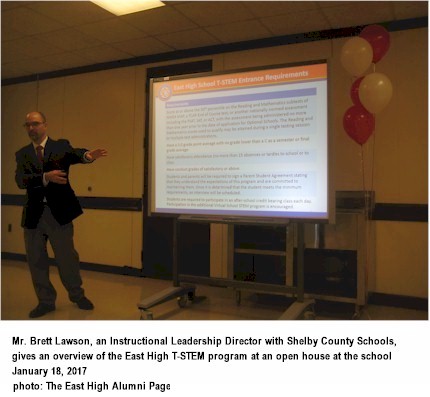
SCS says industry and organizations are excited
about the East T-STEM program and have made commitments to participate
in one way or another. Earlier, SCS cited 25 such partners but at the
open house and in other recent documents about 15 are being listed.
Cummins Diesel will work with the school to provide diesel engine
technology studies, FedEx provides flight simulators for the aviation
curriculum and University of Memphis teachers are participating.
Acceptance into the East High T-STEM program
requires an applying student score at or above the 50 percentile on the
reading and math subtests of the NWEA Map, a TCAP End of Course Test,
or another nationally normed assessment, including the PSAT, SAT, or
ACT. The test must have been taken no more than one year prior to the
application for admission to the East T-STEM program. On the reading
and math subtests, scores may be from a single administration of the
test or multiple instances, which according to Lawson can be merged
into a "super score." Applicants must have, and students in the East
T-STEM program must maintain, a GPA of 3.0 or above and no semester or
end of course grade lower than a C. They must have an attendance record
with no more than 15 absences or instances of tardiness to school or
class and conduct grades must be satisfactory or above. An interview
with the student is required for admission. Lawson says the interview
is mostly to determine that the student is interested in the program,
not only a parent. Parents or guardians, as well as students, will need
to sign an agreement that they understand the expectations of the
program and are committed to maintaining them.
Applications to the East High T-STEM optional
school will be accepted beginning January 27, 2017, however, an
applicant may reserve a virtual place in line by obtaining a bar code
beginning January 23. A portion of the application process is outlined here.
Expectatons of the STEM matter to come before the
board of Education at its January, 2017 meetings are outlined
here.
See additional stories below on East High STEM and also on our
Today's East High page.
East High STEM Plan Next Steps
January 12, 2017 - The East High Alumni Page has spoken with the
administration of Shelby County Schools about the status of the East
High STEM proposal.
The SCS administration expects to implement the plan

effective with the start of the 2017-2018 school year barring
unexpected opposition. It is believed that the members of the Board of
Education support the plan. While there may be some opposition by those
who currently live in the East High attendance zone, since they or
their children might have to attend another school, the administration
does not expect any such opposition to derail the
proposal.
The plan is expected to be discussed at the January
24, 2017, Board of Education Work Session which begins at 5:30 p.m. in
the Coe building Auditorium, 160 South Hollywood Street, Memphis. No
votes are taken and members of the public are not permitted to speak to
the board at the Work Session.
The administration does not plan to bring up the
East STEM proposal at the Board of Education "business meeting" which
begins at 5:30 p.m. January 31. The administration believes, as
most observers do, that the proposal to transition East High into a
STEM optional school does not require a vote of the board. Votes of the
board are taken at the business meeting sessions and the public is also
allowed a limited opportunity to speak to the board members during the
business meeting. Members of the public wishing to speak at the
business meeting must sign up before the meeting begins. A sign up
sheet is available from about 5 to 5:30 p.m.
The administration does not propose to change the
name of East High, at least initially. There has been some discussion
among board members previously about altering the name if the STEM
proposal is implemented.
As reported elsewhere on these pages, the East High
STEM proposal calls for the transition to occur year by year, grade by
grade, beginning with the ninth grade in 2017. The administration
foresees the probability of East having two principals during the
transition phase, one for the STEM students and one for the traditional
students. In an earlier post here, it was disclosed a
job opportunity posting
has been issued by the school district for a principal of East High to
oversee the school as "a local, regional, and national model focused on
Science, Technology, Engineering, and Math in Transportation Based
Careers (T-STEM)." Also previously reported here, the district has
published an estimate that there will be
100 seats available for
students in the ninth grade STEM program at East beginning with the
fall semester, 2017.
For more background, follow the links in the above
story and those below to additional links to some of the previously published
stories.
"Transforming East High School into one of the most high performing high schools"
Handful Hear a Few New Details About East STEM proposal
Decision on "Hyper Underperforming" East High School Needed Soon - Transition would mean many changes
Done deal? - Plan east transition to all optional stem school called official
Report: "It's official. Big changes coming to historic Memphis East High School"
January 7, 2017
Chalkbeat, an on-line education news resource, reported "East High
School, open since 1948 and one of the city's most iconic schools, is
officially on the list of optional programs being promoted this month
as the district prepares to receive applications beginning on Jan. 27."
Read the Chalkbeat article
Handful Hear a Few New Details About East STEM proposal
All commenting spoke in support
by
The East High Alumni Page
November 22, 2016 - There was a decidedly different atmosphere at the
"info session" about the proposal to make East High an optional only
STEM (Science, Technology, Engineering, Math) high school at a very
poorly 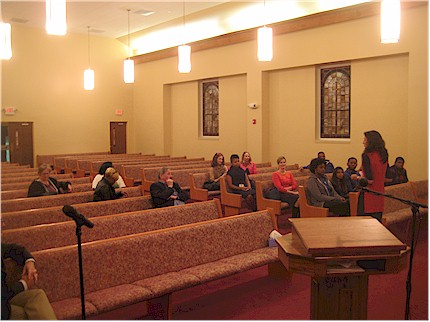 attended
public meeting at First Baptist Church Broad November 22. There was
nary a negative opinion of the plan to convert East into a high
achievement STEM school, very much unlike a similar session held at
East October 17 where the vast majority of perhaps 50 members of the
general public made up of mostly alumni, parents, guardians, and East
teachers had aggressive questions and outright opposition to the idea.
attended
public meeting at First Baptist Church Broad November 22. There was
nary a negative opinion of the plan to convert East into a high
achievement STEM school, very much unlike a similar session held at
East October 17 where the vast majority of perhaps 50 members of the
general public made up of mostly alumni, parents, guardians, and East
teachers had aggressive questions and outright opposition to the idea.
A handful of East alumni,
including Mea King, a 1997 East graduate and now an award winning
teacher at East, made rather long comments in favor of the STEM
proposal.
About the only hint of
opposition came from three or four alumni who expressed concern about
the possibility the name of the school might be changed. Dr. Hedi
Ramirez, Chief Academic Officer of Shelby County Schools fielded the
question with a somewhat ambiguous answer about wanted to preserve the
historic significance of the school and its name and then suggesting
about three names that included the word "east" in them but were not
precisely "East High School."
Mr. Brett Lawson an SCS
Instructional Leadership Director, who coaches principals at eleven
high schools including East, gave a slide presentation but as both he
and Ramirez warned, there was not much new revealed that had not been
made public at the October meeting or at a school board Academic
Performance Committee meeting held late last month.
New elements in the
proposal not expressed in meetings for the general public before were
the suggestions that students living in within a two mile radius of
East would get a "priority" in the admission process and that there
would be a mandatory after-school class for the STEM students followed
by a voluntary attendance class which they would be encouraged to
attend. It was pointed out that the iZone schools in the SCS system,
which special intervention underway and are reportedly making
significant progress in helping students close an grade
level-achievement gap, have an extra hour of class every day.
Other aspects of the
proposed admission requirements were quite similar to those expressed
before including successful applicants being in the 50th percentile on
approved reading and math assessments, a grade point average of at
least 3.0 with no grade lower than a C, and no bad conduct grades.
Students in what is now
the East High attendance zone would be assigned to either Douglass or
Melrose High Schools, both iZone schools starting with the rising ninth
graders for the 2017-2018 school year. For each of the next 3 years one
additional grade would be added to the STEM curriculum while those
currently in the traditional curriculum would be allowed to continue at
East in that study regime until they graduate, assuming they graduate
on time.
This was the fourth
meeting for people not affiliated with the school system could attend.
In addition to this meeting and the October 17 meeting, there was the
afore mentioned Academic Performance Committee meeting and last night,
November 21, there was a meeting for parents and students for those
pupils in the East attendance zone who would be ninth graders next
year. That meeting, too, did not draw a large crowd. An SCS
representative said about eight to ten parents and three students
attended.
Several people mentioned
that one reason so few attended tonight's event at the church was that
the East High boys basketball team was playing a game in the MLK
Tournament at the same time. East has been pre-season ranked as being
the number three boys high school basketball team in the nation.
 At least two of the
meeting attendees mentioned, without criticizing the choice, that the
people at the basketball game should have been at the information
meeting about East High's future.
At least two of the
meeting attendees mentioned, without criticizing the choice, that the
people at the basketball game should have been at the information
meeting about East High's future.
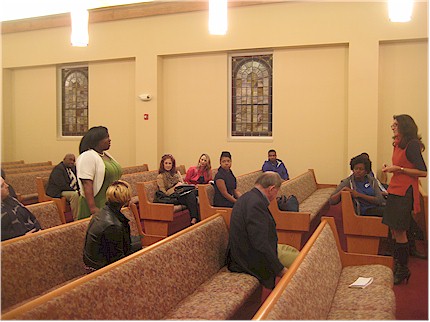
About a dozen people who
were not employees of Shelby County Schools were scattered about the
church's chapel. Six of those were University of Memphis students who
were billed as STEM ambassadors speaking in favor of a STEM education,
particularly as it applied to transportation. Their attendance was
apparently arranged by another "public" attendee and presenter, Dr.
Stephanie Ivey, an associate professor of civil engineering and
Director of the Intermodal Freight Transportation Institute at the
university. Her comments gave strong support of STEM education and the
opportunities it opens for students. The university is one of more than
two dozen entities pledging to support in one way or another an East
High STEM curriculum.
If one subtracts the U of
M people and the SCS administrative staff from the total, one could
count the members of the general public attending in the middle single
digits, most being East alumni.
At an information meeting
at East High held October 17 attracted about 60 people total, perhaps
25 East alumni and 20 teachers from the school. Most of the rest were
either East students or SCS employees. As we have reported, the tone of
that meeting was quite resistant to the STEM proposal.
In her comments, Rameriz
again cited the risk to East saying, "[I]f we don't do something with
East High School someone will do something to East High School." It has
been noted previously East has about 522 students in a building with a
capacity of about 1,500 and it is currently in the fourth percentile of
schools statewide academically. That means more than 95% of the public
schools in the state rank higher. She said the idea is to offer East
STEM students a high quality Dual Enrollment (college and high school
at the same time) and/or college credit courses.
Among the attendees was
school board member Teresa Jones in whose voting district East is
located. She said that while she was open to being convinced otherwise
from the start she has been in favor of the proposal to make East a
STEM optional school.
The Board of Education is
expected to discuss the proposal for an East STEM optional (magnet)
school at its November 29 meeting and perhaps discuss and vote on the
proposal at a December 6 meeting at which a limited time is allowed for
public comments to be made to the board. The school administration has,
however, says it will also be presenting proposals to close two other
elementary schools at the same meetings. School closures often bring
crowds of parents, students and teachers from the affected schools and
that can reduce even further the time each member of the public gets to
speak. Both board meetings begin at 5:30 p.m. in the Coe building
auditorium at SCS, 160 South Hollywood Street (see map).
In addition, SCS announced a few other relevant dates:
January 8, 2017, a SCS optional school\program fair at the University of Memphis,
January 18, 2017, an public open house at East High School, and,
January 27, 2017, optional school\program application acceptance opens at 6:30 a.m.
Look for further details on the January 18 East High open house in the coming days.
Decision on "Hyper Underperforming" East High School Needed Soon
Transition would mean many changes
by
The East High Alumni Page
[Editor's note: a preliminary decision on East High STEM may come in late November and early December, 2016. See our Today's East High page for details.
 October 27, 2016 - Shelby County Schools Superintendent Dorsey Hopson
says a decision from the school board on whether to proceed with his
proposal to transition East High into a Science, Technology,
Engineering and Math (STEM) focused optional school needs to be made
within "the next month or so." He says the administration needs that
lead time to set up the curriculum and choose a school principal and
staff, as well as determine a different school assignment for rising
9th graders who will remain in traditional studies but live in the
current East attendance zone.
October 27, 2016 - Shelby County Schools Superintendent Dorsey Hopson
says a decision from the school board on whether to proceed with his
proposal to transition East High into a Science, Technology,
Engineering and Math (STEM) focused optional school needs to be made
within "the next month or so." He says the administration needs that
lead time to set up the curriculum and choose a school principal and
staff, as well as determine a different school assignment for rising
9th graders who will remain in traditional studies but live in the
current East attendance zone.
Hopson first suggested the transition a year ago which would have taken
place this school year, but questions from board members and an
unsettled situation over closing of other schools led him to delay the
proposal for a year. The idea includes a lot of the STEM curriculum
involving the transportation industry, so much so that the school
system has called it a T-STEM school proposal, the "T" standing for
transportation. However, the top academic department official said that
the transportation aspect could be over played in the discussion but
that transportation is a major employer in Memphis with many career
opportunities.
At an Academic Performance Committee meeting of the Board of Education
attended by board members Miska Clay-Bibbs, Teresa Jones, Mike Kernell,
and Chris Caldwell October 25, Hopson and SCS Chief Academic Officer
Hedi Ramirez outlined the proposal for the transition of East High to a
STEM school with about the same information presented to parents,
teachers, and the public at a meeting at East High October 17. It calls
for a year-by-year transition with the ninth grade to be all STEM
students in 2017-2018, progressing by one grade each year until
2020-2021 when the entire 9-12 grade structure would be fully STEM.
Hopson said it would be "too much to do it well" to change all grades
four grades to the STEM curriculum in one year. The year -by-year
transition would also allow all those students currently enrolled at
East to continue in traditional classes until they graduated from East,
presuming they were promoted to the next grade each year.
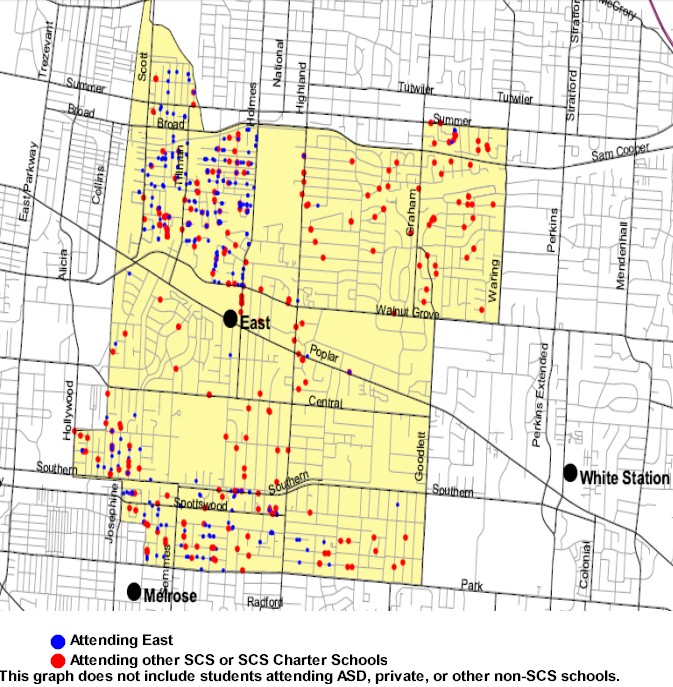
As The East High Alumni Page reported earlier, East is now in the
lowest four percent of all schools in the state in academic
performance. Attendance is down to about 522 pupils while another 245
who live in the East attendance zone go to other SCS or SCS Charter
schools. The administration says the current capacity of East is 1,364.
The engineering optional program which once thrived at East has less
than 40 students enrolled in it. Ramirez described East at "hyper
underperforming."
Weighing in on the side to make East a STEM school in addition to the
poor academics and low enrollment is the report that 21 entities have
pledge to support the East STEM school in one way or another, including
the University of Memphis and FedEx. The potential partners are said to
be "really excited" about the possibilities if East is transitioned
into the optional school and, the school administration says, many have
agreed to support those in the traditional curriculum during the
year-by-year transition. The physical condition and location of the
East High School building are attributes favorable to maintaining it as
a viable school.
As has been said repeatedly, and reported previously here, the poor
academic performance of East combined with the low attendance makes
East a target for closing or for take over by the state's Achievement
School District (ASD). The ASD does not plan to acquire any schools
next year because of the changing of the state assessment tools. The
ASD is likely to be back to taking over poor performing schools for the
2018-2019 school year. Memphis has already been the locale where the
ASD has taken over the vast majority of schools and the number of SCS
schools in the lowest five percent of academic performance continues to
make it a target rich environment.
 Arguments
against making East a fully STEM school include those often expressed
by attendees at the October 17 meeting at East. Of the sixty or so
alumni, teachers, parents, and members of the public that attended that
meeting, there was strong sentiment for keeping East a neighborhood
school for all children in the attendance zone. Parents and other
guardians just want their children to be able to walk to school. A
related concern was that neighborhood children who might want to attend
an East STEM school would not qualify to attend. Alumni, particularly
from the 1990s and early 2000s it seems, believed the school was a good
school when they attended and thought it could be restored just by
raising the standards while keeping it a traditional school. Many at
the meeting said enrollment was down because Career and Technology
Courses (CTE), previously known as vo-tech, had been cut. They said
attendance would rebound if more CTE courses were brought back to East.
Arguments
against making East a fully STEM school include those often expressed
by attendees at the October 17 meeting at East. Of the sixty or so
alumni, teachers, parents, and members of the public that attended that
meeting, there was strong sentiment for keeping East a neighborhood
school for all children in the attendance zone. Parents and other
guardians just want their children to be able to walk to school. A
related concern was that neighborhood children who might want to attend
an East STEM school would not qualify to attend. Alumni, particularly
from the 1990s and early 2000s it seems, believed the school was a good
school when they attended and thought it could be restored just by
raising the standards while keeping it a traditional school. Many at
the meeting said enrollment was down because Career and Technology
Courses (CTE), previously known as vo-tech, had been cut. They said
attendance would rebound if more CTE courses were brought back to East.
A successful STEM school in the SCS system is Maxine Smith STEAM
(Science, Technology, Engineering, Arts, and Math) Academy, a middle
school which is in the building previously known as Fairview Junior
High. Those middle schoolers could continue their STEAM/STEM studies at
an optional high school devoted to that curriculum. It was said,
however, however, that when speaking with parents of Maxine Smith STEAM
Academy students they expressed concerns about safety issues at East
High. It was also noted that Maxine Smith has less than 150 enrolled it
its six through eighth grades and not all of them would choose to
attend East even if it were a STEM school. Ramirez said that a freshman
STEM class at East would expect to have between 100-120 children.
It was revealed at the October 25th meeting that there could be two
principals at East if the STEM proposal is implemented, one for the
pupils in the traditional curriculum and another for those in STEM.
Hopson also indicated an interest in having higher admission standards
for an East STEM school than were included in the failed federal grant
application and mentioned at the October 17 meeting. He said there was
a thought that to push for a higher performance STEM school those
seeking admission might be required to have a grade point average
higher than 3.0 and to take an admissions test. Some other SCS optional
programs have admissions testing, including the Maxine Smith STEAM
Academy. With a GPA requirement of "3.2 or 3.5 then, I think, the
opportunity for long term rigor and high performance is probably even
greater," Hopson added. It was made known that the earlier mentioned
admission criteria with no admissions test and a GPA of 3.0 was related
to the competitive federal grant application and since SCS did not get
that grant it was free to improve the requirements. Ramirez did say
that hiking the GPA requirement or requiring admission testing would
probably make it "not worth the time to reapply" for another federal
magnet school grant as those grants favor a more open admission policy.
The superintendent said the easiest way to transition East would be to
close it as a traditional school and then reopen it as a fully STEM
school but because of tradition and allowing current students to finish
at their school, the grade by grade transition would be preferable. He
said there was plenty of space to, in essence, be running two schools
within the building.
It might be noted that for the years prior to the 1972-1973 school
year, East did run two, perhaps three, schools in the same building:
East Elementary, East Junior High, and East High. The elementary had a
separate principal while the junior high and high school were served by
the same principal.
The recent reputation of East was mentioned in connection with drawing
students to an East STEM school. It was said that just changing the
curriculum and calling it STEM would not necessarily attract students,
that the reworked school would need to be well marketed to parents in
Shelby County. Bibbs, the committee chairperson, said she thought the
name would also need to be changed both because of the lingering
reputation of recent years and to differentiate the traditional classes
from the STEM classes during the transition period, but she added the
new name should incorporate the word "East" in it.
East athletics were mentioned as a positive attraction for students and
both the administration proposal and at least three board members at
the Academic Performance Committee meeting expressed a desire to
continue the "championship" tradition of athletic programs at East. It
was suggested that some athletes who excel academically are going to
schools outside the district or private schools because there were too
few choices of high schools in SCS with good athletic programs and high
academic achievement. Kernell said careers now call for teamwork and
that is a valuable lesson sports can teach.
Jones asked about the possibility of ASD taking over East after the
transition began but before improved academic results starting showing
in the annual statistics. She suggested the administration talk with
the ASD to get some assurance that would not happen and that there
would be some number of years for the turnaround to take effect. Hopson
indicated he "couldn't imagine" the ASD not giving some leeway but that
he would talk with the ASD about it.
Jones told the superintendent she and the board needed a time line
giving the "ideal" dates for each step to happen. Hopson appeared to
agree and said the most immediate need was planning the assignment of
next year's ninth graders to another school. Ramirez added that the
brochures for optional school programs for next year go to the printer
in December.
Jones, the immediate past chairperson of the school board, said she
might like to see both a traditional school and the STEM optional
school in the building if funding and other factors would allow.
Furthermore, she said she would prefer the vision be broader than a
transportation STEM to increase its appeal. Hopson said STEM was the
headline feature, suggesting the studies would entail a considerably
wider focus than just STEM for transportation.
Kernell called an East High STEM school a "beautiful thing we could point to for ourselves and for the rest of the world."
In her Academic Performance Committee report at the school board
"business meeting" later October 25, Bibbs mentioned that the group had
discussed the East High STEM proposal but did not go into any detail.
Two East alumni and two East seniors spoke to the board during the
public comment period. Their main point seemed to be a desire to be
fully informed and the opinions of alumni and students be included in
the decision making process.
The Shelby County Board of Education's next scheduled meeting is a
"work session" (no votes, no public comment, but open for public
observation) November 29. The next scheduled business meeting (with
votes and public comments) is December 6. Various board committees may
meet before those dates and a special called meeting could also occur
if needed. Board policy requires at least 24 hours notice of any board
meeting be posted and placed on the SCS web site. Committee meetings
require a five day notice unless an emergency situation exists. The
Board of Education's section of the SCS web site can be found at http://www.scsk12.org/board/.
Read an additional story on the October 25, 2016, Academic Performance Committee meeting in Chalkbeat.
Initial Public Meeting on Future of East High School As a STEM Optional School
Parents and Public Question the Proposal
by
The East High Alumni Page
October 17, 2016 - The top academic
officers of the Shelby County School system along with the Board of
Education member in whose district East High sits tonight met with
about 60 people comprising a few current East High students, a
contingent of perhaps 25 alumni of the school, about a dozen East
teachers, the remainder were parents and guardians of current students,
and a few concerned members of the larger Memphis community. It
appeared the largest group were alumni.
East High's future is in question
because it is in the bottom five percent in academic performance of
schools in the state. With the decline in enrollment (currently at
522), and the low academic rating, East is open to be taken over by the
state's Achievement School District or, as SCS administrators have
said, on a trend that could lead to a closing of the school.
After introductory remarks from East
Principal Marilyn Hilliard, Superintendent Dorsey Hopson, and Board
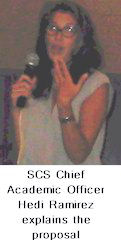
Member Teresa Jones, SCS Chief Academic Officer Hedi Ramirez conducted
a presentation outlining some ideas the district administration has
about transforming East High.
As
was reported here a year ago, the administration's initial proposal is
to make East High a Science, Technology, Engineering, and Math (STEM)
optional school. In particular a T-STEM school, with the first T
standing for a focus on how STEM applies to transportation. Ramirez
noted that Memphis is a transportation hub with thousands employed in
the industry. While emphasizing that the purpose was to inform and get
ideas from the public, the initial proposal called for all ninth grade
students in the 2017-2018 school year to be STEM students, admitted to
the program upon application and meeting the requirements of no more
than 15 combined tardies and absences from school during a year, a
grade point average of 3.0, and no N (needs improvement) or U
(unsatisfactory) in conduct, and participating in an application
interview. Current East pupils in grades 10-12 would continue their
traditional curriculum during that first year of the STEM program. The
second year grade ten would be added as exclusively STEM, the third
year grade eleven, and finally in school year 2020-2021 all four high
school grades would be STEM.
The presentation was interrupted
with a few questions and after trying to answer one or two
administrators asked the group to let the presentation continue and
save questions for discussion in small groups that would assemble in a
few minutes. It was clear from the initial questions, however, that the
proposal was meeting some resistance.
In the small group this writer
attended, there seemed to be little support for the T-STEM program.
Instead, those speaking mostly advocated for maintaining the
neighborhood school, more diverse courses, more tutors, and more career
technology education (CTE) classes (what used to be called vo-tech).
In answering the question if East
were to transition to STEM, would the small group prefer year-by-year
transition or to make the change all at once and rezone all traditional
curriculum students to another school the first year, the small group
overwhelmingly indicated a year-by-year transition. That may not mean,
however, that they like the idea of a STEM optional school at all.
After the breakout sessions, there
were reports on some of the ideas that came from each group. Some of
the summary comments:
Group 1:
- bring back the great things East High has had going for it in
the past (in this case it appeared the past was defined at 5-10-20
years ago)
- if the choice is between converting to STEM all at one
time or transition grade year by grade year, a transition was
overwhelmingly desired
- for traditional curriculum students remaining at the
school, the group wanted great teachers, a dedicated counselor, dual
enrollment classes, and stepped up tutoring
- "some reluctance" for real high admission standards
- suggestion to "recombine some middle school
populations" to increase the feeder pattern into East High so as to
increase enrollment
- get community support to rebrand the school to restore its reputation
- a current teacher expressed the opinion that things had
turned around in the past couple of years and that things would
continue to get better;
Group 2:
- want East to be back as the esteemed East it was once before
- bring back CTE (vo-tech)
- opportunities for students to engage in athletics –
that in the past students came to East because of the successful
athletic opportunities
- continue Peer Power (paid peer tutoring)
- want students grades 10-12 the option to stay at East through the 12th grade
- questions about how students at middle school or at Lester would be supported to attend the T-STEM program at East
- Melrose and East students should not be brought together
- there should be an optional program, a CTE (vo-tech) STEM program, and a traditional program at East
- that students should not have to leave East to get a quality education
- support for elementary and middle schools that will feed into the program
- mostly the big idea is support for a quality program at East without students having to leave, enhance what's already here;
Group 3:
- could there be someone in the community to act as a liaison
between the board of education and the community to provide input on
the next phase of planning
- the question does it have to be an exclusive optional school or could it be both optional and traditional school combined;
Group 4:
- on curriculum and instructional practices our group had a focus
on vocational offerings: mechanics, early childhood, liberal arts,
performing arts, with opportunity for real world experience
- peer to peer learning is important (probably referring to the Peer2Peer tutoring program)
- in regards to STEM, make sure the program is sustainable over time and that the morale within the program is upheld
- in the past vocational students and optional students
didn't mix, if it goes through a combined STEM and traditional
curriculum transition, students ought to have the opportunity to do
both, academic and vocational and have some input on what their
schedule is going to look like
- if the transitional approach to STEM is used, provide
enrichment programs, guest speakers and alums who are very wealthy
would be perfect for that.
Following the small group summaries, there were a few additional questions from the audience.
One questioner wanted to know why SCS
was pursuing the T-STEM idea since it was rejected for the federal
grant. Ramirez said that while the federal government chose not to
provide the grant it was not because of the T-STEM focus. In fact, she
said SCS got very high marks on the plan design. But she pointed out
that the grant application was very competitive and despite losing out
on the funds it also was a learning process which could lead to other
outside grant applications. She further indicated the existence of the
application allowed SCS to go to potential partners in the business
community to get their support.
It might be mentioned here SCS says
numerous businesses are excited about the T-STEM proposal and have
indications they would like to partner with the school system in
implementing it.
Another question was about
permitting the students of East High a voice in the process. Ramirez
said that was a good idea.
SCS administrators and board members
repeatedly said that no final decision has been made about the
direction East High will go and that additional opportunities for the
public to provide opinions will be offered.
[See also the October 18, 2016, Chalkbeat (webnews) story about this event.
Mid-South Memories: East alumni among those rallying for Eisenhower
from
The Commercial Appeal
October 11, 2016 -  Sue Tushingham ('55) pictured far left, Vivian Garland ('54),
second from left, and Butch Bassett (class association undetermined),
second from right, were among the young women in support of Dwight D.
Eisenhower's bid for a second term as president.
Sue Tushingham ('55) pictured far left, Vivian Garland ('54),
second from left, and Butch Bassett (class association undetermined),
second from right, were among the young women in support of Dwight D.
Eisenhower's bid for a second term as president.
Newspaper caption:
October 10, 1956 - Their political
persuasion as obvious as their personal charm, these half dozen young
ladies greeted Memphis voters on October 10, 1956, attracted by the
Eisenhower Bandwagon as it rolled through town. From left, they are
Miss Sue Tushingham of 3587 Mimosa, Miss Vivian Garland of 3195 North
Waynoka Circle, Miss Marilyn Marsh of Germantown, Miss Nicky Hurdle of
Quincy, Illinois, Miss Butch Bassett of 3209 Cowden and Miss Margaret
Marsh of Germantown.
(Photo: Barney Sellers/The Commercial Appeal files)
Possible future direction of East High discussed at School Board
Superintendent cites 40% drop in enrollment since 2011by The East High Alumni Page
September 15, 2015 - Shelby County Schools Superintendent Dorsey Hopson
tonight asked the county board of education if it endorsed staff
exploring the possibility of East High becoming a "STEAM academy." He
said the proposal was for a "high quality" option with a rigorous,
college-ready core academic program.
 While the board members had a
lot of questions during the 22 minute discussion, it indicated the
administration should proceed with its examination of the possibility.
While the board members had a
lot of questions during the 22 minute discussion, it indicated the
administration should proceed with its examination of the possibility.
STEAM stands for a focus on Science, Technology, Engineering, Arts, and
Math. The idea also provided for an increased focus on career and
technical education (CTE) in parallel with the STEAM curriculum. There
is already a CTE center on the East campus that is part of the school.
CTE generally focuses more on hands on learning, what once was called
vocational classes, where STEAM is more traditionally academically
oriented but obviously with considerable technical and laboratory
elements included.
Hopson cited the reason for the district administration's consideration
of changes at East included the drop in enrollment from about 900 in
2011 to 550 this school year and calling buildings underutilized
facilities. He also noted a decline in Tennessee Value Added Assessment
System scores of its students over the past year.
The East High Alumni Page reported in late July that Hopson was
considering changing the focus of East to a STEM school. A STEM school
is similar to a STEAM school but without the additional focus on the
arts.
Hopson said there were numerous options the district's administration
had and would continue to consider. Among the variations if the school
were to become a STEAM academy would be whether that would be all it
would include in the academic curriculum or whether it might be a
"school within a school" that would have another group of students
following the regular high school curriculum. He said the building
could easily hold two "schools." Responding to a question from a board
member he said the school's capacity was about 1,200. In decades past,
East has had enrollments greater than 1,500 when it was a grade 1-12
school. Since then, however, the annex, a classroom add on with nine
classrooms, has been demolished and some other classroom space has been
converted to other uses, for example, a health clinic for students and
staff exists at East.
School board chairlady Teresa Jones, appearing to particularly speak to
the decline in enrollment, said, "[I]t is a concern to me and I think
to parents to bring it back to the level it was."
Board members told Hopson that there were many questions that needed to
be answered in the coming months. Among them, where are the students
living that attend East now, what do parents of East students think
about the idea, how would those who live in the East attendance zone
that thought they would be assigned to East feel if they were no longer
assigned to East should it become exclusively a STEAM and CTE school.
For three decades East has been an optional school for engineering and
health sciences while also maintaining the general curriculum but
enrollment in the optional programs has been very low in recent years.
Optional schools may be exclusive to the focused line of study or may
also have a general student population. Optional schools are open to
any student in the county who wishes to pursue the area of focused
study as long as there is room in those classes and, in some cases, the
student must qualify academically for the optional programs. On a small
scale, East currently could be considered a school within a school
since it has both general education and optional program students in
the building.
The superintendent further outlined his proposal pointing out it would
provide a STEM focused high school for students "city wide" and create
the next level of STEM education for students currently enrolled in the
Maxine Smith STEAM Academy, a middle school previously known as
Fairview.
It is unclear if the presentation was intentionally referencing STEM in some places and STEAM in others.
East currently houses the laboratory for a virtual STEM academy.
Students enrolled at any district school can take STEM classes either
at their school or on-line, and with appropriate grades, can get
practical experience in the advanced STEM laboratory at East.
Hopson acknowledged the evaluation of the idea was just in its
"embryonic stage" but with the board's approval the next couple of
months would be used to refine the idea resulting in a more concrete
plan with answers to many of the questions the board members had.
At this point, making East a STEAM academy is just an idea and if it
even comes to fruition the school might also continue to have students
enrolled in the regular curriculum. Hopson said he did not want the
headlines to misinform people that there was a proposal to close East
High and totally repurpose it. What the final recommendation might be
is still undetermined and any proposals would be not only presented to
the board members for evaluation but also to the community.
The board members gave Hopson the green light to continue exploring the possibility of making East a STEAM academy.
Dr. Marilyn Hilliard is East's New Principal for 2015-2016 School Year
by
The East High Alumni Page
August 8, 2015 -  (For more on this change of leadership and possible change in direction for East High, see the additional story below.)
Dr. Marilyn Hilliard (Principal) has been named interim principal for East High School for the 2015-2016 school year.
As The East High Alumni Page earlier reported, in addition to the new
principal, Shelby County Schools Superintendent Dorsey Hopson is
considering a nationwise search for a permanent principal and the
possibility of making East fully a STEM (Science, Technology,
Engineering, and Math focused) school.
Hilliard comes to East after serving two years as assistant principal
at Southwind High School. Prior to that role she was among faculty in
Memphis schools for ten years, including three years at City University
Boys Preparatory charter school where she was campus president. Prior
to her public school work, Hilliard worked as a Training and
Development Specialist for Memphis Light, Gas, and Water Division.
The new principal at East has her doctorate in education. She attended
Northside High School in Memphis and the University of Mississippi.
[The East High Alumni Page hopes to have more details and an interview with Dr. Hilliard soon.]
East to Get New Principal for 2015-2016 School Year
East alumnus Eric Harris leaving after five years at helm
New direction for school considered
by
The East High Alumni Page
July 30, 2015 - Eric Harris' ('91 and principal 2010-2015) five year tenure as principal of East High School has come to an end.
 Superintendent Dorsey
Hopson has appointed an interim principal whose name has not been
publicly announced to guide the institution through the 2015-2016
school year.
Superintendent Dorsey
Hopson has appointed an interim principal whose name has not been
publicly announced to guide the institution through the 2015-2016
school year.
Hopson said he is considering a national search for a principal and
perhaps making East fully a STEM school, which means one that is highly
focused on Science, Technology, Engineering, and Math. Acknowledging
East's academic "rich history," Hopson indicated something needed to be
done to lift the school's performance.
The interim principal graduated from another Memphis high school and
has worked in the Memphis and Shelby county school systems for several
years, including as an assistant principal.
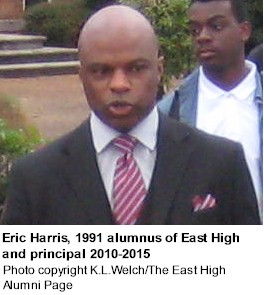 Harris
is an East High alumnus, having attended the school for six years and
graduating in 1991. He had long aspired to be principal of the school,
having told his mother when he was in elementary school he wanted to be
principal of East High one day. When he got the job, he said it was a
wish come true.
Harris
is an East High alumnus, having attended the school for six years and
graduating in 1991. He had long aspired to be principal of the school,
having told his mother when he was in elementary school he wanted to be
principal of East High one day. When he got the job, he said it was a
wish come true.
East High has become a difficult school to lift to higher academic
performance. "My biggest challenge is getting the academics where it
should be here," said Harris in 2010 after accepting the appointment to
East. According to the state's web site, the composite ACT for 2010,
the school year immediately preceding Harris' becoming principal, was
16.2 (equivalent to about a 12.2 in pre-1989 ACT scoring). The 2015 ACT
scores are not yet available but the 2014 composite ACT score at East
was 15.5. (These ACT scores vary slightly from those originally
released with the state report card on schools but are those that are
now posted on the state's web site).
Harris remembers East from his student days there as having about 50%
of the 1,800 students enrolled in the optional programs. He was in the
engineering optional program. At that time, East hosted grades six
through twelve. When Harris took over East only had grades nine through
twelve and the enrollment was about 1,000 and has declined slightly.
Despite his efforts to increase enrollment and boost the optional
programs, participation in the optional programs has remained quite
low, according to Linda N. Sklar, Director of Optional Schools and
Advanced Academics for Shelby County Schools.
In addition to the Shelby County School employees efforts to improve
academics at East, the Peer Power Foundation (formerly The Greater East
High Foundation) has provided free tutoring for East students for more
than a decade, paying qualified advanced students to tutor pupils that
needed or wanted help. Those getting toutored are typically less than
ten percent of the student body. Despite its no-cost-to-the-student or
his/her family and rewards to students attending and improving their
grades, the academic performance overall has changed little because so
few participated. Grade point averages of those who did take advantage
of the tutoring program were generally well above average, according to
the Foundation's reports. Charles McVean (East '61),
who created the foundation and has largely funded it with hundreds of
thousands of dollars, perhaps more, has announced that instead of
tutoring after school the program will be integrated into regular
classes for the 2015-2016 school year. It is hoped that will overcome
the participation problem and lift academic performance of many more
pupils.
Mr. Harris became the sixth principal at East High to serve five years
or longer. The new interim principal will be East's 15th principal in
its 67 year history.
Classes for the 2015-2016 school year begin August 10.
When the name is publicly released, The East High Alumni Page will have more about the new principal.
You may see a report on East High's 2015 academic measurements on our "Today's East High" page.
Tommie Henderson ('91 and Faculty 1998-2003) Appeals to School Board to Keep Charter School Open
Dramatic vote allows charter school to stay open
by
The East High Alumni Page
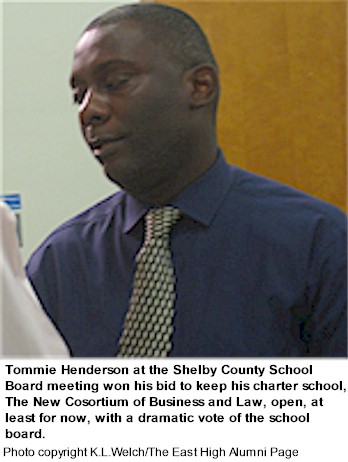
July 29, 2015 -
Tommie Henderson ('91 and Faculty),
executive director of the charter school New Consortium of Law and
Business (NCLB), appeared before the Shelby County Board of Education
July 28 to ask that it not approve a recommendation from the county
school district's superintendent Dorsey Hopson to revoke the charter
school's authorization. The board voted to delay any consideration of
closing the school until its regular timetable for considering
closings, which is in the first quarter of the calendar year, giving
the New Consortium of Law and Business the green light to start classes
for the new school year in a few weeks.
While charter schools have a great amount of autonomy in operation,
they are part of the public school system in Tennessee and the local
school board is empowered to authorize charter schools and to revoke
any of those it has chartered for cause.
In a presentation by Shelby County Schools Chief Innovation Officer,
Brad Leon, the district outlined numerous alleged violations of the
charter contract between NCLB and the school district as well as
violations of state education laws and regulations, particularly in
regards to financial statements. There were also allegations by the
district administration of violations of federal regulations regarding
student Individualized Education Program for Special Education students.
During the period for public comments which was limited to three
minutes for each speaker, Henderson admitted NCLB made some mistakes.
He said missing a payroll and missing payments to the Tennessee
Consolidated Retirement System were both associated with a cash flow
problem resulting from a faulty financial forecast. Henderson seemed to
take issue with the district's characterization that enrolling
employees in an insurance plan other than that offered by the school
district was "illegal," and said at one point the charter school was
not permitted to enroll its employees in the district's insurance
program. The Commercial Appeal reported that after the board vote
Henderson said some of the allegations cited by the district
administration he was hearing for the first time and could not verify
whether they had occurred or not.
The district's administration countered Henderson's comments saying
that charter schools have always been allowed to enroll employees in
the district's insurance program. Board member Chris Caldwell said
financial issues are not new to the NCLB and have plagued it for years.
He said an auditor's finding indicated a significant problem with
financial reports and that it would not be a surprise if there was a
lack of trust in the charter's financial reports. "My gut just tells me
this is not best for kids to keep the school open," said District
Superintendent Dorsey Hopson.
About eight parents or guardians of children enrolled or planning to
enroll at NCLB spoke during the public comments period. One had
complaints about the school but the others praised the charter school
and asked that it be allowed to continue operation.
NCLB serves about 160 students with a faculty of approximately 26.
The board debated the recommendation to close the charter school and
various motions for an hour and a half. Many school board members said
their main concern with the recommendation to close the school was
timing, that two weeks before classes begin would be chaotic for
parents and students if NCLB were closed.
The discussion ended in a dramatic manner in which three members of the
nine member board passed when their name was called to announce their
vote. Then, as those who passed were given the opportunity to cast a
vote, the tally was four to four with only the decision of Miska
Clay-Bibbs remaining. After pausing before speaking, Bibbs voted for
the motion to delay consideration of the charter revocation until the
regular period for considering school closings.
The vote cleared the way for Henderson's school to open for the new school year's classes in about two weeks.
By Daily News Library,
Northwest Florida Daily News, Ft. Walton Beach, Florida
Jun 25, 2013
On a hot June afternoon in 1975, with the summer tourist season in
full swing, someone attacked a bikini-clad young woman on the beach a
scant 500 yards west of Okaloosa Island's biggest condominium.
[Editiors note: This story was published April 20, 1983 as a part of a
12-part cold case series written by Staff Writer Tom Conner. Today
marks the anniversary of Lynn Pyeatt's murder in 1975, which remains
unsolved.]
 FORT WALTON
BEACH -- On a hot June afternoon in 1975, with the summer tourist
season in full swing, someone attacked a bikini-clad young woman on the
beach a scant 500 yards west of Okaloosa Island's biggest condominium.
FORT WALTON
BEACH -- On a hot June afternoon in 1975, with the summer tourist
season in full swing, someone attacked a bikini-clad young woman on the
beach a scant 500 yards west of Okaloosa Island's biggest condominium.
The pretty vacationer was left dead - or near death - close to the
surf. Thirty minutes later, a young man strolling along the beach
mistook her for a nude sunbather until he noticed she was not breathing.
The victim was Lynn Elizabeth Pyeatt [associated with the Class of '74], the third 19-year-old woman slain in Okaloosa County within 27 months. Her murderer remains at large.
Until her death on June 25, Pyeatt had led an enviable life. She came
from a well-to-do family and attended a good college, but on that
Wednesday she was "in the wrong place at the wrong time," says local
FBI agent Mike Dill. "Her murder was one of happenstance."
Pyeatt was the daughter of Wayne Pyeatt, a prominent civic and social
leader who was then chairman of the board of the National Bank of
Commerce in Memphis, Tenn. She had been a cheerleader and an honor
student in high school, and had just completed her freshman year at
Smith College in Northampton, Mass., where she was studying
architecture.
In early June she and a friend, Marian Dickerson, left home to vacation
in El Matador Condominiums, where Dickerson's father owned a unit. They
had been in Okaloosa County about two weeks on the day of the murder.
On that day, Pyeatt and a group of friends pitched an umbrella on the
beach in front of El Matador. About 3:45 p.m. Pyeatt decided to take a
walk along the shore. She went alone and headed west, toward the Eglin
Air Force Base reservation.
"You must remember this was 1975 and the contour of the beach was
different then than it is now," Dill says. "The hurricane (Frederic in
1979) altered the beach, but back in 1975 you could look east to west
and soon lose visibility."
The contour of the beach served Pyeatt's killer well. She was attacked
just a quarter of a mile west of the friends she had left sitting under
the umbrella. Her companions saw nothing.
Exactly what happened is unclear, but 1st Judicial Circuit Deputy
Medical Examiner Dr. Edmund Kielman has tried to untangle the string of
events.
"I felt that perhaps somebody came up to her and she told him to get
lost," he says. "Then, maybe after she had turned her back on him, he
attacked her."
She was hit repeatedly on the head and suffered "several deep scalp
hemorrhages that must have rendered her at least semi-unconscious if
not unconscious," Kielman told the Daily news after the autopsy. "She
was knocked out much like a boxer in the ring."
Then, he thinks, she fell or was pushed into the Gulf and inhaled a
good deal of water. The killer dragged Pyeatt onto shore and tied her
hands behind her back with a nylon cord "to preclude active resistance
should she regain consciousness," he says, reading from his autopsy
report.
The cord scratched her wrists, but not seriously enough to suggest Pyeatt put up a fight after being bound.
"It appears the assailant then attempted to sexually assault the
victim, not realizing she was already dead or very close to death,"
Kiel-man says.
The killer bit Pyeatt's right breast, Kielman thinks, when "abandoned
any further action because he realized she was dead or he thought he
saw someone coming."
Kielman placed the time of death at 4 p.m., just 15 minutes after
Pyeatt had left her friends. She apparently lay on the beach for about
30 minutes before Paul Michael Quinn, an 18-year-old from Smyrna,
Tenn., found her body.
Kielman says Quinn told him he walked past her "and couldn't believe
what he saw. He thought she was alive. He looked back and saw that her
chest was not rising and falling, so he returned to her."
She was lying near the water's edge, both top and bottom of her bikini
missing. A gold earring was pierced through her right ear, but the left
one was missing. A gold ring was on her left-hand ring finger.
Quinn untied Pyeatt's hands to get a better grasp and dragged her up onto a ledge of sand, according to Dill.
"She had faulty breathing and was foaming at the mouth when I found
her," Quinn told the Daily News. "I started mouth-to-mouth
resuscitation and stuff would come out of her mouth. I put my arms
around her and squeezed and more stuff would come out of her mouth."
Quinn spent what he judged to be half an hour tying to revive Pyeatt,
stopping occasionally to try to summon help. From his position up on
the beach, he could see the red-roofed El Matador and sunbathers
basking on the sand. They were oblivious to Quinn's frantic efforts.
"I was afraid to stop," Quinn said. "I was afraid she would die. I'd
never run across a dead person before and I didn't know how to tell. So
I kept on trying to save her."
He removed a blue shirt he was wearing and put it on Pyeatt's body. He
grabbed seaweed from the sand and placed it atop her. "He had just
taken some Boy Scout courses and was trying to keep her warm," Dill
says, explaining Quinn's actions. "He was afraid she might be in shock."
All the while Quinn was thinking Pyeatt would recover and "I'd have to walk her down the beach to where other people were."
He eventually was aided by a jogger who approached from the east. Quinn
explained what was happening and the jogger ran to the condominium and
called for an ambulance.
When authorities arrived, Pyeatt was dead.
The incident occurred on government land, the concurrent jurisdiction
of federal and county authorities, so the FBI led the investigation
with the Okaloosa County Sheriff's Department assisting.
Dill says lawmen did recover some physical evidence, "but I can't talk about it" because the case could end up in court someday.
It is known that authorities recovered the nylon cord used to bind
Pyeatt's hands and the top and bottom of her bathing suit. A man and a
woman strolling the beach found her bikini bottom in the surf about 200
yards from the spot where her body was found.
"We saw them (the bottom) in the water's edge and went out to get
them," the unidentified man said at the time. "Once we saw what they
were we just tossed them up on the beach for the owner to come back and
claim them. We didn't know then that the owner wouldn't be back."
Lawmen also found footprints in the sand. "A variety of naked
footprints are present between the body and the wave-washed beach; also
noted are two sets of grooves at right angles to the beach line
suggesting that a body had been dragged in that direction, toes down,"
Kiel-man wrote in his report.
Dill says the investigation was launched largely on information supplied by Quinn, Marian Dickerson and Pyeatt's other friends.
Also, he said, a public request for anyone who may have seen someone in that area of the beach generated a large response.
"The general public is very good about coming forth with information,"
he says. "They would call us and say, 'How about looking into
so-and-so. He's known to hang out on the beach.' Then we'd start
checking him out, finding out his background and his general
description."
One person who came forward was another vacationing woman. She said
that on June 14 a man had run up to her and grabbed the top of her
swimsuit. She was not hurt and the man did not carry the assault any
further.
The sheriff's department looked for a connection between that incident
and Pyeatt's murder, because they occurred just 11 days apart on the
beach east of El Matador. No link was found, says Sgt. George French.
Quinn was never a suspect, he adds. "We interviewed him and found out
what he was doing out there. We talked to him several times and were
convinced his story was accurate and that he was not involved."
Agents talked to people staying in the El Matador's beachfront units to
determine whether they had seen Pyeatt being attacked. No one had.
Next, the FBI "tried to find out who was on that beach. It was a
laborious task," Dill says, "because of the number of tourists. We
tried to run down what they had seen and what they were doing.
"We received all sorts of information about suspects and people who
might know something, but we never had enough evidence to present to a
grand jury."
Authorities developed "several" firm suspects, all of whom were local people, he says.
Some of the suspects were given polygraph tests during which they were
caught lying, but their lies could not be tied in with the murder, Dill
says.
Off and on during the next six years, lawmen continued to develop
suspects. No charges were ever filed, and the case was taken off the
FBI's active list in 1981 when a suspect last came under scrutiny.
Now, nearly eight years after the murder, Dill can still pinpoint the
spot where the pretty teenager was killed. Walk west along the shore
past El Matador, he says, and when you look to your right and see a
telephone pole with no wires attached to it - "it seems to have no
purpose for being there," he says - you're standing on the approximate
spot of the murder.
That spot is still familiar to Quinn, the young man who found Pyeatt
and tried to save her. Contacted at his home in Smyrna, he says he has
not heard from the FBI in years. Nonetheless, he says he has been asked
to refrain from talking about the case with anyone other than lawmen.
Dill says he knew soon after the investigation began that the Pyeatt case would be tough to crack.
"Most homicides are family-related or there's some kind of connection
between the killer and the victim," he explains. Buy Lynn Pyeatt
probably was killed by someone she had never met.
When that's the case, he says, you'd better find the killer soon or the
search will get more and more difficult as time slips by.
[Editor's note: see also a
1975 story about this murder.]
Love of trickery, showmanship unites diverse members of Memphis magician's club
Lesley Young, The Commercial Appeal, May 16, 2013
Tim Grant claims to have only one bad habit: magic tricks.
"I have enough instructional DVDs, books and
tricks to last a lifetime," said the local medical sales
representative.
Luckily for Grant, 34, he has a group with which to share his obsession: the Society of Memphis Magicians.
The 70-plus-year-old club is linked to a larger
network of similar organizations, or rings, called the International
Brotherhood of Magicians. Memphis is Ring 16.
"That means we were one of the first ones," said
member and professional magician Jeffrey Day. "There are over 400
around the world."
The local club, which meets the first Tuesday of
every month at the Memphis Botanic Garden, counts "several dozen"
members from all walks of life.
"We have young people, middle-age, black, white, Asian, women, doctors, dentists, judges ..., all with the

common bond of magic," said local lawyer and businessman
Mike Speros ['67], 64. "The people in the club are so varied, we might never run across each other otherwise."
Speros, like many of his clubmates, started young
but fell out of the magic of magic when he entered his teen years, with
the occasional dallying while raising children.
Eventually, his grown children would rekindle his love of the craft by a simple gesture.
"One year about 14 or 15 years ago, my children
could not figure out what to get me for Christmas," Speros said. "They
went to the Fun Shop and found a book on card magic with a few other
tricks. I opened it up and said, "What's this?' They said, "Remember
when we were little and you would do magic tricks for us? That was fun,
and you need a hobby.' I decided to get good at it."
Speros joined the club, found a mentor in late
local lawyer and magician Jim Surprise, and worked on his repertoire.
Grant found magic after seeing a show at age 9.
When his parents allowed him one stop of his choice on their visit to Washington, he chose Al's Magic Shop.
"They gave me a AAA guide book and said I could
pick one thing out of the book," Grant said. "I looked at every page
and saw Al's Magic Shop and said, "I want to go there.'"
He grew out of his hobby during his teen years,
but had his memory triggered while visiting nieces and nephews in
Georgia and attending a magic show with them.
"That was the spark that reignited me to say, "I
want to check it out again and learn more about it,'" Grant said.
Four years later and magic is his "favorite
thing to do now," with a weekly gig from 6:30 to 8 p.m. every Friday at
the Trolley Stop Market
"You have to practice every day," Grant said. "There's a famous saying, "Magic should look natural.'"
Grant's secret to perfection is taking video of himself.
"You have to rehearse not just the moves, but
what you say," he said. "You rehearse the scripts and the choreography.
I video myself multiple times until it looks good."
Grant's two favorite tricks include the
traditional cups-and-balls, with the balls vanishing and reappearing,
and one in which rabbits multiply and appear in the audience
participant's hands.
"They have a crowd-pleasing effect," he said. "I like to get a good reaction of laughs and surprises."
For Day, who has worked as a professional
magician around the country for years, the reaction is what keeps a
magician in the game.
"You have to make the spectator believe it, and
you do that by believing it yourself, said Day, 52. "When it happens,
you get goose pimples."
"The best reaction I ever got was when a woman
turned her card over and it was her card, the hair on her arms raised
up," Speros said. "Neither one of us said anything, but we looked at
each other and knew. That's better than a room full of people
applauding."
The group members' specialties are as varied as
their backgrounds, with coin experts, card experts, parlor magicians
and mentalists.
The variety of crafts in one club benefits everyone, no matter his or her specialty.
"Everybody has different skills sets, and we all learn from each other," Day said.
Club members often invite more well-known
performers to give presentations and lectures during the meetings, and
they give one another feedback about their routines.
"It's the toughest audience you can find,
because everyone in the room already knows what you're doing, but it's
really helpful and it's always fun," Day said.
Ring 16 welcomes new members and guests to
meetings. The annual membership fee is $15, and it costs $20 to attend
lectures presented by out-of-town performers.
"Magic fundamentally brings people together," Day said.
"I look at it as a performance art form, as a way
of expressing myself," Grant said, "and I get to do something nice for
other people and hopefully give them an experience they'll remember the
rest of their lives."
It certainly had that effect on Day.
"I remember when I started back in school. I was
very shy and not popular," Day said. "Once I learned a coin trick,
suddenly I was the only kid in school who could do this one thing
nobody else could do. Suddenly, I had self-esteem. That has helped me
my entire life."
For more information about the Society of Memphis Magicians, visit ring16.org.
A video of Mike Speros performing a magic trick can be viewed on youtube.com.
MCS Decides Not To Transfer Teacher after Students Protest
Daniel Hight, WREG, October 26, 2012
 (Memphis) Students
at East High School say one of their teachers has made a lasting impact
on their lives and they were not going to let administrators transfer
her to another school without a fight.
(Memphis) Students
at East High School say one of their teachers has made a lasting impact
on their lives and they were not going to let administrators transfer
her to another school without a fight.
Nearly 100 students gathered in the hallway, refusing to go to class, standing up for Ms. Hightower [Faculty], a teacher they love.
"We're tired of seeing teachers that we care so deeply about and that care about us, going away," said Javian Tunstall.
The latest was their health and science teacher, who was being
transferred to another high school after working 27 years at East High.
"Thats the problem," said Devin Payne, a senior. "We've waited
too long. We've been passive for too long and if we didn't come out
today, who knows who is next."
Payne said students decided to protest when the principal failed to give answers to their questions.
"We've tried talking to him but he told us there is nothing he
can do, so we are trying to reach out to his bosses and get them to try
to stop this," said Payne.
Memphis City Schools did listen and decided not to transfer Ms. Hightower, for now.
MCS told us the teacher will get to finish the rest of the school year and then will likely be transferred.
They say this will create better programs for both high schools.
[Editor's note: the story and video may still be available at WREG's web site.
Nashville coach says former Mississippi State booster gave money to recruit
Pat Forde, Yahoo! Sports, Sep 12, 2012
A now-disassociated Mississippi State booster allegedly made cash
payments to a recruit and arranged for complimentary lodging and meals
for the recruit's seven-on-seven coach, Yahoo! Sports has learned.
 In an
interview with Y! Sports, Nashville-based seven-on-seven coach Byron
De'Vinner – recipient of the lodging and meals – explained in detail
how former Mississippi State booster Robert Denton Herring broke
multiple NCAA rules in 2011 and '12 in an effort to land Memphis East
High School defensive back Will Redmond.
In an
interview with Y! Sports, Nashville-based seven-on-seven coach Byron
De'Vinner – recipient of the lodging and meals – explained in detail
how former Mississippi State booster Robert Denton Herring broke
multiple NCAA rules in 2011 and '12 in an effort to land Memphis East
High School defensive back Will Redmond.
De'Vinner said he also told his story to NCAA enforcement
representatives, who have been investigating the allegations jointly
with Mississippi State's compliance department over the course of
several months. In July the school sent Herring, who lives in Roswell,
Ga., a letter informing him that he had been disassociated from the
athletic program for "impermissible contact" with a recruit. In August,
Bulldogs assistant coach Angelo Mirando resigned for what the school
termed "unforeseen personal issues," but sources told Y! Sports that
his resignation was because of the NCAA inquiry. De'Vinner said Mirando
introduced Redmond to Herring, but that the coach and booster both
wanted De'Vinner "to take the fall" for their relationship.
Vanessa Brown, Redmond's mother, declined comment to Yahoo!
Sports Wednesday morning. Attempts to reach Herring and Mirando were
unsuccessful. Herring has not cooperated with investigators from both
the NCAA and Mississippi State.
Redmond was a four-star recruit according to Rivals.com and
reportedly had offers from Georgia, Tennessee, Ohio State, Notre Dame
and Vanderbilt, among others. He signed with Mississippi State last
February and is currently a freshman on the team. He has not yet played
in a college game. Redmond has been interviewed by the NCAA, according
to De'Vinner, and there have been multiple media reports that the NCAA
interviewed his coach at Memphis East, Marcus Wimberly.
De'Vinner said another Memphis product, defensive back Sheldon
Dawson of Ridgeway High School, also was interviewed recently by the
NCAA about his recruitment by Mississippi State. Multiple media outlets
have reported that as well. Dawson is a freshman at Georgia and has
seen limited action this season. He did not return calls and messages
Tuesday.
A source with knowledge of the investigation said the NCAA
contacted nearly a dozen players who were recruited by Mississippi
State.
De'Vinner said he believes Mirando was the only Mississippi
State staff member who knew "Denton" Herring was committing recruiting
violations.
"I don't think there were no other coaches in the know, but
Denton was dealing with a lot of players over there," De'Vinner said.
"Will was the one caught up, but he was dealing with a lot of players."
De'Vinner provided Yahoo! Sports with hotel bills and other
documentation to back up his claims of violations. Under NCAA rules,
benefits to a third party associated with a prospect are impermissible
from any representative of a university. That includes boosters, and
Herring – a season-ticket holder prior to being disassociated – fits
the definition of a booster.
Because of the ongoing NCAA investigation into Memphis-area
prospects – including Auburn signee Jovon Robinson, who was declared
ineligible earlier this summer by the NCAA after it discovered the
player's high school transcript had been changed – De'Vinner has become
the focus of fan interest across the region. He said he came forward to
Yahoo! Sports to make public what information he's provided to the NCAA
in the hopes of clearing his name. He said he's been accused on fan
message boards and in other outlets of being a "bag man" who was
selling access to recruits who had played on his seven-on-seven team.
Best of the best: Memphis teachers honored for achievements
By Jane Roberts, The Commercial Appeal, September 11, 2012
The billboard with the close-up of Meah King ['97 and Faculty] at Central and East Parkway is a symbol of the East High teacher's rewarding year.
First she received the $25,000 Milken Award for excellence. The
billboard went up this summer. Then Tuesday, she and 133 other
"irreplaceable" city school teachers received the Prestige Award, the
homegrown honor Memphis City Schools dreamed up to highlight its finest
teachers.
"I'm excited and elated," she said. "I feel like I'm basically
a representative for all the educators who do what I do every day.
"We wear all the different hats it takes for those students to
be successful. I am a representative for the teachers whose names
aren't called. It's a joint effort."
One by one, the district honored 134 Prestige winners in a
ceremony Tuesday at the Memphis Botanic Garden. They were chosen by
their peers as the best example of what a teacher should be. More than
4,000 teachers voted.
"These are our irreplaceables," Supt. Kriner Cash said. "If you
lose one of these teachers, it takes eleven replacements to get back to
par."
In the new school achievement parlance, these are also the
teachers capable of getting two years' growth in student learning every
year. They also scored at the top of the teacher evaluation profiles
last year, earning the highest scores for how they make lessons leap to
life.
Each received a $100 prize plus the applause of their peers.
The city schools created the recognition as part of its work
with the Bill & Melinda Gates Foundation to reward excellent
teachers.
The public side of the work started going up on the teacher billboards around town more than a year ago.
"Unless you are in the school every day, teachers are a
monolithic group. You don't know who's who," Cash said. "I wanted them
to come down and be human and real to everybody.
"These are the rock stars in our profession. Everyone knew we
had good teachers. We have never really recognized them in such a
citywide way."
For King, an English teacher, the billboard means strangers now recognize her.
"From where I come from, it was indeed an honor," said King, a
1997 graduate of East. "My family treats me like a celebrity. It's
awesome. It brings out the kid in me a little.
"I've heard from old friends from elementary school all the way
to former parents and students who told me my work wasn't in vain. It's
a big encouragement. And my students say my eyes follow them."
The evening had a sad note. One of the honorees, Hawkins Mill
Elementary teacher Kellee Davis, 29, died of bone cancer in May after
the votes were in.
At home somewhere in Memphis was Cameron Stevens, 9, battling
the same cancer and sorry he was too sick to attend the event. Davis
had reached out to his family via Facebook when she heard he was sick.
"She came to visit him in the hospital and told him exactly
what the disease was," said his mother Ashley Stevens, a high school
friend of Davis'.
"She showed him her scar. She told him she lost her hair and
that he would too. She told him to stay in physical therapy," Stevens
said.
"Then she said, 'One thing I want you to know is to never say you are sick. Never let cancer take over you,' she told him.
"I can count on one hand the number of times he's said he was
sick since he was diagnosed last January. When he says he's not doing
well, I know it's serious."
Spinning us around, especially at 45 RPM
by
The East High Alumni Page
August 17, 2012

East
High opened and began graduating students when our society was
beginning big changes in many ways. One was the influence and wide
distribution of music of all types, but, of course, a big change was
rock 'n' roll. Memphis was the center of that change for many reasons,
it was the birthplace of rock 'n' roll. It was a major distribution
point for the new 45 RPM record format. The key player in that record
distribution was the father of several East alumni.
America's Distribution Center was a catch phrase not
long ago describing Memphis and it is true enough these days. With
FedEx flying packages all over the world, the third largest rail center
in the United States, fourth largest inland port, and the third largest
trucking corridor, Memphis is the distribution center. As Kevin Kane of
the Memphis Convention and Visitors Bureau says, even as far back as
the 1950s Memphis was a major distribution center, and that was
especially true for recordings of music. It included music of many a
genré, but since this was the location of the beginning of rock 'n'
roll, music that spun traditional societal values around at least as
fast as the 45 RPM record, rock was a big part of what was sent to the
rest of the nation from Memphis.
Robert "Buster" Williams owned Plastic Products
Company which formed the disks and pressed the recordings into the
records, especially 45 RPM records. He also owned Williams Distributors
that controlled thousands of juke boxes, and Music Sales, which
distributed the records. Utilizing passenger airline flights, Plastic
Products got new records out to DJs and record stores over night. Sun,
Chess, Stax, MGM, and Atlantic Records and a number of smaller labels
used and benefited from Plastic Products, which quickly became the
third largest independent record pressing firm in the nation.
This morning, August 17, a historical marker was
unveiled at the historical site of Plastic Products, 1746 Chelsea
Avenue, in Memphis. Pictured participants in the unveiling included his
children Richard Williams (associated with the Class of '63) in the
sports coat on the far left, Sue Zan Williams (associated with the
Class of '70) wearing a red blouse, and
Lynn Williams ('68) in the blue and white blouse in the center of the photo.
Also in attendance was East's Jake Schorr
(associated with the Class of '61), who played on the factory floor in
his childhood. Several noteable Memphis muscians along with other
dignataries attended. Despite the drizzly day, a good crowd came to see
the quanset huts where the records were pressed and witness the
unveiling of yet another reminder that Memphis is the birthplace of
rock 'n' roll and home of the blues.
August 2, 2012
Kemmons Wilson opened the first Holiday Inn,
his children cut the ribbon at the ceremony. On August 1, they
recreated that scene 60 years to the day at another Memphis area
Holiday Inn to commemorate the anniversary of one of the most famous
motel chains. Attempting to dress similarly as they did 60-years ago,
in both pictures are Spence Wilson ('60), Bob Wilson ('62), Kem Wilson Jr. ('64), Betty Wilson ('66), and Carole Wilson('67). The Commercial Appeal, August 2

API Photographers has provided the right image for 65 years
API evolves with times, offering wide range of photographic services
By Jonathan Devin, The Commercial Appeal
July 9, 2012.
Bill Carrier ['68] is the owner and director of photography
of API Photographers. Carrier has worked on major films and television
shows including "The Firm," "Cybil" and "Hustle and Flow."
 Bill Carrier's office walls are covered with hundreds of photographs, but he's not in a single one of them.
From behind the camera, Carrier and his family grew a thriving
business in photography and film frame by frame for the better part of
a century.
Now API Photographers is part of a new movement to keep the corporate filming industry local.
"There's been everything in here from two camels, to four cars,
to the 'Hustle & Flow' set," said Carrier, owner and director of
photography for API, referring to the 4,000-square-foot sound stage
inside his building near the airport.
The sound stage was added on in 1984. The cinder block walls
are filled with sand for soundproofing, and a 120 x 16 foot hard cyc
wall and a catwalk wrap around the room. Thirty-two feet of that are
painted green so that imagery can be added in on top of it.
For several weeks the stage was the home of Djay, the fiction
hero of Craig Brewer's Oscar-winning feature "Hustle & Flow."
Djay's homemade recording studio was built and filmed on Carrier's
sound stage.
"Our facility was perfect for that $3 million production
because they could come in and shoot all they needed (for those scenes)
on the stage and everything else was shot on location," said Carrier.
Carrier's father, Bill Carrier Jr., now deceased, started the
company in 1947. A returning World War II veteran, he opened his shop
originally at Main and Monroe, where film processing was a big part of
the business.
Later the company relocated to a site on Overton Square, and
later still on South Cooper. In 1970, the company moved to its current
location off East Brooks at Interstate 55, behind the Smith &
Nephew campus.
Carrier's wife, Tess, does the marketing and casting for the
company, and their daughter, Morgan Bailey, does graphic design. They
have one other employee.
The main lobby, which still has a touch of 1970s décor, also
served as a lawyer's office in "Hustle & Flow" and an upstairs
office was used to film a radio station scene.
In addition to renting out the sound stage and another large
photography studio, API rents film equipment, produces corporate films,
and does still photography. Carrier said he prefers being behind the
camera to the day-to-day paperwork of running a business and handles
most of the still photography himself.
The Wonders Series hired Carrier to shoot stills of all of its
exhibitions over the years, which in some cases involved weeks of
international travel. Shooting aerials, Carrier said, is his favorite.
"We find more and more clients that want us to shoot the video and then they'll want stills at the same time," said Carrier.
Lately, shooting for corporate clients has been the lion's share
of the business, and about 60 percent of that comes from out-of-town
clients like Kroger, which hired API to do a short informational film
about new technology.
The challenge, though, has been attracting local clients.
Corporations in Memphis, said Carrier, will sometimes bring in
out-of-town film crews rather than hiring locals who do the same work.
In that case it's usually because the client is already
connected with an agency that uses its own crews, but sometimes, it's
simply due to lack of awareness.
Carrier is on the board of the Memphis & Shelby County Film
and Television Commission, which is beginning a campaign to encourage
local hiring of film crews. Called "Hire Local, Shoot Local," a DVD
produced for the campaign introduces corporations to film resources in
Memphis.
"I know of at least one nationally-based Memphis corporation
which uses an out-of-state advertising agency for its national
commercials," said Linn Sitler, film commissioner. "Their
decision-makers are already tied into other nonlocal production
companies.
"It's an awareness issue which needs to be addressed with some Memphis corporations and even some Memphis advertising agencies."
And it's having an immediate effect. Carrier said that a number
of talented makeup artists, set builders, and lighting designers have
left Memphis in recent years for states where the work is more
plentiful.
"There's still a lot of business in the state of Tennessee, so
if you get in to the right person you might be able to bring some of
that home," said Carrier.
Bartlett Area Chamber names new director of economic development
The Commercial Appeal, July 9, 2012
Phil Johnson ['68], a veteran economic development profession,
is the new director of economic development for the Bartlett Area
Chamber of Commerce.
In 1990, Johnson was appointed the first director of the
Tennessee International Trade Center. He developed the statewide
program to help Tennessee companies export products and services
worldwide. He joined the economic development office the Greater
Memphis Chamber in 1998, and was later appointed its vice president of
economic development.
"Phil comes to the chamber with ambition and drive to grow the
prosperity of Bartlett and the surrounding area," Bartlett Mayor A.
Keith McDonald said.
"Phil has a strong network in this community and has been in
the economic development business for years," said John Threadgill,
president of the Bartlett Area Chamber of Commerce. "He will be able to
hit the ground running and will start delivering tangible results in
job creation and capital investment immediately."
With bicycle and pedestrian bridge, Main Street riding Harahan's coat tails
By Wayne Risher, The Commercial Appeal
June 26, 2012
The tantalizing prospect of a bicycle and pedestrian bridge linking
two states and cities did the heavy lifting for an elusive face-lift of
Main Street's dog-eared infrastructure.
A planned $29.8 million project connecting Downtown to West
Memphis's Broadway will contribute $10.7 million and possibly more
toward fixing the Main Street Trolley mall and making
pedestrian-friendly connections to it, officials said Monday.
Downtown boosters credited private sector involvement, spearheaded by bicycling trail advocate Charles McVean ['61], with helping this project succeed where a previous grant application had failed.
"Downtown Memphis is getting a lot of money. I don't think a lot
of people know that," Rep. Steve Cohen, D-Memphis, told a crowd that
gathered to celebrate the city's winning of a $14.9 million federal
TIGER IV (Transportation Investment Generating Economic Recovery)
grant.
The Main Street to Main Street Multi-Modal Connector Project
will focus first on building the bicycle/pedestrian boardwalk alongside
the Harahan Bridge.
The bridge project is estimated to cost about $10.7 million and is scheduled to be completed by early 2014.
Main Street Memphis' share of the grant would include about $5.3
million for the Main Street Mall and an equal amount for an overhaul of
Main Street as far north as Henry Avenue and as far south as Carolina
Avenue. Carolina would be improved from Main west to Channel 3 Drive to
make the connection to the Harahan Bridge.
The Main Street projects and connection of the bridge to Broadway are targeted for completion by early 2015.
"The reason we won out is because we had a private-public
partnership to work together," said Downtown Memphis Commission
president and CEO Paul Morris.
Morris loves the idea of seeing the Memphis skyline from the
bicycle/pedestrian trail, but said, "What I'm especially excited about
is the improvements and maintenance on the Main Street Mall."
Downtown Memphis boosters have been looking for ways to
comprehensively upgrade streets, sidewalks and related infrastructure
for more than a decade.
The commission applied for a $16 million grant two years ago but the application wasn't funded.
Commission senior vice president of planning and development
Andy Kitsinger and urban planner Lorie Chapman worked on the grant for
the city, and the private sector, led by McVean, hired HDR Engineering
to write the project application.
McVean used the podium to advocate for complementary projects:
a major riverfront park three to five miles down river from Memphis on
the Arkansas side, and a bicycle and pedestrian bridge over the
Loosahatchie River north of Downtown.
Memphis gets grant to build pathway across Harahan Bridge
By Tom Charlier, The Commercial Appeal
June 19, 2012
The federal government will provide a
key piece of the funding needed to build a bicycle-pedestrian pathway
across the Harahan Bridge over the Mississippi River, U.S. Rep. Steve
Cohen announced today.
The city of Memphis was awarded a $14.94
million Transportation Improvement Generating Economic Recovery (TIGER)
grant that will go toward a $30 million public-private project called
Main Street to Main Street. It includes improvements to the Main Street
corridor in Memphis and trail connections linking Harahan Bridge with
downtown West Memphis.
Proponents of the Harahan Bridge bike-pedestrian pathway, led by businessman Charles McVean ['61],
say the route will provide majestic views of the river, spurring
tourism and economic development, as well as adding an iconic feature
to the area's burgeoning network of trails stretching east to Shelby
Farms Park and beyond. The grant is "one of the biggest things that has
ever happened to Memphis," McVean said in a statement.
Mayor A C Wharton called the project "an
absolutely critical asset in the continuing revitalization of the core
of our city connecting the south part of Downtown to the north and
Shelby Farms to West Memphis."
The pathway, expected to cost about $11
million, will be built on the north side of the 96-year-old railroad
bridge along a cantilevered structure that formerly carried lanes for
motor vehicles. A recent report recommeded a 12-foot-wide path made of
lightweight aluminum planking.
Other parts of the project include
improvements and repairs to the Main Street Trolley, the Central
Station rail and bus terminal, and connections linking Harahan with
Broadway Boulevard in West Memphis.
The project has received support from
local and state officials on both sides of the river. Local governments
and private sources are expected to provide the remaining $15 million
or so needed for the Main Steet to Main Street project, officials say.
Battle of Memphis destroyed Confederate river navy but spared city
By Michael Lollar, The Commercial Appeal
Tuesday, June 5, 2012

[Excerpt]
"The brief battle early in the war actually helped the city survive, says Shelby County historian
Ed Williams ['61].
'The capture probably saved Memphis from a lot of destruction. The last
few cities the Yankees captured they pretty much burned to the ground
-- Atlanta; Columbia, South Carolina; and Richmond. Memphis became a
center for troop disbursements and a shipping center for supplies.'"
Read more...
East Alumnus on Winning BBQ Team
WHBQ-TV, May 14, 2012
 Bill Carrier ('68)
was a member of one of the BBQ teams at Memphis in May in the early
days of the festival.Bill Carrier ('68) was interviewed in a May 14 TV
news story about the origin and development of the Memphis in may world
Championship Barbecue Cooking Contest. WHBQ-TV.
NSU triplets graduating today have great chemistry
Denise Watson
The Virginian-Pilot, May 5, 2012
NORFOLK
 No, they don't read each others' minds.
No, if one gets hurt, the others don't feel it.
But triplets Bre' Andria,
Cre' Andria, and Dre' Andria Thompson are identical in more than looks.
They will be among nearly 900 graduating today from Norfolk State
University, and all three have earned chemistry degrees, magna cum
laude.
The triplets, top-notch
students most of their lives, came to NSU from Memphis, Tenn., as
scholars in the Dozoretz National Institute for Mathematics and Applied
Sciences program. The Thompson women - whose first names appropriately
rhyme with "three" - are the first triplets to graduate from the
program in its more than 25-year history.
The 22-year-olds have
become accustomed to making memorable marks most of their lives. They
said they pushed one another because they all wanted to see the others
succeed.
"We've always had a constructive competitiveness between us," Cre' said. Or maybe it was Bre'.
"It keeps us motivated," said Cre' or, um, Dre'.
The sisters have always
been inseparable. In their early school years, teachers had the girls
wear name tags around their necks to identify them or put them in
assigned seats to keep the names straight.
The triplets said their mom added another layer of intrigue by making them dress identically until they were 13.
"It stopped us from squabbling about clothes," Cre' said.
The girls studied together,
prayed together, ran track together, played on the middle and high
school basketball teams together - the triplets believe that one was
wrongfully whistled for a foul during a game.
Two of them unintentionally confused competitors when they ran on the same relay team.
The triplets graduated in the top 10 of their East High School class: Bre' ranked third, Dre' fourth and Cre' seventh.
They received scholarship offers, together, from other universities but liked NSU's science program and the family feel.
"Being far from home, you
have the brothers and sisters of DNIMAS," said Bre', referring to the
math and science program. "It's become family."
Despite many similarities, they are different.
Bre' - the oldest by a
minute to Cre', who is one minute older than Dre' - is the mother of
the bunch, more serious. She's also the shortest at 4-foot-10.
"I like to have fun, but I will handle my business first," she said.
Cre', at an even 5 feet, is the one everyone calls "feisty," the more outspoken one.
Dre', at 4-foot-11, is the most laid-back of the three.
"Once you get to know us, we have very different personalities," they said. (But they didn't say it in unison.)
As they graduate, they are looking toward different futures.
Bre' and Cre' are chemistry
pre-med majors, and Bre' is applying to medical school. Cre' is
applying to dental school and plans to one day become an orthodontist
or deal with cosmetic dentistry. Dre' plans to study toxicology and
could see a future in forensics or developing cosmetics.
Of course, they are
applying for programs at several of the same schools, such as the
University of Louisville, and could see living more individual lives.
But not too much.
Said Dre' - or was it Bre'? - "I don't think we'll ever separate, at least too far. I get sad just thinking about it."
Denise Watson Batts,757-446-2546,denise.batts@pilotonline.com
From Memphis to Norfolk
The Thompson triplets, top-notch students most of their lives, came to
Norfolk State from Memphis, Tenn., as scholars in the Dozoretz National
Institute for Mathematics and Applied Sciences program
.
Bre', right, is applying to medical school; Cre', center, is applying
to dental school, and Dre', left, plans to study toxicology. They are
applying for programs at several of the same schools, such as the
University of Louisville, but could see living more individual lives.
today's graduations
Norfolk State University 9:30 a.m., Price Stadium
Old Dominion University 9 a.m. and 2 p.m., Constant Center
Regent University 9:30 a.m., Library Plaza
Mid-South Memories
The Commercial Appeal, April 9, 2012

PHOTO BY THE COMMERCIAL APPEAL FILES
Junior League members visit hospital
The Professional Group of the Junior League entertained paraplegics at
Kennedy Veterans Hospital on April 8, 1952. In the audience was Victor
Kemp, son of Mrs. T.L.Kemp of Cleveland, Miss., and on stage was Miss
Beverly Morgan of 18 S. Rembert, a member of the cast of "The Pirate's
Den," presented by Delta Alpha Delta Sorority. Between them is Mrs.
Inez Rosamond, chairman of the Professional Group.
PHOTO BY THE COMMERCIAL APPEAL FILES
Junior League members visit hospital
The Professional Group of the Junior League entertained paraplegics at
Kennedy Veterans Hospital on April 8, 1952. In the audience was Victor
Kemp, son of Mrs. T.L.Kemp of Cleveland, Miss., and on stage was Miss
Beverly Morgan of 18 S. Rembert, a member of the cast of "The Pirate's
Den," presented by Delta Alpha Delta Sorority. Between them is
Mrs. Inez Rosamond [Faculty 1948-1955], chairman of the Professional Group.
Miss Inez Rosamond (Faculty 1948-1955) was pictured in the newspaper in
1952 as chairman of The Professional Group of the Junior League when
they entertained at Kennedy Veterans Hospital. Miss Rosamond, who later
became Mrs. Boone while at East, was among the celebrated original
faculty members at East High and taught Spanish there until 1955. The
photo was published again April 9, 2012, in the Mid-South Memories
column. The Commercial Appeal.
Plough Foundation awards Memphis grant to help adults finish college degrees
by Linda A. Moore,
The Commercial Appeal
Mar 30, 2012

The
Plough Foundation, working with Leadership Memphis and the city of
Memphis, announced Thursday a $1.743 million grant to help raise the
college attainment levels of about 200,000 Greater Memphis adults who
didn't finish their post-secondary education.
The grant to the newly created Graduate Memphis
program will fund the College Resource Center, which will open July 1
at the Benjamin L. Hooks Central Library and will provide customized
counseling and assistance.
"This is just another symbol that not only is
our city growing in terms of factories and parks -- that we're growing
intellectually," said Memphis Mayor A C Wharton, who thanked the Plough
Foundation for its "important gift."
Interested adults will be able to access the
center at the library, at its still-unbuilt website or through a
toll-free number.
They will be assigned a counselor who will help
guide them through the process of re-entering school, selecting classes
or locating financial assistance, if necessary, said Fred Turverey,
director of the Memphis Talent Dividend and Graduate Memphis.
That counselor will stay with that student until graduation, he said.
One of only a handful of such programs in the
country, Graduate Memphis is modeled after Graduate Philadelphia, a
program that has a 94 percent success rate for its participants who
have either graduated or are still in school, Turverey said.
To achieve its goal, Graduate Memphis will also
work with institutions of higher education to create partnerships with
corporations to encourage employees to complete their degrees, said
Diane Rudner ['68], chairwoman of the Plough Foundation board.
Additional funding from local and national sources will also need to be brought onboard, she said.
"It's not a small project. Our goals are
ambitious," Rudner said. "But the success of each individual will have
an immediate and measurable impact on the future of this community."
People drop out of college for various reasons
-- finances, children or jobs, Turverey said. And even if they want to
return to school, life often gets in the way.
"We're not going to say it's easy. And it's not just show up and get
your degree. You've got to commit to the work," Turverey said. "One of
the things we can do is help them get the right major in the right
school, at the right time of day."
A more educated workforce is an economic benefit
for the city. According to the Talent Dividend, a 1 percent gain in
college-educated residents over five years, about 8,000 people, will
produce $1 billion annually in economic impact.
A better-educated community also raises the level of conversation, Wharton said.
"The more educated workforce we have, the greater
tolerance and respect for diversity we have," he said. "Things that are
going on now, people are able to discuss them in much more conversant
terms as opposed to resorting to less peaceful means of airing their
differences. So the benefits are just innumerable that we will get from
this."
One city, two worlds: Stories from both sides of the debate in Memphis over Muslims in America
Is
Islam a religion of peace or a totalitarian ideology? Do Muslims in
America want to assimilate or dominate? Depends who you ask.
by David Waters,
The Commercial Appeal
Mar 18, 2012
[Excerpt]
Rashad Sharif likes to catch his fellow
Memphians and Muslims off guard by repeating his favorite Southern
Arabic greeting: "Assalamu alaikum, y'all."
The Arabic part means "Peace be with you," which
Sharif used to say to his fellow Christians every Sunday when he was an
Episcopal altar boy. The Southern part is becoming more and more
familiar to his fellow Muslims in Memphis, most of whom are immigrants
from the Middle East, South Asia and Africa.
The phrase usually elicits a laugh from the
audience, which for Sharif is a sign that Memphis and Islam are getting
better acquainted.
Sharif, who grew up in Memphis, converted to
Islam in the mid-1970s. Muslims then were a curiosity to most
Americans. Since 9/11, they have become a concern.
"Millions of Americans watched this horrifying
sudden death that seemed to come from nowhere," said Sharif, a Memphis
City Schools teacher and imam of Shelby County's oldest mosque, Masjid
Al-Mu'minum in South Memphis. "It was visual and visceral and it was
connected to Muslims who acted in secret and with deceit. You can't
blame people for being concerned."
Those concerns seem to have grown, especially
among conservative Christians, since the 2008 presidential election of
Barack Obama, a liberal Christian with Muslim family roots.
These are stories from both sides of the debate.
 MASON EZZELL ['62]:'You can't have too much security.'
Mason Ezzell II joined the all-volunteer Tennessee State Guard several years ago. He was 61 years old.
"I am such a patriot, but the regular Guard
doesn't want old guys like me," said Ezzell, now 68, a State Guard
recruiter and former Air Force pilot who was awarded the Distinguished
Flying Cross during the Vietnam War.
"I'm just concerned about the security of our community. As we say in the Boy Scouts, 'Be prepared.' "
For the past year, Ezzell, an Eagle Scout who
delivered Meals on Wheels with Jane, his wife of 46 years, has been
working to prepare people for what he believes is a major threat to our
security: radical Islam.
"I don't live, eat and breathe this stuff, but I
am concerned about Islam," said Ezzell, who leads the Memphis chapter
of ACT! for America, a grassroots, anti-Islam organization that claims
more than 150,000 members in 650 chapters across the country.
"If it's such a peaceful religion, why is there so much violence associated with it?"
Ezzell grew up in Memphis. He went to St. John
Episcopal Church and East High School. His father, a Navy commander who
ran unsuccessfully for the city school board in the late 1950s, died
the year before Mason graduated.
After serving five years in the Air Force,
Ezzell returned to Memphis and started a business in his garage,
laminating restaurant menus. Today, Lamination Service Inc. is
multimillion-dollar business based in Bartlett, run by Mason III, the
youngest of Ezzell's three children.
"My dad is a pretty passionate guy," said Mason
III. "Whether it's family, business or politics, he gets intensely
involved in the things he cares about."
Ezzell is intensely involved in ACT! for America and its local efforts to raise awareness about radical Islam.
It was Muslims who attacked his country and
killed thousands of innocent people on a sunny September morning in
2001.
It is Muslims overseas who subjugate women,
inhibit free speech, and take to the streets to condemn satiric
cartoons but not suicide bombers.
"Why should we tolerate them when they don't
seem to tolerate us?" Ezzell said. "How can we extend civil liberties
to people who ultimately want to restrict or destroy civil liberties?"
Ezzell's company recently installed its badge
management security software with the U.S. Congress and the Capitol
Police. Ezzell also is a member of Infragard, a public-private
cybersecurity partnership with the FBI.
"You can't have too much security," Ezzell said. "Not in this world."
The full article may be read at http://www.commercialappeal.com/lifestyle/one-city-two-worlds-stories-in-memphis-muslims
East High squeaks by Blackman to reach prep AAA semifinals
by John Varlas,
The Commercial Appeal
Mar 16, 2012
East 57, Blackman 56

MURFREESBORO
— Thursday's BlueCross boys AAA quarterfinal game between East and
Murfreesboro Blackman started at 10 a.m. But the Mustangs hit the
snooze button and didn't get their wake-up call until halftime.
The Mustangs turned things around after a
lackluster first half and then looked on as Blackman's Darius Thompson
missed a potential game-winning shot in the final seconds. The result
was a thrilling 57-56 victory that puts East (21-9) in the semifinals.
Today at 3:15 p.m. at the Murphy Center, the
Mustangs — who are bidding to win their first state championship since
1996 — will face Johnson City Science Hill.
"I think we started out slow because it was a
morning game," said Mustangs standout Nick King. "We're not used to
being up (and playing) that early. But we realized at halftime that it
was either win or go home."
Said Mustangs coach Sam Bachelor, "We tried to
get in a couple of morning practices to get their bodies used to
playing in the morning. At halftime, we just had to put it in
perspective. If we lost we were going home and it was going to be a
long trip home."
Instead, the Mustangs will be sticking around at
least another day, thanks in large part to King. The 6-8 junior made
10-of-14 shots from the floor to finish with 22 points to go along with
eight rebounds and three steals.
King was East's only real offense in the first
half, which ended with them trailing 31-23. In the first two quarters,
the Mustangs managed to shoot 32.3 percent from the floor (10-of-31).
The got back into the game with defense.
Bachelor gave much of the credit to reserve point guard Jalen Selmon,
who combined with Alex Anderson to form a small but speedy backcourt
that harassed the Blaze (26-4) into several third-quarter turnovers.
"That's what we call Jalen, the game-changer,"
said Bachelor. "We went to the full-court press and Jalen is just super
quick."
Selmon, who finished with four points and four
steals, helped fuel an 11-0 run in the third quarter that helped East
take its first lead of the game at 41-39 on King's lay-up.
"We had 18 turnovers which I think in that kind
of game is not too bad," said Blaze coach Barry Wortman. "During that
stretch, it was a combination of King on the o-glass and them being
able to turn us over a few times."
East never trailed after that point. But the
Mustangs never could get any breathing room either as Blackman — fueled
on by a huge student section that filled up four sections of the Murphy
Center — stayed within striking range.
Matthew Butler hit a pair of free throws to put
East ahead 57-54 with 48 seconds to go but Quindell Cousin (team-high
17 points) scored inside for the Blaze and drew the foul. He missed a
free throw that could have tied the game and Butler missed the front
end of a one-and-one on the other end, setting the stage for the final
possession.
Blackman got the ball to Thompson, a talented
guard who is drawing recruiting interest from schools like Middle
Tennessee and Belmont., but his deep 3-pointer from the corner missed
and there was a wild scramble on the floor for the rebound before East
gained possession as the buzzer sounded.
"We've been in so many buzzer-beater games this
year," said East freshman K.J. Lawson, who scored nine points. "If he
had made it, it would have felt like death. It's better to lose by 10
points than to lose on a buzzer-beater."
Job fair targets candidates with military background
by Wayne Risher
The Commercial Appeal
Mar 9, 2012
Army Reservist
Josh Alley [Faculty] joined the ranks of the unemployed when his unit returned stateside from Afghanistan in December.
At a job fair targeting Guardsmen, reservists and
veterans Thursday in Millington, Alley's hot-off-the-press résumé gave
a civilian spin on his role with the 655th Transportation Company.
A company commander in the military, Alley
translated that into experience as a transportation manager,
responsible for directing a 169-person organization that helped supply
U.S. forces in Afghanistan from 2010 to 2011.
Alley, 30, was among a couple hundred veterans
taking part in a program to boost job-readiness and connect job-seekers
with 35-40 Greater Memphis employers. The three-day program was
organized by the Employer Support of the Guard and Reserve (ESGR).
Veterans of U.S. military service since Sept.
11, 2001, are disproportionately represented in jobless numbers that
have stayed high since the recession threw millions out of work.
Tennessee National Guard officials organized the
job assistance programs after finding that as many as 25 percent of
younger veterans were jobless after returning from service in Iraq and
Afghanistan, said Tennessee ESGR executive director Marvin Wells.
Alley, a University of Memphis graduate, taught
English on contract at East High School for a year before deployment.
He said the training "really showed me how to take my military
experience and translate it into civilian terms. I basically spent all
night last night changing my résumé."
He was networking and picking up job leads.
"They have some transportation and logistics stuff here, and that's
exactly what I'm looking for."
Employers at the fair included FedEx, Cummins
Mid-South, Mitsubishi Electric Power Products, Electrolux and Great
American Steamboat Company.
Dudley Langston, president of Mr. Pride Car
Wash, hoped to fill two or three managerial positions and replenish his
pool of hourly workers.
"We think there's a lot of transfer from the
military to what we do," Langston said. "We've really been trying to
key in on the military for the last two or three years."
Vicki Czyrnik, apprenticeship coordinator with
Mid-South Independent Electrical Contractors Inc., was pitching
work-study programs with electrical and voice, data and video
contractors.
"Our contractors like hiring a guy from the
military," said Czyrnik. "They're disciplined. They're used to hitting
a time clock and being on time. They accept instruction well."
Sgt. Brandon Bush, 25, a National Guardsman with
the 1175th Transportation Company, said he has a job with a security
firm, but "I'm hoping to use this event to find a better job, possibly
a more stable job, something I can retire from."
Event organizers also promoted an Internet-based
resource with a similar mission: It's Hero 2 Hired, at www.h2h.jobs,
where a veteran can plug in résumé information and find available jobs.
Derailment wrecks East Memphis roads
WMC-TV, March 6, 2012

For many drivers like
Joe Jefferson (associated with the Class of '68),
railroad crossings along Poplar Avenue in East Memphis are still
causing headaches.
"It just shakes the heck out of the car when you go
over them."
Norfolk Southern has spent weeks making repairs after
a train derailment mangled signs, scattered debris, and severely
damaged the tracks.
While a spokesperson says repairs are complete -
officials are still investigating to find out what caused the accident.
Tuesday, the intersection of Southern Avenue and
Patterson was closed and traffic was re-routed so routine maintenance
could be done on the rails. Crews told us they had to
replace cross ties under the tracks, and that the work is not
associated with the derailment.
However, down the street at Poplar and Mendenhall
some drivers are still not taking any chances. Many
of them are afraid they'll damage their cars going over the tracks.
"The tracks are sticking up higher than the asphalt
and you have a very rough ride over the tracks," said Jefferson.
A situation that left drivers like Jefferson
wondering when there will be some relief as they continue to pay the
price with traffic delays and rugged crossings.
"If that's the finished job, they need to come back
and do it a little better because it's no where close to being as
smooth as it was before the train derailment."
Watch the video
Mid-South memories: March 2, 2012
The Commercial Appeal, March 2, 2012

PHOTO COURTESY OF MRS. SUE TACKETT
Tommy
Tackett (center) was elected junior class president for the 1951-52
school year at East High School. Other officers elected are
sergeant-at-arms Robert Burleigh, secretary Sarah Hornsby, vice
president Harriet Mathewes and treasurer Dana Curtis.new student
leaders elected
March 2
25 years ago: 1987
LOS ANGELES -- Cybill Shepherd, star of ABC's Moonlighting, married Dr.
Bruce Oppenheim yesterday in a traditional Oriental ceremony at her San
Fernando Valley home, her publicist said. Ms. Shepherd, 37, who is
expecting twins in October, wore an orange, white and gold antique
Japanese kimono with white silk pajamas underneath, Sheryl Kagan said.
Dr. Oppenheim, 38, a chiropractor, wore a black silk kimono with black
silk pajamas underneath. Ms. Shepherd is a native Memphian and a
graduate of East High School.
MCS virtual tech class offering 2 key languages
By Jane Roberts,
The Commercial Appeal
January 23, 2012
Chinese and Japanese will be required in the
virtual science and engineering program Memphis City Schools is
launching next month.
"These are important languages in the field, and
it's critical you have some understanding of them," Deputy Supt. Irving
Hamer told students and parents at a STEM (science, technology,
engineering and mathematics) orientation last week.
People sat up in their seats. Others nodded
their satisfaction, including Betsy Friedman, a Memphis mother so
excited about the chances for her son, her arm darted in the air
several times with questions.
Starting Feb. 1, about 70 MCS ninth-graders will
start the four-year program by taking principles of engineering in a
virtual classroom they will access through district-assigned logins.
If they earn a B+ or better, they will be
admitted to the virtual STEM school, assigned a Samsung Series 7 Slate
-- priced at $1,047 on Amazon.com -- and be headed to a $700,000
physics lab under construction at
East High.
"Some will take the rest of the semester, some
will finish over the weekend. There is no time period," Hamer said.
"We want everyone to take their time, do the
work and do it as well as they can so they can continue in the
program."
The lab, expected to open in March, will be
directed by six teachers, four of them new hires with lengthy bios in
applied math, electrical and chemical engineering.
"The reason I applied is I smelled that MCS was
being really innovative and really concerned about keeping track," said
Simon Singh, an electrical engineer with a background in molecular
biology.
Singh is moving here from Atlanta. "At end of he
day, I want to be able to say I did something important," he said.
After two courses, students will be allowed to
choose one of four engineering tracks to pursue, including civil
engineering and biomedical-chemical engineering.
There is no cost to parents. The program is part
of state effort to pump up STEM education through $14 million in Race
to the Top funds.
Two high schools, one in Nashville and the other in Knoxville, have been awarded $1.85 million to get started.
The city schools project is expected to dovetail
with a STEM proposal submitted by the University of Memphis for another
$1.85 million investment on the campus here.
If the university project is funded in early
March, Memphis will have in excess of a $3.2 million investment in
STEM, including $1.5 million the unified school board budgeted in
December for the MCS startup.
"STEM education is very important in the
country," said Kelli Gauthier, spokeswoman for the state Department of
Education.
"We have reached the point where we don't have
enough STEM graduates and people willing to teach high-quality STEM
classes to keep up with demand."
Memphis high school students will have the
option of pursuing four-year STEM studies, including internships and
job shadowing with local companies.
The grades they earn through the virtual
classroom will appear on their report cards and transcripts, like any
course.
The difference is, the work likely will have to
be sandwiched in during free time at school or in the evenings at home.
"It won't be exactly fun, but it's good," said David Shelton, a Ridgeway High student.
"I think the virtual school is a great idea. You can't go to two schools at the same time."
The city schools got approval for the investment
from the state, including permission to spend $458,000 in Race to the
Top funds on STEM curriculum provided by the National STEM Academy.
"This was a huge, heavy lift," Hamer said. "The
hard part was getting people to accept that we have a student body and
a parent body that wanted to do this."
The online offerings were supposed to start in
January. MCS delayed it to iron out details, which does not faze parent
Friedman.
"I'm not concerned at all. You want it to be ready."
Lesson in fitness: Younger pupils join the action for Healthy Kids and Teens
By Melody Gordon,
The Commercial Appeal
January 20, 2012

When
trainers with the Healthy Kids and Teens program took over the East
High School gymnasium Thursday morning, controlled chaos ensued.
On one side of the gym, students from Fox
Meadows Elementary School made faces and squirmed as they passed around
a lifelike replica of five pounds of fat. On the other side, Memphis
Academy of Health Science students danced their way through a group
exercise.
"It kind of surprised me with how fun it was,"
said Kierra Norfleet, an 18-year-old 12th-grader from East High School.
About 200 students representing 10 city and
county schools participated in the Healthy Kids and Teens program
kickoff event. The program combines exercise with education and equips
a wide swath of Shelby County youths with easy-to-understand
information about proper nutrition.
Clintonia Simmons, the president and CEO of
Healthy Kids and Teens, wants to instill children with healthy habits
earlier in life.
"We try to make it as simple as possible.
There's just so much confusing information out there," said Simmons.
"We don't necessarily have them counting calories, but we want them to
be aware of how that all works in their bodies and why they continue to
gain weight when they want to lose."
This is the first time elementary schools have
been included in the program. Simmons believes a lack of education is a
root cause of childhood obesity.
Disease prevention is also a large part of the
Healthy Kids and Teens program and was explained with a colorful car
analogy.
"You can treat your body one of two ways," said
East High School principal Eric Harris. "You can treat your body as if
it's a Corvette, a Bentley or a Mercedes. Take really good care of it,
put good stuff in it, make sure it runs forever, keep it clean. Or you
could treat it like it's a Pinto."
Brian Dobbins, the executive director of the
UnitedHealthcare Community Plan's western region, engaged the students
by making the topic of lifelong health more personal. When Dobbins
asked how many students had diabetic family members or family members
with heart diseases, almost half raised their hands.
"Just because you have family members that have it, doesn't mean that you have to have it, too," said Dobbins.
Gloria Askew, a representative with the mayor's
office, encouraged students to become "ambassadors" for health and to
use city resources like community centers and public parks to help
achieve their health goals.
Over two semesters last year, students in the program lost more than 450 pounds combined.
The average weight loss per student was 3 pounds,
"which doesn't sound like a whole lot, but it is," said Simmons.
"Even though we measure it out -- we've got to
have some way to measure what we're doing -- I don't focus on that with
the kids. I don't want them to think, 'I failed because I didn't lose
weight.' It's about changing your lifestyle."
East High School cheerleader and 12th-grader
Jamie Bell wants to stick with the 12-week program, calling it "fun and
interesting."
"I learned about new things, like calories, that I didn't know before," said Bell.
Participating schools for this 12-week session
include Airways Middle, Caldwell Elementary, Craigmont Middle, East
High, Fox Meadows Elementary, Memphis Academy of Health Science,
Millington Middle, Southwind Elementary, Southwind High and Ridgeway
Middle.
For more information on Healthy Kids and Teens, visit HealthyKidsandTeens.com.
================
Memphis Botanic Garden looks into permanent stage for year-round activities
By Thomas Bailey Jr.,
The Commercial Appeal
January 7, 2012

Memphis Botanic Garden has been studying the feasibility of building a permanent, outdoor performing arts area.
The 16-acre plan would include a permanent stage
for the popular Live at the Garden summer concert series, a building to
replace the concerts' Encore VIP tent, and improvements to the adjacent
Audubon Lake waterfront that include a boardwalk and new pavilion,
executive director
Jim Duncan [Faculty 1966-70] said.
Fittingly, the project would incorporate plants as part of the experience for concert-goers, he said.
"The concept is to create a large-scale garden
room," said Barry Yoakum, principal at archimania. The architectural
firm has been hired to develop conceptual plans to present to the
board.
"The experience of the Live at the Garden for
concert-goers will be heightened through a more organic architecture,
while setting the stage for a unique, year-round garden experience of
both performance and nonperformance-based activities," Yoakum said.
Duncan declined to reveal details until after the board sees the proposals.
Memphis Botanic Garden is owned by the city of
Memphis, but has been operated by a foundation since 1969. Through the
membership of about 3,500 families, revenue-producing events like the
concert series, and facility rentals, the Botanic Garden generates 88
percent of its budget, Duncan said. The rest comes from the city.
The 96-acre site at 750 Cherry Road in East
Memphis hosted 189 weddings last year, a farmer's market, plant sales
and other events.
If the nonprofit organization goes ahead with
the performing arts project, it will mount a fundraising campaign to
pay for it.
In years past, Live at the Garden's rented,
temporary stage has faced due north. The permanent stage would move
about 40 yards west and face northeast for better sight lines, Duncan
said.
The new building would serve as the permanent
space where Encore VIP concert-goers dine. But the structure also would
provide another facility on the grounds that the public could rent for
special events, Duncan said.
The project would not require rearrangement of the tables assigned to concert-goers, he said.
Overton Park Conservancy receives $1.5 million pledge
Plough Foundation funds to aid efforts
By Tom Charlier
The Commercial Appeal
December 16, 2011
Barely a week after receiving approval to manage
one of the city's premiere recreational facilities, the Overton Park
Conservancy announced Thursday it received a pledge of $1.5 million to
help pay for operations and improvements at the park in Midtown
Memphis.
The gift from Memphis-based Plough Foundation
represents the largest yet for the conservancy, the private, non-profit
group that hopes to raise $6 million for Overton during the next five
years.
In a statement, Plough chairman
Diane Rudner ['68]
said the board and staff agreed to the grant to "help ensure that
Overton Park continues to be one of the most valued assets in our
community."
The pledge came nine days after the City Council
unanimously approved a management agreement turning over much of the
342-acre park to the conservancy. The group evolved from a committee
that was formed earlier this year to deal with what members described
as Overton's decline in recent years.
While the park remains Memphis property and the
city will continue to contribute funding, the new arrangement allows
the conservancy to raise money from private sources to pay for
improvements the city's Division of Park Services might not be able to
afford.
The conservancy has outlined a number of planned
improvement projects, including the removal of invasive plants from the
old-growth forest, the rebuilding of a playground and the construction
of a dog park.
But acting executive director George Cates said
Thursday there is no specific project targeted for the Plough money.
"It'll go into operations and the capital program," he said.
Message of Hope
Chamber luncheon highlights city's 'medical miracles'
By Andy Meek
The Memphis Daily News
December 15, 2011
Bruce Hopkins [associated with the Class of '68],
First Tennessee Bank's president of banking for West Tennessee,
couldn't attend last year's Greater Memphis Chamber annual chairman's
luncheon.
And at this year's celebratory bash held at The
Peabody hotel, attended by hundreds of area business and civic leaders,
the banking executive shared from the main stage the reason he couldn't
make it in 2010.
It was a deeply personal story about a
life-threatening medical crisis he faced. An eye checkup had revealed a
dangerous and extremely rare kind of tumor, and though friends
encouraged Hopkins to seek treatment out of town at world-class
centers, the First Tennessee executive thought he had what he needed
here.
The retelling of his story was purposeful. It
fit the luncheon's theme this year of believing in the city's miracles
– specifically, its medical miracles.
Hopkins noted that his company's slogan is "Powering Your Dreams."
"And 12 months ago, that became much more than a
slogan for me," he said. "My dream was hoping for a medical miracle."
He got one. Within two weeks of surgery – as the
audience learned thanks to a video that featured interviews with
Hopkins' doctors – he was back at the office.
"You're in the best hands (here) you could be in anywhere in the world," Hopkins said.
The chamber's annual event is meant to celebrate
its accomplishments over the past year. And 2011 brought plenty to
tout, with a string of economic development wins including
announcements of new investment in Memphis by companies like Mitsubishi
Electric Power Products Inc. and City Brewing Co.
This year's luncheon, though, brought a more
personal and emotional touch. It was about health care in the city, and
how that's entwined with the health of the city.
Kenneth Robinson, public health policy adviser
in Shelby County Mayor Mark Luttrell's office, said that one in every
seven jobs in Memphis is in the biosciences.
Steve Bares, president and executive director of
the Memphis Bioworks Foundation, said more than 50,000 people work in
the bioscience industry in Memphis.
A handful of medical organizations, like
University of Tennessee Health Science Center, are celebrating major
milestones and anniversaries. UTHSC turned 100 years old in 2011.
That theme was woven throughout the luncheon, down to the food on the tables.
Appropriately, The Peabody's executive culinary
team prepared healthy meals for appetizers, the main course and
dessert.
Staffers from Le Bonheur Children's Hospital
wrote and choreographed a music video shown at the event. The video
showed the staff singing and performing its own version of Jay-Z's
"Empire State of Mind."
But rather than the song's catchy hook of, "Now
you're in New York. These streets will make you feel brand new…" the
staff sang "Now you're at Le Bonheur/we'll fix you and make you brand
new/our hearts will inspire you."
Amid the commemoration of other medical
advances, jobs, breakthroughs and personal stories like Hopkins', the
chamber introduced its new chairman of the board – Larry Cox, president
and CEO of the Memphis-Shelby County Airport Authority.
Cox assumes the chairmanship Jan. 1.
Cox told the crowd the chamber is gearing up for
a busy 2012. He said the chamber's economic development team is working
21 projects at the moment that have the potential to bring 7,000 new
jobs to the city.
That's why John Moore, the chamber's president
and CEO, said "I always love this annual event. It gets me charged up
again for next year to go out with the team."
A video showing the year's highlights was put
together with a creative touch. It showed the performance a few weeks
ago of local band FreeSol on "The Late Show with David Letterman."
Interspersed throughout the performance were
video clips of local highlights from the year, culminating with
Letterman's thanks to the band and his apparent interest in coming to
Memphis: "Don't be surprised if you see us down there taking care of
business."
Chamber staff thought ahead to make sure and
have boxes of tissue on each table. Because the event wrapped up with a
performance by country band Alabama's lead singer Randy Owen and five
children from St. Jude Children's Research Hospital.
Owen, a longtime St. Jude supporter, led the
patients in a performance of "Angels Among Us." Each time the chorus
came around, he handed the mike to the children, all of whom were
gathered in a semicircle on stage and singing loudly, five pint-sized
testaments to miracles that happen every day at St. Jude and across
Memphis.
=================
Editorial: Good teaching is her ministry
More than a
paycheck: As East High English teacher Meah King has shown, the best
teachers see their jobs as more than a paycheck.
December 5, 2011,
The Commercial Appeal
What makes a great teacher?
Meah King put her finger on it when she said that for her teaching is a "ministry."
During a ceremony Thursday at East High School,
where she teaches 10th-grade English, King was surprised to learn she
was the reason for the celebration.
With state Education Commissioner Kevin Huffman
on hand, it was announced that she had won a Milken Family Foundation
National Educator Award. The honor comes with a $25,000 check for King.
She joins a long list of Greater Memphis
educators whose dedication to the teaching profession and their
students has landed them the award over the last decade.
In the world of education reform, a lot of
teachers feel like they are under siege. Tougher student academic
proficiency benchmarks, new teacher evaluation processes that hold
teachers more accountable for meeting those benchmarks and tougher
requirements to gain tenure are in play.
Memphis City Schools, aided by a $90 million
Bill & Melinda Gates Foundation grant, has embarked on a Teacher
Effectiveness Initiative to get better teachers in the classrooms.
The teachers' angst is understandable. But the
truth is that good teachers drive student academic achievement. The
drive must be there even when too many students, once they leave the
classroom, are dealing with uninvolved parents, medical issues and the
challenges in life that poverty places before them daily.
King is right. Teaching isn't just a way to draw
a paycheck. It isn't a profession where its practitioners can remain
static or reluctant to embrace new ideas.
King, a 1997 graduate of East, knows that. It
explains why her "ministry" garnered her a host of other major teaching
honors over her 10-year career.
She was in the spotlight Thursday, but there are
scores of other great teachers out there who are making a positive
impact on students as well.
Unfortunately, there also are some who aren't
getting the job done. For their sake, and that of their students, local
and state education officials must continue to develop programs to help
those teachers become more effective in the classroom.
East High School teacher wins Milken national educator award, $25,000
December 1, 2011,
The Commercial Appeal
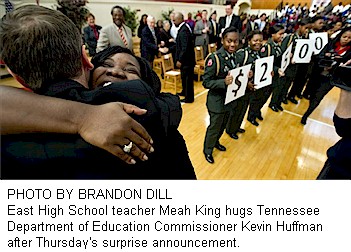
The band played, the cheerleaders danced and East High School English teacher
Meah King ['97 and Faculty] fell into the arms of a colleague after learning she'd won a Milken Family Foundation National Educator Award.
It's an honor that comes with a check for $25,000. And it's for her, not the school.
King, a teacher for 10 years, was surprised on
Thursday during a pep rally that was attended by her parents, local
school officials and Tennessee Education Commissioner Kevin Huffman.
"I'm very excited and grateful and thankful to God for all these blessings," King said.
She doesn't know yet what she'll do with the windfall.
"It's just what the doctor ordered," King said.
"I'll pay my tithes and offering first and then I'll think about the
rest."
"I think Miss King really exemplifies what we're
doing across the state to find educators who reach their kids and help
them learn and achieve," Huffman said. "It's such an honor for me to be
a part of this. I'm so proud of Miss King, I'm so proud of this high
school and I'm proud of Memphis."
Teachers cannot be nominated for a Milken award,
which has been likened to an Academy Award, said Dr. Jane Foley, Milken
senior vice president.
Each participating state's department of
education puts together a panel to recommend candidates based on
criteria that include student results and the teacher's impact on
students, colleagues and the community.
"Research and our own personal experience tell
us that the single most important education element determining how
much you will learn in school is the quality of the teacher in your
classroom," Foley told the East students.
King, 32, teaches 10th-grade English. She is a
1997 graduate of East and has earned a bachelor's degree in English and
a master's in instruction and curriculum from the University of
Memphis.
For her, teaching is a "ministry."
She started as a teenager teaching preschool after school and during the summer.
In addition to her daily responsibilities, she is
a staff member with Peer Power, an after-school peer tutoring and
mentoring service that helps about 1,000 students a day.
The Milken award comes to King following other
accolades. In 2008, she was named outstanding educator of the year by
the Memphis Alliance of Black School Educators.
In 2009 she received an outstanding alumni award from U of M.
And last month she took top honors for high
school English teachers in the first My Favorite Educator Golden Apple
Awards at MCS. Students nominate their teachers for that award.
"She always tries to motivate everybody. She cares about the students," said Charles Reese, 15.
"She gives us life experiences, she relates to
us. She loves young people. She's very committed," said Marquita Shaw,
16.
"She's a parent at times and she doesn't even have kids," said Jalon Netters-Lofton, 15.
The 10th-graders are now studying poetry with King and have poems to read and a list of questions to answer.
So on Thursday, along with the tears, the hugs
and the words of appreciation, King remained a teacher in charge.
"Even though we're not in class," she told the assembly, "to those in the 10th grade, the work is still due."
Milken Foundation honors Memphis high school teacher
View the video
December 1, 2011,
WMC-TV
By Jerica Phillips
MEMPHIS, TN -

(WMC-TV)
- An English teacher at East High School in Memphis received a $25,000
check Thursday from the Milken Family Foundation's National Educator
Awards.
Meah King received the award during a surprise assembly at the school.
"I was told to just get the kids excited and take
them through a few chants, and I was just excited about that, not
knowing it was all for me," she said.
The Milken Family Foundation Award was first
presented in 1987 and is designed to provide public recognition and a
financial reward to teachers, principals and other educators who have a
proven record of excellence in education.
"We look at the whole country and determine who
we believe represent the top 1 percent of the entire profession, and
that's why we're here at East High School for Meah King," the
Foundation's Dr. Jane Foley said.
"I never knew anyone was paying attention
because I always thought that this was a ministry and not a
profession," King said.
A current student, Jalon Netters, described King as special.
"She has a connection," Netters said. "She's
committed to what she's doing, and at the same time she's a friend to
us and connects with us in a way that no other teacher can."
"The personal relationships she forges, allows
both adults and students to not only discover their hidden talents, but
grow into and accept their responsibilities," King's principal Eric
Harris added.
Also in attendance were King's parents, Herbert
and Joyce, whom she credits for fostering her love for education.
"If the award had not come, you would still see her putting forth 150 percent," they said.
King has been teaching for ten years, and often
serves as a mentor to new teachers and underprivileged students at East
High school.
King is allowed to spend the $25,000 in any way
she chooses, but many of her students believe she'll find someway to
put it back in her classroom.

News stories about Miah King receiving the Milken Family
Foundation's National Educator Award were also aired on WREG-TV and
WHBQ-TV, but those stories are no longer accessable.
Anfernee Hardaway visit to Lester Middle School fuels pride in Binghamton
By Sara Patterson,
The Commercial Appeal
November 27, 2011
In what felt like a 20-year time warp Saturday,
former NBA star Anfernee "Penny" Hardaway took on former foes from East
High School, just as he had during his days at Treadwell.
"This is my community that I grew up in," he said. "Any time I can be a part of it, I'm going to be."
Despite the light and friendly atmosphere, old
rivalries resurfaced during the informal, loosely refereed game that
featured a live deejay.
"I expected it," Hardaway said. "These guys all played against or with each other (in high school)."
Playing with Hardaway for team "Lester" was
Corey Bolton ['94], a 1994 East High alumnus who now lives in Little Rock.
Bolton said basketball got him to college. And college helped him become a small business owner.
Event organizer
Tarrik Mabon ['03] said the game's purpose, besides fundraising, was to showcase alumni success.
"We got out, and we came back to give back," he said.
Mabon and his brother
Chanduleon Mabon [class year undetermined], both graduated from East and went on to college at Morehouse in Atlanta.
Mabon organized the first charity game last year
to raise money for 12-year-old twins who lost their mother, his friend
Kena "Shea" Blakney ['94], earlier that year.
The game's success prompted him to broaden his
outreach for the second, and about 1,500 people packed into the
gymnasium Saturday.
Kim Dixon ['97], a 2007 East High graduate
who also attended Lester Middle, said she almost cried when she walked
in and saw renovations to the facility.
"There weren't even bleachers when I went to
school here," she said. "It makes me so happy to come back and see
improvement. Very proud."
Overton Square businesses cheer Loeb's emphasis on arts and entertainment
By Thomas Bailey Jr.,
The Commercial Appeal
September 7, 2011
Grocery shoppers don't pick up some milk and
ground beef, then decide to stroll, catch a play, or sit down at a
restaurant.
Which is why Playhouse on the Square is so happy
redevelopment of a large chunk of Overton Square now will be based on
arts and entertainment instead of a grocery.
"An upscale grocery in the square? It quite
frankly is not going to enhance an entertainment district," said Jackie
Nichols, executive producer of Playhouse on the Square and its
neighboring, sister theater, Circuit Playhouse.
A spot check of businesses in and around Overton
Square shows others in the district are either thrilled about the
change in redevelopment plans or at least happy long-vacant buildings
will have new life of any sort breathed into them.
Most people going to a grocery are on a schedule
and wanting to get in and get out, said Taylor Berger, who with his
partners in March opened a YoLo frozen yogurt shop across Cooper from
the planned development.
"We thrive where people are relaxing and eating, not where they are on a schedule," Berger said.
The Overton Square YoLo is "far and away our best performing store," said Berger, whose company has 10 shops.
"Even imagining it could be better (in an arts and entertainment district) is great."
"... From what I've seen, the reason why it's so
popular is just the pent-up demand for entertainment," Berger said.
"YoLo for a lot of people has become that, a gathering place.
"... I think entertainment and food is exactly what Midtown and Memphis want."
Loeb Properties in May persuaded the City Council
to fund most of a $6 million parking structure/floodwater detention
facility in Overton Square.
In return, Loeb would revitalize the five acres
on the southwest corner of Madison and Cooper with new retail anchored
by a grocery store.
But last month Robert Loeb confirmed the grocery
store is no longer in the plans, replaced by an arts and entertainment
theme and boutique retail.
He plans to unveil details and artist renderings
at a public meeting at 6 p.m. Oct. 12 at Playhouse on the Square.
The Square is almost a theater district already,
with three live theaters -- Playhouse, Circuit and TheatreWorks -- and
a movie theater, Malco's Studio on the Square.
From what he knows of Loeb's new plans, Nichols
said more live, performing arts could be bound for Overton Square.
"I don't know what they are. I know there's been
a number of different organizations that have been approached in the
city," Nichols said.
The synergy of an entertainment district could help all its businesses, indicated
Jimmy Tashie ['66], executive vice president of Malco, which built Studio on the Square 10 years ago.
"You don't want to be an island unto yourself,"
Tashie said. "When you walk out the front door, you want to see some
activity."
Tashie doesn't have a strong opinion about a
grocery versus arts and entertainment district, in part because the
movie theater is "product driven." If someone wants to see a "Harry
Potter" movie, they'll come see it whether there's a grocery or arts
gallery across the street.
But Malco built in the Square a decade ago
because "by and large, it's an area that we felt strongly it needed
some entertainment."
"We're patiently waiting for something good to
happen" with the Square, he said. "Whether it's a grocery or just
shops, as long as it's done in a neighborhood-friendly manner."
Malco is pleased with the amount of business it does in the Square.
"You always wish you could do more business, but
we're not going anywhere," Tashie said. "We'll be there for a long,
long time, and hopefully we'll see a renaissance in that area."
The restaurant/bar Boscos Squared sits directly
across Madison from the empty southside buildings. John Kinzel, one of
Boscos owners, said, "Anything that is going to bring more people into
the area is a good thing for all the businesses."
While it didn't matter to Kinzel whether Loeb
put a grocery or arts and entertainment across the street, he said an
arts and entertainment theme would be a good fit with Boscos.
One of just two businesses that have remained
open in the cluster of buildings to be redeveloped is Golden India
restaurant.
The empty neighboring spaces have created a strain that Golden India has been able to endure.
"It's hard," owner Satina Singh said. "I don't
like that empty," he added while pointing east to adjacent, vacant
space.
He also doesn't care much what form the redevelopment takes, just as long as it draws people.
"Whatever business is good," he said. "Empty not good."
Longtime Rhodes president Bill Troutt keeps inspiring
Cultivates relationships with students, community
By Richard Morgan,
The Commercial Appeal
September 4, 2011
Excerpt from a newspaper article about the Rhodes College president Bill Troutt.
"He likes students," said
Spence Wilson ['60],
the hotelier who has served as a Rhodes trustee for 40 years, including
an eponymous, endowed humanities chair that debuted this year. The two
are friends, with the occasional duck-hunting trip to Arkansas. "He
likes to be around smartness and brightness and capability and
responsibility," he added."
Schnucks to leave Memphis; sells most grocery stores, gas stations to Kroger
Employees can interview for jobs with new owner
By James Dowd,
The Commercial Appeal
September 2, 2011
After nearly a decade in Memphis, Schnucks has left the building.
Or buildings.
Ending weeks of speculation, company officials
confirmed today that the St. Louis-based chain's area footprint will be
resold under the Kroger brand.
Terms of the deal were not disclosed.
"This was a difficult decision, but as a company
of 15,000 teammates, we have an obligation to look to the future.
Unfortunately, that means making tough decisions in order to keep our
company strong and to continue serving customers and providing careers
down the road," said Scott Schnuck, chairman and CEO.
"While it saddens me to announce our departure
from the Mid-South, I can honestly say that I believe our presence here
has had a positive affect on the market. Over the years, Schnucks
invested heavily in our stores and in our teammates and stirred local
competition to step up their games in terms of food expertise and
service. Customers across the region will benefit from that work even
after we've moved on."
Officials with the Memphis-based Kroger Delta
Division announced that eight area Schnucks stores will be converted to
Kroger sites during the next few weeks.
As part of the deal Kroger also purchased the
Collierville Schnucks at 275 New Byhalia, but it is near a recently
renovated Kroger and so company officials have opted to close the
store. Plans are to lease it to another retailer.
Three other Schnucks stores that are in leased properties will also close.
"For over 60 years, Kroger has proudly served the
Memphis community," said Mark Prestidge, Kroger Delta Division
president. "Kroger has demonstrated its commitment to the Memphis area
by investing over $70 million on remodels, expansions and fuel centers
over the last five years. We continue to focus on upgrading our store
base in an effort to provide our customers the best shopping experience
possible. With this acquisition, we are pleased to be able to provide
more convenient locations for our customers to shop at in the Memphis
area."
Kroger counts 37 stores in the Memphis area and
this deal will boost that number to 43. Two of the stores will replace
smaller Kroger stores.
"We plan to convert these stores and re-open
within two weeks after they close. Our primary goal is to minimize the
inconvenience to our customers as we transition the stores to Kroger,"
Prestidge said. "While the acquired stores will be temporarily closed
during the conversion process, the pharmacies and in-store banks will
be accessible and remain open to customers during regular business
hours."
Pharmacy customers at the Schnucks stores that
are set for permanent closure will be able to fill prescriptions at the
nearest Kroger.
The overlapping of Kroger stores that the purchase seems to create in several areas had
Art Seessel ['56] confused.
He was CEO of the Seessel's grocery stores until
they were sold in 1997, and remains the landlord for the Schnucks
buildings on Perkins in East Memphis and on Union in Midtown.
Kroger just spent millions of dollars renovating
its Mendenhall store in East Memphis, which is close to the two
Schnucks stores it just bought on Perkins and Truse Parkway.
"I don't understand the deal," Seessel said. "There's so much duplication."
He figures Kroger must be planning more moves to consolidate.
The purchase also seems to create geographic
overlap for existing Kroger stores in Bartlett and Germantown, said
Danny Buring, managing principal of The Shopping Center Group.
"I think there will be an opportunity for another major player to step in," Buring said.
But Kroger has a history of being aggressive in the Memphis market, he added.
"The grocery market has been pulled from both
ends," Buring said. "From the low end with expansion of Aldi and
Save-A-Lot and on the higher end with Fresh Market and Whole Foods. But
Kroger has always maintained its dominance here. While they don't have
the market share they had 15 years ago, I can't imagine there's a whole
lot of other markets where they have this kind of dominance."
Last year, Kroger announced plans for a $20
million construction project near its Poplar and Highland location,
resulting in a new 87,000-square-foot grocery situated just west of its
current site at 3444 Plaza Ave. But the project has yet to begin
because tenants remain at the site where Kroger plans to raze existing
structures and build from the ground up.
The project is expected to take up to a year to
complete and calls for a new grocery that will be about 30,000 square
feet larger than the Kroger currently at the site.
Thirty associates will be added, increasing its
employee count to 200. The new property will feature a bistro and
onsite chef, sushi station, fresh soup-and-salad bar, doughnut shop and
expanded deli, meat and seafood departments.
And in addition to increasing its organic and
bulk items, the store will offer more personal care products and
maintain its drive-through pharmacy.
That project is still on the table, said Joe
Bell, local manager of marketing and public affairs for Kroger's Delta
Division, and should get under way in the coming weeks.
Plans for the Schnucks remodels will begin on
Sept. 13 with four stores, which will be closed and stocked with Kroger
signage and products. Those stores will re-open by Sept. 24 and the
following week the remaining Schnucks stores will be closed and
repurposed.
Full-scale renovations will be performed on each of the stores during the next three years.
Schnucks has 1,193 employees in the Memphis
market and those workers will be allowed to interview for similar
positions at the rebranded Kroger stores, Bell said. A Kroger job fair
for current Schnucks employees will be held next week.
Schnucks has 10 stores and six Schnucks Express
fuel and convenience centers in Shelby County, and two grocery stores
and two fuel/convenience stations in DeSoto County.
The company counts 106 stores in seven states:
Tennessee, Mississippi, Illinois, Indiana, Iowa, Missouri and
Wisconsin. The Mid-South region is the family-owned company's
second-largest market.
In contrast, Cincinnati-based Kroger operates
109 stores and 68 fuel centers in five states under the Kroger banner
in West Tennessee, Arkansas, Mississippi, southern Missouri, and
southwest Kentucky. And there are more than 3,000 Memphis-area
employees in Kroger's Delta Division, excluding those in its
distribution center.
In total, the company counts 2,449 grocery retail stores in 31 states under nearly two dozen banners.
In addition, Kroger operates 1,966 pharmacies;
1,035 supermarket fuel centers; 785 convenience stores under five
banners in 18 states; 359 jewelry stores in 36 states under such names
as Barclay Jewelers, Fred Meyer Jewelers, and Littman Jewelers; and 40
food processing or manufacturing facilities.
A little over a year ago, Schnucks leaders cited
an oversaturated market and an underperforming economy as reasons
behind shuttering the store at 1150 N. Germantown Pkwy. Schnucks had
bought the 68,000-square-foot Cordova site — which originally opened in
1999 — when it acquired Seessel's in 2002.
The grocery closed on Aug. 28, 2010, but the
nearby Schnucks Express gas station and convenience store at 1210 N.
Germantown Pkwy. remained open.
Rumors of a Schnucks exit strategy intensified
last month when the company abruptly halted its "Pump Up the Savings"
customer card and fuel rewards program.
The company became involved in the fuel business
when it entered the Mid-South market in 2002, eventually opening eight
fuel centers in the Memphis area in what became its largest fuel
rewards market.
The Schnucks exit is the latest chapter in the
story of what was originally a locally owned establishment known as
Seessel's.
Founded by Henry Seessel in 1858, the Seessel's
stores remained family-owned until 1987 when Seessel's
great-great-grandsons, Art and Jerry Seessel, sold the then-10-store
chain to American Banaco Inc., a French holding company.
The following year the Seessel family bought the
stores back, but within a few years they were up for sale again.
In 1996, Fleming Companies, an Oklahoma
City-based grocery wholesaler and Seessel's minority shareholder,
claimed the right of first refusal on any sale and challenged the
attempt by Birmingham-based Bruno's Supermarkets Inc. to buy the
stores.
Originally, Fleming planned to buy the stores and resell to Schnucks.
But a federal judge ruled in favor of Bruno's,
which had acquired the stores and in 1998 the Boise, Idaho-based
Albertson's bought the Seessel's stores for $88 million. Four years
later, Schnucks acquired the company.
At the time of the deal, Albertson's was the No.
2 store in the area with about 15 percent of the Memphis market share,
well behind Kroger with 39 percent, but slightly ahead of Wal-Mart,
which had more than 11 percent.
Wal-Mart launched its Supercenter concept in
1988, entering the grocery store industry by offering items at
significantly discounted prices. Today there are more than 2,900 of the
stores across the country. And its Wal-Mart Market concept, which began
in 1998 with groceries, pharmaceuticals, and general merchandise, today
counts 183 stores nationwide.
"When we came into the Mid-South market in 2002
we felt it was a unique opportunity and we hoped to get a strong
foothold there and maintain a strong presence in Memphis," said Lori
Willis, director of communications for Schnuck Markets Inc.
"Unfortunately, the Mid-South competitive landscape changed
dramatically and there has been fierce competition from non-traditional
grocery stores. We ultimately were forced to make the difficult
decision to leave this market, which has treated us so warmly."
In addition to the Schnucks stores, the Tom
Thumb subsidiary of Kroger is purchasing seven convenience stores in
the Memphis area that are owned by Schnuck Markets. The sites will
operate under the banner name Kwik Shop.
"We are pleased to enter this important market
with our Kwik Shop convenience store banner," said Van Tarver, vice
president of convenience stores for Kroger. "We will strive to operate
stores staffed with great people who want to make your shopping
experience as efficient and enjoyable as possible."
Tom Thumb Food Stores is a convenience store
division of The Kroger Co. and operates 116 stores in Florida and
Alabama.
Tennessee Brewery has intoxicating beauty, sobering challenges for developers
By Sara Patterson,
The Commercial Appeal
August 28, 2011
After a decade of digging, he stumbled on it in a dusty attic.
The long-lost recipe to a forgotten beer: the Goldcrest 51.
"It was a step-by-step description -- what to do,
how to do it, when to do it," said Kenn Flemmons, author and collector
of all things old brew. His book "The Finest Beer You Ever Tasted"
chronicles the rise and fall of the century-old brand, once one of the
most popular lagers in the Mid-South.
"Goldcrest has more hops than what you find in
regular beer today, more malt," he said. "It's heavier, with a fuller
body, but still very clear and a light drinker. ... It's a nice blend,
and a middle point between craft brews people like that are very hoppy,
thick, chewy, and the commercial pilsners that you find on the shelf."
Having never sampled the original, the
55-year-old Arkansan relied on the recipe, his research and taste buds
older than his own to re-create it. When he felt he had made a
close-enough facsimile, he brought it to Memphis for the Cooper-Young
Regional Beerfest last year, and the tap quickly ran dry.
Yet the towering brewery at 495 Tennessee St.
that birthed the Goldcrest brand in 1906 may never see the same
resurrection.
Beer runs through the veins of
Jake Schorr III [associated with the Class of '61].
The local bar owner's great-grandfather founded the Tennessee Brewery
in 1885 with Caspar Koehler and Peter Saussenthaler. Schorr's father,
Jacob Jr., was brewmaster until the company's demise in 1954.
On a tour of the brewery one recent morning,
Schorr's eyes drank in the surroundings. He had last visited the
building about 20 years ago.
He looked past the decomposing dead cat near the
old boiler room, the heavy lines of graffiti throughout the
67,000-square-foot interior and the dozens of trashed bottles.
He filled the empty space instead with childhood
memories -- the smell of hops wafting through the air, the sound of
sifted grains, the sight of bubbling wort in the 250-barrel brew
kettle.
"I was a curious kid," he said. "I'm a curious old man."
Schorr, 69, was always fascinated with the
mechanics of the brewery and he helps explain some of the architectural
oddities of the place -- the mismatched floors, 18-foot-high ceilings
and open courtyard that halves the complex.
Before the age of electricity, grains and hops
were lifted to the highest area of the building using a system of
steam-powered pulleys. Gravity then took care of the downward
distribution.
Horse-drawn wagons would pull into the
5,300-square-foot courtyard to deliver supplies and transport beer to
local saloons -- before trucks expanded distribution across the region.
The brewery produced more than a million barrels of beer in its nearly 70-year production span.
In 1948, at the height of its success, the
brewery distributed more than 200,000 barrels. (A current Memphis
brewing company, Ghost River, makes about 2,500 barrels a year to
service around 100 bars in the area.)
Though it weathered Prohibition and World War
II, the Tennessee Brewery struggled with the advent of national
television advertising that squashed regional brands in favor of beers
such as Budweiser. When the brewery sold the last of its lagers and
ales, the workmen simply walked away from their stations, leaving
behind equipment and filing cabinets brimming with business records.
Jacob Schorr Jr. locked the doors.
The scrap-metal company A. Karchmer & Son
moved in to sell off the valuables, but the reams of information
remained untouched until Kenn Flemmons' obsession took a literary turn
in the 1990s.
"There are two candidates right now, but I can't
elaborate," said James Rasberry, the Realtor representing the property.
Rasberry said he's kissed many a frog in the
search for a development prince. In the last 10 years, two major plans
have fallen through -- one by a local arts group in 2003 to convert the
building into affordable workspace for artists and another in 2006 for
a $50 million condominium project.
The cost of restoring the building, alone, has been estimated at nearly $12 million.
"So many people are seduced by the beauty of the
building, they overlook the difficulty a project of that magnitude"
represents, Rasberry said. "Part of my job is tempering the zeal of
would-be suitors."
"They say you aren't supposed to buy property
for emotional reasons, but that's exactly what I did," said Norman. "I
fell in love."
Norman's optimism about future uses for the
building has faded, but he still holds out hope a creative developer
will buy in to bring the building back to the public.
The building has other fans, too, including the
Downtown Memphis Commission, which has it near the top of its priority
list for redevelopment. The brewery is also listed on the National
Register of Historic Places.
"Such a storied history, such an iconic property
-- it attracts interest by itself," said Andy Kitsinger, DMC vice
president of planning and development. "It's the last building in that
area to be redeveloped because it's the toughest, but it has so much
mystery and nostalgia attached, it creates an emotional connection with
people."
Kitsinger suggested a return to brewmaking as a
good use for the building, coupled with conversion of the open,
four-story atrium into a museum and tourist attraction where visitors
could sample beer.
Nicky Newburger, whose family owned the
scrap-metal business inside the brewery until its 1981 relocation, was
one of the biggest advocates for the art space project several years
ago and stays current on happenings there. She helped facilitate some
of the private parties, theatrical performances and film projects that
have taken place inside the building in the last couple of decades. She
said out-of-towners are still drawn to the site despite its
dilapidation.
"I recently did a photo shoot there with a
couple from Chicago," said Newburger. "They found the brewery online
and got married in the building -- just the two of them and a minister
by the minute."
If only a developer would be so quick to seal the deal, she mused.
Briefly Mentioned
The following East alumni were mentioned or quoted briefly
in the media. Because the reference was so limited, the full stories
are not included here, however for a time the articles are available at
the links provided.
- East High Coach Marcus Wimberly ('92 and Faculty) participated in the NFL summit last month, selected because of his being a former NFL player. The Commercial Appeal, Aug. 12, 2011.
- Erica Davis ('97) is
quoted in a newspaper article about the looming combination of Memphis
City and Shelby County school systems and its effect on the classroom.
""And regardless of whether my badge says MCS or SCS, it doesn't
matter. We are still going to learn biology in this room today." The Commercial Appeal, Aug. 7, 2011.
- East High Coach Marcus Wimberly ('92 and Faculty)
is briefly quoted in a newspaper article about East football players
Will Redmond committing to Mississippi State and Latarius Brady
committing to Arkansas State. The Commercial Appeal, Aug. 1, 2011.
- The Federation of Earth Science Information Partners has
established an award to recognize outstanding service to the Earth
science information community. The award was named after and first
given to Martha Maiden ('68) in 2009. Maiden is the NASA
Program Executive for Earth Data Systems. [Editor's note: delayed
report just coming to our attention]
- John Reed ('69) is briefly quoted in a newspaper
article about the closing of Tennessee Merchandise Market, a Hickory
Hill area flea market that opened to great fanfare earlier this year. The Commercial Appeal, July 19, 2011.
- Attorney Doug Douglass ('68) is quoted in a newspaper article regarding the bankruptcy case of his client, Nelson, Inc. in Memphis. The Commercial Appeal, July 13, 2011.
- Cybill Shepherd ('68) is mentioned in a newspaper article as having named two the Memphis zoo's hippopotamuses 22 years ago. The Commercial Appeal, July 8, 2011.
- Bruce Hopkins (associated with the Class of '68) quoted in
newspaper article about banks becoming more customer focused in their
business model. The Commercial Appeal, July 7, 2011.
- Andrew Bobowski (Faculty), who taught at East High as a
Teach for America teacher previously, will head a new college-prep
middle school that is part of the Kipp Memphis charter schools. The Commercial Appeal, July 6, 2011.
- Eugene "Doug" Douglass ('68) is briefly quoted in a newspaper article as an attorney for developer Rusty Hyneman in Hyneman's bankruptcy case. The Commercial Appeal, July 3, 2011.
- There is a newspaper article about the Comcast Firecracker 5K race, which, "has been held in honor of" the late Libby Wilson ('69). The Commercial Appeal, June 27, 2011.
- A newspaper article features the high ranking of East High's basketball player Nick King, with a quotes from East coach Cheyenne Gibson (Faculty). The Commercial Appeal, June 24, 2011.
- Jimmy Jalenak ('57), chief administrative officer of
the Memphis Zoo, is quoted in a May 29, 2011, newspapaer article about
improving Overton Park in Memphis. The Commercial Appeal.
- Bill Carrier ('68) is briefly quoted about the Memphis
in May barbecue contest being held away from the Mississippi River due
to flooding in a May 13, 2011, article in The Commercial Appeal. He can also be seen in a 2009 video talking about his team's cooking method on youtube.com.
- Bill West ('65), founder of West Clinic has been given the Carnival Memphis President's Award, according to a mention in The Commercial Appeal, May 12, 2011.
- Chas McVean ('61) was honored April 30 as a 2011 inductee into the Memphis City Schools Hall of Fame.
- Wilson Air Center again receives citations for excellence in corporate aviation. Bob Wilson ('62) is the air center founder and president. The Commercial Appeal, May 5, 2011.
- Bruce Hopkins (associated with the Class of '68) has been
named First Tennessee Bank's president of banking for West Tennessee.
Hopkins attended East Junior High in the 7th and 8th grades. He has
been with First Tennessee since 1985 and will continue to oversee the
bank's private client, trust and wealth management services in Memphis.
The Commercial Appeal, April, 29, 2011.
- East High Coach Marcus Wimberly ('92 and Faculty)
discusses running back Brian Kimbrow upcoming senior season and the
college recruitment process in an Apr. 17, 2011, article in The Commercial Appeal.
Memphis City Schools to dissolve, East to become Shelby County School
editor, The East High Alumni Page
August 8, 2011
Federal District Court for the Western District
ot Tennessee Monday, Aug. 8 released its declaratory judgement in the
case regarding the surrender of the Memphis City Schools charter.
Effective with the beginning of the 2013-2014 school year Memphis City
Schools will no longer exist, the schools previously in the Memphis
system will be governed by the Shelby County Schools. East High will
then be a county school.
Kent State athlete indicted for assault
By Dave O'Brien,
The Record-Courier, Ravenna, Ohio
July 31, 2011
A Portage County grand jury recently indicted a
member of the Kent State University men's basketball team on a charge
he allegedly broke into an ex-girlfriend's Franklin Township apartment
earlier this month and assaulted her in an argument over money.
Jarekious D. Bradley ['10], 20, of
Memphis, Tenn., was indicted July 21 on one count of aggravated
burglary, a first-degree felony, for the July 13 incident at an
apartment on Ashton Lane in the Campus Pointe apartment complex on S.R.
59.
Bradley, who according to his attorney is
living on campus this summer, remains free on bond pending a trial in
October in Common Pleas Judge John Enlow's courtroom.
Bradley has been ordered to have no contact with the alleged victim.
According to the Portage County Sheriff's Office,
deputies responded to a 911 call the morning of the incident saying
Bradley had entered the victim's apartment without permission.
Bradley allegedly demanded money he believed
the victim owed him and attempted to take it from her purse, the
sheriff's office said.
When she tried to stop Bradley, he allegedly
shoved her to the ground. Others who were in the apartment at the time
then gave Bradley money and he left, according to the report.
Bradley has been suspended indefinitely from the
basketball team pending the outcome of his case, according to KSU
Athletics.
A shooting guard from Memphis East High School, Bradley entered KSU in August 2010.
An additional story about this incident is bleow.
'Edu-tainer' Ekpe performs lessons for children
By Henry Bailey,
The Commercial Appeal
Posted July 29, 2011

"If you haven't had your exercise, get it while you can," a colorfully clad Ekpe
[Peter Lee ('75)] "the Edu-tainer" exhorted parents, grandparents and children from infant to 11 at the Hernando Public Library.
"That's it. That's it. How low can you go? Keep flapping those wings!"
Against a map backdrop of "One World, Many
Stories," Ekpe (pronounced ECK-pay) spun, strummed, blew and drummed
tales and music with an African flavor and universal messages: health,
love of learning, reading and respect for self and others.
His name tag lists a last name of Abioto, but
just call him Ekpe. In African lore, "Ekpe" is a mysterious spirit
believed to live in the forest and to preside at ceremonies. This Ekpe
lives in Memphis and for 30 years has specialized in motivational music
and cultural diversity programs for children.
With his soft voice and traditional instruments
including the djimbe drum, kalimba hand piano, agogo bell and shakere
bead-draped gourd, Ekpe is rounding out the First Regional Library
series of summer reading time special events.
After this week's morning performance, it was on
to Sardis; on Saturday at 4 p.m., he'll be at the Como library in
Panola County.
"We have reading every Wednesday, but starting
next month I'll lose my school-age kids," said Denise McOwen, youth
specialist at the Hernando library.
Ekpe's story had started with kids bringing a
lunch of carrots, broccoli -- "little trees" -- and other veggies only
to be bamboozled by a clever bird. By now, things had morphed into a
counting lesson and a "funky chicken" tribute to Rufus Thomas.
Hailey Gullick, 8, of Southaven, was flapping
with the best of them. And flipping over the lessons along with her
preschooler cousin, Madison Arnold, 4.
"What did we learn from that bird?" asked Ekpe.
"Don't talk to strangers. You've got to be safe in this world today."
Ekpe sang "I Am a Genius," the title tune from
his motivational CD: "I am a genius/I will learn everything my teacher
teaches me. ... You are a genius/You can learn everything that your
teacher teaches you."
To this, Hailey, a fourth-grader at Southaven
Intermediate, revealed: "I've got two brothers and I'm smarter than
them. I'm a straight-A student."
She's been "waiting and waiting and waiting" to
go back to school. "I can't wait to go back because I have a real cute
blue backpack that will last at least two years or more."
Says Ekpe later: "I use music as a metaphor for
life to teach positive messages -- about school, about life. Children
are attracted through the music, and I have a little fun in the
meantime. That doesn't hurt at all."
But it can be bit of a challenge for a mom, pop or grandma -- or librarian.
"I had a little one who climbed in my arms when
we started the 'funky chicken,'" McOwen said. "So I did the 'funky
legs' under the table."
--------------------
MUSICAL JOURNEY
A Memphis native, Ekpe "the Edu-tainer" also
achieved in school. In an earlier life, as button-downed Peter Lee, he
was selected as "Mr. East High School" by his Class of 1975.
"Can you believe that?" he says.
At Shelby State Community College, now Southwest
Tennessee Community College, he absorbed music, theater and drama, and
later studied African music with master drummer Souleymane Diop of
Senegal.
As a member of the Arista recording group
Galaxy, he toured Canada, Germany and Japan. In 1992, as Ekpe, he
played at the burial ceremony for "Roots" author Alex Haley in Henning,
Tenn. He most recently recorded with saxophonist Kirk Whalum on the
soundtrack for a documentary about HIV/AIDS in Africa and on his latest
CD.
For more information on Ekpe and his music, e-mail  or go online at ekpemusic.com.
McVean wants cyclist/pedestrian path over the Mississippi
By James Dowd,
The Commercial Appeal
July 22, 2011

If we build it, they will come,
Charles McVean ['61]
promises local leaders when pitching a field of beams proposal to
construct a bicycle-pedestrian route over the Mississippi River.
Promoting a plan to rebrand Memphis as the
cycling capital of the world, McVean envisions thousands of tourists
pedaling alongside throngs of walkers on a rebuilt boardwalk on the
Harahan railroad bridge.
Such was his message on Thursday, when McVean,
chairman and CEO of Memphis-headquartered McVean Trading &
Investments and a driving force behind the bridge project, was keynote
speaker at a forum sponsored by the Society of Entrepreneurs.
"If we could get our business leaders and
government officials together on this and spend a few million dollars,
this city could become the preeminent destination for cyclists from
around the world," McVean said.
"The Harahan Bridge boardwalk could be the
centerpiece of a biking trail that begins in New Orleans and goes up to
St. Louis. This project could change the entire image of Memphis."
Built in 1916, the Harahan Bridge had a roadway
that carried cars and trucks until 1949, when the Memphis &
Arkansas Bridge opened. Union Pacific owns the railroad portion of the
bridge, but Memphis and Crittenden County purchased the vehicle lanes
in 1917. The supports, which need to be reinforced, are still in place,
but the roadbed isn't.
McVean said the upfront cost of the project
would be a few million dollars that could be significantly underwritten
by grants, but he'd like to see business leaders embrace the project
and provide additional funding. The economic impact, he argued, would
be lasting.
"If our city and the Mid-South could get
together on this project, the financial benefits of increased tourism
would be substantial and sustainable," McVean said.
In addition, he advocates connecting the bridge
boardwalk to the Bluffwalk in Downtown Memphis, the Shelby Farms
Greenline and a trail along Mississippi River levees from Louisiana to
Missouri.
"This is the kind of forward thinking that
appeals to young creatives and offers a solid plan for recreational
pursuits that would attract and retain talent here," said Brad Silver,
CEO of Memphis biomarker startup Computable Genomix. "I enjoy being
outdoors a lot and so do many of my friends and a bridge trail would be
a brilliant amenity."
SOE executive director Pearson Crutcher agreed.
"The bridge could increase our existing tourism
base and attract thousands of people here every year," Crutcher said.
"It's an entrepreneurial idea that has the potential to transform
Downtown and benefit our entire community."
KSU athlete charged with felony for break-in
By Dave O'Brien and Thomas Gallick,
The Record-Courier, Ravenna, Ohio
July 15, 2011

A
Kent State University basketball player has been charged with breaking
into an ex-girlfriend's Franklin Township apartment on Wednesday
morning, assaulting her and damaging her property.
Jarekious D. Bradley ['10], 20, of
Memphis, Tenn. — a redshirt freshman guard on the Golden Flashes men's
team — is charged with one count each of aggravated burglary, a
first-degree felony, and criminal damaging, a second-degree
misdemeanor, for the incident that took place in an apartment in the
1800 block of Ashton Lane in the Campus Pointe apartment complex on
S.R. 59 in Franklin Township.
According to the Portage County Sheriff's
Office, deputies responded to a 911 call Wednesday morning saying
Bradley had entered the alleged victim's apartment without permission.
Once inside the apartment, Bradley allegedly demanded money he believed
the victim owed him and attempted to take it from her purse, the
sheriff's office said.
When the alleged victim tried to stop Bradley,
he allegedly shoved her to the ground, injuring her, and damaged her
debit card by bending it in half, according to the sheriff's office.
Others who were in the apartment at the time then gave Bradley money
and he left the apartment.
Deputies later made contact with Bradley, who
was arrested and questioned. He has been cooperating with sheriff's
detectives investigating the incident, according to the sheriff's
office.
Arraigned Thursday in Portage County Municipal
Court in Ravenna via video from the Portage County jail, Bradley was
ordered held on 10 percent of $25,000 bond, plus a $175,000 signature
bond, by Acting Judge Marvin Shapiro, sitting in for Judge Mark
Fankhauser.
Assistant Portage County Prosecutor Tim Piero
had asked Shapiro to set bond at 10 percent of $200,000 bond because
the charges give Bradley "significant incentive ... to flee the
jurisdiction."
Defense attorney Errol Can, representing
Bradley, countered by saying that Bradley has no criminal history,
lives on campus in Kent and will be under the supervision of the KSU
athletic department pending trial.
"I don't think he's any threat to flee the jurisdiction," Can said.
Requesting that Shapiro at least place Bradley on
electronically-monitored house arrest pending trial, Piero told the
judge that the case "arises out of passion," and "those kinds of
situations can go awry."
Additionally, KSU athletics officials "are not
law enforcement. They are not accustomed to tracking and monitoring"
people accused of crimes, he argued.
"He would be under strict supervision of the
athletic department," Can replied. "They actually do a very good job
with that."
Shapiro denied Piero's request, though he did
order Bradley to have no contact with the alleged victim or her
residence.
A preliminary hearing on the felony charge is set for 9:15 a.m. July 22 in Fankhauser's courtroom.
In a statement, Alan Ashby, KSU assistant
athletic director, said the department was informed of Bradley's arrest
Wednesday.
"The off-the-court conduct of our
student-athletes is something we take very seriously, and therefore we
are suspending Bradley indefinitely from all team-related activities
pending the outcome of the ongoing legal proceedings." Ashby said. "We
will reevaluate his status at the conclusion of those proceedings."
Bradley, a shooting guard from Memphis East High
School, was admitted to KSU in August 2010 on a scholarship. Bradley
was a non-qualifier, meaning he paid his own tuition and expenses for
the 2010-11 school year, while earning eligibility.
He was supposed to begin playing for KSU this upcoming school year.
Bartlett site chosen for 1st SCS charter school
By Sherri Drake Silence,
The Commercial Appeal
May 26, 2011
A nonprofit organization authorized by the state
to open Shelby County Schools' first charter school plans for it to be
in Bartlett.
Tommie Henderson ['91 and Faculty 1998-2003],
executive director of Smart Schools Inc., said his organization signed
a 10-year lease Wednesday for a 9,300-square-foot building on Stage
Road at Elmore Park Road. The building used to be occupied by FedEx
Kinko's and AT&T.
The group agreed to pay about $121,000 annually
in rent for the first five years and about $139,000 per year for the
remaining five years.
"The renovations that we need to do are very
minor," Henderson said. "... (We) should be in the space as early as
late July."
Smart Schools plans to open the New Consortium
of Law and Business to about 35 seventh-graders in the county district
this fall and add another grade next year.
The official application process doesn't start
until June 1, but the organization has already received more
applications than spots available, Henderson said.
"Parents are very interested," he said. "It's
been parents of all walks, from every type of community inside of
Shelby County."
Shelby County Schools twice rejected the
application from Smart Schools. Following an appeal filed by Smart
Schools, the state Board of Education voted in January to require the
district to approve the request.
Charter schools are taxpayer-funded public
schools that are "chartered" by nonprofit organizations and operate
outside of the control of local school boards.
With approval from Memphis City Schools,
Henderson opened a similar law and business charter school Downtown
last year. He also started the Memphis Academy of Science and
Engineering in MCS.
Henderson said the group plans to submit a proposed contract to the suburban district this week.
County school board chairman David Pickler said
the contract would be negotiated by Supt. John Aitken and SCS attorney
Valerie Speakman.
"At this point, the board has already
reluctantly approved the agreement with them," Pickler said. " ... Our
objective now is to ensure that this school meets the standards of
Shelby County."
Top prep prospect Brian Kimbrow of East High School ready to pick college
Kimbrow expected to make choice Friday
By John Varlas,
The Commercial Appeal
June 29, 2011
Decision day is just around the corner for the
top-rated high school football prospect in the Shelby-Metro area.
East High coach
Marcus Wimberley ['92 and Faculty] confirmed to The Commercial Appeal that star running back Brian Kimbrow will likely announce his college choice on Friday.
Kimbrow is scheduled to make his choice known at the D1 Training Facility in Franklin, Tenn.
"He's on his way up there now," Wimberley said late Tuesday afternoon.
Kimbrow, who is ranked tops in Memphis according
to rivals.com, is the No. 2 all-purpose running back prospect in the
Class of 2012.
He has offers from at least 24 schools, but
Kimbrow said he would select from a list of finalists that includes
Tennessee, Mississippi State, Vanderbilt, Cincinnati and Notre Dame.
"I'm just looking for somewhere that's comfortable for me," Kimbrow said. "Someplace that's a good fit."
The 5-9, 165-pound Kimbrow ran for 1,557 yards
(7.7 per carry) and scored 15 touchdowns for a Mustangs team that went
4-7 and lost to Ridgeway in the first round of the Class 5A playoffs in
2010.
Blazing speed is Kimbrow's calling card; he has been clocked at 4.28 in the 40-yard dash on several occasions.
Kimbrow's teammate, Will Redmond, is drawing a
ton of recruiting interest too, but Wimberley said a decision doesn't
appear to be imminent.
"The earliest he might make a decision is late
summer," Wimberley said. "He hasn't taken any trips yet ... Will is
taking things a little slower."
The 6-0, 179-pound dual-threat quarterback, who
will be in his first season at East after transferring from Manassas,
is also being recruited as a defensive back. He's rated 30th nationally
among athletes according to rivals.com and is the fourth-rated prospect
in the Shelby-Metro area.
Among the schools that have offered are North
Carolina, Clemson, Mississippi State, Tennessee and Memphis. Wimberley
added that Redmond picked up an offer from Miami on Monday.
[The East High Alumni Page editor's note: Kimbrow committed to attend
Vanderbilt University and Redmond chose Mississippi State University.]
Staying busy, getting involved help seniors maintain health, happiness
By Kathy K. Martin / Special to
The Commercial Appeal
May 19, 2011
[Excerpts}
...
Jerrold Graber ['57], 72, feels the
same way. "I wouldn't even want to consider retirement," said the
former securities broker and longtime volunteer for the Boys &
Girls Clubs of Greater Memphis. "I think it's important to be around
younger people...:
Graber graduated from East High School in 1957
and went on to Princeton University, where he received his bachelor's
degree in history. He returned to Memphis and worked for a family
business before joining the securities industry in 1967. His career as
a Memphis financial consultant spanned more than 40 years before he
retired from that in 2007.
His interest in serving the community began in
1963, when he became a member of the Phoenix Club, a volunteer group
for people age 35 and younger who support the Boys & Girls Clubs.
His involvement grew from there, and he went on to serve as board
member and president of the Boys & Girls Clubs.
He serves as a member of the organization's
advisory board, chairman of the planned giving committee, a member of
the investment committee and a trustee of the Boys Club Foundation.
"Being involved with the Boys & Girls Clubs
surrounds me with other volunteers of high ability and energy and the
rewards of seeing 96 percent of last year's senior club members
graduate is great payback," said Graber, who was recently presented
with the national organization's National Medallion award given to no
more than seven people each year. "We're filling a great need with a
great service."
His strong interest in civic groups also led him
to volunteer over the years for Jewish Family Service, the Jewish Home
and Rehabilitation Center and the Mental Health Association, and he was
president of each group...
For a time the full artilce is available free from The Commercial Appeal
Taco Bell Tuesday Club: Old friends swap reminiscences, tall tales at weekly gathering
By Richard J. Alley,
The Commercial Appeal
April 14, 2011
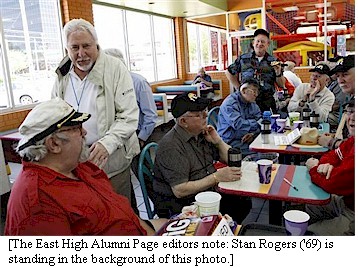
If
you have stopped for lunch at the Taco Bell at Estate and Poplar in
East Memphis recently, odds are you've encountered a group of raucous,
overgrown boys eating and reminiscing.
What you have wandered into is the Taco Bell Tuesday Club.
The club started eight months ago and now includes about 60 members, including quite a few characters.
The club started eight months ago and now includes about 60 members, including quite a few characters.
"We were always sitting in here on Tuesdays, and
it started out as a joke, 'Hey, why don't we start a club?'" said
60-year-old
Stanley Rogers ['69].
That was eight months ago, and the five founding
members -- Ernie Vescovo, a broker with First Horizon; Ronny Birmann, a
retired traveling salesman; Ernie Barrasso, a retired casino executive
and disco owner; Bud Cowgill, owner of Cabinet Services, and Rogers,
who works in IT -- have grown into a roster numbering more than 60.
The average age is about 65 (the oldest member,
at 85, is Albert Caccamisi), and the parameters of the club are loosely
defined, though members do have identification badges on lanyards and
matching baseball caps with the bold letters "TBC" (Taco Bell Club) and
a likeness of a taco embossed across the front.
It's difficult to discern a leader of this
party. Indeed, walking among them, the ringmaster of this circus seems
to change from conversation to conversation, from colorful anecdote to
anecdote.
There is no telling what the common thread is
here, but there are friendships that span half a century. How each is
connected, though, is a puzzle in itself, which they are all too happy
to put together; whether through high schools, lineage, neighborhoods,
work or, more than likely, Elvis Presley.
Many of them grew up with "The King" of rock and roll and knew him personally.
"If Elvis was alive, he'd be sitting right over there," Harold Boone, 70, said pointing to an adjacent booth.
Duke Brando, by far the youngest member at 34, says it's this knowledge that's a draw for him.
"I'm just thankful to be able to know these guys
because I'm the biggest Elvis fan there is, and these guys knew him as
a person," Brando said.
While every member may have a claim to Elvis,
Gene Mason, onetime club owner and manager for the Bar-Kays and other
Stax artists, also admitted, "We just come down here to see who can
tell the biggest lie."
In their golden years, their interests have
turned to reminiscing. They are served tall tales and history with
chalupas and nachos, washing them down with iced tea and memories.
Their stories take them from Memphis to Hollywood and up to New York,
and an auteur would do well to sit down with them over tacos to glean a
story line or study a plot twist. There is certainly no shortage of
characters.
In the mix are investment brokers, club owners,
police officers, a produce peddler, firefighters, security
professional, casino executive and at least one bodyguard, almost all
with "retired" behind their names.
"There are no strangers in here," said Mason.
Though the discussion tends to revolve around who
they've known and who may be sick or hospitalized at the moment, it
inevitably returns to the old days.
"Back then, some Catholic schools had a dance
every night; it was a place for us to go every night," said Fred
Fredrick, 71, son-in-law of Stax co-founder Estelle Axton who regaled
with the story of his first date with his wife, a double date with
Elvis and Priscilla.
Neighborhoods and schools are paramount in the
group, a way to connect the dots. In that Taco Bell, the high schools
represented include Catholic, South Side, Humes, Holy Names and
Christian Brothers.
On a recent Tuesday, they passed around an
8-by-10 photo of the group with member Larry Godwin ("His grandmother
came over from Italy with my mother," Mason said) in uniform shortly
after announcing his retirement as police director for Memphis.
Other notable members include former mayor and
sheriff Bill Morris and legendary street brawler George Tiller, Shelby
County Circuit Court Clerk Jimmy Moore, restaurateur Silky Sullivan and
former Chicago Bear Bob Lyles.
"We're trying not to let it fade away," Sullivan said.
Rogers added, "It's a great town, and it's guys like this that keep the history alive."
Memphis basketball report: East star savors run to NCAA championship

By Marlon W. Morgan,
The Commercial Appeal
April 8, 2011
One of the reasons
Adrienne Pratcher ['09]
chose to attend Texas A&M is because she felt like the women's
basketball program could do some amazing things under coach Gary Blair.
But when the final horn sounded and the Aggies
had defeated Notre Dame on Tuesday night, 76-70, to claim their first
NCAA national championship, the sophomore point guard from East High
was left stunned.
"I was shocked and excited at the same time,"
Pratcher said, "because I never thought I would be in that situation,
on a team that won a national championship."
Pratcher was a backup point guard to Associated
Press honorable mention All-American Sydney Colson. She played in 34
games, averaging 2.4 points and 1.0 rebounds for the 33-5 Aggies.
She enjoyed the NCAA Tournament ride that saw
Texas A&M knock off Big 12 rival Baylor, a No. 1 seed that beat the
Aggies three times this season, in the Elite Eight, then follow that
with a thrilling win over Stanford, another No. 1 seed, in the Final
Four semifinal game.
Pratcher's playing time diminished as Texas
A&M advanced in the tournament. She played a total of five minutes
at the Final Four, where her only disappointment was committing four
turnovers.
"I don't think it was so much me being nervous,"
she said. "I think it was me mentally probably not being ready to play.
It was just me going out there and being nonchalant with the ball. The
turnovers were very crucial. They were basically things that should
never happen."
Still, all was forgotten when the Aggies cut
down the nets at Conseco Fieldhouse, then returned Wednesday to College
Station, Texas, where thousands of fans filled Reed Arena to greet the
champions.
"It was a great experience," Pratcher said. "It
made me realize how the people at this university feel about sports,
how they feel about us as people, it was awesome. We had a great crowd.
Afterwards, we got to sign autographs and mingle with the kids, so it
was cool."
Pratcher, who was the class valedictorian at
East in 2009, looks forward to returning to Memphis later this spring
to share her experience with family and friends. She's also already
looking forward to next season, when she's expected to replace Colson
at point guard.
"I think this offseason I need to work on being
a team leader, getting players together and working out," she said. "I
need to work on my mid-range jumper and getting everything down pat so
I can be ready for next season."
There is also on-line for an undertemined period of time a televsion news report about the same story: WREG.
233 graduate in Class of 2011
Writen by: editor
The East High Alumni Page
May 22, 2011

Two hundred thirty-three students met the
requirements for graduation from East High School and participated in
graduation exercises Sunday, May 22, 2011, according to school
principal
Eric Harris ('91 and current Faculty).
The sixty-first commencement of East High School
took place in the historic Orpheum Theater in downtown Memphis.
Chas McVean ('61), the graduation speaker, told the seniors just before
they walked across the stage to receive their diplomas, that for those
going ton to college, the next six months may be the most important
time of their lives. For those not planning to enter a 4 or 2 year
college, McVean suggested that what ever field of work they enter to do
their very best every day. Saying that this is a great country, McVean
told them if they do that, someone will notice. As an example of what
can be accomplished, he cited a new company he has established to
manufacturer and sell electric bicycles. McVean said he paid a search
firm $50,000 to find the person in the United States of America who
knew the most about building bicycles. After about a 6 month search,
the firm came back with a name and McVean said let's get him to Memphis
and hire him. First, though, the search firm wanted McVean to know one
thing about the individual, he never attended one day of college.
McVean said his response was, "get him to Memphis and let's hire him."
McVean also noted there have been changes at East High since he
graduated in 1961 but he said the colors that matter are red and gray,
not the color of one's skin. East High was once an all white high
school in the segregated Memphis City School system. Today, nearly all
the students are African American.
Memphis City Schools superintendent Kriner Cash released the diplomas
to the students and congratulated each as they walked back to their
seats.
Sometimes, not all the graduation candidates that participate in
commencement actually graduate at that time, as all the elements that
go into the final grades may not have been received. Nevertheless,
seniors were offered $2.3-million dollars in scholarships this year,
according to school counselor LaTanya Pratcher.

Principal Eric Harris concluded the remarks at the graduation by addressing "the Class of 2011 one last time:"
No matter what has
been said about you, no matter what has been done to you, positive or
negative, beginning tomorrow, none of that will matter. Whether you
have overcome serious adversity, or worked hard to be at the top of
your class, none of that will matter tomorrow. Because tomorrow begins
your life, and you have the choice to follow a worn path or begin a new
one.
To borrow from the book of Lamentations:
"I remember my affliction and my wandering, the bitterness and the gall.
I well remember them, and my soul is downcast within me.
Yet this is the moment I call to mind and therefore I will have hope"
As I close my charge to you, 2011, remember that
whatever it is you chose to do beginning tomorrow, always remember East
High School is now your alma mater, and you are the sixty-first class
to have that honor.
As a fellow alum I truly wish you all the best there is.
Before the final procession, the Class of 2011 rose and along with the
Chorus, accompanied by the East band, sang the first verse of the East
High School Alma Mater.
Tennessee governor talks with educators at East High meeting
The Commercial Appeal
April 7, 2011
[Excerpts]

Memphis teachers tell Governor Haslam their fears about new evaluation process
Gov. Bill Haslam got thoughtful advice from
school insiders over eggs and toast Thursday about engaging parents and
freeing teachers from numbing loads of paperwork...
Haslam made several appearances Thursday,
including at Margolin Hebrew Academy and a groundbreaking in Millington
for the three-mile Veterans Parkway, a $19 million project to link Paul
Barret Parkway with U.S. 51 on the north.
He started the day at East with Kevin Huffman --
his newly installed commissioner of education -- telling about 40 city
and county educators he wanted to know what they tell their best
friends about work.
"That's what we are here to talk about, the things you think we should know..."
Consignment shop in Cooper-Young fills high-end niche
By Lesley Young,
The Commercial Appeal
March 30, 2011
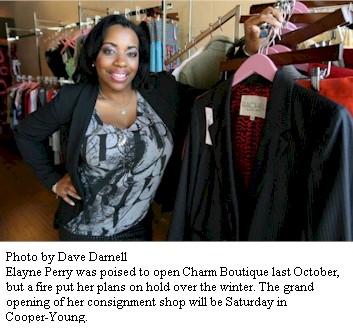 Elayne Perry's ['94]
 first fling with fashion happened around the time she started applying makeup in high school.
"I liked to match my lipsticks. I remember this
one outfit. I wore orange lipstick, carried an orange purse, wore an
orange short set and orange Esprit sandals. I thought I was the cutest
thing," she said.
"I looked like a little pumpkin."
Though her unique style earned her a nomination
for "best dressed" at East High School, these days the 35-year-old
native Memphian has traded her fondness for conformity in for name
brands such as Vera Wang and Trina Turk.
Keeping up with the latest spreads in Vogue magazine has had its consequences for the clotheshorse.
"I am a total shopaholic. I buy so many different
things," she said. "My mom gets onto me. She'll say, 'You have a $600
bag. Are you serious, Elayne?'"
Perry decided to combine her weakness for a good
wardrobe with her dream to have her own business and open a high-end
consignment shop in the Cooper-Young area.
"I think fashion says a lot about you," she
said. "It can boost your self-esteem, and you don't have to spend $700
on an outfit to look good."
This Saturday, Perry will presents her
collection of high-end habiliments at the grand opening of Charm
Boutique, 2296 Young.
"It's going to be a ball. I'll have desserts and
champagne, and I'll be giving out gift cards to the first 20 folks who
come in," Perry said.
So far Perry has acquired more than 300 items,
including garments, accessories and shoes, boasting such illustrious
labels as Gucci and BCBG, some of them from her own closet.
"A lot of garments still have the tag on them,"
she said. "I also try to find out what the celebrities are wearing and
look for that. I know a lot of people are wearing Tory Burch. I don't
have any of hers, so I definitely want it."
She has a list of 10 consigners, drawing both
locally and from out of town, and maintains strict guidelines for what
she will accept.
"Consigners come in by appointment only. The
clothes have to be in good to excellent condition, pressed and clean,
and in season and up to date," she said. "I don't want it to become or
be perceived as a thrift store."
Consigners will receive 40 percent of sales, and
if an item doesn't sell within 90 days, they have the option to either
pick it up or donate it to charity.
Opening her own business hasn't been a smooth
ride for Perry, who will run the business from her home in Houston,
Texas.
She was poised to open her doors last October,
but a mechanical fire put a hole in her ceiling and destroyed all of
her equipment.
"It was so heartbreaking," she said. "My feelings were so hurt."
Over the winter, while a construction crew gutted
and restored the space, Perry continued to meet with consigners at
local eateries and her mother's house, determined not to fold.
"It's amazing they were willing to trust me and
drop off these really nice items just meeting me at a deli or at the
Clark Tower," she said.
"This is something I am passionate about. I love
dressing up. It's natural to me. It's something that's just in me."
Careful management lets Hope House expand help to city's most vulnerable kids
By Jonathan Devin,
The Commercial Appeal
March 26, 2011
Hope House is emerging from a nationwide slump in
charitable giving with the realization that raising funds after the
recession means getting the lead out.
For Memphis' only early childhood education
center for preschoolers with HIV, exterior renovations, tree care and
lead abatement are all i's to be dotted and t's to be crossed when
preparing to compete for grants.
"We've talked about buying just one modern
building, but part of the charm for our children is that we have
houses," said Dr. Betty Dupont, executive director, referring to the
three turn-of-the-century houses on South Idlewild in Midtown where
Hope House is located. "In poverty, mostly what children have is
institutional settings."
At Hope House, about two dozen children affected
by HIV/AIDS prepare for kindergarten with lessons and directed play
designed to alleviate the stress of home life and poverty.
For example, Hope House has a play therapy room
where two social workers play with children such as a boy who watched
his mother being murdered. In therapy, the boy buried a hand-sized
coffin in a sandbox.
Dupont knew that change was in the air in 2008
when the recession hit and purposefully did not fill staff positions
that became vacant through natural attrition. In the fall, though, she
hopes to add one, possibly two new teacher positions, and to do so, she
had to do some house cleaning.
The Plough Foundation and Assisi Foundation
agreed to provide funding for major renovations but were concerned
about the organization performing at capacity, so the Plough Foundation
challenged Hope House with a matching grant of $250,000 and two years
to raise the match.
"I wanted to grow our endowment to $1 million so
we could use the income to cover two additional classrooms," Dupont
said.
Plough and Assisi money paid for siding and new
roofs on all three houses and pruning of several century-old oak trees
on the property that had become a safety concern.
Hope House's accreditation with the National
Association for the Education of Young Children required lead abatement
of all interior walls, which will begin this summer after the program's
graduation.
"They have to take out all of the walls right
after graduation," said Kevin Dean, Hope House's director of
development. "First, all of us will be moving everything out of the
middle house and into PODS. All of the kids' programs will move to the
house at 27 S. Idlewild, and then again to 23 S. Idlewild."
The work will take most of the summer and will
cost about $50,000 for each house. Proceeds from special events like a
5K run in March and a golf tournament in April, as well as gifts from
other groups such as Carnival Memphis, will help them reach their
match.
If that sounds like a lot of work to keep the
agency in good shape for future fundraising, it may well pay off in the
end.
Diane Rudner ['68], board chairman of the
Plough Foundation, said scrutiny of grant applications is at an
all-time high and relationships are more important than ever.
For example, Rudner said that it is much harder
to award grants for endowments these days because the income from
interest is not as certain as it used to be. Also, foundations are
looking closely at whether it makes more sense to buy a new building
than to repair an old one.
Hope House was an exception in both of those cases.
"Hope House is very different because we've known
the organization a long time," said Rudner, noting that the Plough
Foundation was an original contributor to Hope House when it was
founded by the Junior League 15 years ago.
Agencies, she said, need to prove financial
health and not ask for money to repay existing debt, and they need to
demonstrate that they have cut as many expenses, including staff, as
possible.
Most important, Rudner said, agencies must not duplicate other programs.
If the numbers line up for Hope House the way
Dupont expects them to, the agency should be able to raise its capacity
to 40 children within the next couple of years.
A Bridge to Cross
Harahan at center of ambitious pedestrian, cycling plan
By Bill Dries,
The Daily News
March 28, 2011

Martyrs Park sits atop the Chickasaw Bluff and
overlooks the Mississippi River, its lone modern sculpture a memorial
to victims of the 19th century Yellow Fever epidemics that devastated
Memphis from the 1850s through the 1870s.
Nearby on the bluff is the First Unitarian
Church of the River, whose modern open space facing the river is the
perfect companion to the sculpture. A rail line passes the church en
route to the 94-year-old Harahan Bridge, whose stark metal work and an
ornate wrought iron rail clearly come from an earlier era.
The church's open space and adjacent park offer
a view of the river and a trio of bridges, including the Harahan, but
this spot has never reached the same popularity for strolling and
viewing as Tom Lee Park or Greenbelt Park on Mud Island.
That is already changing. With the first weekend
of spring-like weather just ahead of the season's arrival by the
calendar, the area, bordered by tall grass where the bluff begins its
rapid drop to a rising river, bristled with bicyclists and walkers and
river watchers.
The oldest of the three bridges, the Frisco
Bridge, was once the only bridge across the Mississippi River south of
St. Louis. The three bridges still handle cars, trucks and rail
traffic. And under an ambitious plan, one of the old "wagon ways" on
the Harahan may again be opened to pedestrians and bicyclists as a
boardwalk that links a system of trails on both sides of the river.
Memphis commodities broker
Charles McVean ['61]
is lending important connections to the effort and is as relentless in
his pursuit as the trains that cross the bridge daily. McVean's goal is
to have people walking and bicycling across the Harahan in 18 months at
a cost he estimates at "several million dollars."
"This is big," he said. "We're going to go across that bridge."
Terry Eastin, executive director of the
Mississippi River Trail Inc., has watched the recent trail fever in
Memphis from Fayetteville, Ark., with growing interest. Eastin's group
has set a goal of 3,000 miles of bike-friendly roads and pathways
connecting 10 states – and the Bluff City has been a cornerstone of
that ideal.
"It's fun to watch Memphis come alive," she
said. "It's such a change from when I started this job in 2005. It's as
though the entire culture of the city has undergone this wonderful
transformation."
She has met with McVean about the Harahan
project, something she endorses for many of the same reasons McVean
does.
"We place a pretty darn high priority on that
bridge," she said. "Right now with no bridge crossing at all in
Memphis, it's hard for us to be able to direct riders to go that way.
You just can't cross the river unless you have a car or rent a taxi or
have some other vehicle to take you across. This bridge will change all
of that."
McVean also said the bridge crossing is bigger
than just the view of the Mississippi River. He hopes the bridge can be
the start of a link to a 120-mile riverside levee bike path being
planned between New Orleans and Baton Rouge, La.
"The trade balance of any political entity is
very important to its economic vitality," he said as he talked of the
international biking community coming to Memphis to ride a regional
trail system along the Mississippi River. "This project could drive a
powerful swing in our region's net balance of trade and tourism."
The venture also becomes more complex on the Arkansas side of the boardwalk.
Crittenden County elected leaders, including
Arkansas state representative and former West Memphis mayor Keith
Ingram, were among those in the group that went to Omaha, Neb., in
February to meet with executives from Union Pacific Corp. – the
railroad that owns and operates Harahan – about access to the bridge.
They are already working toward a levee park
that could include trails along river levees in Arkansas. It's also a
goal of some trail advocates in North Mississippi.
Those advocates have talked of the ease of
maintaining the levee tops with asphalt trails and pathways for
bicyclists. But the levees weren't built as roads; they were built as
flood control projects and the boards that administer them have, in
some cases, been concerned about what public access might mean. For now
the levees are a politically sensitive topic that few want to comment
about on the record.
Despite the political roadblocks that remain,
McVean has brought the same energy and high level connections to the
Harahan effort that he has brought to other ventures, including a bid
to race hackney ponies with electronically controlled jockeys and his
efforts to promote his alma mater East High School.
McVean founded the Greater East High Foundation
in 2004. Its goal was to pay upperclassmen at the school $10 an hour to
tutor underclassmen. McVean put some of his own money into the venture
and helped get others to contribute.
When McVean put a political fundraiser in Omaha
on his busy 2008 calendar, he took a University of Memphis student with
him and the two got face time with then-President George W. Bush to
talk about the program. Bush himself got the group in touch with John
Bailey, a domestic counsel at the U.S. Department of Education.
That Omaha event was a fundraiser for the
successful U.S. Senate campaign of Mike Johanns, the former governor of
Nebraska, who is a personal friend of McVean's.
Johanns was instrumental in getting the Memphis
delegation in front of Union Pacific CEO James Young earlier this year
to make its Harahan Bridge proposal.
The project is near and dear to McVean for other
reasons as well. He is developing and marketing an aerobic cruiser
hybrid bicycle and is just as avid about bicycling as an international
tourism draw. His new venture, Cruiser's High Point Hub, is a lifestyle
center for bicycle enthusiasts about to open near the Shelby Farms
Greenline.
"The enemies of bicycling are automobiles,
hills, winds and altitude," he said. "But if we control the
automobiles, our flat temperate zone, low wind, is an ideal place for
bicycling."
The bridge, which has two rail lines and
originally had wagon ways on both of its sides, was built after the
Frisco Bridge but before the Memphis-Arkansas Bridge (also known as the
Interstate 55 or "old" bridge), the two spans that parallel the
Harahan.
The bridge was designed by Ralph Modjeski, co
founder of the Modjeski and Masters bridge engineering firm of
Mechanicsburg, Penn., now being used by Union Pacific in its study of
how a bridge boardwalk might be designed.
Union Pacific officials could not be reached by
press time for comment on the bridge project, but the Memphis delegates
returned from Omaha in February saying Young told them the railroad
would work to make it happen.
For now, the project involves the Memphis group
and the railroad assessing whether the steel framework that once held
the wooden wagon way can support a boardwalk with pedestrian and
bicycle traffic.
"It's counterintuitive, but a crowd of people
out there to watch fireworks could put more weight on it than cars and
trucks," McVean said of a very preliminary study he's had in consulting
with engineers.
"There's no doubt that our group will end up
retaining a structural engineering company to interface with the
railroad's engineering consultants and move forward to put a plan
together," McVean said.
The city's engineer is also consulting with
Union Pacific executives on the bridge, which McVean described as
"overbuilt."
"Back in those days if you wanted to be the
greatest bridge builder you didn't want bridge failure," he said.
"There was only one way to be sure and that was to overbuild."
Access directly to the bridge is still difficult
and limited because of railroad security needs. The rail line that runs
directly by the Church of the River has a chain link fence on both
sides.
It once didn't, and the area was the scene of
several protests in the 1980s and 1990s by groups calling attention to
trains they said were hauling nuclear weapons and waste through the
city. Access would change with plans to restore the wagon way on the
north side of the Harahan. By choosing that side, the Memphis group
avoids any rail crossings that might add safety concerns. The north
side of the bridge also offers an unblocked view of the Mississippi
River and the city skyline.
But McVean's aspirations don't end there – he
wants to connect the city's burgeoning network of bike and walking
paths.
That's why McVean also is pursuing a link from
the Harahan to the Shelby Farms Greenline, the wildly popular and busy
rail-to-trail project whose western terminus is at Tillman and Walnut
Grove Road. Lately, McVean has thought of Holmes Road, further east, as
a connecting point for the trail to Downtown and the river.
"I'm all in favor of Tillman," McVean said. "But
there remains the fact of that dangerous intersection at Tillman and
Sam Cooper. Holmes has got an underpass under Sam Cooper."
McVean originally wondered aloud about a bicycle
path along the tree-lined median of North Parkway. But since then, the
city of Memphis has begun exploring bicycle lanes in both directions on
the parkway itself.
"However we do it," McVean said, "I think that
we've got to have the vision to recognize that we've got to have a
first-class route to get from Shelby Farms to the bridge."
The final mile: Memphian laces up running shoes for last time
By Mike Mueller,
Memphis Magazine
March 14, 2011
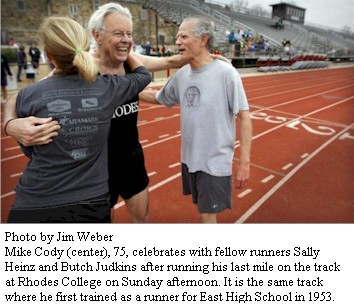
As 75-year-old
Mike Cody ['54]
ran on the track at Rhodes College on Sunday afternoon, his college
coach Freeman Marr, 86, watched his former star's final race from the
stands.
On doctor's orders, Cody was running what would
be the final mile of a remarkable, nearly lifelong running career.
"Hey, Coach! What a lead!" Cody shouted to Marr
as he distanced himself from four longtime friends accompanying him.
Cody finished in 8:52, ending a career that
began on the Rhodes (then Southwestern at Memphis) campus. He logged
more than 80,000 miles.
"Shut the book at 80,345," a beaming Cody said as he took his shoes off.
Cody didn't log his miles for the first 20 years
of his career and credited himself only an average of 1,000 miles per
year during that time.
A Memphis native, local lawyer and former state
Attorney General, U.S. Attorney, Memphis City Council member and
mayoral candidate, Cody ran competitively since his junior year at East
High School in 1953.
East High didn't have a track, so Cody would
practice at Southwestern, which he would later attend on scholarship.
Marr, track coach at Southwestern during Cody's
final three years at the school, recalled some of his star's
accomplishments as he watched him circle the track for the final time.
He said at one meet, Cody ran the mile, the
quarter-mile, the half-mile, the 2-mile and the anchor leg in the mile
relay and won them all.
"He did an unbelievable, unthinkable thing," said Marr.
For Cody, running has been a "positive addiction"
since he outran his father in a race to a pier in Pensacola, Fla., as a
kid.
While he argued cases in the U.S. Supreme Court, running is what cleared his head, he said.
Cody's decision to hang up his shoes came after "a most peculiar injury," he said.
The mileage on Cody's feet has worn away his heel
pads, leaving no cushion between skin and bone. Cody said after about
40 minutes of running, his feet are "on fire."
A doctor and friend of Cody's told him if he doesn't stop running, he won't be able to walk without pain.
"That's the issue with 80,000 miles, they don't
give you any retreads," he said. "I hope to live a number of more years
and I hope not to be all crippled up."
For Cody's wife, Suzi, watching her husband run for the final time was difficult.
"It was emotional for me. I can't believe it was
his last," she said. "Ever since I've known him he's been running. It's
a reality that hasn't quite sunk in yet."
Cody plans to replace running with other forms
of exercise. But he knows he'll miss running, he said, especially "in
beautiful places on beautiful days."
"There will be days when I look out the window
and it'll be hard not to put on the shoes to get back in that old
feeling."
Battering Ram
The Tragedy of Busing Revisited
John Branston,
Memphis Magazine
March, 2011
[Memphis Magazine] Editor's note: Fifty years
ago this coming October, the Memphis City Schools system was
desegregated by 13 first-graders chosen, with considerable difficulty,
by leaders of the NAACP. At first the process was slow; ten years
later, the federal courts speeded things up by approving forced busing
to achieve integration.
By 1974, more than 30,000 students had left the
Memphis public schools, and Memphis had the largest private-school
system in the country. Busing was a life-changing and city-transforming
experience. The people who remember the early 1970s — black and white,
parent and student, teacher and administrator — still say that.
Today, in the spring of 2011, we are at another
key moment in our educational history. Barring intervention by the
courts or state legislature, Memphis voters will likely decide on March
8th whether to surrender the Memphis City Schools charter and transfer
control to Shelby County Schools, effectively merging the two systems.
This story is built around an earlier one,
originally published in the December 1995 issue of this magazine. John
Branston, the author, updated and included that article in his 2004
book, Rowdy Memphis: The South Unscripted. Our thought is that
publishing a revised version at this time will provide historical
perspective as Memphians try to make up their minds how to vote, and,
if the referendum passes, a new system is invented.
Many of the principal figures Branston
interviewed in 1995 are no longer alive, including federal judge Robert
McRae, who presided over Memphis desegregation cases for 20 years, and
MCS attorney Louis Lucas, who argued the case for busing as a
desegregation tool; McRae died in 2004, Lucas in 2005. But other key
players are still active in public life, and while many are retired,
most are following recent events with keen interest. Their observations
are included here, along with those of others who well remember the
tumultuous years of 1973 and 1974 that tore Memphis apart.
So as this city and this county begin the
process of reinvention that might possibly create a unified school
system of 150,000 students — roughly the same size MCS was in 1970 — we
look back, but we also look forward. Another era of change has begun.
On a Memphis summer morning in 1971, seventeen
years after the highest court in the land outlawed segregation, the
mayor of Memphis, Henry Loeb, pulled up to the intersection of Poplar
and Third, glanced out his window, and saw the familiar face of U.S.
District Judge Robert S. McRae.
Loeb, who was on the passenger side next to his
plainclothes policeman driver, rolled down the window, looked at McRae,
and hollered, "Hey, you son-of-a-bitch, quit integratin' those
schools," then grinned his famous grin and sped away.
The mayor pretty much expressed the sentiments
of the majority of his white constituents at that time. But Judge McRae
wasn't about to quit "integratin'" those schools. In fact, he had only
just begun.
The next year, McRae ordered desegregation Plan
A to bus 13,789 students. A year later, he followed it up with Plan Z,
which called for the busing of nearly 40,000 students. Those students
and their schools would knock down the legal walls of segregation. Or
the legal walls, at least.
The issue of busing would dominate the political
and social life of this city during the 1970s, and well into the next
decade. Busing was not unique to Memphis, of course. In city after city
in both the North and South, federal courts called upon local school
boards to use their public school systems as battering rams for
integration.
With an evident eye to the future, the courts'
chosen method involved children. Other approaches that might have
focused upon adults — for example, the use of property-tax rebates to
encourage integrated neighborhoods — were put aside. As a result, the
American dream of the melting pot and equal opportunity was set against
the American dream of choosing a home and raising a family in a nice
neighborhood with good schools.
It was no contest. Tens of thousands of white
Memphians, some racist, many not, fled the city for points north,
south, and east. Looking back, it is difficult to imagine anything that
the most powerful pro-suburban real estate developers and politicians
in town could have concocted that would have done more to accelerate
urban sprawl and the growth of Shelby County, and contributed more to
the decline of the city of Memphis and its public schools.
Plan Z failed for a lot of reasons, but perhaps
the main one is that, in a democracy, people cannot be denied the right
to vote with their feet. And Memphis and Shelby County, with its
peculiar geography, two-headed government, separate school systems, and
powerful churches, gave them options ranging from private schools to
county schools to Mississippi schools just minutes away.
One of the most prophetic statements in the
massive court record of Northcross v. Memphis Board of Education, the
original Memphis schools desegregation case, was made by Federal
Appeals Court Judge Paul C. Weick. In 1972, the appeals court upheld
Memphis' first court-ordered busing plan, called Plan A, on a 2-1 vote.
Weick dissented.
"The average American couple who are raising
their children scrape and save money to buy a home in a nice
residential neighborhood near a public school," he wrote. "One can
imagine their frustration when they find their plans have been
destroyed by the judgment of federal courts. . . . The burden of
eliminating all the ills of society should not be placed on public
school systems and innocent school children."
Busing didn't create the suburbs, of course, but
it certainly accelerated a process that was already well under way. In
the two previous decades (1950-1970), the white population of Memphis
had decreased by 2 percent while the black population had increased 2
percent, according to census reports. That decline of the white
population would have been even greater had it not been for the
annexation of parts of East Memphis, Frayser, Parkway Village, and
Oakhaven during that time. And busing came at a time when developers
were building suburban office complexes, and when governments were
building the roads to get people to the far reaches of Shelby County.
Busing gave thousands of white Memphians one more reason to use them.
What was lost in the process, more than anything
else, was something best described as "connectedness," for want of a
better word. Connectedness is the difference between a geographic area
and a neighborhood, between school attendance and school spirit, and
between a group of people and a caring community. Memphis still hurts
for connectedness, and busing is partly to blame.
In its follow-up to the 1954 Brown V. Topeka
Board of Education decision, the Supreme Court said schools must be
integrated with "all deliberate speed." In Memphis and the states of
the Deep South, "all deliberate speed" meant very slow. In 1960, there
still were no black students in mixed schools in Mississippi, Alabama,
South Carolina, Georgia, and Louisiana.
In 1958, 8-year-old Gerald E. Young tried to
enroll at all-white Vollentine Elementary in Memphis but was turned
away by the attendance officer, the superintendent, and finally the
school board.
In 1960, the NAACP Legal Defense Fund filed a
lawsuit, Northcross v. Memphis Board of Education. Dr. T. W. Northcross
was a Memphis dentist whose daughter Deborah was 8 years old. He was on
the executive committee of the NAACP and an independent businessman who
could handle reprisals better than others. At the time, there were
53,142 white children and 42,061 black children in the system, all
attending segregated schools.
"You have to remember where we were coming
from," says former Memphis NAACP Executive Secretary Maxine Smith. "In
the years after Brown, absolutely nothing was done here to integrate
our schools. They started building all-black schools like Carver and
Lester near white neighborhoods just to keep [blacks] out of schools
like Southside and
East. It was shameful."
Maxine Smith helped persuade parents to let their
children be used as pioneers when desegregation began in 1961. "I bet
we went to 200 homes trying to get volunteers," says Smith. "It was
difficult to persuade the mothers that this was good for their kids."
Compounding the problem, classes had already
started when integration began that October, and students were enrolled
in neighborhood schools with their friends. And in the cruelest stroke
of all, the desegregation plan called for integrating one grade at a
time, starting with the first grade.
The 13 students whose parents eventually agreed
to participate were assigned to four schools, with no more than four
black students at any one school. Dwania Kyles said classmates asked to
see her tail "because black people were supposed to have tails."
Michael Willis, who later changed his name to Menelik Fombi, was called
"rich nigger" because he came to school in his parents' Cadillac. Deep
down inside, he admitted years later, he wished he had not gone through
it. For E.C. Marcel Freeman, the desegregation experience was not as
traumatic.
Now E.C. Fentress, she was one of four black students assigned to Rozelle Elementary School.
"That opportunity to learn what other students
were learning was magnificent," she says. "I can only guess that my
experiences were different because I was quiet. I kind of stayed to
myself."
Deborah Northcross, namesake of the Memphis
lawsuit, graduated from an integrated Central High School in 1969 and
went to college at Mount Holyoke. She is grateful to Central for giving
her a good education, newer textbooks than the ones used by her friends
at all-black schools, and a heavier homework load. But she feels whites
then and now often get the wrong message.
"Desegregation gave whites the impression we
wanted to be with them," she says. "That was not the point. It was a
matter of school choice and educational equity."
The 12 years that Fombi, Kyles, Northcross, and
Freeman spent in the Memphis public schools from 1961 to 1973 spanned
the major milestones of both desegregation and re-segregation. The
grade-a-year plan held for five years as the pace of integration
increased all across the country. Congress passed the Civil Rights Act
of 1965. In 1966 the Memphis city schools faculty was integrated, and
all 12 grades were integrated, often with only token numbers. By 1969,
for example,
East High School still had 1,866 white students and only 19 blacks. Nearby Lester Junior High and High School were all black.
Desegregation began in earnest in 1971, with the
Supreme Court's decision approving busing as a means of desegregation.
Student enrollment reached an all-time high of 148,015 in 1970-71,
making the Memphis City Schools system the tenth largest in the
country. By 1973, all deliberate speed had become full speed ahead,
thanks to Desegregation Plans A and Z and Judge McRae.
In retirement, two decades later, McRae isolated
himself in a carrel at the University of Memphis library and prepared a
nine-part oral history for the Mississippi Valley Collection. He was
surrounded by newspaper clippings, court documents, boxes full of old
hate mail, and a score of yellow legal pads in which he wrote notes in
longhand. His famous red judicial robe was replaced by casual clothes
and an ever-present Greek fisherman's cap.
Did it work, a visitor asked?
"Yes it worked," he said. "People are going to
debate that because they disagree on what the purpose was, but yes, it
worked. The plan was to get rid of the biracial school system. It did.
It wasn't part of the plan to run the whites off. They just left."
That they did. After Plan A ordered the busing
of 13,789 students in 1973, approximately 8,000 white students left the
system. A federal appeals court ruled that busing was "but a first
step." Plan Z called for busing 39,904 students, although only 28,000
actually participated. Another 20,000 white students left the system.
Within a year, Memphis had the largest private (and segregated) school
system in the country.
Said McRae in 1995: "I tried to stop with Plan A
but the appeals court wouldn't allow that. I was disappointed in the
reaction to Plan Z. But I had to keep a stiff upper lip because this
[reaction] was an act of defiance. Still I was disappointed that we
hadn't come up with something that worked.
"No, I wouldn't do it any other way. I am
convinced there was nobody who could have settled this the way the
parties were opposed. Somewhere along the line I became convinced that
it was morally right to desegregate the schools."
It is often overlooked that for a variety of
reasons Plan Z was not popular with many blacks either. The NAACP
wanted 60,000 not 40,000 students bused and sued to overrule Plan Z,
which it called "a grotesque distortion of the law." A total of 26
inner-city schools were never integrated because, take your pick, there
were not enough white students to go around or because the architects
of desegregation believed white students would refuse to attend them.
Black parents complained to civil rights lawyers that marijuana and LSD
were far more common at white schools like
East than at black schools. Others were worried to the point of tears at putting their children on buses.
"Judge McRae was as easy on the school system as
he could possibly have been," says O.Z. Stephens, a former city schools
official who helped devise the desegregation plan. "Plan A might have
held the white population but we would not have had integration. It was
something that had to be tried. We would not have had any rest in this
city until it was tried. Plus, the Constitution said we had to."
So O.Z. Stephens wrote Plan Z.
The title was McRae's idea. After Plan A, he
didn't want to deal with a succession of Plans B, C, and D etc. So he
dubbed the first acceptable plan Plan Z in hopes that it would be the
terminal plan. For the most part, it was.
"Inasmuch as my middle initial was Z, I got
tagged with it," says Stephens. "My identification with Plan Z killed
me professionally in the school system."
Still, he called McRae a profile in courage who
could easily have ruled in favor of the school board, let the appellate
court overrule him, and let them take the heat. Stephens' unsung hero
of school desegregation is John P. Freeman, superintendent of Memphis
schools in the busing years.
"He was a big, tough, salty South Memphis
railroader and product of the school system. He had been a navigator on
a B-17 bomber in World War II and could be unbelievably profane but he
had a big heart. He was the one who went head to head with Mayor Wyeth
Chandler over all the impediments. When the bus drivers threatened to
walk out, he railed at them, 'you blankety-blanks will blankety-blank
pick up those little kids.' And they did."
There was at least one partial success story
which has survived. Optional schools are magnet schools or schools
within schools for college-bound students or students with a special
interest in theater or some other area. These are open to students from
outside their attendance zone and include some of the few racially
balanced schools in the city. Started in 1975, optional schools like
Grahamwood Elementary and White Station High School had a distillation
effect that concentrated a high percentage of high achievers while
gutting other schools of their best and brightest, both black and
white.
By the mid-Nineties, the effect was obvious on
teachers like Karen Champion at Central High School, a 1967 graduate of
Hamilton High School.
"Our games were packed when I was at Hamilton,"
she says. "Now unless the team is great it's difficult to get fans.
When kids don't live in the neighborhood and can't walk to games, there
is not as much loyalty to the school."
Memphis attorney Louis Lucas was one of the
legal masterminds of school desegregation, working with the NAACP Legal
Defense Fund. Lucas believed systematic segregation did not go away
after Jim Crow laws were struck down. It continued because of
neighborhood patterns influenced by bankers and realtors and school
attendance zones drawn for years by a whites-only board of education.
Several years after the great busing experiment,
Lucas moved to Germantown. His daughters attended Shelby County schools
that were overwhelmingly white. "My kids went to county schools because
that is where we lived when we had children. We didn't move out there
for the schools."
For whatever reasons, thousands of families
moved to the suburbs after busing. In 2011, white flight and black
flight from the inner city is very much an ongoing process. Memphis
City Schools enrollment of 103,593 includes 92,157 blacks, 1,438
Asians, 7,067 Hispanics, and 7,655 whites. The number of whites would
be even lower had the system not absorbed former county schools in
annexation areas. Put another way, the chances are better than 90
percent that a black or Hispanic student attends a high school that is
99 percent or 100 percent minority and more than 90 percent
economically disadvantaged. Only two city high schools, White Station
and Cordova, come close to matching the city demographics as a whole.
The Shelby County school system has 47,342
students including 25,244 whites, 18,226 blacks, 2,340 Asians, and
2,233 Hispanics. As Memphis demolished its housing projects, subsidized
housing was dispersed, with a heavy concentration in Hickory Hill, and
other annexation areas. When pending Memphis annexations are completed,
12 schools operated now by Shelby County Schools are scheduled to
become Memphis schools.
Nine of those 12 schools are majority-black. In
all, these 12 schools have 7,656 black students, or more than 40
percent of the black students in the county system. One of them,
Southwind High School, has 1,764 students but only 18 of them are
white, a ratio quite similar in reverse to
East High School in 1969.
The Southwind anomaly was noted by U.S. District
Judge Bernice Donald in her 2007 review of the county schools'
compliance with federal desegregation orders. She ordered the county
system to redistrict to achieve better racial balance, but a federal
appeals court overruled her in 2009.
In a line of reasoning that was ironically
opposite the federal court's affirmation of busing in 1972, this
appeals court said the school district has no duty to remedy imbalance
caused by demographic factors, annexation, and "voluntary housing
choices made by the public."
The idea of surrendering the Memphis City
Schools charter and merging the school systems is not new. Maxine Smith
recalls an effort in 1976 that failed by a narrow vote on the school
board when she was a member. Smith is a supporter of the referendum. At
a rally earlier this year, she predicted that it would pass. "They know
we are right and they know we are going to win."
Julian Bolton, a Memphis attorney and former
member of the Shelby County Commission, was involved in another merger
effort in 1990.
The commission was redistricting to increase
black representation. Suburban interests countered with a threat to
secede and create a new county, Nashoba County. The underlying reason
was fear of school system consolidation.
Bolton vividly recalls a meeting at Bartlett
High School in a gymnasium packed with more than 3,000 people. He was
the only county official to speak, and he did not mince words. "I said
that county commissioners swore an oath to Shelby County and could be
removed from office for violating their oath," Bolton said. "They were
booing me, and a sheriff's deputy rushed me out of the auditorium."
Two years later, newly elected Memphis mayor
Willie Herenton picked up the cause, suggesting in an interview with
The New York Times that Memphis could surrender its charter and thereby
consolidate with Shelby County. A task force concluded that would be
difficult, at best, and nothing came of it.
"I did not want Memphis to become another
Detroit," Herenton says now. "I saw that white flight left cities black
and poor."
During his four and one-half terms as mayor,
Herenton supported several attempts to revamp the school systems by
committee, but although the intentions were always admirable, the
results were negligible. The failure of those efforts convinced many of
the current charter surrender activists that negotiations with county
school board members and suburban mayors were futile.
O.Z. Stephens retired from Memphis City Schools
in 1984 after 30 years. He lives in Bartlett. In a recent interview, he
said he would vote against the merger if he lived in Memphis. He
believes a 150,000-student system is too big. And he predicts another
round of white flight if the merger passes.
"Then they will start tinkering," he said. "I
can just hear some of the thoughts. 'We've been talking about closing
50 schools. We've got all these portable classrooms in Bartlett and
Germantown. We don't need to build any more schools out there. Let's
bring them here.' I guarantee some talk like that is going to emerge.
The minute it does, bye-bye."
Virginia Burnette was the mother of four
school-age daughters when busing began. She and her husband, a
Methodist minister, decided it was their Christian duty to make the
best of what was, she says "the most tumultuous time of my life."
Her youngest daughter went to Dunbar Elementary
in south Memphis with about 40 other white children. Virginia went to
class with her for a few weeks and was PTA president. It was a hard
year, but she remembers humorous moments too. Someone asked if her
daughter was "bright," meaning light-skinned. "I said, yes, she is very
smart."
One day Virginia read the class a poem by Paul
Lawrence Dunbar, namesake of the school. Doing her best to speak in
dialect and explain that "black" was not a literal color but more akin
to chocolate, she asked, "What do you call me?"
A little boy piped up, "We call you a honky."
Ridgeway was the Burnettes' brand-new
neighborhood school, but their oldest daughter was bused to Melrose. As
she boarded the bus for the first day, she assured her mother
everything would be fine. There was a bomb scare that afternoon.
"That was the biggest single witness we ever
participated in because we gave our children to Memphis City Schools,"
said Burnette. "It was your Christian discipleship that was at stake.
We thought we were doing the right thing and I think we were. Our
children did not suffer."
All of Burnette's daughters went to college and had professional
careers. Now living in Cordova, Burnette said she would vote for the
referendum.
At 79 years old, Joe Clayton is the white-haired
eminence of the Shelby County Schools Board of Education. When he
retires next year, his career will have spanned three generations and
three school systems — Memphis, Shelby County, and Briarcrest Christian
Schools, where he was principal of the high school from 1974 to 1996.
Like Virginia Burnette, he says 1974 was a test of his Christian faith.
"In the spring of 1974 I was principal at
Overton High School when we graduated 600 students, the largest senior
class in the history of Memphis City Schools. Briarcrest had opened an
elementary school in 1973 and wanted to start a high school. When I was
contacted by the board, I did a lot of praying because I had been in
public education for so long, but God had other plans for my life. My
life plan was to spend the next 22 years of my life bringing Briarcrest
into existence.
"It blows my mind even today. We opened with 963
students, and 103 of those were seniors, which meant they had left
another school. By the second year we were accredited. That school was
a miracle school. It just took off and never looked back."
The school's first location was on Sweetbriar in
East Memphis. It has moved further east as its enrollment has grown.
The movie The Blind Side is based on the life of Briarcrest student
Michael Oher and the Tuohy family.
Clayton sees similarities between then and now.
"When I went to Overton in 1974 busing had just started. It was a fear
thing. You were busing kids out of Overton to Hamilton. Parents were
not going to let that happen. I don't see the fear factor in this now.
I think people are concerned about taking a large system of 100,000
students and 105 failing schools and merging with a school system of
48,000 students and five failing schools. The big concern is who is
going to be in charge and why are we doing this. Why are we taking a
good school system and merging it with one that on paper looks like it
is having troubles?"
Clayton ended the interview with the Bible
passage "all things are possible with God" from the Book of Matthew.
"To put this thing together by man is going to be impossible, but if
this is God's plan we can make it work."
Young artists put best work forward under gaze of judges and peer pressure
By Jane Roberts,
The Commercial Appeal
March 3, 2011
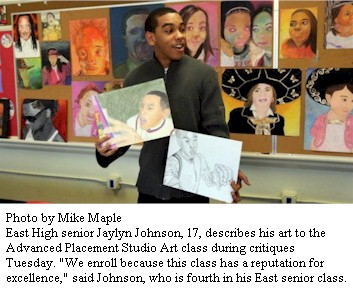
A funny thing
happens in the course of learning to critique peers' work in the
Advanced Placement Studio Art class at
East High.
With the path wide open to blurt out insults, no one does.
"I was nervous," said Jaylyn Johnson, 17, a
senior. "But we've gone through so many critiques that I know they
won't tell me something that would hurt."
Dominique Wein is more practical: "You have to
have a reason for what you are saying; it's not just 'you took my milk
at lunch.'"
The intensity is heating up now as AP Studio Art
classes in high schools across the city drill down to the final
portfolios due for judging in Cincinnati in early May.
Each student must present 24 canvasses, a blend
of work showing the breadth of their skill -- pen and ink to pastel --
plus canvasses in their concentration subject.
The work will be judged or "read" by 136 AP Art teachers from around the country.
"It's one of the most amazing things I have ever
seen," said Wendy Free, director of fine arts curriculum and content
development at the College Board in New York, which oversees Advanced
Placement courses.
"You'll see over 40,000 portfolios from AP
classes around the world laid out before your eyes. It's like the
future of artwork laid out before you."
If the just-completed Mid-South Scholastic Art Awards are representative, Memphis students are on their way.
Of the 200 student pieces of art selected from
1,600 regionally to hang in the Memphis Brooks Museum, Memphis city
students earned 31 gold keys, qualifying them to compete at the
national Scholastic event in New York this month.
Of the 19 high school winners, 11 are enrolled
in AP Studio Art courses across the city, including Terrello Lane, 18,
salutatorian at East.
His AP class, taught by
Dorothy Northern [Faculty], also includes valedictorian Wein; No. 3 Erika Olveral and No. 4 Johnson.
"We enroll because this class has a reputation for excellence," Johnson said.
In a time when AP test grades are slipping
nationally, Northern continues to have East's highest AP scores,
including a perfect 5 last year.
While she takes credit for some of it, she's quick to say art has a way of combining brain hemispheres.
"If you get the two sides of the brain to cooperate, you can do a better job."
Her teacher colleagues at East say her students
look at problems differently and as a result are better critical
thinkers. "They also say that my kids are very good at critique in
other subjects," Northern said.
They get a lot of practice. Northern schedules
critiques once a month, insisting that it's easier to hear the
criticism in a group than it is to be home alone when a poor portfolio
grade comes in the summer.
"I think that would be horrible when nobody had indicated there might be something wrong," she said.
So the discussions are frank, including
assessments of where students think they are stumped, where they have
triumphed and what they admire in their colleagues' work.
"My biggest challenge is my background," admits
Marquis Stewart, 16, standing before his self-portraits and peers.
"Do you feel you have a solid idea or are you
struggling to make something?" Northern asks. "Maybe put it aside for
awhile," she advises.
Wein is next, standing beside four urban
landscapes. "I don't like this one," she says, pointing to streetscape.
"I want to make the colors more intense, but I haven't done it yet."
"You handled pointillism really well," Northern
says. "I would like to see you go really big. I have some big canvasses
in the closet," her way of pushing students to stretch.
Kathy Dumlao, associate curator of education at the Brooks, sees the strides.
"The other night, we had an opening for a
contemporary artist while the Scholastic exhibit was still on view. The
security officers enjoyed watching the visitors get so excited about
the student work."
Theories hit dead end on how world-famous Beale Street got its name
By Michael Lollar,
The Commercial Appeal
February 28, 2011
The Pantaze Drug Store was an anchor on one
corner of Beale Street. With its soda counter, it gave a family
atmosphere to a place also known for saloons, gambling dens, pawn
shops, theaters and houses of prostitution.
With a name made famous by W.C. Handy's "Beale
Street Blues" in 1916, the spot attracted Duke Ellington and Ella
Fitzgerald to town and was a regular gig for the likes of Riley "Blues
Boy" King and Bobby "Blue" Bland.
Their names would become household names, and
Beale Street would become the best-known street in Memphis and one of
the biggest tourist attractions in the state. But its beginnings are as
murky as the business and politics of early Memphis.
While other early streets were named for
presidents, politicians and heroes, no one is sure how Beale got its
name.
It's a name that first showed up on a city map
in 1841 as "Beal," without the eventual "e" at the end, says Wayne
Dowdy, manager of the history department at the Memphis Public Library.
The man credited with naming the street was wealthy developer and
entrepreneur Robert Topp, but the person he named it for has eluded
historians ever since.
"It's wild. It's kind of crazy," says Beale
Street developer John Elkington, who spent six months researching the
street for his 2008 book, "Beale Street: Resurrecting The Home Of The
Blues." "There was a rumor that it was named by Andrew Jackson for a
lieutenant, a sharpshooter, in the Battle of New Orleans."
That 1815 battle was the final battle of the War
of 1812 and would have meant a long memory -- 26 years -- for anyone
choosing him as a namesake for a Memphis street that didn't show up on
a map until 1841.
Charles Crawford, a history professor at the
University of Memphis, says the name remained on maps and on the
tongues of Memphians until the street was among the most famous in the
nation, along with Bourbon and Basin streets in New Orleans, State
Street in Chicago and Broadway in New York.
"By the time people got around to asking obvious questions about the name, the records were gone," he said.
Crawford has directed dozens of student theses involving Memphis history.
"I've always said, 'If you hear anything about
the origins of the name Beale Street let me know.' No one ever has," he
said.
While various theories have come and gone, Shelby County historian and former county commissioner
Ed Williams ['52]
has his own. McCall was on the 1841 map as the street immediately north
of Beale. (It is now Peabody Place.) It was named for a staff member of
Edmund Pendleton Gaines, commander of the southwest United States
(including Memphis) before the Civil War, says Williams.
"McCall was a major on Gaines' staff, and I
think Beale was probably also named for a staff member (of Gaines)," he
said, although there is no specific person whose name has surfaced to
prove the theory.
Williams dismisses other popular theories. One
held that Beale was named for a Gen. Edward Beale, who became famous in
1848 or early 1849 for bringing back samples to the East from the first
gold nuggets discovered at Sutter's Mill, Calif., that helped set off
the California gold rush. A San Francisco street was named for him,
but, by then, "Beal Street" already was on the map in Memphis.
Williams used the same historical reasoning to
dismiss a popular myth about another well-known Memphis street. The
theory held that Union Avenue was named to signify the "union" of
incorporated South Memphis with Memphis in 1850, but Union Avenue was
on city maps as early as 1827. It also is on the 1841 map, and Williams
says the name Union simply "was a popular word in the American
vocabulary at the time." It followed the naming of other streets for
U.S. presidents.
"There had only been five presidents and they ran out of names, so they named the next street Union," he said.
Former Streetscapes reporter Ann Meeks, who wrote
the column in The Commercial Appeal for 14 years, researched all of the
theories about the Beale name in a frustrating effort to solve the
mystery.
"I would love to know the answer, and I just knew I'd be able to determine it," she said.
Instead, Beale became the single exception to her sleuthing.
"I can't think of another one" that led to a complete dead end, she said.
Williams suggests the spelling of the name,
either Beal or Beale, may not be significant, saying, "Historians
frequently find variations of spellings because a mapmaker makes a
mistake."
Bill Day, heir to the historic Hunt-Phelan Home
at 555 Beale, contributes another theory. His relatives, the Phelan
family, were related to the Beale family of the documentary film "Grey
Gardens." Charles Beale, born in Chattanooga, later became an Alabama
Supreme Court justice. In 1917, he married Jacqueline Kennedy Onassis'
aunt, Edith Ewing Bouvier. After a divorce, she was given the couple's
28-room summer home, Grey Gardens, in East Hampton, N.Y.
Day's uncle, Stephen Phelan, told him the Beale
family connection led to the naming of the street, although the early
maps, mistakenly or not, were spelled differently.
Another longtime Beale tenant, Elliott Schwab,
owner of the legendary general merchandise store A. Schwab that was
listed for sale last week, says he has always heard that Beale "was
named for a general. I don't think he was even tied to Memphis."
Either way, Memphis Convention & Visitors
Bureau president Kevin Kane says Beale, though shrouded in a certain
mystery, is "world famous."
"It is what Bourbon Street is to New Orleans,
and it is synonymous with the city's entertainment and culture," he
said, adding that state tourism figures indicate the street draws up to
4.2 million people a year. He says that translates to about 2 million
visitors (not counting locals) a year. "It generates about $50 to $60
million a year in revenue."
It is the mystery of the street that attracts
historian John Harkins, president of the West Tennessee Historical
Society: "As a species, we're too focused on knowing the answers to
everything. We have a precision that takes some of the grace out of
life."
CBHS Hall of Fame inducts 10
By John Morris, Special to My Life,
The Commercial Appeal
February 27, 2011
[Excerpts]
The Christian Brothers High School Hall of Fame
inducted 10 new members in ceremonies on the CBHS campus Jan. 30.
Candidates are chosen by the Hall of Fame
membership on the basis of personal accomplishments, civic and public
contributions and support of or involvement with activities of interest
to the school. CBHS graduates must have graduated a minimum of 20 years
prior to selection.
The CBHS Hall of Fame was established in 1968.
Since then, 485 men, living and deceased, have been inducted into the
group (386 of whom are CBHS grads) by their peers.
Joseph "J.G." Griesbeck, Jr. (Faculty 1964-1972)
(CBHS '35), was at the time of his death on Oct. 12, 2010, the last
living teacher from the Adams campus. A member of five generations of
Griesbecks who graduated from CBHS, J.G. Griesbeck served for nearly 30
years as an educator with the Memphis City School system, including
principal at Guthrie School, Fairview Junior High, and East High
School. His father, Joseph Sr., brother Charles, stepson Roy Henderson
and 13 nephews are graduates of CBHS. He is the fourth member of the
Griesbeck family to be inducted into the CBHS Hall of Fame.
A. Schwab for sale, signaling possible end for Memphis store on Beale Street
By Wayne Risher,
The Commercial Appeal
February 25, 2011
Besides the Internet, where else can you buy fake
samurai swords, suits of armor, cowboy hats, cast-iron cookware, voodoo
dolls, love potions and mojo bags?
But unless there's some magic to make time stand
still, the legendary A. Schwab dry goods store on Beale Street may fade
into history.
Descendants of Abraham Schwab, a haberdasher who
founded the store in 1876, have listed it for sale with commercial real
estate broker Slovis & Associates.
"It's sort of the next generation is not interested," said
Sam Braslow ['73],
a schoolteacher who owns the Le Sel Corp. with his brother Marvin
Braslow and cousins Elliott Schwab and Mike Weis. "There's a reason
businesses like ours don't exist anymore."
Store manager Elliott Schwab, 49, has mixed
feelings about selling out after 32 years walking the ancient
wood-planked aisles.
"I don't want to go along with it; I'm kind of
going along with it," said Schwab, wearing flannel shirt, jeans and an
A. Schwab ballcap.
"With the economy, and the headaches of having
to do everything, it has just kind of gotten to me. I'm tired of it,"
Schwab said.
He added, "If I were in a position to keep it open, I think I would. I enjoy coming down here."
Family members signed papers to put it on the market three weeks ago.
Commercial Realtor Adam Slovis said an asking
price hasn't been set and will likely be determined by give-and-take of
offers and development plans from potential buyers.
The buildings, connected on the interior, cover
nearly 20,000 square feet, according to the Shelby County Assessor of
Property, which has them appraised at $426,000.
Slovis said it's hard to set a value, because of
the historic nature of the brand, lack of comparable sales and the
location in the state's top tourist destination.
"This truly has the old adage of location,
location, location. It is smack dab in the middle of Beale Street
between Silky O'Sullivan's and B.B. King's Blues Club."
Because it was a going business when the City of
Memphis bought up Beale Street to create an entertainment district in
the 1970s and 1980s, "It is the only property on Beale Street the city
doesn't own," Slovis said.
"It's just time" for the owners to sell, Slovis
added. "They would love to see a part of the history remain in whatever
happens."
"I think my mother realized at some point it's
going to have to end," said Sam Braslow, 56, a teacher at Houston High
School. His mother, the late Eleanor Schwab Braslow, was a
granddaughter of Abraham Schwab. She died in 2005.
Customers browsed in the store Friday, pausing
over unusual items and snapping photos of each other trying on
feathered hats.
Dustin and Megan Doherty of Tahlequah, Okla.,
with 2-year-old son Jonah in tow, were enticed by a storefront armor
display.
"It looks interesting," said Dustin. "We just came from Tater Red's, so this is pretty mild," he added.
Jonathan Dreifus, visiting from Portland, Maine,
grew up in Memphis and was on Beale Street showing his children around
Schwab's. The Dreifuses and Schwabs are connected somewhere on their
family trees. "I hope it stays like it is."
Joseph Braslow, Sam's son and a fifth-generation
family storekeeper, said Memphis-themed postcards, Elvis Presley items,
old-fashioned candies displayed general store style, and "the
mojo-voodoo stuff" are among best sellers. Younger customers favor the
armor: breastplates, helmets, knives, swords, axes.
"This store is kind of random, but it works."
Elliott said, "We've always been almost a bizarre
mix of merchandise, so that's what we keep doing. We'll buy something
and if it sells, we'll buy more of it. If it doesn't, we won't get it
again."
Best-sellers vary from day to day and sometimes surprise even a veteran like Elliott Schwab.
"These old ladies came in, and they went crazy
for these knit caps. They bought all we had, four to six dozen. We had
had them for a few years. They had this old-style look to them."
Over in the incense, curios, oils and
lode-stones department, one could find jinx removing candles, $6, mojo
bags for purposes ranging from "attraction" to "gamblers" to "strong
love," $10, and a John the Conqueror Voodoo Doll, $5.
Buyer beware, though. "The articles in this
department are sold without any claims or pretense of any natural or
super-natural powers, affects or revelations. Signed, A. Schwab."
Society of Entrepreneurs: Robert Wilson builds on his family's legacy of innovation
By James Dowd,
The Commercial Appeal
February 18, 2011

This is the last in a four-part series on the
2011 Society of Entrepreneurs inductees, who will be honored during a
black-tie gala April 9.
Growing up as the son of the man who transformed the hospitality industry, young
Robert A. "Bob" Wilson ['62] learned plenty about customer service early on.
And to this day he credits his dad, Holiday Inn
founder Kemmons Wilson, with instilling in him a sense of civic pride
and the drive to be the best in every pursuit.
As founder and president of Memphis-based Wilson
Air Center, Wilson is nationally renowned and his company is
consistently ranked as the top fixed-base operator in the country.
He also serves as vice president of his family's
Kemmons Wilson Companies, where he focuses on hotel construction,
warehousing and time-share operations.
In recognition of his innovations in the
hospitality and aviation industries, Wilson is being honored by the
Society of Entrepreneurs. He will be formally inducted into the
organization April 9.
"Pop said we had a family business, and so I
never really thought about doing anything else. It was always my desire
to grow this venture and see it thrive in different areas," Wilson
said. "I love this city, I love this area, and it's been great for my
family. I never wanted to work anywhere else."
After graduating from East High School, Wilson
headed to Dallas to attend Southern Methodist University. While there,
he studied business and finance, and after graduation returned to
Memphis to work for his father.
Working primarily in construction, he took jobs
as a roofer, electrician and framer on hotel projects in such far-flung
sites as Monaco, Nigeria and Panama.
Along the way, he joined the Tennessee Air
National Guard and entered the pilot training program. A lifelong
aviation lover, Wilson had earned his pilot's license at 16 and
described the Guard program as "a paid vacation."
It was that passion for flying that later led
him to establish Wilson Air Center at the Memphis International Airport
in 1996.
"It's sort of like a big service station for
airplanes, but with amenities for the customer to make the experience
as positive as possible," Wilson said. "Our policy is to never say 'no'
to a customer and to treat them right so that they'll keep coming
back."
The center has been rated as the top FBO in
Aviation International News and received the Operational Excellence
Award by AIG Aviation Insurance in 2002.
Since its early days in Memphis, the company has
grown to include more than 200 employees and expanded to markets in
Houston and Charlotte, N.C.
"I've known Bob for a long time and admired his
ventures into all types of aviation," said Memphis-Shelby County
Airport Authority president Larry Cox. "He revolutionized the FBO
business with his attention to detail and focus on customer service.
I'm a pilot myself and I've been in many airports, but his operation
exceeds any I've ever seen."
Wilson has been honored by numerous aviation
organizations and was inducted into the Memphis Aviation Legends Hall
of Fame in 1998. In 2006, he was inducted into the Tennessee Aviation
Hall of Fame.
"Memphis is rich in aviation history, and Bob
Wilson has carved out a special place for himself through his
leadership and innovation in establishing Wilson Air Center here," said
Memphis-Shelby County Airport Authority chairman Arnold Perl. "The
model he founded here has been replicated across the country, which
points to Memphis as a center of aviation innovation."
For markets and his city, commodities trader Charles McVean looks ahead
By James Dowd,
The Commercial Appeal
February 17, 2011

With keen insight and unwavering determination,
Charles McVean ['61] remains focused on the future, whether he's trading commodities or envisioning a healthier landscape for the city.
As chairman and CEO of Memphis-headquartered
McVean Trading & Investments, he oversees a company that manages
accounts for more than 6,000 clients worldwide. And as the innovator
behind the Aerobic Cruiser Hybrid Cycle, McVean promotes
state-of-the-art lithium battery-powered bicycles and touts the
recently opened Shelby Farms Greenline as an attraction that could help
Memphis leapfrog other cities as a tourist destination.
"There's a growing desire to promote more
environmentally friendly products, and the potential is here for
unparalleled recreation and exercise along the Greenline," McVean said.
"I believe we're in a position to define our destiny and create
something special."
For his varied contributions, McVean is being
honored by the Society of Entrepreneurs. He will be formally inducted
into the organization April 9.
A native Memphian, McVean graduated from East
High School and later studied philosophy and economics at Vanderbilt
University, where he earned a bachelor's degree in 1965.
After graduation, he accepted a job as a trader
in the grain industry and subsequently worked with Cook Industries in
Memphis and later in New York with the Louis Dreyfus Corp.
McVean moved back to Memphis in 1974, taking a
job with brokerage firm Refco, where he focused on cattle trading and
eventually became a principal. As a futures trader, he relied on advice
that still guides him today.
"My grandfather was an old cattle trader, and he
used to say that at the end of the day, if you're going to be in a
business like this, you have to know where legitimate business ends and
where gambling begins," McVean said. "I've based my career on knowing
the difference between the two and making the right decisions for my
clients."
In 1986, McVean branched out and established
McVean Trading & Investments, which today counts 80 employees and
concentrates on livestock, grains and oilseeds, and global
macroeconomics.
"Memphis has a terrific commodities history and
Charles is a leader in that area," said David Waddell, president and
CEO of Waddell & Associates. "He's got a tremendous business mind
and has inspired countless others, encouraging them to create an even
more robust community of entrepreneurship in Memphis."
One way McVean does that is through education.
In 2004 he founded the Peer Power Foundation,
which helps guide disadvantaged students toward academic success. The
program is active in nearly a dozen schools, employing more than 150
high school and college students to tutor and mentor more than 1,000
younger students every day.
In part because of that initiative, in 2007
McVean was named Humanitarian of the Year by the Memphis City Council
for his efforts to improve public education.
"Through his work with clients, his presence in
the community and his advocacy for students, Charles exemplifies a
positive role model in our community," said Pearson Crutcher, executive
director of the SOE. "He's a wonderful example for all of us."
Increase in Advance Placement failure rate 'troubling'
Tennessee's Advanced Placement exam failure rate inches up to 48 percent
By Jane Roberts,
The Commercial Appeal
February 14, 2011
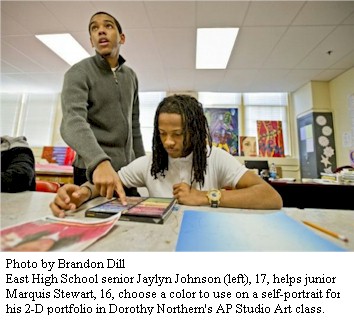
While the
number of public school students taking Advanced Placement courses
nearly doubled last decade, the number who fail in AP classes also is
up, a sign school leaders are relying too heavily on AP to increase
course rigor.
In its annual report this week, the College
Board praised its AP program "as one of the great American education
success stories of the last 56 years." The board cited the growing
percentage of minority high school students who successfully complete
the courses designed to reflect college-level work, and the correlation
between AP and college success.
But in Tennessee and around the nation, an
increasing number of students are not doing well enough in the classes
to get college credit for their work.
Last year, of all the seniors who took at least
one AP course in high school, 41 percent -- about two in five -- did
not pass the exam, up slightly from 40 percent in 2009 nationwide.
In Tennessee, failure rates inched up to 48
percent last year compared to 47.2 in 2009. Since 2001, the number
getting a score of 3 or better on the 5-point grading scale dropped 7
percentage points.
A 3 is considered a college grade of B or C. A score of 1 corresponds to a grade of D or F.
In Memphis, 40 percent of public school seniors
passed with a 3 or more in 2009. In 2010, the percentage dropped to 33.
In Shelby County Schools, 61 percent of the
2,466 students who tested in 2010 scored a 3 or higher. That's only a
slight drop from 2009, when 62 percent of the 2,240 who tested scored a
3 or higher.
AP is a program of the College Board, designed
to improve student access and readiness for college. The board also
administers standardized entrance exams such as the PSAT and SAT.
As the nation hurries to improve the math and
science skills of its workforce, the haste is reflected in AP
chemistry, environmental science, calculus, computer science and
biology scores. More than a third of AP test-takers in those subjects
earned a score of only 1 last year.
While only one fifth scored that low on the
physics exam, nearly 20 percent got a 2, which means half of the
physics enrollees did not do well enough to get college credit for
their AP work or post a significant return on taxpayers' investment in
teachers and lab equipment.
The College Board made specific reference to the
scores this week, calling them a "troubling and emerging trend.
"Thirty percent of U.S. high schools are rushing
AP students into AP biology and chemistry without having them take
prerequisites first," said Trevor Packer, AP vice president.
AP courses are designed to follow traditional subject courses, preferably work at the honors level.
"The heart of the matter, success in AP is much
more dependent on the years leading up to AP than what can happen in
one year," Packer said.
When school leaders focus on "an array of educational improvements, AP becomes an outcome rather an a result."
Between 2008 and 2010, MCS added 60 AP sections, beefing up offerings in schools like Hamilton and
East
where there had been few choices. Across the city, the city school
district added German language, human geography, art history and
environmental science for a total of 27 AP classes.
Since 2008, the number of students enrolling and taking the final AP exam in Memphis increased 19 percent.
"Increased access makes a difference," said John Barker, the district's chief of research and evaluation.
"Research shows that even if you are not
successful in the exam, participation in AP prepares you for success in
college."
But growing fast has unintended consequences,
including a thin pool of qualified teachers. If one of those teachers
leaves unexpectedly, administrators may have no choice but to cut
courses, even at under-served schools.
Westwood High, for instance, dropped AP English
language and composition, and English literature and composition this
year when the teacher who taught both transferred, erasing with one
move the school's entire gain in access.
The city schools have also had to train dozens
of teachers for the increased course rigor. Not only is it expensive
(an in-town, College Board-certified class for 25 teachers costs
Memphis City Schools $11,500; the cost jumps to $1,500 to $2,000 per
teacher if they have to go out of town to do the work), but new
teachers usually don't get high test scores from their students
immediately.
"It takes an AP teacher about three years for
their students to score 3 or above," says Linda Sklar, head of the AP
program at MCS.
Memphis also requires each student to take the exam, not the case everywhere.
"In some districts, if they have children they
don't think are going to do well, they may discourage them from taking
the test.
"We're saying, if you want students to make
commitment, then we want true commitment, that you are going to work to
the highest level," Sklar said.
State education board orders Shelby County Schools to OK charter school application
By Sherri Drake Silence,
The Commercial Appeal
January 28, 2011
Shelby County Schools, which has long fended off
charter schools, has been ordered by the state to approve a charter
school application twice rejected by the district.
The state Board of Education voted unanimously Friday to require that
SCS approve a request from Smart Schools Inc. to open a New Consortium
of Law and Business charter school in the suburban school system.
The charter school would be the first in SCS.
"I feel like the dog that's caught the mail truck,"
Tommie Henderson ['91 and Faculty 1998-2003],
executive director of Smart Schools, said Friday. "... All we are
waiting on is for the Shelby County Schools board to move forward with
this decision, so that we can get rolling."
The action is unrelated to the controversial
effort to surrender the charter for Memphis City Schools, which would
result in the merger of the two systems.
Smart Schools plans to open its school to about
35 seventh-graders this fall and add another grade and 60 more students
next year. A location for the school hasn't been determined.
The school would be open to county students who
failed the reading or math portion of the state's achievement tests or
to those who attended charter schools before joining the county system.
Smart Schools Inc. filed an appeal with the
state after being denied by SCS. District officials gave the group's
initial application a score of 54.5 points out of 100. They gave a
revised request a score of 71.
SCS board chairman David Pickler said Friday
that he's "deeply disappointed" with the state board's decision, but
said the vote is final and the district can't appeal. The board will
vote to approve the application at its February business meeting.
"The application had issues, but that is now a
moot point," Pickler said. "Now, we need to move forward to ensure that
this school is as successful as any other school in Shelby County."
At a business meeting in 2009, Pickler said
district leaders would be more open to charter schools if they thought
they'd better serve students. Former SCS superintendent Bobby Webb, who
played a major role in putting up legislative roadblocks for charter
schools in the county, called them a "fad" at that time.
Charter schools are taxpayer-funded public
schools that are "chartered" by nonprofit organizations and operate
outside of the control of local school boards.
After an appeal hearing this week, Gary Nixon,
executive director of the Tennessee Board of Education, recommended
that the state board remand the decision by SCS. Nixon said SCS had
acted "contrary to the best interests of the pupils, the school
district and the community."
Since 2003, the state board has heard 26 charter school cases and remanded only a handful.
With approval from Memphis City Schools,
Henderson opened a similar law and business charter school Downtown
last year. He also started the Memphis Academy of Science and
Engineering in MCS.
State may force school approval
Charter may open in Shelby County
By Sherri Drake, Sherri Drake Silence,
The Commercial Appeal
January 28, 2011
Shelby County Schools may be required by the
state board of education to approve a charter school application that
the district has emphatically rejected.
The suburban district, which has no charter
schools, twice denied an application from Smart Schools Inc. to open a
New Consortium of Law and Business for middle schoolers in county
schools.
Gary Nixon, executive director of the Tennessee
State Board of Education, recommended Thursday that the full board vote
today to remand the decision by SCS and instruct the district to
approve the charter school.
The decision by SCS to deny the application was
"contrary to the best interests of the pupils, the school district and
the community," Nixon said in the recommendation.
The state board's attorney said today's vote will be final. SCS can't appeal the decision.
Smart Schools' executive director
Tommie Henderson ['91 and Faculty 1998-2003], who made his case before Nixon at an appeal hearing Monday, said his organization feels "vindicated" by the recommendation.
"This is huge," Henderson said of Nixon's recommendation Thursday. "We're very happy about the decision."
With approval from Memphis City Schools,
Henderson opened a similar charter school Downtown last year. He also
started the Memphis Academy of Science and Engineering in MCS.
SCS officials gave Smart Schools' initial
application a score of 54.5 points out of 100. They gave a revised
application a score of 71.
Nixon said SCS officials used an outdated
version of the review guide for charter school applications and didn't
explain why denying the application was the right move.
"Instead, SCS seemed focused on complimenting its current schools for the programs they already offer."
Since 2003, the state board has heard 26 charter school cases and remanded only a handful.
State hears appeal of Shelby County Schools 2-time application refusal
By Sherri Drake Silence,
The Commercial Appeal
January 25, 2011
A local educator whose application to open the
first charter school in Shelby County Schools has been twice denied by
the district made his case to state education officials in an appeal
hearing Monday.
Tommie Henderson ['91 and Faculty 1998-2003],
executive director of Smart Schools Inc., argued that leaders of the
suburban district didn't use the correct scoring system when evaluating
his organization's application to open a New Consortium of Law and
Business charter school. And, he said, they didn't reveal what score is
required for approval or what process they use to make their decision.
"Due to this, our organization has truly been
shooting in the dark as it relates to the district's charter school
application process," Henderson said at the appeal hearing before Gary
Nixon, executive director of the Tennessee state Board of Education.
Shelby school officials rejected Smart Schools'
application in November, giving it a score of 54.5 points out of 100.
The organization submitted a revised application to SCS and was
rejected again with a score of 71.
In August, with approval from Memphis City
Schools, Smart Schools opened a similar law and business charter school
Downtown that serves about 35 seventh-graders.
Henderson, who also started the Memphis Academy
of Science and Engineering charter school in MCS, said the proposed
school would provide innovative instruction and help struggling
students.
"Shelby County Schools does use numerous
interventions," Henderson said. "And we consider ourselves to be just
one more intervention they can use."
Charter schools are taxpayer-funded public
schools that are "chartered" by nonprofit organizations and operate
outside of the control of local school boards. Shelby school leaders
were long opposed to the nontraditional public schools, but now say
they're open to them.
County school officials said they did use the
right scoring system and that the application had many flaws, including
an unclear instructional strategy. They said the proposed courses are
already offered by the district and the application didn't include a
location for the school.
Margaret Gilmore, who oversees instructional
programs for SCS, highlighted several intervention programs the
district uses to assist a growing population of economically
disadvantaged students. And, she said, county schools continue to
perform at a high-academic level even as standards increase.
"Shelby County Schools stands steadfastly behind
the decision to deny this application and preserve the rich tradition
of educating all 47,000-plus (SCS) students and acting in the best
interest of all stakeholders," she said.
Nixon will make a recommendation to the state
board of education, which will likely vote on the appeal Friday, said
Rich Haglund, the state board's attorney. If the state board reverses
the decision by SCS, the district will be required to approve
Henderson's application.
Haglund said, since 2003, the state board has heard 26 charter school cases and reversed only a handful.
Span plan: Group works to open Harahan Bridge boardwalk
By Tom Charlier,
The Commercial Appeal
January 24, 2011
Melton Holt looks forward to the day he'll be
able to drive down to the Mississippi River, get out of his car and
stroll or ride a bicycle on a boardwalk over the river while enjoying
stunning vistas of Downtown Memphis.
"The view is a beautiful view, and I think it
would really be an attraction," said Holt, who serves as county judge,
or executive, for Crittenden County.
If a Memphis group is correct, the day for which
Holt and others are waiting may not be far off. It appears increasingly
likely, they say, that a bike and pedestrian boardwalk can be built on
portions of the 95-year-old Harahan Bridge, a still-active rail span.
The Greater Memphis Greenline, a nonprofit group
that champions trails for recreation and transportation, has enlisted
support for the project from local governments on both sides of the
river, along with a host of other groups.
Working with local officials, they've identified
several grant programs that could cover much of the project's cost.
What's more, they say they've found
documentation that the Harahan's cantilevered "carriage-ways," on which
the boardwalk would be built, are owned by the city of Memphis and
Crittenden County -- not Union Pacific Railroad, which owns and
operates the rail portion of the nearly 5,000-foot-long span.
Within the next two weeks, a local delegation is
expected to travel to Omaha, Neb., to meet with Union Pacific president
and chairman James R. Young in an effort to secure the railroad's
cooperation.
"We've got a lot of the right players on board,"
said Syd Lerner, executive director of the greenline group. "... We
feel like it is the right time for this."
The Harahan boardwalk is the highest-profile
project of several new bike-pedestrian trails sought by the group in
the aftermath of the opening last fall of the Shelby Farms Greenline.
The nearly seven-mile-long trail from Shelby
Farms to Binghamton has attracted heavier-than-expected crowds, with up
to 400 bicyclists and pedestrians per hour counted passing some
locations on weekends.
In addition to the recreation and transportation
benefits associated with other trails, the Harahan project could be a
significant tourist attraction, Lerner said.
"People all over the world know us for Elvis, barbecue, the Blues and the Mississippi River," he said.
The northernmost of three bridges crossing the
river south of Downtown, the Harahan span was built with roadways
extending outward from either side of the main span to carry carriages,
wagons and motor vehicles.
In 1917, a year after the bridge was completed,
a railroad company that owned the span before Union Pacific sold the
roadways to Memphis and Crittenden County, according to property
records found by the greenline group.
The roadways accommodated highway lanes until
the nearby Memphis & Arkansas Bridge opened in 1949. The road
surfaces were later dismantled and removed, but the structural steel
framing of the road beds remains.
Greenline members say the boardwalk would be built only on the north side of the bridge, which faces Downtown.
It could be connected to the Downtown Bluffwalk,
which ends within a few hundred yards north of the Harahan span, as
well as roads on the Arkansas side.
The surface that would be used -- whether it's
wood or some other material -- hasn't been determined. Neither has the
cost, although Lerner estimated it would be in the "low to median seven
digits."
Kyle Wagenschutz, the bikeway/pedestrian
coordinator for the city of Memphis, said there are "at least a
half-dozen" grant programs supporting multi-use trails such as the one
sought on the bridge. He expresses optimism that the boardwalk can be
built.
"I wasn't 100 percent sold on the project until I went out there and inspected it," he said.
Although Union Pacific doesn't own the former
roadways, the railroad's cooperation would be helpful for the project,
Wagenschutz said.
Holt, the Crittenden County judge, is among the
local officials who have written to the railroad on behalf of the
effort.
Union Pacific officials haven't stated their position yet.
"We are reviewing the request and analyzing how
the bridge structure and the current rail operations could impact
public safety," said railroad spokeswoman Raquel Espinoza.
Lerner said state transportation agencies would
have to be involved in the project, as would the federal Department of
Homeland Security, which monitors threats to potential terrorist
targets, such as major bridges.
The likely timetable for getting the boardwalk built is "measured in years, not decades," Lerner said.
Charles McVean ['61], a Memphis
businessman and the principal in a company that makes plug-in electric
moped bikes, said the Harahan boardwalk could be a link on a larger
trail along the Mississippi and help define the Memphis area as a prime
destination for bicyclists.
McVean, who is working with the greenline group, foresees no major hurdles.
"I think somebody has got to come up with a
surprise for this not to happen in the foreseeable future," he said.
Rape Charge Dropped Against Former East High Students
By Omari Fleming, WREG
January 18, 2011

FAST FACTS:
- Rape Charges Dropped Against Three Former East High Teens
- Teens Say Accuser Was Willing Participant
- They Say They've Learned Valuable Lesson From The Experience
(Memphis, 01/17/2011) Brian Bland and Demarious Moore were all smiles reciting their new mantra.
"Minor setback for a major comeback," they said in unison.
The two teens are talking about the fact that
court records show on Friday the Shelby County District Attorneys
office dropped aggravated rape charges against them and another
teenager involved in the alleged rape.
In March of last year, the former Eat High School students' lives were forever changed.
They spent a week behind bars after being charged with raping a fellow female schoolmate, off campus.
The 17-year-old girl admitted she willingly left
school with the three boys and consensually had sex with Demarious.
She told police when she urged him to stop, he "slapped her in the face..."
That's when she says the two other teens "came into the room and forced her to have oral sex."
Demarious says he had an ongoing relationship with the girl and never hit her.
"She was like who's going first. She told him why
don't you got first since he's new. Because she's never performed on
him," explained Demarious.
Demarious and Brian were kicked out of East High and lost their jobs after the allegations.
A month later they were allowed to enroll in an alternative school.
Both earned their diplomas.
Despite missing a month of school because of the
rape charge, both teens say they've learned a valuable lesson.
"Sit back and think about everything before you do and everything will come out better."
For an unknown period of time, you may also watch a video of this report from
WREG TV.
Chemistry between trainer, client important for achieving goals
By Gee Sharp,
Memphis Commercial Appeal
January 3, 2011

A
client's trust in a personal trainer can help the trainer construct a
workout that is precisely suited to the client's goals.
Llana Smith Rada, 58, owner of Broadway Travel
in West Memphis, has been working out with personal fitness trainer
Dion Welling for 16 years. She says the success of her fitness program
is due in large part to her relationship with Welling.
"Dion can read me like a book," Rada said. "If
I'm having a bad day, he will figure that out and adjust our workout to
fit what's going on.
"I truly feel the relationship you have with
your trainer is of utmost importance. You have to trust each other and
respect each other."
Welling, 43, who trains out of the Racquet Club
of Memphis, has been in the business as long as Rada has been his
client. He says the relationship he has with his clients plays a large
role in their exercise experience.
"I have to be able to quickly pick up on (the clients') mood or mindset
as soon as I greet them. Sometimes they might have had a bad or
stressful day. I need to adjust their program to fit their mindset at
the time," he said.
"Personalities are important. I have had clients who felt as if our
personalities didn't click, and so they have moved on to another
trainer, or I have helped them find a trainer that might work well for
their personality. As a trainer, I can't take that personally; after
all, it isn't about the trainer, it's about the client and helping him
obtain his fitness goals."
Welling said over the years he has learned the
art of building trust with his clients. He said trainers should never
treat their clients merely as a source of income. "To quote
(motivational speaker) Zig Ziglar: 'If you help other people get what
they want, then you will get what you want.'"
Trainer Adria "AD" Davis, 30, who has been at
Germantown Athletic Club for 10 years, views her job as a journey with
her clients.
"When a client has a goal to reach, I am
responsible for getting them there, and we are working together as a
team," Davis said.
"Over time, I begin to know my clients' bodies
and what their bodies have been through, as well as what the client
himself has been through. There is a lot of emotion that goes into a
workout. Knowing my clients as well as I do allows me to cater to them
specifically."
Dee Dee Dunehew, 42, of Piperton has been training with Davis since 2006.
"For me, chemistry with my trainer is what makes
it work," Dunehew said. "I initially set out to train with AD for two
weeks, but once I got started, I was hooked. ... Within the first year
of working with AD, I lost 25 pounds, and my whole outlook on life
improved, physically and mentally. AD's attitude is contagious. She
pushes without being pushy."
Many find inspiration in the relationship they have with their trainer.
Russell Lindsey Jones, 24, a Memphis native now
living in Knoxville, spent her high school years training with Marcus
Santi, who had been hired as a sprint coach by Hutchison School.
"We
had fun working hard, but we knew when Marcus meant business," Jones
said. "Marcus always started us with a message and had a talk with us
after the workout.
"He would write us inspirational messages that
were personal to each of us and our individual journeys. I still have
some of those today, and they help me continue my drive for a healthy,
happy life."
Santi, who has been training since 1996 and uses
a private gym, private homes and the great outdoors, said his clients
range from professional athletes to weekend warriors and soccer moms.
"Some like super-aggressive workouts and like
the challenge of knowing one is coming," he said. "Others will get
intimidated by a super-big challenge if they know it is coming. Either
way, I want to help them overcome obstacles in their lives, whether I
have to sneak in the challenge or make it known from the onset."
Santi believes clients rise to a challenge if
they trust their trainer. "I believe in an acronym I saw once:
'T.E.A.M: Together Everyone Achieves More.'"
Mary Frances Vookles Pitts ['59], 70, a
residential real estate agent, said she was immediately comfortable
with her trainer, Gaye Keller, and the environment at Healthy Habits in
East Memphis, where Keller trains clients.
"It was friendly and cheerful, and I hardly
noticed when I began working my muscles in never-before-known ways,"
she said. "Gaye has an easy manner, and the hard work is always
punctuated by laughter (and a few screams). That is important to me."
Pitts had surgery that left her with a titanium
rod in her spine, four fused vertebrae and two fake discs. "Gaye was
with me every step of the way," she said. "She prepared me for the
surgery by strengthening my core muscles, and after the surgery, she
took over where the physical therapist left off. When people ask me
about my fabulous recovery and obvious improved fitness, I credit
Gaye."
Keller, 56, with 16 years of personal-training
experience, said that some of her clients have become close friends
over the years. "I enjoy getting to know my clients and finding out
about their lives," she said. "That part is important because it helps
me design a fitness program that is best for them and their goals."
Said another Keller client, Pat Bernatsky, 59,
of Germantown, "Because I trust Gaye, I also trust her judgment. I've
left her (workouts) sore, but never injured. I don't even have to think
about the workout; I just try to relax and follow the program."
Charter school group denied by Shelby County appeals to state
By Sherri Drake Silence,
Memphis Commercial Appeal
December 30, 2010
Proponents of the third charter-school
application denied by Shelby County Schools have filed an appeal with
the state Education Department.
Tommie Henderson ['91 and Faculty 1998-2003],
executive director of Smart Schools Inc., said his organization wants
to open a New Consortium of Law and Business charter school in Shelby
County to focus on preparing students for careers in those fields of
study.
In August, Smart Schools opened a similar
charter school with the same name Downtown, with approval from Memphis
City Schools. It serves about 35 seventh-graders.
Shelby school officials rejected Smart Schools'
application in November, giving it a score of 54.5 points out of 100.
The organization filed an appeal with the suburban district and was
rejected again earlier this month.
This is the third charter school to be proposed and the third to be denied in the county system.
On Dec. 23, Smart Schools mailed an appeal to the
state. The group expects to have an appeals hearing with state
officials in January.
"We understand (Shelby County Schools') initial
concerns about charter schools," Henderson said. "Charter schools are
about supporting a district. Our intention is to not be adversarial in
any way."
Charter schools are taxpayer-funded public
schools that are "chartered" by nonprofit organizations and operate
outside of the control of local school boards. Shelby school leaders
have long been opposed to the nontraditional public schools.
When denying the initial proposal from Smart
Schools in November, Shelby school officials said the application
didn't have a clear instructional strategy, that proposed courses
already are offered in the county system and that the discipline plan
doesn't comply with state law.
"This application fell well short of excellence," school chairman David Pickler said at that time.
Earlier this month, Supt. John Aitken advised the
board to deny an updated and improved application by Smart Schools,
saying his staff is concerned with the financial stability of the group
and that SCS already offers the proposed courses.
"We do intend to propose courses that are quite
different than what the county is offering," Henderson said. "(In SCS),
you don't have those classes immersed or collaborating with each other.
What we offer that is different is a focused curriculum."
Henderson said he hopes to open the school in
fall 2011 and to educate only seventh-graders the first year. His
organization would open the school to students in grades 6 and 8 the
following year and add a grade of high school each year after that.
Students in the Shelby County and Memphis city
law and business consortium would collaborate with one another. And
they'd be mentored by professionals in business and law.
Henderson said he and his board are looking for a location in the county that has a need for such a school.
Members of the Smart Schools board are originally
from the Shelby County area. Three of the board members, including
Henderson, graduated from the Massachusetts Institute of Technology.
Henderson founded and served as principal of the
Memphis Academy of Science and Engineering, a charter school in the
Memphis system.
Photo of former East principal and brief quote in newspaper
by By Richard Morgan,
Memphis Commercial Appeal
December 10, 2010
[Excerpts from the article]

The nation's high school counselor of the year is
Randy McPherson, a 15-year veteran of Trezevant Career and Technology
Center, where students from five high schools in northwest Memphis
spend half of every school day learning skills such as cooking,
cosmetology, health care and forensics.
The award, which comes with a trip to Washington
in February for a black-tie gala and meetings with Congress, is doled
out by the American School Counselor Association, which has 28,000
members nationally.
McPherson was nominated by Betty Russell, a now-retired teaching colleague.
Memphis City Schools was notified of the award a
few weeks ago, but kept it secret for a surprise party for McPherson on
Wednesday.
It's fitting that McPherson, 55, is getting
rewarded for helping students with the woes of young employment. He
went through a lot of that himself.
As a youngster in farmland near Henderson,
Tenn., when he was too small to lift bales of hay, his job was to
straighten out loaded bales.
"I was the gofer's gofer," he recalled.
Desperate, he headed into a new job field called
computing. He and some friends drove to Memphis and signed up for
community college classes. They jammed into a duplex and he paid bills
by being a stockboy at TG&Y (Toys, Goods & Yarn).
He pursued multiple degrees in education at what
was then Memphis State University, all the way up to a Ph.D...
"Memphis' school system is data-driven. And he always has the right data," said McPherson's principal,
Milton Burchfield II [East Faculty 1997-2001].
State flower a favorite for Collierville gardener
Memphis Commercial Appeal
November 11, 2010

When asked what is his favorite flower,
Van Smith ['65] of Collierville is quick to answer.
"The iris, the state's flower," Smith said.
Smith, who has been gardening for more than 40
years, is a member of the West Tennessee Iris Society where he is the
club's treasurer.
Every year, the club holds its annual iris contest where Smith shows off his award-winning flowers.
Aside from gardening, Smith also is a avid golfer and spends several days a week on the golf course.
"I play golf an average of three times a week," he said. "It raises your blood pressure."
Are you with a gardening club? If so, which one?
Smith is a member of the West Tennessee Iris Society. There is a Club
Garden on West Street at the railroad tracks in Germantown.
Smith is the club's treasurer. He also is the landscaping chairman for the Village of Bailey Station.
How long have you been interested in gardening? Forty-five years.
Average amount of time involved with gardening:
On the average, Smith says he spends about eight hours a week
gardening.
How'd you get your green thumb? "From my
parents, who even with a small city lot, always had at least a few
tomato plants."
Current or most recent gardening project: "I
just completed a Arkansas field stone extension to a water drain off
area just in case it ever rains."
Favorite gardening project: "When I bought my
present house there was a eroding area on the side from the rush of
water coming off neighbors yard. I built an Arkansas field stone creek
like drainage area about 30 feet by 5 feet long to carry runoff water
down the creek to the woods. Sometimes when we have heavy rains I go
out with an umbrella and watch the water rush down just like a small
river."
What are your favorite gardening experiences? My
favorite gardening experience would be related to...growing and showing
irises.
What type of gardening project would you like to
try in the future? "I have run out of space for new projects. All I can
do is improve on what I already have."
What advice would you give to someone interested
in gardening? "If planting a tree, shrub or flower and watching it
develop into something appealing to the eye doesn't turn you on, you're
in the wrong business. I spend at least an hour a week in a meditation
area in the woods beside my house looking around and absorbing natures
wonders. It also lowers your blood pressure."
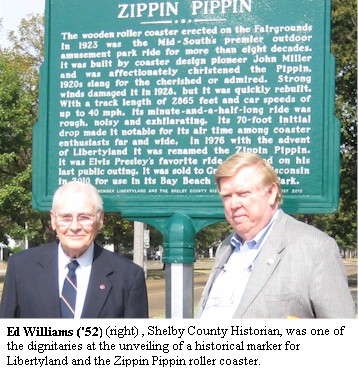
Alumnus notes history of the Fairgrounds at unveiling of historical marker
The East High Alumni Page
November 1, 2010
The Fairgounds, Libertyland, and the Zippin
Pippin roller coaster were remembered at a ceremony today unveiling a
historical marker near the former site of those attractions.
Ed Williams ('52), Shelby County
Historian, joined other dignitaries including the Memphis Mayor and
members of Remember Libertyland, formerly Save Libertyland, gathered to
at least preserve the memory of the decades of festival-like
attractions which once stood at what was then the Fairgrounds.
Mayor A C Wharton said great cities are not made
by what's going forward, but remembering what is in the past. He said
he preferred to see Libertyland not as something lost but as something
that was part of the transformation into something new at the site.
Williams briefly told those attending about the
history of the Fairgrounds and the Mid-South Fair, which he said were
part of a nearly 200 year history of amusement parks in Memphis.
Libertyland, the 1976 transformation of the
amusement park at the Fairgrounds, closed in 2005. The Pippin, which in
later years was known as the Zippin Pippin, was dismantled and parts
are now being reconstructed at a Green Bay, Wisconsin, amusement park.
The Mid-South Fair's lease was not renewed and it moved to Mississippi
after the 2008 festival.
You may read more about the Fairgrounds and Libertyland at the
Landmark and Legend web site.
Inspired Instruction
School signals new direction for practical education
by Susan Agee, Special to The Daily News
The Daily News
October 25, 2010
The New Consortium of Law and Business could be a sign of a new wave of education in Memphis.
The recently opened charter school takes its
students through a curriculum grounded in the realities of the world of
business and law. While its location – 110 N. Court St. in the
mixed-used CA2 building in Downtown's Court Square – is unusual, the
school's mission is deliberate in that it places students right in the
midst of the world they are learning about.
Each day starts with a classroom forum of
current events and relevant topics. Classes follow, either in pairs or
small groups. Business leaders and lawyers from the area visit
regularly to give students a "real world" perspective on their studies.
"One of our major units is about the judicial
process," said principal Elana Ragsdale. "We plan to have legal
professionals come in to discuss their role in the legal system so that
the students are exposed to the variety of options in the field as well
as obtain a realistic understanding and identification of the judiciary
process."
Students at the New Consortium of Law and
Business charter school hang out in a locker and cafeteria area inside
the school.
"The students were ecstatic about what they
saw: from the U.S. Supreme Court to the U.S. Capitol to the
Smithsonian," said Ragsdale. "It was a trip that I am certain they will
remember for the rest of their lives; they truly were inspired."
The school's founder,
Tommie Henderson ['91 and Faculty 1998-2003],
has done this before. He was a cofounder of the Memphis Academy of
Science and Engineering in 2003 and began a wave of charter school
startups. His interest in education was accidental; while waiting to
enter a masters program at the University of Tennessee, Henderson was
invited back to East High, his alma mater, to teach in the engineering
program that he had been a part of.
Henderson had since earned a degree in chemical
engineering at the Massachusetts Institute of Technology and hadn't
planned on teaching. East's principal
Milton Burchfield [Faculty 1997-2001] asked him to fill in while Burchfield searched for a full-time replacement.
"He never found a new engineering teacher," said
Henderson, laughing. "But he didn't have to, because once I got into
education, I was hooked."
While teaching at East, Henderson found the
motivation that propelled him toward the goal of starting a charter
school.
He coached five students through the process of
preparing for and taking an advanced placement physics test. They all
passed, the first African-American young men to do so in Tennessee.
Their success led to other students feeling they could do it too, and
Henderson had 20 who were willing to try. Then his program was cut.
"If you're in a traditional school system and
they are pulling back the great exploration for learning, there's got
to be a better way," said Henderson.
He went so far as to write a curriculum for the
school he wanted to start, even though he didn't know how he was going
to start it. Then he met a reporter who heard about Henderson's desire
to start a school and connected him with the Memphis Bioworks
Foundation. The organization wanted to sponsor such a school, so they
teamed with Henderson in founding MASE.
The Tennessee charter school admission
requirements state that applicants be those in a "high priority"
school, those who have received failing TCAP scores or those who
qualify for free or reduced price lunches. When asked how he could take
these students and turn them into students who excel, Henderson said
that they didn't teach the students a new way of studying.
"We taught them a new way of being," he said.
"For many of these students there was an acceptance of mediocrity; an
acceptance of their 'station in life.' We changed the entire mindset,
not just of how to study, but of wanting to study."
The plan is working at New Consortium.
"All of our goals and objectives are falling into
place," said Ragsdale. "The students are still very much intrigued by
their opportunities here. We expect much more success in the near
future."
Former executive overcame bad grades, dyslexia because he had something to prove
By James Dowd
Memphis Commercial Appeal
October 17, 2010
Trumpeting a message of triumph over adversity
and promoting family over finance, author Tommy Spaulding was in
Memphis recently as part of a 75-city book tour to discuss his New York
Times bestseller, "It's Not Just Who You Know."
Spaulding was keynote presenter at the second in a speakers series launched by
Kem Wilson Jr. ['64]
to inspire local business leaders to strengthen their personal and
professional lives.
Tommy Spaulding, best-selling author, entrepreneur and business coach,
enjoys a few laughs with Willie Baldwin (left) and Roy 'Soup' Campbell
during a recent speaker series.
More than 200 attended the invitation-only
event, which was held at the Holiday Inn at the University of Memphis.
Spaulding, who is dyslexic, rose to prominence
as a top sales exec for IBM and later as president of Up With People.
But after years of drawing an impressive salary and traveling the world
over, he left his high-powered executive lifestyle and founded a
nonprofit leadership organization dedicated to helping young people
reach their potential.
On his stopover in Memphis, Spaulding challenged
listeners to strive for success instead of succumbing to insecurity.
"I used to think dyslexia was a scar, but now I
see it as a gift because it caused me to overcompensate in other areas
to make people see that they were wrong about me," Spaulding said. "I
wasn't a good student, so I went out of my way to excel in other ways.
I didn't give up and I tried harder because I wanted to prove to the
world that I wasn't stupid."
For Spaulding, not giving up meant taking
classes every year during summer school to boost his grade-point
average, committing to marathon study sessions during college, and
maintaining a sense of optimism after applying to and being rejected by
more than three dozen law schools.
"He's a great example of the power of
determination and drive," said Wilson, executive vice president of
Kemmons Wilson Companies. "Everybody has a story and Tommy's is a
particularly inspiring one. By telling it, he's changing the world."
Persistence and a can-do attitude helped
Spaulding win a Rotary scholarship, he said, that paid for graduate
school and enabled him to earn an M.B.A. despite a less than stellar
academic career.
"I convinced the scholarship committee that I
could overcome bad grades and achieve something and I kept my word,"
Spaulding said. "I had to prove that I deserved the scholarship and
that they made the right choice."
Eventually Spaulding made good on his promise
and achieved considerable success as as corporate executive. But a
growing desire to create a more lasting impact in his community led him
to walk away from his career and use his own money to establish a
nonprofit organization to help others develop leadership skills.
"If I'm able to make a difference, I hope it's
by inspiring people to have the courage to love one another and build
relationships and strive for the best," Spaulding said. "The
opportunities are out there, it's just up to us to be tenacious about
pursuing them."
Spaulding's message is one that people of all
ages can learn from, said University of Memphis president Shirley
Raines.
"He worked hard in the face of academic
challenges and achieved substantial success, but there's more to it
than that," Raines said. "He also knew that his family loved and
supported him and that provided a solid foundation for what came later.
All of us should be positive influences like that on the lives of
others."
Life on Adams: George Griesbeck
George Griesbeck: Alum, Teacher, Friend
Purple & Gold, the official alumni magazine of Christian Brothers High School.
Fall, 2010
As a student,
George Griesbeck [Faculty 1964-1972]
made good grades. He came to CBC from Immaculate Conception Grade
School, operated by the Sisters of Mercy. He recalls fondly Sister
Martina, "who could run a school with a long handled bell and keep
things in order." The upper stories of the building had just become
Catholic High School, a co-ed high school that would later become an
all-boy school and move to McLean Street. The girls would remain at
Immaculate Conception under that name; today it is the last of the
parish high schools in the state.
[Read the entire article]
 [The East High Alumni Page
Editor's note: Mr. J.G. Griesbeck, principal of East High School
1964-1972, died shortly after the article was published in the Purple & Gold. An obituary is available.
[The East High Alumni Page
Editor's note: Mr. J.G. Griesbeck, principal of East High School
1964-1972, died shortly after the article was published in the Purple & Gold. An obituary is available.
Mr.
Griesbeck came to East as principal after East's first principal was
killed in a traffic crash in the summer of 1964. It is often said that
a person does not wish to follow a legend in a job, but that's the
situation in which Mr. Griesbeck found himself. J.P. Snider was highly
respected, his name spoken in revered tones in many homes of students
of his at East. Mr. Griesbeck continued the high academic and
citizenship standards at East.]
In brief: Top U.S. historian at MUS tonight
Memphis Commercial Appeal
October 11, 2010
Columbia University professor
Kenneth T. Jackson [associated with the Class of '57],
one of the nation's pre-eminent historians and an alumnus of Memphis
City Schools and the University of Memphis, will speak at 7 p.m. today
at the meeting of the West Tennessee Historical Society at Memphis
University School's Wunderlich Auditorium.
At Columbia, Jackson is the director of the
Herbert H. Lehman Center for the Study of American History and the
Jacques Barzun Professor of History and Social Sciences. Jackson's
seminal book, "Crabgrass Frontier: The Suburbanization of the United
States," is considered one of the most important works of history in
the latter decades of the 20th century.
Reprinted 29 times in paperback and five times
in hardcover, "Crabgrass Frontier" was the first full-scale history of
the development of American suburbia and has been described as an often
critical examination of "how 'the good life' in America came to be
equated with the a home of one's own surrounded by a grassy yard and
located far from the urban workplace."
Among Jackson's other major works are: "Robert
Moses and the Modern City: The Transformation of New York," "The
Dictionary of American Biography," "Scribner's Encyclopedia of American
Lives," "Silent Cities: the Evolution of the American Cemetery," "The
Ku Klux Klan in the City," "American Vistas," "Empire City: New York
Through the Centuries," and the "Encyclopedia of New York City"
(seventh edition due in 2010).
Documentary parallels issues at East High
By Amy Barnette
Memphis Commercial Appeal
October 11, 2010
When more than 100 Memphians gathered Sunday at
East High School to watch the Indie Memphis Freedom Series'
presentation of "Heart of Stone," a documentary that examines how a
principal and alumni of a troubled New Jersey high school sought to
improve life for its students, the parallels to local concerns were
clearly observed.
Eric Harris ['91 and Faculty], principal
(and alumnus) of East, said the film pointed out some of the issues he
faces in making sure teenagers, whose minds and viewpoints are still
being shaped, have positive role models in their lives.
"(It) really reminded me a lot of East High
School -- not totally, not even mostly, but the demographic shift that
occurred, the student body as a whole, some of the perceptions that
they had," he said.
But East's challenges are not as daunting as those portrayed in the documentary.
Though Weequahic High School in Newark, N.J., was
one of the nation's top schools through the 1950s, racial conflict and
economic downturn took their toll. When the school's primarily Jewish
alumni from its heyday decided to give back to their school, they
worked alongside principal Ron Stone to encourage students, setting up
scholarship funds and backing trips to Europe.
In Memphis, that partnership between alumni and
administration can be found in the Greater East High Foundation and its
offshoot, the dynamic, youth-led Peer Power program.
Hosted by Bridges and the Memphis Jewish
Federation, the community-minded event Sunday afternoon featured
small-group discussions after the film. Student tutors from Peer Power
guided the conversation to discover what participants thought could be
learned from Newark's example and how it might be applied to Memphis
schools.
Anna Ham, who teaches math at Craigmont High
School through the Teach for America program, said she thought that
Craigmont and East both dealt with the consequences of suburbanization,
just as Weequahic did.
"I've heard stories about how Craigmont was once
one of the best schools in the country, and everyone wanted to send
their kids there, as well as East, but I feel like with sprawl and
white flight, schools have gotten into disarray," she said.
Writer Michelle Malsbury said that community
involvement was what helped the New Jersey students, and that same
principle could be applied locally.
"They saw all their mentors, all their alum in
essence become their role models, and it helped them see that if they
just worked hard, they could also achieve the same things," she said.
The Freedom Series ties film to the community.
Each event is hosted by a different group and ends with an open
discussion.
Director Robin Salant said the series has been
extremely successful. Each community featured has asked to be involved
again next year, and other groups are clamoring to be included as well.
"We've made sure (the screenings) have been kept
free so we can have economic diversity," she said. "We want this to
inspire everyone."
Next up for the Freedom Series is "The Life
& Times of Rosie the Riveter," showing at the National Civil Rights
Museum at 6 p.m. Thursday. The film and discussion will focus on fair
wages for women in the workplace, Salant said.
Online maps show Memphis' makeup by ethnicity
Race still dividing line for city
By Richard Morgan
Memphis Commercial Appeal
October 10, 2010
The South is pretty big on euphemisms, bless its heart.
So maybe it was fitting that it took a computer
programmer in San Francisco to shake things up. Because when Memphians
talk about "tensions" or "divisions" or even "issues," we are often
really talking about race and, by extension, racism.
In September, Eric Fischer, 37, posted a series
of images to his Flickr account. Inspired by a racial mapping of
Chicago last year on a website, RadicalCartography.net, Fischer took
2000 Census data and color-coded dozens of U.S. cities by race of
residents. Blacks were blue, whites were red, Latinos were orange and
Asians were green. The images went viral online.
"I was shocked," Fischer said. "I thought things
were better than this. Whatever city, whatever part of the country,
there is still such division."
Chiefly a black-and-white split, the maps evoke
that stark, bitter presidential election in 2000 when "Red America" and
"Blue America" became household terms.
The map of Memphis shows a ring of whites -- in
Germantown, Bartlett, Collierville, Millington, Horn Lake --
surrounding a black city core. There are isles of whites both literal
(Mud Island) and metaphoric (Central Gardens, Cooper-Young, the Poplar
corridor). The two most-integrated neighborhoods are Raleigh-Frayser
and Hickory Hill.
There is almost no orange on the map.
A small but noticeable green blob, at the
so-called "Little Vietnam" area around Cleveland and Jefferson, is an
Asian oasis.
For Asians and Latinos, government surveys
routinely point to underreporting of population due to obstacles
including language barriers and immigration concerns.
"It's not surprising," said Mayor A C Wharton,
who is black and campaigned on a post-racial slogan of "One Memphis."
"But I'm not concerned with racial divisions. My job is to look at
quality of life, regardless of these splits."
That approach could sound like the "separate but
equal" doctrine of Jim Crow, but Wharton, who lives in the center of
the city, at Carnes and East Parkway South in an area he calls "West
Orange Mound," quickly clarified:
"Separate is inherently unequal. To the degree
that we have division because of poverty or outright racism, it saddens
me. We have to work on that.
"But if these are divisions of choice, we have to accept that. You can't mandate polka dots."
"We tried that and it made things worse," said
Ed Williams ['52],
Shelby County historian. "Before 1960, Memphis City Schools were
superior to Shelby County schools," he said, "but then (desegregation)
busing ruined that."
U.S. Rep. Steve Cohen, D-Tenn., is the only
white member of the U.S. House of Representatives to represent a
majority-minority district. Cohen grew up in 1950s Memphis, left in
1961 and returned in 1967 to an apartment building on Walnut Grove
with, he recalled, only one black family.
Looking at the race-data map, he called Uptown
"promising" and Mud Island "integrated," adding that there are now
"respectable specks of blue" on Walnut Grove.
"There's progress and lack of progress," he
said, saying concerts and schools and restaurants in Memphis are still
sometimes effectively all-white or all-black, and repeating the common
quip that noon on Sunday is the most segregated moment of the week.
"There are a lot of bad memories. And it'll take time to erase them
from our collective consciousness. They don't facilitate progress, but
they should breed understanding."
Former Memphis NAACP executive secretary Maxine
Smith, who was turned away from the old Memphis State University
because of her race in 1957, this year received an honorary doctorate
of letters from what is now the University of Memphis.
"Desegregation doesn't make us love each other,
but it brings us closer so that we can understand each other," she
said. "You can't understand someone you never see. Our goal is not for
everyone to have a black neighbor and a white neighbor, but just equal
opportunity, equal access."
She laughed. "Used to be, our barriers were
legal. We took care of those. Now there are these more pernicious
economic barriers. We'll get them with enough time and hard work."
Bill Patton, author of "A Guide to Historic
Downtown Memphis," moved here from Washington in 2006 and runs Backbeat
Tours, which focus on Memphis music.
"It's the locals, the folks from East Memphis
who never come Downtown, who get blown away by our tours," he said.
"I personally don't like thinking of white
history or black history. The story of Memphis is a shared history,"
Patton said.
"There's so much for everyone here: food, music.
It's not like the Otis Redding folks hate Johnny Cash or Elvis. Or vice
versa. Memphians all secretly love Memphis. But Memphians are in many
ways their own worst enemies."
Racial tension is nothing new to Memphis, home
of the National Civil Rights Museum. The discussion has timeless
sentiments, such as the one quoted by Martin Luther King Jr. in a 1959
speech he gave in Hawaii, two years before President Barack Obama was
born there: "Lord, we ain't what we want to be. We ain't what we ought
to be. We ain't what we gonna be. But thank God we ain't what we was."
A Tale of Sorts
After 32 years, library volunteer still reading, sorting, and selling.
by Halley Johnson
The Memphis Flyer
October 7, 2010
When
Sherman Dixon ['60] was in college, there was a moment when he thought he might like to be a writer.
"I mentioned it to a teacher of mine who had read some of my themes,
and she said, 'You know, Sherman, some people are born to be writers
and some are born to be readers.'" Remembering this, Dixon laughs.
"Point well taken."
Indeed. Dixon has been an avid Friends of the Library volunteer for 32
years, sorting — and reading — the library's donated books.
A graduate of East High and the University of
Memphis, Dixon is a retired postmaster who began his career as a buyer
for Sears. But it wasn't until his late 30s when he stumbled across his
first Friends book sale that he found a passion for volunteering.
"I used to haunt bookstores," he says. "I just like looking at old, used books."
There's a lot of looking involved. In the
Benjamin Hooks Central Library basement where donated books are housed,
there are more than 60,000 volumes at any given time. The rest are in
the library's bookstore, Second Editions, or waiting to be priced and
posted on Amazon.com.
Dixon is part of a team of dedicated volunteers
who each manage a different part of the process, though all do quite a
bit of sorting. The volunteers — among them, retired teachers, a
retired doctor, a zoo employee, and another retired postmaster — have
widespread interests. Dixon's English degree means that he oversees the
sorting of the literature books, as well as presiding over the art and
religion sections.
"We're such a small group, but we have every section covered," Dixon says.
When Dixon started volunteering, the library
occupied the corner of Peabody and McLean, and the Friends averaged
$12,000 from two annual booksales. Now, in the massive Poplar Avenue
building, they've expanded to three annual sales and year-round book
sales through Second Editions and Amazon — bringing in at least
$185,000 this year.
Many books sell for less than a dollar in the
sales or in the bookstore, though rare books bring much better returns
on the Amazon site. The most valuable books, Dixon says, are the ones
that go straight into the library.
"We call those 'cost avoidance' donations," he
says, noting that saving the library money on buying books is as good
as bringing in extra revenue. The Friends do their fair share of
donating as well, letting nonprofits peruse the leftover books from the
annual sales, taking whatever they can use.
"I've probably touched a million books in the
last 30 years," Dixon says, "but I still get excited when I find
something valuable."
Visit the Friends of the Library's Amazon site at www.amazon.com/shops/memfolbooks1
Cruisin': Electric bicycle combines aerobic exercise, transportation
By Wayne Risher
Memphis Commercial Appeal
October 6, 2010
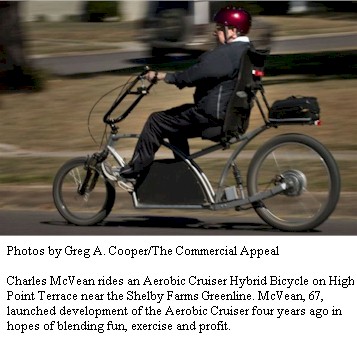
The leader of the pack is a 67-year-old millionaire who wears a warm-up suit and a smile as broad as a kid with a new toy.
Charles McVean ['61] gestures toward a fleet of funny-looking electric bicycles parked nearby and tells his entourage "OK everybody. Let's cruise."
And away goes The Mild Bunch, nine laid-back
riders gliding silently down High Point Terrace to East Memphis' new
railbed-turned-trail, the Shelby Farms Greenline.
At the head of the column rides McVean,
financial whiz and principal in Aerobic Cruiser Hybrid Cycle LLC, a
maker of plug-in electric moped bicycles.
The founder and president of McVean Trading and
Investments LLC launched development of the Aerobic Cruiser four years
ago in hopes of blending fun, exercise and profit.
To hear him tell it, the long, low-slung bicycle
with a battery-powered motor between the driver's legs is a cure to
what ails Memphis and America.
He believes it can help fight climate change,
the obesity epidemic, the foreign trade deficit and a diminished
manufacturing base.
McVean's company is assembling the Aerobic Cruiser in Memphis, albeit from mostly foreign-made parts.
"One of our objectives is to be a microcosm of
the rebirth of manufacturing in the United States of America," he said.
It's developing a bicycle lifestyle center a few
blocks north of the Greenline, in the neighborhood shopping strip where
McVean rode his bike as a kid.
Cruiser's Lifestyle Center, 485 High Point
Terrace at Philwood, will contain a bicycle service center, Cruiser
showroom, convenience store, restaurant and public restrooms. First
will come restrooms, opening in November, to provide pit stops for
Greenline users.
Thinking big is old hat for McVean. In the 1980s
he dropped millions on a proposal for indoor racing featuring hackney
ponies ridden by robot jockeys. Six years ago he started the Peer Power
Foundation at his alma mater, East High School. It cultivates high
achievers to boost performance of their lagging peers.
McVean said he's invested "several million
dollars" so far to create his own spin on the electric bicycle, a
low-impact conveyance that sells tens of millions of units a year
worldwide, primarily in Asia and Europe. His design combines pedal
power with electric power so riders can go faster or further, climb
hills or take a breather without stopping.
"It has not caught on yet in the USA because
nobody has built the right machine," McVean said. "I think this is it."
"It's fun. It's exercise. But most of all, it's serious transportation," he added.
McVean has 12 to 15 people carrying out his
vision, which sees Aerobic Cruisers dovetailing with efforts to make
Memphis a bicycle haven.
McVean said the ultimate would be a bicycle lane
atop the Mississippi River levee from Walls, Miss., to Vicksburg, with
a high-speed ferry filling the gap between Walls and Downtown.
Employed by his venture are bicycle mechanics, competitive cyclists and business, retail and restaurant types.
McVean punctuated their cruise from High Point to
the Shelby Farms visitor center with comments on marketing, economics
and recent articles about the electric vehicle market.
"The Cruiser is a very unique project that's
exciting to be a part of," said Jeremy Reese, who started working for
McVean four years ago.
The Aerobic Cruiser is pricey: $5,000 for a
deluxe model with well-padded semi-recumbent seat and shock-absorbing
frame. The top-of-the-line can go 75 to 100 miles on a charge.
McVean's company has built 20 prototypes, outfitted with high-efficiency lithium iron phosphate batteries.
A lower-line model, the Commuter, will sell for less than $2,000. A three-wheeler also will be offered.
Kyle Wagenschutz, bike and pedestrian coordinator
for city and county governments, said the Cruiser suits people who want
both exercise and transportation out of a bike, but maybe need help
covering longer distances.
McVean's plan for the High Point Terrace center
is an example of economic activity spurred by the new Greenline,
Wagenschutz said.
The trail's opening has been eagerly anticipated
by the bicycling public, said Daniel Duckworth, general manager of
Midtown Bikes on South Main.
"September was my best month all year,"
Duckworth said. "In my conversations with customers, it's obvious,
whether they're buying new or dragging in something old to refurbish,
generally most people have a high interest in utilizing that great
asset we now possess."
As for the Aerobic Cruiser, Duckworth said, "The only segment that product will reach is well-to-do boomers."
Duckworth said purists, which covers most bike
shop owners , "tend to have a general disdain for the electric bicycle.
I embrace it."
He sells a plug-in electric unit for about
$1,500 and can put an electric motor on a conventional bike for about
$1,000. "Once people hear that price, they shy away."
McVean said he regrets initial prices are so
high, due to the cost of batteries and components, but he expects costs
to drop as production ramps up. "I hate telling the postman I don't
have anything for him," he said.
He plans to target upscale retirement
communities such as Johns Island, Fla., and Bay Harbor, Mich. It was on
an annual visit to Bay Harbor that he got the idea for the cruiser,
after seeing a man drive a plug-in electric car to and from a fitness
center workout.
McVean views Memphis as a test market. "We're
going to come in here and see if the concept has traction. If it does,
we're going national fast."
The Commercial Appeal also has a video interview with Chas McVean which was still available at last check. See the video: Aerobic Cruiser.
Letter: Fire crew shows government works
Letter to the Editor
Memphis Commercial Appeal
October 5, 2010
Just as I, a 94-year-old retiree from the faculty
of East High School, was about to reluctantly buy into the current
disillusionment with the operation of our city and its services, I have
had an experience which has restored my confidence in our city
government. My frenzied call to 911 last week promptly brought a fire
engine and crew from Station 13 to my home. Three young firemen, led by
fireman Mike McGee, not only quickly located and removed the cause of
alarm, but did so with remarkable efficiency, while at the same time
calming me with their reassuring words. Their concern for my welfare
and peace of mind was touching and greatly appreciated.
Congratulations to our Fire Director Alvin
Benson on the hiring and training of such an exemplary crew of city
employees.
Frances F. Marks [Faculty 1963-1973]
Charter school operators want fairer funding, board independent of Memphis City Schools
By Jane Roberts
Memphis Commercial Appeal
October 3, 2010
Steve Bares minces no words when it comes to what
it's like to run a charter school under Memphis City Schools.
He says MCS officials withhold money, obfuscate
on issues and so effectively control who gets approved -- and who
doesn't -- that charter operators are effectively silenced.
"When charter school principals got together and
realized our kids were getting deep-fat-fried funnel cakes and sugar
for breakfast," Bares said, "no one said anything.
"To be blunt, we are in a very awkward position. If you argue, you get threatened."
As chairman of the Tennessee Charter Schools
Association, he's pushing for creation of an independent board to
oversee the state's charter schools, including how they are approved
and funded.
Of the 40 states with charter laws, 21 have some
kind of statewide authorizing body. In most cases, it is the state
board of education.
Bares' biggest beef is that MCS does not fairly fund charter schools.
The city of Memphis has 22 charter schools,
including seven that are new this fall. Together, they educate more
than 5,000 children, or about 5 percent of the city schools' student
population.
The charter schools got none of the $90 million
grant awarded to Memphis City Schools last November by the Bill &
Melinda Gates Foundation.
They saw little, if any, of the $57 million --
about $670 per Title I student -- that MCS received in federal Race to
the Top dollars this summer.
The district has not decided whether it will
share the roughly $200 per student it received this fall in a $23
million stimulus project to save teacher jobs.
"Here's Congress saying this is additional
support for public schools nationwide. But if you are going to a
charter school, you don't count," said Matt Throckmorton, executive
director of the state charter association.
MCS has heard the argument many times. It says
it allocates funds and services based on the same formula used for its
schools.
Tennessee law says local school districts must
pass 100 percent of the state and local per-pupil funding on to the
charters.
The law is murkier on the allocation of federal money.
Last year, the district received $10,394 for every child in Memphis City Schools.
It passed $7,630, or 73.4 percent, to the
charters, excluding money for capital projects, as defined in state
code.
Metro Nashville Public Schools received $10,495 per student and passed $8,090, or 77 percent, to the charters.
The difference fuels the argument that MCS
withholds too much money on one hand and charges the charters for
services the federal government pays the school district to provide,
including lunches, bus transportation and special education services.
Memphis Academy of Science and Engineering, the
largest charter in Memphis, stopped buying school lunches from MCS this
fall, saying it could provide better-quality food on its own and shave
$100,000 a year off expenses.
Bares, who is chairman of the board of directors
at Memphis Academy of Science and Engineering, says MCS pockets the
profit and keeps "a separate P & L" (profit and loss statement)
charters are not allowed to see.
Not every charter operator is as vocal, but when
pressed, most say they wish MCS distributed funds, particularly federal
dollars, more evenly and that they had a voice in how funding decisions
are made.
For instance, charter leaders whose schools
received computers and professional development training this summer
through funding from MCS said they didn't realize it was a trade-off
for thousands in stimulus dollars.
"We essentially have two professional development programs going on, funded by two different sources," said
Tommie Henderson ['91 and Faculty 1998-2003], head of New Consortium of Law and Business charter school.
"But we've found ways to make it work," he said, adding that MCS is "transparent and open" about funding.
"It definitely means we understand why they are
spending the way they are, but does it mean we are always happy? No."
Rev. Anthony Anderson, who runs Memphis Business
Academy in a converted Kmart in Frayser, says funding is a loaded
issue.
"I was disappointed that there weren't as much
stimulus funds passed down for facilities, especially," he said.
Memphis Business Academy, with one of the lowest
per-pupil costs in the city, bought the vacant store in foreclosure for
$986,000 last year.
It borrowed $1.9 million and invested $400,000 of its own money to cover renovations.
If it were a traditional MCS school with 250
students, it would receive roughly $691,000 a year for capital
expenses.
Instead, charter schools get $600,000 in start-up funds over the first three years to cover facility costs.
"Most will go to curriculum, textbooks and desks," said Throckmorton.
"Some of that money -- $20,000 to $30,000 -- may
be used to cover remodeling. There are so many other expenses in
opening up a school."
Anderson says it's not enough to cover school
buses, lunches and capital costs, "but it's legal. It's a state and
legislative issue."
Bares says the community, and specifically Supt.
Kriner Cash, should do more than cling to the law when the issue is a
matter of integrity.
"These are all public school kids. Where is the
leadership? This is an opportunity to say are we going to be an
organization that is in for reform or not? Are we leading by integrity
or not?"
State Rep. Harry Brooks, R-Knoxville, chairman
of the House Education Committee, says the funding argument comes up
"in spurts" when charters are struggling with cash-flow problems.
"I think there is need for clarification on the
funding language," he said, adding that even legislators tend to see
charters as separate from public schools.
"What has to come across is these are not private institutions."
Greg Richmond, chief executive of the National
Alliance of Charter School Authorizers, says it's easy for charters and
school districts to come to blows when they compete for the same
students and dollars.
When the school districts are also in charge of
overseeing the charters they approve, the water can get even bloodier.
"School districts exist to directly run schools;
most are not structured to oversee autonomous schools they don't run,"
Richmond said.
"Many superintendents would rather focus on
running their own schools; that's why statewide authorities can make
some sense."
The issue cooled this summer when charter
operators say Cash struck a conciliatory tone by delaying a plan to
withhold 3 percent of the charters' funding as an administrative fee,
saying he wanted to hear from them first and was open to compromise.
"I want to forge a different conversation here
in Memphis with the charters," Cash said last week. "I want us to be
more we, not us versus they .... and I am going to take leadership in
that regard. We will continue to find good common ground so that all
children in Memphis can have good schools."
The goodwill evaporated when the district told
Throckmorton that unless the service fee is agreed on, MCS could no
longer afford to pay charters in 10 equal installments, and instead
would pass the money on as it is received.
The district says it has discussed the
possibility with the charters since the City Council withheld funding
from MCS in 2008.
"The reason for the conversations was due to
cash-flow implications to the district," said Pam Anstey, MCS chief
financial officer.
"MCS could be forced to have these conversations again."
If the change happened now, charter schools say
they would receive less than half of what they are expecting between
now and late winter.
"It would bleed our charter schools dry," Throckmorton said.
He's wants an independent board for other
reasons, including that it would make charters possible in cities where
they are now politically unpalatable, including Knoxville.
"Three out of four charter applications are
rejected in Tennessee now. And in some places, it's four out of four,"
he said.
A statewide authorizer gives the power to start charters to a group beyond the local school board.
"We think school districts should have the power
to authorize, but then there should be another authorizer in the
state," said Richmond, so charter operators have another option if
their application is rejected by the school board.
Over six years, a handful of states have created
statewide independent authorizers, including Colorado, South Carolina,
Georgia, Florida and Idaho.
"It's definitely a discussion that is happening in more state legislatures now," Richmond said.
Cary Booker, co-founder of Omni Schools, says he "would be inclined to take a very close look and consider it.
"I'd want to lay the plans next to each other and compare them."
But Anderson would rather be aligned with MCS,
saying he's not sure a new organization would commit to serving the
neediest students, as Tennessee law now dictates.
He's also not sure another group could pay
retirement benefits to teachers and staff and provide the service he
gets from MCS.
"I'm fortunate that I can get $4 million to run
our school, and for the most part, break it down the way I want. That's
the most benefit to our kids."
TV Program: Ophra
September 30, 2010
Cybill Shepherd ('68) appeared on the Sept. 30 Oprah Winfrey
show along with several other beautiful models and movie stars
discussing how they dealt with their beauty as young women and how
they've handled aging.

Memphis Memories
By Staff,
The Commercial Appeal
September 18, 2010
[The following was republished on September 18, 2010, in the Memphis/Mid-South Memories item in
The Commercial Appeal, originally published September, 1951.]
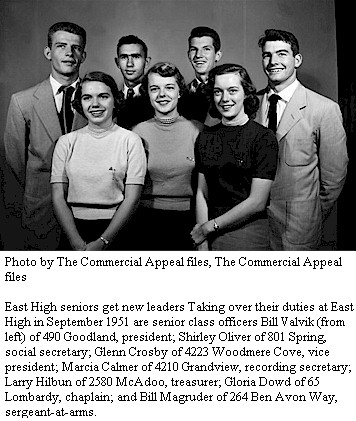
Yellow fever left mark on Memphis; historians disagree on impact
Yellow fever left mark on Memphis; historians disagree on impact
By Michael Lollar
Memphis Commercial Appeal
Posted September 11, 2010
It began in the filthiest part of the filthiest
city in America and turned into a plague of Biblical proportions.
"You can't take the kind of hit Memphis took and
believe that it didn't matter," says historian Dr. John Harkins,
referring to the 1878 yellow fever epidemic.
Harkins, who taught at the University of Memphis
and Memphis University School, encounters a chorus of dissenting
historians when he argues the city might have become "the premier city
of the South" if not for the 1878 epidemic.
It killed then faded away with the first frost
of 1878. People had no idea what caused it, but it took more lives than
the Chicago fire, the San Francisco earthquake and the Johnstown flood
combined, says author Molly Caldwell Crosby, who wrote "The American
Plague" with Memphis as the focus of the country's search for the cause
of plagues like those that came to Memphis seven times between 1828 and
1878. It would be 22 years after the 1878 epidemic before the cause was
traced to a virus transmitted by mosquitoes.
This weekend, dubbed Martyrs Weekend, recognizes
victims of that deadliest outbreak in 1878 and the people who came to
their aid, often dying in the process. Twelve Catholic nuns, 9 priests,
4 Episcopalian nuns and 10 Protestant ministers died. Survivors had to
face the city's bankruptcy, the loss of its charter and an image that
Harkins says steered immigrants away from Memphis for years.
Many of the immigrants who had helped the city
to grow are in what Elmwood Cemetery's assistant director Jody Schmidt
calls a "trench grave," holding 1,500 caskets placed side by side and
end to end. Another 1,000 marked graves are scattered through the
cemetery. They made up less than half the city's victims. The
population had been roughly 50,000 before about 30,000 fled at the
start of the epidemic on Aug. 5, 1878. Of the 19,000 who stayed in
Memphis, 17,000 came down with yellow fever, and 5,150 died.
Memphis had been a magnet for German and Irish
settlers looking for jobs along the heavily traveled river. "I think
there's a chance Memphis might have rivaled Atlanta if it had continued
to attract a cosmopolitan mix of people. Memphis became more
provincial," says Harkins.
What visitors found at the start of 1878 was a
city growing in spite of itself. There was no city sewer system. Water
was collected in cisterns, and maimed animals were left rotting in
Downtown streets made of ill-advised cypress paving blocks that rotted
and caved in, creating chasms that broke the legs of horses and mules.
It was as if the Medieval Era had been dropped
onto the Mississippi River bluffs. People were proud of their
sweet-smelling magnolias and roses, but the city was also a
pestilence-ridden rathole. It stunk so bad people knew they were
nearing the city when they came within five miles of it. "Cologne, that
European city of a thousand disgusting smells, backs down before
Memphis," wrote a visitor from North Carolina in 1867.
Memphis was designated the nation's most
unhealthy city with the U.S. surgeon general referring to sanitary
conditions here as "shameful and a disgrace."
Shelby County historian
Ed Williams ['52]agrees
with Harkins up to a point about those who fled. "The German element of
the population prior to the epidemic was substantial and included a lot
of merchants and business people who were middle- and
upper-middle-class." Many of them fled to St. Louis and Cincinnati, he
says.
But Williams also agrees with University of
Memphis Bureau of Business and Economic Research director John Gnuschke
that the effect of any wholesale migration in 1878 would "largely have
dissipated" over a few decades.
If the epidemic forever scarred Memphis,
Gnuschke says, historians would have to explain why the Chicago fire or
the San Francisco earthquake didn't forever hamper the growth of those
cities.
Memphis began to recover quickly after 1878. Its
artesian water supply was discovered and turned into one of the purest
water supplies in the nation in the 1880s. Its charter was restored.
Its sanitation and sewer systems became models for other cities.
Between 1900 and 1950, Memphis almost quadrupled from 102,350 to
396,000 residents.
Historian Dr. Robert Sigafoos, retired from the
University of Memphis, says many of those who left the city returned
soon after 1878.
But a major difference in Memphis and other
cities in the South, he says, is that "Memphis has always had an
underclass of rather sizable proportions." Its burgeoning population in
the early 1900s was primarily from surrounding rural areas. Many had
been sharecroppers. While Memphis focused on cotton, St. Louis focused
on manufacturing and Atlanta got a head start on Memphis as a rail hub.
It's largely a speculative issue from a
historical standpoint, Harkins agrees. But for those who argue the
city's 1878 descent was an aberration and that Memphis returned to an
unaltered course, he says, "I tend to disagree."
Area executives are urged to follow a 'family first' business plan
By James Dowd
Memphis Commercial Appeal
September 10, 2010
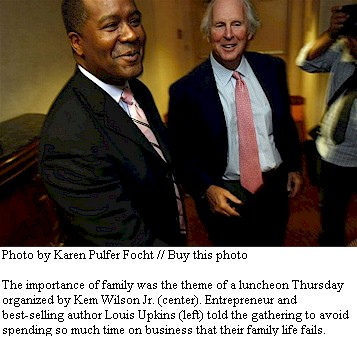
Joking that he was in the presence of "every outlaw in Memphis,"
Kem Wilson Jr. ['64]
on Thursday joined about 150 relatives, friends and business executives
to celebrate what he considers the most important thing in the world.
Family.
Wilson, executive vice president of Kemmons
Wilson Companies, hosted a luncheon at the Holiday Inn at the
University of Memphis featuring Louis Upkins Jr., author of "Treat Me
Like A Customer: Using Lessons from Work to Succeed in Life.
The invitation-only event was designed to
inspire area leaders to focus as much attention on their home lives as
on their corporate careers, Wilson said.
"Everyone at this event knows what it takes to
be successful in the business world, but sometimes we need to be
reminded to take that acumen and use it to enrich our families," Wilson
said. "Family is the most important legacy."
Through personal anecdotes and observations,
Upkins advised business executives how to use professional expertise to
succeed in personal relationships.
Of primary importance, he said, is respecting loved ones as much as clients.
"All of us understand what it means to value,
respect and even lose a customer, whether you're working at Mapco or
running the White House," Upkins said. "The tragedy occurs when you
spend so much time on your business that your family life fails. You
can build a political career, fail and start over, or build a business,
fail and start over, but you can't always start over if you fail with
your family."
Upkins practices what he preaches, devoting most of his time these days to spreading the family-first message.
After publishing his book earlier this year,
Upkins stepped back from his global branding agency -- which has
included such clients as Bono, Whitney Houston and Oprah Winfrey -- to
addressing business audiences and faith communities.
Among his suggestions for building stronger
familial relationships: Turn off mobile devices when spending time with
loved ones, take note of what they are saying and respond.
In other words, treat family members like A-list clients.
"When you're with your family, really be with
them. Remember that it's OK to let your phone go to voice mail
sometimes," he said.
"As a community, the fabric of family is the most important, and to wear it loosely is a dishonor."
Duncan Williams, president of local investment
banking firm Duncan-Williams, plans to take the advice to heart and
hopes others do, too.
"I've got three young children and I'm trying to
aggressively grow my company, and I appreciate hearing such a
successful executive encourage us to make family a priority," Williams
said. "It helps us redefine what constitutes success."
Family of Kemmons Wilson marks 50 years of philanthropy in city he loved
By James Dowd
Memphis Commercial Appeal
August 31, 2010

A
half-century ago, Memphian Kemmons Wilson's Holiday Inn enterprise was
flourishing with an average of one new property opening every week.
Leveraging the company's national success to
benefit his local community, the entrepreneur -- along with his wife,
Dorothy, and his mother, Ruby -- created a philanthropic arm of the
business solely dedicated to charitable giving.
In the decades since, the Kemmons Wilson Family
Foundation has awarded about $20 million to more than 450 organizations
in the Greater Memphis community.
Today, on the foundation's golden anniversary,
family members are excited about continuing that tradition for the next
50 years and beyond.
"Everything we do continues the legacy of giving established by our parents," said
Spence Wilson ['60],
president of Kemmons Wilson Companies and a member of the foundation's
board of trustees. "That tradition connects us as a family and in
broader sense it connects us to this community that we all love."
The foundation awards grants to a variety of
institutions, said Lauren Young, the organizations's executive
director. The five grant categories are: Advancement of Education;
Community Outreach; Enrichment of Youth; Faith-Based Ministries; and
Health and Research.
Recipients have included the Memphis Pink Palace
Museum, the Memphis Zoo, the Salvation Army, Streets Ministries and
Youth Villages.
"Kemmons and Dorothy were active and faithful
members of this congregation and the family has been extravagantly
generous to worthy causes in Memphis," said Dr. Maxie Dunnam, interim
senior pastor at Christ United Methodist Church. "They're involved in
so many areas."
In addition to its financial contributions, the
family-run foundation sponsors regular meetings for staffers to assess
pressing needs of the community and offers employees paid time off to
volunteer at nonprofit organizations.
Jim Boyd, president of Bridges, praised the foundation's focus.
"They're constantly looking for ways to build up
this community and they've been generous supporters of Bridges," Boyd
said. "The family's heart is evident throughout the foundation, not
just in their financial contributions, but also in their commitment to
creating a better environment for all Memphians."
And that's an integral part of the foundation's mission, said
Bob Wilson ['62], executive vice president Kemmons Wilson Companies and a member of the board of trustees.
"Dollars are important, but money isn't
everything. We also strive to be actively engaged in and positively
affect our community," he said. "Our parents encouraged us to give of
ourselves and we continue that tradition today."
Kem Wilson Jr. ['64], executive vice president of Kemmons Wilson Companies and a member of the board of trustees, agreed.
"I learned a long time ago that you can't just
write a check and expect things to improve. It works better if you get
involved and work for positive change," he said. "Because of our
parents we've been very fortunate and our family is committed to
helping others succeed, too."
Kemmons Wilson Family Foundation
Established: Aug. 31, 1960, as the Kemmons, Ruby
and Dorothy Wilson Foundation; renamed the Kemmons Wilson Family
Foundation in 2003
Board of trustees:
Betty [Wilson '66] Moore,
Carole [Wilson '67] West,
Bob Wilson ['62],
Kem Wilson Jr.['64],
Spence Wilson ['60]
Impact: Donations and grants of about $20 million to more than 450 organizations
Online: kwilson.com/wilsonfoundation.php
Business leaders discuss local role in future of the Memphis Redbirds
By Marlon W. Morgan
Memphis Commercial Appeal
August 31, 2010
Spence Wilson Sr. ['60], president of
Memphis-based Kemmons Wilson Inc., said he would ideally love to see
the Memphis Redbirds sold to a group of local investors.
That's why about 10 local businessmen, including
Wilson, have been gathering facts about what it might take to purchase
the team from the Memphis Redbirds Foundation, which owns the Redbirds
and AutoZone Park.
But Wilson is quick to point out that Kemmons Wilson Inc. is not leading any such pursuit of the team.
"We happened to have a meeting in our office and
we're just kind of learning and trying to figure out what's really
taking place and what the opportunities might be," Wilson said.
"Obviously, we, like all Memphians, would love to see some stability
take place with the team and the stadium. If there's something we can
do to help in that regard that makes sense, we'll probably hold our
hand up and be willing to participate. We're not going to lead any
effort. We'll be a small player."
Wilson said there is also an outside party that
has talked with the group of Memphians, whom he declined to identify.
They are currently in a fact-finding mode.
John Pontius, treasurer of the Redbirds
Foundation, said he was aware of such talks, but confirmed that the
foundation has not been approached with any bids.
"I had a conversation with Spence about (the
meeting)," Pontius said. "I asked him if I could answer any questions
for him and he didn't (respond). That's really all I know. To my
knowledge, none of the groups are advanced enough to make a bid."
The Redbirds have had about a half-dozen groups
express interest in buying the team over the last two years, Pontius
said, including the St. Louis Cardinals, who began talks in 2008 but
withdrew when the economy entered a recession.
No one has come close to making a bid on the
team. But when that time comes, Pontius believes one or more local
groups will likely be part of the deal.
"I would think most anybody who would buy a
minor league baseball team would want some local representation,"
Pontius said. "Minor league baseball is a very local activity. It's
very much part of the local fabric. Most everybody wants somebody that
lives here as part of their group.
"There's no question I'd love to have local
ownership. The Redbirds have approached professional sports unlike any
other. It's very much a civic endeavor. Having a local partner who
understands the value of that is very important."
Since defaulting on a $1.625 million bond
payment in March 2009, the foundation has entered into an agreement
with its bondholders this year that will allow it to make bond payments
of just over $1million this year.
That has allowed the club to not only remain
current with this year's bills but also to pay off some of its previous
debt in hopes of making the club more attractive to suitors.
Earlier this summer, Pontius predicted the club
will owe about $2 million, mostly to its top 10 vendors, down from $2.5
million a year ago.
Two Memphis City Schools principals indicted, accused of not reporting assault
By Jane Roberts
Memphis Commercial Appeal
Posted August 20, 2010
The
East High principal who was suspended with pay last spring after nearly
600 laptops went missing is now assistant principal at Cypress Middle
School.
Fred Curry [Faculty 2005-2010] was
suspended after an internal audit showed the laptops were missing,
hundreds of dollars could not be accounted for in a school candy sale
and a teacher expense account was overdrawn by $1,225.
District spokeswoman Staci Franklin said she
could not comment on personnel issues. In an e-mail about the missing
money, she said, "I'm familiar with the computer situation but not any
missing money."
The audit was released to the public June 22 through Franklin's office.
In Curry's comments in the audit, he said one student was charged for stealing 200 computers April 22.
Franklin did not know if any additional students
had been charged. She said it was her understanding "that those
students who were responsible are going through their due process in
the legal system."
She referred to the statement Supt. Kriner Cash made when the audit was released.
Cash listed a series of changes he was making at
East, including removing Curry and making security and safety
assessments.
"It is important that parents and community
members know that the well-being, academic achievement and safety of
our students are always priority one, and I will continue to hold all
staff to the highest standard in educating our students."
When he announced new principals in June, Cash
said Curry "was not on my radar. I don't know where he is; he's not on
my screen."
Curry had been principal at East since 2005, the school's fourth principal in five years.
Tuesday, several parents and school volunteers
supported his work. "A huge ovation at graduation occurred when one of
the students quoted Mr. Curry's motto, 'Failure is not an option,' "
parent Jill Piper wrote in an e-mail. "Because our son had such a
positive experience at East High, we were distressed that MCS chose to
put (Curry) on administrative leave," she said.
"If a bunch of knuckleheads decide to ditch out
one of East High's 28 doors with a cartload of laptops, that is not
Fred Curry's fault."
Eric Harris, former assistant principal at White Station High, was moved to the East High principal's job.
On Friday, Harris was indicted by a Shelby County
grand jury for failing to report a student assault last fall at White
Station.
"Mr. Harris is an alumni of East and he
certainly has shown that he was the right selection," said Bill
Sehnert, director of Peer Power, the tutoring program businessman
Charles McVean started six years ago at East.
"Being a principal is like being a pitcher. I
may strike out the first batter, but I need to get 26 more outs. And I
need my team to support me with some hits and runs," Sehnert said.
Two Memphis City Schools principals indicted, accused of not reporting assault
By Jane Roberts
Memphis Commercial Appeal
Posted August 20, 2010
Two city schools principals were indicted Friday
by a Shelby County grand jury for failing to report a student assault
last fall at White Station High School.
David Mansfield, White Station principal, and
Eric Harris [Faculty],
now principal at East High, failed to report an incident that allegedly
left a 17-year-old student bleeding on the floor after being beaten by
several students, according to an affidavit.
Harris was an assistant principal at White Station when the incident occurred last September.
"I would like to make it clear that both
principals have my full support, and they will remain in their
respective positions as they go through their due process," Memphis
City Schools Supt. Kriner Cash said in a statement.
"These administrators deserve the opportunity to
have this matter heard in court, and I ask that the community reserve
judgment until that process has been completed."
The mood at White Station Friday was somber as
word traveled among pockets of angry students and parents who believe
the two are being made an example due to White Station's high
visibility.
"Mr. Mansfield and Mr. Harris are men of
extraordinary character and deeply committed to the education of their
students," said parent Susan Edleman.
The crime is a Class A misdemeanor. If convicted, Mansfield and Harris face a maximum fine of $2,500.
Last fall, the girl's mother told police her
daughter had been beaten and kicked by a male and four female students
inside the school shortly after the day was over.
The mother said the girl's knees were scraped
and bruised from being dragged and that she had contusions on her chest
and back from being kicked.
One of the students was charged and found not guilty in Juvenile Court.
"There are two reasons for this," said Atty. Gen.
Bill Gibbons. "There was contradictory testimony as to who was the
primary aggressor in the fight." Some evidence suggested the victim was
the aggressor, he said.
"Two, because of the failure to report, there
was no crime scene evidence. This incident occurred on a Friday. The
Police Department was not able to conduct their investigation until the
next Monday. By that time any blood or other evidence had been cleaned
up."
Gibbons said the not-guilty verdict in Juvenile Court had no bearing on the case involving the principals.
"Which of the students was primarily responsible
for the altercation and whether or not they should have been charged
has absolutely nothing to do with the responsibility for the school
officials for properly reporting this."
The girl's parents reported the incident to police Friday night.
School footage of White Station's homecoming game
that night shows her in uniform, performing with the band's flag
carriers during halftime.
In the spring of 2009 -- after a school
administrator had been charged with erasing sexual content from a
student's cell phone and several alleged school-related rapes were not
reported -- Gibbons said he would not tolerate school officials
investigating incidents on their own and/or destroying evidence.
At Cash's request, a letter Gibbons wrote on
April 23, 2009, was sent to faculty and staff to clarify the law on
reporting issues.
The principals waived their Juvenile Court
hearing, pleaded not guilty and asked to have their cases transferred
to Criminal Court.
With no prior criminal record, both are eligible
for diversion, a special form of probation in which their records would
be cleared, likely in a year, if they meet certain conditions, Gibbons
said.
North Panola student search investigated
Parent says procedure was improperly done
By Ron Maxey
Memphis Commercial Appeal
August 21, 2010
North Panola School District officials are
investigating a search of students at North Panola High School to
ensure proper procedure was followed.
Oscar Love [Faculty, 2001-2002], conservator for the district, said there's no question some students at the school were searched on Wednesday.
"The question is how it was conducted," said
Love, who is overseeing the district while it is under state control
because of low test scores.
Love is a former principal at Raleigh Egypt High
School, East High School and Trezevant Vocational Technical Center in
the Memphis school system.
A parent of one of the students involved said
her son, a junior, and other students -- she wasn't sure how many --
were searched after a police K-9 unit dog picked up a scent on a
backpack as part of a routine search.
"The boys were taken into the boys' restroom and
the girls were taken into the girls' restroom, and the principal had
them take their shoes off and put their hands on their heads," said
Linda Hall of Sardis. "Then they were told to drop their pants and they
were patted down."
Love would not characterize the search as a
strip search or comment on whether proper district policies were
followed until the district completes an investigation into exactly how
the search was conducted. He also would not comment on whether a
particular incident prompted the search or what agencies were involved.
"We want to make sure it's a safe environment
for learning, so yes, there was a search," Love said. "We won't know
more until an investigation determines details of what happened."
Hall said she filed a report with the Sardis
Police Department. Chief Marcel Jojola confirmed that his department
took a statement from Hall, but said that because Sardis police do not
provide security at the school, which is in Sardis, he did not know any
more about the situation than what Hall said in her statement.
"She was agitated and upset," Jojola said of
Hall. "Due to the fact that we have received information, we took a
report and an investigator will check to see if anything is wrong."
A spokesman for the Panola County Sheriff's
Department said the department's in-house attorney is conducting an
investigation and had no further comment.
Hall said she has four children in the school
and will keep them at home until the situation involving her
17-year-old son is resolved to her satisfaction.
"It was the first time something like this has
occurred," she said. "I think it was handled wrong all the way around."
Teach for America ratchets up numbers in Memphis City Schools
By Michael Sheffield,
Memphis Business Journal
August 22, 2010

More
Teach for America Inc. teachers will be working in Memphis City Schools
this fall than have ever worked in the city, progress that has a
special meaning for Barbara Hyde, president of the Hyde Family
Foundations. Hyde played an integral role in bringing the organization
to Memphis in 2006.
Teach for America, which recruits top college
graduates for two-year commitments to teach in inner city schools, has
placed slightly more than 300 teachers in Memphis with a retention rate
of more than 40 percent since it added the city to its ranks in 2006.
This fall, the organization will bring 100
teachers to MCS, with plans to triple its total number of teachers by
2013, according to Irving Hamer, MCS deputy superintendent. Hamer says
MCS wants to tap into the "terrific and robust network" Teach for
America provides, especially in the areas of math, science and second
languages. Plus, he says the teachers tend to be placed in high
schools, which are more difficult hires.
"They have math teachers that would have a
higher degree of math knowledge because they've majored in math in
college," Hamer says. "That's particularly useful in high school where
they have to focus on that."
Public education has long been an albatross for
economic development officials trying to sell companies on moving to
Memphis. Teach for America and other new initiatives, including large
grants that have been awarded in recent months, have many Memphians
optimistic that MCS could turn the corner in becoming a better
educational system.
Athena Turner, Teach for America's executive
director in Memphis, says the organization brought in 49 new teachers
in 2009 and the increase in numbers for 2010 puts Memphis in the middle
of Teach for America cities in terms of size. Larger areas like Dallas
began with 100 teachers, while Nashville started with 60 teachers.
"What the district realized was it would take an
effort from everyone to really effect change in the district and they
could maximize us in their work to achieve that goal, if they really
wanted to," Turner says.
Hyde says when the foundation first approached
Teach for America about coming to Memphis, it had to sell MCS as a
viable option. Since MCS has received $90 million from the Bill &
Melinda Gates Foundation that will be used to study teacher retention
and effectiveness and $70 million from the federal Race to the Top
program in the last year, perception has changed dramatically.
"When we first spoke to (Teach for America
founder) Wendy Kopp, she said they only came to cities where they felt
the conditions for success existed and at the time they weren't
convinced those conditions existed in Memphis," Hyde says. "Since then,
Tennessee has emerged as a state on the forefront of education reform.
Having them come to Memphis was a sign we were ready to move in a more
progressive direction."
For Ashley Foxx, a Memphis native and Teach for
America corps member who will teach at Memphis College Prep, teaching
in Memphis would be the beginning of a career she hopes extends either
into starting a local charter school or working in educational policy.
She heard about and became interested in Teach
for America while in graduate school at Columbia University. Two of her
classmates started schools in Connecticut and New York. She decided
doing the same in her hometown would be the best move.
"I wanted to come back to make the city better,"
Foxx says. "The best way to do that is to invest in the children who
are here and will be the next leaders."
Hyde says the transition of Teach for America
teachers from the classroom to administrative positions helps spread a
wealth of skills at a variety of different levels instead of taking
resources from one place to another. As more teachers come into the
fold, there's no reason why they can't do both.
However, the organization isn't the only source
of effective teachers. MCS, she says, does a good job of hiring
teachers through traditional means, but organizations like Teach for
America and New Leaders for New Schools or The New Teacher Project
should be seen as ways to reinforce what the district is doing.
"It's all about supporting the best, most
talented people that are already teaching and bringing more talent into
the district at every level," she says.
Having taught in Kenya for a year after she
graduated from college, Hyde has used that experience as a starting
point for her advocacy of public school education, but says all
Memphians have a "moral obligation" to find ways to provide
opportunities for young people in the city. She cites several different
ways of involvement, from mentoring or tutoring students or sponsoring
a Teach for America teacher to simply getting involved and being
informed on school board races.
"Memphis is at a watershed moment that it has
never had to create fundamental, transformational change," she says.
"We have a chance to not just play around the edges, but to change
education for generations. Every one of us needs to find a way to help
make it happen."
Ex-Vol gets crash course in NFL defensive line play
Memphis Commercial Appeal
August 4, 2010
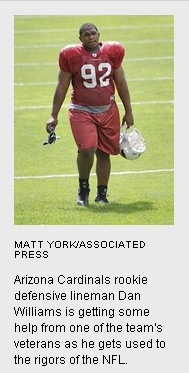
FLAGSTAFF, Ariz. --
Dan Williams ['05]
passed the conditioning test, gasping his way through the drills at the
7,000-foot elevation of the Arizona Cardinals' training camp on
Tuesday.
Now, the first-round draft pick will try to beat
out 36-year-old Bryan Robinson for the nose tackle position. Robinson,
Arizona's starter for the past two seasons, has vowed to help the
youngster all he can.
No one helped him when he broke in, Robinson
said, and he promised that would not be the case if the roles were
reversed.
"I just remembered that if I ever got in that
position, I would never not try to help a rookie succeed," Robinson
said. "In the case of Dan, he's going to be here regardless of whether
I help him or not. ... The more he knows, if he knows what I know, it
gives us a better chance to win. I'm a team player."
Williams, the 26th draft pick overall out of
Tennessee and a former star at East High, said Robinson's help since
minicamp "is a huge advantage for myself."
"The guy has been in uniform for a long time and
has done his job well for a long time," Williams said at a news
conference. "I really think it's big toward my development. He's been
very willing, showing me the playbook, showing me different techniques.
For everything he's been showing me, I've been very thankful. But he
also tells me 'I'm not giving you nothing.'"
Williams said he stayed in shape by working out
at local fitness club, doing the workouts that Arizona strength and
conditioning coach John Lott had provided.
"I was just waiting for that call telling me to
come back out here to Arizona," he said. "I just watched what I ate and
didn't eat anything after 6 o'clock. My biggest thing was eating late
at night. So I just stayed away from the table. If I felt hungry, I
just went to sleep."
Coach Ken Whisenhunt said the stocky Williams
weighed in at 325 pounds, a few pounds under what he had been in the
summer workouts.
Williams played in a 4-3 defensive system in
college. He will be between Darnell Dockett and Calais Campbell in a
3-4 set with the Cardinals. The nose tackle gets little glory but fills
a significant role in freeing linebackers to make the big plays.
"I know this," Whisenhunt said. "Those
linebackers love it when they have a big nose tackle in front of them
because it makes their job easier to not only see the play but it
usually causes the offense to use up two blockers, which allows them
more freedom to make plays."
Players to fill that role are "few and far between," Whisenhunt said.
From 'little brother' to lifelong friend: Duo to co-host Sportsball 2010
By Michael Lollar,
Memphis Commercial Appeal
July 30, 2010
His mentor is technically a "Big Brother," but William Terrell once invited him to his elementary school Father's Day program.
It was one of the "proudest moments" of attorney
Richard Glassman's ['64]
life. Fourteen years since they met through Big Brothers Big Sisters of
Greater Memphis, Terrell, 23, and Glassman, 63, have become the
longest-lasting match in a program that has taken them through two
graduations -- with one more to go.
Glassman once had to fire Terrell as a runner at
his law firm. The attorney calls that moment one of the few "bumps and
hard spots" of watching a little brother grow from a 10-year-old boy to
a 23-year-old law student.
William, who shortened his name to "Will" while
an undergraduate at the University of Memphis, is set to enter law
school Aug. 15. The U of M has been part of the pair's bond from the
beginning. Both are diehard fans of Tigers basketball.
On Saturday, they'll serve as co-hosts of
SportsBall 2010, the biggest annual fundraiser for the organization
that brought them together.
"This is the first time a 'big' and a 'little'
have served as co-chairmen of the SportsBall," said Adrienne Bailey,
president and CEO of Big Brothers Big Sisters of Greater Memphis.
Matches between bigs and littles "age out" when
the little reaches 17. On average, a match lasts two years. For
Glassman and Terrell, it didn't end.
"I've
never considered it a father-son relationship. Will and I are friends.
We go to a lot of ballgames together, eat a lot of popcorn," said
Glassman.
He doesn't have to go far to watch his "little"
grow up. Will moved into the Glassman family's Germantown home a little
more than a year ago, after the youngest of the Glassman's four
daughters left for college.
Inevitably, the family is asked about parallels
to the Hollywood story of Leigh Anne and Sean Tuohy, Memphians who
invited hard-luck student Michael Oher into their home and eventually
adopted the NFL-bound football star.
Terrell was not an athlete, nor was he a
hard-luck case. He was an honor student at White Station High School,
earning a full scholarship to U of M.
"I've always been in Will's life. He's always
had a solid home," said Will's mother, Vera Terrell, a journalism
graduate who worked as a communications manager for the FBI, then for
FedEx. She now is working on an MBA degree online.
After a divorce, she signed Will up for Big
Brothers Big Sisters when he was 10 because he was growing up in a
family with a sister, two step-sisters, a grandmother and two aunts.
"He was around women all the time," she said.
At about the same time, Glassman complained one
night about "crime and youth. My wife said, 'Why don't you do something
instead of complaining?'"
Will remained with his own family, only moving
in with the Glassman family about a year ago after his roommate got
married.
For the Glassmans, it was great timing.
"My wife, who had done almost a full-time job
raising our girls was suddenly relieved of her position. She needed
somebody to mother," says Glassman.
Susan Lawless-Glassman, had grown up in a family
of eight children and welcomed the prospect of another young person in
the house.
"Having kids around is great," she said, especially one who "loves to eat anything."
Glassman and Terrell are among about 65 percent
of Big Brothers Big Sisters who are racial cross-matches. There are 127
black males on the waiting list now, along with 37 black females, an
Asian male and two multiracial males.
The cross-racial match was never a problem, says
Will, who became especially close to the Glassman's youngest daughter,
Zoe, three years younger than Will.
"I always introduced him as my big brother," says Zoe. "People just looked a little bit confused," she says.
Will invited friends to the Glassman home to play video games, watch TV and hang out.
"It was a little weird at first. Friends would
say, 'How did you know this guy?' But they never felt uncomfortable
here," he says.
"I think the most looks we got was the day I
took him to get a haircut off of Vollintine," says Glassman. "I don't
think they had seen a white person in there for a long time."
Will was fired by Glassman for jeopardizing a
legal case by failing to deliver time-sensitive documents on time. It
was a lasting lesson in responsibility, they say.
In a speech prepared for the SportsBall, Will
tries to sum up his experience: "Big Brothers Big Sisters of Greater
Memphis Inc. is grounded in the willingness of families and volunteers
... to travel outside of the traditional family structures to try and
give children the best possible opportunities to succeed in life. The
Big and Little have to be willing to be open-minded and perhaps travel
outside of their comfort zone in order to make the relationship
successful."

Downtown charter school to focus on law, business
By Wayne Risher,
Memphis Commercial Appeal
July 20, 2010

Charter school founder
Tommie Henderson ['91 and Faculty 1998-2003] and developers of Court Square Center met over lunch last summer at a Downtown awards program that honored them as visionaries.
Henderson started the Memphis Academy of Science
and Engineering, a highly successful charter school where test scores
and graduation skyrocketed.
The developers saved a chunk of Downtown skyline
by renovating Lincoln-American Tower and the Lowenstein Building and
raising the new CA2 building from the ashes of a devastating fire.
A year after their meeting at a Center City
Commission luncheon, Henderson and the developers have a new vision.
It's a potentially innovative charter school led
by Henderson, the New Consortium of Law and Business, in commercial
space developed by partners Yorke Lawson, John Basek and Willie
Chandler.
The school is on track to open Aug. 7 on the
ground floor of the CA2 building, 110 N. Court, with 30-35
seventh-grade students. As it grows by one grade per year, it will
occupy Lincoln-American Tower's third floor as well.
The school will immerse students in legal and business communities.
"I immediately knew Downtown was the place to do it," Henderson said.
Lawson called the school a "perfect dovetail"
with federal tax credits that helped finance Court Square Center.
It represents "what the mission of the New
Market Tax Credit program is all about, which is community
development," he said. The credits are aimed at stimulating economic
development in depressed census tracts.
Henderson said all of the students registered qualify for free and reduced-price school lunches.
"It's a great example of a good project," said
city director of Housing and Community Development Robert Lipscomb, who
kept the redevelopment on track at City Hall.
"Tommie Henderson has a track record, and at
that location, it's going to be a perfect fit and an opportunity for
the students to be right where the action happens," said Center City
Commission president and CEO Paul Morris.
The school is seeking a $5,000 office incentive grant from the Center City Development Corp. on Wednesday.
Henderson nurtured MASE from a startup in 2003 to
an 89-senior class with a 100 percent graduation rate in 2009. He left
to pursue an MBA from the University of Memphis and, starting this
fall, a doctorate in educational leadership from Harvard.
Henderson's nonprofit Smart Schools Inc. and
Court Square Partners LLC are finalizing a lease of 4,700 feet on CA2's
ground floor. It will have an amphitheater-style courtroom for mock
trials and discussions, a cafe and lounge where students can mix and
mingle and a board room where students will run businesses.
Students will get laptops with wireless Internet
access for classroom and home use. Curriculum and textbooks will be
online.
Henderson envisions the school growing to about
200 students. The high school experience will include internships,
shadowing of professionals in business and legal communities and real
student-run businesses.
For starters, seventh-graders will run mock
restaurants online, read novels and enact courtroom scenes and hear
from a procession of speakers: breakfasts with business executives and
lunches with lawyers.
"Unlike a lot of models, where you call yourself
something but you never actually do that thing, we're going to be doing
it from Day One," Henderson said.
Preservation effort leads to history honor
Students inspired by teacher at East High
By Emily Greenberg,
Memphis Commercial Appeal
July 15, 2010

For
Mark Scott [Faculty], history is not about decades or centuries.
"For me, it's not a time period. It's a place," said Scott, a history teacher at East High School.
Recently, Scott was named Tennessee's 2010
Preserve America History Teacher of the Year for helping his students
preserve one such "place": a one-room segregated schoolhouse which
stood until the 1960s on Presidents Island.
The schoolhouse, which was primarily used to
educate the children of sharecroppers, was built in 1921 and relocated
to Presidents Island from its original location. More recently, the
schoolhouse was displayed at the Mid-South Fairgrounds, where it faced
possible demolition.
As part of the preservation project, students
wrote letters to community leaders, conducted research at the Memphis
library and compiled oral histories. They held meetings with public and
private organizations. Some students built a scale model of the
schoolhouse. Others started a blog and wrote a skit.
Eventually, the students hope to relocate the
schoolhouse to East High School and turn it into a museum. With help
from East High School alumni, they also hope to build an amphitheater
for lectures. Together, the museum and amphitheater will educate the
community about the evolution of equality in education, said Scott, who
hopes the schoolhouse will serve as a "point of reference" for the
city's progress.
"I think our community would be well-served
(seeing) the juxtaposition of the one-room schoolhouse in front of East
High School," said Scott.
As for his students, he hopes they will make
connections between history and their own personal identities -- as he
did when he first began his history studies.
Originally, Scott became interested in history
while researching his family tree. He says teaching was a natural fit
and he began his career in 1987.
Scott has taught at Memphis City Schools since
1990 and at East High School for the past 13 years. Currently, he is
the chairman of East High School's social studies department and
teaches honors and Advanced Placement U.S. History. In addition to
American history, Scott also teaches Facing History and Ourselves
classes and was honored with Facing History's 2010 Margot Stern Strom
Teaching Award.
As the state Preserve America History Teacher,
Scott will receive a certificate of recognition and a $1,000 award. The
East High School library will also receive an archive of classroom
resources presented in Scott's name.
This fall, Scott will represent Tennessee in the
National History Teacher of the Year competition. Although the
competition offers a $10,000 prize, Scott won't have much time to think
about it. In August, he and his students will resume work on the
preservation project.
Peer Power Foundation puts high achievers to work tutoring their classmates
By Wayne Risher,
Memphis Commercial Appeal
July 13, 2010
Sixty students from five inner-city schools are the newest foot soldiers in businessman
Charles McVean's ['61] fight against school failure.
They've enlisted with the Peer Power Foundation,
which trains and pays high-achieving students to serve as tutors for
their classmates.
After intensive academic and leadership
training, which began Monday at the University of Memphis, they'll join
100 other high school and college students earning $10 to $12 an hour
as tutors in the Peer Power program.
McVean, an East High graduate who made a fortune
trading commodities and futures, started the program at his alma mater
six years ago.
He was not on hand for an opening session at the
Holiday Inn University of Memphis, but program veterans quoted McVean
liberally.
"The world is competitive," said
Cortney Richardson ['07],
20, a U of M senior majoring in organizational leadership, who started
tutoring as a sophomore at East. "Mr. McVean wanted to bring that
competition into academics.
"We knew our school needed help. We asked what
we could do. They made it clear how much power the upper end of the
inner-city youth had to help the others. That upper end has made a
change not only at East High but at other schools in the city."
Peer Power Foundation director Bill Sehnert said
the program gives incentive for bright students to achieve mastery of
subject areas and share it with others.
"It makes more sense for them to work as tutors than to go to work at a burger place," Sehnert said.
A fringe benefit is typically higher scores on
college entrance tests, which translates into larger scholarship
awards. Tutors have increased ACT scores 15-20 percent, Sehnert said.
After beginning at East, it has spread to
Whitehaven, Northside, Westwood and, new for the 2010-11 school year,
Manassas High. It has been picked up in the Mississippi communities of
Shelby and Como.
Officials from Pontotoc-based Three Rivers
Planning and Development District attended Monday's event to evaluate
Peer Power's applicability to grooming a skilled work force.
"The idea of using your peers to help tutor our
students and to pay the tutors for that service is just a very exciting
concept to me and one that I believe will bring additional success to
our students in North Mississippi," said Three Rivers official Bill
Renick.
Sehnert said the program reaches about a dozen
schools including middle schools, and has another half-dozen waiting
for expansion, when funds can be found.
Manassas junior Will Redmond, 16, is glad a teacher recommended him for Peer Power.
"It's a good way for me to help others and get
better as a student myself," he said. "We need more tutors at
Manassas."
Whitehaven High principal Vincent Hunter said
Peer Power has clearly made a difference. Scores on standardized math
and writing tests have increased significantly.
"The data speaks for itself," said Hunter. "It
was utilizing the resources we had in our building: the children who
were already excelling."
Steve Stern at Burke's Books
By Peggy Burch on July 9, 2010, "The Shelf Life" blog,
Memphis Commercial Appeal
July 9, 2010

Critics have lavished exuberant praise on the work of Memphis-reared fiction writer
Steve Stern ['65]. Still, his book sales have always been modest.
An editor at The New York Times described the
Stern phenomenon in 2005, under the headline "He's a Literary Darling
Looking for Dear Readers." Stern's spectacular novel "The Angel of
Forgetfulness" had just been released when Peter Edidin wrote: "He has
received critical praise in the places that matter, won his share of
prizes and is devoted to his work. ... But he remains largely unknown
to readers at a time when even the most gifted writer, if he does not
sell well, may have difficulty finding a publisher for his next book."
The highly regarded but under- appreciated
literary hero returns to his hometown this week for an appearance at
Burke's Book Store from 5:30 to 7 p.m. July 13. He'll read from and
sign his latest book, "The Frozen Rabbi" (Algonquin, $24.95).
The San Francisco Chronicle began its review of
"Frozen Rabbi" this way: "It has become something of a literary
tradition, when reviewing a new book by Steve Stern, to mention that he
is not as popular as he ought to be. Back in 1987 Gordon Lish, the
renowned editor and literary kingmaker, was already calling Stern 'far
and away the greatest of our unrecognized writers.' "
Unfortunately, Stern said by phone from his home
in Saratoga Springs, N.Y., where he teaches creative writing at
Skidmore College, "unrecognized writer" still sort of describes his
situation, though he has received O. Henry Awards, a Guggenheim
Fellowship and the National Jewish Book Award along the way.
He compares himself to the Kevin Costner character in the movie "Bull
Durham," a great player pitcher unaccountably stuck for eternity in the
minor leagues.
"I get really, really tired of the reviews that
start 'much neglected, possibly this book will bring him the
attention...'
"It's never gonna happen. My expectations have always been very minimal; I'm just pleased to be acknowledged."
His cheerful pessimism bleeds into all areas of
his life. He recently had a hip replacement, about which he said: "I've
gone from a walker to crutches to a cane to Walter Brennan in three
weeks."
He shares homes in upstate New York and Brooklyn with his "spousal
equivalent," the comic artist Sabrina Jones. The relationship has what
he calls "a hitch," one that some might consider a blessing. Jones's
family is French, and she inherited a house in the countryside there.
"I have such a low beauty threshold," Stern says of his trouble
adapting to visiting France.
Though he moved to Saratoga Springs in 1987, his
stories still have Memphis settings. Stern himself grew up near East
High, but he found his writerly bearings in The Pinch -- the
neighborhood on North Main Street that formed an East European Jewish
ghetto in the late 19th century -- which he discovered while he was
working at the Center for Southern Folklore in the early 1980s. "I did
an endless series of interviews with old survivors of the North Main
Street neighborhoods, and it began to reassemble itself in my mind."
He agonized in advance about his homecoming this week: "I don't handle
these things well. I see people I haven't seen in years. It's
overwhelming. I like to think most of them have forgotten me."
Elizabeth Anne Brown marks 50 years of teaching young performers
By Jonathan Devin,
Memphis Commercial Appeal
July 9, 2010

The name of
Elizabeth Anne Brown's [class association undetermined]
Performing Arts of Germantown is readily recognized by a half-century's
worth of young dancers and vocalists, even if it confuses delivery
drivers.
For one, the programs for Brown's 50th
anniversary celebration show in June were sent four blocks down Exeter
Road to the similarly named Germantown Performing Arts Centre (GPAC).
"We get along great (with GPAC), but some of my
parents have mailed their tuition checks to them and then GPAC will
call and say 'we've got a check for you,'" said Brown, who is sole
owner of the studio.
Another time, Brown arrived to find that a
plumber, whom she hadn't called, had just repaired a toilet that wasn't
broken.
"Then one day I came to work and there were 50
eight-foot tall ficus trees everywhere," Brown said. "My doors were
open, and men were bringing them in. They said, 'We're delivering the
trees you ordered.'" Brown hated to tell them that they would have to
load all the trees back in their truck.
Despite the confusion with GPAC, Brown's name comes with a long legacy of keeping things in step.
Brown started teaching dance, mostly tap and
jazz, 50 years ago at the age of 18, when she was a senior at East High
School.
"Back then you went to a small town to open your dance studio before you moved to the big city," Brown said.
She and a friend, Karen Dover, who still teaches
with her today, drove Brown's 1958 Impala convertible to a rented
skating rink in Senatobia every Saturday at 6 a.m. They taught about 30
students from 9 a.m. to 4 p.m. before returning to Memphis.
A year later, she moved her operation to New
Albany, Miss., catching the Greyhound bus from Lamar Avenue for a
two-hour ride each way. In 1963, she opened her first Memphis studio in
a house in Raleigh in which the one-car garage served as her main
ballroom.
Now her 2,400 square-foot studio in Germantown
has two ballrooms and a voice studio, enough space for about 200
students, mostly between the ages of 3 and 16. She has been there since
1981.
Students pay $70 per month for one-hour classes
each week, or $65 per private lesson. Extra workshops in acting and
other forms of dance, such as hip-hop, are offered on weekends.
If it sounds unusual to offer both dance and
voice to the same students, Brown said that was a throwback to her
dreams of auditioning on Broadway, where performers must be able to
sing and dance.
Brown went to New York City at age 17 to
audition for the Broadway production of "Sweet Charity," but was cut
during the ballet portion of the audition.
"That got me on the road to realizing how
important ballet is," Brown said. "Now at my studio, whether you're
doing tap, ballet or jazz, you're wearing a black leotard, pink tights,
and hair slicked back in a bun -- and it's been that way since 1960."
In 1980, she joined forces with vocal instructor
David Francis, after numerous meetings at various local talent
competitions.
"The winners at the competitions were either
David's vocalists or my dancers, so we just got to talking," Brown
said.
Francis moved to Los Angeles 10 years later, but voice is still taught at Performing Arts, by Cindy Barrett.
"The thing that drew me to Elizabeth was her
attention to detail and technique and the quality of her performers,
year in, year out," said Debbie Branan, a volunteer organizer of the
Mid-South Fair's Youth Talent Contest, whose daughter, Whitney, started
taking lessons from Brown at age 2. "Her studio seemed to fit the niche
for my child."
Branan said she too met Brown after several
years of watching Brown's students win awards in the Youth Talent
Contest.
Brown herself took the stage at the June 16 anniversary celebration, performing alongside her daughter, Misty.
She has no plans to retire.
"What would I do?" said Brown. "Sit at home and plant flowers? Not me."
If anyone can identify the correct East High graduating class with
which Ms. Brown was associated and the name by which she was known at
East, please send that information to editor@EastHigh.org
Food Bank leader Sanford retiring after 2 decades feeding area's needs
By Barbara Bradley,
Memphis Commercial Appeal
June 29, 2010

Susan
Sanford, president and CEO of the Mid-South Food Bank, will retire at
the end of this year after almost 20 years at the helm. She will be
succeeded by Estella Mayhue-Greer, senior vice president and chief
operating officer, who has been with the Food Bank for 14 years.
Susan Sanford will retire at the end of the year after nearly 20 years
as leader of the Mid-South Food Bank she has helped expand.
Sanford will serve as a Food Bank consultant for
two years after she retires, and then perhaps consult for other
nonprofits and businesses and serve on civic committees. "I'm not a
good sitter-downer," she said.
To many, Sanford, 65, is the Food Bank, said
board member Carol Prentiss. Chairman Gwendolyn Tucker called her "a
great leader both at the Food Bank and in the community."
"When I was first there, it was a folksy
catch-as-catch-can organization," said board member Clifford Lynch,
president of the logistics consulting firm C.F. Lynch & Associates.
"But she has given it professionalism and structure that has really
helped us do well. One thing she insisted on was letting the donor base
know what's happened to its money."
Since Sanford joined the Food Bank in September
1991, it has doubled its food distribution to 10 million pounds. The
agency now serves 31 counties in Tennessee, Mississippi and Arkansas
and feeds an estimated 186,500 different people annually.
Few realize, Sanford said, how strictly the Food
Bank monitors use by its partner agencies of scarce resources. Sanford
recruited professionals for the staff, and board members who could
supply missing expertise, including media executives who did much to
raise the agency's profile.
She brought in new corporate sponsors and motivated others.
Dick Tillman, then-president of Kroger Delta
Marketing Area, was accustomed to people asking him for things. Sanford
went to him and asked what he expected of her. "Kroger really stepped
up in a big way," she said.
Programs added during her tenure were Kids Cafe,
where boys and girls get hot meals and a nutrition lesson twice a week
in a restaurant-like setting, and Food for Kids BackPack Program that
sends kids home for the weekend with food they can fix themselves.
Last year the Food Bank began picking up
perishable foods nearing expiration dates in a refrigerated truck and
started the Mobile Pantry that delivers food to rural pantries too
small to stock large amounts and distributes it directly to qualified
recipients.
Sanford is a founding member of the Safety Net
Collaborative, a group of eight essential services organizations in
Memphis. She is a past president of the Memphis Rotary Club, a former
chairwoman of the board of directors of United Way of Greater Memphis,
and a recipient of the 2009 Legends Award from the Women's Foundation.
She feels confident about the nonprofit's
future: "We are finishing a strategic plan that makes me feel so
comfortable." About Mayhue-Greer, she said: "I told the board I've
mentored this brilliant woman for 15 years, and you can't do better."
Looking back over her career, Sanford noted she
is often touched by notes people send with their contributions. "I feel
the generosity in the Mid-South poignantly, and I feel fortunate."
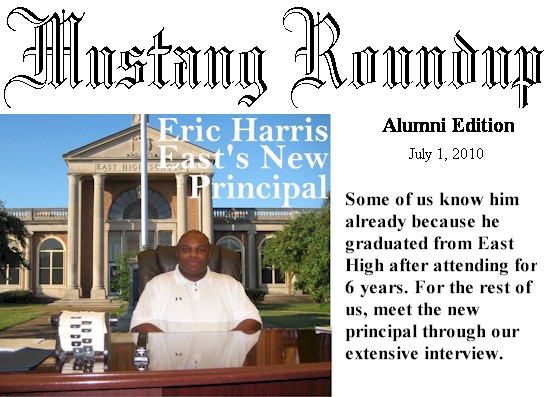

[This photograph has been cropped and otherwise adjusted from the originally published photo.]
Memphis Commercial Appeal
June 10, 2010
The Tennessee
Jewelers Association sponsored the 2010 Jewelers Open Golf Tournament,
which raised $500 for St. Jude Children's Research Hospital. There were
12 Memphis area jewelers that participated in the golf tournament at
the Cherokee Golf Course. Those in attendance were Bill Russell (front
row, left), Frank O'Connor, and Jim Gordon; Bob Richards (back row,
left), James Gattas, Anthony Richards, Sonny Pike, Elmer Holder,
Randolph Reeves, Peter Poole, Van Smith ['65] and Cope Williams ['65].
The Tennessee Jewelers Association is a state-wide organization
dedicated to the maintenance of professional standards, professional
ethics and education in the jewelry profession.
East High students plan restoration of one-room schoolhouse
By Jane Roberts,
Memphis Commercial Appeal
April 30, 2010
About 6,500 community volunteers showed up at
city schools Thursday, pen in hand, ready to grade student artwork,
engineering projects, computer programming and sophisticated themes.
East High School seniors Devin Mcbe, 18, (left) and Shakila Boyd, 17,
explain the layout for the future site of the restored one-room
schoolhouse once at Presidents Island that will be moved to the East
High campus.
At East High School, they nearly dropped their
score pads over work to move and restore the one-room segregated
schoolhouse that in 1964 -- a decade after Brown v. the Topeka Board of
Education integrated public education -- was still serving
African-American students on Presidents Island.
"I was so impressed. I was just blown away,"
said Donna McCraw, juror in the fourth districtwide student exhibit.
"I thought it was the coolest thing ever. I
don't think the students have the life history to realize what an
impact their work is going to have.
"Years down the road, they are going to be able to say they did that," she said.
The exhibit's image was retooled this spring with
the pro bono help of Clear Channel and Red Deluxe, which created the
name ThinkShow! and produced and placed billboards to tell the story.
District officials say the campaign attracted 500 new judges.
"We had a lot more professional people sign up
this time. I think Stinson Liles with Red Deluxe has really helped us a
lot," said Judy Jackson, director of project-based learning.
If plans go well, the city of Memphis this
summer will move the one-room schoolhouse to East, and build a
foundation under it to shore up the dreams students are sketching out,
blogging about and acting out in skits.
"We hope to one day have an amphitheater outside
the museum for lectures and programs," said Daphanie Johnson, 17.
"This project means a lot to me. I'm grateful
for what I have. I think a lot of students might look at this and say
they don't care because this old building doesn't mean anything to
them.
"But it helps me see how far we've come."
At schools across the city, teachers and jurors
said the work was more sophisticated than when the show started in
2008.
"In real life, you're not often given a simple
task like adding up a column of numbers," said Sam Shaw, principal at
Berclair Elementary.
"If you're buying a car, you have to consider
economics, aesthetics and practicality and make a judgment about style.
That is the real world."
For East history teacher
Mark Scott [Faculty], the school house lodged in his brain back in 2008 when Memphis Heritage used a picture of the school in its calendar.
The idea crystalized when Scott found June West, head of Memphis Heritage.
"This is a once in history thing as far as I am concerned," she said.
The school, long displayed at the Mid-South Fairgrounds, lost its home when the fair moved.
"Not only are we looking at preserving one of the
only artifacts left, but we're also educating the youth of the city of
the importance of historic preservation."
The building "is on wheels, ready to move," she said.
Most of what the students know about it -- the
last one-room schoolhouse in the county -- comes from a 1964 news
clipping they found in the Memphis Room at the Benjamin L. Hooks
Central Library.
"These pictures will help us restore it," said
Jaylyn Johnson, 17, tapping the clipping showing African-American
children in the school with no electricity or plumbing.
"This has helped me realize how bad it was. Even
though the government said it was illegal, black people were still left
without equal facilities."
 Read a summary of the
student proposal written by the students themselves.
Read a summary of the
student proposal written by the students themselves.
Princiapl Fred Curry suspended, then removed from East High
[The following is compilation of news stories regarding the
suspension, then removal, of Mr. Fred Curry as principal of East High
School. These are in reverse chronological order, most recent first.]
A copy of the City Schools internal audit of East High School for the majority of the 2009-2010 school year is available.
June 23, 2010 - A newspaper article Wednesday, June 23 reports on the audit of former East High Principal Fred Curry's  (Faculty
2005-2010) administration. "East High School principal replaced for
lack of control; student funds, laptops missing" can be read in The Commercial Appeal.
(Faculty
2005-2010) administration. "East High School principal replaced for
lack of control; student funds, laptops missing" can be read in The Commercial Appeal.
[Editor's note: Monday night Memphis City Schools Superintendent Kriner
Cash told The East High Alumni Page the report was "available," but
declined to otherwise comment on it. Tuesday, an e-mail was sent to the
e-mail address linked on the City Schools web site as being the
director of Communications requesting a copy or access to the report.
The link and the listed address were not the same. The City Schools
e-mail system reported that the linked e-mail address was not in their
system.]

May 15, 2010, The East High Alumni Page - Mr. Harry Durham is
serving as interim principal at East during the paid suspension of Mr.
Fred Curry while the school system conducts an audit/investigation into
issues at East High. Mr. Durham, a city school principal, also served
as interim principal at East 2002-2003 after another principal was
removed from the position.
April 28, 2010 - Television news report: Audit of principal Fred Curry's administration at East High completed:
WHBQ-TV
April 19, 2010 - Television news report: suspended principal Fred Curry says he's proud of East High: WREG-TV
April 19, 2010 - Television news report: superintendent is reported
to be "very worried about the culture and safety" of students at East
High: WREG-TV
April 16, 2010 - East
High Principal Fred Curry
was suspended with pay Thursday, April 15, by the Memphis City Schools
superintendent pending an internal investigation by the school system.
East has recently been in the news when about 10 girls got into a fight
in a hallway requiring the use of pepper spray by security personnel to
bring things under control and after a girl and several boys left
campus during the school day, with 3 boys eventually being charged with
rape.
Principal Curry had brought considerable stability to the position of
East High principal, serving in that position since 2005. Prior to
that, East had been plagued with turnover at the top spot for several
years, with two principals being removed for financial irregularities,
one asking to be reassigned after faculty and parents resistance to his
management style, and a retired principal serving most of a school year
before a permanent principal was assigned.
Source: The Commercial Appeal, The
East High Alumni Page

'91 Grad is new East High principal at East High
The East High Alumni Page
June 21, 2010
Eric Harris ('91 and Faculty), a 1991 graduate of East High
School, has been appointed principal of his alma mater. Mr. Harris
comes to East after serving as 11th grade principal at Memphis City
Schools best academic performing high school, White Station. Harris and
White Station principal David Mansfield face misdemeanor charges
November 3 in Shelby County Juvenile Court for allegedly failing to
report to police an on-campus attack upon a student at White Station
last September which resulted in injury. State law requires such
reporting.
Mr. Harris replaces 5-year East principal
Fred Curry (Faculty 2005-2010).
Jason Smith: East's Brian Kimbrow turns up heat
Junior RB runs 4.28 at combine
By Jason Smith,
The Commercial Appeal
June 4, 2010
As he's traveled from one scouting combine to
another this spring, East High rising junior running back Brian Kimbrow
has made a habit of calling his Mustangs head coach,
Marcus Wimberly ['92 and Faculty], and reporting his performances in the 40-yard dash.
"He calls me every time from every camp if I'm not there," Wimberly said.
So it wasn't unusual that Wimberly received a
call Saturday from the 5-9, 165-pound Kimbrow, who had just been
clocked at a ridiculous 4.28 seconds in the 40 at the Byron De'Vinner
Elite Prospect Combine at Crump Stadium.
"We knew he was 4.3-fast," Wimberly said. "I didn't realize he was 4.28-fast."
Kimbrow, who averaged an area-best 9.9 yards per
carry on 85 rushing attempts as a sophomore, has also been clocked at
4.31, 4.35 and 4.37 this spring.
"Quite a few (programs) have been inquiring
about him," Wimberly said. "They want to see him at their camps so they
can further evaluate him. But it's clear to them that he has plenty of
speed."
In April, following a standout performance in
the BadgerSports Elite 7-on-7 passing camp in Tuscaloosa, Ala., Kimbrow
was one of five underclassmen named to Scout.com's Tuscaloosa Fab Five.
Rivals.com also selected Kimbrow as one of the camp's top performers.
On Saturday, Kimbrow's 4.28 40 at the De'Vinner
Combine was apparently enough to convince the remaining prospects not
to run.
"No, sir. Nobody else ran after I did," Kimbrow
said. "I saw it coming, though, because I've been clocking low 4.3s,
like 4.31s and 4.30s, all spring. Coach Wimberly has worked me hard to
better myself."
Obama is lightning rod for hatred
Letters to the Editor,
The Commercial Appeal
June 3, 2010
It's hard to believe that you printed the June 1 letter "Engineer has a
cheap idea." I have lived in Memphis all my life. Not since I was the
fat Jewish girl at East High (the country club high school) have I seen
such blatant hatred as I have seen since Barack Obama became our
president.
This country was founded on religious and
political freedom. All of us do not have to be the same color and the
same religion to have rights. If these same people would try to
befriend even one person who was different, this city might have fewer
problems. It has to start somewhere.
I hope the letter writer never needs a policeman, firefighter, doctor
or nurse. They might not be someone she would want to touch her.
Helen Tower
Memphis
[A Helen Levy, now Helen Tower, is a member of the Class of '62.]
Awards honor 5 Memphians with diverse backgrounds
Each has worked to help community
By Linda A. Moore,
The Commercial Appeal
Posted May 27, 2010
The tie that binds five Memphians being honored by Diversity Memphis is their commitment to the community.
At 7 p.m.
today, those Memphians will be recognized during the fifth annual
Humanitarian Awards Dinner at the Esplanade Banquet and Conference
Center, 901 Cordova Station.
Founded in 2005, Diversity Memphis is a human
relations organization that brings together and promotes tolerance and
respect for people from all walks of life.
"These individuals reflect the diversity of our
community and challenge all of us to do more," said Herb Wells, board
chairman.
The recipients are:
W.J. Michael Cody ['54] is an attorney and
a former Tennessee state attorney general. He is a partner with Burch,
Porter & Johnson, where he has spent most of his career. He is
listed with Mid-South Super Lawyers as one of Tennessee's Top 100
attorneys.
His community involvement includes work with
Rhodes College, the Memphis YMCA and the National Civil Rights
Museum...
Memphis Memories
By Staff,
The Commercial Appeal
May 27, 2010
[The following was republished on May 27, 2010, in the Memphis/Mid-South Memories item in
The Commercial Appeal, originally published May 27 1953.
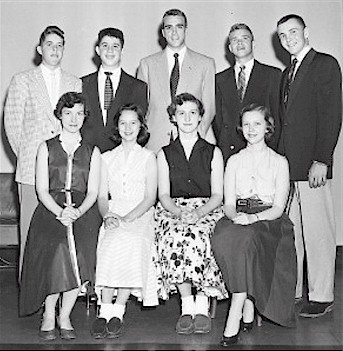
"East High
School representatives gather for photo: Elected as officers of the
East High School student body in May 1953 are Donna Hurt (front row,
left) , commissioner of activities; Suellyn Scott, junior high girls
vice president; Nina Braswell, commissioner-at-large; and Mary W.
Glass, senior high girls vice president. Other officers include Mike
Cady (back row, left), senior high boys vice president; Gerrald Graber,
junior high boys vice president; David Johnson, commissioner of
traffic; Robert Bessire, president; and Reed Knight, commissioner of
sanitation."
Memphis Memories
By Staff,
The Commercial Appeal
May 23, 2010
[The following was republished on May 23, 2010, in the Memphis/Mid-South Memories item in
The Commercial Appeal, originally published May 23, 1987.
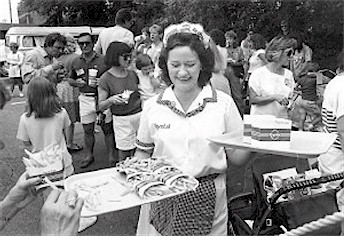
"East High Alum get their fill of Krystal burgers Mary Moorman and
other Krystal employees serve burgers and fries to about 250 East High
School alumni at a parking lot picnic on May 23, 1987. The group downed
650 Krystals and 250 orders of fries at a gathering of the class of
1967 at their favorite hangout on Poplar, across from the school."
Needed: A cap for grad spending
Senior costs too high, judge warns board
By Jane Roberts,
The Commercial Appeal
May 20, 2010
Spring is not a pleasant time for Probate Court
Judge Robert Benham, whose job includes approving expenses of minors in
guardianships.
One of his most vexing problems is "senior
expenses," a laundry list that includes luncheons, class trips,
"lock-ins," caps, gowns, rings and hundreds of dollars in clothing,
souvenirs and food.
"I've been seeing it for years, but it's getting
to be more and more money," Benham told the Memphis Board of Education
on Monday, handing over papers outlining $3,489 in graduation expenses
for one student at Hamilton High, which he said is typical of what he
sees in Probate Court.
"This is a lot of money that could be used to go
to college," Benham said, asking the board to make a policy decision on
what is "reasonable" and asking whether anyone is monitoring people
"attempting to sell goods to these seniors."
Memphis City Schools says to expect no change in policy after wrapping up its own research on senior costs.
"I don't know why (Benham) is requesting a policy change," said Deputy Supt. Irving Hamer.
"That is not the right request," he said, adding
that he has no intention of recommending a change to the board.
Senior dues range from $65 at White Station High
to $350 at Wooddale High and cover events, consumables, souvenirs and
parties, depending on what the senior class officers decide.
At some schools, prom is optional. That's the case at White Station, which suits Elizabeth Bailey fine.
"If you don't want to go to prom, you don't have to pay for it," she said.
She sees no way for the board to hold the line on discretionary spending.
"What are you going to do, say you can't have a
limousine or your prom dress has to be cheap?" she asked "It's not
going to work."
Phillip Piper ['10], a senior at East
High, felt no pressure to spend more than the $400 he said his family
shelled out for cap and gown, graduation costs and Advanced Placement
test fees.
"I didn't feel the need to go on a senior trip," he said.
Ditto on the prom, "and I don't see myself needing a ring after high school."
At Hamilton, $175 in senior dues does not cover
prom ($50), senior lock-in ($45) or the senior luncheon ($45),
ostensibly allowing families to tailor their senior's experience based
on budget and personal preference, Hamer said.
A minor whose expenses Benham is responsible for
overseeing spent $400 for a senior trip to Florida, $613 for senior
photos, $446 for a class ring, $1,500 for incidental travel expenses,
plus fees for a luncheon, picnic, cap and gown, medallion and trip to
Nashville.
Benham says he is put in the position of having to be "the ogre."
"What happens is that I disappoint these
children," he said. "I don't allow the encroachments. I deny, even
though their friends get to do these things."
He wants the school board to create a list of sanctioned vendors catering to senior activities.
"We all know there is a lot of easy money to be
made in this town and in any community," he said. "It's not the way you
need to start someone out by having a lot of peer pressure when you are
17 and 18."
Germantown man to head rail passengers association
By Bartholomew Sullivan,
The Commercial Appeal
May 18, 2010
WASHINGTON -- The country needs a good railroad
running regularly between Chicago and Florida through Nashville and
Chattanooga, the newly elected, Memphis-based president of the National
Association of Railroad Passengers said Monday.
William B. Strong ['61] of Germantown,
the Tennessee delegate to the association that he's been a member of
before there was an Amtrak, was elected to a two-year term, the
association announced in a statement Monday.
"I'm going to do everything I can to get more
and better passenger service for Tennessee," he said when reached
Monday to ask how he'll use his new bully pulpit.
Strong said he hopes to see not high-speed but
higher-speed train service in the Midwest, where The Floridian used to
travel from Chicago to Florida before it was killed by the Carter
administration in 1979. Right now, to go from Chicago to Florida by
train, passengers have to go through Washington.
A graduate of East High School and Vanderbilt
University with a degree in mechanical engineering, the 67-year-old
Memphis native has been active as a passenger advocate since 1968. He
is a vice president of Tencarva Machinery selling industrial equipment
like pumps and air compressors, he said.
He said that, being based in Memphis, he doesn't
travel by rail "excessively," simply because it's not convenient. He
said he averages about 3,000 miles by rail a year.
The association is the only one of its kind advocating the interests of the rail passengers.
Class of 2010 graduates
by The East High Alumni Page, May 15, 2010

Two hundred fifty-one students were presented as
candidates for graduation at the 60th Commencement Exercises of East
High School Saturday, May 15, 2010. The East High Concert Band under
the direction of Ollie Liddell, Director of Bands, played the
traditional Pomp and Circumstance in the Cannon Performing Arts Center
in downtown Memphis as the candidates marched in, lead by school and
school system officials who would share the dias with the graduates.
Thirty students received Tennessee Hope Lottery
"academic" scholarships, with another 18 receiving other, more
traditional, academic scholarships to colleges and universities. Note
was made at the ceremonies of one student, Dariouis D. Hankins, who has
been offered a full four year scholarship at Mississippi Valley
University. Give that special notice, it might be assumed that
scholarship offer was the only "full ride" offer made to the graduating
seniors. Hankins also had other scholarship offers a paragraph long.
Two students have been offered music (choral) scholarships or grants,
one of which also received academic award offers. Eight students have
received athletic scholarship offers. It was announced that more than 2
million dollars in scholarships were awarded, however, that number
almost surely is the cumulative value of all the offers rather than
representing actual funds that will be made available to the graduates.
For example, if competing colleges offer the same student scholarships,
only the school to which the student goes actually gives that student
the money or services.
There was no keynote speaker at this year's
ceremonies. Other than brief comments, the only speeches given were by
Student Council President David Ross, Valedictorian Brandy Maclin, and
Salutatorian Tevin McInnis.
Interestingly, suspended principal Fred Curry
was saluted about 4 times in the student's comments, while Board of
Education Commissioner Jeff Warren also credited Curry with the success
of the Class of 2010. Curry was suspended with pay a month ago by
schools superintendent Kriner Cash after a fight in a school hallway
which allegedly involved a "girl gang." A few parents complained that
their complaints about security for their children at school were not
being well received. There have also been other troubling incidents
this year on campus or by pupils who left campus during the school day.
According to one school staff member helping organize the graduation
exercises, Curry was not in attendance at the commencement. It has been
reported that the investigation/audit has been completed for nearly two
weeks but the school system has refused to release any information
saying that the school board needs to approve the findings before they
are made public.
Harry Durham, a retired city school principal
who has served several times as an interim principal at city schools
after his retirement, is again acting as interim principal at East. He
filled that same role for the entire 2002-2003 school year when another
East principal was removed from that position.
As the morning ceremonies drew to a close, the
East High Concert Choir, directed by faculty member Jeffery Murdock,
and the band performed the school's Alma Mater. The printed program
gave appropriate credit for the words of the Alma Mater to Shirley
Wilkes of the East High Class of 1951. The new alumni of East High then
marched out of the auditorium once again to Pomp and Circumstance.
Letters: The MCS dike needs rebuilding
Letter to the Editor,
The Commercial Appeal
May 23, 2010
In response to your May 13 editorial "This is no
time for pessimism": As a lifelong Memphian, and as someone who loves
Memphis for what it is, and can be, nothing in Memphis is dearer to my
heart than Memphis City Schools. As a 1972 graduate of East High and as
a parent who has raised three children in the MCS system, I have
witnessed the 25-year decline that now leaves the district on the edge
of hopelessness.
The debate in the press over Supt. Kriner Cash's
"police force," or the debate over a $250,000 federal grant to
stimulate reading once a week during the summer (May 12 article) only
serves to provide the "perception" that something -- anything -- is
being done to reverse the decline. These types of measures are too
little, too late.
Until the discussion is open, frank and brutally
honest, the district will continue to decline. I'm not sure how much
further it can go before it becomes beyond rehabilitation. The core
issues are: the attitude of parents of MCS children, insufficient
capital to fund a year-round program, the lack of political will to
fight the inevitable pushback from parents, and the lack of support
from the broader Memphis community for higher taxes to support this
effort.
The depth of the decline requires "outside the
box" thinking, which naturally scares parents who are resistant to
change, and going to a 12-month program will meet a lot of resistance.
I would suggest that the federal government, which has no problem
finding billions of dollars for almost any special-interest group,
could belly up to the bar and fund a long-term experiment in turning
around one of the most depressed school systems in the nation. There is
no way increased local taxes can fund this type of gargantuan effort.
No matter how loud the rhetoric or how creative
the slogans, our propensity for "fingers in the dike" solutions will
not stem the flow. We need to rebuild the dike from the ground up.
Shep Fargotstein
Memphis
All decked out: Buntyn Presbyterian preparing for 100-year anniversary celebration
By Pat Hickman, Special to My Life,
The Commercial Appeal
May 8, 2010
What do you do when company is coming? You spruce up the place and try to put your best foot forward.
That's what members of Buntyn Presbyterian
Church, 561 S. Prescott, have been doing for weeks in preparation for
the church's 100-year anniversary celebration. The celebration actually
began with a birthday party that served as a gathering for past and
present church members, as well as some of the neighbors in the Buntyn
community. There was also a special worship service on May 2 in
recognition of the milestone anniversary.
Next, there will be two organ concerts, given by
former Buntyn organists; the first on May 15 at 3 p.m. featuring Dr.
Angela Saunders, from Memphis, and the second one on June 13 at 3 p.m.
featuring Scot Stout, from Seattle, Washington.
Additionally, the
Rev. Dr. Louis B. Weeks ['59],
former President of Union Presbyterian Seminary, will preach at 3 p.m.
on May 16 at Buntyn to celebrate the beginning of the church's next 100
years.
Dr. Weeks was active in youth activities at
Buntyn, where his family worked and worshipped. He graduated from East
High School, where he served as Student Council President and won
football honors. He has written broadly in church history, ethics,
administration, pastoral care, and ministry. His books include "All For
God's Glory: Redeeming Church Scutwork" (2008), "The Presbyterian
Presence: Bible Words That Shape a Faith" (1992), and his articles
regularly appear on the website for "Resourcing American Christianity,
Faith, and Leadership."
The church's current pastor, Rev. Maggie
Jorgensen, said, "The church's commitment to service in the Memphis
community in the next 100 years drives this celebration. The Buntyn
congregation feels blessed to have a large building which we share with
the Fresh Wind Christian Center Church and The Dwelling Place Church --
two other churches which are listening for direction in God's world.
Church Women United, Meditation Fellowship, Wings Gymnastics, Shoaf's
Loaf, and the East Buntyn Neighborhood Association also work here."
Another community aspect of the church is the
Buntyn Preschool, which has been nurturing children for more than 60
years. And over the years Buntyn Church served Orange Mound Day Care,
Parkway Gardens Presbyterian Church, Lester School summer program,
Youth Fellowship for Downs Syndrome and Beltline Teen and Enrichment
Centers.
For more information, call 458-8271.
Pat Hickman is an elder of Buntyn Presbyterian Church.
East High students plan restoration of one-room schoolhouse
by Jane Roberts,
The Commercial Appeal
April 30, 2010

About
6,500 community volunteers showed up at city schools Thursday, pen in
hand, ready to grade student artwork, engineering projects, computer
programming and sophisticated themes.
At East High School, they nearly dropped their
score pads over work to move and restore the one-room segregated
schoolhouse that in 1964 -- a decade after Brown v. the Topeka Board of
Education integrated public education -- was still serving
African-American students on Presidents Island.
"I was so impressed. I was just blown away,"
said Donna McCraw, juror in the fourth districtwide student exhibit.
"I thought it was the coolest thing ever. I
don't think the students have the life history to realize what an
impact their work is going to have.
"Years down the road, they are going to be able to say they did that," she said.
The exhibit's image was retooled this spring with
the pro bono help of Clear Channel and Red Deluxe, which created the
name ThinkShow! and produced and placed billboards to tell the story.
District officials say the campaign attracted 500 new judges.
"We had a lot more professional people sign up
this time. I think Stinson Liles with Red Deluxe has really helped us a
lot," said Judy Jackson, director of project-based learning.
If plans go well, the city of Memphis this
summer will move the one-room schoolhouse to East, and build a
foundation under it to shore up the dreams students are sketching out,
blogging about and acting out in skits.
"We hope to one day have an amphitheater outside
the museum for lectures and programs," said Daphanie Johnson, 17.
"This project means a lot to me. I'm grateful
for what I have. I think a lot of students might look at this and say
they don't care because this old building doesn't mean anything to
them.
"But it helps me see how far we've come."
At schools across the city, teachers and jurors
said the work was more sophisticated than when the show started in
2008.
"In real life, you're not often given a simple
task like adding up a column of numbers," said Sam Shaw, principal at
Berclair Elementary.
"If you're buying a car, you have to consider
economics, aesthetics and practicality and make a judgment about style.
That is the real world."
For East history teacher Mark Scott, the school
house lodged in his brain back in 2008 when Memphis Heritage used a
picture of the school in its calendar.
The idea crystalized when Scott found June West, head of Memphis Heritage.
"This is a once in history thing as far as I am concerned," she said.
The school, long displayed at the Mid-South Fairgrounds, lost its home when the fair moved.
"Not only are we looking at preserving one of the
only artifacts left, but we're also educating the youth of the city of
the importance of historic preservation."
The building "is on wheels, ready to move," she said.
Most of what the students know about it -- the
last one-room schoolhouse in the county -- comes from a 1964 news
clipping they found in the Memphis Room at the Benjamin L. Hooks
Central Library.
"These pictures will help us restore it," said
Jaylyn Johnson, 17, tapping the clipping showing African-American
children in the school with no electricity or plumbing.
"This has helped me realize how bad it was. Even
though the government said it was illegal, black people were still left
without equal facilities."
-- Jane Roberts: 529-2512
Know anyone from Presidents Island school?
East students would like to find alumni from the one-room school,
Lizzie Louise Munn, Roy James Munn or George Gary Munn. Call 416-6160.
See additional story immediately below.
A summary of the proposal to move a one-room schoolhouse to the East High campus
by By Nicholas Shanks, Jhmarkus Simpson, Tiara Austin, and Dominique Wein (East High School Students)
The Keystone, March/April 2010 (
Memphis Heritage, Inc.) Article used with permission.
March/April 2010
Walking through the Mid-South Fairgrounds you may come
across a small unimpressive shack. The little red
structure, built from clapboard, is probably no larger than
the size of modern classroom. However, this shack may not
be as unimpressive as you think. In 1896 the Supreme Court
decided on the separate but equal mandate in the landmark
case of Plessy vs. Ferguson. From this decision many
schools for African American children were established in
the South such as this one room school house located at the
fairgrounds. This school was originally founded in 1921 and
rebuilt on Presidents Island in 1952; it was the last
operating one room school house within the Memphis City
limits up until the 1960s. Unfortunately, the
Presidents Island School House, a symbol of the importance
of education for the beginning of the twentieth century, is
in danger of being destroyed.
We, the students of East High School, would like to save
the Presidents Island School House by relocating the
building to East High School's campus and preserving its
structural integrity. To our student body, the school house
represents the evolution of equality as we examine how
Memphis City Schools have evolved over time. Saving this
historical site is important because it reminds us of the
past in Memphis and Shelby County. It shows us how citizens
have worked together to overcome adversity. Through the
preservation and restoration of this landmark, each
generation can show their children how education has
changed and how it continues to enrich the community.
Memphians passing by our school will be able see the vast
contrast between the one room school house and East High
School's large and architecturally striking building. The
exposure to the history of Memphis' educational development
and its current benefits encourages us to take every
advantage of what we have today. The Presidents Island
School House is also a symbol of the sharecropping practices
that were once dominant in the South, representing the
importance of education to those who were economically
oppressed.
This project is also important to East because it is being
studentled. Our student body realizes that no matter what
color or nationality we are, we all must fight for what we
believe in; we believe that this one room school house is a
significant symbol of progress. To facilitate this project
we have created student sub-committees and divided the task
into manageable parts. We sought guidance from
various stakeholders by conducting a steering committee
meeting this past Friday, February 26, 2010. Our AP history
teacher and mentor, Mr. Scott, along with various other
stakeholders were especially excited about getting our
project off the ground. If the school house is relocated to
East High, we hope to turn it into a museum with an
attached amphitheatre for lectures. This structure and the
attached amenities would enlighten the youth of Memphis
about our history and
transformation.
The little red school house in front of East High School
will illustrate the comparison of an actual school from the
past to a Memphis City School that we love and are proud of
today. This tiny room with its humble beginnings could
spark an enormous interest in a better future for education
in Memphis as we seek to unite the Greater Mid-South.
The one room schoolhouse.
The following photograph is not part of The Keystone's article:
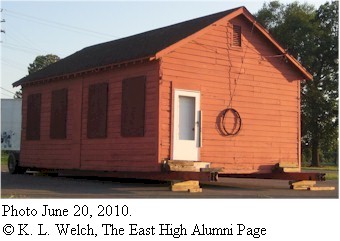
Urgent: East High Principal Suspended
April 16, 2010
URGENT
- East High School Principal Fred Curry was suspended with pay
Thursday, April 15, 2010, by the superindent of Memphis City Schools
while an internal investigation ordered by the superintendent, Kriner
Cash, is conducted. The school system gave no reason for the inquiry.
East has been in the news recently as a group of about 10 girls got
into a fight in a school hallway requiring security personnel to use
pepper spray to break up the scuffle. A few weeks earlier, a girl and a
few boys left school during the academic day. Reportedly the girl and
one of the boys were having consensual sex when it went bad. Three boys
were subsequently charged with rape. It is not know if these events are
the reason for the suspension.
Updates on news of the school are typically posted on our
Daily Update and Portal page first. Please refer to that page for the latest updates.
Sweet magnolias
East High science class plants 26
By Janie Hopkins, Special to My Life,
The Commercial Appeal
Posted to the newspaper's website April 8, 2010
More than thirty students from
Nicholas Getschman's [Faculty]
AP environmental science class at East High School joined members of
the Memphis Garden Club, a member of the Garden Club of America, to
plant 26 magnolia trees around their school's campus.
As part of the Garden Club of America Centennial
Tree Project, 26 magnolias were propagated by Dale Skaggs, director of
horticulture at the Dixon Gallery and Gardens, and repotted last spring
by the garden club members. The three deciduous types -- Dr. Merrill,
Waterlily, and Galaxy -- were tagged and remained in their pots in the
woods at the Dixon over the summer and fall.
The Peer Power Foundation, a tutoring program started by East High graduate
Charles McVean ['61]
that trains upperclassmen and college students to tutor underclassmen
in math, English and science, was contacted to get permission to plant
these trees. Julie Smith, a landscape architect and member of the
Memphis Garden Club, chose specific spots to help screen out the views
of neighboring shopping centers.
Peer Power Foundation director Bill Sehnert,
Dixon horticulture staff member Amy Berthouex and members of the
Memphis Garden Club led by Margaret Atkinson and the students from East
High School worked hard toward improving the campus.
The full day of digging and planting was
rewarded with lunch provided by the Peer Power Foundation. The science
class will continue to care for these trees by fertilizing and watering
them throughout the year. A sign will be placed on site to recognize
the efforts and document the event.
Janie Hopkins handles public relations for the Memphis Garden Club.

Judge upholds newspaper columnist Maruca's right to shift to competing journal
By Daniel Connolly,
The Commercial Appeal
April 2, 2010
When the columnist and advertising rep known as
Maruca switched from one local Hispanic newspaper to another, the first
newspaper sued, since she had signed documents saying that she wouldn't
work for a competitor for a year.
But Maruca — real name Maria Guevara — recently
won a favorable ruling in Shelby County Chancery Court, her attorney
said.
Chancellor Walter Evans hasn't filed a written
order yet, but he said in court that the employee can continue working
for the other newspaper, according to lawyer
Ralph Noyes ['68].
"I feel very pleased, because they wanted to leave me without work for a time," said Guevara, 32.
Guevara gave birth to a boy last week and is
working from home now. But she said she's eager to write more of her
columns, which touch on topics ranging from domestic violence to bosses
who don't pay workers wages. Most are prompted by calls from readers.
"If I don't do this, it's like I'm letting the people down, you know?"
The conflict reflects the ongoing competition for
audience and advertising dollars in the local Spanish-language media,
despite a slow economy that's cut into the earnings of many Hispanic
immigrants.
This case involved the bilingual weekly La Prensa Latina.
Publisher
Sidney Mendelson ['68] declined to comment in detail.
"The judge made his decision and that's what we go by," he said. "That's really it."
According to court records, Guevara joined La
Prensa Latina as an independent contractor in May 2008, producing a
column called "Maruca's balcony" and also contacting customers to sell
ads. She started working full-time in November of that year, and her
duties included acting as master of ceremonies at some events.
Guevara says she was such a well-known figure that the newspaper used her image on a billboard.
She left in December and began writing a similar
column for a different newspaper, called El Grafico. She's now also
involved in ad sales and management.
La Prensa Latina filed suit in February, arguing
that Guevara should be banned from working for El Grafico because this
violated her noncompete agreement and because she was using trade
secrets to entice customers of La Prensa Latina to do business with El
Grafico.
La Prensa Latina asked for a restraining order
to make Guevara stop working for El Grafico or any other print media,
as well as to allow recovery for financial damages.
But in a hearing, Guevara's lawyer, Noyes,
pointed to a Tennessee Supreme Court case that says non-compete
agreements are enforceable only if the employee has received a great
deal of specialized training and inside knowledge.
He successfully argued that Guevara hadn't received these things.
Letter to the editor: "Children are our future"
The Commercial Appeal, March 25, 2010
On March 16, I rode the 50 Poplar bus to the
Midtown Driver's License Service Center to transact some business. I
took the 50 Poplar bus to return home. This bus stopped in front of
East High School, where a horde of students filled the bus to capacity,
some standing.
Most of these young people were not wearing the
school-mandated uniform; most had cell phones and were using them;
several had iPods and were bopping to the music; many were talking
loudly and cursing profusely. Most important, very few carried books or
backpacks.
Myriad thoughts crowded my mind: Neighborhood
schools should never have been abandoned; walking home by your
neighbors to your house has merit. Do not parents ask their children
where their books are in the evening? Do not principals strictly
enforce the city schools' dress code? Is it not school policy that no
cell phones and such be allowed on school grounds?
Behavior of some students is a direct reflection
of the home and other behavior is induced by peer pressure; still, was
I about to shush them and ask that the loudness, cursing and pushing,
etc., stop? No. Was I chicken? Maybe.
President Barack Obama, Bill Cosby, Benjamin
Jealous (NAACP), Spike Lee (recently in the city to speak at the
University of Memphis) and others are desperately trying to reach out
to our youth and show them another path. However, it is going to take
everybody to find the solution to our errant youth. America's future
progress and success as a country greatly depend on our youth of today.
Who has the answer or answers? I await.
Sharon E. Dobbins
Memphis
Teacher at East High in Memphis busted on drug charges
By Lawrence Buser
The Commercial Appeal
March 25, 2010
Two formerly married Memphis City Schools
teachers have been suspended without pay after they were busted on
separate drug charges this week.
 Emily Tubb [Faculty
,
listed as Emily Magill on the East High web site], 33, who also is
known as Emily Magill, was indicted earlier this month on federal drug
charges.
She is accused of possessing with intent to distribute Adderall, alprazolam and heroin.
Adderall is an amphetamine commonly used for
attention deficit disorders. Alprazolam, also known as Xanax, is used
to treat disorders including anxiety and depression.
No other details were included in the indictment
and there is no allegation that she was trafficking in drugs on school
grounds.
Federal prosecutor Greg Gilluly asked for a detention hearing for Monday.
Tubb, who is in the English department at East
High School, is being held in federal custody without bond because she
was found in two meth houses this week, including the Southaven home of
her former husband, Mark Magill.
He was arrested Monday evening after police were
called to a disturbance at his home on Northfield Drive where there was
a reported altercation with his former wife, according to Southaven
Deputy Police Chief Steve Pirtle.
He said Magill, 42, a physical education teacher
at Fairley Elementary, was charged with domestic violence, simple
assault and manufacturing a controlled substance, methamphetamine.
Magill also was charged with kidnapping for
allegedly taking the couple's two children to another location, which
he refused to reveal to investigators, Pirtle said.
Magill is being held on $125,000 bond in the DeSoto County Jail in Hernando.
Reporter Yolanda Jones contributed to this story.
Memphis teacher with drug charges to remain in custody
By Lawrence Buser
The Commercial Appeal
March 29, 2010
A Memphis City Schools teacher will remain in
federal custody for at least a few more days while her attorney tries
to find a secure drug-treatment facility for her before addressing
criminal drug charges.
Emily Tubb, 33, of Southaven, who is in the
English department at East High School, was indicted last week for
alleged possession with intent to distribute Adderall, alprazolam and
heroin.
Tubb, whose married name was Magill, made a
brief appearance Monday before U.S. Magistrate Charmiane Claxton, who
told attorneys to return Thursday with more information on a drug
treatment facility.
Asst. Federal Defender Mary Catherine Jermann,
did not ask for a bond, but instead had suggested several possible
inpatient facilities to address her client's drug addiction.
Federal prosecutor Greg Gilluly, however, argued
that a more secure facility is needed because Tubb had made statements
that she might harm herself.
"She could leave these facilities and she's a
danger to herself because she has no control over her drug problem,"
Gilluly told the court. "She needs to get help, but at a place where
she would be locked down and not have the ability to walk away."
Tubb, who was shackled and wore yellow prison
garb, is being held without bond at a federal detention facility in
Mason, Tenn. She made no statements in the hearing.
Last week her former husband, Michael Magill, a
physical education teacher at Fairley Elementary, was arrested
following a domestic disturbance at his home in Southaven, which was
reported by Tubb.
Magill, 42, was charged with domestic violence, simple assault and manufacturing methamphetamine.
He is being held on $125,000 bond in the DeSoto County Jail in Hernando.
He also was charged with kidnapping for allegedly
taking the couple's two children to another location, which he refused
to reveal to investigators.
Magill and Tubb have been suspended without pay by Memphis City Schools.
'Warm, fuzzy' relaunch for Holiday Inn brand
By Wayne Risher
The Commercial Appeal
March 24, 2010
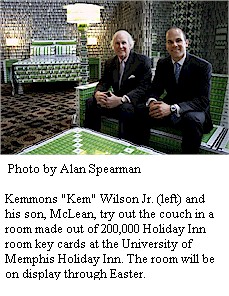
The late lodging industry pioneer Kemmons Wilson would have felt right at home in a hotel room made of plastic key cards.
Fittingly, the kitschy creation of card-stacking
artist Bryan Berg has found a permanent home in a Holiday Inn in
Wilson's hometown.
InterContinental Hotels Group commissioned Berg to build a Holiday Inn
room out of key cards to promote the brand's global relaunch.
After appearances in New York, Washington, New
Mexico and on , the 2-ton exhibit was trucked to Memphis and set up at
the University of Memphis Holiday Inn.
The exhibit, which took four months and 200,000
cards to build, features a reception desk, a bed, a comforter, a sofa,
an armoire, lamps, tables, a toilet and a shower curtain, all covered
with key cards.
It's on display through Easter on the University
of Memphis campus as part of Kemmons Wilson Week. It will eventually
become decor for the Kemmons Wilson School of Hospitality and Resort
Management.
"This is sort of a nice way to kick it off," said
Kemmons "Kem" Wilson Jr. ('64),
the founder's son, as he viewed the display with his son, McLean.
Kemmons Wilson opened the first Holiday Inn in 1952 and sold the chain
20 years ago.
The family business holdings include the
University of Memphis Holiday Inn and a new Holiday Inn near Wolfchase
Galleria; they are also developing a Holiday Inn Express in Jackson,
Tenn. The 92-room Jackson hotel will be built near Pringles Park off
Interstate 40.
InterContinental embarked in 2007 on a $1
billion effort to revitalize the brand with new signs, furnishings,
bedding and amenities.
"This is a huge effort on their part," said Kem
Wilson. "They could either have let the brand fall away or they could
welcome it, and they welcomed it. They found it had a feel-good, warm
and fuzzy feeling" for customers.
Kevin Kowalski, senior vice president, global
brand management, for Holiday Inn, said the company had redone 2,050
hotels and was on pace to finish all 3,300-plus by year's end.
"We've found the relaunched hotels perform 3-7
percent better and are up 2-6 points in market share," Kowalski said.
"We're moving the needle."
McLean Wilson said Wolfchase, which opened last
July, attracted an unheard-of 25 walk-up customers one night last week.
"We would attribute a lot of that to having a new sign and a new hotel.
People driving down the interstate take that as a sign of
rejuvenation."
Sarah-Ann Soffer, a Holiday Inn spokeswoman,
said the relaunch affects 11 Memphis-area hotels and two that are
projected to open by 2011.
Kowalski said corporate support for the U of M
hospitality program is a natural. Angela Brav, chief operating officer
for IHG Americas, will be Kemmons Wilson Week Distinguished Speaker at
1 p.m. today.
"Kemmons Wilson made a very strong value for
traveling families," Kowalski said. "We're not doing radical, crazy
things. We talked to customers, tried to figure out what made the most
value for them, and incorporated them in the hotels."
They left the crazy stuff to Berg, whose playing
card creations include the Capitol, the Empire State Building and most
recently, China's Venetian Macao resort hotel.
"We thought it would be kind of a neat idea to
work with him to build a hotel out of key cards," Kowalski said.
Debra Burns, director of development for the
hospitality school, talked IHG executives into donating the exhibit to
the school after she and the Wilsons saw it in Washington.
"This is the appropriate place to come to:
Memphis, the birthplace of Holiday Inn," Burns said. "If not for the
Wilson family, none of this would be here."
Director of Bands calls for on-campus music building
The East High Alumni Page
March 17, 2010
Calling the existing facilities for the East High
Band and Choir "inadequate," Mr. Ollie Liddell (Faculty), the Director
of Bands at the school, wants a new building added to campus to house
those activities. He says every city school in Memphis has adequate
music facilities for their bands except for East. He and the Band
Booster Club are working on plans for a new building and he has written
this open letter seeking support.
March 17, 2010
I am very proud of the students and the direction the program is
going. However, we need support. After several discussions with the
Band Booster Club, we are trying to come up with a plan of action to
get a Music Building built on campus--possibly in the space left by the
demolished annex building. This building would be built according to
MENC Opportunity-to-learn Standards (www.menc.org) It would have
sufficient space for a Choir, Band, and Orchestra Rooms as well as
sufficient storage area, small ensemble rehearsal space, and offices.
Both the choir and "band" rooms are inadequate. The Orchestra rehearses
in the choir room. They need their own space. The choir room is band.
However, the band room is riddiculous. It is very, very small, the
ceiling is too low, there is no adequate storage area, no practice
rooms, and no acoustical treatments what-so-ever. With the size of the
band growing each year, it will soon (maybe next year) be too small to
accommodate the band at all. The low ceilings and lack of acoustical
treatments make hearing the music correctly impossible. So much so, we
had afterschool rehearsals in the Auditorium so I could hear what is
being played. The auditorium isn't readily available. The lack of
storage space makes things worse. Furthermore, EVERY high school in MCS
has an adequate band room except East. I find this unacceptable. I
would appreciate any help or advice to this end. Please call.
Musically Yours,
Ollie Liddell
Director of Bands
East High School
3206 Poplar Avenue
Memphis, TN 38118
901-416-6160 School
901-416-6161 Fax
Truant pupils, victim, accused, involved in off campus rape
[multiple stories]
Memphis police arrest three suspects in sexual assault of East High student
By Jody Callahan,
The Commercial Appeal
commercialappeal.com, March 10, 2010
Memphis police have arrested three suspects in
the apparent sexual assault of a 17-year-old East High student Tuesday.
The incident happened around 11:30 a.m. near the school at 3206 Poplar, police said.
A 17-year-old girl told police that she was taken
to a nearby location and sexually assaulted by at least five males.
The incident allegedly took place at a vacant
house in the 200 block of Red Oak, not far from the school. The victim
was then taken back to school. She told police that four of the
suspects are East High students. The fifth suspect remains unknown.
Two of the suspects in custody are 18, while the third is 16. No charges have been filed yet.
Memphis police spokesman Karen Rudolph said the
girl willingly left school with one of the boys, one of the
18-year-olds in custody. At that point, the other four were either in
the car with the suspect who called the victim, or were waiting at the
vacant house. In either case, the victim wasn't expecting the other
four to be there, Rudolph said.
Rudolph added that they know the name of the
fourth suspect, the other East student. They don't have an identity on
the fifth suspect, though. Charges are expected to be filed Thursday
morning.
Three teens charged in rape of 17-year-old East High student
By Jody Callahan, The Commercial Appeal
commercialappeal.com, March 11, 2010
Three teenagers were charged Thursday in the rape of a 17-year-old East High student Tuesday morning.
 DeMarious Moore, 18, Brian Bland, 18, and Martavious Humphries, 16, are facing charges of aggravated rape.
Bland and Moore are being held at 201 Poplar, while Humphries is confined to Juvenile Court.
The incident began at about 11 a.m. Tuesday, as
the victim willingly left East High with the three teens, also students
at East.
They took her to an abandoned house at 278 Red
Oak, a little over a mile away. There, according to police, the victim
had consensual sex with Moore.
Then things spiraled out of control.
During sex, Moore slapped the victim in the face,
police said. She told him to stop, but he continued, investigators
said.
At that point, police said, Bland and Humphries
entered the room and forced the victim into additional sex acts.
Two others were named by the victim but didn't
take part, said police, who would not reveal whether the other two were
at the scene of the assault.
"Through a thorough investigation, we found that
these three suspects will be charged with aggravated rape. That's it,"
Memphis police spokesman Karen Rudolph said.
Neither Bland nor Moore has any prior serious
charges on their records, Juvenile Court spokesman Barry Mitchell said.
Moore has a few traffic citations and a curfew violation.
Humphries, however, was arrested in December
2008 on a felony drug charge, Mitchell said. He was placed in custody
of the Youth Services Bureau, which oversees home confinement. He was
released in April 2009.
It is uncertain how four students could leave a school campus so easily during the middle of the day.
Memphis City Schools spokesman Quintin Taylor
wouldn't discuss how the students were able to leave East High School.
 Television Reports
For
an undetermined amount of time, television news stories on this topic
may be available for viewing. If they are still available, you may see
them at
WREG-TV,
WMC-TV, and
WMC-TV
Society of Entrepreneurs will honor Spence Wilson as a 'master'
By James Dowd,
The Commercial Appeal
March 3, 2010
To hear Spence Wilson tell it, the work he does is simply part of carrying on the family tradition.
But what a tradition it is.
As
president of Kemmons Wilson Companies -- established by and named after
his late father, who also founded Holiday Inns -- Wilson oversees an
expansive operation that has included investments in more than 400
different ventures.
Now, after more than four decades of business
ingenuity, the native Memphian who grew up on Galloway and graduated
from East High School is being recognized for his efforts by the
Society of Entrepreneurs
"He's earned it, and I understand just how much
he deserves it because he and I are a lot alike, we're both SOB's --
sons of bosses," said friend Bob Buckman, retired CEO of Buckman
Laboratories. "It can't always have been easy for him, but Spence has
done well and he's a wonderful guy."
Wilson will be honored as a "Master
Entrepreneur" at the organization's annual gala on April 10. His
selection was announced at the organization's new-member reception on
Tuesday.
"I'm honored and humbled because this isn't just about me. I owe everything to my family,"
Wilson said. "They've been very understanding
about the risks and the sacrifices I made and about the time I had to
spend away from them. It wasn't easy, but made it through, and any
success I have is owed to them."
The oldest of five children, Wilson was the
first in his family to attend college, and after graduating from
Vanderbilt University he joined the Tennessee Air National Guard. After
the service he enrolled in Harvard Business School; when he finished,
he moved back to Memphis, where he has spent the bulk of his career.
"My dad had it in the back of his mind that I'd
come back here and join his company, and ultimately that's what I did,"
Wilson said. "I worked with him for a while at Holiday Inns, but
eventually transferred to Kemmons Wilson Inc. and that's where I
stayed."
During his 40 years as an entrepreneur, Wilson
has been involved in a number of projects to broaden the company's
holdings, including office building construction and development,
injection molding businesses and even a tortilla manufacturing company.
Perhaps the most successful has been Orange Lake
Resorts in Orlando, Fla., which today features 2,500 timeshare villas
on more than 1,400 acres. The property counts some 140,000 owners and
hosts more than 12,000 guests each week.
"My dad was a serial entrepreneur and I have
some of that DNA. I'm very curious about how things work and I love to
see a deal go through," Wilson said. "We've built a great brand, and
it's fun for me to continue to take it to higher levels."
Despite his success, Wilson is determined to
remain grounded in his hometown and serve as a mentor for future
generations of entrepreneurs.
His lengthy list of community involvement
includes working with Junior Achievement of Memphis and the Mid-South,
Rhodes College and Youth Villages, and it's his commitment to giving
back to the community that most impresses many of his fellow business
leaders.
"He's a consummate entrepreneur and has done a
great job of continuing the substantial legacy of the Wilson family,"
said Gwin Scott, president of EmergeMemphis. "He charted his own path
in numerous endeavors, and what's equally impressive is his
longstanding sense of altruism for this community."
Larry Colbert, senior vice president at Junior Achievement, agreed.
"He's been phenomenally supportive of our
organization for years, and I can't think of anyone more deserving of
this honor," Colbert said. "He really cares about the community and
continues in the spirit of his father in doing everything he can to
make our city stronger."
Grizzlies and the Mid-South McDonald's Co-Op salute Black History Month

from www.nba.com
February, 2010
In honor of Black History Month, the Memphis
Grizzlies and McDonald's are recognizing basketball stars that honed
their skills in Memphis and shared their talents with the world during
Grizzlies home games played in February 2010. Here are the players who
were honored:
...
Cedric Henderson ['93] – Feb. 9 vs. Hawks
Henderson is a product of East High School where
he became a McDonald's High School All-American. A standout at The
University of Memphis, Henderson is the only player in Memphis history
to rank in the top ten in all-time scoring, steals and blocks. He was
selected by the Cleveland Cavaliers in the 1997 draft and spent five
years in the NBA. After playing in the NBA he went on to play in
Greece, Ukraine and Dubai. Since coming back to Memphis, Henderson has
supported his hometown by hosting the SportsBall, a benefit to support
Big Brothers Big Sisters of Greater Memphis. He currently assists the
middle school girls' and varsity boys' basketball teams' coaching
staffs at Harding Academy.
Memphis Memories
By Staff,
The Commercial Appeal
February 23, 2010
[The following was republished on Feb. 23, 2010 in the Memphis/Mid-South Memories item in
The Commercial Appeal, originally published Feb. 23, 1958.
The All-Memphis junior high basketball team for
1955 has players from five schools. Considered tops among the
youngsters are Richard Howell (11), Bellevue; Robert Randolph (25),
Treadwell;
Lee Welch ['58] (12), East; J. W. Adams (22), South Side; and Bobby Wiginton (8), Humes.

People Cybill Shepherd - Supermodel
By Vance Lauderdale, www.memphisflyer.com
February 12, 2010

Most people these days probably think of
Cybill Shepherd ['68]
as mainly a TV and movie actress. And who can blame them, after some
really fine roles in the movie The Last Picture Show and then on
television with Moonlighting (with Bruce Willis, back when he had hair)
and later, Cybill.
Others may know her for her singing, or maybe
her political activism, or maybe because she kept a home in the South
Bluffs for years and years.
But many people, it seems, have quite possibly
forgotten that this East High School graduate was, by any definition of
the word, a Supermodel. She got her start by winning the "Miss Teen
Memphis" contest in 1966, which launched an extraordinarily successful
modeling career. In fact, in the late 1960s, it was hard to pick up a
teen or fashion magazine without finding Cybill on the cover or
featured inside.
While rooting through the Lauderdale Library one
lonely Saturday night, I turned up a collection of Glamour magazines
(as shown here) from 1969, 1970, and 1971 with Cybill on the cover. Not
only was she a fetching cover model, but rumor has it that director
Peter Bogdanovich spotted one of these Glamours while standing in line
at a Hollywood supermarket and decided, right then and there, that the
then-unknown girl would be perfect as Jacy in The Last Picture Show.
(Other stories claim that his wife actually came
up with the idea. If that's so, she probably came to regret it, since
Peter and Cybill started, uh, "dating" after the movie came out.)
The rest, as they say, is history. But here are some other Cybill-adorned Glamours for you to admire.

Advanced Placement courses see increase in enrollment
By Jane Roberts,
The Commercial Appeal
February 12, 2010
For students taking Advanced Placement
environmental science at East High School, no class has ever consumed
so much mental and emotional energy.
The 90-minute lecture-lab meets daily instead of
on alternating days like other courses. Since every lecture generates
about an hour of homework and all AP students at East must attend two
hours of tutoring each week, registering for an AP course means at
least 15 hours per week.
"You have to be on your study game," said
Terrello Lane, a junior also taking AP art this year. "I'm taking AP
classes because colleges want to know if you're taking a challenging
load."
Lane is determined to go to college and
confident that his AP scores will get him noticed and give him credit
for two college-level courses.
He is among a widening group of students
enrolling in AP classes, according to the College Board's annual
analysis, released this week. It shows that enrollment in the decade
has doubled to 800,000 students.
But with the "democratization" of AP classes,
tens of thousands of students are also failing while simultaneously
financially taxing their school districts because the AP's
lab-intensive courses are also among the most expensive schools offer.
Last spring, 60 percent of AP seniors in Memphis
City Schools did not score high enough to get college credit for their
work. Nearly 55 percent scored under par in 2008.
The financial burden will bear down this year
when a $1.6 million grant that has covered most of the district's AP
costs since 2006 runs out.
"Our scores are very much in line with the
national 60/40 attainment rate," said Linda Sklar, head of optional
schools for MCS, who cautions against using "pass/fail terminology."
"The score simply represents whether a college
will award that student credit," she said. "It does not mean failure."
Because high schools have their own standards
for grading, it's very possible, Sklar said, that a student earning a
"1" would get high school credit for the class.
AP exams are graded on a scale of 1 to 5. A
score of "3," which translates into a grade of "B-" or "C," is accepted
by 80 percent of U.S. colleges and universities. A score of "5" would
translate into a grade of "A."
According to a USA Today article last week, more
than two in five students -- 41.5 percent -- earned a score of "1" or
"2," an increase from 36.5 percent in 1999.
In the South, nearly half of all those tested --
48.4 percent -- earned a "1" or "2," up 7 percentage points from a
decade ago and statistically significant from the rest of the country.
AP classes have been offered since 1955. But
about a decade ago, states and high school leaders started easing
restrictions on who could enroll, part of a strategy to improve the
number of college-ready students.
MCS Supt. Kriner Cash added 40 more AP sections
this year, including three at East High, where all 33 students who
applied for the AP environmental science class were admitted.
Teacher
Nicholas Getschman (Faculty) admits that the class is larger than optimal, "but we didn't want to discourage anyone in the first year."
While several students are struggling, he is
convinced that their chances for success in college and life are better
even if they don't do well on the final exam.
"They're getting exposure to college-level
work," Getschman said. "I have a student who may not pass, but she's
worked hard and has really grown. It's easy to see."
My Words: Pardon my French! But we need it
By
Michele Mallory (Faculty), Special to
The Commercial Appeal
February 7, 2010

I
was mistaken for a French woman once. I was on a scholarship in
Normandy studying the Second World War, and some friends and I had
taken a weekend jaunt down to the wine country of the Loire Valley.
After a long day touring, I decided to run into
a cave de dégustation (a wine cellar) on my own to purchase some wine
to take home to my parents. After some polite conversation, the
viticulteur (wine maker) asked me what region I was from. Region?
"Non, non, je suis américaine," I said. The
temperature in the cave dropped five degrees in an instant. Ah, the
French and their love of Americans.
Still, as a lifelong Francophile, I was much
chagrined to hear the news that my alma mater is "phasing out" French
as a foreign language offering to make room for Mandarin Chinese.
From a purely economic perspective, I suppose I understand.
Mandarin Chinese has about 800 million native
speakers, with French falling far behind with only 90 million. I
understand the need to change with the times; to teach marketable
skills. After all, parents who fork over $15,000 for tuition each year
need to get their money's worth. But, to quote my epicurean
mother-in-law, "how will they ever learn to read a menu?"
French is so tied to the English language that
by not studying it, these next generations will miss out on one of the
building blocks that make us who we are as Americans.
Does the Battle of Hastings in 1066 ring any
bells? When William the Duke of Normandy conquered England, our
language changed forever. Without this infusion of the French, and
thereby Latin, language into our own, we'd sound almost German right
about now.
Studying French allows us to truly understand
words like "fraternity," "equality" and "liberty." Or more useful to
our American plight these days, "mortgage" (mort = death, gage =
pledge).
I'm curious to see how the Mandarin will take
off. For one, there is absolutely no common etymology between Chinese
and English. Get out those flashcards! Also, Mandarin is a language of
intonation. The French student's struggle with pronouncing nasal vowels
pales against the Mandarin student's struggle to convey the difference
between the spoken ma (mother), má (hemp), ma (horse) and mà (scold).
Good luck with that. I'll stick with my pain au chocolat, s'il vous
plaît.
And about that Franco-American hatred; it makes
a good joke, but it's far from true. Anyone who loves to say that the
French hate Americans has never been to Normandy.
Visit the American Cemetery at Omaha Beach of
D-Day. Go now before our greatest generation is no more. You will see
nothing but thankfulness, honor and sincere tribute paid to the
Americans who died for that country.
And the conversation with the viticulteur I
mentioned earlier? It turned out, his response to my being American was
halting, but out of shock, not disrespect, that an American had taken
the time to learn the French language so well. He asked me to stay and
have a glass of wine with him, as my friends in the car honked for me
to hurry up. Rude Americans. Vive la France!
Michele Mallory lives in East Memphis and is a
wife and mother to two boys. She has a degree in communications from
the University of Tennessee, Knoxville, with French as a second major.
She teaches French at East High School.
Weapon and drug arrests at East High
4 arrested at East High: 2 for marijuana, 2 for gun possession
By Jane Roberts,
The Commercial Appeal
January 26, 2010
4 arrested at East High: 2 for marijuana, 2 for gun possession
Four juveniles were arrested this afternoon at
East High School after two threw a gun on school property while being
pursued by police.
The incident started when officers were
questioning two other students on campus about drug use. They were
arrested for possession of marijuana.
In the process, the officers noticed two
students acting suspiciously, according to district spokesman Quintin
Taylor.
"The students took off running and tossed a
weapon," he said. The two were also arrested. Those two students, both
16, were charged with carrying a weapon on school property and
possession of handgun by juvenile.
The incidents happened around 2 p.m.
Taylor said the school's metal detectors had been used today.
"East is not one of our high-incidence schools; we do random metal detection at (those) schools," Taylor said.
School officials were tipped about the marijuana
through Trust Pays, a confidential hotline that allows students or
members of the public to call in tips.
If the tip pans out, the caller is eligible for a cash reward.
Guns at Memphis city schools ring alarm bells
MCS, police stepping up screening, patrols
By Jane Roberts, The Commercial Appeal
January 28, 2010
Supt. Kriner Cash and Police Director Larry
Godwin put out a community "all-call" Wednesday after five gun
incidents were reported in or near city schools over nine days.
"We have doubled up our effort -- redoubled our
efforts -- on security screening each morning," said a grim-faced Cash.
"We must continue to ensure -- not only in the
morning but randomly during the day -- that we are checking all
entrances and exits. ... Students can be very, very creative if they
want to get weapons in schools."
Godwin said he's ordered more patrols at hot points.
"We're going to do it in a covert way; we're
going to do it in an overt way, but we are going to address this
problem. We will make those arrests and do the things we have to for
those violent individuals who are disrupting the good students of
Memphis City Schools."
Tuesday, two students were charged at East High School with possession of a handgun. It was loaded.
Eight hours later, a male leaving a ball game at
Kirby High was shot walking away from the school by someone he had
argued with earlier.
Monday, as school was getting out at Vance
Middle, a police officer ordered a 14-year-old to drop his weapon after
a parent tipped off authorities. It also was loaded.
The story was similar at Hamilton High on Jan. 19, when a 16-year-old was taken into custody.
To date, 10 guns have been found in city schools
this year -- six of them loaded. At this time last year, six guns had
been confiscated; three were loaded.
Godwin is working with Juvenile Court
prosecutors to trace the source of the guns, "ultimately interrupting
the source," he said.
He's also buying gunshot-recognition cameras to place around schools.
"Once a weapon is fired, we will have a recording; we'll have information," he said.
Principals at several large high schools say it's
impossible to run 1,000-plus students through scanning devices,
including X-ray equipment, and get them to class on time.
"There will be disciplinary action for any
further breaches of the procedures we require," Cash said. He has
assigned members of his "top teams" to do spot checks.
Metal detectors were used Tuesday at East. Cash
didn't know the specifics of how the gun got in school but said he
doubts the principal did anything wrong.
Weapons in city schools tend to be found at the
end of the day, leading authorities to suspect they are being smuggled
in through propped-open doors before school dismisses, partly because
students are worried about walking home.
"When you look at the data and go to the root
cause of why students bring weapons to school, they tell us they feel
safe in school," Cash said.
The walk home is another story, particularly for known gang members walking through rival territory.
Because about a third of students in Memphis
change schools once a year, Cash says, "when they leave to go to a new
community, they feel threatened. That is no excuse for bringing guns to
school."
According to MCS policy, principals are expected
to conduct checks by metal detector at least nine times a year in most
middle and high schools. In the 14 schools with the most crime, the
checks are supposed to happen daily.
A memo to district principals Wednesday from
Cash's chief of operations, Roderick Richmond, said daily scanning logs
now will be mandatory in every school.
Football remains in news in off season
By Phil Stukenborg,
The Commercial Appeal
Posted January 15, 2010
[Excerpt] ...
East High senior defensive tackle Brandon Ivory
is scheduled to make an official visit to the UofM this weekend, but
it's not to make a decision about his college future. That decision has
been made.
Ivory, 6-4 and 330 pounds, will play for
first-year Tigers coach Larry Porter, according to Ivory's high school
coach,
Marcus Wimberly ('92). Wimberly said Ivory also considered the University of Miami, Wimberly's alma mater. National Signing Day is Feb. 3.
Wimberly called Ivory, who played defensive
tackle and offensive guard for East, a natural leader. And he said
Ivory was an assignment nightmare for opposing offensive linemen.
"He was one of our captains," Wimberly said. "If
we needed a stop and the (football) was going up the middle, he made
the play nine times out of 10. He gave people fits, especially
centers."
Ivory started each of his four seasons at East,
where Wimberly took over four years ago. Ivory played primarily on
offense as a freshman and grew into a two-way performer, gradually
becoming a dominant defensive tackle.
"He really came on last year," Wimberly said.
"He worked hard in the weight room and he understands the game,
especially at this level. He still has a lot of work to do, but he also
has a lot of potential."
Wimberly said Ivory "sparked a lot of interest"
by finishing with six tackles for loss in last month's AutoZone Liberty
Bowl High School All-Star Game at Memphis University School.
"That got a lot of attention, but he's been
doing it all year," Wimberly said. "And he's done it against some good
teams, teams like Olive Branch, MUS, Whitehaven, White Station ... he
didn't do it all against cupcakes."
Ivory is the third Memphis-area commitment,
joining Horn Lake receiver Bakari Trotter and Houston High receiver
Jerry Anderson. He said the hiring of Porter played a part in his
decision.
"First of all, I like coach Porter and I think he is going to change the program around," Ivory said.
Two arrested, another sought after high-speed chase in Bartlett
By By Clay Bailey,
The Commercial Appeal
January 8, 2010
A witness gave Bartlett police dispatchers a
move-by-move account of three people breaking into a house on Guffin
around lunchtime Friday -- providing officers with an edge on capturing
the trio.

But
it took a high-speed car chase through the suburb's northwestern
quadrant, foot pursuits, a pair of wrecked cars and at least one
shotgun blast from police before two of the suspects, a man and a
woman, were captured in Memphis.
One of the suspects is the son of the owner of the home that was burglarized.
The crime unfolded over the police radio after
the witness, watching nearby, called police to report the break-in at
5195 Guffin shortly before noon.
"If (the witness) wouldn't have called when they
did, there's a good chance (the suspects) wouldn't have been caught,"
said Insp. Jeff Cox, head of the department's investigative division.
Police said the witness told them a woman was
driving a gray Mitsubishi through the neighborhood while two men went
into the house.
The men would put the goods in the car, then the
woman would drive around again while the intruders returned to the
residence.
When police pulled into the neighborhood, the suspects fled in the Mitsubishi, starting a chase.
The pursuit went along various streets in the
suburb's northwest corner and carried into Raleigh. Insp. Steve Todd
thought he was about to stop them at one point, but the driver tried to
ram his unmarked car.
One person jumped from the Mitsubishi on August Moon, sending part of the pursuing officers on foot after him.
He was still at large Friday evening.
Meanwhile, the car with the other two people
continued to flee -- followed by police -- eventually ending up on
Bruton Place near Old Brownsville.
At one point, an officer fired his shotgun at
the vehicle. A hole was visible above the left tail light. That part of
the case is still under review, Cox said.
The suspects were trapped in the cove on Bruton
Place. When they headed out of the dead end, the car slammed into one
of the pursuing Bartlett squad cars in the curve of Bruton Avenue and
Bruton Place.
The suspects' car banged into the curb and ended up in a yard.
The suspects fled from the scene, but were caught
a short time later, according to Lt. Rory Mack, Bartlett police
spokesman.
Tremaine Artry ('09), 18, identified by
police as the son of the homeowner, is charged with aggravated
burglary, evading and resisting arrest, reckless endangerment and four
counts of aggravated assault.
Bridget Jones, 21, faces the same charges except resisting arrest.
Both were being held without bond.
Television news stories are also available from WMC-TV and WPTY-TV.
The
television stations are not likely to provide those stories and clips
permanently,so if you find they are no longer available, please notify editor@EastHigh.org.
Ole Miss' Cassius Vaughn grows into CB role
NFL looming as senior closes career
By Scott Cacciola,
The Commercial Appeal
December 31, 2009

DALLAS --
Cassius Vaughn ('06)
can remember meeting with three friends that day, all Memphis-area
products who, like him, were bound for Ole Miss. He convened with Greg
Hardy, Cecil Frison and LaDerrick Vaughn at one of Downtown's finer
dining establishments -- "Hooters," Cassius Vaughn said -- for a
signing day party in February 2006. They signed their letters of
intent, and the future was theirs.
"It was an exciting moment," Vaughn said.
In some ways, it feels like yesterday. In other
ways, it feels like a lifetime ago. Because as quickly as the past four
years have evaporated, Vaughn also knows he has changed a great deal.
He has one game left in his college career, a meeting with No. 21
Oklahoma State on Saturday in the 74th AT&T Cotton Bowl at Cowboys
Stadium, but he has little time for nostalgia. He already finds himself
looking ahead once more.
"I'm out the door on my way to another chapter
in my life, and it all catches up with you real fast," said Vaughn, a
senior cornerback and former standout at East High. "But for a lot of
the seniors, this game is like an audition. We're going to play hard."
An audition for the NFL: It has come to this for
Vaughn, who has transformed himself from a raw talent into one of the
more reliable cornerbacks in the Southeastern Conference. Tied for
seventh in the league with 11 passes defended, including two
interceptions, Vaughn is a major reason Ole Miss (8-4, 4-4) is ranked
15th in the country in pass defense, limiting opponents to 179 yards
per game.
Playing cornerback tends to be a thankless job,
but Vaughn -- recruited by most schools out of high school as a running
back -- has embraced his role. He enjoys being out there on the island,
matching up against top-flight receivers, man-to-man without a safety
net.
"Cassius is a big-time competitor," said senior
cornerback Marshay Green. "Anytime people like playing defense, you
know it's going to be fun."
Vaughn showed up at Ole Miss with extraordinary
speed. According to Green, Vaughn is capable of running the 40-yard
dash in just over 4.3 seconds -- a time that would seem sure to pique
the interest of NFL scouts. But as a freshman and sophomore, he was
extremely raw. In high school, he could rely on his athleticism to
compensate for mistakes or slight hesitations. Not in the SEC. He
needed to hone his instincts, and he had to learn how to anticipate.
"The one thing about this league is that if you
don't have a pre-snap plan for what you think they might do, you're not
going to make the play," cornerbacks coach Chris Vaughn said. "Because
these teams are too good at throwing and catching."
He made several plays this season that he
probably would not have made earlier in his career. Chris Vaughn
recalled two examples in particular. Against Southeastern Louisiana on
Sept. 19, he went up with two hands -- a subtle but important detail --
to intercept an errant pass. And early in the second half against
Tennessee on Nov. 14, Vaughn anticipated a screen pass across the
middle that he deflected.
"I just got way more confident with this
coaching staff," Cassius Vaughn said. "Just really understanding how to
play defense, knowing what to do, being able to play fast. You come
here wanting to practice and wanting to get better because you know you
have lots of support."
No one besides his coaches and perhaps his
teammates would remember those moments, but the significance was not
lost on those who had invested in him. It was rewarding for Chris
Vaughn, because all the pieces were beginning to fit. And while it
might sound clichéd, Cassius' potential remains largely untapped.
"He's going to test well," Chris Vaughn said of
the upcoming NFL Scouting Combine. "The big thing is, there's got to be
a team out there that feels he brings something to the table and that
he's nowhere near done with his development as far as where he can go.
A team has to believe in him."
Vaughn will turn his full attention next week to
preparing for the combine, though he will miss his friends --
especially his daily games of "Madden NFL" with teammates. He has more
responsibilities now, including a 1-year-old son, Cassius Vaughn II,
who won the Grizzlies' baby crawl contest during halftime of their game
against the Indiana Pacers on Dec. 18.
Asked if his son is a cornerback in the making, Vaughn said: "Well, he's just trying to walk now."
As his father knows, there is plenty of time to grow.
A new year, new hope for Memphis
Letters to the Editor,
The Commercial Appeal
December 31, 2009
It seems like 100 years ago that I had the great
privilege of living in Memphis and teaching in the junior high part of
East High School; actually, it was around 1962-65. We lived on
Charleswood, about 10 miles from the river.
Those were three wonderful years -- the
unbeatable park and zoo, where you could wander all day and never see
everything; attending high school and college sporting events; the
superb medical care at Methodist Hospital; the joy of driving Downtown
for many cultural events, one of the greatest of which was the Front
Street Theater.
I had no contact with Memphis until a few years
ago when we attended some wonderful exhibits at Cook Convention Center,
combined with visiting our money in Tunica. This newspaper was always a
great read, but these later years your news has been sad for a person
who dearly loves this beautiful city of the old and the new South --
the crime, the social ills, the politics, the weaknesses of the public
schools.
I hope and pray that some of the optimistic
items I've read the last couple of weeks are the light at the end of
the gloomy tunnel for this city -- the Gates grant, the new city
politicos, a Downtown park, renovation rather than destruction of some
of the priceless buildings like The Washburn, mentioned in your Dec. 30
article "Views to history."
The Dec. 25 Viewpoint guest column by Pat
Halloran of the Orpheum prompted this letter; it was full of such
optimism and hope.
Memphians, do not let this wonderful city become
another run-down, has-been grande dame. Love it and protect it.
Marty Henry (Faculty)
Malvern, Ark.
[If anyone can adise the subjects Ms. Henry taught, the specific
years she was at East Junior High, and her name then, if different,
please send that information to editor@EastHigh.org.]
Post-Christmas sales lure shoppers back into stores
By By Ryan Poe
The Commercial Appeal
December 27, 2009
[Excerpts]
Shoppers swamped Memphis-area retailers Saturday
to take advantage of after-Christmas sales, spend their gift cards or
return presents, capping a holiday season that showed signs of a slight
improvement over last year's dismal sales figures.
"People were just piling in today," said
Lisa Ortasic-Hayes ['74], owner of one of the Shops of Saddle Creek in Germantown that sells fashionable maternity clothes.
Ortasic-Hayes, who operates the shop with help
from her daughter, said she kept Haute Mama open an extra hour because
of the heavy flow of customers. "I had about 16 people in at one time,
and this is a small store."
...
Shelby Middle School gets $600,000 grant to continue Peer Power tutoring
By Richard J. Alley
The Commercial Appeal
December 19, 2009
Memphis businessman
Charles McVean ['61]
is well-versed in the art of speculation, and his recognition of the
opportunities to invest in young students is paying dividends.
The latest investment is Shelby Middle School
and its North Bolivar School district in Shelby, Miss., which has been
awarded a $600,000 grant from the U.S. Education Department.
The grant was awarded to the school to continue
its yearlong work with Peer Power Foundation, McVean's tutoring
initiative aimed at students in grades 7-12.
Prompting the Education Department grant was the
surge in state math exam scores among seventh-graders at Shelby Middle.
"This kind of financial support will mean that
we can touch the lives of so many more students," said Rives Neblett,
the Shelby businessman who funded the program through a nonprofit
group.
McVean, a 1961 graduate of East High School, has
made a career in the futures and trading markets of New York and
Chicago, becoming a nationally recognized authority on beef cattle
along the way.
In 1986, he founded McVean Trading &
Investments, a Memphis-based global organization that manages
investments for more than 5,000 clients.
He is also a philosopher who sees a troubled future for Memphis unless someone takes action.
"There is an over-investment in private colleges
and universities relative to efforts to improve primary and secondary
education for underprivileged kids," he said.
His private, nonprofit Peer Power began in 2004
with the Greater East High Foundation in 2004, which uses
high-performing high school and college students to tutor
underperforming students.
"One of our main goals is to give constant encouragement and constant praise," said
Meah King ['97 and Faculty], tenth-grade English teacher and faculty sponsor for Peer Power at East.
But the program's rewards are tangible, as well.
"Peer Power also gives monetary incentives," King said. "We try to exhaust all possibilities."
The program's effectiveness at East is
measurable: King said they awarded several thousand dollars for
attendance and report card grades after the first nine weeks of this
school year. East now boasts a 70 percent passing rate, versus a 75
percent failure rate in 2002.
"We're teaching them that life is a competitive
sport," she said. "You're not just competing among each other, but
you're competing worldwide. You have to be the best to be successful."
James Griffin, principal of the Grizzlies
Academy, a nontraditional school within the Memphis City Schools system
that accepts students who are one to two years behind, praises the
program.
"Students see they have a model of what they
want to become," Griffin said. "The methods come not just from me and
my staff, but their peers as well. They can explain something in a
totally different way. It's relationship building."
Other Memphis schools involved in the program include Whitehaven High School and Lester Elementary.
The key to the program is giving students the individual attention they need.
Collapsing the student-teacher ratio is the only way to focus more attention on the student.
"The only answer for East High School was to
implement the dynamics of the one-room schoolhouse on a large scale by
using the top end of the older kids on a professional basis to teach
the younger kids, thereby collapsing the student-to- teacher ratio from
28 to 1 to 2 to 1," McVean said. "Through this process, we identified
the most underutilized asset in our society today: the top end of these
underprivileged kids."
Third-year University of Memphis student Cortney
Richardson, a 2007 East High graduate and Peer Power tutor, said he
admires McVean's effort to give back to the community.
"A lot of what he does goes unnoticed, but he is
a wonderful philanthropist and so genuine, and that's one of the most
important things," Richardson said. "He makes a lot of things seem
attainable."
Planned Parenthood clinic move criticized
Lieutenant governor calls for Senate hearing
By Lindsay Melvin
The Commercial Appeal
December 18, 2009
Lt. Gov. Ron Ramsey is criticizing a state agency
for allowing a clinic that provides abortions to locate near Memphis
Catholic High School.
In a mass-distributed letter on Thursday, the
Republican lawmaker from Blountville bashed the Health Services and
Development Agency, which grants certificates of need to health care
facilities.
"It is shocking that the HSDA would do something
so stupid and insensitive," said Ramsey, who is running for governor in
next year's elections.
On Wednesday, the HSDA voted to grant Planned
Parenthood Greater Memphis Region permission to relocate less than a
mile from its current Union Avenue office to 1750 Madison.
The new location, about two-tenths of a mile
from Catholic High, has been the focus of the Catholic Diocese of
Memphis, which has been trying to block the move.
The 54-year-old lieutenant governor, with a
history as an abortion opponent, is demanding the agency apologize and
revoke its vote.
Further, he intends to bring the 10-person
volunteer board before the Senate Government Operations Committee in
January to determine how it reached its decision.
"It's just common sense, if you don't want something next door to you, you should have a say," he said.
The certificate of need passed with four for the
relocation of Planned Parenthood and two against. Remaining board
members were either absent or abstained.
Agency board member and Memphis physician
Dr. Charles Handorf ['69]
said the board focuses on whether a proposal contributes to orderly
development of health care, whether it's economically feasible, and
whether there is a need.
"We're not a zoning body. We're not the morality
police. We're not judging right from wrong. That's not the role of this
body," he said.
As customary, Handorf recused himself from the vote because the project was based in his hometown.
This will be the first time the agency will
report to the operations committee to dissect one particular project, a
state official said.
Flinn considers run for Tanner vacancy
By Alex Doniach
The Commercial Appeal
December 12, 2009

Republican Shelby County Commissioner
George [Sonny] Flinn [associated with the Class of '61] -- a prospective candidate for county mayor -- is considering a run for the 8th Congressional District.
A week after the surprise retirement announcement
of longtime incumbent U.S. Rep. John Tanner, D-Tenn, Flinn said he may
seek the seat that includes parts of Memphis and Shelby County. He
won't announce until January.
"I'm weighing the support and actually just what
can be done," said Flinn, 66, a two-term commissioner and radiologist
who runs a group of clinics as well as Flinn Broadcasting Co., a group
of radio stations.
Tanner announced last week that he won't seek
re-election to the office he's held for 11 terms, creating a wide-open
race that's drawn interest from a flurry of Democrats and Republicans
across the state.
The 19-county district includes Frayser and
Raleigh in Memphis, Millington and northwest Shelby County, and
stretches through Jackson to Clarksville.
Although Democrats have long held the seat,
National Republican Congressional Committee spokesman Andy Sere said
the district has become increasingly conservative and overwhelmingly
voted Republican in the 2008 presidential election.
"We're actually favored to take it," Sere said of the 2010 congressional race.
But Sere said if Flinn runs, he'll have to catch
up to Republican challengers Stephen Fincher, a Crockett County farmer
and gospel singer, and network systems engineer Donn Janes of Brighton,
who both announced their candidacies this summer.
Convincing voters in this mostly rural district
could be another challenge for Flinn, who divides his time between four
homes in Shelby County and Washington, D.C., only one of which is in
District 8.
Flinn, whose commission district encompasses
mostly the suburbs and East Memphis, said he doesn't have a primary
residence -- "it depends on the week" -- but that constituents in the
8th Congressional District have urged him to run.
Yet Flinn said he still hasn't ruled out a run
for county mayor in 2010. In 2002, he spent $1 million of his own money
in an unsuccessful campaign against A C Wharton for county mayor.
"That's my other decision -- where I can serve
the best," Flinn said. "As county mayor or as a congressman from the
8th District?"
So far only Democrats Deidre Malone, a
commissioner, and Harold Byrd, Bank of Bartlett president, have
announced bids for the county mayor's seat. No other Republican has
indicated a strong interest in running.
Shaw Joins Glankler Brown, Has High Goals for Future Practice
REBEKAH HEARN |
The Daily News
Thursday, December 10, 2009
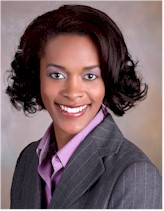 Miska L. Shaw ['00]
has joined Glankler Brown PLLC as an associate. Shaw practices in civil
litigation, including family, personal injury, employment and business
law.
She received her bachelor's degree in applied
economics management from Cornell University and her master of public
administration degree from the University of Memphis. Shaw earned her
law degree from Washington University School of Law in St. Louis, where
she was a member of the Dispute Resolution Society and received the
Excellence in Oral Advocacy Award.
During law school, Shaw also spent a semester studying international law in the Netherlands.
She is a member of the Memphis, Tennessee,
American and National bar associations, the University of Memphis
Alumni Association and serves on the Memphis PREP Alumni Committee.
Q: In law school, you were active in the Dispute
Resolution Society. Is this related to arbitration/mediation? Are you
interested in becoming a certified mediator?
A: Yes, the mission of the Dispute Resolution
Society is to promote law student awareness and training in the areas
of mediation and arbitration. While in law school, I obtained
certification as a mediator according to the requirements of the state
of Missouri. I have observed several hours of very experienced
mediators wrangling with contentious parties.
I also undertook an intensive study of
community-based mediation in Nepal. The Nepalis have adapted our
Western model of mediation to address their cultural beliefs and the
lack of suitable government courts to handle personal disputes. Most of
their mediators are just ordinary people, not lawyers.
I will eventually obtain mediator certification
in Tennessee. However, I am more focused on gaining trial experience
right now. I think one of the most beneficial qualities for an attorney
mediator is to have tons of courtroom experience under your belt, so
that the disputing parties have faith in what you tell them. At
Glankler Brown, I have some of the best trial attorneys as my mentors,
so I am definitely on the right track.
Q: How did you get the opportunity to study in
the Netherlands during law school? Did you focus on any particular
aspects of international law at the University of Utrecht?
A: I was chosen to participate in an exchange
program arranged by my law school. I have always been interested in
comparing our American legal system with that of other countries. My
studies in the Netherlands focused on human rights, juvenile law and
Dutch law. One area of international law that I intend to incorporate
into my practice is international adoption. I am looking for supervised
pro bono cases to work on so that I can develop my expertise in this
area.
Q: Why did you choose to pursue a master's
degree in public administration? Has that degree helped you in the law?
A: I chose the MPA program at the University of
Memphis because I was considering a career in either the government or
nonprofit sector. There may come a time when I decide to pursue a
career in public service. But for now, the degree is quite helpful in
my private practice. Glankler Brown serves clients that are government
agencies, as well as clients seeking our guidance to ensure compliance
with governmental regulations. My public administration background
helps me to understand the political and legal environments in which
these clients operate, so that we, as a firm, can closely tailor our
legal services to match their needs.
: As a recipient of Washington University School
of Law's Excellence in Oral Advocacy Award, what do you think is one of
the most important aspects of oral arguments?
A: Making sure that what you say is factually
and legally correct is one of the most important aspects of a good oral
argument. This requires meticulous research and preparation and, of
course, high ethical standards. You never want to lose the trust of
your audience.
Q: What brought you back here after law school?
A: I was born and raised in Memphis. I received a
great education from East High School, which is a Memphis City School.
I went away to upstate New York for college and to St. Louis for law
school. I was drawn back here by the down-to-earth people, the Southern
culture, the cost of living, and most importantly, the fact that a
majority of my family members live here.
Q: If you were not a lawyer, what would be your second career choice?
A: If I were independently wealthy, I would
travel all over the world helping refugees and poor people obtain human
rights like education, clean drinking water, the right to vote, freedom
from oppression, etc. If I should win the Powerball jackpot, I will
definitely pursue this dream. In the meantime, I fulfill my
humanitarian duty by volunteering with local charities, including
(providing) pro bono legal representation.
Out-of-towner returns to express heartfelt gratitude for men who saved his life
'What words do you use to thank somebody who saved your life?'
Hank Dudding,
The Commercial Appeal
November 7, 2009
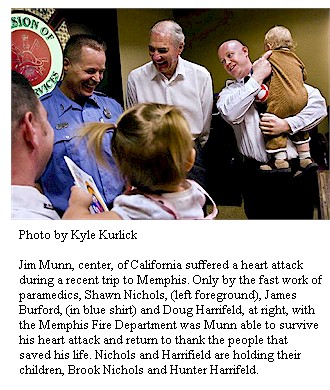
Jim Munn, center, of California suffered a heart
attack during a recent trip to Memphis. Only by the fast work of
paramedics, Shawn Nichols, (left foreground), James Burford, (in blue
shirt) and Doug Harrifeld, at right, with the Memphis Fire Department
was Munn able to survive his heart attack and return to thank the
people that saved his life. Nichols and Harrifield are holding their
children, Brook Nichols and Hunter Harrifeld.
If Jim Munn could remember Aug. 19, he'd tell
you he was on his way to see a fancy golf course when he dropped dead.
He'd tell you how his friend of 55 years,
Herschel Worthy, noticed they'd just driven past the police and fire
training academies near U.S. 51.
And he'd tell you how Worthy flagged down three never-say-die firefighters who helped save his life.
Munn, 70, of Upland, Calif., came back to Memphis
on Friday to thank his heroes, Memphis Fire Department driver James
Burford and paramedics Doug Harrifeld and Shawn Nichols.
"What words do you use to thank somebody who
saved your life?" Munn asked, wiping away a tear. "There's not any.
It's just handshakes and hugs."
Munn and Worthy had spare time in August when
they drove up for a look at the recently renovated, upscale Mirimichi
golf course near Millington.
But on the way, Worthy saw something was wrong with his friend.
"I touched him, and he fell over against the door," Worthy said.
Worthy wheeled around and pulled onto O.K.
Robertson Road, flagging down Burford, Harrifeld and Nichols, who were
headed to lunch after training at the academy.
They put him in an ambulance, but Munn was in full cardiac arrest.
"In full arrest, they usually don't make it," Nichols said.
Burford performed CPR — "I pumped that chest
hard" — while the paramedics administered drugs and shocked Munn at
least six times with a defibrillator.
Then they rushed him to Methodist University
Hospital, which they knew had an "ice suit," an experimental device
that cools heart patients' bodies for treatment.
Despite their efforts, they were pretty sure he
wasn't going to make it, and they often never find out how their
patients do because of confidentiality laws.
But Munn, now with a small automatic
defibrillator implanted in his chest, was determined that they know
their long shot paid off.
He traveled from California for a gathering the fire department hosted Friday for him and the firefighters.
"I told him, 'When I saw you, you didn't look that tall or this good,' " Burford joked.
Munn knows he wouldn't be alive without the firefighters' determination not to let him go.
"Had they not done all the things they did, I
would have been dead on arrival," said Munn, whose only lingering
side-effect is a 10-day gap in his memory and a sore chest from
Burford's vigorous CPR.
"Every time I breathe and it hurts, I say, 'Thank you,'" he said.
 WHBQ-TV also did a story on Jim Munn's return to Memphis to thank paramedics. It can be viewed from the www.myfoxmemphis.com website.
[Editor's note: viewers: please let us know when this video clip is no
longer available from the WHBQ-TV website so we can make other
arrangements. Contact editor@EastHigh.org.]
WHBQ-TV also did a story on Jim Munn's return to Memphis to thank paramedics. It can be viewed from the www.myfoxmemphis.com website.
[Editor's note: viewers: please let us know when this video clip is no
longer available from the WHBQ-TV website so we can make other
arrangements. Contact editor@EastHigh.org.]
Mid-South Memories
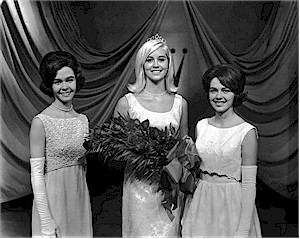
The Commercial Appeal files,
The Commercial Appeal
October 9, 2009
Crowning glory before film, TV fame
Cybill Shepherd ['68]
(center), a senior at East High School, was named Miss Teenage Memphis
on Oct 9, 1966. She is the daughter of Mr. and Mrs. W.J. Shepherd of
3420 Highland Park Place. She will compete in the Miss Teenage America
Pageant in Dallas on Nov. 5. Top prize in the national contest is a
$10,000 college scholarship. Debbie Salter (left) of Savannah, Tenn.,
was second alternate and Marcia Swett of 3561 Rhodes was first
alternate.
Urban Land Institute will use greenways to start connecting region's dots
By Tom Bailey Jr.,
The Commercial Appeal
September 23, 2009
Improving regional dialogue on important issues
is the most pressing of seven new initiatives recently established by
the Urban Land Institute Memphis, the new chairman says.
"Right now, regional topics don't get the focus they deserve," said
Russell 'Rusty' Bloodworth (associated with the Class of '63),
who chairs the five-year-old Mid-South chapter.
Russell Bloodworth is the new chairman of Urban Land Institute Memphis,
which promotes "responsible" use of land. Sustainability, connectivity
and more green space, exemplified by Schilling Farms in Collierville
(backdrop), are some of the institute's concerns.

The
overarching goal of the institute is to promote the "responsible" use
of land and to help create sustainable, thriving communities.
Bloodworth, executive vice president of Boyle
Investment Co., set six other initiatives: promoting economic
sustainability; visioning the future; promoting environmental
sustainability; supporting great neighborhoods; supporting great
government and infrastructure; and helping create great places.
The chapter was founded in 2004 and counts a
membership of 140, consisting of individuals, organizations and public
agencies. Its territory encompasses North Mississippi, West Tennessee
and eastern Arkansas.
The institute will begin promoting regionalism
in earnest with "Greenways for the Mid-South Region: Connect the Dots,"
a workshop in early November that will focus on the Mid-South's rivers
and greenways.
The goal is to help establish a system of
connecting trails, greenways and "blueways" along such regional rivers
as the Wolf, Hatchie, Coldwater, Loosahatchie, Nonconnah, St. Francis
and, of course, the Mississippi.
Creating hundreds of miles of greenways will
make the area a more appealing place to live and help preserve open
space and habitat for animals, officials say.
And Bloodworth believes rivers and greenways
offer the best chance for improving regional dialogue. Once
communication has been established, the topics can shift to other, more
complicated issues.
Founded in 1936, the Urban Land Institute is a
nonprofit research and education organization that promotes the
"responsible" use of land, and it counts more than 40,000 members in 80
counties.
Officers of Urban Land Institute
Chairman: Rusty Bloodworth (Boyle Investment Co)
Assistant chairman:
G. Dan Poag ('59) (Poag & McEwen Lifestyle Centers)
Treasurer: Earl Williams Jr. (Loeb Properties)
Immediate past chairman: Frank Ricks (Looney Ricks Kiss Architects)
Membership vice chairman: Michael Oakes (Shelby County government)
Sponsorship vice chairman: Mark Halperin (Boyle Investment)
Programs vice chairman: Robert Fogelman II (Fogelman Investment Co.)
Communications vice chairman: Chris Brown (Coleman Etter Fontaine-Commercial)
Young Leaders Group co-chairmen: Donald Drinkard
Jr. (CB Richard Ellis) and Thomas A. Pacello Jr. (Shelby County)
Hometown heroes Soldiers earn accolades
Special to My Life,
The Commercial Appeal
September 11, 2009
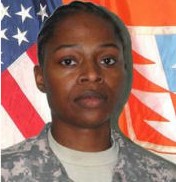 Army Sgt. Deneva L. [Sledge ('96)] Payne
 has been named Noncommissioned Officer of the Quarter for the 261st Signal Brigade.
Selection was based on the individual's exemplary
duty performance, job knowledge, leadership qualities, teamwork,
significant self-improvement, personal achievements, notable
accomplishments, and community service and support.
Her knowledge and dedication were exemplary in
winning the award and was decorated with the Army Commendation Medal
for her distinguished acts of heroism, meritorious achievement or
meritorious service.
Payne is a dining facility sergeant supervisor
serving with the Multi-National Corps-Iraq, assigned to Headquarters
and Support Company, I Corps at Camp Victory, Iraq. The sergeant has
served in the military for five years.
Payne is a 1996 graduate of East High School. She is the daughter of Dorothy M. Graham and Edward Sledge, both of Memphis.
...
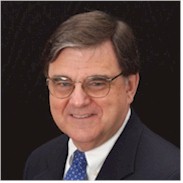
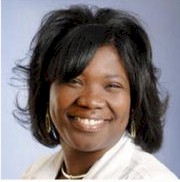 U of M alumni to honor accomplishments of five
By Fariss Adams Ivey, Special to My Life,
The Commercial Appeal
September 9, 2009
The University of Memphis College of Arts and Sciences Alumni Chapter
will celebrate the achievements of five individuals at its annual
awards dinner Oct. 1 at The Racquet Club of Memphis.
Dr. Thomas Appleton ('67), James Morse and Keith Prewitt will be honored as Outstanding Alumni;
Meah King ['97 and Faculty] will recognized as Outstanding Young Alumna;...
Appleton, who earned his Bachelor of Arts in
1971, is professor of history and associate director of the Center for
Kentucky History and Politics at Eastern Kentucky University...
King, who earned a 2002 B.A. and a 2005 Master of Arts, is an English teacher at East High School.
The East High Alumni Page Editor's Commentary: This is more like it: multiple alumni receiving recognition.
Music festivals keep downtown Memphis hopping from trolley tracks to riverfront
By Linda Moore,
The Commercial Appeal
September 6, 2009
After 35 years in the North, James and Margie Bailey figured it was time to return to the South.
And there was no better Southern homecoming for
the Baileys than a visit to the Memphis Music and Heritage Festival,
one of two musical events Downtown on Saturday.
Pedro Valenzuela (left) and Domingo Montes from Los Cantadores delight
the crowd Saturday at the Memphis Music and Heritage Festival. The
event continues on multiple stages from 11 a.m. to 11 p.m. today along
Main Street.
"We're just loving it," said James Bailey, formerly of Ann Arbor,
Mich., now of Horn Lake, after listening to guitarist David Bowen's
rendition of Rev. Al Green's "Let's Stay Together."
The free, family-friendly festival is sponsored
by the Center for Southern Folklore and celebrates the South in its
musical and cultural glory.
Performers are asked to give "their best 45
minutes" in genres that include blues, rockabilly, jazz, gospel,
bluegrass, funk, rock and mariachi, said
Judy Peiser ['63], executive director of the center.
Others dance, from African to belly, give cooking demonstrations, make pottery or sell original art.
"The festival gets to the soul of Memphis," Peiser said. "I think it's the most diverse event in the city."
And it makes a statement about what is right about this region, she said.
It's an event the world should see, said Johnny
Sandberg, who since 2001 has led a tour group from Sweden to Memphis
solely to attend the festival.
Sandberg, with Memphis Travel in Herrljunga,
Sweden, has brought as many as 40 people in years past. But with the
tough economy, there are 20 in this year's group.
"People from other countries would be very
interested," Sandberg said. "This festival represents so much good
music and so many different styles of music."
The festival, on Main from Peabody Place to Gayoso, continues today from 11 a.m. to 11 p.m.
Meanwhile on Saturday, music from Spiritual
Excitement at the 35th Annual Stone Soul Picnic had colorful umbrellas
bobbing when they led a chant that went, "Ain't no party like a holy
ghost party 'cause a holy ghost party don't stop."
The men's group was part of a daylong lineup of gospel acts at Tom Lee Park.
With temperatures heating up after last week's
cool start, Terri Taylor, her parents, relatives and friends made
themselves as comfortable as possible, planting a tent, unfolding
chairs and bringing water, snacks and a barbecue grill.
"There are about 15 or 20 of us," Taylor said.
Most are members of her father's church, Abundant
Life Deliverance in North Memphis, and they come to the picnic every
year to enjoy Christian music and fellowship.
"I think this is a phenomenal event for the people of Memphis," Taylor said.
Malco Paradiso theater tightens security; vows better crowd control
By Jody Callahan ,
The Commercial Appeal
September 4, 2009
If you're under 18 and want to see an R-rated
movie at the Paradiso at night, even if mom is with you, tough luck.
In response to a disturbing crowd scene in the
parking lot of the East Memphis theater Saturday night that led to nine
arrests, Malco officials announced the policy change at a town-hall
meeting at Clark Tower on Thursday: No one under 18 gets to see an
R-rated movie after 6 p.m., even if accompanied by an adult.
For now, the policy applies seven days a week,
but only at the Paradiso. Malco vice president Jimmy Tashie said the
theater would also use its security guards to prevent teens from
hanging out in front of the theater.
This was all sparked by Saturday's disturbance, which began a little after 11 p.m.
A promotional flier from a local deejay
encouraged kids to see two R-rated movies that opened that weekend,
"The Final Destination" and "Halloween 2."
Many of the youngsters were underage and were
turned away but had nowhere to go after their parents dropped them off.
That led to hundreds of them milling about in the parking lot, leading
to at least one fight, grainy videos of which showed up on YouTube.
At Thursday night's meeting, Tashie repeatedly referenced the importance of the Paradiso to the locally owned company.
"As our flagship, this theater means more to us
than anyone in this room can imagine," Tashie told the 100 or so people
gathered Thursday for the meeting. "Our interest is so great that we
can't afford to have the kind of incident we had Saturday night."
That underscored Malco's concern over whether
the fallout from the fight or other bad behavior could affect business
at the theater.
It's generally believed that similarly unruly
behavior led in part to the demise of Downtown's Muvico 22, which
gained a reputation for disruptive patrons.
"I don't think that'll happen here," Tashie
said. "Hopefully, the measures we've taken will bring some Memphians
back."
Memphis police will have their "Skycop" camera system at the theater this weekend, Director Larry Godwin said.
"We're going to take some precautions to make citizens feel better this weekend," he said.
The Paradiso wasn't the only Malco theater affected by bad behavior Saturday.
At the Raleigh Springs Mall location, police
arrested a 17-year-old boy who fired a shot in the parking lot after
people left a movie at about midnight. No one was hurt.
At the Majestic in the Riverdale area, 30 police
cars responded to a crowd of as many as 1,000 youngsters, issuing
between 30 and 35 juvenile summonses.
And while nothing happened at the DeSoto Cinema
16 in Southaven that night, officials are concerned about the generally
large crowds that gather there.
Southaven Mayor Greg Davis said the Board of
Aldermen is working on a loitering ordinance to try to reduce crowds.
Godwin defended the security at the Paradiso
last Saturday night and questioned how much of the blame should rest on
parents.
"I think we've all got to take some
responsibility. We didn't drop my kids off like that," he said. "When
they went to a movie, they were old enough to go. We instructed them on
what they were supposed to do."
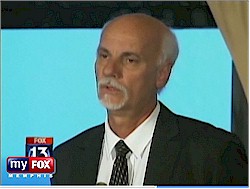
Television news coverage of response to Paradiso parking lot fight
September 3, 2009
At least 3 television stations had news coverage of
Jimmy Tashie ('66) talking about Malco's response to fight in parking lot.
Additional newspaper stories are also posted here, dated September 1, 3, an 4, 2009.
See video of the television news stories:
WMC-DT
WHBQ-DT
WREG (video not available)
Town hall meeting tonight will discuss disruptive behavior in East Memphis
By Hank Dudding,
The Commercial Appeal
September 3, 2009
Memphis city officials and police will hold a
town hall meeting tonight to address concerns about disruptive behavior
at East Memphis entertainment venues.
Officials plan to announce new measures to keep
residents safe, according to a press release from City Council member
Kemp Conrad.
The release didn't disclose what the measures were.
The town hall meeting and press conference will
be held at 6 p.m. at the Tower Room atop Clark Tower at 5100 Poplar.
Conrad, Mayor Pro Tem Myron Lowery, MPD Deputy
Chief Toney Armstrong and Col. Jeff Clark of Tillman Station will be in
attendance.
The conference follows an incident at the Malco
Paradiso on Saturday night, when hundreds of teenagers gathered in the
theater's parking lot.
Several fights broke out, and 10 people ranging in age from 12 to 18 were detained, police said.
Nearly two dozen Memphis police cars responded,
and officers blocked the exits to the parking lot while the crowd was
dispersed.
Earlier this week, Malco executive vice
president Jimmy Tashie blamed part of the problem on parents dropping
off teens who were too young to see the scream movies "The Final
Destination" and "Halloween 2."
Tashie said Malco is determined to protect movie-goers and the theater's reputation.
"We're going to make sure we maintain a safe,
friendly environment, and that's on everyone's mind right now," he said
Tuesday.
Three initiatives to enhance the East Memphis
entertainment area will also be announced at the meeting, according to
the release.
All residents are invited to attend.
Hhgregg Inc. to fill Circuit City void in example of big-box, anchor trend
By Don Wade,
The Commercial Appeal
September 2, 2009
[Excerpts]
...
"This is exactly the trend with big boxes and medium-size and large anchors," said
John Reed ['69]
of The Shopping Center Group. "We're working with Panera Bread, and
when Atlanta Bread Company had difficulty, they jumped in. They're
opening a store in Germantown next week that was a former Atlanta Bread
Company"
...
"I'm working with a national retailer now that
has told me to perch on several intersections like a vulture and wait
for Brand X to go out of business," Reed said.
...
Poice to increase patrols around Paradiso theater in East Memphis
By Hank Dudding,
The Commercial Appeal
September 1, 2009
Shantique Brady saw the potential for trouble in
the way parents offload teens outside the Malco Paradiso on weekend
nights.
"It's like we're at a parade of minivans, with
kids coming out of every door," said Brady, who manages the Ben &
Jerry's ice cream parlor nearby.
The gathering of youths reached critical mass Saturday night when
brawls broke out among hundreds of people gathered in the theater's
parking lot at 584 S. Mendenhall.
Memphis police detained 10 people ranging in age
from 12 to 18 for disorderly conduct, issuing misdemeanor citations to
some and taking others to Juvenile Court.
"I wish there was a camera so everyone could see
how chaotic it was," said Brady, 29, who closed her store early that
night. "It was really crazy."
Nearly two dozen Memphis police cars responded
to the scene. Officers blocked cars from entering the parking lot while
vehicles inside were allowed to leave.
The department plans to increase patrols around
the theater this weekend, said spokeswoman Karen Rudolph, who
encouraged citizens to call police if they see problems.
"We're hoping it was a one-time thing, and we're not going to have to deal with it again," she said.
Malco executive vice president Jimmy Tashie
blamed the chaos on underage kids who were dropped off for the R-rated
scream flicks "The Final Destination" and "Halloween 2."
When the teens were turned away, they had no place to go but the parking lot, he said.
"We're going to let parents know that they can't
drop their kids off ... and expect them to go into an R-rated movie,"
he said. The Paradiso's Web site now includes an advisory warning
parents that minors will not be admitted to R-rated films.
Will Duren, 30, manager of a nearby restaurant,
said he noticed the weekend crowds have grown since school started.
"It's not a problem in the summer," he said.
"Since schools let back in, it's been, 'Boom!' crazy on Friday and
Saturday nights."
News about the scene Saturday night spread by
e-mail and word of mouth, kindling fears that the theater could be
headed for the same fate as Muvico's closed, 22-screen Peabody Place
theater, which acquired a reputation for disorder.
"We're very sensitive to the e-mails and the
phone calls," Tashie said. "This is our flagship theater, and we're not
going to see it go down."
As noon approached Tuesday, Brady gazed through
the Ben & Jerry's window toward the empty Paradiso parking lot.
"You look at it now, and it's like the calm
before the storm," she said. "You can't imagine how many people were
out here."
Presbyterian Day School unveils colorful early childhood addition
By Jane Roberts, Memphis Commercial Appeal
Friday, August 28, 2009
Presbyterian Day School throws open the doors
today on the boy-friendly, $20 million Norma T. Wilson Early Childhood
Center.
The colors are bold (the staff affectionately
calls the color scheme "Skittles on steroids") in the
76,000-square-foot addition funded largely by school trustee
C. Kemmons Wilson Jr. ['64], an alumnus of the school, and his wife, Norma.
Her portrait in the foyer is oil, not pastel, in keeping with the hearty boys-school atmosphere.
"We have boy-friendly classrooms with lots of
room for hands-on work and movement," said headmaster Lee Burns, who
revels in a world where learning tends toward the visual and the most
convincing characters in literature are heroes and adventurers.
"Around here, we like girls just fine, but we
love boys," he said while giving a tour of the expansive construction
project, completed in the middle of an economic meltdown.
"We started in better times," said honorary
building chairman Bruce Campbell. "But I wish we had started a little
earlier."
The wing for 3-, 4- and 5-year-olds has 12
Internet-connected classrooms -- each with its own SMART Board -- a
gym, climbing wall and quick access to the playground where equipment
is sized to age.
There's unstructured play time each day --
outside if it's 32 degrees or warmer -- an intentional tribute to
large-muscle movement.
Boys learn to "settle their own disputes" on the
playground, said Debbie Isom, head of the school's early childhood
education. "Most children's time is so supervised, they always have
adults around to run interference."
The planning for the center began seven years ago and construction took 10 months.
"The boys loved it," Burns said. "We had 150 to 170 workers here on a daily basis."
The school, which has about 630 boys in
prekindergarten through sixth grade, is one of several Memphis
independent schools adding space for the youngest learners.
Grace St. Luke's Episcopal School added
classrooms this summer. The first opened this month for the school's
fourth section of prekindergarten. Section five will open next year,
said headmaster Tom Beazley.
"It is a little unusual to be expanding now," he
said. "All I can say is that our parents do not see an independent
school education as a luxury."
Along with the Wilsons, about 200 Memphis donors
have pledged gifts to the new wing at Presbyterian Day School, which
Wilson decided early in the process to dedicate to his wife.
He ticked off a list of the reasons why in the
dedication Aug. 18, including that she tucked notes in their five
children's lunches and made dinner every night for the family.
"The little things that he remembered about when
we were raising our children were very touching," Norma Wilson said.
"Men see more than we wives realize."
She has taught swimming lessons for 45 years in
the family pool, she said, and knows a few things about lifetime
skills.
"This little early childhood building is where
it all starts. It wouldn't have meant as much to me if I had my name on
a gym."
Presbyterian Day School
Established: 1949 by Second Presbyterian Church
Enrollment: 637
Tuition: $14,000
Scholarships: 15 percent of student body
Address: 4025 Poplar
Grand opening: 8:30 a.m. today
Principal invites alumni to health clinics grand opening
The East High Alumni Page
Wednesday, August 19, 2009
East High Principal Fred Curry invites alumni to the grand opening celebration for four city wide school based health clinics
Tuesday, August 25, 11am - 1pm. The Northeast Regional Health Clinic is located inside East High School and opened this summer.
The clinic is located in a remodeled area of the
school on the lowest floor in the southwest corner of the building, an
area that was used for art classes in years past. Nurse practitioners
from Memphis Health Clinic staff the clinics, which have several
examination rooms, a waiting area, and a conference room.
The
establishment of the clinics was made possible, in part, by a $600,000
donation from the Plough Foundation to cover the cost of construction
and equipment. "We try to tackle the root problems of this city," said
Diane Rudner ['68], Plough Foundation chairwoman.
In addition to the clinic at East High, three
others have been established at Northside, Sheffield, and Westwood High
Schools.
Sources: The East High Alumni Page, Memphis City Schools,
The Commercial Appeal
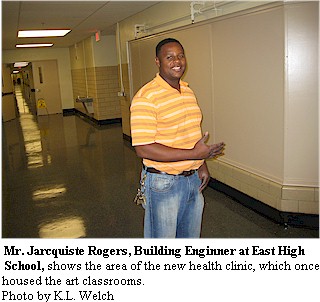
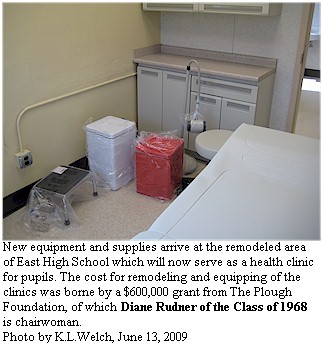
Former Manufacturing CEO Takes Over Executive Networking, Mentoring Group
ERIC SMITH | The Daily News
Friday, August 14, 2009
After 30 years at AZO, a global manufacturing company whose North American headquarters is in Memphis,
Bob Moore ['73] decided it was time to try a new challenge.
In December 2007, he sold his ownership stake in
AZO, where he served as president and CEO, and spent the next few
months on a "decompression" sabbatical, which included a cross-country
road trip, to mull his next move.
During his travels, Moore recollected his final
six years at AZO and the affiliation he had forged with TEC (The
Executive Committee), an organized peer group of corporate chief
executives who met in a confidential setting to discuss various
business and personal issues.
No longer employed at his company, Moore had to
leave the group, whose name had become Vistage International Inc. He
figured he would just start a new business, but his Vistage mentor, Ken
Edmundson, advised him to consider becoming a Vistage chair, which
manages the CEO group.
Ultimately, Moore decided it might be wiser to head down the Vistage path rather than the entrepreneurial one.
"I was reading the tea leaves of the economy,
thinking 2008 was not going to be a good year to start a new company or
to buy an existing one," Moore said. "I came back to Memphis after the
road trip, called Ken and said, 'OK, I'm interested.' "
Select group
Moore went through an extensive interview process
and was chosen last fall to be the chair of Memphis' lone Vistage
group. The group, formed in November, consists of 10 area corporate
executives and business owners.
Because of confidentiality, Moore was not able
to disclose their names and companies, but those 10 members' companies
employ 800 people in the Memphis area and have combined revenues of
$171 million, according to Vistage data.
Moore said he gets to spend his days working
with "10 of the brightest, sharpest CEOs." The group meets the second
Thursday of each month, and sessions involve everything from
high-profile speakers to brainstorms where members help each other with
problems ranging from how to handle layoffs to how to manage company
growth.
"I don't solve any issues for them," Moore said.
"I just ask a bunch of questions and then help them facilitate within
the group meetings."
Moore also conducts confidential one-on-one
sessions with each member of the group, all of whom have access to
extensive Web articles and resources through Vistage, plus networking
opportunities with the organization's 15,000 other members.
Moore said he has one particular line he likes to uses when describing Vistage to potential members.
"It's one day a month that you spend working on
your business, not in your business," he said. "CEOs and business
owners can relate to that. They can relate to the opportunity to get
away. Sometimes getting away from the office and thinking strategically
and thinking long-term – especially if you have a peer group with no
vested interest, no agendas on their part to influence your decision
one way or the other – you can't beat that."
A taste of freedom
When Moore began approaching people last fall
about joining his group, he cited the abysmal economic climate as a
reason. The way he saw it, there was no better time than a recession to
team with Vistage and other executives in the same boat.
"If you're having to do layoffs and cutbacks and
find cost savings, what a great way to figure out the best way to do
it," Moore said.
The fee to join Vistage is $1,100 a month, or
$13,200 for a year, but Moore said the price is well worth it for the
great advice that can be obtained from like-minded executives.
For example, it was Moore's Vistage peers who
helped him decide to sell his 50 percent share of AZO, a company whose
other executive half was based in Germany.
"My group helped me go through the thought
process of ending a 30-year partnership with my German partners, which
was a difficult but necessary decision for me to make," Moore said. "I
knew what the right thing to do was, but it sure was great to get the
feedback from 16 or 17 other guys that said, 'Yeah, based on what we
know, that's the right thing for you to do.'"
Moore, 53, who grew up on Poplar Avenue and
graduated from East High School and the University of Memphis, plans to
do this new gig for a while. He hopes to form a second group and
someday find another chair for even more Vistage groups in the area.
Though he loved his business and the time he
spent there, the freedom and flexibility of his new schedule makes him
realize how happy he is to have 30 years of boardrooms and airplanes
and executive reports in his rearview mirror.
"I almost feel guilty for getting paid doing
this," Moore said with a laugh. "This is the most enjoyable thing I've
ever done."
Town hall tension: Meeting turns ugly over health care
By Linda Moore, Memphis Commercial Appeal
Saturday, August 8, 2009

Hundreds
of people crowded into the BRIDGES building in Downtown Memphis on
Saturday for a congressional town hall meeting that quickly deviated
into a raucous shouting free-for-all, requiring extra law enforcement
officers to watch over the scene.
The meeting, hosted by U.S. Rep. Steve Cohen,
D-Memphis, was scheduled to address constituents' concerns about Social
Security and veterans' benefits, but the real topic of the day was
health care reform legislation being crafted by Congress.
Most people in the crowd of close to 500 were in
loud opposition, although Cohen supporters held their own, waving signs
that read "Health Care Now."
And as one heckler yelled, another shouted back,
"Shut up! I want to hear my congressman. You shut your mouth!"
Within 15 minutes of the start of the event, a
nearly nose-to-nose confrontation between individuals with opposing
views became so heated they had to be separated as Shelby County
sheriff's deputies and Memphis police officers called for
reinforcements. No arrests were made.
With town hall meetings greeted with similar protests across the nation, Cohen was prepared.
"This is America, this is Memphis, Tennessee.
Take two aspirin and come back in the morning," he yelled over out over
the room.
Cohen invited area physicians to share their opinions on health care reform.
Dr. Neal Beckford was roundly booed when he said 50 million people were without health insurance.
However, he pointed out that as a society Americans need to decide what they want.
"And when we've decided what we want and how much
it cost, we then need collectively to decide what we are willing to
pay," he said.
Cardiologist Dr. James Klemis believes that
ethically the poor must be taken care of. But this bill is being rushed
and is too similar to Canada's and Britain's socialized medicine, he
said.
"The problem is, government can't be the solution. It's got to be within the community," Klemis said.
Dr. Laura Bishop shared her disdain for insurance companies but is no fan of Washington's plan.
"Government getting involved in deciding what
health care you are receiving is not the way to go," Bishop said.
Honesty, said Dr. Autry Parker, must be part of the conversation on health care reform.
"This issue will not be solved by people
shouting, it will not be solved by people telling lies over and over
again," Parker said. "Yes, I have read it and I do not agree with
everything in it, but there is absolutely nothing in the bill that is
going to euthanize grandma."
One of the signs waved by a plan opponent said
"Don't tell my gigi how to die," referring to allegations that the bill
would allow senior citizens to be euthanized, something the nonpartisan
group FactCheck.org said is false. Cohen also denied that the bill
would pay for abortions -- another claim made by opponents.
Roger Fakes ['56],
70, said he sat quitely during most of the meeting, but Cohen's
insistence that citizens would be able to keep their private health
care drove him to his feet.
He argued that changes to private insurance would force citizens into the government plan.
"There are some of us old gray-haired folks that
don't want the government involved in any of our business," he said.
The nearly all-white audience was not a snapshot
of the mostly African-American 9th District that Cohen represents.
One of those who came from outside the district
was Mark Mullis, 67, of Olive Branch, who was treated for cancer two
years ago. He's afraid of what the plan will do to his insurance
coverage, a combination of Medicare and retiree benefits.
"I know some people think a 25-year-old has a
whole lot more to give. Maybe I've got seven or eight more years. To me
all life is precious no matter what age," Mullis said.
Also from outside the district was bill
supporter John Miles, 21, of Tupelo, Miss., who debated with opponents
during the meeting.
"The purpose of this is to ask questions and
receive answers. These people had all the answers," Miles said. "It's
frustrating. It seemed that side in particular was doing a lot of
yelling and screaming and booing. I just felt like yelling back."
Cohen is also proposing an amendment to the bill
that would create a national pilot program on infant mortality, an
issue of grave concern in Memphis, where infant-mortality rates are
like those of a Third World country, he said.
Despite the boos, jeers and general disorder
Saturday, Cohen said that after 33 years in public service he wasn't
rattled.
"I expected it to be a lot worse," Cohen said.
Wolfchase Holiday Inn reflects modern 'relaunch' of chain's brand
By Tom Bailey Jr., Memphis Commercial Appeal
Friday, July 31, 2009
The Wilson family will ceremonially open an
updated version of Holiday Inn on Saturday, exactly 57 years after
their patriarch unveiled the original.
"We are going to get as many Wilsons as we can" for Saturday's ribbon cutting at 11 a.m.,
Kemmons 'Kem' Wilson Jr. ['64] said of the grand opening of Holiday Inn & Suites -- Wolfchase.

He and his four siblings cut the ribbon on Aug. 1, 1952, for their dad's first Holiday Inn on Summer.
Now, Wilson, 62, and his son, McLean Wilson, 31,
have built a 133-room hotel at 2751 New Brunswick Road near Wolfchase
Galleria.
Kemmons Wilson, who was Kem's father and McLean's grandfather, died in 2003.
He is credited with reinventing the lodging
business by building a chain of hotels with standards on which
travelers could count no matter where they were.
Holiday Inns, now one of seven hotel brands
owned by InterContinental Hotel Group, is primarily a franchised
business.
Individuals or companies own one or more hotels
in the system. The corporation provides the reservation service,
quality standards, inspections and marketing support.
Kem and McLean, through their Wilson Hotel
Management Company, also own a Holiday Inn in Jackson, Tenn., two
Holiday Inns in Huntsville, Ala., manage the Holiday Inn at the
University of Memphis, and will soon build a Holiday Inn Express in
Jackson.
The full-service hotel that ceremonially opens
on Saturday -- it actually opened June 9 -- features updates that
reflect the "relaunch" of the Holiday Inn brand in 2007.
Following a 2005 survey of 18,000 consumers,
Holiday Inns modernized its iconic sign, (green for Holiday Inn and
blue for Holiday Inn Express), lit the exteriors in blue or green
light, installed new soundtracks for the lobby, put in scent machines
with customized aromas, gave the lobby a cleaner, less- cluttered look,
hung new art behind the lobby desk, put all-white bedding in the rooms,
labeled pillows as firm or soft, erected shower curtains that let in
more light, and provided more towels and other amenities.
Holiday Inns started renovating its brand almost
10 years ago, said John Merkin, senior vice president for brand
management.
"We took up this work in 2000 on what is a modern Holiday Inn hotel going to look like," he said.
The project is one-third completed. About 300
hotels are new like the Wilsons', another 700 have been renovated, and
another 2,000 are to be refurbished by the end of next year, Merkin
said.
About 1,000 old hotels have been removed from the system.
"Over the past five or six years the Wilson
family has appreciated the way we were revitalizing the brand," Merkin
said. "Our system and brand are becoming younger."
The investment is already paying off.
The hotels that have been renovated or built to
newer standards produce 6 percent more revenue per available room,
Merkin said.
Kemmons Wilson Jr. appreciates that Holiday Inns has recommitted to the brand his father founded.
"We have had a new excitement about Holiday
Inns," he said. "That's primarily driven by the InterContinental Hotel
Group, who has had the wisdom and foresight to promote this iconic name
of Holiday Inn.
"They found that right under our noses we have a
great brand. It's got warm and fuzzy feelings to most everyone. We just
needed to put capital behind this brand and to bring it back to the
prominence it had."
McLean Wilson appreciates the legacy his grandfather created.
"As a third-generation Wilson working in the
hotel world now, it's really neat to think about the fact I'm doing
work that 57 years earlier my grandfather was doing with Holiday Inn."
[Editor's note: Kem Wilson and his siblings all are East High alumni.]
Storm causes tree damage on campus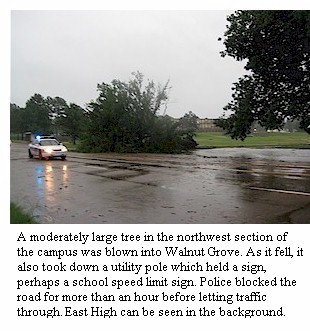
The East High Alumni Page
Thursday, July 30, 2009
Severe storms in and around the Memphis area
spawned numerous tornado warnings this evening and caused minor damage
to the East High campus. The most significant immediately apparent
damage at East was a tree on the northwest section of the campus which
had blown over into Walnut Grove Road. It either laned on or in front
of a car, which police say had to be towed from the scene. However, no
injuries are being reported from the storms area wide.
Other trees on the campus also had branch
damage but it was relatively minor, with only one or two limbs of
significant size having been blown down. A soccer goal was partially
collapsed but it is unknown if that was due to the storm or had
occurred at another time.
No damage was noticeable to the buildings on
campus, other than a portable restroom was tipped over near the Career
and Technology Center.
She's Still Here, Up for Anything
By MARGY ROCHLIN, The New York Times
July 23, 2009

THE first time
Cybill Shepherd ['68]
appeared on a talk show was on "The Tonight Show" back in 1968. At the
time she was a radiant 18-year-old from Memphis with a confrontational
gaze who owned the title Model of the Year. "I could barely say a
word," she said. "All I could do was say 'Yes' and look terrified."
Forty-one years later Ms. Shepherd now looks at
the untold hours she has logged talking about herself on camera as not
unlike time spent on a different kind of couch. "Before I ever did
psychotherapy or analysis I did interviews and talk shows, which are a
kind of therapy," she said. "I mean, you're talking about yourself, and
it does bring about some possibilities of thinking about who you are
and where you are in your life."
Occasionally she would play with the format: On
"Late Night With David Letterman," she once strolled onstage wearing a
bath towel. Sometimes the format would play with her, as when she was
promoting her 1971 feature-film debut as the self-possessed small-town
enchantress in "The Last Picture Show."
"On all these talk shows I just seemed like I
was a nattering airhead, just nattering on and blond," said Ms.
Shepherd, who also heard that her persona so irked the director Elaine
May that it nearly cost her a key role in "The Heartbreak Kid."
"Looking back I can see why she didn't want to cast me. But I'm
different now. I finally have become just more of who I am."
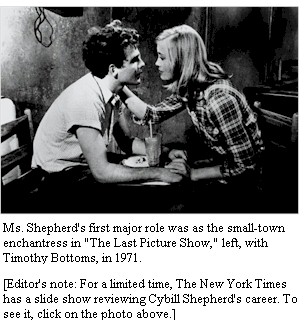
So
who is Ms. Shepherd? At 59 she has become the actress who is up for
almost anything. She has done guest spots on popular television shows
like "Psych," "Criminal Minds" and "Samantha Who?" On Showtime's
defunct lesbian drama, "The L Word," she had a recurring role as a
university vice chancellor who started out severe, then ran hilariously
amok the minute she discovered her attraction to other women. And she
has just signed to a recurring role on the new ABC series "Eastwick"
(based on the movie and novel "The Witches of Eastwick"), in which she
will play a former witch who has become a reclusive cat lady.
"Years ago one of my mentors, Orson Welles, told
me, 'A career is made not by what you do but by what you don't do,' "
she said. "But so much about these past few years has been about saying
yes, and it's really paid off."
Lead roles are part of the mix. In "Mrs.
Washington Goes to Smith," which has its premiere on the Hallmark
Channel next Saturday, Ms. Shepherd plays a middle-aged housewife,
Alice Washington, who returns to Smith College to get her diploma, find
herself and forget that her dweeby dentist husband has left her for a
younger woman. "Mrs. Washington" is the kind of television movie for
which you can predict most of the plot twists, including the dazzling
makeover Ms. Shepherd's dowdy character will receive. But no one can
say that Ms. Shepherd doesn't bring a certain been-there authority to
the role.
Like Alice, she attended college when she was
young but dropped out before graduating. Like Alice, she's been married
and divorced (Ms. Shepherd twice). Like Alice, Ms. Shepherd, who has
three grown children, knows what it's like to walk around a spacious
house once noisy with offspring and wonder how to beat back the
silence.
"I was in such denial at first. I said, 'Empty
nest? No problem. I just won't go home,' " said Ms. Shepherd, whose
tenure on "The L Word" required commuting between Los Angeles and
Vancouver. "But when it did hit me, oh my God. It was just that
howling-at-the-moon time. It's still very, very important for me to go
into their rooms at a certain time at night and close the shutters and
turn on a night light."
But on this afternoon Ms. Shepherd's tall,
floppy-haired son Zack, 21, was home, back for the summer. Stretched
out on the living room sofa in Ms. Shepherd's hilltop house with its
expansive views of the San Fernando Valley, he read the newspaper and
listened in as his barefoot mother, dressed in loose black pants and a
billowy turquoise print blouse, told show business stories. At
unpredictable moments she would slip into a honey-dipped Southern
drawl. This, according to Jane Lynch, Ms. Shepherd's good friend and
her "L Word" co-star, was a sign that she was relaxed.
"The more comfortable she is, the more her
Tennessee comes out," explained Ms. Lynch, who portrayed Ms. Shepherd's
lawyer girlfriend on the series and recalled that the biggest hurdle
when they filmed their love scene — Ms. Shepherd's first with a woman —
was Ms. Shepherd's surplus of enthusiasm.
"She was very 'I can do this! I can do this!'
She'd kiss me in the middle of a sentence," Ms. Lynch said with a
laugh. "I had to say to her, 'Um, I kind of got to get the line out
first.' She kind of went into overkill."
Young
Hollywood could learn a thing or two about resiliency from Ms.
Shepherd. Just as people began to know her name, she was labeled a home
wrecker, as her on-set affair with Peter Bogdanovich, her director on
"The Last Picture Show," broke up his marriage. When he cast her at the
center of two follow-up movies that flopped both critically and at the
box office — an adaptation of Henry James's "Daisy Miller" and the
musical "At Long Last Love" — people said her career was over. Then, a
year later, she landed a role as a poised political aide in Martin
Scorsese's "Taxi Driver."
Another lull followed, forcing her to take movie
and television scraps, like a small part on "Fantasy Island." In the
mid-1980s, however, she emerged victorious as the fast-talking model
turned private eye Maddie Hayes on the hit ABC series "Moonlighting."
Four years later the dream soured again, when "Moonlighting" ended amid
reports of unmanageable backstage infighting between her and her
co-star, Bruce Willis. She rebounded in the mid-1990s as the
wisecracking actress at the center of the CBS sitcom "Cybill," but now
finds herself playing, for the most part, secondary roles.
The woman who survived such tumult seems
philosophical about her place in Hollywood. "One of the things that
really changed for me in my life is that I've learned how to be a guest
star," she said. "It's like, 'Oh, yeah. I remember being the lead on a
show and the guest stars having to be the last person shot.' Do you
understand what I'm saying? This has been a real learning curve, a
growing-up process. But I'm happy to have a job."
When she's not working she studies with acting
and vocal coaches. "It's my continuing education, what I consider to be
a kind of master class situation," said Ms. Shepherd, who grew up
singing in a church choir, started taking voice lessons at 16 and has
recorded 11 albums.
In her mind age has presented her with
opportunities that were once out of reach. "What I'm trying to say
about being beautiful," she said, "is that there's an element of it
that can cause you to be emotionally underdeveloped. People do things
for you, doors will open because you're beautiful. It was like I took
off on this airplane in 1968 and just flew into world fame. There were
a lot of times in between where I just didn't get a chance to grow and
learn."
A version of this article appeared in print on July 26, 2009, on page AR18 of the New York edition
Editor's note: several additional articles about Cybill Shephered are included on this page.
Eyes, imaginations cast to moon in '69 on historic day
Memphians reflect on the night man made that iconic footprint
By Cindy Wolff, Memphis Commercial Appeal
Sunday, July 19, 2009
It was 9:56 p.m., just about bedtime for 9-year-old Memphian Skip Howard.
Kids had bedtimes in 1969, even in the summer. But they stayed up late on special days, and July 20 was one...
Apollo 11 landed on the moon at 3:15 p.m. But it
was more than six hours later before astronaut Neil Armstrong took a
step onto the surface. People ate dinner on TV trays and watched,
afraid to miss the historic moment...
Here are two other memories e-mailed by our readers:...
"I was 13 and had faithfully followed all the
media coverage leading up to the moon launch, even making a scrapbook
from Life magazine photos and constructing a cardboard miniature Lunar
Excursion Module. (My favorite astronaut was Mike Collins, who I
thought was "dreamy!") On the day of the launch, my father got out his
trusty reel-to-reel recorder and taped the TV broadcast. We all teared
up along with Walter Cronkite as the rocket left the launching pad.
Although landing day, July 20, was supposed to be the first day of our
vacation trip to Illinois, we waited until midnight to depart, so we
could watch Neil Armstrong's first steps on the moon. Now, whenever we
watch our home movies of that 1969 vacation, we are reminded of the
national excitement that the moon landing generated. Interspersed with
shots of my sister and me swimming, Abraham Lincoln's tomb, and
roadside picnics are motel marquees with messages like,
'Congratulations Apollo 11!' and restaurant signs advertising 'moon
pancakes.' I still have the scrapbook (although it's falling apart
now), The Commercial Appeal with the headline, 'WE MADE IT,' and the
home movies. Unfortunately, the LEM model apparently lifted off to the
trash at some point during the last 40 years."
--
Joy [Tiffin] Sutherland ['74], Collierville
Guest column: My Thoughts: Summertime opens road to follow your dreams
By
William K. Richardson [class year unverified], Special to The Commercial Appeal
Sunday, July 12, 2009
The late playwright Lorraine Hansberry once wrote
that "it has taken me a good number of years to come to any measure of
respect for summer," and added, "For the longest of time I simply
thought summer was a mistake."
Her first impressions of summer were shaped by
the long and often steamy days of her youth in the 1940s on Chicago's
South Side. So hot were the nights, in that era of no air conditioning,
that her father would sometimes pack up the entire family and go to the
local park, where all would sleep on the cool grass.
As I
was born in June, I guess it is only natural that I take exception with
the late writer's initial take on summer; it is my favorite time of the
year. I love the summer for the obvious reasons: the warm temperatures,
the longer days, the leisurely pace, the scant clothing. (And lest
anyone accuse me of lechery, let me clarify that a pair of shorts, a
T-shirt and flip-flops are my own standard attire in the summer, though
I must admit pretty women in shorts are an added perk.)
While January 1 signals the day to start anew or
to turn over a new leaf, I have always believed it is the summer that
presents endless opportunity and hope. Summer, to me, is a form of
"rebirth." As a high school English teacher and coach, I find that
summer not only offers me time to recharge for the new school year, but
it also provides the time to do many things I don't have the time to
pursue during the school term: catch up on my reading, take in the
latest movies, get to the gym often, travel the country. The extra
hours of light during the summer day give everyone the opportunity to
dedicate more of their day to leisurely activities of their choice:
beautifying the homestead, enjoying a long weekend with family and
friends, fishing in an out-of-the-way spot, or simply lounging by a
pool.
My favorite summer was the year I turned 18, the
summer of 1979. To this day, I vividly remember those hot days in a
summer school classroom repeating a semester of senior English
(dreadful) and those cool nights in my '65 Chevy in pursuit of a
pretty, blue-eyed brunette (not the least bit dreadful).
It sometimes feels as though I never left that
era. I am (ironically) a high school English teacher, for whom
brunettes are still a bit of a weakness.
I also remember the optimism of that first
summer after high school; it was palpable. All I could think of was the
future, which for the 18-year-old me, extended no further than the next
week. A brand-new graduate of East High School, I was ready to conquer
the world, as long as I could do such beginning at noon each day.
Youthful optimism, as in my case, is sometimes wasted on the young.
Summer is, in the words of Hansberry, "life at
the apex." I have tried to live each summer that way. Every June
presents another chance to "re-do" the summer of 1979. I've been
chasing 18 since I was 18. Just like a dog chasing its own tail, I've
come close, but have yet to capture it fully. Yet it is the chase that
is most enjoyable.
In summers past, I've gone back to school to
finish my master's degree. I've spent time on the beaches on both
coasts. I've hiked the Rockies in Colorado. I've traversed the streets
of Manhattan. I've written and edited a book I hope to get published.
One summer, I boxed professionally to pay the rent. I already have
plans for a trip to Europe next summer.
During the summer months, anything is possible
-- with a notable exception or two. My bald head will never again have
a full growth of hair, even if June were year-round. And I will never
again be 18, no matter how hard I try, which I will continue to do.
I am fast at work again this summer at another
fruitless attempt to reach back to a time long gone, and it couldn't be
more enjoyable. Never has a dog had so much fun chasing its tail.
William K. Richardson teaches ninth-grade
English at Millington High School, where he also coaches the wrestling
team. Contact him at Coachwkr@gmail.com.
Camp lets teens try advanced learning program
By Jane Roberts, Memphis Commercial Appeal
Saturday, July 11, 2009
If din is to ruckus like will is to learning, the
hoots, hollers and full-body tackles Friday were nearly redemptive.
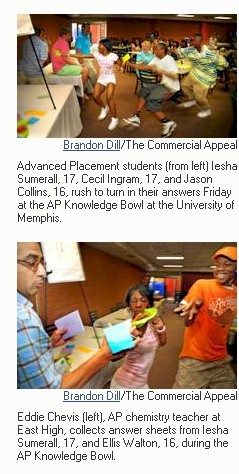
Besides,
who wants to shush students thrilled beyond reason to be calculating
the molecular weight of copper sulfate or defining imagery's place in
literature?
The first session of the week-long Summer
Scholars Camp for Advanced Placement Students wrapped up Friday in a
Knowledge Bowl of sorts at the University of Memphis, feeling and
sounding more like a football game as teams channeled their wits, then
ran pell-mell to the front of the room to turn in their answers.
AP teachers from across the city kept a safe distance but couldn't help marveling at the spectacle.
"Seventy percent of these kids will have no
trouble in AP chemistry. That is much higher than I would have
expected," said
Eddie Chevis [Faculty], AP chemistry teacher at
East High School and one of handful of city school staffers putting in
extra time this summer to give students from disadvantaged high schools
a pre-taste of AP.
As camp den mother, Sandra Lewis shepherded 65
first-time AP students through a smorgasbord of camp offerings --
calculus to literature -- giving them a feel of what's available and a
chance to meet kids from across the city on the same path.
She will do it again July 20-24.
"The first day, we wrote an essay," said Tacorria
Dunlap, 15, registered for AP pre-calculus and English at Northside
High and freely admitting she didn't expect to dig in so quickly.
"We had to write on a mortally ambitious character. None of us knew what that meant."
She quickly chose Macbeth, remembering she knew
plenty about his dark side after watching her brother act the lead in
Shakespeare's play.
Student after student told similar stories,
including Reginald Johnson Jr., 17, registered for four AP classes at
Booker T. Washington, knowing full well it means no social life.
"I want to better myself. Life is going to be
hard anyway, so I want to take the big stuff before I get to college,"
he said thoughtfully.
"If I pass these, the credits count for college."
In 2007-08, the district offered 151 AP courses.
Last year, the number jumped to 167. Figures are not available for the
2009-10 year, according to the district, but Supt. Kriner Cash has said
he wants at least eight AP courses per high school, starting
immediately, and has budgeted $1.7 million this year to accomplish the
goal.
The mistake some people make, according to Chevis, is thinking that AP is only for gifted children.
The campers "are average students in Memphis City
Schools who really believe in themselves and who get support at home.
They are interested in succeeding."
With one AP course under their belts,
African-American students are 21 percent more likely to graduate from
college than students who didn't take AP courses, according to the
College Board, the New York-based nonprofit that monitors AP
instruction and oversees college entrance exams.
"Students know these are challenging courses.
They have to prepare themselves differently than the way they prepare
for other classes," said Lewis, coordinator of a $1.8 million federal
grant to improve AP quality and quantity in city schools.
But in Tennessee, where African-Americans make
up 21.3 percent of high school student bodies, only 7.9 percent take AP
courses.
"The end product is not necessarily the test," Lewis said. "The end product is developing habits of the mind."
More than $296 million in federal funds begins flow into 9th District
By Alex Doniach (Contact), Memphis Commercial Appeal
Saturday, July 11, 2009
[Excerpt]
When
Judy Peiser ['63] set out to create a
digital archive from decades of Southern art, music and film, she
didn't realize how much time it would require.
"A lot of hours are spent making it look easy,"
said Peiser, executive director of the nonprofit Center for Southern
Folklore in Downtown Memphis.
So when Peiser found out about U.S. stimulus
money available for the arts, she applied and was recently awarded a
$50,000 boost from the National Endowment for the Arts.
With donations down in a national recession,
Peiser said this much-needed stimulus money will help her retain a
staff of six.
The grant is among a growing list of awards from
the $787 billion U.S. stimulus package slated to flow into Shelby
County, according to information released this week by U.S. Rep. Steve
Cohen, D-Memphis
Software designer says hometown's 'authenticity' has no peer
By John Schranck / Special to The Commercial Appeal
Saturday, June 27, 2009
Although he has lived a variety of places, Memphis has always been home for
Meka Egwuekwe [associated with the Class of '91].
He grew up in South Memphis near Lamar and South
Parkway, and attended Memphis City Schools through ninth grade.
It was in ninth grade that Egwuekwe won a
scholarship to the prestigious Philips Academy in Andover, Mass. From
there he went to Morehouse College in Atlanta to study computer
science, and interned at NASA.
Upon his graduation from Morehouse, Egwuekwe
headed to Duke University, where he earned his master's degree in
computer science in 1996.
After Duke, Egwuekwe returned to Atlanta to
begin his career working for Hewlett-Packard. A few years later, during
the dot-com boom, Egwuekwe left HP to join a startup company called
Online Insight.
In 2001, after the birth of his oldest daughter, Egwuekwe decided to come back to his hometown.
"I'd always felt like a Memphian at heart, even
living in Atlanta," he said. "I'd read (The Commercial Appeal) online
to stay connected to the community."

Egwuekwe
now works as senior software architect for Memphis-based Lokion
Interactive. A boutique software agency, Lokion "runs the gamut in
terms of what we can do. We create digital experiences that help
companies generate brand awareness, customer loyalty, and growth."
As a Leadership Academy Fellow, Egwuekwe worked
with his classmates on a Community Action Project to bolster the
marketing and public relations of Memphis Athletic Ministries.
"It was an A-to-Z marketing project," Egwuekwe
says. "We did everything, from making things like brochures to
designing digital billboards to getting new logos to overhauling the
Web site."
He adds, "It's great to be part of an established ministry that's making a difference in kids' lives."
Ministry is no small part of Egwuekwe's life. He
is chairman of the Trustee Board, the college tour director, the math
tutor, the webmaster, a chorister, the Bible study teacher and, along
with his wife, the youth director at Castalia Baptist Church.
Egwuekwe is also active with the Nigerian Family and Friends of Memphis and serves as its treasurer.
Egwuekwe has lately become a regular contributor
on MemphisConnect.com, a site launched this spring by The Leadership
Academy where "diverse Memphians discuss ... what inspires them to make
Memphis home."
"I love the history of the city, I love the
culture, the music of the city, I love the authenticity of Memphis.
That's not something you see everywhere. I've lived in seven different
cities, and this is hands-down the most authentic place I've ever
lived. I love the entrepreneurial spirit here.
"Given all that, there is no legitimate
foundation for an inferiority complex. When I hear people saying
negative things about Memphis, I can point them to (MemphisConnect.com)
and say, 'Look, this is the Memphis I know. This is the real Memphis.'"
Computer repair program puts eager students to work for schools
By Jane Roberts, Memphis Commercial Appeal
Saturday, June 20, 2009
Memphis City Schools is offering the basics of
computer repair this summer, hoping to turn some of its most
sophisticated tech heads into day savers.
The school district is paying students $7.25 an
hour to complete the 240-hour class, hoping to put them to work as PC
troubleshooters in a district with 30,000 computers. The plan gives new
meaning to the term "crash course."
DeVionne Coffee (left) and Bettie Mays identify computer parts on
Friday as part of a summer institute on information technology.
For 115 students -- mostly seniors -- the deal
was too sweet to pass up. They get an air-conditioned summer job that
can continue when school starts and a chance to learn a skill they're
pretty sure they'll use the rest of their lives.
"In due time, I'll learn all this," says
JaQuisha Gray, 17, looking at into an open hard drive for the first
time in her life and getting comfortable with the components.
"I just found out that this is the motherboard,"
she said, beaming a smile befitting the co-captain of the Booker T.
Washington cheerleading squad.
The city schools have computer technicians, but
with the volume of desktop and handheld models, each is responsible for
maintaining 750 to 800 computers, plus software installations.
If one goes down in a classroom that may have
only a handful to start with, learning for a significant portion of
students slows to a crawl.
"You can see how this is going to help us," said
Curtis Timmons, city schools chief technology officer. "We are trying
to expand our tech support by using the students.
"If I've got a tech in one school, and I get
another call for help from a school nearby but the tech can't leave,
one of the students could assist and at a very good price," he said.
The funding -- $155,000 for student pay and
$65,000 for teacher summer salaries -- is part of workforce development
stimulus money funneled to the states. In Memphis, it is administered
by the city's Workforce Investment Network.
"This gives them the chance to be the big man on campus," said
Michael Toney, former systems analyst for the IRS and lead teacher in the program at
East High School.
The program is also offered this summer at
Messick and through career and technology programs at Trezevant,
Sheffield and Southwest high schools.
"When people say 'My system is down or not
working,' it's usually something minor," Toney said, ticking off a list
of situations he's been called to repair while someone surely sat by
red-faced -- an unplugged mouse here, a misplaced taskbar there, or the
ubiquitous forgotten password.
Actually, the summer class is an intense version
of the computer hardware and software course taught all year in the
district's career and technology centers, and the students earn credit
toward graduation.
But to get on the payroll, they must pass tests
of their "inside-the-box" skills, plus communication and work readiness
skills, such as how to dress for work, Toney says.
The wrinkles in the program were ironed out in
districts like Chicago and New York, where students have been covering
tech assignments for years.
"We went to Chicago Public Schools this winter
to see how it worked," Timmons said. "Students told us that it helped
them be more engaged in their schoolwork," he said.
In Memphis, service calls will be made mostly by
students enrolled in work-based learning programs, a block of time
reserved for paid internships at the end of the day.

East alum endures long power outage after storm
June 18, 2009
Gayle Kemp ('67) was interviewed by
WHBQ-TV about the power outage still affecting her home after
thunderstorms caused moved through the city June 12, 2009. The 80 mile
per hour winds downed trees across the Memphis area leaving 7,000
customers without electricty. It took nearly a week for all customers'
power to be restored. East alumnus Gayle Kemp, who still lives near the
school, was one of those waiting days for the utility company to get
the power back on at her home.
The video is available.
'Renaissance man' opened window to black Memphis
Southern Folklore Web site showcases treasure trove of minister's work
By John Beifuss, Memphis Commercial Appeal
Wednesday, June 17, 2009
The most significant filmmaker in this city's
history might be a man who never worked with movie studios or stars.
He was inspired by the Bible and the black
neighborhoods of Memphis, not by fictional screenplays or the glitter
of Hollywood.
"He was a one-man CNN of the community," said
Dr. Beverly Bond of the University of Memphis, speaking about the
subject of "Taylor Made: The Life and Work of the Rev. L.O. Taylor," a
new "online exhibit" that can be found on the recently launched Web
site of the Center for Southern Folklore at southernfolklore.com.
From the 1920s to the early 1960s, Rev. Lonzie
Odie Taylor -- a self-taught "Renaissance man," according to Bond --
documented African-American neighborhood life through some 7,000
photographs, close to 100 audio disc recordings and 15 hours of film
footage -- short, silent movies of baptisms, beauty colleges and
barnstorming "Negro" airmen, among other subjects.
An artist of limited means but limitless
curiosity and ingenuity, Taylor (1899-1977) began many of his films
with hand-lettered credits and title cards that demonstrate he was
aware of the potential importance of his work. His 1940 film of a
Manassas Street "baptising" opens with the legend: "Another Taylor-Made
Picture -- Bringing You News & Historical Records -- Photographed
& Produced by Rev. L.O. Taylor."
Sometimes, Taylor organized screenings in church
basements, and charged 15 cents admission to give people their first
opportunity to see themselves on film. Of course, in the current online
exhibit, Taylor's work can be seen free of charge, by those with access
to a computer.
Curated by center executive director
Judy Peiser ['63]
and produced by Center Web development director Elisa Blatteis, the
exhibit includes three "galleries" focusing on Taylor's photographs;
clips from his films; and his life and career. (He produced his work
out of a home studio.)
"It's a major treasure trove of African-American
history," Peiser said of Taylor's voluminous archives, which had been
stored in boxes in the attic of the pastor's North Memphis home until
being donated to the center more than 30 years ago by Taylor's widow,
the late Blanche Taylor.
The collection is "unlike any that I have seen
in a folklore archive, including the massive archive of the Library of
Congress," said Michael Taft, head of the library's American Folklife
Center archive in Washington. "Its value lies in the fact that Rev.
Taylor was an insider to his community... He was both an artist and an
ethnographer."
Located at 119 S. Main, the Center for Southern
Folklore -- a 37-year-old non-profit organization that showcases and
celebrates the culture of the South -- is too small to display much of
Taylor's work in its physical space. The Center's Web site was launched
in August, as "our media station -- our portal for people to learn
about our region," Peiser said.
The Taylor exhibit, which debuted last week, will remain online for about six months.
Taylor's work provides an intimate look at
everyday life in black Memphis in the pre-Civil Rights era, without,
for the most part, the technical polish or emphasis on celebrity found
in some of the most famous work of other notable local African-American
photographers, including Ernest Withers and the Hooks Brothers. His
subjects included barbers, mechanics, ushers, soldiers on leave and
little girls at the piano.
Pastor of Olivet Baptist Church from 1931 to
1955, Taylor lives on not just in his documentary art but in the work
of the many pastors he mentored through the decades. "What
distinguishes him is his perspective as a minister," Peiser said. "He
really cared about people."
Thanks to corporate and government grants and
donations, the Center was able to begin making digital copies of
Taylor's work in 2003, to preserve it for posterity as well as to make
it accessible online.
Some of Taylor's photographs were included in a
2006 exhibit at the Memphis Brooks Museum of Art, and in 1989 native
Memphis filmmaker Lynne Sachs produced a half-hour documentary titled
"Sermons and Sacred Pictures: The Life and Work of Reverend L.O.
Taylor."
"His films give people an opportunity to open a
window on black Memphis," said Bond, director of African and African
American Studies at the U of M, who is writing a biography of Taylor.
Taking stock: Cattle producers adapt to shrinking economy, rising costs, aging owners
By Karen Ott Meyer, Special to The Commercial Appeal
Sunday, June 7, 2009
If the U.S. cattle industry faced challenges
before the fallout of 2008, the recent economic slide has pounded
producers, revealing the cracks in an agricultural model that drives
beef production in this country.
"More dollars have been lost in the
cattle-feeding industry in the last 12 months than during any other
year in history,"
Charles McVean ['61], founder and president of McVean Trading & Investments, said this spring.
Located in Memphis, the commodity futures
brokerage firm specializes in grain and livestock research and
analysis, conducting field studies with producers, elevators and
agronomists across the country.
While herd reduction is at historic levels, McVean

maintains even the number of remaining herds is questionable.
"The USDA can't count the number of cows in any
reasonable, scientific way," McVean said. "The government applies a
static model used for crop production to a migratory animal like the
cow."
With four employees who travel the country
specifically to gather field data and conduct inventories, McVean is
confident he sees the real picture.
"We conclude there aren't as many cattle out there as the USDA says there are," McVean said.
According to the U.S. Department of Agriculture
agricultural census report, the United States had 1,018,359 cattle
farms in 2002. That number dropped to 963,669 by 2007. However, the
USDA reported a total cattle increase from 95,497,994 to 96,347,858.
McVean said the number of cows raised in the
future will be only what the land can support; the industrial commodity
model, based on fossil fuel, won't any longer, he said.
"Production is going to drop," he said.
Europe, Canada, Brazil and Argentina are all
either liquidating herds or have inventories at an all-time low, McVean
says, although Australia and New Zealand are maintaining current herd
numbers.
Other factors affecting the industry are
conversion of agricultural land to residential or recreational uses,
and the aging of the cattleman. The average age of the cattle producer
now is over 60.
Droughts in the U.S. have also been affecting herd numbers.
The summer of 2008 dealt two final blows to many
operations. Corn prices hit record highs -- jumping from $2 a bushel to
over $7 a bushel -- at the same time fuel prices spiked.
"The producer was trapped between a weak economy and strong corn prices," McVean said.
"We've seen a lot of our members exit the
industry," said Sammy Blossom, executive vice president of the
Mississippi Cattlemen's Association. "Some due to age," he adds.
But economic factors caused a lot of red ink in the industry.
He estimates his 3,100 members closely reflect the state averages, with herd sizes at less than 50 head.
From a socio-economic perspective, owning cattle for some families hasn't always been tied to profitability.
"Low-income families have always treated cattle
like a savings account," Blossom said. "It's completely liquid and
provided some security for tough times."
Blossom does see a bright spot in branded beef
programs such as Certified Angus Beef or Laura's Lean Beef, which fetch
producers a premium price.
He said using technology, such as ultrasound to determine marbling, gives producers an edge.
McVean agrees: "Those efficient producers who can make it through will make money in the long run."
Sale barn owners Bobby and Hays Lipscomb of
Lipscomb Brothers Livestock Market in Como, Miss., have persevered by
cutting expenses and handling the work themselves. This year, the sale
barn celebrates its 50th year in business.
"Since 1996, the numbers have gone down," Bobby
Lipscomb said. But he's optimistic, pointing out that the market is
cyclical.
"Folks are going to eat beef," he said.
Will Harris, a fifth-generation cattleman at his
family's White Oak Pastures in Bluffton, Ga., converted to grass
feeding his stock when he tired of what he considered industry
excesses. An active board member of the American Grassfed Association,
Harris finished construction on a $2.2 million processing facility at
White Oaks in 2008, right before the economy collapsed.
How is the operation faring today?
"To be sure, our operation continues to be a
high-risk venture, and we're just reaching a break-even point," Harris
said. "We have to a great extent cut ourselves off from the industrial
model and we're not tied to the vagrancies of the system.
"We'll either make it or not make it."
Six area producers raise beef under contract for
White Oak Pastures, which serves a niche population of sophisticated
consumers who are willing to pay higher prices for the assurance that
their meat is grass fed rather than grain fed. Harris said his customer
base represents less than 1 percent of the population.
"I believe that the current system that serves
90 percent of the population has a lot of problems, chiefly that it was
a system developed in the 1950s and is based on cheap fossil fuel and
government-subsidized feed," Harris said. "What we don't have (now) is
cheap fossil fuel or grain."
Harris thinks the beef industry's current model is held together only by existing infrastructure.
"At one point, the textile industry in this
country remained only because we had infrastructure," he said. "When
that was finally exported overseas, the industry vanished."
Harris said a side benefit to his operation is that it creates rural jobs.
"I own about 1,000 acres and lease another 1,000
and employ 17 people, including skilled meat cutters and master's-level
individuals," he said. "I have a friend with a much larger operation
who employs three people."
Despite the existing challenges, Blossom believes one final factor could cause more damage.
"The worst thing right now would be for the consumer to lose confidence in the product," he said.
Causes of Herd Reduction
Rolling droughts
Increasing cost of feed, hay, fertilizer and fuel
Advanced age of cattle producer
Vast tracts of land being converted to recreational uses or real estate
There are additional stories about Mr. McVean below.
100% graduating: Charter school grants diplomas to entire senior class
By Sara Patterson, Memphis Commercial Appeal
Saturday, May 30, 2009
As each of the 89 seniors from the state's first
charter school rehearsed accepting a diploma from their principal,
ear-splitting cheers from their classmates filled the auditorium.
"OK, now we've got all the screams out of your system, because you can't do that Sunday," principal
Tommie Henderson ['91 and faculty '98-02] told the lively seniors at Memphis Academy of Science and Engineering. "You've got to let everyone else cheer for you."
Family members won't just be cheering for the
graduates in The Cannon Center for the Performing Arts, but for the
charter school's first graduating class, students who have been
together since starting the seventh grade in 2003.
A framed picture of each one hangs on the
"Founder's Wall" in the auditorium, and that's all that will remain of
the class of 2009, because 100 percent of the students are graduating.
"They've proven there's no excuse. Every child
can learn," said State Rep. Beth Harwell, R-Nashville. "We have a
responsibility to give our children the best education we can, and
that's what this public charter school has done."
Harwell has vowed to resurrect a bill she
sponsored in the legislature that would ease the restrictions on
charter schools and nearly double the number of children in Memphis who
are eligible.
In Tennessee, which has the strictest standards
in the country, a student must be failing or come from a failing school
to be eligible.
"The success at MASE emphasizes how important it
is for more children to be able to attend charters," Harwell said.
"Some students need a different learning environment than the
traditional school."
Memphis City Schools' graduation rate is less
than 70 percent, and the average ACT score is 17.7. Students at MASE
average 21.5 on the ACT, said Henderson.
"Clearly, charter schools in this state are
succeeding," said Matt Throckmorton, executive director of the
Tennessee Charter School Association.
"In America, we're getting away from the old
paradigms of education. Charters have different focuses so children who
go there want to be there. It's where they thrive."
For MASE salutatorian Michael Harding Jr.,
leaving his Raleigh neighborhood school helped him see what he wanted
to pursue in college.
"My mom wanted me to go here, and I trusted her," he said.
The 17-year-old came to MASE as a seventh-grader
in 2003 from Keystone Elementary. He will graduate with a 4.9 grade
point average and plans to attend Christian Brothers University.
Deutria Williams, 18, said MASE changed her behavior.
"If I didn't go here I'd be a wild girl," she said.
Chelsea Bailey said the same thing.
"At Snowden (Elementary) we'd get paddled and go
back to class," she said. "Here, you would get suspended, and I got
tired of flunking."
Bailey, 18, plans to major in environmental science at the University of North Alabama.
So far, 63 of the 89 graduates, roughly 70 percent, have applied for college.
Tyra Hall, 19, will be first of her family to go.
"My mom, she cries a lot because she is so proud," said Hall. "I've been waiting on this day all year."
For principal and founder Henderson, it's also
time to move on. He is leaving to pursue his doctorate. He said he
never thought he'd last to see this class graduate.
"They were the toughest group of young people,"
he said, laughing. "It's so great to look at them now. I expect them to
lead Memphis in 10 years, to come back and give back."
When Henderson walks out with his class, former
dean of admissions at Boston-based Clark University, Harold Wingood,
will step in. Wingood's expertise in college admissions will help
future MASE graduates transition to college, Henderson said.
Since 2003, science teacher Michael Masters has watched the school change.
"We all feel a real connection with this class.
When they came in, we didn't have the perfect setup, and they didn't
have another class to look up to," he said. "They helped make the
school what it is today."
Measuring Success
The charter school outpaces city and state averages:
ACT Scores
MASE (2009): 21.5
MCS (2008): 17.7
State (2008): 20.7
Graduation rate (%)
MASE (2009): 100
MCS (2008): 66.9
State (2008): 82.2
There are additional stories below about Mr. Henderson, a 1991 East High graduate and a faculty member at East 1998-2002.
Frayser shooting claims East High pupil
Brandon Harris, last enrolled as an East High
School pupil, was stabbed to death in the Frayser community on Sunday,
June 21, 2009. Police have charged Markeith Miller, 16, with the
voluntary manslaughter and say an ongoing feud lead to the fight.
It is unclear if Harris was attending East High during the summer term.
Visitation will be from 10-11:55 a.m., with
service to follow at 12 noon, Monday, June 29, 2009 at Greater Mt. Zion
Baptist Church on Chelsea Avenue, Memphis.
Source:
The Commercial Appeal
East High Band Resumes Competition
May 18, 2009
The East High Alumni Page
East High Band Director
Ollie Liddell
reports the East High Band participated in the West Tennessee School
Band and Orchestra Association's Concert Festival this year. He was
told by former Band Director
Joseph "Buddy" Morton (Faculty 1964-72)
it was the first time East had participated since the early. The band
received good ratings for its concert performance and superior ratings
in sight-reading. One East student was selected to the All-West
Tennessee Honor Band, which reportedly is also another first in at
least 25 years.
Mr. Liddell says he has "big plans for the Band
at East" and that he wants to build the program to compete with the
likes of Overton High School, which is an optional school for the
performing arts. He admits it will take time and a lot of effort, but
says "it can and will be done!"
Editor's note: Mr. Liddell's profile is scheduled to be posted with the next batch of updates near the end of the month.
Nearly 200 seniors presented for graduation
May 16, 2009
The East High Alumni Page

It was the 59th time for an East High School
commencement exercise, as important to the nearly 200 students
presented for graduation today as it was for the first graduating class
in 1951, though it is possible at the time of graduation not all of
those participating realized the significance.
Hundreds of family members and friends of the
seniors all but filled The Cannon Center in downtown Memphis, a
facility that replaced Ellis auditorium where many other East classes
were graduated. The East High Band and vocal Ensemble provided the
music. The center table was stacked with diploma folders.
Despite Principal Fred Curry starting the event
by telling the crowd it was a solemn occasion it is not likely too many
people heard him. It was a raucous group, not only shouting the names
of family members and friends among the seniors but talking among
themselves throughout the ceremony. About the only speakers or singers
heard clearly were those that vocalized too loudly and too close to the
microphone to the extent the volume in the auditorium was painful and
probably damaging to listener's hearing. As bad as not being able to
hear the speakers and singers over the conversation in the audience,
the overly loud volume was worse. Police or security officers stood
near the front doors of the auditorium but the vocal disorder of the
audience did not invoke their intervention.
Regardless of these setbacks, the notes of Pomp
and Circumstance played by the East High Band did not fail to thrill
those who understood the significance of the day for those who were
marching onto the stage and the East High School legacy they inherit.
The keynote speaker for the afternoon was Rev.
Keith Norman of First Baptist Church, of, as he said, "Binghampton,
Tennessee." He likened the name cards each senior carried to an airline
stand-by ticket which they were about to trade in for a guaranteed
ticket for a flight which was about to begin. He urged the graduates
not to settle for a flight that was just good, but to persevere through
the storms that would surely come to make the flight, and themselves
beyond good, to make their trip through life great.
Sadly, many onlookers mocked and laughed at one
of the faculty members making a presentation because of her distinctive
and slightly unusual pronunciation. Furthermore, it was quite
unfortunate that the closing remarks by Mr. Curry were virtually
impossible to hear above the continuous boisterous behavior of the
audience. However a few of his words as he recited the poem
Invictus
were audible, especially as members of the newly graduated class joined
him in something that must be taught for inspiration at the school.
The graduating seniors were more settled than
the crowd during the graduation exercises, though some did stand
briefly or wave their hands when others were at the podium. One might
assume that behavior, which was not apparent last year, was encouraged
by the audience's rowdiness. As one would expect, a few did a some jive
steps or other demonstration as their name was called and they walked
to to receive their diploma folder.
It was announced from the podium that 198
students were being presented for graduation consideration, though the
program listed 196. Regardless of the number, some may not receive a
diploma based on work completed as of today. Not all test results are
available at the time of graduation ceremonies so it is possible that
some that walked across the stage will have to do additional work if
they want to receive a high school diploma. A little more than
$1.2-million in scholarship and award offers were made to members of
the Class of 2009. Sixty-two seniors have been offered the financial
help for college, by far most qualifying for a Tennessee Educational
Lottery Scholarship Award. It appears 7 students are receiving
scholarships based on excelling in academics alone, 5 are receiving
music/band scholarships, 3 are getting choral scholarships, two get
full 4 year college rides courtesy of R.O.T.C. programs, and three
appear to be receiving athletic scholarships.
While the atmosphere could have been far more
respectful of the graduates, faculty and guest speakers, the
significance of earning a high school diploma, especially an East High
School diploma, is not diminished.
Surely it is hoped that the members of the
Class of 2009 will go forth with civility, worthy values, family,
academic and career success, and always adhere to the one word on the
East High School crest: "Honor."
Follow up - May 26, 2009: As a point of
comparison, White Station High School, which includes an optional
college preparatory school program, reports scholarship offers of $25.8
million. Among Memphis City Schools, other top schools on the
scholarship offers list are: Ridgeway $14 million; Whitehaven $13.7
million; Cordova $12.8 million; Central: $11 million.
The Tennessee Education Lottery Scholarship
Award appears to require minimum 21 ACT (Composite)/980 SAT (Math +
Critical Reading ONLY) score on a national test date or a final
cumulative 3.0 GPA for entering freshmen graduating from an eligible
high school.
The "excelling in academics alone" category
cited above was determined by noting those students listed in the
graduation program who appeared to be listed as receiving scholarship
offers in addtion to or seperate from Tennessee Educational Lottery
Scholarships. Other academic scholarship offers may differentiate
execellence in academics from simple, though worthy, good performance
in academics.
Editorial: Support your school! Please consider attending East High
functions and don't hesitate to tell administrators & faculty you
expect East to be the top school again soon.
Sweet sounds in an unusually beautiful setting
May 6, 2009
The East High Alumni Page
More than 30 East High students, along with faculty director Jeffrey
Murdock and accompanist Dr. Leo Davis, presented a Spring Choral
Concert and Piano Recital Tuesday, May 5, 2009.
In an unusual and beautiful setting, the concert
was held in the main foyer of the school. The performers were up the
steps in front of the auditorium while the audience was seated directly
in the foyer between the school office on one side and the cafeteria on
the other. It is said that Mr. Murdock likes the acoustics, which
supply considerable reverberation. Certainly the visual aspects of the
foyer of East High School must rate among the most impressive in the
nation for a public high school.
The Concert Choir, consisting of about 27
students, sang beautifully. If you like choir music, you would
appreciate the accomplished singers and talented voices.
Most of the seven giving a piano recital were
first year piano students, according to faculty member Jeffery Murdock.
Given that limited exposure to formal piano training, Murdock was
impressed with their performances. As one would expect from students at
that level, however, there were occasional unplanned pauses in piano
pieces while the student set their hands right for the next cord or an
occasional note hit on a key adjacent to and in addition to the one
intended. Despite the difficulties of first year pianists performing in
front of an audience, each appeared to successfully complete their
musical selection, a significant goal under the circumstances.
The concert started a few minutes late and was
over about 25 minutes after the first note. Approximately 50 people
were in the audience, a number principal Fred Curry said he believed
was the largest turn out in recent years for the spring and fall
concerts by the group.
You may hear a brief, casually recorded audio clip of the Concert Choir.

Editorial: Support your school! This and similar events, often free
and open to the public, are great ways for alumni to show current East
students and faculty we care about East High and expect great things
from it. Please consider attending East High functions and don't
hesitate to tell administrators & faculty you expect East to be the
top school again soon.
East's 1st Annual Silent Auction & Dinner
May 1, 2009
The East High Alumni Page

East
High School held its first annual Silent Auction and Dinner tonight
with an estimated 100 attendees enjoying the elegant ambiance of the
foyer of the school. Auction items included a wide screen television,
art work, sports memorabilia from recent teams, Persian rugs and many
other items. Guests were greeted by the student leaders at the door and
serenaded by the Chamber Singers during a meet and greet session at
which cider and cheese were available. Much of the bidding on the
auction items occurred during this time before the dinner. A free
dinner was served in the cafeteria, the wait staff were East student
leaders. Dinner music was provided by student cellists. After dinner,
people lingered and visited as auction winners picked up their prizes.
We believe in full disclosure. This writer
attended the auction and dinner and enjoyed meeting and visiting with
other guests, faculty, staff, and alumni. It was a fun evening and it
is hoped next year's event can be organized earlier and more advance
notice will allow more alumni to attend.
In the neighborhood: Old rail line to become paved trail
April 24, 2009

The old
CSX railroad right-of-way, which, in the East High area, runs along and
north of Walnut Grove Rd., Waynoka Ave., N. Waynoka Cir., Del Glade
Dr., Aurora Cir., Rosedale Dr., Hilldale Ave., and Princeton Ave., will
be converted into a paved walking and bicycle trail by the end of the
year. It will extend from the Union Avenue viaduct to Shelby Farms park
(the former Penal Farm). Shelby County government agreed to purchase
the 7.04 mile corridor with $4.775 million given for the purchase by
the Shelby Farms Park Conservancy to cover the purchase, design, and
bridge improvement. The Conservancy rasied the money through private
fundraising activities. An additional $1.5 million for construction of
the trail will come from a federal surface transportation grant and
local "matching" funds of $375,000.
(primary Source:
The Commercial Appeal, March 22, 2009, March 31, 2009)
Photo: CSX right-of-way near Highland Street, looking west, taken April 24, 2009, K.L. Welch
East alum honored as Emissaries of Memphis Music
In brief...
By Staff , Memphis Commercial Appeal
Thursday, March 26, 2009
The Memphis and Shelby County Music Commission
will hold a luncheon today from 11:30 a.m. to 2 p.m. at the Tower Room
Restaurant in Clark Tower to honor 11 women as "Emissaries of Memphis
Music." Honorees include ...
Judy Peiser ['63], executive director of the Center for Southern Folklore
TV report: Alumnus likes her ice cream
From: WMC-TV
A video of this story is available from wmctv.com
Turner to stop making ice cream at Covington plant
March 23, 2009 05:24 PM

COVINGTON,
TN (WMC-TV) - Turner Dairy's will stop making ice cream at the
company's Covington plant, officials said Monday.
When it comes to ice cream, Turner Dairy has lots of loyal customers.
"I am a big fan of the Turner chain, and I would buy their products," supermarket shopper
Mara [Fulghum] Sprott ['66] said Monday.
That's why news Turner will stop manufacturing
ice cream its Covington plant after 60 years has some customers
concerned.
Turner President Steve Turner said ice cream
once made at the plant will now be manufactured at the company's
Springfield Missouri facility. The move will also mean the permanent
elimination of 20 jobs.
Turner said a decrease in the demand for ice
cream, and the loss of several major customers, led the company to make
the decision.
Meanwhile, Sprott said she would stick with their favorite ice cream company.
"That's good you will still be able to buy it," she said.
While the Covington plant will stop making ice
cream, it will continue to function as a distribution site for Turner,
as well as the company's maintenance and truck facility.
Memphis Memories
Memphis Commercial Appeal
Friday, March 20, 2009
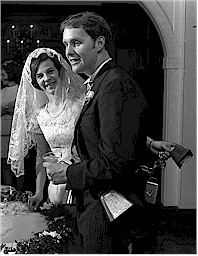
Barney Sellers/The Commercial Appeal files
Sounding a musical note at his wedding reception at the University Club on April 12, 1969 is Charles Kemmons Wilson Jr. ['64],
who was locked in a chain adorned with bells after the wedding in
Grace-St. Luke's Episcopal Church. His bride is the former Norma
Caruthers Thompson, daughter of Mrs. Norman Thompson of 4150 Kriter
Lane and the late Mr. Thompson. Mr. Wilson is the son of Mr. and Mrs.
Charles Kemmons Wilson of 3615 South Galloway Drive.
Third man pleads guilty in 2005 robberies
Spree ranged from Oak Court Mall to G'town
By Lawrence Buser, Memphis Commercial Appeal
Friday, March 20, 2009
A third former East High student involved in a
robbery spree two years ago was sentenced to three years' probation
Thursday in Criminal Court.
Won Colby Pierce, 20, the driver, pleaded guilty
Thursday to three robbery-related charges. He was convicted last August
of another robbery-related charge. He is now a college student in
Kentucky.
The incidents occurred Feb. 14, 2007, when
Pierce and three other students skipped school. They told officers that
they wanted to buy shoes and robbery seemed like the best avenue after
seeing a man withdrawing money from an ATM at Poplar Plaza.
They followed the man to Germantown, where they
lost him. They then picked out their first victim, a man beaten in the
parking lot of the Germantown Village Square at 7730 Poplar.
Pierce and three fellow classmates were also
charged with robbing a Germantown High School teacher outside the
school; knocking down and stealing the handbag of a 70-year-old woman
who was walking with the aid of a cane at Hickory Ridge Mall; and
robbing a woman in a parking lot at Oak Court Mall.
Earlier this week, co-defendant Preston
Williams, 19, pleaded guilty to attempted aggravated robbery in the Oak
Court Mall case and was sentenced to three years probation.
Tommy Brown, 18, pleaded guilty to counts that
include aggravated robbery in the teacher case and attempted aggravated
robbery in the Oak Court Mall case. He was sentenced to 7.2 years in
prison, but will be eligible for parole after serving 20 percent of his
sentence, or 1.4 years.
Williams and Brown also are now college students.
A fourth defendant, Deandre Clark, 19, whose case
is pending, has been arrested on separate charges of aggravated
burglary and theft over $1,000. Judge James Beasley Jr. revoked his
bond and set his case for next week.
Two enter guilty pleas to robbery charges
By Lawrence Buser, Memphis Commercial Appeal
Tuesday, March 17, 2009
Two East High School students who cut class and
went on a random crime spree two years ago pleaded guilty to
robbery-related charges Monday.
The pleas by Preston Williams and Tommy Brown
and a guilty verdict last summer against classmate Won Colby Pierce
leaves defendant Deandre Clark with the only pending cases.
They were accused of beating a man in the
parking lot of the Germantown Village Square at 7730 Poplar; robbing a
Germantown High School teacher outside the school; knocking down and
stealing the handbag of a 70-year-old woman who was walking with the
aid of a cane at Hickory Ridge Mall; and robbing a woman in a parking
lot at Oak Court Mall.
On Monday, Williams, 19, pleaded guilty to
attempted aggravated robbery in the Oak Court Mall case and was
sentenced to three years' probation.
Brown, 18, pleaded guilty to counts including
aggravated robbery in the teacher case and attempted aggravated robbery
in the Oak Court Mall case.
He was sentenced to 7.2 years, but will be
eligible for parole after serving 20 percent of his sentence or about
1.4 years. He is scheduled to go into custody June 2.
Williams and Brown are both college students now, said state prosecutor Michael McCusker.
Pierce, 20, who was convicted last August of
helping to commit aggravated robbery in the Oak Court Mall case, is
expected to be sentenced this month in Criminal Court by Judge James
Beasley Jr.
Sons of Holiday Inn founder given trip down memory plane
By Wayne Risher, Memphis Commercial Appeal
Tuesday, March 10, 2009
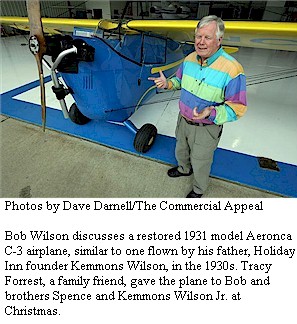
The
spitting image of Kemmons Wilson's first airplane is dredging up fond
memories for the late Memphis business legend's family.
The Aeronca C-3, affectionately dubbed the
Flying Bathtub, was a gift from a family friend to the Holiday Inn
founder's sons
Spence ['60],
Bob ['62] and
Kemmons Jr. ['64]
Tracy Forrest, who has built homes in Wilson's
Orange Lake development near Orlando since the 1980s, found the plane
in storage in south Georgia and had it restored. He brought it to
Wilson Air Center at Memphis International Airport last Christmas and
surprised the Wilson sons.
Bob Wilson ['62], president of the
fixed-based operator and co-owner of Kemmons Wilson Companies, said,
"We had no idea about it. They walk us in and show us the airplane,
which was really just an unbelievable gift, really unique. You couldn't
have asked for a more surprised three guys and a more grateful three
guys."
The Wilsons grew up hearing stories about the
plane their father owned with a friend. It figured prominently in their
father's courtship of wife-to-be Dorothy.
"Often on Saturday or Sunday afternoons, Kemmons
would take Dorothy on a flight to a small town in the area. Dorothy
would sell tickets for $1 to anyone who wanted to take a flight in the
plane," Wilson's 1996 autobiography said.
Forrest heard about the Aeronca when he and Bob
Wilson were touring an aviation museum. "Seeing the look on Bob's face
telling me the story, it was a very special story."
"That was Kemmons' first aviation experience,
which laid the groundwork for a lot of his life: being a pilot in World
War II, the use of aviation to further his business," Forrest added.
"That thought always stayed with me."
Kemmons Wilson died in 2003 at 90.
Aeronautical Corporation of America made 425 C-3s
in Ohio in the 1930s. It was easy to fly and maintain, said Jim
Thompson of Roberts, Ill., president of the National Aeronca
Association. "It was the right plane at the right time. Lots of people
learned on it. That was the thing of it, it wasn't a big old heavy
biplane of the day."
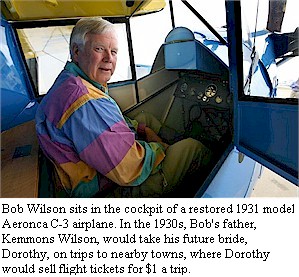
Thompson
said the Aeronca C-2 and C-3 are popular display items in vintage
aviation museums. "People who know anything about them would love to
see them again, and they're just nice to look at."
Forrest pored over aviation records for several years in a vain attempt to track down Wilson's old plane.
A friend in the Smithsonian Institution's archives eventually traced the full registration history.
Forrest found the same model and had it
refurbished. "We did it with the original colors, the original
equipment, pretty much the way the airplane would have been when
Kemmons owned the airplane," Forrest said.
The fabric-covered body is sky blue with yellow
wings and yellow trim accents. It has a single wooden propeller and the
original N number of Wilson's plane.
The Wilsons wanted to display it in the lobby of Wilson Air, but there was a problem.
"I hate we didn't have a big enough place in the
air center to hang that thing. It's about two feet too big," Wilson
said.
Dave Ivey, vice president of Wilson Air Center,
said the hangar nearest to the terminal was being modified so the
Aeronca could be placed in a harness and hung from a structural steel
beam.
Wilson said, "We're putting it there to keep it
out of the way until we figure out where to put it. We'll find
somewhere much more positive, where everybody can see it."
The plane is for display only, because its two-cylinder, 36-horsepower engine has a weak cylinder.
It won't be taking anyone for $1 rides.
Teacher touts Latin to aid vocabulary, critical thinking
By Jonathan Devin Special to The Commercial Appeal
Wednesday, March 4, 2009
Like many high school students of Latin,
Dawn LaFon ['73] was forced to take the subject by her mother, but the language of Cicero and Virgil quickly became her life's passion.

"My
mother said I could stop after one year, but I had to take it," said
LaFon, 52, one of two Latin teachers at White Station High School. "And
I fussed and fumed. Then I got in there and I really liked it. It's
like a big jigsaw puzzle."
Studying Latin is popular with students who hope
to enter medical professions, since 95 percent of medical terminology
comes from Latin. LaFon recommends it for developing vocabulary and
critical thinking skills as well.
She teaches five classes each day, including
Latin I, III, IV and Advanced Placement (AP) Latin for grades 9 through
12.
"At White Station we work very hard and we do
deserve our reputation for excellence," said LaFon, a Memphis native
who has taught at the school for 20 years.
In her efforts to relate Latin to her students'
lives, LaFon has rewritten songs with Latin pronouns ("I don't know
where I come up with these things," she laughed), employed the letters
of Cicero for discussions on career choices, and drawn connections
between ancient and current events.
"When 9/11 happened, we talked about how Pompey
had to clear the Mediterranean of pirates," said LaFon. "I told them
that terrorism isn't anything new, (that) this was the terrorism of
their time, and we'll always get through it."
During her first year at White Station, LaFon got a chance to submit questions for the AP Latin Exam.
Then, "about five years ago, I got a call out of
the blue, and they asked me to be on the exam development committee."
Only two other high school Latin teachers in the
United States are on the committee, which writes and grades the AP
Latin exam. Students who pass it receive college credit.
"It's a year-round process," LaFon said. "In the
fall, we write the rough drafts of new questions and meet to finalize
those drafts. In the spring, we work on the multiple-choice part of the
exam. In the summer, we gather together in some location and grade the
exams."
LaFon knows of at least two former students who
went on to become Latin teachers, but said even the ones who didn't
found Latin useful in college and beyond.
One college-bound student, Derion Givens, wrote
in a letter to LaFon, "As I sit through any lecture on the Latin
language or Roman history, I will think back to 'bo, bis, bit, the
Spartans really hit; bismus, bitis, bunt, Spartani magni sunt!"
Another former student, Darrell Kiedo, now a
comedian living in Los Angeles, visited LaFon last year and showed her
his recently published novel titled "The Black Actor's Guide to Not
Working in Hollywood," published by Xlibris.
In it, a high school Latin teacher inspires a
boy to leave gang life. Kiedo told LaFon that the teacher in the novel
was based on her.
"I told him that if it's made into a movie, Teri Hatcher is the only choice possible to play me," said LaFon.
As for the rumor that Latin as a language is dead? LaFon weighed in: "It's not dead. It's just evolved."
Name: Dawn LaFon
Profession: Latin teacher at White Station High School
Age: 52
Education: Graduated from East High School; B.A.
in education, the University of Memphis; M.A. in Latin, the University
of Washington.
Family: Lives with Peaches the poodle, and cats
Teddy and Daphne. LaFon is the first cousin of former vice president Al
Gore.
Favorite Quote: "Docendo discere," which means "One learns by teaching."
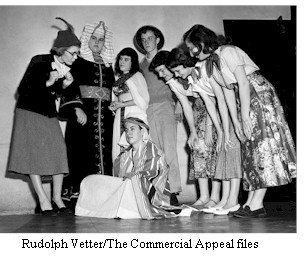 On February 18, 2008 The Commercial Appeal Memphis Memories section republished a photo from 1951 that included some East alumni (then students). On February 18, 2008 The Commercial Appeal Memphis Memories section republished a photo from 1951 that included some East alumni (then students).
Performers take stageThe Beethoven Club Junior
operetta, "The Riddle of Isis," is presented in February 1951 at
Memphis Little Theatre. Top roles are played by James Crow (seated) of
Messick and Theresa Steuterman (left) of Bellevue, Bill Biggs Jr. ['52] of East High, Mary Ann Hunter of Snowden, George Hearn Jr. of Central, Jackie Alper ['53] of East High, Jane Smalley of Fairview and Margaret Rose CaPece of St. Agnes.
|
A trailblazer and a role model
Letters to the Editor, Memphis Commercial Appeal
Saturday, February 7, 2009
I didn't know Eleanor Gandy was such a
trailblazer as a member of the Memphis State 8 (Feb. 4 article); maybe
it was because she was too busy encouraging me and her other students
to blaze our own trails.
For Ms. Gandy it was about her students, not
about her. I graduated from East High School in 1974, and she was not
only a teacher of mine during that time, she was a mentor and a friend.
She encouraged diverse thought and acceptance of other cultures,
people, their histories and ideas.
I was fortunate to have had great teachers and
mentors while at East, such as Douglas Wilkins, Hubbard Alexander and
Sonny Scruggs, to name a few, and Eleanor Gandy is one of the people
whose influence is still with me today.
Frank McLallen ['74]
Cordova
[See the story on Eleanor Gandy immediately below.]
Memphis State Eight: College was path to a better life
She viewed education as best way to change family cycle of poverty
By Linda Moore, Memphis Commercial Appeal
Wednesday, February 4, 2009
Editor's note: Second in a series
It was all a joke for
Eleanor Gandy [Facutly 1971-1977] when she volunteered to take the admissions test for Memphis State University.
It was the late 1950s. Her family couldn't afford college, and Memphis State didn't admit African-Americans.
"I was kidding, and I said I'd do it," Gandy, 68, recalled.
But the 1958 Douglass High School honors graduate did well.
On Sept. 18, 1959, she was one of eight
African-American students to integrate MSU, a group now known as the
Memphis State Eight.
Integration didn't happen without a struggle,
and it was a year from when they were accepted until they were allowed
to start classes. Many spent that year at other colleges.
Not Gandy.
"We were really poor. I knew we really couldn't
afford college," she said. "I got a little scholarship from LeMoyne
(College) but it wasn't enough."
This was her only chance.
"What we were trying to do was get a good job,
something more than cleaning somebody's house," said Gandy, one of 15
children.
That first year, the NAACP gave scholarships to
the eight. The Hyde Park-Hollywood Civic League bought Gandy's books.
Her mother gave her a "shiny silver dollar" every day.
Fortunately for Gandy, the NAACP and the civic league continued with those arrangements.
She graduated from Memphis State in 1963 with a
degree in French and minors in history and psychology. She earned a
master's in education in 1966 and is now retired from Memphis City
Schools. She taught French for 22 years.
Gandy believes greater than her personal
accomplishment is the impact that being first has had on the
educational dynamics of her family.
"It made my family evolve," Gandy said.
Most finished high school and a few went North for better jobs, she said.
But today her nieces and nephews know they can go to college, and they know they can go wherever they want.
"The joy is in the evolution of the family. My
brother went back, got a degree in accounting after he had a family and
a job," Gandy said. "He wanted to do that after he saw it could be
done. That's the joy with me that the family has risen above where we
were."
[The East High Alumni Page Editor's note: Ms.
Gandy was a faculty member at East 1971-1977, teaching French, world
history, and spelling.]
Secondary helps Ole Miss halt Texas Tech at Cotton Bowl
By Marlon W. Morgan, Memphis Commercial
Friday, January 2,
[Excerpt]
DALLAS — Graham Harrell. Michael Crabtree.
Michael Crabtree. Graham Harrell.
For a month now, all Ole Miss cornerbacks Marshay Green and
Cassius Vaughn ['06]
heard about is how the Texas Tech quarterback-wide receiver duo was
going to torch the Rebels secondary. To be honest, they could care less
if they never hear those names again.
Ole Miss quartberback Jevan Snead celebrates with fans after beating
Texas Tech 47-34 Friday.
That pre-game talk actually caused Green and
Vaughn to take that torch and light a fire under them. The two took
turns not only holding Crabtree to just four catches for 30 yards, but
they kept the entire Red Raiders receiving corps from running roughshod
through the Rebels defense.
Thanks to Green, Vaughn, and the usually stout
Ole Miss front seven, the 20th-ranked Rebels were able to come away
with a convincing 47-34 victory over seventh-ranked Texas Tech Friday
afternoon in front of an AT&T Cotton Bowl record crowd of 88,175.
''They say he's the best receiver in the game,''
said Vaughn, a junior from East High School. ''Why wouldn't you
(consider covering him a challenge)? He's won the (Biletnikoff)
receiver award two years in a row. Harrell is just awesome. They're
great players.
''But the challenge was what are you going to do
today? Not in the past. It wasn't about the past, it was about now. We
stepped up today, the whole secondary and the whole team.''
With the game tied at 21 in the second quarter,
Vaughn intercepted a Graham pass and returned it 13 yards to set up a
27-yard Joshua Shene field goal that put Ole Miss ahead, 24-21.
With the Rebels (9-4) clinging to that lead to
start the third quarter, Green picked off Harrell on the Red Raiders
opening drive, returning it 65 yards for a touchdown and a 31-21 lead.
Both players also added three tackles.
Coaches offer a 'fair' deal to football recruiters
By Jason Smith, Memphis Commercial Appeal
Saturday, November 22, 2008
[Excerpt]
East High football coach
Marcus Wimberly ['92 and Faculty)
was sitting in front of a projector and DVD burner at Memphis
University School, distributing highlight reels of his players in
action to any college coach who came within three feet of his
science-fair-like set-up.
"We've got to get them in school," Wimberly
said, sounding desperate. "That's the whole purpose of them playing
high school football."
Wimberly was one of more than three dozen high
school football coaches who participated this week in the AutoZone
Liberty Bowl High School All-Star Game's first "recruiting fair" at
MUS.
The event, which drew about 30 college coaches
Wednesday evening, was intended to familiarize college coaches with
some of the area's top uncommitted talent...
Crime uptick alarms citizens
East Memphis burglaries rise 90% over year ago
By Cindy Wolff, Memphis Commercial Appeal
Saturday, November 22, 2008
Burglars stole an air conditioner, a computer,
televisions, cuff links, even a kitchen sink on Friday, all before
noon.
Memphis police are dealing with a blast of
thievery that's hitting homes citywide, the worst of which is in East
Memphis, where the number of burglaries so far this month have nearly
doubled from the same period last year.
In the Tillman Station precinct, which includes
High Point Terrace, Kingsbury, Berclair, Grahamwood, Normandy and other
East Memphis neighborhoods, there have been 118 burglaries so far this
month, a 90 percent increase over the same period in 2007, when 62
homes were broken into.
Authorities blame a variety of factors,
including unemployment, the economy and repeat offenders who spend
little time in jail for their crimes.
Memphis City Council members and police
officials met Monday night at the Links at Galloway golf course with
about 200 area residents to discuss burglaries.
East Memphian Joe Evangelisti attended that
meeting. On Tuesday, he went to the council meeting to ask members to
relax residency hiring restrictions. They didn't.
On Wednesday, burglars scaled an 8-foot fence,
cut his phone line and ransacked his house while an alarm blared.
"I'm angry," said Evangelisti. "I've lived here
51 years, my whole life, and I feel like the welfare of the citizenry
is being compromised by city officials. There aren't enough patrol cars
in my neighborhood."
Eight precincts showed an increase in burglary
this month. Ridgeway, which includes Hickory Hill, showed a 4 percent
drop.
So far this year, home burglary is up about 13
percent across the city compared with last year. Police spokeswoman
Detective Monique Martin said that from Jan. 1 through Thursday,
Memphians reported 10,437 burglaries compared with 9,260 for the same
period a year ago.
She said commanders identify hotspots, beef up
patrols, look for patterns and meet with citizens to talk about trends.
But, she said, the problem is beyond basic police work.
"We lock up the same burglary suspects over and
over, and they are let out because our laws are weak," Martin said.
Residential burglary is a Class C felony, which carries a penalty of
3-15 years and a fine of up to $10,000. But with some exceptions for
extremely violent crimes, prisoners are eligible for parole after
serving one year.
"We have people who have committed more than 100
burglaries out there," said University of Memphis criminologist Dr.
Richard Janikowski.
"Sometimes they get out for time served, which
is the time from when they are arrested and go to trial. They look at
it as the cost of doing business."
Like other U.S. cities, Memphis is facing a
tough economy, which might explain some of the uptick, Janikowski said.
The unemployment rate hit a 21-year high in
Tennessee at 7.1 percent in September. The rate in the Memphis metro
area was 7.3 percent.
But in addition to a strong unemployment rate,
Memphis also has a high rate of unemployed men between age 19 and 30
who are not trying to look for jobs, a category called "non-labor force
participation."
Susan [Welting] Pohlman ['68] said her neighborhood near Avon and Normandy is being rocked with burglaries just about every day.
"They're mostly kicking in doors, taking big
screen TVs, laptops, Xboxes," said Pohlman, who sends out e-mails for
her Avon/Normandy Neighborhood Watch.
"We're all watching now," Pohlman said. "We're
looking at people we don't recognize, at cars that slow down a lot, at
people walking around we don't recognize."
The Real Time Crime Center, which operates
CyberWatch, a crime report notification for Memphians, introduced a
blog for High Point Terrace residents this week.
It connects citizens instantly with police
officers and commanders who monitor the blog to hasten communication
between the public and law enforcement.
Munford head football coach out
By Jason Smith, Memphis Commercial Appeal
Thursday, November 20, 2008
Munford High principal Darry Marshall said Thursday evening he has relieved Cougars head football coach
Wayne Randall [East Faculty 1994-2006] of his coaching duties because of "philosophical differences" between the two.
Marshall would not go into specifics but said
Randall's dismissal had nothing to do with the recent resignation of
former Munford assistant football coach Mike Norwood, whom Randall
brought with him from East when he was hired at Munford in 2006.
Norwood resigned Tuesday after Munford school
officials discovered he had sent text messages to an 18-year-old female
student at Brighton High.
"I don't want people to think this had anything
to do with (Norwood's resignation)," Marshall said. "This was a
decision I'd made several weeks ago, and I had to let Wayne know
(Wednesday) so he could go ahead and try to start finding himself
another position somewhere."
Marshall said Randall would continue to teach at Munford through the school year.
"I respect Wayne very much, and basically what we
have here is a difference of opinion on the direction we need to be
going," Marshall said. "Wayne's a great coach and a great friend of
mine. I've always respected him. It's just that we basically have a lot
different philosophies."
Randall, who could not be reached for comment,
was 17-16 in three seasons at Munford, which finished 2-8 this season.
He guided the Cougars to playoff appearances in 2006 and 2007.
Munford High School coach resigns over text messages to student
By Tom Bailey Jr., Memphis Commercial Appeal
Tuesday, November 18, 2008
A Munford High assistant football coach resigned
Tuesday over text messages sent to an 18-year-old female student at
Brighton High.
Mike Norwood [former East Faculty], who
also taught science, had been suspended since Friday and turned in his
resignation Tuesday, Tipton County Schools Supt. Tim Fite confirmed.
"Right now we don't know a lot. Don't know if it
was profane or vulgar. He just said it was probably inappropriate for a
teacher to say," Fite said.
No improper physical contact has been alleged, he said.
The Brighton High student had a boyfriend on the
Munford team. Norwood started text-messaging her to communicate with
his player, Fite said.
The school system found out about alleged,
inappropriate messages after a friend of the girl's informed a Brighton
teacher.
School officials interviewed the coach and the female student.
The school system also is trying to get access to the text messages.
"After five days they pretty well delete those
things," Fite said. "It'll probably take us a few weeks to see."
But Norwood acknowledged to school officials the texts were "not something a teacher ought to say," Fite said.
"We got a low tolerance on that, anything inappropriate," Fite said.
Norwood, who Fite said is about 40 years old, was in his third year at Munford High.
Locators can help find the missing
Device tracks when person is lost or wanders
By Cindy Wolff, Memphis Commercial Appeal
Monday, November 17, 2008
[Excerpt]
It took only 2 minutes to find a missing
Alzheimer's patient last week in Towanda, Pa., and 47 minutes last
month for a person in Norfolk, Va.
They were both wearing a bracelet that operates on radio telemetry, which helps track someone who wanders.
Two Memphis doctors who do research with Alzheimer's patients want to bring Project Lifesaver to Memphis.
Dr. Linda Nichols ['68], a University of
Tennessee Health Science Center professor and Memphis Veterans Medical
Center researcher, and her colleague, Dr. Jennifer Martindale-Adams,
believe the device may have helped on May 5. That's when 86-year-old
Elizabeth Ferguson, who suffered from slight dementia, drove away from
her Berclair home headed to a doctor's appointment and vanished.
...
East fails to sustain overall progress according to standardized test results
by Ken Welch, The East High Alumni Page
Tuesday, November 11, 2008
East High, mired in low academic performance,
measured as an average across its entire student population, did not
show much progress from the previous year according to the 2008 Report
Card on Schools released by the Tennessee Department of Education on
November 10.
As a result of the scores on standardized
testing and other criteria, East failed to meet the "No Child Left
Behind" benchmark for Annual Yearly Progress (AYP).
The AYP failures for 2008 occurred in two
categories. The school's pupils scored worse than last year in the
"reading/language plus writing" testing by 2 percentage points with 87%
of the students achieving proficient or advanced status. Statewide 93%
made the grade, which also is the state's goal for this year. The
school also fell far short of the state's 90% goal for the graduation
rate with East graduating only 69% in 2007. The state's report card
uses the previous year's graduation rate. It should be noted that the
2008 graduation rate for East was 72.73%. The state average graduation
rate in 2008 was 82%.
Another figure disappointing those hoping for
significant improvement at the school was the ACT score. For those at
East taking the ACT in the 2007-2008 school year, the average composite
score was 15.8, a full point lower than the year before. As a college
entry evaluation test, pupils are not required to take the ACT,
therefore, the score may not accurately reflect the academic level of
the student body. Likewise, some colleges, sometimes those with higher
admission requirements, prefer the competing SAT exam, so pupils might
take that instead of the ACT. SAT scores are not included in the report
card issued by the state. If higher achieving students took only the
SAT, then the ACT score reported could be below the academic level of
the student body. On the other hand, pupils with a poor academic record
might not consider college an option and not take the ACT test, skewing
the reported ACT score higher than if all students took it. The ACT
test, depending on whether the writing test was included, cost either
$30 or $44.50 during the 2007-2008 school year. While there were fee
waivers for economically disadvantaged pupils, the waiver required an
application and funds had to remain available. If any of the 85% of
East students classified as economically disadvantaged did not take the
test for financial reasons, that also could skew the results.
Regardless of the potential for the ACT score not to reflect the
academic level of the entire student body, it is an important marker
that allows comparison among schools nationwide, among those gaining
admission to college, and allows for compairson of scores from various
years (but see the
ACT Concordance when comparing scores before and after 1989).
There was at least one brighter spot on the
state's evaluation of East this year. The percentage of pupils
achieving a designated level of proficient or advanced in the math
testing improved by 8% over the 2007 figures. The two year average of
the math scores showed a 13% improvement over the previous average.
Despite this advancement, East's math score for 2008 is 9 percentage
points below the average of all participating high schools in Tennessee
and 5 percentage points below the state's target score for this year.
Private schools are not required to participate in the NCLB assessments
but all public schools participate.
While it cannot be conclusively demonstrated by
the aggregate scores released by the state Department of Education in
its report card on schools, it is entirely possible East's improvement
in math scores is directly related to
The Greater East High Foundation's
tutoring program at the school which has been focusing on mathematics
since it began in 2005. The Foundation offers pupils after-school
tutoring 4 days a week and on Saturdays and also offers a summer
program.
Despite the failure to meet the AYP
requirements, the school did move from the high priority "state/LEA
reconstitution plan 1 - improving" category to the "target"school
category, a single step up in the state's intervention categories. That
change results from East achieving Annual Yearly Progress last year.
Despite East's previous history of being in more serious intervention
categories, last year's progress served to reset the evaluation so that
this year's failure to meet the AYP requirements is counted as a first
year failure. With a first year failure, the school is placed in the
"target" category and is offered technical assistance from the state in
an effort to keep it from slipping down into the high priority
category. In 2006 and 2007, East had been in the high priority
"reconstitution" category in which the state intervened in the running
of the school, though such intervention appeared rather limited since
East had already changed pincipals and had taken other steps in an
attempt to address the academic issues.
The cohort dropout rate at East, meaning those
starting the 9th grade who didn't continue through the 12th grade was
26.7% in 2008. That's a 4.8% increase from 2007 and 11% above that for
2006.
There were 293 suspensions or expulsions from
East during the 2007-2008 school year. The percentage of students
suspended was 31.1 and the percentage expelled was 0.2.
The 2008 state report card on schools, for the
most part, reports on the status of the school for the 2007-2008 school
year.
The number of pupils at East on October 1, 2007
was 895, of which 685 were categorized as being economically
disadvantaged. African-Americans made up 98.6 of the student body, 0.2%
were Asian or from the Pacific Islands, 0.3% were Hispanic, and 0.9%
were white. There were 487 girls and 454 boys enrolled. During the
2007-2008 school year East hosted grades 8 through 12. Because of a
change in the way the number of students is reported, some demographic
data in the state's 2008 report card does not match/relate to the
number of students listed as being enrolled on the count date of
October 1, 2007.
One other broad category reported by the state
in its report card on schools is "academic growth." It "measures
student progress within a grade and subject and for high school a
prediction formula is used based on a student's previous academic
performance for ACT, Gateways and End of Course assessments and
Writing." Based on the test results and the formula, East High grades
9-12 scored above the predicted result of their progress in Biology I
and English I. They were below the prediction in U.S. History, and
there was no detectable difference between their predicted progress and
their scores in other curriculum areas tested. The ACT predictions
showed that the test takers were below the expectations in the
composite and science/reasoning scores with no difference detected in
the other categories.
The acting principal of East High, substituting
while the principal is out on leave due to heath reasons, did not
return a call requesting comment.
The state's report card on East High is available at
www.EastHigh.org/report-card-2008.html.
Any alumnus with the knowledge and skills to further analyze the
state's data for posting on this web site is invited to contact the editor.
East High players back coach's prediction
Wimberly: Hard work key to postseason return
By By Jason Smith, Memphis Commercial Appeal
Friday, November 7, 2008
This time last year, East High football coach
Marcus Wimberly ['92 and Faculty] was already looking ahead to the 2008 season.
His Mustangs had finished 2-8 in 2007 in his
second year on the job and Wimberly, a former East standout who went on
to star at the University of Miami, had no intentions of watching his
alma mater plod through another losing season.
Mark WeberThe Commercial Appeal East's Demario Vester brings down
Tromarcus Toney of Melrose in last week's victory, which clinched the
Region 8-4A title for the Mustangs.
Mark WeberThe Commercial Appeal East's Demario
Vester brings down Tromarcus Toney of Melrose in last week's victory,
which clinched the Region 8-4A title for the Mustangs.
"We expected this. We put the work in, and I
said, 'Don't be surprised if we go from 2-8 to 8-2.' I said that before
the year started," said Wimberly, whose Mustangs managed to make his
prediction a reality this season.
East (8-2) earned its first outright region title since 2000 with its
30-25 road win at Region 8-4A foe Melrose last week. It was the
Mustangs' sixth straight victory overall.
Tonight, for the first time since 2005, East
will host a first-round playoff game when fourth-seeded Hardin County
(7-3), led by standout senior quarterback Will Gilchrist, invades
Fairgrounds Stadium.
"They're a hard-nosed team. They're pretty
balanced," Wimberly said. "It's not just (Gilchrist). They've got two
guys who have rushed for over 700 yards."
Wimberly credits East's six-game turnaround this
season to its offseason work in the weight room and the emergence of
several team leaders.
He's also had a direct hand in the turnaround
himself, having applied for and receiving a grant from the NFL to
improve the school's weight room.
"This time last year, we were preparing for this
year," said Wimberly, a former fifth-round NFL draft pick. "We were
getting our new weight room in, and I think that's been one of the
biggest differences between last year and this year, because we were
physically weak.
"As an overall team, there's a lot more
discipline in place. These are pretty much my guys, the class that came
in with me, and they came in under different guidelines."
The return of senior linebacker Mark Guyton from
a season-ending injury in 2007 and the improved play of junior
quarterback Jaszy Parker (1,566 total yards, 22 TDs) have also been
major factors in East's resurgence.
"(Guyton) has made a big difference. He's made
us tougher at the linebacker spot, which we really needed," Wimberly
said.
"(Parker) is improving each and every week. He
had to learn last year. We threw him in the fire and it was kind of
rough on him. But he's stepped it up this year tremendously."
 The Commercial Appeal, November 5, 2008: The Commercial Appeal, November 5, 2008:
The
East High School Class of 1956 meets for lunch at the Racquet Club on
the fourth Thursday of every month. The Mustang group includes Dale
Turner Lowery (seated, left) of Germantown, Marti McDonald Kruchton of
Germantown, Bonnie Thomas Seitz and Raymond Young; Ray Henley
(standing, left), Marcia Scarborough Dunlap of Germantown, Buddy
Shindler of Germantown, Lee 'Dickie' Cardwell of Germantown, Pat Black
of Germantown and Gail Valvik Bruce. Class members interested in
attending should call 683-2276 for information.
|
Man held in '06 slaying
He's brother of suspect already charged in killing of ex-East High football star
By By Hank Dudding, Memphis Commercial Appeal
Tuesday, October 28, 2008
A second brother has been charged with
first-degree murder in the 2006 death of a former East High football
star.
Damon Davis, 23, was charged last week with killing
Arthur Sallis [associated with the Class of '01],
22, during a robbery Jan. 26, 2006, at Sallis' home at 5445 Flowering
Peach in Hickory Hill. Davis' brother, Ronnie Davis, 25, was charged in
September.
Sallis led East to a state football championship as a junior in 1999, rushing for 1,406 yards.
He was shot at least twice in the chest during a
struggle after three men robbed him at his home. Police are still
trying to develop a case against a third suspect.
The men took money and Sallis' 2000 Chevrolet
Suburban, which was stripped and burned in Byhalia, Miss., according to
a police affidavit.
Damon Davis was taken into custody Oct. 19 after a domestic incident at an apartment at 3184 Steele.
He is accused of attacking ex-girlfriend Erica
Jackson, beating her with his hands and fists before she grabbed a
knife and cut him, according to an affidavit.
Damon Davis is charged with aggravated burglary and domestic assault in that case.
He was arraigned on the murder charge Monday.
An obituary and an additional newspaper article about the death of Mr. Sallis are available.
Retired organist built bombers, taught music
By Nevin Batiwalla, Memphis Commercial Appeal
Saturday, September 27, 2008
From the age of 20, Rosa "Rose" Gillespie, the
grande dame of local organists, dedicated her life to teaching music.
In churches and schools, she had a way of inspiring her pupils.
"She had an almost magical gift to bring out in people what they did
not think they could do," said Amy Lindeman, 38, who called Ms.
Gillespie her "surrogate grandmother."
Ms. Gillespie died Wednesday from complications of bone cancer at a Memphis nursing home. She was 89.
Born in the small town of Stamps, Ark., Ms.
Gillespie was raised by a single mom during the Depression. Those tough
years, where she bounced between 22 houses, helped mold her can-do
spirit, Lindeman said.
"She was completely self-made, and she used that to help other people make it on their own," Lindeman said.
Ms. Gillespie received master's degrees in English and psychology from Memphis State University.
She instructed for 35 years in Memphis schools,
at Fairview Junior High and then later at East High, where she taught a
pretty teen named Cybill Shepherd. Despite her best efforts, she never
could convince the budding celebrity to join the school's chorus.
"I knew if I could get Cybill to join then
everyone else would want to join," Ms. Gillespie told The Commercial
Appeal in 2006. "But she said she just couldn't because she was too
busy with cheerleading."
During World War II, Ms. Gillespie rode a
motorcycle to get to her job as an aircraft riveter at the Fisher
Aircraft factory. Working the late shift building B-52 bombers with a
hardscrabble group of women, Lindeman said, Ms. Gillespie "learned a
bunch of new words she had never heard before." On Sundays, she'd
finish up early, head home for a quick change, and then dash off to
church to play the organ.
She also pitched for the Humko professional softball team.
In 1949, she played her first church service at
First Baptist Church. She served as minister of music at McLemore
Christian and spent 35 years at Central Christian Church.
She never married. Her only children were her pets and students.
"Someone told me once that when he died he wanted
to come back as one of her dogs, because that was the best life he
could imagine," Lindeman said.
In 2006, after 35 years as organist and choir
director at Central Christian Church, the 86-year-old retired to enjoy
a view from the pew.
"There comes a time when you know it's right to
step aside and this is that time. I have no regrets and I've loved it
all," she said.
Services will be at 11 a.m. today at Central Christian Church. Forest Hill Funeral Home has charge.
The family requests that in lieu of flowers,
donations be sent to the Memphis and Shelby County Humane Society.
A standard obituary is also available as is a news story about when she retired as a church organist in 2006.
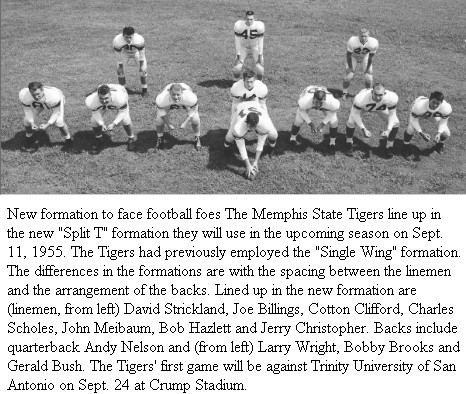 On September 11, 2008 The Commercial Appeal Memphis Memories section republished a photo of the Memphis State Tiger football offense, which inlcuded Larry Wright (Faculty, 1959), shown on left side of backfield, and Bobby Brooks (Faculty, approx. 1960-66), pictured in the center of the backfield. The photo was first published September 11, 1955. On September 11, 2008 The Commercial Appeal Memphis Memories section republished a photo of the Memphis State Tiger football offense, which inlcuded Larry Wright (Faculty, 1959), shown on left side of backfield, and Bobby Brooks (Faculty, approx. 1960-66), pictured in the center of the backfield. The photo was first published September 11, 1955.
|

1959 East coach still coaching
Larry Wright coaches with son at Briarcrest Christian School
September 5, 2008
Larry Wright (Faculty, 1959), former track and
football coach at East High, was featured in a television story about
his coaching with his son. Produced by WPTY-TV.
The video is available.
Larry Wright was also mentioned in a June 18, 2009 article that
profiled his son, Major Wright, the head football coach at Briarcrest
Christian School, when his son named his father as "the person I most
admire."
Perfect fits: DT Williams, LB Wilson sized up right for Vols defense
By Ron Higgins, Memphis Commercial Appeal
Monday, September 1, 2008
Dan Williams ['05] was told he was too big. Ellix Wilson was viewed as too small.
Williams listened to nutritionists, Wilson listened to his heart.
The result is that a rarity should occur at 7
p.m. CDT today in Rose Bowl Stadium in Pasadena, Calif. -- two Memphis
high school products starting on defense for Tennessee against UCLA in
the 2008 season opener.
Williams, a former East High star, will likely open at tackle, where he started 10 games last year.
"I've worked harder this offseason than I've ever
worked before," said Williams, a junior, whose only weakness seems to
be a fondness for his mother's chicken casserole.
Wilson, a former Melrose standout, is the
starting middle linebacker as a fifth-year senior. It's a spot he first
stepped into last January in the Outback Bowl when Jerod Mayo was hurt.
"I've been around here for five years, so
everybody knows what I've got," Wilson said. "I hadn't had a lot of
chances to get out there and do it, and now I will get those chances."
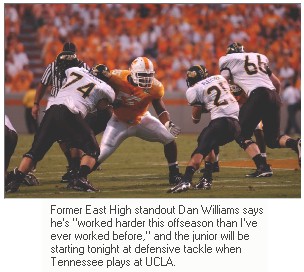
When
Williams arrived in Knoxville as a true freshman in July 2005, the
Vols' coaching staff wasn't happy with what they saw. ... or rather,
what they couldn't miss.
It was Williams, reporting at 6-3, 360 pounds.
What happened to the more svelte DT that Tennessee had signed?
"I guess I took advantage more than I should of
all the free food you got on official recruiting visits," Williams said
with a laugh. "Then after I graduated, I just got lax working out. All
I did was eat pizza and play PlayStation.
"I guess I wanted to relax before I went to
college, because I knew college and college football would be an
all-year thing. I guess I relaxed too much. I showed up in Knoxville
still thinking I was about 320 until Coach told me to hop on the
scale."
And when Williams did, Fulmer gave him an ultimatum. Drop weight or welcome to the offensive line.
"I thought Dan would be an offensive lineman,"
Fulmer said. "I didn't know if he would have the quickness and the
speed or dedication to be a defensive tackle in this league."
Williams proved Fulmer wrong, much to Fulmer's delight.
"I really wanted to show the coaches I was
committed," Williams said. "Coach Fulmer gave me a very small window
like until the next spring to lose about 50 pounds. I did that."
As Williams lost weight, his strength increased
and his speed returned. Last year, he stepped solidly into the Vols' DT
rotation. After making a career-high six tackles in an early season
game vs. Southern Mississippi, he also felt for his mental fog in
learning the college game finally burned off.
"It was one of my better games," said Williams,
who now weighs 308. "I felt for the first time I could be a factor in
helping my team win. My mind now understands there's no way I'll ever
go back to being that heavy."
Vols' defensive tackle Dan Brooks said Williams' diet discipline has spread to his football.
"Dan is not a flashy guy, but he's there every
snap, because he was Mr. Reliable this past spring," Brooks said. "He's
such a nice guy that sometimes I have to tell him he needs to play with
an attitude. He started to that some last year."
...
August 29, 2008, The Commercial Appeal publishes this
photo of Bonnie Williams, Joanie Williams, Patsy Williams, and Debbie
Williams in it's Memphis Memories column. Class associations of the
girls is undetermined though it probably is or is near the classes of
'62, '64, '65 and '72 respectively. The photo was first published in
the newspaper August 29, 1960.

Tiger offensive lineman happy to be back home
Malcom Rawls didn't fit in at Knoxville, but will start vs. Rebels
By Dan Wolken, Memphis Commercial Appeal
Monday, August 25, 2008
Malcom Rawls ['05] always heard that
college was supposed to be the best time of his life. But when the East
High product arrived at the University of Tennessee in 2005, he could
tell immediately that something was wrong.
"I realized early that I didn't really like it," Rawls said. "I was in Knoxville, and I wasn't happy."
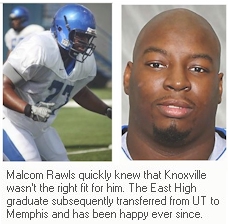
One of
the top offensive linemen to come out of this area along with Ole Miss'
Michael Oher, Rawls knew something had to change. But he also knew that
doing what was in his heart -- transferring to the University of
Memphis -- would likely begin a long climb back into the spotlight.
On Saturday, Rawls will complete the journey when he starts for the Tigers at right guard against Ole Miss.
"It's good to come back home and be a part of
it," Rawls, now a junior, said. "I get to represent Memphis, and that's
a big deal to me."
Much has changed for Rawls since he chose
Tennessee over Memphis and a number of other Southeastern Conference
schools three years ago.
Once focused on engineering as his major, he's
now studying Spanish. Once a can't-miss prospect, he's now fighting to
establish himself as a legitimate college player. But coach Tommy West
believes one thing hasn't changed: The talent that was so evident to
recruiters from some of the top programs in the country.
"Malcom has a lot of ability, a lot of God-given
talent," West said. "The thing that's holding him back right now is a
conditioning level. He's got to get his conditioning to a level where
he can play at a pace for a period of time. If he does that, he can be
an outstanding player. Right now he can play three or four plays as
good as anybody, but he gets tired after that."
Memphis, however, will be as patient as possible
with Rawls' conditioning because his potential to make an impact is so
promising. Listed at 6-foot-5, 315 pounds, Rawls fits perfectly into
West's desire to get bigger on the offensive line in recent years. But
West also wants to play an up-tempo game on offense, which could test
Rawls' staying power.
As a backup last season, Rawls was on the field
for 56 snaps against Rice as a replacement for the injured Dominik
Riley but played sporadically in the other eight games he participated
in.
"It's just keeping him fresh. (If he's tired),
we'll put somebody else in," West said. "I think mentally he's fine
with our system."
Rawls' mental strength has always been one of
his biggest attributes. He turned down opportunities in high school to
play at prestigious prep schools in the Northeast and was recruited by
most of the academically elite Division 1 football powers.
During the recruiting process, in fact, Rawls
said his top two choices were Notre Dame and Stanford. But as fate
would have it, the coaches at both schools -- Tyrone Willingham and
Buddy Teevens, respectively -- were fired before signing day. So when
Rawls settled on Tennessee, it was not based on enthusiasm as much as
process of elimination.
"I just never liked Knoxville," he said. "It was
a difficult adjustment, not liking the city. Coming out of high school
my major was civil engineering, and I jumped right into some difficult
classes, physics, calculus and trying to learn the playbook. It was a
difficult adjustment."
Rawls commiserated often during his redshirt
year with defensive tackle Dan Williams, his friend and former teammate
at East, who was also struggling to adjust. While Williams stuck it out
at Tennessee and has had a successful career, Rawls decided to come
home.
Though it's taken three years to become a Division 1 starter, Rawls said it's been worth the wait.
"I tell people every time I can that I love it
here," he said. "I just have to work hard and continue to go over
plays, talk to offensive line coach (Rick) Mallory. If you listen to
the coaches, they have so much experience they'll prepare you.
Everything they ask, I try to do it to the best of my ability. That's
the best way to get on the field here."
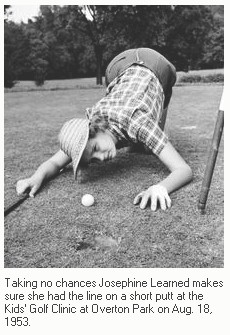 The Commercial Appeal
Memphis Memories
Friday, August 22, 2008
[Editor's note: this photo of Jo Learned ('61) appeared in the "Memphis Memories" section of The Commercial Appeal on August 22, 2008, after having first being published in 1953.]
From The Commercial Appeal, August 21, 2008 -
East alumni Tyrone Johnson (class year undetermined) and T.J. Pointer (class year undetermined) move into residence hall at the University of Memphis.
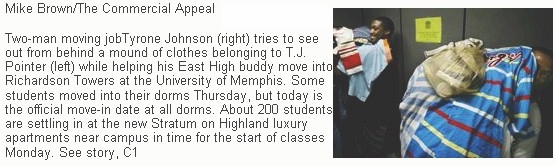
Cash Wants to Enlist Paid Tutors From Student Ranks
ANDY MEEK | The Daily News
August 13, 2008
As part of the sweeping overhaul he envisions
bringing to Memphis City Schools, new district superintendent Dr.
Kriner Cash wants to enlist students to work for the school system as
tutors.
"What if instead of working for Back Yard Burger
… for $6 an hour, work for me. Work for city schools," Cash said last
week to about 250 members of the Memphis Rotary Club.
His idea to tap students to work as tutors is
only one component of Cash's transformative plan for a school system
that has about 113,000 students and is beset by a mix of academic and
operational challenges.
But as he spoke to the Rotarians, one person
listening in the crowd no doubt felt a measure of satisfaction when he
heard Cash mention the tutors.

Bill
Sehnert, director of a nearly five-year-old academic foundation begun
at East High School, was in the crowd and caught up with Cash after his
remarks. Sehnert helps lead an army of tutors – albeit a private army –
at East that already is putting into practice the very idea Cash
floated to the audience.
Capitalism in action
Started as the Greater East High Foundation in
2004, the basic idea is that academically strong upperclassmen at the
school can get paid $10 an hour to tutor their fellow students. One
measure of the program's success is the number of local school
officials eager to replicate it at their own institutions.
Versions of the program are up and running in at
least five Memphis area schools, including East, Whitehaven High
School, Westwood High School, Douglass High School and Lester Middle
School.
"It's the same tune we've been singing for five years," Sehnert said about Cash's idea.
Commodities trader and East alumnus
Charles McVean ['61]
provided the financial backing and operational framework that gave
birth to the academic program at East. He tapped his eighth grade
teacher, Margaret Taylor, to become the foundation's director emeritus.
The program is one example of how, as the
performance of and funding for local schools has lagged in recent
years, successful business professionals like McVean are seizing the
moment to preach education reform in a way school bureaucracies can't
always do. And while he didn't allude to it in his remarks at the
Rotary Club, Cash has taken notice of the program at East.
MCS administrators have asked for details of the program to share with the new superintendent.
"At Rotary, I said we need to sit down and talk
about it, and he said he'd like to," Sehnert said. "So we're trying to
schedule a meeting to talk about it.
"Our programs actually dovetail. They shouldn't
compete. We can't compete with our customer. We will work hand in glove
with Dr. Cash in any way that he sees we can be an asset to the
community."
The trappings of a movement
The East High foundation is catching fire even beyond the boundaries of Shelby County.
McVean has friends and business associates in
Mississippi, and schools there in places such as Bolivar County have
shown an interest in adapting the foundation's operation for their own
use.
A burgeoning component of the program at East
also calls for tapping college-age tutors to come back and train
struggling high school students. The foundation's leadership sees that
as another way to motivate children – by showing them what they
eventually can become.
Another Memphis businessman, meanwhile, has
plunged headlong into the same effort McVean is pursuing. But local
venture capitalist Bob Compton is doing so on a much larger stage.
Taken together, the separate efforts reflect a
spirit apparently building among local business leaders to do what the
public sector can't when it comes to education reform.
Compton spent half a million dollars of his own
money to produce "Two Million Minutes," a documentary that compares how
a group of students in India, China and the U.S. choose to spend their
high school years.
The title comes from the period of time between
the first day of classes for a high school freshman and graduation day.
That four-year period equates to roughly 2 million minutes.
Fallacy or fact?
One of the themes of Compton's project is that
American students are being far outpaced by their counterparts in other
areas of the world when it comes to excelling in studies that lead to
degrees in highly sought-after jobs.
"And since I spent the last 20 years creating
and building new technology companies, I happen to know that what
creates companies and what creates jobs are products and technologies
that are invented by scientists and engineers," Compton said.
In June, Compton debated Washington Post
education columnist Jay Mathews on the CNBC program "Street Signs."
Probably the only thing Compton and Mathews agreed on is that their
spirited debate is crucial to fixing the country's woes in the field of
education.
"Don't ever go on CNBC to debate Bob Compton,
one of America's most energetic prophets of doom, without careful
preparation and a willingness to be rude," Mathews said in a column he
wrote – only slightly tongue in cheek – after the broadcast.
Speaking with The Daily News by phone, the
veteran education reporter for The Post elaborated on the two men's
differences.
"He and I generally agree that American high
schools need to get much better, more rigorous and need to challenge
kids in a way they're not doing now. I think we're absolutely on the
same wavelength there," Mathews said. "But this scare tactic that we've
got to fix our schools or we're going to become the Third World of the
world is false.
"It's pretty clear that if you look at how our
kids are doing in school, they're way ahead of the education kids are
getting in most other countries."
A different emphasis entirely
From Compton's point of view, the divide he
highlights in the movie reflects shortcomings in the way U.S. schools
educate children compared to the way schools in India and China pursue
the same thing.
"Indians and Chinese (people) pursue academic
and intellectual training the way Americans pursue sports – with
passion, rigor and intensity," Compton said.
Compton, who's currently in Beijing to watch the
Olympics, enlisted a filmmaking team that includes veterans of the
"Frontline" series on PBS to help him create the documentary. The
places where he's screened the film include Harvard, Stanford
University and the Aspen Ideas Festival in Colorado in July.
The latter event was sponsored by Intel Corp.
and during a question and answer session after his film was shown,
Compton said he was excited to spot a few rows back from the stage New
York Times columnist Thomas Friedman. Friedman's widely acclaimed book
"The World is Flat" is what inspired Compton to go to India in 2005, a
trip from which the idea for the movie was born.
Prominently displayed on the Web site for the
movie – www.2mminutes.com – is a quote from Microsoft Corp. founder
Bill Gates that reads: "Two Million Minutes casts a bright spotlight on
a crisis in this country." A similar thought is reflected in a speech
to the nation's governors in 2005, during which Gates described
America's high schools as obsolete.
Movers and shakers are paying attention to the
point of the film. Compton had a private meeting about the movie in
February with presidential candidate and U.S. Sen. John McCain, R-Ariz.
Compton caught up with McCain's opponent, U.S. Sen. Barack Obama,
D-Ill., back in November.
In addition, Compton is screening the film
during the Republican National Convention in Minneapolis next month. He
also hopes to be able to take his film to the Democratic National
Convention in Denver later this month.
East High removed from State's "high priorty" list of troubled schools
Memphis City Schools gets mixed report card
District improves, but some schools still lag
By Dakarai I. Aarons , Memphis Commercial Appeal
Monday, July 28, 2008
The news on No Child Left Behind for Memphis City
Schools is a mixed bag of results, according to information released
Monday by the Tennessee Department of Education.
While the district returned to good standing
under No Child Left Behind, the number of individual schools in good
standing decreased from 128 to 119.
In the good news category, the number of schools
on the state's "high priority" list dropped by 11, including six
schools that had long languished on the list of schools eligible for
state takeover.
Memphis has 30 schools -- down from 41 the year
before -- on the "high priority" list, which tracks schools that failed
to meet federal benchmarks two years in a row. Twenty of those schools,
however, improved in several categories, including 12 of the 15 schools
that were eligible for state takeover last year.
The results released Monday show how close -- or
far -- students are from meeting standards for reading and math
proficiency, attendance and graduation rates.
Schools must meet benchmarks in 37 categories or
use some other method approved by the state to be considered in good
standing.
"The students, parents, teachers, and staff in
schools that performed admirably, as well as those schools that
continue to show improvement, are to be commended and should be
encouraged by these results," said Supt. Kriner Cash in a prepared
statement. Cash and board members are in Park City, Utah, at a reform
governance retreat.
Not all the news was good for Memphis schools, however.
Memphis schools on the state's less-urgent
"target" list, which places schools on watch for narrowly missing
benchmarks in the first year, increased to 34 from 16 last year.
The number of target schools increased statewide
as the federal benchmarks went up from 79 to 86 percent proficiency in
math and 83 to 89 percent proficiency in reading and language arts.
That tripped up a number of schools in Greater
Memphis. Shelby County's Woodstock Middle and Tipton County's Covington
High also landed on the target list.
A number of Memphis schools used the "safe
harbor" provision to meet the mark, which gives schools credit for
making a 10 percent reduction in students who tested below proficient
the year before and meeting either the attendance or graduation rate
target, depending on grade level.
The number of schools that used "safe harbor,"
along with details on how individual schools fared on the state's
exams, will likely be released by the state in November.
State officials had high praise for the work
done in improving schools that had been on the state's failing list for
years, such as Treadwell Elementary, Airways Middle, Vance Middle and
East High.
"They are to be congratulated for what they've
done," said Connie Smith, executive director of innovation,
improvement, and accountability for the state department of education.
Smith said she was "particularly proud" of
Vance, which had been on the list longer than any of the other schools.
Smith credited the work done by former Supt.
Carol Johnson's "fresh start" plan for the improvements in many
schools.
In those schools, which included Vance and
Airways, principals and entire staffs were changed in an effort to
boost student achievement.
But the work remains unfinished. Hamilton High,
for example, is in the state's worst-performing category under NCLB.
Many staff were replaced there last year and
Cash recently moved Michael Bates, credited with turning around Humes
Middle School, into the principal's position at Hamilton.
The No Child Left Behind List
These 56 Memphis-area schools remain on the
state's No Child Left Behind list, either as "target" or "high
priority" schools.
Target schools
The first year a school does not meet federal
standards, it is given a warning. There are no sanctions for "target
schools," which have another year to demonstrate progress.
Alcy Elementary
Alton Elementary
Coleman Elementary
Corning Elementary
Covington High (Tipton County Schools)
Downtown Elementary
East High*
Egypt Elementary
Evans Elementary
Fairley Elementary
Fairview Middle
Georgia Ave. Elementary
Getwell Elementary
Graves Elementary
Guthrie Elementary
Hamilton Middle
Hanley Elementary
Hawkins Mill Elementary
Hillcrest High
Holmes Road Elementary
Kate Bond Elementary
Lakeview Elementary
Lester Elementary
Lucie E. Campbell Elementary
Magnolia Elementary
Mitchell High
Raineshaven Elementary
Raleigh-Egypt High
River City High
Ross Elementary
Shannon Elementary
South Park Elementary
Vollentine Elementary
Westhaven Elementary
Woodstock Middle (Shelby County Schools)
High priority
A "high priority" school has missed the same
benchmark at least two years in a row. Sanctions in this area can lead
up to becoming a school eligible for state takeover.
A. Maceo Walker Middle
Booker T. Washington High
Carver High
Cherokee Elementary
Chickasaw Middle
Cordova Middle
Corry Middle
Craigmont High
Cypress Middle
Dunbar Elementary
Fairley High
Frayser High
Geeter Middle
Georgian Hills Elementary
Grizzlies Academy
Hamilton High
Kingsbury High
Kirby High
Manassas High
Northside High
Oakhaven Middle
Oakhaven High
Pyramid Academy**
Raleigh-Egypt Middle
Sheffield High
Treadwell Middle
Trezevant High
Wells Station Elementary
Wooddale High
Wooddale Middle
*Moved up from the "high priority" list
**not a traditional school; most students attend for only part of the school year
East High English teacher named Educator of the Year by Memphis Alliance of Black School Educators
'I guess it was God's calling for me to be an educator'
By Linda Moore, Memphis Commercial Appeal
Saturday, July 5, 2008
Meah King's ['97, Faculty 2002- ] success
as a teacher can be measured in many ways, by the number of students
who adore her or the lists of administrators who admire her methods.
Or there are simply the raw numbers.

This past
school year, 99 percent of the 10th grade English teacher's students
passed the state mandated language exam. Over the past five years, the
East High teacher's average is about 97 percent.
For that achievement, along with her activities
outside the classroom, King has been named the outstanding educator of
the year by the Memphis Alliance of Black School Educators.
"I see results," said King. "The students are
successful regardless of their so-called disabilities and the things
that go on at home. We don't let that be an obstacle."
Although still a young teacher, King, 29, is a
standout, said Janice Tankson, treasurer of the alliance and an
assistant principal at East, noting that most of King's students are
not taking honors English.
"She's setting those high expectations and the
kids are reaching those expectations," Tankson said. "That speaks
volumes to us that she's working with those students to be the best
they can be."
East High principal Frederick W. Curry described King as a phenomenal teacher, one of the best he's ever seen.
"She believes her success is tied to their success," he said.
King begins every class with a chest-thumping chant of "I can do anything," he said.
"It's a chant the kids have bought into," said Curry, who is considering taking it school-wide.
Former students say King is not your average teacher.
"She makes learning fun," said Alexandria Jones,
18, who will be a freshman at Baptist College of Health Sciences this
fall.
King kept them motivated, kept them reading and
had them write at least one essay a week to prepare for the exams.
"I can't even remember a dull moment in her
class," Jones said. "And in 10th grade I had her for sixth period. By
the end of the day, after lunch, everyone was ready to go home. But not
in her class."
King also gives of her time and talent away from school, said Jeff Akins, the alliance's president-elect.
"Not only is she an excellent teacher in the
classroom, making sure all her students excel in what they're trying to
learn, but she also gives of herself in the community when school day
is over," Akins said.
She is one of the youth advisers for Youth Eager
to Serve (YES), a mentoring organization at her church, Lord's
Tabernacle Holiness Church, for children 7-17.
King is the faculty sponsor for Peer Power, a
student-to-student tutoring program funded by the Greater East High
Foundation.
"She loves them and they know it," said Margaret
Taylor, retired principal of Grahamwood Elementary School and director
emeritus for the foundation.
And King teaches adult General Equivalency Diploma classes and ACT prep classes for high school students.
King first began working with children at church
where at 16 she taught pre-school after school and during the summer.
She graduated from East in 1997, and earned an
undergraduate degree in English literature and master's in instruction
and curriculum at the University of Memphis.
King has been at East for six years.
"I guess it was God's calling for me to be an
educator," King said. "I know it's my calling because once my day is
complete I have peace when I go home."
Mitchell Hires New Basketball Coach
Reported by: Jamie Griffin
WPTY-TV
July 4, 2008
[The video of this story may be still be available at
WPTY-TV]
 Sorrell Valentine ('93 and Faculty)
spent his fourth of July watching basketball. "I couldn't find anyone
who barbecued," said Valentine. Truth be told, Valentine is just a
basketball junkie. "I would do this for free," he said of coaching high
school basketball. "If I wasn't coaching high school I would be
(volunteering) at AAU basketball or working with kids anyway."
Fortunately for Valentine, he will be allowed
to continue to do what he loves to do and get paid at the same time.
Mitchell hired Valentine to replace Jerry Johnson, who recently left to
coach at Wooddale High.
Valentine, a graduate of East High School in
Memphis, will take over the Tigers after one season at Treadwell where
his team finished 13-15 this past season with a lost in the regionals
to Mitchell, who went on to play in the Division I AA State Finals.
U.S. Border Patrol Recruiting Minorities in Memphis
Reported by: Joyce Peterson
WPTY-TV
July 1, 2008
[The video of this story may be still be available at
WPTY-TV]
Memphis, TN -
Mention a job that pays 70-grand a year, with no college degree or high school diploma needed and 21 year-old
Courtney Moore ['05]
is all ears. He graduated from East High in 2005, but with spiraling
tuition costs making college next to impossible, Courtney's looking at
every opportunity.
"Sounds like a good idea," says Moore. "I'm really thinking about joining the border patrol myself."
The U.S. Border Patrol is actively recruiting
African-Americans right now. Of the 16,500 agents currently on staff,
only about 1-percent are Black. The federal government's Minority
Recruitment Strike Team is targeting cities throughout the Southeastern
United States, including Memphis.
Agents are telling young people like Courtney
this is their chance to do something that pays well and provides a
service to their country.
"What they'll be doing," says Agent Michael E.
Douglas, "is protecting the nation from terrorists and drug smugglers.
And they'll be making life better for those who are here in this
country as citizens."
To become a border patrol agent, you have to
study the law, learn self-defense tactics, take aggressive driving
lessons and go through firearms training. And you have to be willing to
relocate to the Southwest. Border patrol agents live in California,
Arizona, New Mexico and Texas.
Applicants also need to be able to speak
Spanish. Those who can't, will undergo an intensive 8-week language
course at the agency's training academy in New Mexico.
"Recruits are going to have to put in some
effort," says Agent Douglas. "They're going to have to put everything
they have into it, whether it be academics or the physical abilities.
They're going to be taken to their limits."
Courtney Moore, and his mother Paulette, both
agree that a little hard work is worth it in order to get a big payoff.
"He's an adult," says Paulette. "He has no
family as far as a wife or children. This would be a good opportunity
for Courtney."
"It's not about the money," says Courtney,
"because everyone needs money. It's about me doing something. I
understand it's a dangerous job. But I'm willing. I'm willing!"
Agent Douglas says 175 Memphians filled out
applications during two previous recruiting trips to the Bluff City.
Douglas and his team will be back in town on July 25th.
How we met: Separate ways lead back to 'the one'
By Anita Houk, Memphis Commercial Appeal
Sunday, June 29, 2008
They were kids when they met.
"We were between 7 and 10," declares LaLita
Washington Bivins, 31. "He tries to say we were older, that he was not
playing with G.I. Joe then. We met as kids at summer camp at Goodwill
Homes."
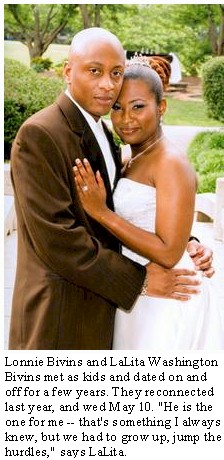
As predicted,
Lonnie Bivins (class year undetermined), also 31, says they met as teenagers.
"The meeting," he says, "was quite interesting,
quite unexpected for me." It was at a party with a mutual friend the
summer they were rising seniors -- he at East High, she at Whitehaven
High. "From that point on, we talked quite often. We dated for a
year-and-a-half, two years."
He's a jokester. She's reserved. But they made it mesh -- for a while.
Then she went off to Austin Peay State
University, and he attended University of Memphis. Before long, "She
went her way, I went my way," says Lonnie.
LaLita became a Memphis City Schools teacher. Lonnie moved to Houston, Texas.
"I'm a contractor at NASA," he says by phone from
Houston, "at the facility where they do the astronaut training."
Working underwater can simulate working in
space, as a recent PBS documentary featuring Lonnie's unit illustrates.
" 'Good Morning America' was here seven or eight months ago and did a
live show. 'Armageddon' and 'Space Cowboys' are part of the movies
filmed here."
Oddly enough, he was in Memphis when he dove into this line of work.
"I was in welding school at William R. Moore
(School of Technology), and I was reading a book about underwater
welding. I'd never heard of it. A couple of weeks later, about 3
o'clock in the morning, this commercial came on with this guy
underwater welding. There was a school down here (in Houston) that
offered it. I moved down here the next month, finished school, got a
job and been here ever since.
"But now," he states emphatically, "it's time to come home."
Since he left Memphis, he and LaLita each
married; each had a daughter. Hers, Lauryn, is 10 and lives with LaLita
in Memphis; his, Arianna, is 7 and lives with her mom in Houston.
"When we were married, we weren't in contact,"
Lonnie says. "But I would always see her mother when I was in town and
she would see my mother ... That's how we knew what was going on in
each other's lives."
When they discovered they were both divorced,
the terrain changed. He was already planning to return to Memphis,
making inroads to a new career here. Then last summer he was invited to
a cousin's wedding.
"When I came home for the wedding, I called
(LaLita)." She invited him to speak to her business students at
Trezevant Career & Technology Center. "So I did. Then we went out
July 20 of last year. Not even a year later, we're married."
May 10, in the Japanese Garden at Bartlett City Hall.
"It's crazy," LaLita says, "because we dated on
and off over the years. Recently when we got back together, we said,
'OK, this is it.' So we planned the wedding and we thought he'd be in
Memphis before now, but hopefully he'll be here by October.
"He is the one for me -- that's something I
always knew, but we had to grow up, jump the hurdles," she says. "He's
smart, giving, loves baseball. He reminds me of my dad. He's a 'pretty
boy' but doesn't mind getting dirty. He can figure anything out."
Well, almost anything. Lonnie has been known to
ask for help: "When you ask God for certain things, and God puts the
thing in your face that you asked for, you can't do nothing but say
thank you," he declares.
"I asked for the chance with specifically her."
In Brief: Jury convicts Memphis man in 16-year-old's murder
From The Commercial Appeal, June 21, 2008
A jury on Friday convicted a Memphis man of
felony murder and robbery involving the 2004 shooting death of a high
school student whose burning body was found near a bike path near
McLean and Chelsea in North Memphis.
Gerraldo White, 19, will be automatically sentenced to life in prison by Criminal Court Judge John Colton Jr.
State prosecutor Glen Baity said White and two
other men abducted DeAngelo Shaw on the night of May 26, 2008, and took
him to the bike path, where he was robbed of drugs and money and then
shot.
They carried him to a grassy area nearby, shot
him again and then doused him with gasoline and set him on fire.
Police said Shaw, a 16-year-old student at East
High School, had run away from home five days earlier and had been
reported missing.
Joshua Taylor, 19, also was charged in the murder. His case is pending.
-- Lawrence Buser
After the glory days pass by, the lessons instilled by 'Coach' continue
By Cathryn Stout, Memphis Commercial Appeal
Monday, June 16, 2008
The kitchen lights are not as grand as the stadium lights he once knew.
But Jack Turner never needed bright lights to
shine. Seventy-seven years old and several years retired from coaching,
the gridiron giant radiates leadership as he sits at his Raleigh home
crunching tacos with his former players...
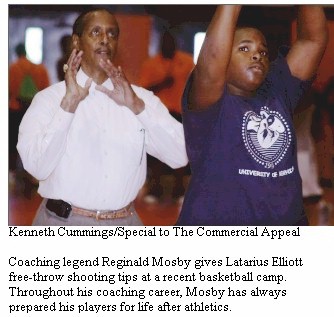
An administrator's offer of autonomy recently lured a local hardwood legend out of retirement.
For 21 years,
Reginald Mosby [Faculty 1986-2007]
was synonymous with the East High School boy's basketball program.
After taking a sabbatical in 2007, he'll be coaching basketball next
year, under the leadership of principal Dr. Lowell Winston at Northside
High School.
"Northside is really blessed to find a coach of this caliber to coach our kids," said Winston.
Aside from adding a sixth state championship ring to his collection, Mosby has a more pressing goal.
"To keep those guys off the street," he said of his future players.
"It's a vacuum for the type of guys that I
coached with and against," he said. "And the kids feel it. They don't
feel like they have to give back because they don't see their coaches
give back."
Part of his job as a coach, explained Mosby, is teaching about life beyond basketball.
So he talks to his boys about dating women with
values. He forces them to make eye contact when they speak. He reminds
them to shine their shoes before job interviews. He even finds jobs for
some of them.
In the 1970s, Mosby coached during the school
year and ran the Lester community center pool in the summertime. Daniel
Young was one of the high school players he trained as a lifeguard. Now
44, Young has worked his way up to aquatics manager at the same pool.
Raised without his father in the home, Young is not sure where he would be without Mosby's guiding hand.
"Probably be in jail. Probably have about three
or four babies. Ain't no telling what would have went on," said Young.
"It's just a blessing that he was in my life."
Whether for future or former players, Mosby
feels an obligation to offer tough love and unwavering encouragement to
the athletes who cross his path, as his grandparents and mother, Lillie
Mosby Simmons, did for him.
"I wasn't privy to being raised by my father,"
said Mosby, father of two. "I had to scratch my way up, so if I can
give somebody else a leg up, I want to."
At a recent basketball camp at Northside, Mosby
scanned the gym of kids until his eyes landed on a middle-schooler
about to make a free throw. Before the youngster could release the
ball, Mosby put his hands on the child's shoulders, straightens them up
and whispered to him.
Even though the shot missed the basket, the boy looked up at Mosby and smiled.
Northside turns to veteran coaching duo
By Jason Smith, Memphis Commercial Appeal
Thursday, June 5, 2008
Northside athletic director Donald Holmes said
this week the school has hired a pair of former East High head coaches
to resurrect the Cougars' floundering football and boys basketball
programs.
Holmes said legendary former East boys basketball coach Reginald Mosby
has agreed to replace longtime Northside boys basketball coach Curtis
Bivins, who was 202-228 in 15 seasons with the Cougars.
Also, former East boys track and field coach
Gary DeBerry is set to replace former Northside football coach Cleodis
Weaver, whose Cougar football teams have dropped 30 consecutive games
going back to the 2004 season.
"Both of them (Mosby and DeBerry) have kind of got winning in their system," Holmes said.
Mosby, who was unavailable for comment, is
Shelby-Metro's seventh-winningest boys basketball coach of all time
with 500 victories. He takes over a Northside program that won just
three games last season.
"I called him, and he let me know (he would take
the job) after he had sat down and thought about it for awhile," Holmes
said. "His experience will be a plus for the program."
DeBerry, who had also been an assistant football
coach and assistant girls basketball coach at East, said he hopes to
restore some tradition to a Cougar football program that hasn't
qualified for the playoffs since 1991.
"It's a big challenge, but we're going to take
it a little at a time and get the guys over here back in the frame of
mind of winning," DeBerry said.
"In the 1970s and '80s, they had a winning
tradition over here with guys like Willie Fry (a first-round draft pick
of the Pittsburgh Steelers) and Mike Hegman (Dallas Cowboys), and we're
trying to get it back to that same status.
Don't call Margaret Taylor retired
From "The Columns: Alumni Reviews," The University of Memphis Magazine, Spring, 2008
by Gabrielle Maxey
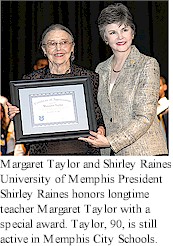 Margaret Taylor [Faculty 1955-69]
ended her 41-year career as a teacher and principal in the Memphis City
Schools in 1995, but she's hardly retired. At age 90, she works full
time for a mentoring program at East High School designed to generate
excitement for learning and give students the necessary tools to
graduate and pursue meaningful careers.
Taylor (BS '63, MA '66) retired from Grahamwood
Elementary School 12 years ago after serving as principal from 1972-96.
She quickly returned to school, serving as substitute principal for six
years and supervisor of student teachers at the University of Memphis
for four years.
Under her direction, Grahamwood was designated a
U.S. Department of Education Blue Ribbon School of Excellence and was
named one of the 10 best schools in the state. Grahamwood was so
popular during that time that parents would camp out overnight at the
Board of Education just to get to their children spots at the school.
Taylor prefers to share the accolades she earned
as an educator. "We had the best faculty, good kids, good, supportive
parents, and the Board of Education supported us," says the lively
nonagenarian who wears her hair in a sensible gray bun. Taylor has won
a string of personal honors as well. She was named Educator of the Year
by the University of Memphis Society and Memphis' Outstanding Senior
Citizen by the Downtown Kiwanis Club.
Taylor was tapped for the Peer Power program by businessman and benefactor
Charles McVean ['61],
who established the Greater East Foundation in 2004. McVean, a 1961
East High graduate and former student of Taylor's, donated $1 million
to the school to pay for extra support teachers, building improvements
and payments to students who make good grades and who tutor other
students. Under the pay-for-performance plan, students make $10 an hour
for tutoring math, English and science. The students who attend
tutoring sessions, called "scholars," can earn incentives for good
grades.
Tutoring is done for an hour after school Monday
through Thursday and three hours on Saturday. East added an eighth
period at the end of the day, with only tutoring allowed during that
time. Athletics, cheerleading, choir and other activities must wait
until after tutoring.
There are 35 to 40 tutors at East, upperclassmen
recruited from the ranks of honor students. They tutor about 100
scholars. Tutors train three days a week for around an hour and a half
and teach six to eight hours a week. Tutors are paid for the time they
train as well as their teaching. "The tutors benefit by the additional
training in communication, academic skills and leadership," says
foundation director Bill Sehnert. "They work nine to 12 hours a week,
so they don't need to get a job outside of school."
Scholars and tutors also have a chance to win
cash and other prizes in weekly and six-week grading period team
competitions. Teams earn points based on quizzes, tests, attendance,
and class and conduct grades.
Many students in Memphis City Schools are
classified as economically disadvantaged, says Sehnert. A large number
come from single-parent homes, which generally have lower incomes than
two-parent families. The way to break the cycle of poverty, says
Sehnert, is education. "We want the students to see the connection
between hard work, good grades and rewards for performance," he says.
"We take kids and advance them a little every day. We make incremental
advances. We try to improve not only their grades, but their conduct."
The results have been impressive since the
program was launched three years ago. Of students who attended tutoring
last year, 100 percent passed their algebra Gateway exam, compared to
72 percent schoolwide. Of seventh and eighth-graders who were tutored,
100 percent passed the Tennessee Comprehensive Assessment Program
(TCAP) test last year, with 51 percent scoring advanced in math. In
addition, all of the tutors went on to attend four-year colleges.
The Peer Power model was created so that other
schools can adopt it. The program already is in place at Whitehaven
High School. "Margaret Taylor is blessed and also a blessing by being
productive in a vital field into her 90s," says Anne Freeman, who
established the program at Whitehaven with her husband, Dr. Jerre
Freeman. "She has a ready and contagious laugh, a face full of life and
a quick wit. I've seen her laughing at a joke while some friends
decades younger are still scratching their heads."
McVean has similar praise. " 'Lady Margaret'
taught me eighth-grade math at East High School in 1956 through '57,"
he says. "She is every bit as sharp now as she was more than 50 years
ago. Margaret makes a huge contribution to our program at East and is
an inspiration to me each and every day. She is a wonderful living
example of what the Greatest Generation was all about."
Taylor is usually at East by 8 a.m. Mondays
through Thursdays. "Sometimes I stay until 4:30, 5, sometimes 7," she
says. Taylor takes Fridays off since there is tutoring on Saturdays.
She reserves some Fridays for trips to casinos in Tunica. ("I take $50
with me. When I spend what I took, I'm done," she explains.) Taylor
also has been active in Leadership Memphis, the Kiwanis Club, the
Germantown Education Commission, the Memphis Symphony League and
Memphis Brooks Museum of Art.
How does she manage when many others her age
have retired? "I keep on keeping on," says Taylor. "It keeps me
involved. It's a challenge. I like to see kids learning."
Tutors and scholars at East begin each learning
session by saying a creed which begins "I want to be somebody some
day." Most would agree that Margaret Taylor is someone indeed.
Alumni reaching back to help students at former school
Assisting with tutoring, mentoring, keeping history alive
From The Commercial Appeal, March 19, 2008
Alumni reaching back to help students at former school
Assisting with tutoring, mentoring, keeping history alive
By Lindsay Moore
Monday, May 19, 2008
Mattie Brown Guy never attended the new, modern Manassas High School.
But she walks the halls as if it were her own.
Students in the cafeteria shout greetings and make room for her at a table.
Guy, class of '54, is a fixture among the alumni
who are at Manassas every Tuesday. She never misses a program or
sporting event, and students say she doesn't sugarcoat the truth.
High school administrators say they need more like her.
With schools feeling pressured from the outside
and the inside, alumni can be a valuable resource, administrators say,
providing financial assistance, tutoring and mentoring, while also
helping to instill a sense of history, school spirit and pride in
today's students.
"If we don't help them, who will help them?"
asks Guy, surrounded in the Alumni Room at Manassas by decades-old
memorabilia.
It was the alumni who bolstered the students after a shooting there last October.
"They let it be known it was an accident and our
school is not bad," said DeMarcus Douglas, 17, who graduated on
Saturday. "They stood behind us."
East High model
Many see the Greater East High Foundation as a model of how alumni can help.
The foundation, which has received national recognition, was created by Charles McVean, class of '61. Among it's many functions, the foundation pays students to tutor others after school.
"We have identified the most underutilized
resource in our city today, the top performing students at these inner
city high schools," said McVean, chairman and CEO of McVean Trading and
Investments.
Known at East as "Charlie Mustang," a nod to the
school's mascot, McVean has funded lunch for 200 during parents'
meetings and routinely supplies outside speakers to inspire the
students. Recently, visitors from the Chicago Mercantile Exchange
exposed students to a new world of possibilities.
East principal Fred Curry is the first to credit
McVean's involvement at East for bolstering test scores and school
pride.
"He has the right idea in terms of trying to get
pride back in school and in terms of getting alumni back in these
schools and to assist schools," Curry said.
McVean's idea is also being used at Whitehaven
High School, where Dr. Jerre Freeman sponsors the Greater Whitehaven
High Foundation.
Dr. Vincent Hunter, principal and member of the class of '82, has proof the program works.
"Our scores went from 68 percent to 85 percent proficiency in one year."
Some hard to reach
As accepting as some students are of the alumni,
in many schools there is a large part of the student body -- teens
dealing with bad grades, crime-ridden neighborhoods, uninvolved parents
or gang recruitment -- who past graduates don't reach.
"What we have to do is figure out a way to turn
these kinds around who are headed in the wrong direction," says McVean.
He's planning a tutoring program for the students who are not college-bound.
The Greater East foundation plans to train 50
tutors at the University of Memphis this summer. If Memphis City
Schools gives its approval, the foundation will pay them to work with
students.
While intervention might work, others say
programs need to bring in some younger alumni to make an impact on
students who are harder to reach.
At Manassas, most active former students
graduated in the '40s, '50s and early '60s, said Nadie Kinnard,
president of the Manassas Alumni Association.
She said the students "think we think everything
they do is wrong," said Kinnard, class of '65. "They need somebody that
understands their language, why they do what they do."
Manassas alumni have raised money and maintained
a college scholarship program but have been unable to establish a
formalized mentor program, Kinnard said. Money always helps, but it's
not the only answer.
"You've got to have some people power," Kinnard
said. "Younger people can relate to these students better than I can."
-- Linda A. Moore: 529-2702
School Volunteers
Adult volunteers at Memphis City Schools must submit to a background check and meet other criteria.
To learn more, call 416-7600 or go online to
mcsk12.net and click on Volunteer Services at the bottom of the site
index list to the right of the page.
[A photo which accompanied this story is not included here.]
East alumnus, first woman on MUS board, ends term
MUS Today - The Magazine of Memphis University School
March 2008 [posted November 12, 2008]
 At the February Board
of Trustees meeting, it was announced that Susan [Bach ('67)]
Faber, Jim Varner '73, and Kent Wunderlich '66 were rotating off the
board after 52 years of collective experience. They were thanked and
recognized as trustees who love this school and have served
unselfishly. Each will become a member of the Honorary Board.
At the February Board
of Trustees meeting, it was announced that Susan [Bach ('67)]
Faber, Jim Varner '73, and Kent Wunderlich '66 were rotating off the
board after 52 years of collective experience. They were thanked and
recognized as trustees who love this school and have served
unselfishly. Each will become a member of the Honorary Board.
Susan Faber
Susan Faber, the school's first female trustee,
joined the MUS board in 1998. In her decade on the board, Faber served
on the Education Committee
and was co-chair of the Doors to New Opportunities Special Gifts
Committee. Perhaps her most significant contribution as a board member
was being co-chair of the Strategic
Plan 2004-05 (which also included her being co-chair of the Strategic
Plan Ad Hoc Committee on Process). Academic Dean Rick Broer, who was
co-chair of the strategic planning process with
her, recounts, "Susan Faber was a terrific trustee to work with. It is
easy to
see that she loves MUS and always has tried to keep the school's best
interest uppermost in her mind. As co-chair of the Strategic Planning
Steering Committee, she was a great leader.
She worked hard and kept the group organized and focused, yet she made
the work interesting and fun. I think of her as a quiet but extremely
effective trustee."
Faber and her husband, Butch [Faber ('67)]
, were founding members of the Thorn Society and are currently members
of the Thorn Society Headmaster's Circle. They are the parents of sons,
Michael '96 and Robert '98, and daughter, Carey. Faber is a graduate of
East High School and Indiana University.
East High Foundation Gains Admin Friend
ANDY MEEK | The Daily News
Monday, April 21, 2008
 President
George W. Bush did not forget about his impromptu encounter late last
year with a Memphis businessman and a University of Memphis student.
President
George W. Bush did not forget about his impromptu encounter late last
year with a Memphis businessman and a University of Memphis student.
The two Memphians had crossed paths with the
president in December at a political fundraiser in Omaha, Neb. Local
commodities trader Charles McVean ['61] and U of M student
Cortney Richardson flew to the event and approached Bush with the goal
of selling him on the strengths of an emerging academic foundation at
East High School.
McVean, an East alum, started the foundation in
2004 with the basic idea that upperclassmen at the school would be paid
$10 an hour to tutor their fellow students. Richardson is involved with
the program as a tutor.
During their encounter with Bush in Omaha, where
the president had traveled to support the U.S. Senate candidacy of
former Nebraska Gov. Mike Johanns, the president told his personal
assistant to give the pair from Memphis a business card. A packet of
material describing the East High program was then forwarded to the
White House.
Bush eventually asked John Bailey, a domestic
counsel affiliated with the U.S. Department of Education, to get back
in touch with the backers of the local program known as the Greater
East High Foundation. That's what led to a 45-minute conference call
last week involving McVean, foundation director Bill Sehnert and Bailey
as the representative of the education department.
Taking the next step
Bailey, impressed with the pitch he was given, at
one point asked the East High officials, "What can we do to help?"
"Charlie said, 'Well, what you can do to help is
we believe that a proliferation of these types of private foundations
that are privately funded around the country could receive grants from
the government or from other private foundations that would pay for
performance,'" Sehnert recalled. "And (Bailey) thought that was a good
idea.
"They liked the idea of each foundation
basically working with one or two schools, because that way the money
goes more to the tutors and to the students in incentives rather than
to a large organization."
Bailey already had read up on the program before
last week's phone call. But he also requested more written information
on things such as the program's intent to hire additional tutors and
the impact of those additions.
That supportive nod from the nation's capital,
meanwhile, joins encouragement from the public and private sectors
around the country for the local academic program. After a recent visit
to Bolivar County, Miss., for example, one of McVean's friends in the
area decided to help launch a version of the academic tutoring program
there.
At the program's three-year anniversary
celebration last year, a panoply of notable guest speakers was brought
in to praise the effort. Among those people was Clear Channel
Communications co-founder and Texas billionaire Red McCombs.
Creating masters
And the East High program, which started out as a
way McVean figured he could give back to his alma mater and have his
money put to productive use, is growing. New college-age tutors will be
added to the program's lineup for the next school year.
"We're going to hire 25 college tutors for next
year," Sehnert said. "And we're going to try to use those tutors during
the day. They will be math, science and engineering students, so they
will have the subject content knowledge.
"One of the problems in our schools is that we
give kids many, many different choices, so they become masters of
nothing. And then when they graduate, if they do graduate from high
school, they're not really very well-versed in math or very well-versed
in science or very well-versed in English."
Interest in the program is blossoming in other
corners. Backers of the foundation have met with officials at Douglass
High School in Memphis with the hope of starting a version of the
program there. At the moment, East High foundation supporters closer to
home are especially eager to bolster the program's lineup of tutors.
"That," Sehnert said, "will be a walking demonstration to kids that they can succeed."
How we met: Couple 'In the Right Time' for love
Professionals find vision and fulfill their destinies
By Anita Houk
Special to The Commercial Appeal
Sunday, April 6, 2008
 "Ricky's
vision," his bride, Gwendolyn, explains, "is to help people be their
very best, and that's right in line with my vision as well: helping
people understand how to get to the next level toward their purpose,
their destiny."
"Ricky's
vision," his bride, Gwendolyn, explains, "is to help people be their
very best, and that's right in line with my vision as well: helping
people understand how to get to the next level toward their purpose,
their destiny."
Who knew, they marvel, that when she attended
and he emceed a 2006 Habitat for Humanity Women Build fund-raiser that
they were fulfilling their destinies to build their lives together?
"The theme of our wedding," Ricky L. Tucker ['75] inserts, "was 'In the Right Time.'"
And so it was that in the right time a mutual friend introduced them.
"I was the manager of diversity and inclusion at
International Paper," says Gwen J. Nicholson Tucker. "He told me about
being an executive coach, and I thought, wow, this might be an
opportunity to understand better what he does in terms of coaching,
about young professionals moving up in the organization, and
specifically African-American males and what skills and tools they need
to move up in corporate America.
"That was Sept. 7, 2006, we met. We exchanged business cards."
A few contacts later, Gwen invited Ricky, who
owns Rix International, to her office to discuss his proposal to work
with IP employees. At that first meeting, he had made an impression.
"Ricky said that as he was building the
executive coaching business, that it was developing his character. I
don't hear many people talk about developing their character. People
talk about what they do, but not about evolving in their character. So
that was something that really stood out to me."
They talked business -- "I felt that I was
getting grilled!" he admits -- and at some point he volunteered his
professional package for auction at her church fund-raiser. And then
....
"I went to this one appointment so that I could
secure the business (with IP)," Ricky says, "but between the time I
went there and the time I left, it was decided."
"...We couldn't pursue the business part of the equation," says Gwen.
They were discussing assessment tools and
personality profiles. He knew his. He asked about hers. At first she
recoiled, but then took the risk. "I'd never shared anything of that
magnitude," she admits.
He realized the import. "I definitely don't mix
business with pleasure," Ricky says, "and I don't take advantage of
people. I think I said something to her like, 'I don't have mine but my
kimono is open, so if there's anything you want to ask me, you can.' "
"As I think about it," Gwen continues, "there
were certain gates of trust that had to be passed through, and that was
me taking a risk to trust him. It was a risk that I took. I found out
it was (trust) well-placed. I think this must have been the second or
third time that we had met."
They had learned about each other quickly. He's
from Memphis, graduated from East High, University of
Tennessee-Knoxville and has worked toward a master's degree. He's 51,
divorced, has lived in Indiana and visited South Africa.
"My prayer was to grow to an international
business" and return to South Africa and do good, he says. But then:
"When there were straight-line winds in Memphis, my cousin was in an
accident and in a coma; he passed away. He had two children. Now, when
my mom passed away, his mom had stood in the gap, she was there for me;
so I said, I have to come here for him."
That was 2002, two years after Gwen had moved
from her home state of Florida to Memphis for her job at International
Paper. While she wasn't looking for a husband, "I'd really been praying
for a long time to be married to the right man, the husband that God
had prepared for me," says Gwen, 48. "One of the things I've longed for
is for the man I'm to marry to ask for my hand in marriage, regardless
of how old I am. And he did that."
They met in September; he proposed in November.
He met her family and friends and passed all their tests. She was
delighted: "I didn't wait this long to get married to get it wrong!"
They married April 28, 2007, at The Life Church
of Memphis. She has joined Ricky at Rix International, and they do
business as a team.
"I had this vision in my mind that I would
probably die alone and lonely," Ricky says. But instead, he found "my
soulmate."
"He calls me My Joy," says Gwen, beaming. "My middle name is Joy, but he says My Joy."
Alumnus featured in column: "80 percent of poor Americans work"
The road from government aid to self-sufficiency often not a smooth one
By Wendi C. Thomas
The Commercial Appeal
Sunday, March 30, 2008
Poverty in Memphis looks a lot like Taurus Green.
In fact, 80 percent of the poor people here are single moms and their children.
Green, 30, is raising her three daughters in a drafty duplex in Parkway Village.
She dropped out of South Side High School in the
12th grade, but earned a GED from a program she later found out wasn't
certified. She can't afford a car, so her world is limited to where she
can get rides or where the bus goes.
Best-case scenario: She earns $800 a month
cleaning houses. That's $9,600 a year, which puts her at less than half
of the federal poverty level for a family of four -- $21,200.
But you can't raise a family on $800 a month, so
Green receives government assistance. There's about $400 a month in
food stamps for her girls, 22-month-old Makayla, 7-year-old Jada and
13-year-old Candace. Section 8 pays for her apartment and part of her
staggering utility bill.
Overweight, Green vows that this month is the
month her diet and exercise program will begin in earnest. She takes a
handful of pills daily for high blood pressure and diabetes.
And for many people, including most who have
never been poor, that's all they need to know about Green and her
family.
The thinking goes like this: Green made poor
choices and now, she's paying for them. No, correction, taxpayers are
paying for Green's poor choices.
For those whose safety nets have safety nets, it can be difficult to muster any compassion for Green.
After all, no one made her get pregnant. No one
made her drop out of high school. No one made her have three children,
all by different fathers, only one of whom is involved in his
daughter's life.
But Dr. Martin Luther King Jr., were he alive
today, might see Green's fate a bit differently. He would have less
judgment for how Green got where she is. He would want to know how
America planned to help Green and the other 35 million Americans who
live in poverty.
When King was assassinated, he was in the midst
of planning a Poor People's Campaign, an effort that was unpopular even
among his civil-rights compatriots. The campaign, which culminated
posthumously with a monthlong settlement camp of poor Americans on the
National Mall in Washington, demanded that the government provide more
jobs with a decent wage, better unemployment insurance and
higher-quality public education to prepare children for the workforce.
"Instead of spending $35 billion every year to
fight an unjust, ill-considered war in Vietnam and $20billion to put a
man on the moon, we need to put God's children on their own two feet,"
King said on March 18, 1968, in speech to striking Memphis sanitation
workers.
But to be fair, poverty 40 years ago didn't look
like poverty today. Then, poverty was starvation, homes with rodent and
insect infestation but no heating or indoor plumbing.
And that's not to say that there aren't poor
people in America living in such situations. But Green and her family
do have food, shelter and clothing. There is just little room in her
budget for extras and certainly no money for emergencies.
Even the $6 it cost for her daughter Jada's field trip to Pink Palace is a strain.
A former resident of the Dixie Homes housing
project, she moved into her duplex in July and has received job
training through Memphis Hope. For her perfect attendance and stellar
performance in a job-training class, she got a computer, which she used
to make fliers for the residential-cleaning business she hopes to
start.
The computer is now unusable, felled by a virus and Green isn't sure how to fix it.
Besides, a computer isn't a necessity. What she
needed more than a computer was new shoes. Hers had holes in them, and
she suspects walking to and from the bus stop with wet feet is probably
what made her sick with the flu.
So when she got her tax refund, it was quickly
spent -- on shoes for her and clothes and shoes for her children. On
buying the dryer she'd been renting. On a working TV. Life insurance
policies for her children. Stocking up on canned goods. And paying all
her bills, including an overdue $500 utility bill, through April.
Like 80 percent of poor Americans, Green works.
She has a few regular clients, but if they go on vacation or just don't
need her that week, she doesn't get paid.
In late March, she had $2.41 in her checking account and $14 in her savings account.
She used to get $142 each month in cash
assistance, but last month, she turned that down. The check came with
strings -- including a requirement to spend 30 hours each week either
at work, school or in volunteer service, but volunteering just a few
blocks away at her daughter's school didn't count.
Green knows her time on welfare is running out.
The 1996 Welfare Reform Act limits benefits to 60 months over a
lifetime, with some exceptions for aid to children.
Green estimates she may have two years of that five years left.
"That's one of the reasons I gave the check up. ... I wanted to see if I could do it myself."
* * *
That's a myth about the poor -- that they don't
want better for themselves. That they don't want to work, that they're
lazy.
"Sure, that group is there," says Doug Imig,
professor at the University of Memphis and fellow at the Urban Child
Institute. But that group gets magnified well beyond its size, and
examples of fraud are held up as the norm rather than the exception.
More importantly, says Imig, "We need to pause
and realize we hold completely contradictory attitudes" about poor
people.
On one hand, Imig says, we believe poor people
are a crafty bunch, adept at scamming the system so they can collect a
check. But at the same time, we believe that they must be dumb, because
otherwise, they'd figure out a way to escape poverty.
But moving from poverty to self-sufficiency is rarely a smooth transition free from setbacks.
Imig has his urban-policy students meet in the Walgreen's lot at Poplar and Cleveland.
The students are to pretend as if they have a
baby in arms and just 20 minutes to find dinner before catching the
next bus home.
Will they try to cross Poplar to go to Kroger --
and if so, will they spend part of that 20 minutes sorting through the
produce for the most healthful food available? Or will they pick up a
quart of milk at Walgreen's? Or will they stay on the same side of the
street and grab some fast food from McDonald's?
"It's hard to be poor and this is a city that's
hard to be poor in," unlike other cities that have efficient mass
transportation, Imig says.
Many
Americans earning a middle-class income are still just a paycheck or
two away from poverty, and but for the safety nets they have --
families with financial resources, property that can be pawned, even
the smallest of nest eggs -- they, too, might find themselves in need
of welfare.
Welfare, Imig says, can be likened to a hospital room with two beds.
"In one bed, there's someone who stays for just
six months. And the other bed, a new patient comes every day," says
Imig, who has a "Poverty Sucks" sticker on his office printer.
"Yes, both beds are occupied all the time, but 98 percent of the use is short-term."
The new patient would be
Lashadran Nelson [class year undetermined], who is well on her way to moving off government assistance.
Nelson, 21, had graduated from East High by the
time she had Aniyah, who turned 2 in January. Aniyah's father, his
family and Nelson's mother and grandmother were there with cameras when
Aniyah, dressed like a little angel, won a fashion show at her
Binghamton day care center.
Welfare reform forced Nelson, and thousands of
other Memphis mothers who receive government assistance, into a
workforce-readiness program at BRIDGES.
Nelson came to the Downtown center last July
with a bad attitude, a pierced eyebrow and yellow hair she later dyed
hot red. Her clothes were better suited for a night club than an
office.
But that was before she was taught what it'd
take to succeed in a professional environment, lessons her mother, who
is an IT coordinator for BRIDGES' workforce-development arm, had tried
to teach her but Nelson wouldn't listen.
"My attitude has really improved," says a poised Nelson over dinner, her brown hair braided neatly.
But, Nelson admits, "It took someone else to tell me."
That someone else was Pam McCoy. Dr. McCoy,
director of supportive services for BRIDGES' Work Bridge program, who
is proud to tell you she went from a GED to a Ph.D.
McCoy, 51, dropped out of high school and had
her first child at 15. She married her daughter's father, but was
separated just a few years later and divorced in eight years.
Unmarried, she relied on the government for
help, following in the single-motherhood path traveled by her mother
and her grandmother.
But then she got a break, a break that makes the
difference between failure and success: Patient teachers and a devoted
financial-aid counselor at what was then Shelby State Community
College.
Her first day at junior college in 1977, she
showed up wearing a halter top and too-tight jeans, sporting red hair
and a gold tooth right in front.
"With the attitude I had, the first week, I
ended up cussing out the dean of students," probably over her financial
aid, she assumes.
"My mindset was, 'You owe me something.'"
The kindness of her teachers softened her spirit.
After she got her degree in counseling at Shelby State, she was hired
as an academic adviser. And she had her gold tooth replaced with a
natural-colored one.
In 1991, she got her bachelor's degree in human
relations from Western Illinois. She moved to Tulsa, Okla., and earned
her master's degree in counseling from Oral Roberts University in 1996.
Her Ph.D. came from Jacksonville Theological Seminary in 2003.
When McCoy -- affectionately called "Madear" by
younger BRIDGES clients and staffers -- talks to recalcitrant mothers
uninterested in the training program, she does so with the special
insight of having been where they are now.
"You're setting yourself up for defeat," she
tells them, when they come in with pierced lips and unusual hair
colors. Society will judge them on their appearances -- that's reality,
so deal with it.
Yes, it's hard to be a single mother navigating
an often-unfriendly system, when you're so easily knocked off course by
a sick child or a late bus.
"Sometimes we beat ourselves down and we refuse to come up and come out of that," McCoy says.
But, McCoy says, "Once we change our thinking, we can change our life."
For Nelson, her thinking changed when Aniyah was born. "When you have a child, it's not about you no more."
After her classes at BRIDGES were over, she was
hired there part-time, and in that job, she and another BRIDGES
graduate transformed the transportation-payment system from a daily
time-sucker to an orderly process that happens just once a week. Her
initiative -- seeing and solving a problem -- impressed McCoy and
others. And last month, BRIDGES hired Nelson full-time.
When the new BRIDGES workforce classes begin on
Mondays, it's Nelson who gives a pep talk to the women, most of whom
are as reluctant to be there as she was.
"You can't look and them and say, 'They're not
going to do anything' because I had that same expression on my face."
Still, the transition hasn't been easy. In her
first few weeks as a full-time employee, in her first professional job,
she sneaked into a bathroom stall to cry.
Nelson was overwhelmed by all the work, she explained when her mom saw her tear-stained face.
But she was also crying for joy.
"I am so proud of myself."
Back in the saddle
Stable operators treat horses like athletes
From
The Commercial Appeal, March 13, 2008
Back in the saddle
Stable operators treat horses like athletes
By Chris Van Tuyl
Thursday, March 13, 2008
Trey Lawson has an accounting degree from Ole
Miss, but the 26-year-old's office setting isn't typical. On any given
day, he can stomp around 65 acres.
Lawson has returned home to Olive Branch to work with his parents,
Wes [Lawson ('68)] and
Rose Marie [Manning ('73)] Lawson, at Oak View Stables, an equestrian training center that has been operating in the Mid-South since Oct. 1, 1977.
"Ole Miss treated me well, but I was ready to
come back to work and play with the horses a little bit," Trey said.
"It's an addiction in the blood. When you grow
up with it, it's hard to move away from it. You're stuck with it one
way or another."
For Trey, it's a good kind of "stuck." He's
surrounded by beginner, intermediate and advanced riders every week.
"We take them as early as about 5 or 6 and work
'em on up as far as they want to go," he said. "We've got people that
are happy to sit there and walk around in circles, and we've got people
who are ready to gallop at the next big jump in front of them."
Oak View opened its doors in Germantown but
moved to 13600 Looney Road in Olive Branch a little over a decade
later.
"It's been a beautiful life in DeSoto County," Rose Marie said. "I love it."
The horses certainly aren't complaining.
"Everybody is checked on everyday," said Trey,
"most of the time more than once. They have blankets that come on and
off with the weather. They have their own medications, their own
speciality diets, their own particular brand of hay -- it just depends.
"They're professional athletes and we treat them
as such. A lot of times, as a professional, we all wish we could be as
well-treated as our horses."
In the next couple of months, it will be prime
time for shows and summer camps at Oak View. The next Hunter/Jumper
Show is scheduled for May 31, while four sessions of camps begin June2.
That means plenty of excitement -- even for Wes.
"I rode horses as a kid," he said, "but I think my wife married me because I knew how to operate a shovel."
On a serious note, Wes is the chief groundskeeper, yet his feet aren't always on the ground.
"He very much appreciates any hauling jobs he can
get," Trey said. "He'd take horses all the way to Canada and back if
need be."
For more information on Oak View Stables, visit the Web site oakviewstables.net or call (662) 895-4544.
Don't judge East by actions of a few
From Letters to the editor,
The Commercial Appeal, March 3, 2008
Don't judge East by actions of a few
It is quite unfair to categorize the East High
student body as uncivilized because of the actions of a few students,
as the writer of a Feb. 28 letter to the editor did
[see below].
He is obviously basing his opinion on mere observations and not facts.
I'm sure if he truly paid attention, he would see that it is the same
students who cut across his yard each day, not the entire student body.
I am a proud 2003 graduate of East High, and I
recently received a B.S. degree from Middle Tennessee State University.
I also have classmates who have gone on to graduate from institutions
such as Morehouse University, Clark-Atlanta University, Dartmouth
University and MIT, just to name a few. Several people who are employed
in the medical field in Memphis are products of East's optional Health
Sciences program and the Health Occupations Students of America program
the school provides. I believe we are very productive, civilized
citizens of Memphis.
Although I do believe that some people need to
better their parenting skills, you can't expect the school to pick up
where parents leave off. That's what a community is for, or at least
that was the original idea. If the writer is so concerned about the
behavior of these students, who apparently reside in his community,
maybe he should mentor them instead of criticizing them.
Kearea Ellis
Memphis
East students are uncivilized
From Letters to the editor,
The Commercial Appeal, February 28, 2008
East students are uncivilized
Thursday, February 28, 2008
The author of your Feb. 21 letter "High expectations are the answer," [
see letter below]
East High School principal Frederick W. Curry, would do well to observe
the behavior of some of the East pupils when they leave school at the
end of the day.
If indeed he thinks these pupils conduct
themselves as members of a civilized community, he is sadly mistaken. I
live in close proximity to East, and I see and hear the way those
so-called students behave.
Fist fights, yelling obscenities at each other, walking across people's
yards -- these are the order of the day. Shirts are hanging out of
trousers, which are worn to the point of hardly covering body parts
that civilized society expects to be covered.
These students Curry seems to be proud of have
picked flowers from my garden and thrown stones at my dog. The blame
for this behavior obviously falls on the parent/parents. Since they
have failed, we hope the school will pick up where society has not.
The letter also stated that each East staff
member is asked to mentor one student. Unless the ratio of staff to
student is one for one, then I believe the majority of these students
do not experience this encouragement.
The community judges East by the observed
behavior of its students. While success may be observed inside East, it
certainly is not displayed in the neighborhood in which these students
live.
Finally, I would like to share this thought: "Self praise is no recommendation."
John Nicholas
Memphis
High expectations are the answer
From Letters to the editor,
The Commercial Appeal, February 21, 2008
High expectations are the answer
Thursday, February 21, 2008
I applaud Mayor Willie Herenton for his
leadership and concern for our plight as educators (Feb. 14 article,
"Beefing up school safety"). Metal detectors and more police
reinforcement seem to be the way of large urban school districts. These
strategies will definitely quell the violence. But is this what we
really need in our schools?
It has been my experience, as a principal,
assistant principal, teacher and football coach, that high expectations
and character education for all students make schools safe. Students
rise or fall to expectations set for them.
We do not have a Memphis Police Department
officer assigned to our school. Instead, my staff members are asked to
mentor one student. We believe high expectations are taught through
good teacher-student relationships. At East High School, we expect our
students to conduct themselves as members of a civilized community.
When I arrived at East there was much chaos with
an officer assigned to our school. Some students who have succumbed to
a lifestyle of gang violence may see it as a "badge of honor" to be
arrested or to challenge police authority. It has continued to be my
observation that corporal punishment and a stronger Memphis police
presence in the school lower expectation. This is evidenced at East
High School, as we have experienced decreased numbers of Memphis police
calls and discipline referrals over a three-year period with no police
presence and no corporal punishment.
We have maintained high expectations for our
entire student body, and they do a great job of governing themselves
accordingly.
I also believe children must be taught how to
behave. We have found that teaching them to "use your inside voice,
tuck in your shirt, and walk to the right of the hall," are important
elements of behavior for children.
Methods we use to teach good character and
behavior include requiring our students to learn the school creed and
school poem, "Invictus." We also enlighten our students school-wide
through announcing daily character words, having character assemblies,
and showing great movies like "Akeelah and the Bee."
Older students at East mentor and tutor younger
students after school through our "Peer Power" program. We use "Trust
Pays" as a tool for students to take ownership of their school. They
are rewarded when they report instances of crime and graffiti to
trusted adults.
I am convinced that high expectation and good
character translate into a safe environment. I am proud to report that
these things work for us at East High School, and can work at all high
schools.
Frederick W. Curry
Principal, East High School
Memphis
Alumnus opens new store
From
The Commercial Appeal, February 2, 2008

Vineyard vines spreads to Memphis
Clothing fashion shop opens at Regalia site
By David Flaum
Saturday, February 2, 2008
Almost as quietly as vines grow, vineyard vines, the
retailer of bright-colored, preppy fashion, opened its first Memphis
store Friday.
The joint venture with Oak Hall, which has sold
vineyard vines goods for several years, is next to the Oak Hall store
in Regalia Center.
"We've been working on this for three months and it
all came together this week," said Bill Levy, co-owner of Oak Hall...
The Oak Hall and vineyard vines folks hope to use the
grand opening event to raise money for St. Jude Children's Research
Hospital, a charity Oak Hall has long supported, Levy said. Pediatric
oncology is also an interest of the vineyard vines leaders, he said.
The store may set aside a percentage of sales revenue
for grand-opening week for St. Jude and try to give St. Jude patients
gifts -- hats or shirts -- from the store, he said.
In addition, the owners will look into creating a
vineyard vines product line from which profits would go to St. Jude,
Levy said.
Peer Power program at East High appeals to entrepreneurial spirit of student tutors
From The Memphis Business Journal, January 18, 2008, posted January 31, 2008
Memphis Business Journal - by Karen Ott Mayer
Friday, January 18, 2008
Peer Power represents the best marriage of business and education.
When local businessman and founder of the Greater East High Foundation, Charles McVean ['61],
formed the foundation for the express purpose of funneling private
funds into a single public school, he stepped into uncharted territory.
What he believed, however, was that by tying simple
business principles to an incentive-based tutoring program, educational
performance just might improve.
"We are students of global economics," says McVean,
who has personally invested $2 million in foundation programs over the
past three years. "Unless we can impact the next generation of kids,
America doesn't have a chance to continue being a world leader."
More importantly, Peer Power recognizes an untapped
resource within East High School: "The most underutilized resource is
the top-end kids in inner city schools," he says.
Peer Power treats top-notch students as employees,
effectively making their tutoring role also their first job where they
are paid at least $10/hour to tutor.
This past year, the program's third year, 250
students participated. Tutoring happens four days during the week and
for at least three hours on Saturday.
Besides collapsing the teacher ratio from 25:1 to 2:1, Peer Power seeks to change culture.
"We recognize that the strongest influence on a 7th
grade child is a high school student," McVean says. "They look up to
them for good or bad. By making this program the desired, elite
activity, we can do things like replace gang activity with a
competitive team identity. And as business people, we know people
respond to monetary incentives."
And it's working.
In 2006, 97% of those tutored (called scholars)
passed the Tennessee standardized Algebra I Gateway exam, compared to
only 52% of the untutored. In 2007, that number jumped again, with 100%
of scholars passing the exam.
Alyssa Carter, now a sophomore at the University of
Memphis, became a Peer Power tutor in 2005, helping tutor football
scholars in math.
"I think the most surprising thing I've seen is how
motivated kids are," Carter says. "They can relate to someone their own
age."
Students like Carter submit to a formal hiring process.
"Tutors participate in 80 to 100 hours of paid
training during the summer," says William Sehnert, foundation director.
"Before that, we ask for a faculty recommendation and students must
display honor conduct and be involved in the school as a whole."
Another important feature of Peer Power is the team
approach. Scholars are broken into teams and compete through quizzes,
attendance and conduct.
"Every six weeks, teams are eligible for monetary incentives of $75 and $100," Sehnert says.
Perhaps the most exciting part of Peer Power for
McVean and his team is that the program can be easily duplicated, and
his primary objective is to see it replicated nationwide. In the past
year, it has been replicated with success at Whitehaven High School
where the program is funded by Jerre Freeman.
"It is management intensive and takes qualified,
motivated people to support it, but with the support of the school
administrations and strong discipline, anyone can have results
comparable to our success," McVean says.
An early challenge McVean encountered at East High
was the lack of discipline: "When we went into the school three years
ago, it was bad. You couldn't hear over the noise in the halls."
McVean says that the support of East High principal Fred Curry and the administration has been essential.
"Teachers in public schools often get too much blame
for education problems," he says. "They signed up to teach, not raise
kids. What we've got is a broader societal problem stemming from the
failure of the traditional family unit."
In this light, McVean explains that tutors accept an even greater role.
"Tutors are qualified to help in the teaching of
intangibles, acting almost like surrogate parents to the younger kids,"
he says.
Greater East High Foundation
Chairman: Charles D. McVean
Address: 850 Ridge Lake Blvd., Suite 1
Phone: (901) 761-8400
Web site: www.easthighfoundation.org
Memphian set for Tennis Hall induction
From The Commercial Appeal, January 15, 2008, posted January 16, 2008
By Phil Stukenborg
Tuesday, January 15, 2008
She had been invited by friends last summer to The
Racquet Club to play tennis, the sport that has been her calling card
and companion for more than 55 years, when Bonnie Dondeville Farley was
hit, not with an errant forehand, but unexpected news.
Bonnie Dondeville Farley, well known for her competitive play, has
earned her spot in the USTA Southern Section Tennessee Tennis
Association Hall of Fame.
The invitation to play tennis was a ruse. A party
celebrating her entry into the USTA Southern Section Tennessee Tennis
Association Hall of Fame was not.
A lifelong Memphian known by the local tennis
community for her fierce competitive nature, her blistering forehands
-- righthanded and lefthanded -- and her deep love of the game, Farley,
63, will be inducted into the hall during ceremonies held Jan. 26 in
Cool Springs, Tenn., a Nashville suburb.
Also inducted will be Knoxville native Ben Testerman,
a former Top 20 player in the world and a one-time Australian Open
quarterfinalist, and Chattanooga's Sue Bartlett, a former All-American
at UT-Chattanooga and a longtime high school coach.
"I'm so proud, it's really neat, it's really cool,"
Farley said. "I'm probably going to be boo-hooing because my mom and
dad won't be there to see me inducted, and they sacrificed so much for
me to play tennis."
Farley said her tennis-playing parents, Clem and
Jean, introduced her to the game when she was 5, taking her with them
when they'd play matches at old Beauregard Tennis Center. Using a
cut-down racquet, she'd hit balls off the backboard on Court No. 18.
"I'd hit against the wall with one hand, change hands, and hit with the other hand," she said.
The practice developed two strong forehands, allowing
her to avoid using a backhand stroke. By the time she was 12, Farley
was playing -- and winning -- local tournaments for 15-year-olds and
competing deep into the draw in older age brackets.
"That whole first summer I competed, I didn't know
how to keep score," she said. "All I could do was run over to the ball
and dink it back."
She quickly progressed, learning more about the game
than keeping the score. By 1959, when she was 14, Farley competed in
national tournaments in Philadelphia and Chicago and earned a No. 1
ranking in the South in the 15-and-under division. In 1960, she was
ranked 15th in the nation in the 15s.
As an amateur, she dominated the women's open
division in Tennessee. From 1962, when she graduated from East High,
through 1974, she was ranked No. 1 in the division on six occasions.
While her success as a junior generated headlines,
Farley garnered extensive publicity in the early 1960s when, as a
student at then-Memphis State University, she tried out for, and made,
the men's tennis team. Few college athletics programs offered women's
tennis, so Farley played her way onto the Tiger team at the No. 5
singles position. In 1963, she won the singles title at her position
while competing in the Tennessee Intercollegiate Athletic Conference
Championships at Sewanee.
An excellent doubles player, she and Ken Lewis formed
the No. 1 doubles team at Memphis for two years and went undefeated.
Despite the attention her college career brought,
Farley admits she wasn't trying to be a pioneer or make a statement for
the women's game.
"There's no doubt in my mind the best women aren't
going to come close to competing against the men," she said. "But that
was a two-year fun thing. Then I had to get serious about getting my
degree."
Farley taught children with special needs in the
Memphis City Schools system for 42 years, retiring last May after
spending the last 26 of those years at Egypt Elementary. She played
tennis competitively and taught the sport until 1983 when her son,
John, was born.
It was during those local events that her legend as
an intense competitor grew. Former Tiger men's player Phil Chamberlain,
a member of Memphis' team in the mid-1970s, often drew Farley and her
partner in local mixed doubles events. He called her "intimidating."
"If she had a good partner, she'd win with whoever
she was playing with," Chamberlain said. "She was a dominating player
and a great competitor. And her ground game was awesome."
Chamberlain said Farley's unique two-forehand ground game made it difficult to choose how to serve to her.
"I remember thinking, 'Where do I serve it? Out wide
or to her body?"' said Chamberlain, who is tournament director of the
Regions Morgan Keegan Championships and Cellular South Cup, the annual
pro tennis stop at The Racquet Club. "I've never seen someone who had
two forehands before or since Bonnie."
During her dominating run in the women's Open
division in the state from 1962-74, Farley was ranked No. 1 in doubles
three times and No. 2 twice, including once with her mother, Jean.
"She was dynamic," said Charlotte Peterson, who
played and coached women's tennis at Memphis. "And those were heavy,
devastating forehands she hit. If you tried to make her decide which
forehand to hit by hitting it down the middle, it didn't matter. The
ball she hit was so 'heavy,' it was like hitting a rock."
Peterson also played in tournaments where her doubles team often drew Farley's.
"Her first shot was always at the net person,
especially in mixed doubles," Peterson said. "She was so competitive.
And she didn't like to lose. She was fun to play against, but she was
scary to play against, too."
As intense and competitive as she was, she also
showed a compassionate side on the courts. Although she taught lessons
at several country clubs and tennis centers through the years, she
often gave lessons for free on the Memphis Park Commission's public
courts. Her skill level allowed her to be placed in exhibition matches
against some of the sport's legendary players, including Pancho Segura
and Tony Trabert.
Tommy Buford, a longtime tennis teacher in the
Memphis area and a former director of the pro tournament at The Racquet
Club, said, like several others who saw Farley play as a junior, that
she could have competed at a higher level. Farley said, "a lot of
things held me back, one was a lack of funds; I couldn't even afford a
tennis lesson."
She said she doesn't regret what some regard as a missed opportunity.
"It's a shame she didn't have a chance to expand her
skills outside of the Mid-South area," said Buford, who lives outside
of Boise, Idaho.
Farley will add the Tennessee Tennis Hall of Fame
honor to several others she has received, including an induction into
the University of Memphis' M Club Hall of Fame in 1997 and the Memphis
Amateur Hall of Fame in 1982.
"Had she been in the right place, she could have
played on the pro circuit," Peterson said. "My hat's off to her for
getting in the Hall of Fame."
The Value of Good Grades
Schools offer Happy Meals and cash to improve scores
The following excerpt is from U.S. News & World Report, January 3, 2008.
By Eddy Ramírez
Facing mounting pressure to raise students' scores on
standardized tests, schools are prodding kids to work harder by
offering them clear-cut incentives. Happy Meals are at the low end of
the scale. With the help of businesses, schools are also giving away
cars, iPods, coveted seats to basketball games, and—in a growing
number of cases—cold, hard cash. The appeal of such programs is
obvious, but the consequences of tying grades to goods are still
uncertain.
...
Even if rewards don't lead to individual achievement
on a test, they could have a meaningful effect in the school. Rather
than give money to his college alma mater, Charles McVean ['61],
a businessman and philanthropist, started a peer tutoring program at
East High School in Memphis, where he was once a student. The program
pays higher-achieving students $10 an hour to tutor struggling
classmates and divides them into teams. During the course of the year,
students bond and compete. The team that posts the highest math scores
wins the top cash prize of $100. McVean calls the combination of peer
tutoring, competition, and cash incentives a recipe for "nothing less
than magic."
See the full article at U.S. News & World Report.
Presidential Approval
East High tutoring program receives supportive nod from Bush
From The Daily News, December 11, 2007
ANDY MEEK | The Daily News
President George W. Bush flew to Nebraska last week
to attend a political fundraiser. University of Memphis student Cortney Richardson ['07] flew to the same event, albeit for a different reason.
 Richardson, accompanied by wealthy Memphis commodities trader Charles McVean ['61],
hoped to score some face time with the president and bend his ear about
an emerging academic foundation at East High School. The U of M
freshman got his wish, and then some.
Richardson, accompanied by wealthy Memphis commodities trader Charles McVean ['61],
hoped to score some face time with the president and bend his ear about
an emerging academic foundation at East High School. The U of M
freshman got his wish, and then some.
Bush was in Omaha to support the U.S. Senate
candidacy of former Nebraska Gov. Mike Johanns. Richardson and McVean
showed up on behalf of the Greater East High Foundation, a
peer-tutoring program launched with funding by McVean, a 1961 East High
graduate.
A few weeks before the Nebraska event, the East High
program celebrated its third birthday with an event at the school that
included a panoply of notable guest speakers. Among those brought in to
extol the program's virtues was Clear Channel Communications co-founder
and Texas billionaire Red McCombs. Johanns was there, too.
The month before that saw Lamar Alexander, a former
U.S. Secretary of Education and one of Tennessee's current Republican
U.S. senators, show up to applaud the work at East, which uses
academically strong students to tutor their struggling peers.
Hopes for the road
Fresh off all that attention for the fledgling
program, McVean and his protégé took their effort on the
road.
"Actually, we were in line to take a picture (at the
fundraiser), and we had some documents about the program we wanted the
president to see and take with him so that he could read on the plane
back home," Richardson said.
They were told they wouldn't be able to give anything
to the president, however, so McVean and Richardson quickly improvised.
McVean let the young East High alumnus make the pitch himself.
"I just went up and told him, 'I'm Cortney Richardson
from the Greater East High Foundation of Memphis, Tenn.,' and 'This is
an exceptional program,'" said Richardson, recalling his pitch to Bush.
"And I told him, 'Sen. Lamar Alexander and Red McCombs from San Antonio
think so, too.'
"Then he interjected, 'You mean Big Red McCombs from
San Antonio, Texas?' And we said, 'Yes, sir.' And we told him Red
McCombs said this tutoring program concept is the most significant
advancement in education in the last 100 years. (Bush) said right then
and there, 'It's a deal.' And he told his personal assistant to give us
a business card."
Proof is in the results
McVean founded the program in 2004. The basic idea is
that East High upperclassmen are paid $10 an hour to tutor their fellow
students.
As a measure of the program's success, in the last
school year 100 percent of the seventh- and eighth-grade students who
receive the tutoring at East passed the Tennessee Comprehensive
Assessment Program (TCAP) tests.
Bush promised he would read everything that
Richardson and McVean forward to Jared Weinstein, the president's
personal assistant. The president also gave Richardson a pointer about
his salesmanship.
After Richardson made his initial pitch, Bush gave
him Weinstein's card, then said: "C'mon, let's take this picture."
Richardson tried to get in another plug for the program at East and share a few statistics related to it.
"But he stopped me and said, 'There's one thing you
need to know as a salesman. Once the deal is closed, stop selling,'"
Richardson recalled.
Following that brief encounter, McVean held court
last week in the school library at East. Voice booming, arms
outstretched, he predicted to a small group of teachers and
participants in the foundation that Bush ultimately would pay a visit
to the school.
Then the transformative program would be on everybody's map, impossible to ignore.
"We've spent a couple of years trying to create a
model that could be replicated elsewhere," said Bill Sehnert, the
foundation's director. "Cortney's an example of that model. And if we
can create a couple hundred Cortneys and get other schools to create a
couple hundred Cortneys, then the future for Memphis gets a lot
brighter."
Farmer's Market open house draws crafters, sellers for last hurrah
From The Commercial AppealDecember 2, 2007, posted December 20, 2007
By Pamela Perkins
Sunday, December 2, 2007
[Editor's note: this story has edited to condense it from the original]

... other customers got to come back to the Farmer's
Market one last time this year for its open house Saturday...
"This is kind of our last hurrah before the Christmas
shopping season is over," said Farmer's Market manager Mark Hoggard.
Usually open only May through October, nearly 30
vendors of arts and crafts, jewelry, woodwork, Christmas decor, pies
and pastries and other delicacies and knickknacks came back for the
open house. Hoggard hopes to make it a major annual event.
"We had a small one last year, but it wasn't quite this magnitude," he said.
He said it was designed to showcase vendors who don't just sell the traditional farmer's market produce.
"Through the course of the summer you had people
coming in that are buying fruits and vegetables and flowers that are
available that time of year. Crafts vendors sometimes don't get the
full impact of it. Their season is more or less when people are buying
gifts during the holidays," Hoggard said.
The open house also probably helps the business stand
out among the growing number of farmer's markets in the Mid-South...
Locally, Arlington started one this year and the
Memphis Farmer's Market downtown opened last year. Organizers of both
markets have said they wanted to bring their communities together while
giving them an economic boost.
"A lot of little communities have it ... for little,
small farmers, which is great. Somebody has a backyard garden and has a
few tomatoes, a few extra heads of lettuce or cabbage and wants a place
to market them," Hoggard said.
"Everybody thinks it's just the way to go. It's great for a community."
Hoggard also said if the newer farmer's markets have hurt his business, he hasn't noticed.
Neither has Eric Matheson ['58] of Germantown, who sells Jerry's Deep Fried Peanuts just about every day during Farmer's Market season.
"There's so much customer loyalty. ... It's unreal,"
Matheson said. "I get almost 30 to 40 percent in repeat business. And
I've made a lot of friends."

November, 2007 - Chas McVean ('61) and Courtney Richardson ('07)
were interviewed on WREG-TV (Memphis) morning program November 21,
2007, discussing The Greater East High Foundation's peer tutoring
program. The video can be seen on youtube.com
Pep Rally for Alumnus McVean and Peer Tutoring Program
The East High Alumni Page, November 28, 2007
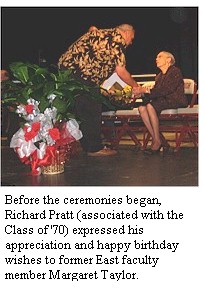 The
Greater East High Foundation held what amounted to a pep rally for
hundreds of spectators the evening of November 20, 2007, in the
auditorium of East High School.
The
Greater East High Foundation held what amounted to a pep rally for
hundreds of spectators the evening of November 20, 2007, in the
auditorium of East High School.
The program was billed in various ways, depending on
the source of the information. The Greater East High Foundation called
it "A Birthday Celebration of Accomplishments," the school announced
the event as the "McVean Auditorium Dedication Ceremony," and The
Commercial Appeal called it "a ceremony Tuesday to commemorate the
school's 60th anniversary and the role the Greater East High Foundation
has played in boosting student performance." The event was about as
focused as the decision on what to call it.
Starting fifteen minutes late and going 30 minutes
beyond the advertised time, the program mostly featured politicians,
friends, and associates of Charlie McVean ('61) trading accolades with McVean about each other.
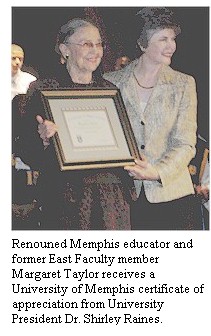 A former
faculty member of East, Mrs. Margaret Taylor, was celebrated for her
many years of educating the children of Memphis, first as a teacher at
East High, then as an award winning principal at Grahamwood Elementary
School. For the past three years she has been very involved with The
Greater East High Foundation's efforts at East, first serving as its
director and now as director emeritus. Mrs Taylor turned 90 years old
late this month. Dr. Shirley Raines, President of the University of
Memphis presented Mrs.Taylor with a certificate of appreciation for her
service in education and City Councilman Jack Sammons gave her a key to
the city. In response to the accolades, Mrs. Taylor said, "I think for
the first time in my life I'm speechless. All I can say is I'll get
even with you!" She went on to say, "Thank you for all your good
thoughts. I'll try to live up to them. Thank you."
A former
faculty member of East, Mrs. Margaret Taylor, was celebrated for her
many years of educating the children of Memphis, first as a teacher at
East High, then as an award winning principal at Grahamwood Elementary
School. For the past three years she has been very involved with The
Greater East High Foundation's efforts at East, first serving as its
director and now as director emeritus. Mrs Taylor turned 90 years old
late this month. Dr. Shirley Raines, President of the University of
Memphis presented Mrs.Taylor with a certificate of appreciation for her
service in education and City Councilman Jack Sammons gave her a key to
the city. In response to the accolades, Mrs. Taylor said, "I think for
the first time in my life I'm speechless. All I can say is I'll get
even with you!" She went on to say, "Thank you for all your good
thoughts. I'll try to live up to them. Thank you."
Some of the compliments seemed overly exaggerated.
Mr. Red McCombs of Texas, a wealthy businessman who made a fortune with
major league sports teams, a major broadcasting chain, and car
dealerships, and who has donated millions to the University of Texas M.
D. Anderson Cancer Center and to the University of Texas-Austin,
alluded to Mr. McVean's inspired peer tutoring program at East as being
one of the greatest innovations in education in the past 100 years.
Peer tutoring may be a winning strategy for secondary school education,
however, it was already an established program at several schools
nationwide, most notably perhaps, through the Breakthrough
Collaborative, before Mr. McVean began The Greater East High
Foundation.
Dr. Carolyn Farb, a Houston, Texas, based fund raiser
for charities, deviated from the ad-lib nature of the comments making a
prepared speech.
According to Mr. McVean, both Dr. Farb and Mr.
McCombs are associates and/or friend of his who he persuaded to join
him specifically for this event.
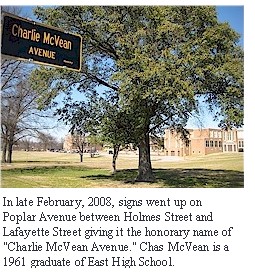 There were brief moments of substance during the
evening's comments. Mr. McVean called on the "rank and file of the
middle business leaders" to get involved in programs such as his
Greater East High Foundation. Mr. Jerry Freeman who has adapted the
peer tutoring program at East for Whitehaven High School and Whitehaven
High principal Dr. Vincent Hunter spoke of major gains in academic
testing results after just one year of the program at that school.
There were brief moments of substance during the
evening's comments. Mr. McVean called on the "rank and file of the
middle business leaders" to get involved in programs such as his
Greater East High Foundation. Mr. Jerry Freeman who has adapted the
peer tutoring program at East for Whitehaven High School and Whitehaven
High principal Dr. Vincent Hunter spoke of major gains in academic
testing results after just one year of the program at that school.
There was a brief discussion of a chart displayed on
stage showing that of those students to receive peer tutoring through
The Greater East High Foundation's program at East, 51 percent graded
"advanced" on state standardized testing of mathematics. Several other
charts indicating academic improvement by pupils participating in the
program were displayed outside the auditorium doors and in handouts for
attendees to review. (see charts below)
Not to miss the apparent point of the night,
councilman Sammons announced that the City Council had designated
Poplar Avenue from Lafayette Street to Holmes Street "Charlie McVean
Parkway" and that signs announcing that would be posted along that
stretch of highway that fronts the East High School property.
Finally, near the end of the program, East principal
Fred Curry was able to quickly announce the East High auditorium was
being named in honor of Charles McVean, a fact already reported here
several months ago when the city school board approved the naming.
[If you attended the above event, The East High Alumni Page would like to know. Send us a message at editor@EastHigh.org
Resources:
Visit The Greater East High Foundation web site
See the charts:

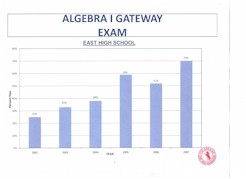



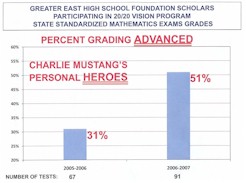
Good news at MCS
From The Commercial Appeal Editorial page, November 23, 2007, posted November 25, 2007
Friday, November 23, 2007
If Memphis City Schools is the hopeless case it's
portrayed as by some critics, how does East High senior Alexandria
Jones manage a 4.883 grade point average while taking calculus through
dual enrollment at Southwest Tennessee Community College and tutoring
an East High freshman?
Why were last year's seniors throughout the MCS
system offered 3,436 scholarships, only 189 of which were for
athletics, worth $97,353,806?
The reason is that MCS has the resources to help
students perform academically and even excel if they're motivated to do
well.
While management problems in the district and a grand
jury investigation of school building contracts dominate the headlines,
there are good teachers and administrators quietly and effectively
carrying out the district's educational mission.
And there are students like Jones, who manages to
keep her grades up, take a college-level class and help freshman Jerica
Falls in her studies, earning $10 an hour in a Greater East High
Foundation tutoring program.
Greater East High Foundation is the creation of businessman and East alum Charles McVean ['61], who has a desire to see the school recapture some of the glory of its earlier years.
It's the kind of program that can provide the
motivation and the role models to help students excel no matter what
their socioeconomic status may be.
Help like that isn't available at every one of the
district's schools, but it sets an example that alumni and support
groups throughout the system should try to follow.
Students reap benefits of peer tutoring
TCAP scores soar thanks to East High Foundation program
From The Commercial Appeal, November 18, 2007, posted November 20, 2007
By Dakarai I. Aarons
Sunday, November 18, 2007
The way Jerica Falls and Alexandria Jones talk, you'd think they'd grown up together as sisters.
The two East High School students have formed a tight
bond in the months they've spent together in the Greater East High
Foundation's tutoring program, often finishing each other's sentences.
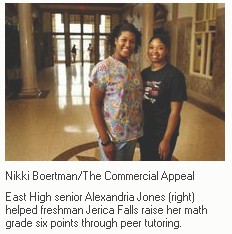 Jones, a senior with a 4.883 GPA, spends her afternoons helping Falls, a freshman, with her geometry homework.
She is taking calculus through dual enrollment at Southwest Tennessee Community College.
Jones said she's also seen a benefit from participating as a tutor.
"Being a tutor has taught me how to analyze a
problem," she said. "That has helped me with my communication skills
and people skills."
And Falls says learning from a peer is sometimes less
intimidating than working with a teacher one-on-one after school.
"To have someone your own age who knows the subject, it helps you form a relationship with them."
And the personalized attention is also a plus, she said.
"In a classroom, the teacher has 20 or 30 other students to think about," Falls said.
Founded in 2004 by businessman and East alum Charles McVean ['61], the foundation aims to help return the school that has seen many transitions in the past decade back to its former glory.
Nearly 120 students participate in the foundation's
program, which works with students for an hour after school Monday
through Thursday and three hours on Saturday mornings.
Students receive tutoring from upperclassmen in
mastering their math, science and writing skills. The tutors are paid
$10 an hour.
The foundation's work will be celebrated at a Tuesday night ceremony in the school's auditorium.
Legendary Memphis educator Margaret Taylor [Faculty],
who will turn 90 later this month, plays a key part role in the
foundation's work, spending countless hours each day mentoring and
tutoring students.
The student-to-student tutoring has paid off.
In the 2005-06 school year, 97 percent of the
foundation's seventh- and eighth-graders passed the state's Tennessee
Comprehensive Assessment Program tests. Last school year, 100 percent
of students passed, said Bill Sehnert, the foundation's director.
In a study released earlier this year by the
University of Memphis' Center for Research in Educational Policy,
researchers found that students in the scholars tutoring program scored
"significantly higher" than their peers at the school.
Sehnert said he is proud of the results, but those test scores are just the beginning.
The foundation's hope is to make sure these students
advance through school and do well enough on the ACT college entrance
exam that they can attend the nation's top colleges and universities on
scholarship.
Along the way, students learn the benefit of giving
back to their community and can help create a vibrant workforce for
Memphis, Sehnert said.
At the end of the year, they can look and say, 'I've helped my fellow kids.'" he said.
East High Celebration
What: East High School is having a ceremony Tuesday
to commemorate the school's 60th anniversary and the role the Greater
East High Foundation has played in boosting student performance.
Who: Speakers include philanthropist Carolyn Farb of
Houston, Texas, who has raised more than $35 million for hundreds of
charitable causes and Clear Channel Communications co-founder Red
McCombs.
When: The celebration will take place Tuesday from 5 to 6 p.m.
Where: It will be held in the East High auditorium, 3206 Poplar.
Alumnus expresses views on annexation
 From The Commercial Appeal, October 26, 2007, posted November 1, 2007
Compiled by Raina Hanna
Desoto Appeal, October 26, 2007
How do you feel about the city of Olive Branch's plans to annex the land east of the city to the Marshall County line? [italics theirs]
Well, I don't suppose we have any choice about it
happening. I really wish they would let the residents vote on it. They
didn't ask or get our opinion, but I guess we'll have to accept it.
Wes Lawson ['68]
DeSoto County
"My Two Cents" takes the pulse of the DeSoto County community on topics in the news....
Alumnus album features songs about Mid-South murders
posted October 16, 2007
Bob Frank ('62)
is featured in an article in the October issue of Memphis Magazine
about his colaboration with another Memphian in producing an album with
songs about legendary or actual murders having occurred in the
Mid-South. There is also a
web site for the album and the artists.
Aim high, honors students are told
Alexander cites work of East High Foundation
From The Commercial Appeal, Tuesday, October 16, 2007
By Dakarai I. Aarons
October 16, 2007
 Sen.
Lamar Alexander told East High School honors students Monday not to let
challenges like poverty get in the way of their goals.
Sen.
Lamar Alexander told East High School honors students Monday not to let
challenges like poverty get in the way of their goals.
"Aim for the top," Alexander said. "There's more room there."
Tennessee's senior senator was on hand for a ceremony naming the school auditorium for businessman Charles McVean ('61), who founded the Greater East High Foundation.
Alexander said there is support on Capitol Hill for
giving more flexibility to teachers in helping students succeed.
He cited the Greater East High Foundation's work in
mentoring students as an example of local-based solutions that help
schools succeed.
"Back in Washington, I think we need to make sure we
give schools and states the flexibility they need to use models like
this program and the work of Charles McVean to improve the rest of our
nation's schools," said Alexander, a former U.S. secretary of
education.
Alexander, who sits on the Senate's Committee on
Health Education, Labor and Pensions, said the No Child Left Behind law
has been good for the country, but could use some work, as it undergoes
reauthorization.
The current rules heavily penalize schools that
narrowly miss the benchmarks, placing them on the same level as schools
that are consistently underperforming, Alexander said.
In a few weeks, he will introduce a bill that creates
a pilot program that would allow 12 states to create their own method
for calculating Adequate Yearly Progress under No Child Left Behind,
with permission of the U.S. Department of Education.
The states would have to keep the same standards, but
would have more flexibility in determining whether students and schools
have met those standards.
States would also be given more leeway in how to spend education dollars.
"We ought to catch people doing things right rather
than wrong," he said. "In No Child Left Behind, it seems like we give
only C's and F's."
Former East Student Asks Mayoral Candidates Question

From WMC-TV Mayoral Election debate, September 21, 2007
John Reed (associated with the Class of '69) was one of the members of
the public chosen to ask the Memphis mayoral candidates a question
during WMC-TV's candidate debate airing Friday, September 21, 2007. He
asked, I was wondering if there's one thing ... that inspired you to
want to run for mayor."
The debate telecast can be viewed on the Internet by pointing your browser to www.midsouthvotes.com
and selecting to view the "Memphis Mayoral Debate (Part 1)." Reed
appears in the clip entitled "Memphis Mayoral Debate (Part 2)," which
has to be selected separately.
Family marks 90 years
From The Commercial Appeal " My Life" section September 16, 2007
By Mary Mitchell
Special to My Life
Sunday, September 16, 2007
 Winnie Allbright [Faculty]*
recently celebrated her 90th birthday. She was feted by family on a
railroad car in Collierville. Family came from Los Angeles, Atlanta,
Gatlinburg, Mississippi and Memphis. Food and celebration were the
order of the night.
Winnie Allbright [Faculty]*
recently celebrated her 90th birthday. She was feted by family on a
railroad car in Collierville. Family came from Los Angeles, Atlanta,
Gatlinburg, Mississippi and Memphis. Food and celebration were the
order of the night.
Winnie has three nieces; Mary Mitchell and Martha
Gandy of Memphis, and Charlene Stinson of Gatlinburg. Winnie has been a
second mother and best friend to all her nieces, as well as her
great-nieces and nephews. Her family feels that she's "the greatest"
and that she has been a wonderful influence to all of them through the
years.
Winnie was born in Arkansas and raised in Harrisburg.
She graduated with a bachelor of science degree in education and began
teaching at Oak Ridge, Tenn., during WWII. After college, she married
Paul H. Allbright. He was sent to Pearl Harbor and was there on the day
of the bombing.
In addition to her teaching, Winnie has enjoyed being
active in community service. She served as president of the American
Association of the University Women in Memphis and was honored by the
AAUW with a Grant Fellowship Award. She also enjoyed being a docent for
the Wonder Series.
Winnie's hobbies include pickling, cooking, traveling
and educational tours. She is a member of Kingsway Christian Church.
Mary Mitchell is a niece of Winnie Allbright.
*See Mrs.Allbright's page in the Elementary section.
Harvey Goldner Remembered
From KPLU, September 10, 2007
Daysha Eaton
SEATTLE, WA (2007-09-10) Earlier this year, Seattle lost a man who became known as the Bard of Belltown. Harvey Goldner ['60]
was a regular at poetry readings across the city, where he became a
mentor to many. After years of chain-smoking, Goldner died this summer
at age 65. A memorial for him brought Seattle's poetry community
together. KPLU'S Daysha Eaton has more. (5:00)
[The story can be heard at this KPLU link.].
A printed obituary for Harvey Goldner is available.
East principal, coach smooth over concerns
From The Commercial Appeal, September 4, 2007
By Jason Smith
Tuesday, September 4, 2007
While most of you were barbecuing and spending your
Labor Day relaxing, I arrived at work Monday afternoon to find several
urgent phone messages alerting me that Fred Curry, the principal at
East, had fired his head football coach and his staff following the
Mustangs' 12-6 loss to Wooddale last Friday.
The rumor had also reached the high school sports
message boards. On CoachT.com, a post titled "Memphis East, Principal
fires entire football staff -- new direction again?" also claimed that
Curry dismissed the entire Mustang coaching staff sometime after
Friday's loss.
Keep in mind, this is the same Fred Curry who dumped
former Mustang coach Wayne Randall following the 2005 season for no
reason other than "as a new principal, I want to take the football
program in another direction."
But Curry said Monday that contrary to rumor, he has
not fired second-year head coach Marcus Wimberly, whom Curry described
Monday as "a good influence and a great guy."
Curry did confirm, however, that he met Monday
morning with Wimberly and members of the Mustang booster club to
discuss what he called "some concerns" he had about the program.
"I met with the coaches this morning and I met with
parents. We kind of ironed out those concerns, so he's still my coach,"
Curry said.
"It had nothing to do with winning, because as you
know, I would've kept my last coach if everything had to do with
winning. ... I just thought that we needed to get on the same page in
terms of what kind of young men we want to produce."
Also reached Monday, Wimberly, an East graduate whose
Mustangs have gone a combined 6-7 since his hiring last year, said
Curry's concerns were "smoothed over" during Monday's meeting.
"That's what he conveyed to the parents and myself,
that it wasn't about wins and losses," said Wimberly, whose Mustangs
(0-2) travel to face 12th-ranked Fairley on Friday. "Like I tell
everybody, I have a young football team, and in the years to come, I
think we're gonna be pretty good. I think we're gonna end up being
pretty good this year.
We're going in the right direction. Everything's been smoothed over, so we're all right."
 Outdoor warning siren on the roof of East High School one of the oldest
In an article
published in the "My Life" section of The Commercial Appeal September
1, 2007 (or possibly August 25, 2007, the newspaper gives both dates)
focusing on the career of an employee of the Memphis/Shelby County
Emergency Management Agency, a photo of the siren atop East High School
and a cutline (caption) was included:
Officer Thompson checking the
Biersach & Niedermayer outdoor warning siren on the roof of East
High School. It is one of the oldest sirens in Shelby County, powered
by electricity now but originally operated by a gasoline engine.
| Recent articles
in the "Memphis Memories" column of The Commercial Appeal
have included the following: |
In the August 18,
2007 Memphis Memories features a photo of Mac Holladay ('63).
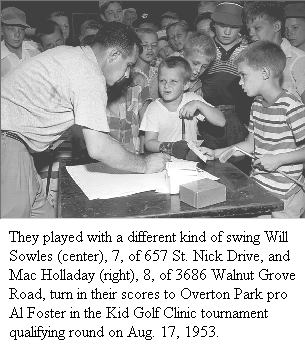
The August 25,
2007 Memphis Memories also carried an article from 1982 about Jake Schorr ('58):
August 25
25 years ago: 1982
Jake Schorr and Shawnee Cavnar have expanded their carriage business in
the shadow of downtown Memphis. They're restoring several 1890s-vintage
horse-drawn carriages salvaged from an old barn near Jackson, Tenn.
When finished, the enclosed carriages will be used by River City
Carriage Tours for cozy wintertime tours of downtown Memphis and others
will be sold to collectors. Schorr, a woodworking hobbyist who does
most of the restoration, says the restored carriages are worth about
$5,000.
|
The August 25, 2007
Memphis Memories featured a picture of former East High faculty member
and head football coach Bobby
Brooks (faculty approximately 1960-1966) when he was a student athlete at Memphis State College.
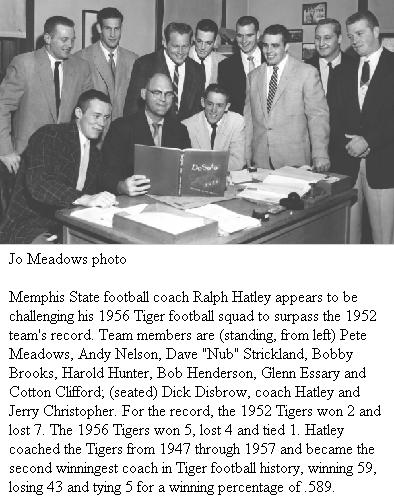 |
No verdict again in 2001 killing
From The Commercial Appeal, August 21, 2007
Tuesday, August 21, 2007
Greater Memphis
For a second time this summer, a jury could not reach
a verdict in a murder trial involving a shooting outside 150 Peabody
Place.
John Edward McClee, who is now 25, was charged with killing Tedrick C. Dawson ['93], 26, on Aug. 26, 2001, outside of Jillian's.
Dawson was shot once in the shoulder and twice in the
back, while a friend, Romond Arnold, was shot in the buttocks, police
said.
McClee did not deny the 1:50 a.m. shooting, but said he acted in self-defense.
A Criminal Court jury deliberated more than 10 hours
Friday before announcing it was deadlocked on the second degree murder
charge.
McClee was convicted on three lesser charges,
however, including reckless endangerment, possession of marijuana and
unlawful possession of a weapon.
The case is set for a status report next month.
-- Lawrence Buser
A previous story about Mr. Dawson's death is below.
Laptop computers to be supplied to East pupils and teachers
August 21, 2007 - East High is among 16 Memphis high
schools in which an "Interactive ACT-Designed Laptop Learning System"
will be implemented, according the the Memphis City Schools system.
The Epic Learning System, developed by the academic
standardized test firm ACT, provides the laptop computers loaded with
Math, Science, English and Social Studies courses. The school system
claims the pupils will be able to submit assignments and quizzes online
to be graded automatically and placed in the teacher's grade
book, allowing students and their parents to receive immediate
feedback.
"We believe that this supplemental curriculum
and instructional support program will enhance the positive academic
programs already in place that are designed to accelerate achievement
and directly impact student performance on the ACT," said Dr.
Alfred Hall, Chief Academic Officer for Memphis City Schools.
The laptop computers should be in place at the schools in September.
There is a web site with more information about the
Epic Learning System at http://www.epiclearningsystem.com/aboutEpic.asp
Source: Memphis City Schools
2007 ACT scores may show small improvement
August 19, 2007 - The academic testing service ACT
has released the composite ACT scores for graduating high school
seniors and it appears to show a very slight improvement in the level
of accomplishment at East High.
The average composite ACT score for the East High
Class of 2007 was 16.8, according to an August 19 article in The Commercial Appeal.
State data shows the "three year average" ACT composite scores for East
pupils at 16.7 for 2005 and 2006. However, the numbers may not be
comperable since one is based on a "three year average" and may include
all pupils who took the test and the 2007 figure purports to show the
composite score of graduating seniors.
The 2007 graduating seniors average composite score
average for all city schools was 17.7, the average for all Shelby
County schools was 21.7. The Tennessee average for the Class of 2007
was 20.7 and the national average was 21.2. White Station High and
Houston High had the highest local public school averages with seniors
at both instutitions averaging a composite score of 23.6.
There have been other indications of some improvement
at East High. While the state has involved itself with the running of
East due to inadaequate progress over recent years, it did classify the
school as "State/LEA Reconstitution Plan 1 - Improving" in July. The
East High Alumni Page had earlier reported that the results of the
Gateway exams showed significantly higher scores which met the level
required by the state to be categorized as satisfactory performance.
The results of other standardized tests have yet to be released to the
public.
Please also see the reports below: "State recognizes improvement at East," and
"Could these numbers represent the much needed turnaround?"
Sources: The Commercial Appeal, Tennessee Department of Education, ACT, Inc., The East High Alumni Page
Race led to firing, alleges ex-coach
From The Commercial Appeal, August 10, 2007
By David Healy
August 10, 2007
Wayne Randall was a successful head football coach at East High School before leaving 17 months ago.
A lawsuit filed by the coach earlier this year,
claiming racial discrimination, may shed some light on why he is now
coaching Munford High.
In his lawsuit Randall contends that East principal Fred Curry fired the coach because Randall is white.
The lawsuit states Curry, "created an atmosphere of
racial animosity and let it be known that he wanted a black football
head coach. Although Mr. Randall produced a winning team that won a
state championship, Mr. Curry never gave a reason for his dismissal."
Numerous attempts to reach Curry were unsuccessful.
In the defendants' answer to the complaint, attorney
Michael R. Marshall, who is out of town, wrote that "the defendants had
legitimate nondiscriminatory reasons for relieving Mr. Randall as
football coach at East High School."
Curry gave little reason for Randall's firing.
In a March 21, 2006, story in The Commercial Appeal,
Curry would only say, "I can't tell you another reason other than as a
new principal, I want to take the football program in another
direction."
The lawsuit names Memphis City School board members and former Supt. Carol Johnson as co-defendants.
Efforts to reach school board officials regarding the lawsuit and Randall's claims were unsuccessful.
Randall, who also declined comment on advice of his
attorney, became head coach at Munford a month after his dismissal at
East.
Randall seeks $500,000 for mental and emotional
distress from his termination, and another $100,000 in punitive damages
against Curry individually.
Randall's attorney, Richard B. Fields, filed the lawsuit March 9 in Shelby County Circuit Court.
"We have a great case. There was no reason for him to
be fired," Fields said. "Coach Randall's teams did extremely well and
he was universally loved by the parents and the students at the school.
He was one of the most outstanding coaches in the history of Memphis
football. The principal simply didn't want him to coach anymore because
he was white."
Fields said it may be two years before the case is finally decided.
In his 12 seasons at East, Randall led the Mustangs
to nine straight playoff appearances and won the 1999 Class 4-A state
championship. He had a record of 100-42, and over the last eight years
averaged 10 wins a season.
Last year, Randall led Munford to an 8-4 record and
the District 7-4A championship. Munford won just two games the season
before Randall's arrival.
State recognizes improvement at East
August 6, 2007
The latest State evaluation of East High School, released Aug. 6, 2007,
puts East in the category of "State/LEA Reconstitution Plan 1 -
Improving." For the previous school year (2005-2006), it was listed
simply as State/LEA Reconstitution Plan. The "improving" aspect may
reflect better TCAP results anticipated after scores on Gateway exams
were higher. See our related stories below: "Could these numbers represent the much needed turnaround?" and "
State intervenes in running East High School - details now available."
State intervenes in running East High School - details now available
by Ken Welch, editor, The East High Alumni Page
August 2, 2007
[updated 4:05 pm CDT with comment from Principal Curry]
The State of Tennessee Department of Education
intervention into the running of East High school calls for changes in
the guidance office but endorses the leadership of top administration
at the school.
See the directives
Since the implementation of the No Child Left Behind
and other monitoring methods early in this decade, East High has
performed poorly. The State put the school "on notice" that it needed
to improve during the 2001-2002 school year. Each year thereafter the
school has received some classification indicating significant
improvement was needed. On July 31, the State announced its direct
intervention in the troubled schools, its most forceful step yet. It
has classified East as being in the State/LEA Reconstitution Plan
category.
In its directive to the school system, the Department
of Education says it found East's principal for the past 2 years, Fred
Curry, to apparently be "an effective administrator who communicates
high expectations to both staff and students." The report says Mr.
Curry is well respected by the faculty and has 2 educational
facilitators who also seem to be effective. This endorsement of the
school's leadership is in contrast to some other of the schools in
which the State is ordering the administration be changed.
After the directive was issued, Mr. Curry said, "My
vision of East
High is to not only raise the academic rigor to where it was [decades
ago]..., rather to raise it to a level where our kids can compete
academically with the Japanese, Indians(India) and the rest of the
global community."
The primary personnel directive given by the state
for East High is that it orders the reconsideration of the removal of
one "effective" guidance counselor and the retention of one
"ineffective" counselor. The report indicates the retained counselor
was kept on the school's staff due to seniority and tenure issues. The
report also calls for the school system to ensure that the school has a
"highly effective" attendance clerk to address student attendance and
participation rates.
Beyond those personnel considerations, the orders
from the State for East High generally are of a supporting and
monitoring nature. It calls for an incentive plan, including bonuses,
for attracting and keeping qualified administrators and teachers who
meet performance benchmarks for student proficiency. It also directs
that the school to be afforded the necessary resources for behavioral
and family specialists.
The State is requiring the school system to provide
special oversight and support to East and the other school in which it
is taking direct action. It also is requiring a number of reporting
actions such as a response within 10 days of how it will implement the
orders it has been given and to show cause if it fails to follow
staffing recommendations made by the principal or the special personnel
assigned to oversee the school's rehabilitation.
The Department of Education says the current $12.8
million renovation must be completed by the time students are to resume
classes on August 13 and that some stolen technology equipment be
replaced in the same time frame. (See our report on the renovation in a
August 1, 2007 edition of the
Mustang Roundup - Alumni Edition.
You can see all the directives ordered by the State Department of Education by clicking/selecting this link.
It should be noted that East no longer has a middle
school component. The seventh grade was removed from the school for the
2006-2007 school year and with the opening of classes August 13, East
becomes a pure high school with only grades 9 through 12.
The State is expected to release its latest "report
card" on the evaluation of East and other schools within the next
several days.
For more information about the academic performance at East, you may review the
Today's East High section of The East High Alumni Page and the
story below about the improvement on some standardized tests.
Mustang Roundup — Alumni Edition:
Photo tour of $11.5 million renovation as construction rushes toward completion
Biggest visual change in decades underway at East High
Click here to go to the August, 2007 edition of the Mustang Roundup — Alumni Edition.

State intervenes in running East High School
August 1, 2007
A day after the announcement, details as to how the
Tennessee Department of Education intervening in the running of East
High and 16 other Memphis schools remain hard to come by. [
see above update]
As reported yesterday, the Department of Education is intervening in
the running of East High School and 16 other city schools after years
of unsatisfactory performance.
Memphis City Schools did finallly post some general
information on its web site about the state's intervention.
Out of the $42,040,000 in additional state revenue
(BEP 2.0) going to the Memphis City Schools district, $9.7 million will
be used for intensive improvements in teaching and learning in a core
group of Memphis City Schools currently on the state's
probationary list of "striving schools." The remainder of
the funds will be used across the district for additional teaching and
teacher support and enhanced academic and student support programs.
Governor Phil Bredesen has mandated that the school district adopt and
implement a stringent action plan for schools that still remain on the
state-identified probationary list. Each of the Memphis schools in the
core group will receive academic support tailored to its particular
needs. In addition, the probationary or "striving" schools
will have longer school hours beginning with the start of the 2007-08
school year.
The plan for these "striving schools" is modeled after
Douglas Reeves' STAR Model for Success, and other strategies
successfully implemented in the Miami-Dade and New York City Public
Schools. Schools will be provided with ongoing professional development
for their teachers, more visible tracking of student progress,
additional staff and greater collaboration between school staff,
parents and students. The plan also provides district-level
accountability and support, such as content-area specialists to work
with school-based literacy and mathematics coaches and an academic
superintendent to directly supervise the principals in the core group
of schools.
The anticipated group of schools to receive this support are: Airways
Middle, Carver High, Cypress Middle, East High, Fairley High, Frayser
High, Geeter Middle, Hamilton High, Kingsbury Middle/High, Sherwood
Middle, Treadwell Elementary, Treadwell High, Vance Middle, and
Westside Middle. The school day at those schools for the 2007-08 school
year will begin at 7:30 a.m. and end at 2:45 p.m. This change adds 30
minutes to each school day, for the equivalent of approximately 14
additional days of instruction each year.
In addition to a longer school day at these schools, other changes for
the "striving schools" are: * Graduation coaches will be
hired for high schools, based on a state recommendation to increase
graduation rates. The coaches will provide intensive support of schools
and students. * Additional staff will be hired for the probationary
schools, including literacy and mathematics coaches to help monitor and
improve teaching and learning. * Based on the need of the individual
school, an additional parent/family or behavior specialist will be
allocated to the school. * Based on the school's need, an
additional school counselor or social worker will be allocated. *
Performance-based incentives for principals, teachers, and staff will
be offered.
Slightly more than $14 million of the funding will be used across the
district to hire additional teachers and staff to support schools with
high percentages of Special Education students, additional mathematics
teachers and tutors to lower the student-teacher ratio in secondary
schools, additional support for English as a Second Language teachers,
for ongoing, comprehensive school-based professional development for
teachers, and an additional allocation for supplies and materials for
every teacher in the Memphis school district ($200 per teacher, double
the amount teachers received previously).
The changes will be in place for the 2007-08 school year. Memphis City
Schools will work collaboratively with the state to successfully
implement the measures.
Neither the Tennessee Department of Education nor
East High Principal have yet responded to requests from The East High
Alumni Page for more informaton.
As indicated in the story below, East Principal Fred
Curry had hoped improving test scores would keep the state from taking
immediate action. To what extent the improved scores, if they hold true
for all the standardized tests, may mitigate the state's intervention
in the oversight of East High remains to be seen.
More details here as they become available.
Special Report:
Could these numbers represent the much needed turnaround?
Indications are of academic improvement at East High
A special report from The East High Alumni Page
July 13, 2007
The top administrator at East High School is smiling
these days. After years of academic and disciplinary difficulties,
there is hope a new trend is beginning. Although some of the aggregate
standardized test scores for the 2006-2007 school year have not been
released to the public yet, those that have seem to indicate a
considerable improvement. "I'm amazed and pleased,"
said second year principal Fred Curry as he discussed the
"quick" turnaround he's seen since coming to the
school.
With some data to indicate improvement and optimism
by East's principal, for some the dismay about the school's
performance may now replaced by questions. Has East High turned the
corner? Could East High be headed in the right direction with enough
momentum to establish an ongoing trend leading to it regaining the
academic status it once had?
Pupils who entered the ninth grade in 2001-2002 must
obtain a score indicating "Proficient" or
"Advanced" on each of the Gateway examinations in three
subject areas - mathematics, science and language arts - in order to
earn a high school diploma. Mr. Curry says the Gateway results for East
for the 2006-2007 year were up significantly. The school's
percentages of students taking the Algebra I Gateway exam this year
getting proficient or advanced scores was 77% compared to 52% the
previous year. In English II, essentially 10th grade English, 91%
attained the proficient or better categories. In 2005-2006 the figure
was 85%. The Gateway results for Biology were 91%, an increase of 9
percentage points over last year's scores. All of this
year's Gateway scores are above those the state requires as
satisfactory performance.
After more than two decades as one of the premier
academic public schools in Memphis and the region, the problems were
first noted in the 1970s. East High becomes a school administrators
considered as a school in trouble. At that point, a public
acknowledgment of the problem was that many in the school's
attendance district were choosing not to go to East. By the 1990s and
2000s, as standardized testing scores were mandated to be made public,
the highly questionable academic performance of the school's
students became apparent. Average ACT composite scores had plummeted to
the low 16s. As a comparison, White Station High School's 2005
composite ACT score was 23.2. ACT possible scores range from 1 to 36.
The University of Memphis requires a 19 on the enhanced ACT for
admission without a student being required to take special remedial
courses. Since the federal government got highly involved in academic
accountability in the past few years, East was characterized as
deficient in meeting No Child Left Behind requirements. It was assigned
the status of "restructuring 2" by the state in 2005, meaning
significant changes in the school were required. Options included
conversion to a charter school, replacing existing staff, taking over
management or contracting with a university to take over management.
Principal Curry has made changes. A number of faculty
members, including coaches, have left the school, more advanced
placement (AP) classes have been offered, and he has continued the work
with The Greater East High Foundation, which had begun to organized
peer-to-peer student tutoring and classes the year before Mr. Curry was
transferred to East, and with other individuals and organizations
offering help to the school.
It takes two years of satisfactory performance for a school to get off
the "target list" of troubled schools. The tale is not
yet told as the full assessment for this year has not been
released and it will take likely take years of improvements to bring
East High into academic repute. The alumni of East High will be
watching closely and with great hope.
Critic back at Malco job -- temporarily
Chain now requires 'confidentiality agreement'
From The Commercial Appeal, June 19, 2007
By John Beifuss
June 19, 2007
It was more like compromise time than clobberin' time
when projectionist Jesse Morrison and Malco senior vice president Jimmy Tashie ('66)
met Monday morning to resolve Morrison's suspension for writing an
unauthorized early review of "Fantastic Four: Rise of the Silver
Surfer."
The outcome: Morrison is back at his 30-hour-a-week,
$7-an-hour job at Malco's Ridgeway Four for the next two weeks, after
which he'll leave to pursue other opportunities.
What's more significant is that as a result of the
Morrison incident, Malco projectionists and other employees who see
advance screenings of films will be required to sign a "confidentiality
agreement" stating they will not write about the movie in advance of
its opening date.
Other movie chains may follow suit, Tashie said.
"There's heightened security now, there's no doubt about it," he said.
Morrison, 29, became something of an Internet
celebrity after he was suspended June 11 for posting a week-early pan
of "Fantastic Four: Rise of the Silver Surfer" on the popular Web site,
Ain't It Cool News (aintitcool.com).
Morrison -- who also writes reviews for his own site,
Memflixbeyond.com -- blasted "Silver Surfer" after seeing the film when
he projected it at a private "trade screening" for Malco officials and
other local movie exhibitors.
Angry representatives of 20th Century Fox, the studio
that produced "Silver Surfer," contacted Malco to complain, and Tashie
suspended Morrison for what he called a breach of trust.
The disciplinary action generated nationwide debate
about freedom of speech, job responsibility and the Internet's impact
on movie publicity.
Many members of the online community accused Fox and
Malco of violating Morrison's free speech and punishing him for not
liking the movie.
The story was picked up nationally, with The
Hollywood Reporter writing that the incident "might mark the first time
someone working in the entertainment industry has lost a job for
voicing an early opinion online."
Monday, Tashie lifted Morrison's suspension, but with
the stipulation that the projectionist would no longer work advance
screenings. Morrison decided to return to work but gave two weeks'
notice.
"The national exposure ... put a strain on the
employee-employer relationship," Morrison wrote Monday on his Web site.
"I don't believe it is a reparable situation. I feel it's better to
just move on."
The brouhaha didn't hurt "Surfer" at the box office,
where it was No. 1 this past weekend, earning more than $57 million.
Longtime East coach moves on
From The Commercial Appeal, June 7, 2007
Jason Smith
June 7, 2007
After 21 years, the hardest part of leaving East High
was packing up his white van with more than two decades worth of
memories as the Lady Mustangs' track and field coach.
"It hurt me," longtime East coach Danny Joe Young
remembers of last Thursday, his final day at East. "All the kids had
gone home, and I had one girl that came up there Tuesday, Wednesday and
Thursday and helped me real hard, crating stuff up and boxing stuff up
and loading stuff up.
"It hurts, but they understand. They understand it
wasn't my doing and that I'm not walking out on them just because we've
had a couple bad years here lately. This was probably one of the best
and most memorable teams I've ever had because everything that came out
of my mouth, these kids listened to."
One of several longtime East coaches to have recently
been "surplussed" (let go), Young, 56, who guided the Lady Mustangs to
seven track and field state titles since joining East in 1985, is set
to become the new girls cross-country and track and field head coach at
Melrose.
"It was just like the sky opened up," Young said this
week. "(Melrose principal LaVaughn) Bridges opened his arms up and
said, 'Mr. Young, I've been watching you for 20 years and I've seen
what you've done at East High School -- not just win, but how you
handle your kids and how you teach life skills.' He said, 'I want you
on my team. My kids deserve that. They haven't had it in years.'
"I mean, what can you say? He wanted me, and he wanted me for the right reasons."
Young said he harbors no ill will toward East
principal Fred Curry, who, since his hiring at East in 2005, has also
let go longtime Mustang football coach Wayne Randall, legendary Mustang
basketball coach Reginald Mosby and Mosby's longtime assistant, Willie
Turner.
"I'm a very loyal person when it comes to Mr. Curry,"
said Young, who also led the Lady Mustangs to three state runnerup
finishes (from 2002-04) and 18 city championships. "From an education
standpoint, I am very loyal to him, his ideas and what he's trying to
do. I understand he's trying to raise the test scores at East and I
applaud him for that.
"But I'm looking forward to going to Melrose. There
has been a tradition at Melrose in girls track. Sheila Echols (a 1988
Olympic gold medalist) came from there, and also Rochelle Stevens (a
1996 Olympic gold medalist). Even before that, (three-time Best of the
Preps girls cross-country winner) Tania Wells came through there. She
holds the state record in the 800-meter run. So there's a tradition to
a point, and I don't know why (Bridges) just hasn't been able to get
the kind of coach he needed to continue that. But I do believe things
happen for a reason."
...
Former Tiger Gibson following Mosby at East
From The Commercial Appeal, May 12, 2007
Jason Smith
May 12, 2007
Cheyenne Gibson calls them huge shoes to fill, those
of former East High basketball coach Reginald Mosby, and he's right.
With 500 career victories and five state-title rings,
Mosby has left behind a legacy of success at East, where Gibson, the
former Memphis State basketball standout and Sheffield High head coach,
has been hired as the Mustangs' new head basketball coach.
"I think it's a better situation than where I was,"
said Gibson, who compiled a 118-70 record in six seasons at Sheffield,
but was let go by Sheffield principal Jimmy Holland following a 19-10
campaign this season.
"I sat down with the (East) principal (Fred Curry)
and Mosby (on Thursday), and we just talked about some things. I told
(Curry) I was going to take (the job), and Mosby said that it couldn't
have gone to a better guy."
Mosby told The Commercial Appeal in February he was
considering stepping down following his 21st year as East's head coach.
"Those are some big shoes to step into," said Gibson,
who played against Mosby's East teams during his days as a high school
standout at Westwood. "He's so well respected. He's done a great job."
...
How we Met Mail call: packet of love for Ensign Terrell
'When he was gone overseas this past year, he got a letter every day'
From The Commercial Appeal, May 6, 2007
Anita Houk
May 6, 2007
The officer in soon-to-be Navy Ensign Jason Terrell knew he had to do what he had to do.
The gentleman in him knew he had to come clean about it with Kamilah Averyhart.
The question: When?
He chose the February night in 2005 they went to the Orpheum to see the Alvin Ailey dancers.
"I got accepted into Officer Candidate School with the Navy," he announced to her before the show.
"Congratulations. So you're going to be in Millington?"
"No," he said. "I'm going to be in OCS in Florida for
three months, then six months in Georgia and then overseas."
Kamilah was distraught. She didn't want to see the
dancers. She didn't want to talk about his news. She wanted to cry. "At
intermission I said, 'Why didn't you tell me about it before?' He said,
'I tried to tell you but I was scared you were going to dump me.'"
He explains: "We had a conversation once about the
military, and I asked her would you ever date somebody that was in the
Navy? And she says, 'No!' So I just kept it to myself."
After all, they'd met in marketing class in fall
2003, working on master's degrees at Webster University (Millington
campus). Jason was a Memphis Catholic High and University of Memphis
grad (2002, management information systems) and worked in marketing at
FedEx.
"He sat across from me every week," says Kamilah, who
graduated from East High and UT-Chattanooga (2001, finance and
marketing). She's a community development analyst for Memphis' Division
of Housing and Community Development.
"There was some other guy who was always talking,
just rambling on, and every time he would talk we would look at each
other and go (roll our eyes)," she says.
Next class: economics. "In econ, (Jason) beat me on a
quiz. No one had ever beat me on a quiz before. After he didn't come to
our first study session I saw him and said, 'You think you're too smart
to come to the study session?' And so he showed up for the next one.
"By the time we got to finance (class), he said he was going to ask me out, but ..."
"I was watching her!" he interjects. "I remember the
first time I saw her in marketing. I just said to myself, 'Wow! That's
the woman I'm going to marry.'"
Kamilah was watching him, too. "Then, he was always
showing off his arms. Huge arms. He always had on these shirts that
would hug his arms. I'd actually check 'em out and then look the other
way and keep doing my work."
Then one evening when he took his sister to Isaac
Hayes' club for her birthday, Jason saw Kamilah there alone. When the
Prince song "Adore" was played, they danced.
Days later, he was gloating that he got tickets to a
Prince concert -- and would she take notes for him in class that night.
"It was probably three hours before the concert and
finally I called her and said, 'Would you like to go to the Prince
concert with me?' She actually goes to Oak Court Mall and buys a
completely new outfit."
"I had to get something purple!" she protests.
"That," says Jason, 28, "is when we really officially had our first date, the Prince concert."
"So we had known each other about seven months before our first date," says Kamilah, 27.
By then, Jason knew that if she said she didn't want
a military man, "I'm not going to tell her I'm even thinking about
becoming an officer in the Navy. I didn't tell her until I thought she
could be The One."
Or rather, until she knew he was The One.
"I guess I was a little iffy on the long-distance
thing," she admits. "But as soon as you gave me your address, I mailed
your first package. And every day that he was gone, I had written him a
letter."
When he came home last spring, they married April 22,
2006 at St. Mary's Episcopal Cathedral. Four days later he departed for
Diego Garcia, a tiny atoll of a military base 7 degrees south of the
equator in the heart of the Indian Ocean.
"When he was gone overseas this past year, he got a letter every day," she says.
"When mail call came," he says, "I was always expecting a box full of letters."
"And Oreo cookies," she adds.
"Because I love Oreo cookies," he says smiling.
Tuesday, they're off together to San Diego to live,
as he's been assigned to the USS Nimitz. But before they go, they want
to recount how an early family tradition came to be.
It was Jason's birthday, Jan. 5, 2006, and he was
ready to propose. He asked her mom for Kamilah's hand, then went to
pick up Kamilah for what she thought was his birthday dinner at Ronnie
Grisanti & Sons on Poplar. When Jason arrived, Kamilah was just
putting on her shoes. He dove right in.
"Do you love me?" he asked.
"Yes."
"How much?"
"Very much," she said.
"Well, HOW much?"
"Priceless," she responded.
At that, he fell to his knee and asked, "Will you marry me?"
It's a moment to hold dear.
"Every now and then we conjure it up," he says. "We say, 'How much do you love me?'
" 'Priceless.' "
Bartlett personnel chief Hilbun praised at retirement ... again
From The Commercial Appeal, April 5, 2007
By Shannon Massey
Special to Bartlett-Cordova Appeal
April 5, 2007
Between the plaques and gifts, Bartlett's personnel
director fought back tears at his retirement party as three of the
city's mayors praised Larry Hilbun's ['52] sense of duty and his integrity at
City Hall on Tuesday night.
"Get us legal and keep us legal," former mayor Bobby
Flaherty says he told Hilbun when he was hired 12 years ago. "We looked
for a good man, and we found him."
When Hilbun was hired by Bartlett he was 60, and had
already retired once as personnel director for Shelby County after
serving more than 16 years. Before that, he was director of employee
relations for Cook Industries Inc. for 13 years.
Before he came to Bartlett, the city never had a
personnel director. Each individual department handled its own human
resources issues.
"The best part of my job with the city of Bartlett is
the quality of the people that I have had the pleasure to work with
from the personnel staff to the managers and supervisors and the many
fine employees," Hilbun said. "I have had the opportunity to serve
three outstanding mayors, all dedicated and competent men who work hard
to do what is best for the citizens of Bartlett." When Hilbun arrived
in Bartlett, the city had 262 full-time employees; today there are more
than 500.
"You really have cost the city a lot of money," joked
Mayor Keith McDonald, who presented Hilbun a plaque and the key to the
city. Richard Stokes of the Tennessee Personnel Management Association
also presented Hilbun with a plaque. In 2004, Hilbun was the first
recipient of the state's Outstanding Human Resource Professional award.
Former mayor Ken Fulmar said Hilbun made an
impression on him early on. "He was so honest, we really appreciated
his honesty."
Since Hilbun also had a hand in bringing the local
Bartlett-area Lifeblood to the area, Jason Sykes of Lifeblood presented
Hilbun with the Community Partner Award.
"Several years ago, Bartlett was using about 8,000
units of blood a year but only receiving about 1,800 units in donations
from its residents," Sykes said. "Now, through Mr. Hilbun's vision and
a strategic five-year plan, Bartlett is the only self-sufficient suburb
in Shelby County."
"It took only three years to reach that goal under
Hilbun's leadership," Sykes said, adding that Hilbun will continue to
serve as chairman the Bartlett-area Lifeblood facility.
Hilbun grew up in the Binghamton neighborhood of
Memphis and never lived away from there until he joined the Army. He
was in the second graduating class of East High School in 1952 and a
graduate of the University of Memphis, where he was named Mr. Memphis
State in 1956. He earned this title on the same day his future wife,
Peggy Duke, was crowned Miss May Queen.
Hilbun officially retired from the city of Bartlett
on Friday, the same day he and his wife celebrated their 50th wedding
anniversary.
The city's new personnel director, Peter Voss,
thanked Hilbun for being a mentor. "Mayor Flaherty told me some good
advice. He said, 'Get to know Larry.' And I did."
Retired educator answers call, goes back to school
'Lady Margaret' is heart, soul of East High Foundation
From The Commercial Appeal, March 27, 2007
By Dakarai I. Aarons
March 27, 2007
Margaret Taylor retired once.
Twelve years ago, at age 77, she packed up the
pictures on the desk where she sat for 24 years as principal at
Grahamwood Elementary School.
She boxed up teacher-of-the-year awards and the
countless notes she'd received over her more than 40 years as an
educator.
She left the school and headed to a life where she
didn't have to compete with the rising of the sun each morning.
That lasted three months.
She hadn't even figured out what her first retirement
project would be before she found herself back in the classroom,
supervising student teachers.
And when a former student came calling, Taylor was
once again in the bustling hallways of East High School, where her
teaching career began in 1955.
Her silver hair in a sleek bun, she's walking through
its grand halls from 7:30 to 4:30 each day in her role as the heart and
soul of the Greater East High Foundation.
"I'm the only one who's here all day," she says with a wry laugh. "I wanted to be busy busy."
Founded in 2004 by businessman and East alum Charles
McVean, the foundation aims to help return the school that has seen
many transitions in the past decade back to its former glory.
"(He) wanted to bring academic achievement back up to
a level where they could be proud of it, so he drafted me to help," she
said.
And how could Taylor say no? She's had a soft spot
for McVean since he was a student in her eighth-grade math class.
Her title is director emeritus, but Taylor's true
role is den mother, providing invaluable advice, said Bill Sehnert, the
foundation's director.
"She's our methodologist," he said. "She knows more than anyone else."
Taylor shrugs off such a notion.
"It's just a challenge and it keeps me busy."
Taylor has dusted off those skills, showing the adult
staffers and upperclassmen tutors alike how to help young students
grasp the complexities of algebraic concepts.
The witty octogenarian known as "Lady Margaret"
spends her days in East's algebra classes, observing teachers and
looking for lessons that cause students the most difficulty.
The foundation's scholars program works with students
for an hour after school daily and three hours on Saturdays.
Eighth- and ninth-grade students receive tutoring
from upperclassmen in mastering their math science and writing skills.
The tutors are paid $10 an hour.
The focus is on producing quality high school
graduates who can go on to successful post-secondary lives, Sehnert
said.
The foundation's work is proving effective, according
to an analysis done by the University of Memphis. It found that
students in the scholars program were significantly more likely to pass
the state's TCAP tests than their peers.
On a recent afternoon, Sehnert and a group of East
teachers walk around helping the student tutors who are quizzing
students on equation solving.
Taylor floats from table to table, greeting students
and encouraging them as they race each other to find the answers first.
To see her energy, you'd never guess she'd turned
down school district staffers when they first asked her to teach.
Back then, Taylor was 38 and didn't have a college
degree, having spent her adult life rearing two kids and working in her
father's grocery store.
But it didn't take long for her to see it was where
she belonged. And more than 50 years later, she couldn't imagine being
anywhere else.
"I got caught up in it and loved it so much," she said.
Culture of Corruption
Ex-cop wore badge of evil culture of corruption 'No regard for rules'
From The Commercial Appeal, March 26, 2007
By Marc Perrusquia
March 26, 2007
Terrance Harris [class year undetermined] lived very well for a police officer on a $48,000-a-year salary.
He built a large home overlooking a golf course and
had a stable of expensive cars. He owned a fast-food restaurant and
bragged of running another.
If his bosses at the Memphis Police Department ever
questioned how a uniformed patrolman could afford such expensive toys
or how he managed bank deposits of $43,000 a month -- cash with "an odd
odor," tellers said -- there's no record of it in his personnel file.
But then, few supervisors dared to lean too hard on Harris, a large man with a menacing temper.
Hired in 1997 despite arrests for theft and criminal
trespass, Harris befriended rappers and drug dealers, and seemed
untouchable as he skated through one misconduct charge after another
until federal authorities arrested him last year on drug conspiracy
charges.
Harris, 32, pleaded guilty last fall to aiding a drug
cartel, and with that admission joined a growing gallery of MPD rogues:
He's one of 23 cops busted since 2004, lifting Memphis into unenviable
company with cities such as New Orleans and Los Angeles that are
wrestling with rampant police corruption.
"We no longer have Officer Collig on the beat like in
the old Hardy Boys movies, where he was the honest, caring protective
cop," said Leslie Ballin, a prominent Memphis defense lawyer who deals
regularly with MPD officers.
"Now there's very little difference from the ones who
are locked up and the ones who are doing the locking up."
MPD employees have been charged with stealing huge
sums of cash and drugs from the evidence room, providing protection to
criminals, running drugs, even planting evidence on innocent drivers
during traffic stops. Even the brass have gotten involved: Two
commanders took diversion and are on probation for fixing a traffic
accident.
The story of Terrance Lashun Harris is more than one
police officer's personal tragedy. It's an anatomy of the department's
insidious corruption.
Personnel files for Harris and others reveal some
common threads, including a failure by the department to detect hidden
character flaws during the hiring process and a lack of supervision of
troubled officers once they are turned loose on the streets.
Unlike many police agencies, MPD doesn't administer
lie detector tests to recruits. And for years, the department allowed
many people with arrest histories onto the force -- often a predictor
of trouble.
Until recently, MPD didn't attempt to predict
problems by tracking disciplinary patterns among its 2,018 uniformed
patrol officers.
Police Director Larry Godwin, the city's sixth police
director in 12 years, says he's working to correct those mistakes.
"Godwin is exhibiting the first real leadership of
the police department since I left," said former director E. Winslow
"Buddy" Chapman, who ran the department from 1976 to 1983 and is now
executive director of CrimeStoppers of Memphis and Shelby County.
Nonetheless, supervision still seems lacking, Chapman
said, particularly when one considers officers such as the convicted
Harris, whose ill-gotten wealth included two fast-food restaurants.
"Wouldn't it seem logical that his supervisor would have been aware that he owned two Dixie Queens?"
It was a cold, drizzly day last winter when Harris
pulled into the lot across from East Towne Shopping Center and parked.
He was meeting a new acquaintance, a drug smuggler from Texas, he was told.
Harris didn't know it, but the smuggler, already
convicted of dealing in cocaine, was working for the FBI. He approached
Harris with a proposition: Help him move shipments up from Texas, and
both would profit handsomely.
"Let's go. What you waitin' on?" the impatient cop told his new companion on a surveillance recording.
"I'm ready to rock and roll with it, man."
The officer vowed there would be no trouble from his colleagues in law enforcement.
"If they were stopped, Harris would simply have to
show his police credentials, and in any event the drugs would be in a
hidden compartment in the vehicle," read an FBI affidavit unveiled in
court.
Harris performed as promised over the next several
weeks, investing cash in the venture and riding along on a dope
delivery up Interstate 40 into rural West Tennessee.
It was clear to the FBI agents involved in the sting that Harris had done this sort of thing before.
In fact, the investigation found he'd been doing it
right under the noses of his MPD employers. Though suspicions led the
department to eventually refer him to Operation Tarnished Blue -- an
FBI-led sting to nab corrupt cops -- Harris had been going strong for
some time.
In retrospect, the signs were everywhere. In 2003,
six years after he joined the force, Harris somehow came up with
$360,000 to open a Dixie Queen franchise. Then another. He was driving
a new Hummer, a Mercedes and a two-year-old Corvette and bragged of
holding interests in a nightclub.
His personnel file bulged with disciplinary
complaints. Yet, the department was ill-equipped to do much about him.
"I feel officer Harris has proven that he has no
regard for the rules and regulations of the department and will
continue to be an embarrassment to the Memphis Police Department,"
chief Mike Dodd wrote in 1999 in firing Harris -- a termination later
overturned by the Civil Service Commission.
Harris and his attorney, Dewun Settle, declined requests for an interview for this story.
Perhaps there were no absolute signs when he was hired in 1997 that Harris would become a dirty cop.
But there were plenty of concerns -- issues seemingly overlooked when police brass gave him his commission.
Harris had been arrested twice before joining the
force. As a 15-year-old, Harris was taken into custody for stealing a
Nintendo game from a local Sears store. Juvenile Court records show he
was counseled and released. As an adult in 1993, Harris was arrested on
suspicion of aggravated criminal trespass, but the charge was
dismissed.
His record was minor yet it was exactly the sort of
thing many police agencies want to know about their recruits.
"In the police business, you are really looking for
reasons not to hire people," said Tom Long, chief of police in
Southaven. That department, like many others, subjects recruits to
polygraph testing aimed at learning if they've ever stolen anything,
used drugs or done other things that may affect their ability as cops.
MPD gives recruits a battery of psychological tests,
yet hasn't administered lie detector tests in years, said Insp. Matt
McCann, who oversees the Training Academy. He said he got a polygraph
when he was hired in 1974, but neither he nor several recent directors
could tell The Commercial Appeal when the practice was discontinued.
"The importance of that is to establish character," Long said. "You should be able to stand up to that."
In his job application, Harris also made it clear he
wasn't the long-suffering type when it came to performing a job he
didn't like. In his job history, he listed employment as a
$7.50-an-hour warehouse worker -- a job he quit after the first day.
"I didn't want to waste anyone's time," Harris wrote. "I left because after one day it wasn't for me."
As a teen, Harris stayed with an aunt in North
Memphis' rough-and-tumble Howell Street Apartments, estranged from his
mother and incarcerated father. One of his peers went to prison for
murder and another for robbery, yet Harris stayed in school, playing
football at East High. As a senior defensive lineman, Harris, already
6-2 and over 200 pounds, was called into a meeting by assistant coach
Wayne Randall, who asked if he was ready to get serious.
"I want to play, I want to contribute this year. I
will do whatever it takes to get out there on that field," Randall
recalled Harris telling him. "There was a commitment there his senior
year that we didn't find there previously. And he did an outstanding
job for us."
After high school, Harris joined the Navy, serving
two years in Jacksonville. With his military service, Harris was waived
from an MPD standard requiring two years of college. At 23, Harris got
a badge and a gun, and was turned loose in South Memphis.
Harris was fired two years into his new career. The
statement of charges cited a number of reasons -- sleeping on the job;
harassing and flirting with a nurse; displaying obscene pictures at
work.
By then, Harris had already been written up and disciplined at least eight other times.
He'd been admonished for defying security at a
concert in Atlanta by taking a gun into an auditorium. He'd been
suspended 10 days for allegedly stealing a drunken-driving suspect's
cell phone.
When complaints began to pour in about his work in
the police holding area at The Med, police brass had seen enough and
terminated him in November 1999.
But four months later, the city Civil Service
Commission reversed the termination and ordered a 30-day suspension
instead. Ruling that Harris had been treated unfairly, the commission
unanimously found that another officer with a similar record had only
been suspended, ruling that discipline must be meted out equally.
"Those are tough decisions," said City Councilman
Dedrick Brittenum, who chaired the commission when it reversed Harris'
termination. Police once had the power to fire officers on a
case-by-case basis, but a lawsuit around that time required police
brass to consider how it had treated peers, Brittenum said.
Veteran police administrators such as Melvin Burgess,
who served as MPD director until his 1994 retirement, say latitude is
needed in dismissing unfit cops because of the danger they pose to the
public.
"If you believe you can salvage a person you try to do it," Burgess said.
But when it's clear a cop is unfit, supervisors need the authority to cut him loose, he said.
Reinstated, Harris became a holy terror.
Over nearly nine years on the force he was written up
on conduct violations 35 times -- four times a year on average -- for
everything from crashing vehicles to cursing out fellow cops and
citizens to mishandling evidence.
He grew ferocious and seemingly unaccountable, yet
each time he wriggled off with reprimands or minor suspensions.
When a passing supervisor questioned why he was in a
parking lot speaking with an unidentified man wearing a bandana on his
head, Harris became irate.
According to a report of the Dec. 9, 2001, incident,
Harris shouted a derogatory term at the supervisor and accused her of
"racial profiling and disrespecting" him. He followed her into the
Southeast Precinct station and began pounding his fists on a captain's
desk and yelling he "was not going to be treated this way."
Weeks later in a written response to disciplinary
charges, Harris claimed he was in the parking lot with his son and a
law-abiding friend.
Harris exhibited "outrageous behavior," wrote the
supervisor, Lt. Stephanie Hanscom, who pressed an insubordination
charge against him. Curiously, when the disciplinary hearing rolled
around, Hanscom didn't remember it like that anymore.
"Lt. Hanscom states now that the statement of charges
was not accurate," wrote Maj. Larry R. Young, dismissing the charge.
The following July, Harris again skated in and out of
trouble, this time over the disappearance of cocaine from a crime
scene.
Responding to shots fired at the Greenbrook
Apartments in East Memphis, Harris and a partner soon veered from the
scene of the shooting and focused their attention on the complainant
who reported it.
Obtaining a pass key from the manager, Harris entered
the apartment over the objections of the complainant's girlfriend, and
began rifling through drawers, according to an official report of the
July 16, 2002, incident.
Harris and a partner tagged a gun, drug scales and
other evidence -- but not a bag of cocaine said to be at the scene.
Harris and his partner told investigators they only
found drug residue. Yet the " complainant advised that he had 10 grams
of cocaine." Other officers, too, said they saw "what appeared to be
about an ounce of cocaine in the cellophane bag."
A hearing officer found several problems with Harris'
performance that day. For starters, he'd had no probable cause to
search the apartment in the first place. And Harris made several
inconsistent statements to investigators. Nonetheless, police brass let
him go with a three-day suspension.
"I feel that this will be sufficient to remind
officer Harris to be more careful in the future," Maj. D.W. Cooper
wrote.
Even before the ink dried on Cooper's September 2003 written decision, Harris found even deeper trouble.
That January, he and an associate bought a vacant
piece of commercial property for $150,000 on Winchester Road in Hickory
Hill. The pair sank more money into the site -- another $191,000 -- to
build a restaurant and obtain a Dixie Queen franchise. The food stand
opened in 2004 and is worth $360,400, property records show.
That and other financial details led agents to
conclude Harris "appears to be laundering significant amounts of
illegal income," according to an FBI affidavit.
Following a tip about suspicious cash deposits,
federal agents determined Harris was depositing $15,000 a week into an
account at the Bank of Bartlett.
In all, investigators identified $835,422 deposited
into the account from March 2004 through September 2005 -- $43,969 a
month. "The deposits were all of small denomination bills, and some of
the bills have had an odd odor," an FBI affidavit said. "Harris usually
went to a particular teller for the deposits, and when he dealt with
other tellers he objected if the tellers requested identification."
Harris' partner in the venture was a medical doctor,
Larry Walker, who told a reporter he never knew Harris was in the drug
trade and suspects he was set up by authorities.
"People get set up with this sort of thing all the
time," Walker said. He said he met Harris through mutual friends and
believed he was in the recording business -- something Harris told
others.
Harris' facade began to crack on Aug. 23, 2005, when
he was pulled over while off duty and caught riding with a thug. The
driver, Calvin B. Glenith, had a long rap sheet of felonies -- robbery,
theft and gun possession among them.
At first, Harris tried tried to talk his way out,
then became "verbally beligerent," alleging he was a victim of
oppression.
"I hope I stop you in a traffic stop!" Harris yelled at an officer.
Exactly how the incident affected the federal
investigation is unclear, yet by January 2006, the FBI dispatched a
confidential informant to sting Harris. Wired with a recording device,
the informant paid Harris to escort him on a cocaine delivery to a town
near Jackson, Tenn.
Harris was just part of a long, endemic problem of
poor supervision at MPD, said former director Chapman. Wayward officers
seldom got the attention or discipline they needed, he said, likening
management's outlook to a kind of connivance.
"Don't ask too many questions. Don't get into it too deep."
Mosby's influence surpasses wins
From The Commercial Appeal, February 23, 2007
February 23, 2007
To the hundreds of boys he helped become men, East
boys basketball coach Reginald Mosby will always be more than "Coach."
He's been a father, a mentor and an inspirator, and they have cherished him for it.
"Strip me of any material things that I've acquired
or been awarded, and the one thing I know is that I am a man because of
what Reginald Mosby taught me day-in and day-out," former East High and
University of Memphis basketball standout Billy Smith said of Mosby,
who after reaching the 500-win mark for his career is contemplating
retirement.
"I'm going to try to sum this up, but it's hard to
condense when somebody has done as much as he has in the neighborhood
and for young people. Coach is one of the people who molded me into who
I am today. To see things for what they are, and if things are bad, to
make them better.
"Before he taught me basketball, it was all about
being a young man and being a gentleman. He's a
teacher-slash-coach-slash-father. ... He's what society is missing now
as far as grooming young people to be productive citizens in the
community."
On Feb. 13, in the Mustangs' final regular-season
game, Mosby picked up his 500th career victory -- a 48-41 district win
over Melrose -- without much fanfare.
There was no celebration. Just a few handshakes and
pats on the back for a man who's spent nearly half of his life
mentoring youths raised in the same Binghampton neighborhood he was
from.
"The thing I've always felt like was I had a calling
to stay in my area here at East and in this neighborhood," said Mosby,
who's been a part of five state-championship basketball teams at East
going back to his days as an assistant under former Mustang coach
Robert Manning. "Just like how proud the people are to come from Orange
Mound, I'm just as proud to come from Binghampton.
"If people only knew that the little money we get for
coaching is nothing. When you touch these young guys and see them keep
straight, and then they come back, it gives me complete reverence. I
thought that some of the them would come back and get on my butt for
running them so much, but they always come back and say, 'Coach, thank
you.'"
Mosby, who recently wrapped up his 21st year as
East's head basketball coach, is not in the best of health, and refuses
to discuss the issue in detail other than to say "I've got to step back
and look at some things."
Yet even while dealing with his own health concerns,
he's still "Coach," even to former players like Andre Laird, whose
older brother Eric Laird, a former standout at East and Ole Miss
(1982-85), died Feb. 15 of congestive heart failure, just two days
after Mosby earned his 500th victory.
Eric Laird helped East earn the school's first basketball state title in 1979.
"When they were playing for us here, I took them
under my wing and right now, (Andre) is disoriented," Mosby said. "I'm
trying to help him through this thing."
Andre, who also starred at East and later played at
Ole Miss, said Thursday he's called on Mosby often since graduating
from East in 1983.
"I wasn't able to celebrate his 500 wins with him
because my mother was ill at the same time my brother was passing
away," Andre said. "I was like, Coach what am I going to do?'
"I mean, I had to be totally strong for my mother, so
the first person I called was Coach, and he said to leave it in the
Lord's hands. He said everything would be all right. ... Coach hasn't
been there just for me. He's been there for all East High products."
Poag's retail taste shaped shopping revolution
Creator of Saddle Creek lifestyle center was 'way ahead of curve'
From The Commercial Appeal, February 21, 2007
By Amos Maki
February 21, 2007
Editor's note:
This is the first in a series of four profiles of
this year's Society of Entrepreneurs inductees, who will be officially
inducted into the organization April 21 at the University of Memphis.
G. Dan Poag Jr. ['59]
Chief executive officer, Poag &McEwen Lifestyle Centers
Age: 65
Hometown: Memphis
Education: Princeton University, Class of 1963.
Hobbies: Memphis Grizzlies games, travel and his four grandchildren.
Community involvement: Poag is chair-elect of the
Memphis Symphony Orchestra's board of directors. He also serves on the
executive committee of the Urban Land Institute's Memphis District
Council.
On the Internet: pm-lifestyle.com.
G. Dan Poag Jr. didn't set out to start a retail
revolution, he simply wanted to design and develop a high-end retail
center that appealed to him and the way he liked to shop.
That meant no mall crowds or long walks to the stores
he wanted to frequent. Poag also wanted great landscaping and
architectural touches to set his centers apart and to keep the
customers in the shopping center.
The result was the Shops at Saddle Creek, the
Germantown lifestyle center that opened in 1987 and is still considered
one of the area's premier shopping destinations.
"We were just building a center that appealed to us,"
said Poag, chief executive officer of Poag & McEwen Lifestyle
Centers. "There were really just a few tenants in the malls we were
interested in, so we thought, 'what if we took those few tenants and
put them in a format we liked?'"
That format, so new in the mall-dominated 1980s, is now the nation's fastest-growing retail format.
In 2002, there were only 30 lifestyle centers in
existence. The International Council of Shopping Centers says more than
50 lifestyle centers will open this year, joining 150 existing centers.
Industry observers credit Poag, and longtime partner Terry McEwen, with starting the trend.
"Most people in the industry credit them with
creating the lifestyle center concept," said Malachy Kavanagh,
spokesman for the ICSC. "They were way ahead of the curve."
For his vision and determination to build a better
mousetrap, or in this case, retail concept, Poag, 65, will be inducted
this April into the Society of Entrepreneurs.
Although lifestyles centers are all the rage in the
retail world today, the story was quite different 20 years ago.
For one thing, massive suburban malls, complete with
department store anchors, had dominated the retail scene for decades.
Movies and pop songs -- and the social lives of
millions of American teenagers -- revolved around the monolithic,
windowless malls.
Lenders weren't accustomed to financing large,
uncovered shopping centers with no department store anchors. When
lenders asked Poag which department store he had lined up as an anchor
tenant, he said there wasn't one. When they asked who his main anchor
would be, Poag told them the individual stores and retailers would be
the anchors.
A few people told Poag he was crazy.
"When we tried to arrange financing, I heard it many, many times," he said.
But overcoming adversity in the business world was
nothing new for Poag, who graduated from East High School before
attending Princeton.
In fact, his first foray into retail could have ended
in disaster, but Poag's ingenuity and determination, hallmarks of his
career, turned it into a winner.
After beginning his real estate career in the
apartment business, Poag had the opportunity in the early 1980s to buy
the Knickerbocker building on Poplar, just east of Perkins.
The retail and office portions were leased by Casual
Corner, and Poag signed a contract to purchase the building. However,
Casual Corner decided to leave the property while Poag was under
contract.
It could have been a crushing blow, but Poag
renegotiated the purchase price and was able to re-lease the building
at four times the rate of the previous tenant.
"Dan is very bright," McEwen said. "He's able to look
at things with a clear head and not let emotion cloud the issue."
Poag's son, Josh Poag, said the company's one major
defeat, a rejection by Germantown for an early Saddle Creek expansion,
may have been his dad's finest moment.
The first phase of Saddle Creek was wildly successful
and Poag & McEwen wanted to expand on the site that is now home to
Memphis Pizza Cafe.
Neighbors who had caught wind of the possible
expansion contacted Poag and told him they would support the project if
Poag built them a new pool and made a $50,000 donation to the
neighborhood association.
"My dad just said no because he has always taught us
you never do anything like that that crosses ethical lines," Josh Poag
said. "Once you cross those lines, people own you. And not only do they
own you, you ruin your reputation, and that's all you've got in this
business."
The neighborhood showed up en masse to a city meeting and the project was defeated.
"It was the only time in our 25-year history as a
company that we got a negative vote on anything we were working on,"
Josh Poag said. "We don't have a perfect record, but that's because my
dad stood by his morals and ethics."
Mid-South Memories
On January 11, 2007, The Commercial Appeal, published a photo of East High School during a snow day in 1962.
See the image.
Ex-anchor admits sexual abuse
Meroney to serve 18 months at home
From The Commercial Appeal, November 17, 2006
By Bartholomew Sullivan
November 17, 2006
Former Fox 13 anchorman Ron Meroney ['54] pleaded guilty to
child sexual abuse in Maryland Thursday and was sentenced to 15 years
in prison, but the judge suspended all but 18 months.
Those months will be served with electronic monitoring when he returns to his Shelby County home in Arlington.
Meroney, 70, a minister and former host of Fox's
"Good Morning, Memphis" show, had been indicted on a charge of
statutory rape last December stemming from an incident in 1974.
In court in Salisbury, Md., on Thursday, he was
ordered to register as a child sex offender and was told to have no
unsupervised contact with minor children and to enroll in a
state-approved sex offender program.
Meroney came to Fox 13 in December 1995 after running
a radio station near St. Petersburg, Fla., that played pop-style
Christian music. In the late 1950s, he replaced well-known TV
personality Wink Martindale on Channel 13's "Top Ten Dance Party."
In a dramatic courtroom statement, one of his
victims, abused at age 4 and now an adult, described Meroney as an
alligator in a swamp who snatches "unsuspecting children."
"He takes us to the murky bottom where there is no
light and no hope. He stole the natural sparkle from our eyes and left
them dull," said the woman. The newspaper is not identifying her
because she is a victim of sexual abuse. "He took our spontaneous
bursts of giggles and laughter and replaced them with silence..."
"He has left a wide path of destruction, of broken
spirits," she continued. "Spiritual murder is what I call it. And to
compound it, he portrayed and continues to portray himself as a
righteous Christian."
Wicomico County Circuit Judge W. Newton Jackson III
sentenced Meroney to 15 years but suspended all but 18 months, which
will be served inside his home in Shelby County and coordinated with
local law enforcement.
In his own statement in court, Meroney addressed both
the victim and her brother. "I want to apologize to you for sexually
abusing you when you were little. It was wrong of me and I know it has
caused pain in your life. I ask you to forgive me."
The woman's nearly four-page, single-spaced
typewritten statement was faxed to The Commercial Appeal by Asst. State
Atty. Elizabeth Ireland, who prosecuted the case. In it, the woman said
that she and her other siblings, both boys and girls, had been fondled
by Meroney when they were pre-pubescent.
The Wicomico County charges relate to events that
occurred in 1974, but Meroney faced similar charges, also in Maryland,
10 years later.
According to court records in Towson, Md., near
Baltimore, seven criminal charges were filed against Meroney in July
1984 that included child sexual abuse, assault and rape.
All were dismissed a month later with the exception
of a charge of third-degree sexual offense in which he was given
probation before judgment, a resolution in which a defendant is found
guilty or pleads guilty but with the final judgment technically
suspended.
Rivalry's real, so let's manage it
From The Commercial Appeal, November 12, 2006
By Anthony 'Tony' Valentine
Special to Viewpoints
November 12, 2006
Photo Photos by Karen Pulfer Focht
The Commercial Appeal
Anthony Valentine: "The rules are simple. When you go
to someone else's neighborhood, you should respect their neighborhood
as much as you would respect your own. . . . But, if you come looking
for trouble or trying to start something, you will find what you are
looking for."
I don't know how it all started, but the point is, it's real.
A rival is defined as a person or thing that can
equal or surpass another in some way. Rivalry, then, is the condition
of being a rival.
As a student at East High School, one of the very
first things I became acclimated to was the "Rival Feud" between
Binghamton and Orange Mound. It was not until we played Melrose in
2001, my seventh-grade year, that I was even aware of a problem with
the neighborhoods.
I have been able to discern that the perpetuation of
the rivalry is deeply based in beliefs and opinions about the opposing
neighborhoods. The rivalry seems to center on the sports teams that
represent local high schools in the areas.
Problems arise due to a lack of healthy sportsmanship
and competition, particularly from the fans and some other students.
Unfortunately, the school gets the negative attention from the media
and other communities when actually it is only an innocent bystander.
I am now a graduating senior and I have watched the feud grow more violent over the last few years.
As far as the day to day, there really is no direct
effect that can be seen. The rules are simple. When you go to someone
else's neighborhood, you should respect their neighborhood as much as
you would respect your own. For example, if you come to Binghamton and
just chill, then there is not a problem.
But, if you come looking for trouble or trying to
start something, you will find what you are looking for. Also, each
neighborhood seems to have an "all for one, one for all" philosophy.
People in the neighborhoods are very closely knit and
many believe that sticking together is the best chance at survival for
all. Many Binghamton residents think that if a person, especially one
from Orange Mound, has a problem with them, then it is a problem for
the entire neighborhood.
In today's society, this attitude is somewhat out of
place and has been the cause of many avoidable deaths and brutal
beatings because of things being so out of hand. Just this summer, an
eighth-grade student, Melissa Robinson, was senselessly killed stemming
from an argument between young ladies from Binghamton and Orange Mound.
Concern primarily centers on the sporting events held
at the respective schools. There is definitely a lack of, or low
participation in, nighttime social events (games, dances, etc.) in
these areas because of fears about violence.
Do I see a resolution? Some may think this is a bit
extreme, but you could compare the feud between Binghamton and Orange
Mound to the generations-long feud between the Capulets and the
Montagues (in Shakespeare's "Romeo and Juliet").
Like crime or racism, this feud will never be
completely eradicated. It is going to take strong leadership from
people very closely connected to each neighborhood before any type of
agreement can be reached.
How the neighbors perceive a person is critical and
is definitely something to consider if you have already made a name for
yourself in the neighborhood. You certainly would not want to appear to
be an outcast or viewed as a "traitor."
As a proud product of Binghamton, I only hope that
each individual person involved will step up and take responsibility
for their choice of actions.
Rivalry has its place, so it is up to the communities to end the violence now.
Anthony 'Tony' Valentine, who lives in Binghamton, is a senior at East High School.
Freshman tackles the odds
Rebels' Vaughn makes strides for playing time
From The Commercial Appeal, November 10, 2006
By Scott Cacciola
November 10, 2006
 OXFORD, Miss. -- Cassius Vaughn ['06]
realized he would have to make the most of his brief moments on the
field. After all, most true freshmen in the Southeastern Conference are
limited to honing their play in practice, staying patient as they try
to climb the depth chart.
OXFORD, Miss. -- Cassius Vaughn ['06]
realized he would have to make the most of his brief moments on the
field. After all, most true freshmen in the Southeastern Conference are
limited to honing their play in practice, staying patient as they try
to climb the depth chart.
Vaughn, a freshman cornerback who starred at East
High, knew that when he first stepped foot on campus last summer. But
he also understood that the Rebels were young, that he would have
opportunities to make an impact.
"I wanted to come in and make a statement," Vaughn
said. "And I feel like I kind of made a statement on special teams."
Vaughn blocked a punt against Georgia on Sept. 30.
The next week against Vanderbilt, he topped himself by actually
tackling the punter for a 13-yard loss, and the Rebels went on to score
a touchdown. Coach Ed Orgeron said he could sense Vaughn's track
background when he made those plays.
"He has a tremendous start," Orgeron said. "The thing we like about him is his speed."
For many of the Rebels (3-7, 1-5 SEC), the season
has, in fact, been a blur. They are enjoying their lone open week of
the season before they play at No. 12 LSU (7-2, 3-2) on Nov. 18, and
defensive backs coach Chris Rippon said the break would be invaluable
for his young players.
For 10 straight weeks, Rippon said, they have been
subjected to a constant stream of information. Every week, there are
new schemes and new personnel to study, and there has been little time
to focus on technique. But having a mini-vacation to rest and recharge,
Rippon said, should benefit the team's young players, who have been on
overload since the preseason. That group includes Vaughn.
"There are glimpses of his skills that reaffirm that
he is going to be a good player," Rippon said. "There's also evidence
that the speed of the game, the technique issues that you have to have
to be successful against these people aren't developed enough.
"He has those physical skills, he has great speed, he
has real good hips, he accelerates out of cuts, he has excellent hands.
So all of those things are good. It's just working on different
techniques and consistency. It's a mark of a freshman."
Vaughn, a standout running back and sprinter in high
school, said he chose Ole Miss over schools such as LSU and Alabama
because of his relationship with his position coach. Rippon, he said,
convinced him he could grow to be a good cornerback -- and, considering
Ole Miss' overall youth, there was the added benefit of potentially
playing early at an SEC school.
"If it weren't for Coach Rip, I don't think I would
have wound up here," Vaughn said. "But I am here, and it's a blessing."
Like the rest of his teammates, Vaughn said he feels
disappointed in the Rebels' record. A break here or there, he said, and
things would be different.
"If it all came down to almost winning, we'd be up
there with them," he said. "But we know with the young talent we have
this year and the experience we're going to have next year, it's going
to be like, man, you better watch out for Ole Miss. We're coming
together as a unit."
After playing special teams almost exclusively,
Vaughn got several snaps at cornerback in Ole Miss' 23-17 loss to
Auburn on Oct. 28. He looked a step behind at times, Rippon said, and
that was no surprise.
"He's going to make some young mistakes," Rippon
said, "and primarily the hardest thing these kids have to do is have
the ability to focus on each play, one at a time. Cornerbacks need a
short memory. Things happen quickly. As soon as one play breaks, he's
gotta get rid of that. And I think he understands that."
Vaughn said he expects there to be plenty of competition for a starting role on next year's team.
"You'll always have to beat someone out for a spot,"
he said "I'll be a sophomore next year, I'll have a little more
confidence, and I really want to be considered a lockdown corner for
us. I just have to continue to work hard."
A sky king
In Air Guard, business aviation, Bob Wilson ['62] has hit heights
From The Commercial Appeal, November 8, 2006
By Jane Roberts
November 8, 2006
For years and years, Bob Wilson lived a double life,
managing the affairs of the Kemmons Wilson Cos. while the sun was out,
then stealing away to fly nighttime missions for the Tennessee Air
National Guard.
Saturday, he will join the state's heroes of flight
-- including astronaut Margaret Rhea Seddon, FedEx Corp. founder
Frederick W. Smith and Walter Beech, the brilliant tinkerer from
Pulaski who ultimately founded the Beech Aircraft Corp. -- as members
of the Tennessee Aviation Hall of Fame.
Wilson, 62, got there by dint of his ambition,
serving 28 years -- the maximum allowed -- for a lieutenant colonel in
the Air National Guard.
"The difference was, I could work all day, leave my
office and fly a local training mission. I'd be in a whole other world.
I always loved it and came away really refreshed," Wilson said.
Wilson signed on with the Air National Guard in 1966.
By 1969, he was carrying cargo to war zones in Vietnam, fending off
shots that downed many U.S. planes.
While the TV ads say National Guard duty takes two
days month, Wilson often flew once a week, delivering outsize
equipment, paratroopers or cargo needed in war and peacetime operations
on four or five continents.
"Many months, I would end up being gone 10 to 14
days. Often on very secret stuff," Wilson said, chuckling that he flew
Delta Force missions "before I even knew what the Delta Force was."
(Formed shortly after Vietnam, the unit's primary task revolved around
counterterrorism, although it is capable of many mission profiles.)
In the 1980s, Wilson, son of Holiday Inn founder
Kemmons Wilson, went to work to get safety equipment installed on the
C-130 that ultimately made it much safer for low-visibility landings.
The trouble was, the military had few C-130s at the time and didn't feel like investing more in them.
"Bob talked to a lot of folks in Washington. He is a
very respected businessman. When Bob speaks, a lot of folks listen,"
said Maj. Gen. Russ Cotney, commander of the nearly 3,700 Air Guardsman
in the Tennessee Air National Guard.
When the hall of fame nominations came around this year, Cotney made his first, choosing to honor Wilson.
"Bob Wilson taught me a lot. I picked up a lot of
good flying habits from him. He's the kind of person you want to follow
just to see what he does in difficult situations."
Wilson got his first taste of the great blue yonder as a kid, sitting in his father's lap in the cockpit.
At 15, he had his student pilot's license.
"On my 16th birthday, I got my pilot's license, then I went and got my driver's license."
The Air Guard gave him a chance to fly with the
country's great pilots, he said, "from airline people down to the
farmers that flew with us."
He would trade nothing for it, saying simply that he'd hate to think he spent his life without it.
"Bob is an easy guy to fly with, and a great guy to
be around," said Col. Harry Montgomery, head of the 164th Airlift Wing.
"He didn't need to spend any time in the Guard, let alone 28 years.
He's a great patriot for doing it."
Wilson's own theory is that that the country would be a better place if military service were not voluntary.
"I'm one that thinks the draft was a good deal; it
would change a lot of attitudes if everyone would serve a year or two,"
he said.
When Wilson retired from the Guard in 1996, he was
operations group commander for the Memphis-based 164th Airlift Wing,
and he was also starting up Wilson Air Center, the fixed-base operator
with its signature canopy at 2930 Winchester.
For seven years since, the readers of Aviation
International News have ranked it the best FBO in the country, heaping
praise on the staff for efficiency and service that mean a pilot 10
minutes away can have pizza, barbecue, even caviar waiting when the
plane lands.
Everyone on the staff calls it the Wilson way.
"We do not say 'no' to customers," said Dave Ivey, manager.
"That was the creed in the hospitality industry. You exceed customer expectations."
--------------------
Hall of Fame Induction
When: 5:30 p.m. Saturday at the Tennessee Museum of Aviation, Sevierville
Other inductees: James W. Campbell, posthumously, created the FAA's Flight Instructor Refresher courses, still used today.
John Ellington, longtime commercial airline pilot and executive from Murfreesboro.
Dr. Charles Smith was both a physician and pilot for American Airlines.
simultaneously. Today, he practices medicine as an FAA medical examiner
in Nashville.
Alumnus promotes products on morning talk shows
October 17, 2006
Class of '68 alumnus Eric "Ricky" Witherspoon was on television morning shows in Memphis on October 17 promoting his Wacky's products. You can watch the 10 minute clip at YouTube.com.
East drops 7th grade, 8th grade goes next year
September 2, 2006
East High School took another step with the beginning
of this school year to becoming a high school only institution. The
school no longer has a 7th grade. Most pupils who would have attended
7th grade at East were assigned to the grade at Lester, which has been
an elementary school but is transitioning to a middle school.
For the 2007-2008 school year, East will give up the
8th grade to Lester, making East the 9-12 grade school recommended in
the proposed Master Plan for city schools.
This is the first adjustment in grades at East since
the elementary was removed in 1972. At that time, many East elementary
pupils were assigned to Lester, while Lester's junior high pupils were
assigned to East in a grade swap called pairing.
East began as a 10 grade school when it opened in
September, 1948. It added the 11th grade the next year and the 12 grade
in 1950. The first class was graduated in the spring of 1951.
Source: The East High Alumni Page
East gets failing grade in No Child Left Behind assessment
August 16, 2006
East High has again failed to meet the Annual Yearly Progress requirement of the No Child Left Behind act.1
According to the Tennessee Department of Education, East High is
assigned the 2006-2007 status of "State/LEA Reconstitution Plan.2" (LEA = Local Education Agency).
Tennessee lists the following actions as its response to a school being
put on the status of "State/LEA Reconstitution Plan3"
Notes:
1. High Priority Schools, 2006-2007, Tennessee Department of
Education,
http://www.tennessee.gov/education/nclb/ayp/doc/2006%20High%20Priority%20Schools.pdf.
2. U.S. Department of Education, Facts and Terms Every Parent Should
Know About NCLB,
http://www.ed.gov/nclb/overview/intro/parents/parentfacts.html.
3 Source: Tennessee Department of Education, Consolidated State
Application, Accountability Workbook, Revised June 27,
2006
(http://www.ed.gov/admins/lead/account/stateplans03/tncsa.pdf)
Sources: Tennessee Department of Education, Memphis City Schools, United States Department of Education
East High Teachers Canvass Neighborhood for Students
From WREG
Posted by Stephanie Scurlock
East High Teachers Canvass Neighborhood for Students
8/12/2006
MEMPHIS,TN-Class starts Monday for students in
Memphis city and DeSoto county schools. This weekend teachers at East
High hit the streets to talk to parents about their expectations.
Step by step the faculty at East High hopes to make a
difference in the lives of their students.
They started this weekend meeting with potential parents. Teachers
split up into 5 teams. They visited almost every section of the
neighborhood. "We're a family friendly school and the only way we can
educate the students of binghamton is that we work together,"said Fred
Curry, East High School Principal.
The teachers are walking the Binghamton neighborhood
in order to bridge the gap between the school and the community. They
believe in order to have a successful school year the two have to go
hand in hand. Building that line of communication starts with everyday
conversations. What follows is a recipe for success.
East High teachers want the focus fixed on education.
They believe in it so much they're willing to walk these streets on a
hot summer day. "Our motto is failure is not an option. We're going to
get in those kids faces and let them know you're going to set a plan.
You're going to follow that plan and you are going to be
successful,"Curry said. He says if the school is successful then so is
the community.
Some attorneys back off black mold lawsuit
From WMC-TV, July 25, 2006
By Kontji Anthony
[The video of this story may still be available from WMC-TV]
Almost five years after the discovery and cleanup of
black mold at East High School, attorneys behind a class action lawsuit
want off the case.
This week, 15 Memphis City School parents and
students got a letter from attorneys asking the courts to be cut from
the case. Parents claim they're being dropped cold with just three
months to regroup.
Zorina Bowen says she doesn't know where to turn
after attorneys mailed her this letter saying they want off the case.
"It's been a mess ever since we started this thing back in 2001," she said.
The former PTA president says black mold discovered at East High School gave her daughter, Jessica, asthma.
"When I'd walk up the stairs to class, I would notice
I'd get short of breath and I stayed out a lot during my seventh and
eighth grade year," said the former East High School student.
Jessica says she never had asthma before then and
gave up ice skating because of it. She's one of several students at
East High who say mold made them sick.
"I think they're gonna have a very, very difficult
time showing that any of the mold that was in east high school had
anything to do with the problems that some of these folks complained
about," said Memphis City Schools Attorney, Mike Marshall. He says
plaintiffs have until October to make their case. "The court has set a
deadline that if they can't prove their case or at least bring forth
evidence to show that there's reason to go forward, then those cases
are gonna be dismissed," he said.
The attorneys dropping the lawsuit say the parents
have a good case against Memphis City Schools and their former cleanup
company Aramark-ServiceMaster, but they don't have the money to prove
the case.
"I believe they actually took the case under false
pretenses because they led us to believe that they had the resources to
fight it and we find out later that they don't," Bowen said.
Attorneys say they did everything they could to move
the case forward. Now plaintiffs say they're back to square-one.
Parents and students are now looking for new legal counsel.
Helping kids Golden's goal
Former standout player relies on knowledge
From The Commercial Appeal, June 29, 2006
By Jason Smith
June 29, 2006
LaMarcus Golden (class year undetermined) has
yet to take a seat on the bench behind him, even with his 8-and-under
Amateur Athletic Union basketball team now trailing by 20 points late
in the first quarter.
No, Golden, the former Treadwell High and University
of Tennessee basketball standout, is smiling and dishing out praise,
content that his Memphis Mustangs, playing in this week's AAU
8-and-under national tournament in Memphis, are giving it their all.
"To me, it's just like raising my own kids or kids
around me in my neighborhood," said Golden, now a 32-year-old father of
three and current point guard for the World Basketball Association's
North Mississippi Tornadoes.
"It's not who wins or who loses. I mean, that's what you want to do in the long run -- is win.
"But we're trying to teach them how to work hard, and
that they'll be rewarded for working hard ... We want them to
experience something different, and if I can inspire three of these
kids, or just one, to do better than what I've done, to me that's an
accomplishment."
On Wednesday at Sheffield High, Golden's Mustangs,
based out of Lester Community Center in Binghamton, were overwhelmed on
the court by a North Carolina squad that led, 22-2, after a quarter
and, 31-6, by halftime.
Yet there were Golden and his assistant coach,
Desmond Merriweather, still teaching and encouraging their overmatched
team in an eventual 51-14 blowout loss.
"(Golden) took me out for no reason," complained star
player Jalen Winston upon being pulled in the first quarter.
"Calm down," explained Merriweather. "You've got two fouls already. You'll foul out!"
Just two days earlier on Monday, Golden and
Merriweather had been driving the Mustangs back to Binghamton from
their tourney opener at Sheffield when they learned of the shooting of
13-year-old Melissa Robinson, who died Tuesday after being shot in the
head Monday in a Binghamton park.
Like the kids they're coaching this week, Golden and Merriweather grew up in Binghamton and North Memphis.
"We want to send our condolences out to Melissa
Robertson's family," said Merriweather, a 32-year-old East High
graduate. "That's why we're getting these kids out here, because tragic
things like that happen in our neighborhood.
"We want to give them an opportunity to see something
besides all that. Where we're from, you've got to give kids
opportunities to see better things."
Added Golden, whose team was supplied its white, away
jerseys Wednesday by current Treadwell basketball coach Richard
Cummings: "Desmond and I have both been in North Memphis and Binghamton
all of our lives, and we're just trying to help the kids who haven't
been able to do anything like this."
The AAU's 8-and-under national tournament continues
today through Sunday at Sheffield High and Hickory Ridge Middle School.
The championship game is set for Sunday at 1:45 p.m. at Sheffield.
The AAU's 13-and-under Division 1 and 2 national
tournaments also continue in Memphis through Sunday, with the Division
1 championship game set for Sunday at 3:10 p.m. at Wooddale High.
The 13-and-under Division 2 championship game will be played Sunday at 1:45 p.m. at Ridgeway High.
East student fatally shot in Binghampton park - Obituary
Thirteen year old Melissa Robinson, who would have
been an 8th grader at East High School this autumn, was shot during a
gang related confrontation at Howze Park near Mimosa and Tillman
Streets in Memphis June 26. Police Lt. Toney Armstrong said the girl
was involved in the argument but it was uncertain whether she was a
gang member. A 19 year old woman and others in the car from where the
shots came were arrested within minutes.
Source: The Commercial Appeal
MELISSA NICOLE ROBINSON, 13 year old daughter of
Carol Robinson and Milton Ellis, Sr. of Memphis, died June 27, 2006 at
the Regional Medical Center. Visitation will be from 6-8 p.m. Friday,
June 30 at N.H. Owens Funeral Home. Service will be at 1 p.m. Saturday,
July 1 at Greater Pleasant Hill Baptist Church with burial in Galilee
Memorial Gardens. She was a student at East High School. She also
leaves three sisters, Michelle Robinson, Nathalie Ellis and Marquita
Ellis; two brothers, Milton Ellis, Jr. and Milton Ellis.
The king's prerogative
The crown came off, but the Crown & Sceptre Ball went on in celebration of Carnival Memphis' 75th year
From The Commercial Appeal, June 6, 2006
Donahue/Party Line
Michael Donahue
June 6, 2006
Shortly after being introduced as 2006 King of Carnival Memphis at the Crown & Sceptre Ball, Giles Coors (associated with the class of '74) said he was going to remove his crown: ". . . if my royal subjects will allow me. 'Cause it's hurting my head."
Giles and Carnival Memphis Queen Katie Brindell
kicked off their reign of Carnival festivities and charitable visits
during Carnival Week at the ball Friday night at the Hilton Memphis.
Carnival Memphis, known as the "Party With a Purpose," is celebrating
its 75th anniversary this year.
Giles removed his crown, but this year the princesses
of the Royal Court revived an old Carnival tradition of wearing tiaras
with their evening gowns. Their escorts revived another tradition: They
wore white gloves with their white tie and tails.
Carnival Memphis began as Cotton Carnival in 1931 as
"a celebration of our community," said Carnival president Neely
Mallory.
Since it began its Children's Charity Initiative in
1999, Carnival has raised $600,000. The Grand Krewe of Ennead, which
already raised almost $40,000 this year, is the No. 1 fund-raising
Carnival krewe of 2006, followed by the grand krewes of Luxor and
Osiris. A total of $125,000 has been raised by the grand krewes and
Carnival Memphis for charities this year. Ed Galfsky, Carnival Memphis
executive director, described the krewes as "the heartbeat of the
Carnival celebration."
This week, the Carnival king and queen, the Royal
Court, the Royal Pages and the Loyal Order of Scarabs -- young men
whose duty is to protect the queen --will visit the krewe clubrooms at
night. During the day, royalty and their entourage will visit hospitals
and nursing homes.
Also taking part activities are the men in green who
wear masks with snouts and ride around in a green truck -- the members
of the Secret Order of Boll Weevils, which celebrates its 40th
anniversary this year.
"This has been my dream since my dad was king and
sister was queen," Queen Katie told the audience. Her father, Charlie
Brindell, was Carnival King in 1993, and her sister, Jennifer Brindell
Pembroke, was Carnival Queen in 2001. "My sister is giving me tips on
how to be a good queen."
King Giles Coors
King Giles Augustus Coors III and his wife, Suzette
Turner Coors, who was Carnival queen in 1984, have two children --
George Russell Coors II, 15, and Suzette Randolph Coors, 13.
Giles is senior vice president of Stephens Inc., a
privately held, full-service investment banking firm based in Little
Rock, with offices in the United States and London. Giles was 2000
Carnival Memphis president. His sister, Mignon Coors Canale, was
Carnival queen in 1985. Their father, Giles 'Bull' Coors, served as the
41st king of Carnival in 1972.
Giles, whose mother is the late artist Sophie Coors,
attended East High School and graduated from The Darlington School in
Rome, Ga. He majored in banking/finance at University of Mississippi
and graduated with a business administration degree. He attended the
Wharton School of Business at the University of Pennsylvania and
completed the Stephens University master's program at Wake Forest
University in Winston Salem, N.C.
Queen Katie Brindell
Carnival Memphis Queen Katherine 'Katie' Conner
Brindell, the daughter of Ronell and Charlie Brindell, is a junior at
Texas Christian University in Fort Worth, majoring in advertising and
public relations. She is assistant pledge educator in her sorority, Pi
Beta Phi.
Katie volunteers at the Fort Worth Women's Shelter
and at Cook's Children's Medical Center. She also is an active member
of the Reformed University Fellowship at TCU. She attended The
Darlington School in Rome, Ga., where she received the John Glenn Award
for Achievement and a special award from the Rome Rotary Club.
East Career and Technology Center Becomes Separate School
June 5, 2006
The East Career and Technology Center (CTC) became a
separate school on the East High campus earlier this year, according to
East High principal Fred Curry.
It was noted here in January that Charles Green had been appointed principal of the East CTC (see earlier story).
The East CTC started as East Vo-Tech when a separate
building was constructed behind the school, north of the faculty
parking lot in 1976. In 1984, another additional building was added to
the campus, immediately west of the Vo-Tech building and connected to
it. The 1984 building held computer, engineering and health science
classrooms and laboratories and was the focus of the school's new
optional program in those areas.
It is reported that both of the newer buildings are
now part of the East CTC and the academic optional school programs at
East High have been moved into the main school building.
Source: The East High Alumni Page
East student's death gives life to organ recipients
From The Commercial Appeal, May 17 2006
By Zack McMillin
May 17, 2006
Inside the mother's purse, next to a photo sleeve
filled with pictures of her children, rested a small roll of toilet
paper.
Monica Walker knew her daughter's name would be
called often at East High's Senior Day on Tuesday. She knew she would
be asked to walk to the stage at the school's new auditorium, knew she
would smile some and cry some, too.
A sinus infection had stripped her voice bare, but
she knew she would be asked to talk about how her 17-year-old daughter,
LaMetra, had become what the Mid-South Transplant Foundation calls a
hero.
Her daughter should have been there Tuesday, in one
of the smart white dresses, swaggering down the auditorium aisles with
the rest of East's Class of 2006, joining in the choreographed hugfest,
lifting a joyful noise into the whirlwind of exuberance.
She should be preparing for boot camp -- though her
parents tried to talk her out of it, the National Guard was paying her
money on top of the scholarship she had earned to attend UT-Knoxville.
She had just gotten the $3,000 signing bonus, and had
already talked about shopping for new dresses when she returned from
spring break with her grandmother in Martin, Tenn.
She never made it to Martin. Around 10 a.m. on March
17, a hit-and-run accident triggered by two other cars forced her
Toyota Camry onto the median on U.S. 51 near Atoka, flipping it over
and over.
Donald and Monica Walker found out a few hours later
and rushed to The Med. Monica, a nurse at Methodist-University, said
she knew as soon as she saw the chaplain.
Very early the next morning, she began having
conversations with another man whose job is to help guide grieving
loved ones -- Brent Manseau, a transplant coordinator for the Mid-South
Transplant Foundation.
"She was so, so strong," Brent recalled Tuesday,
after he'd told the overflow crowd of the lives LeMetra's organs had
saved.
Her heart was given to a 59-year-old man.
Her kidney to a 51-year-old father married for 30 years.
Her other kidney to a 32-year-old woman in Tennessee on the waiting list for four years.
Her lungs to a 15-year-old in Oklahoma with Cystic Fibrosis.
Anyone who knew LaMetra well had heard her talk about
her desire to be an organ donor. She had responded after a presentation
by the Foundation in Sharon Hightower's class.
Every day, according to the Foundation, 18 people die
waiting on an organ transplant, and 40-45 percent of families opt not
to have their loved one's organs harvested.
"She always said that," said Krystal Jeffries, her
best friend since sixth grade at Colonial Middle. "She said if she
died, she wanted to help somebody else."
LaMetra's was the second funeral for the Class of
2006. Jessica Sisson was killed last summer, an innocent bystander to a
gang feud in Raleigh.
East gave each girl's parents the red cap and gown
they would have worn to graduation. The art department painted
portraits. The National Guard presented the Walkers with LeMetra's
orders and an American flag.
Monica reached for that roll of paper often, but she
also snapped pictures and laughed with her husband and hugged.
"I was happy for the ones that were able to be here,"
Monica said, "but I was just sitting back wishing LaMetra was able to
be here as well."
Monica has tried to explain to her youngest children,
8-year-old LeMoyne and 7-year-old LaTosha, about their sister's organ
donation. She pulls out a medical book and points to the parts of the
body.
"Sometimes they'll just say, 'She has given a part of
her body to someone else,' and that makes me think they understand,"
Monica said. "But they don't elaborate."
To 7-year-old LaTosha, the most obvious reality is
that her big sister, who would make funnel cakes for her every Saturday
morning, is gone.
Every day, she writes letters that say, "I miss my big sister."
On Mother's Day, LaTosha made Monica a card, with LaMetra's name written inside a heart.
"I miss you," the little sister wrote. "Love, LaTosha."
See an additonal story below.
Students and family remember kind spirit of organ donor
From WMC-TV, posted May 17, 2006
May 16, 2006
She should have been graduating with East High School's class of 2006.
Two months ago, LaMetra Walker died in a car wreck
near Atoka. But the Walker family's tragedy was a blessing to four
others. LaMetra's organs saved four lives. Four strangers are using her
heart, lungs, and both kidneys.
At an event in LaMatra's honor East High School
Tuesday, Monica Walker, her mother, said the donation shows LaMetra's
kind spirit.
"She was a special child," Monica Walker said. "She loved everybody. She loved helping everybody."
LaMetra Walker had talked to her parents about being
an organ donor. When she was in that fatal wreck, Monica Walker knew
what her daughter wanted to do.
LaMetra's classmates celebrated that generosity at
their awards ceremony, with artwork, flowers and an eternal flame, all
given to her parents.
"It makes me feel like she's still here," Monica
Walker said. "Not with me, but with others, so she's bringing life for
everyone else to survive."
Walker said her daughter was still touching lives, even in death.
Handorf to lead state doctors
From The Commercial Appeal, May 6, 2006
Pathologist once saved Captain Kangaroo
By Mary Powers
May 6, 2006
A Memphis pathologist who once saved Captain
Kangaroo's life is scheduled to become the Tennessee Medical
Association's 152nd president Sunday.
Dr. Charles Handorf ('69) is set to be installed during its annual meeting this weekend in Nashville.
Even as he prepared to lead the 7,000-member
organization, Handorf acknowledged he might always be best remembered
for coming to the aid of Bob Keeshan when the longtime children's TV
host collapsed in the Toronto airport. It was 1981 when Handorf
performed CPR on Keeshan for 45 minutes. Keeshan died in 2004 at age
76.
As TMA president, Handorf's focus will likely be on
medical liability reform and Gov. Phil Bredesen's new proposal for
expanding coverage of the uninsured.
Dr. Phyllis Miller, a Chattanooga obstetrician and
outgoing TMA president, said Handorf's humor and intelligence will be
an asset. "He has a charisma about him," she said. "Sometimes meetings
can get pretty dull and boring. He always injects some humor."
Bredesen's Cover Tennessee plan is designed to expand
health insurance coverage in the next three years to include about
185,000 of the state's estimated 700,000 uninsured residents.
With many Cover Tennessee details undetermined,
Handorf said physicians want to play a role in shaping the plan. "We
all understand we have limited resources," he said, adding that doctors
are looking for fair pay, understandable rules and transparency.
Handorf said TMA's campaign to revamp the state's
medical malpractice statutes has been under way for several years.
In March, a bill backed by TMA and nearly 50 other
groups failed to attract the necessary votes and died in a state House
subcommittee. "We have more work to do. We won't go away on this,"
Handorf said.
It would cap noneconomic damages at $250,000, limit
attorneys fees and require that a malpractice claim either state a
specific allegation of negligence as well as the expert expected to
testify or post a $10,000 bond the person filing suit could lose if the
case is dismissed.
The American Medical Association is also pushing a
national cap of $250,000 on damages designed to compensate patients for
pain and suffering. In February, the AMA listed Tennessee as one of 20
states where access to health care is being jeopardized by the medical
liability climate.
The changes are designed to slow malpractice
insurance premium increases. Handorf cited California, which overhauled
its system in 1975, as a state where the approach has worked.
California medical malpractice premiums rose 282
percent between 1976 and 2003. In comparison, the National Association
of Insurance Commissioners reported premiums nationally rose 920
percent nationally during that period and 335 percent in Tennessee.
Since then, Tennessee rates rose slightly more than 4 percent.
Without change, Handorf predicted it would be harder
for Tennessee residents, particularly in smaller communities, to find
specialists like neurosurgeons, obstetricians or orthopedic surgeons.
He argued it also harms both patients and doctors.
"If the system is supposed to provide recompense for injured patients, it doesn't do that very well," he said.
"It is personal when you are told you've done
something to a patient," Handorf said, who's been named in four
lawsuits. All were dismissed. "It is also very expensive to defend
yourself."
But he said the alternatives proposed so far,
including nonbinding arbitration, are flawed because they might still
end in a courtroom.
"An open approach is a good approach, but how do you
put it into practice? I have a lot of faith in the public to be
reasonable, but the unreasonable (patients) can ruin your life."
--------------------
Dr. Charles R. Handorf
Education: He earned a bachelor's degree from Rice
University, a doctorate in medicinal chemistry and medical degree from
the University of Tennessee Health Science Center.
Professional: He is a board certified pathologist and
president of Duckworth Pathology Group. He is also professor and
chairman of the University of Tennessee Health Science Center's
department of pathology and laboratory medicine.
Community volunteer: Opera Memphis, St. John's United Methodist Church and the Boy Scouts of America.
Personal: He is 55 and married with two children.
Shots Fired At East Memphis High School
From WREG-TV, posted May 10, 2006
Memphis, TN-- An investigation is underway by Memphis
Police after shots ring out Friday night [May 5, 2006] outside an East
Memphis High School. It happened as students left East High School
Friday night after a dance. Police say 2 men were injured in the
shooting. Detective Byron Braxton with the Memphis Police Department
says, "Sometime during the argument someone in one of the groups pulled
a hand gun and started firing." No one involved in the shooting was a
student. In fact, Memphis Police say they were adults at East High,
picking up students from the dance. Two people were sent to the
hospital. One was treated and released at Methodist, the other who
suffered a gunshot wound to his lower back is still recovering at the
Regional Medical Center. Police are not sure at this point if either is
a suspect or victim. Detective Braxton says, "The charges can range
depending on circumstances, it could range from assault to reckless
endangerment -- if robbery was a motive, aggravated robbery, it depends
on what the evidence shows."
TV anchor charged in child statutory rape
From The Commercial Appeal, May 3, 2006
By Lawrence Buser
May 3, 2006
"Good Morning Memphis" anchor Ron Meroney was
arrested this afternoon on a warrant from Maryland charging him with
statutory rape of a child under 14, authorities said.
Meroney, 69, was arrested without incident at his
home by agents from the Tennessee Bureau of Investigation shortly
before 4 p.m., according to spokesman Jennifer Johnson.
He was taken to the Shelby County Jail and will
appear in General Sessions Criminal Court as early as Thursday to face
extradition.
Meroney was indicted in December by a grand jury in
Wicomico County in southeastern Maryland where the county seat is
Salisbury.
The indictment was sealed, according to the arrest
warrant, and prosecutors there could not be reached late today.
According to a FOX 13 Web site, Meroney's
career has spanned five decades. He has been in Memphis since at least
1998. In the late 1950s, he replaced TV legend Wink Martindale on
Channel 13's "Top Ten Dance Party." He has since worked in a
number of markets throughout the country in both radio and television.
Meroney lived in Maryland from 1972-85 and also has
lived in Florida, according to an online public records data base.
Additional stories on this subject are below.
Charges against Fox anchor date from 1974
From The Commercial Appeal, May 5, 2006
By Lawrence Buser
May 5, 2006
Fox 13 anchor Ron Meroney was released Thursday on
$50,000 bond after his arrest on statutory rape charges filed against
him in Maryland.
The indictment stems from an alleged incident with a
child under age 14 more than 30 years ago, according to authorities in
Wicomico County, where Meroney faced similar charges in 1984.
Meroney, 69, made a brief appearance in General
Sessions Criminal Court and will return to court May 16. In the
meantime, he may surrender to Maryland authorities, seek a bond there
and begin his defense.
"Ron denies the charges and is anxious to go up there
(to Maryland) to retain a lawyer and fight the charges," said his local
attorney Mark Mesler, who described his client's mood as "upbeat."
"He's trying to make his arrangements."
Meroney, host of "Good Morning Memphis," is accused
of having sex with a child under 14 between June and October of 1974.
Maryland authorities would not comment on why the charges were filed
only now.
Despite the long passage of time involved, the
Wicomico County Child Advocacy Center "thoroughly investigated the
case," said Maryland State Police Cpl. Ryan Pradon of Salisbury, the
seat of Wicomico County.
Statutory rape carries up to 20 years in prison.
WHBQ-TV Fox 13 General Manager John Koski said the
station became aware of Meroney's indictment when he was arrested
Wednesday. He said Ernie Freeman began substituting for Meroney
Thursday, but otherwise declined to discuss his status.
It's not the first time Meroney has had legal
troubles in Maryland, where he lived and worked from 1972 to 1985.
According to court records in Towson, which is near
Baltimore, seven criminal charges were filed against Meroney in July
1984 that included child sexual abuse, assault and rape.
All were dismissed a month later with the exception
of a charge of third-degree sexual offense in which he was given
probation before judgment, a resolution in which a defendant is found
guilty or pleads guilty but with the final judgment technically
suspended. The case can be expunged after a specified period of good
behavior.
Third-degree sexual offense involves someone at least
age 21 who engages in a sexual act with someone age 14 or 15.
Meroney has been at Fox 13 since December 1995 after
running a radio station near St. Petersburg, Fla., that played
pop-style Christian music. In the late 1950s, he replaced well-known TV
personality Wink Martindale on Channel 13's "Top Ten Dance Party."
Additional stories on this subject are below.
Letter alleges greater claims against Meroney
From www.wmctv.com
May 12, 2006 08:53 AM
The Memphis newsman charged with raping a child is
facing even harsher allegations by his accuser. Now, he awaits a trial
date in Maryland.
The mystery surrounding this charge is no clearer
today than it was a week ago. But this letter, which led to Meroney's
arraignment here, makes much stronger allegations than even the grand
jury in Baltimore.
The letter, obtained by Action News Five, alerted
Governor Bredesen to Meroney's presence in Memphis. Written by a woman
who calls him her quote "uncle," Meroney's accuser says, this man has
many victims, including my five brothers and sisters," and "please do
what you can to expedite his extradition and to protect the children of
Memphis."
"I am sure he is heavily involved in his Church as he
was while he was molesting all of us. Please warn the people of his
church," the letter continues.
At Meroney's church, the pastor expressed support for
Meroney and his family. And - according to the general manager at FOX
13 - Meroney is still on staff, although the company will not discuss
details of the charge against him.
An internet search pulled up this blog, purportedly
written by a Fox13 employee who called Meroney "kind, generous, and
professional" and "one of the elder statesmen in the newsroom."
The employee wrote, "this morning I looked over at
his desk, where pictures of his smiling family are proudly displayed. I
can't even imagine what they're going through."
Again, Meroney only faces one charge of statutory
rape in Maryland. To our knowledge he has not been charged for the
incidents mentioned in that letter. We tried to reach Meroney and his
lawyer for comment, but were unable to do so.
Additional stories on this subject are below.
Meroney's lawyer questions prosecution
From www.wmctv.com
May 12, 2006 05:43 PM
Meroney Investigation: Darrell Phillips
Meroney's lawyers are talking to prosecutors in
Maryland today, trying to figure out exactly how serious they are about
going to trial before Meroney heads back to the state to surrender
himself.
Memphis TV news anchor Ron Meroney's lawyers say that
until an angry accuser sent her warning letter to Governor Phil
Bredesen, it wasn't clear that Maryland prosecutors had any interest in
extraditing or trying him on the three-decade old rape charge.
"One of the things that I think the lawyer up there
was going to try to find out was... Does Maryland really want to
prosecute this case?" said Mark Mesler by phone.
"I'll tell you that when we first heard there may be
allegations like this, one of the things we were advised is Maryland
was not going to extradite him."
So Meroney waited, knowing - Mesler says - that to
return to Maryland meant he would have to surrender himself over to
authorities instantly. Maryland prosecutors tell us Meroney still has
not turned himself in and that they are working on a Governor's warrant
in the event that extradition proceedings begin and Meroney resists.
Meroney's lawyer tells us that won't happen. And the lawyer takes
offense to the letter, written by Meroney's accuser, making allegations
that "this man has many victims, including my five brothers and
sisters."
"You would assume that the authorities would have
contacted these other alleged victims because I am certain that she
would have brought their names up to them when this investigation
started and I am assuming that they wanted no part of coming forward if
anything in fact happened," says Mesler.
Ron Meroney - he says - adamantly denies all of the
charges. We've been emailing with the Maryland prosecutor who is
bringing these charges. When asked about Mark Mesler's claim, that it
wasn't clear that they were necessarily interested in moving forward
with Meroney's extradition, Wicomaco County D.A. Davis Ruark wrote that
he won't engage in a public dialogue over this.
An additonal story on this subject is below.
Legal experts comment on Meroney case
From www.wmctv.com
May 12, 2006 09:41 PM
Meroney Grand Jury: Jason Miles
Ron Meroney's accuser came forward more than 30 years
after she says she was raped as a child. A Maryland grand jury's
decision to indict made Meroney the top story.
"And they didn't hear from Ron, any other
information, just what she had to say," says his attorney Mark Mesler.
Defense attorney Leslie Ballin says one side of the story is often all a grand jury gets.
"The prosecution presents a witness, more times than
not a police officer, who simply reads off a report," says Ballin.
Ballin believes an indictment is merely a prosecutor's rubber stamp.
"It's often been said that a prosecutor could indict a ham sandwich if they wanted to," says Ballin.
"An indictment only comes after a good deal of work," says Larry Parrish.
Parrish is a former federal prosecutor. He says evidence was always solid before he sought an indictment.
"Well over 95% of the people who are indicted are convicted by a trial jury," says Parrish.
But Ballin believes the indictment itself means nothing.
"It puts that person on notice of what they're accused of--it carries no weight whatsoever," says Ballin.
"You ask these same defense lawyers--how many of
these indicted people are you able to get acquitted?" asks Parrish.
Regardless, Ron Meroney's reputation may have already suffered.
Meanwhile, Meroney is still in Memphis. Prosecutors
in Maryland tell Action News 5 he hasn't surrendered himself to their
custody yet. His lawyer, Mark Mesler, says the legal parties are still
trying to determine what bond might be available for Meroney.
East aide takes reins; Cordova, Melrose search
From The Commercial Appeal, May 3, 2006
By Jason Smith
May 3, 2006
It was new Munford head football coach Wayne
Randall's voice that answered the football office phone at East High on
Tuesday.
That's because East's new head football coach, former Mustang and University of Miami (Fla.) standout Marcus Wimberly ['92],
still has some things left on his to-do list following his recent
hiring by East principal Fred Curry, including recording a new voice
message.
"I'm very excited," said Wimberly, 31, a fifth-round
pick of the Atlanta Falcons in 1997 following standout careers at East
and Miami. "It's something I've been looking forward to for a long
time, and everybody up here (at East) knows that because it's my alma
mater."
Wimberly's hiring at East and Randall's at Munford
are just the first of several prep football coaching changes set for
2006.
After three years at Cordova, Lynord Crutchfield has
stepped down as the Wolves' head football coach to become the new head
football coach at Tunica (Miss.) Rosa Fort High School.
Crutchfield, 34, whose Cordova football program was
rocked this season by the arrest, suspension and eventual return to the
field of star player Jocques Crawford, went a combined 14-19 in three
seasons at Cordova, though he guided the Wolves to three consecutive
Class 5A playoff berths.
"It was an opportunity to coach in a town where
there's only one high school. They've got athletes, and they're looking
for somebody to build a program down there," said Crutchfield, a former
running back at the University of Memphis.
"It was a tough decision because I had no problem at
Cordova at all. The kids and the community, they've been great to me.
But I want to coach at the next level, and this will give me an
opportunity to make myself more marketable. If I can go down here and
get this program going, I think it'll get me more exposure."
Crutchfield's principal at Cordova, Dr. Larry McGhee,
has been hired as an assistant football coach at Briarcrest Christian,
where he will serve under second-year head coach Joe Hamstra.
Other than one year he spent as an assistant football
coach at Cordova in 1997, McGhee, a former University of Memphis
starting offensive guard in the late '60s, hasn't coached since the
late '80s, when he left Bartlett to go into school administration.
"It's been a while," McGhee said. "I just don't want
to get to the point when I'm all through with education, sitting on the
porch rocking, and I say, 'I wish I would've coached more.'
"It kind of gets the blood stirring again. ... I've
already laid in bed at night thinking about what I need to do as far as
drills and everything else. I'm trying to get back into it."
At Melrose, principal LaVaughn Bridges has begun the
search to replace Chester Flowers Jr., who stepped down last month
after just one year on the job to pursue other interests.
Melrose athletic director Robert Newman said it will
take a special coach to handle the pressures of coaching in Orange
Mound, the community that called for Flowers' head this season when he
benched junior quarterback Courtney Madison in favor of senior Monte
Wilson.
"It's a pressure cooker," Newman said. "I don't
think, other than probably (two-time defending Class 4A state champion)
Maryville, that anybody has performed any better than Melrose in the
last five years."
Wimberly -- who had served as an assistant under
Randall for the last four years at East and as a graduate of the school
is extremely familiar with the Melrose-East rivalry in Region 8-4A --
had a message Tuesday for the Golden Wildcats and their next head
coach.
"Bring 'em on," he said.
Memphis City School Board focuses on No Child Left Behind scores
From wmctv.com
April 17, 2006 09:50 PM
Memphis School Leaders are well aware of a provision
in the No Child Left Behind Act that lets them exclude yearly progress
scores from students that come from small racial groups.
Memphis School Board Member Tomeka Hart says there's good reason for that.
Hart says, "In some schools if there are three of a
group, those three are really not representative enough to be able to
determine how the entire group will do."
In Tennessee, if a school has less than 45 students
from a particular racial background those scores can be dropped.
Superintendent Carol Johnson thinks that's an acceptable number but might not go any higher.
Memphis City School superintendent Dr. Carol Johnson
says, "We would be concerned that it would allow schools to leave out a
sizeable population of a sub-group so that you would not know who was
achieving and who might not be."
Bellevue Junior High in Memphis dropped scores from
20 Asian students, 12 Hispanics, 1 Native American and 4 white
students.
Unlike many other districts, Memphis drops a lot of white student scores due to school make-up.
Johnson continues, "That probably works against us in
terms AYP because not being able to count those students if they're
making adequate yearly progress."
The Associated Press found East High dropped the scores of 20 white students, 6 Asians and 4 Hispanics.
...
Letter: Storm scene at East High was shocking
From The Commercial Appeal, April 14, 2006
Letter to the Editor
In response to the April 12 letter from Michael Kyle,
principal of Ridgeway High School, I was pleased to hear that the
personnel there handled the April 7 early closing situation calmly and
professionally.
However, I take issue with his assurance that this
was the case for all schools. As a friend and I were driving down
Poplar past East High School that afternoon, with warning sirens
blaring, the staff at East High were leading the students out onto the
grounds, apparently to the buses and for parents to pick up. We were,
to put it mildly, shocked.
Apparently, East High School doesn't adhere to Kyle's
policy: "Early dismissal does not mean students must leave immediately
or be put out of the building." If tornado warning sirens do not
warrant keeping the students inside, it's hard to envision a situation
in which they would be kept inside for safety's sake.
Deborah K. Green
Germantown
Student obituary: Lametr'a S. Walker
From The Commercial Appeal, March 24, 2006
LAMETR'A S. WALKER, 17, of Memphis, daughter of
Donald and Monica Walker, died in a tragic accident, March 17, 2006.
She was a senior at East High School, a student of high achievement
with a GPA of 4.0, ranked 14 of 255 of her class, received a
scholarshop to attend UTK to study Veterinary Medicine/Wildlife and
Fisheries and enlisted in the Tennessee Army National Guard. Graveside
service will be at Memorial Park Cemetery East, with full military
honors, at 10 a.m. Saturday, March 25. A Memorial service will be held
to celebrate her life at Midtown Church of Christ, 1930 Union Avenue,
Saturday, March 25 at 1 p.m. with family and community fellowship
afterwards. She is survived by a brother and sister, LeMoyne and
LaTosha. Christian Funeral Directors 901-358-0062
East High principal fires Randall as coach
From The Commercial Appeal, March 21, 2006
Reason behind dismissal as football leader is a mystery
By Jason Smith
March 21, 2006
Wayne Randall was fired as East High football coach
by first-year East principal Fred Curry, and Randall says he still
doesn't know why.
Randall, who over the past 12 seasons guided East to
a Class 4A state championship (1999), a state runner-up finish (2000)
and three state semifinal appearances, was informed via letter on March
10 he'd been removed as East's head football coach. Curry did not
explain the reasoning for the firing in the letter.
"Thank you for your many years of service to East
High School," Curry's letter stated. "After consideration and
discussion, I have decided to make a change in football leadership.
This change is effective Monday, March 26, 2006.
"Again, thank you for your years of service to East High School."
Randall said he later met with Curry, but came away with no reason for the firing.
Reached Monday, Curry declined to expound on his
reasoning, other than to say, "I just decided to make a move as the new
principal, a move in the coaching staff.
"I can't tell you another reason other than as a new
principal, I want to take the football program in another direction.
That's all."
Memphis City Schools spokesman Vince McCaskill
affirmed Monday a principal does not "need any specific reason" to
remove coaching duties from an employee.
"In this particular case, Mr. Curry, being that he is
the new principal, felt that he wanted to go in a different direction
with the coach," McCaskill said.
Curry -- who last August stripped Randall of his
athletic director duties in a letter similar to his March 10 letter --
informed East football assistants Keith Setler, Michael Norwood and
Marcus Wimberly of Randall's firing in a March 10 meeting in his
office.
"After (Curry) was done speaking with us, I just
simply asked if there was anything specific coach Randall had done, and
he told me, 'No, it was a personal matter. We'll leave it at that,'"
Setler said Monday.
"To this day, we still haven't heard anything, and
for it to come down like this, the timing is terrible. You have a
program that just had a great year and is poised to do something even
better next year. ... But like he said, it's (Curry's) prerogative. As
a staff, we're pretty insignificant in the decision-making."
Norwood said he was speechless during the meeting.
"Personally, I felt uncomfortable with the way the
whole thing was handled, so I didn't have anything to say," Norwood
said Monday. "I left a great situation at Kingsbury to come and work
with coach Randall and do what we could to make the East High football
program what it is and to continue it. To be moved out so arbitrarily
and to lose the opportunity we came to East to achieve for personal
reasons, it's a shame."
Randall, a former Tennessee Sports Writers
Association Coach of the Year who's averaged 10 wins per season over
the past eight years and led the Mustangs to nine consecutive playoff
appearances, said Monday he remains shocked by his dismissal, though he
continues to teach physical wellness at the school.
"When I was hired in 1994 by Mr. Ronnie Bynum, I was
instructed to, quote, 'Build me a championship football program,' and
over the next 11 years, I think we did that," said Randall, whose
Mustangs finished 10-2 last season.
"Right now, I'm an unemployed football coach. This
has been my life for 31 years, teaching and coaching youngsters. That's
what I do, and that's what I want to continue to do."
Update: [posted April 28, 2006] - Former
East High head football coach Wayne Randall, who was removed from his
football coaching duties last month, will leave East High to become
head football coach at Munford High School (Munford, TN). Randall
continued to say that he was given no reason for his removal at East
High other than it was "the principal's prerogative."
Source: The Commercial Appeal, April 26, 2006
Elderly woman killed in house fire
From The Commercial Appeal, January 25, 2006
Back of home gutted in Highpoint Terrace
By Chris Conley
February 27, 2006
An elderly Highpoint Terrace woman was killed by a
fire in her home Saturday night, despite Memphis firefighters' efforts
to pull her in time from her burning building.
The woman, identified as Joyce Ferguson by neighbors,
and believed to be about 70 years old, was found unconscious by a
rescue crew in her home at 3593 Aurora Circle.
She was rushed to Baptist Hospital East, but later died.
When firefighters first arrived about 9:40 p.m.,
smoke and fire were rolling from the rear of the one-story, brick
building.
Neighbors told them that Ferguson might be trapped inside, and the rescue team went in to get her.
They found her unconscious in the bathroom.
Fire investigators were trying to determine the cause
and origin point of the fire, Chief Fire Marshal Ronald Brown said
Sunday. Damage was put at about $40,000.
Most damage was to the rear of the home, where a back
bedroom was gutted. Two sleeper couches that had been badly burned were
lying in her backyard.
Ferguson lived alone in the home with her four dogs,
neighbors said. It was not clear whether the dogs were injured.
Neighbor Frances Harry described Ferguson as reclusive. "But if you got to know her, you liked her," she said.
An obituary is available.
Holt: Lower taxes and a better quality of life in DeSoto
From The Commercial Appeal, February 5, 2006
By Bill Holt
Special to Viewpoints
February 5, 2006
Bill Holt, an Olive Branch resident who co-owns a business in Memphis, sent this letter:
I lived in Memphis all
my life. I was educated at a Memphis public school (East High School,
'68 ), and got my degree from Memphis State University ('73 ). I am a
co-owner of an automotive service business that has proudly been
serving the Memphis area for 41 years, without concern as to a
customer's race, education level or political affiliation.
As a homeowner in Memphis, I saw property taxes rise
to absurd levels and city services decline to levels that are almost
undetectable.
As a business owner, I have seen the decline of my
customer base, the introduction of a myriad of regressive taxes, whose
only purpose is to raise money for programs or causes that are dubious
at best, and the collapse of the city's infrastructure. Crime is
rampant, city schools are churning out uneducated children into an
environment in which they have no chance of becoming productive members
of society, and the pool of available workers is among the worst in the
country.
Three years ago, I started the search for a new home.
I looked at homes in many areas and finally found a home in DeSoto
County that was perfect for me. The decision to move there took a lot
of soul-searching, and I took a lot of kidding from my friends because
I have told more than one Mississippi redneck joke in my life.
I have been pleasantly surprised and thrilled at what
I have experienced since then. When I applied for a Mississippi
driver's license, I was, literally, the only person there. It took all
of 15 minutes and was a very pleasant experience. I went to the
electric company to make my security deposit and was greeted in a
friendly fashion without any waiting in line. Their attitude was
positive, friendly and customer-oriented. When I registered at the tax
assessor's office, they were gracious and accommodating and welcomed me
to Mississippi.
I knew when I moved that my taxes would be less, but
I had no idea the difference would be as great as it is. If my home
were located in Memphis, my annual property taxes would be about $5,000
more than in DeSoto County. I feel that this money is safer in my
pocket than in Mayor Willie Herenton's. I am confident that my
Mississippi tax dollars are spent more wisely and efficiently than they
would be in Memphis/Shelby County.
I take great exception to anyone stating that I do
not care about Memphis. I still have a business in the city and pay
substantial property taxes on our family business property. I go to
Beale Street, FedExForum, local restaurants, movies and other
businesses.
I pay taxes at all of those places. Because I lay my
head down to sleep in Mississippi, I have no vote on how my Memphis
property and sales taxes are spent. That is taxation without
representation, and if my public school education serves me, a
revolutionary war was fought over that issue.
But this is more than just a tax issue. It is about
quality of life, peace of mind, a much lower crime rate, a completely
different outlook on life, and feeling like you are getting what you
pay for with your tax dollars. I am proud to be a DeSoto County
resident, and urge others to consider moving to a place where elected
officials do not father out-of-wedlock children, manufacture crack
cocaine, take money under the table from a developer and allow the dead
to vote.
Bill Holt
Olive Branch, Miss.
East High shooting victim discharged from hospital
From: WMC-TV
Jan 29, 2006 [original news article posted Jan. 27, postings revised Jan. 28, 29, and 30, 2006]
Students, adults and school officials are speaking
out about violence that erupted after an East High basketball game last
night.
Police say gunfire erupted twice as people left the East versus Melrose game.
The first time shots were fired, police arrested a
17-year-old East High student. The second time, an East High student
was shot in the arm and that suspect got away.
The victim, Alvin Wilkerson, is home from the
hospital tonight, but police are still looking for the person who shot
him.
Action News 5 spoke to a number of people today -
from a school board member to the district's PTA president and a
student at East High School. Most of them feel that security was not
the problem last night.
People that we talked to felt that these were a
couple of rogue shooters in a large crowd and that nothing could have
stopped them from acting criminally.
However, that's not to say that there's no call for action.
PTA President Annabel Turner said that she'd like to
see something done about loiterers at school sponsored events.
School Board member Jeff Warren says the solution has
to start with what we're teaching our children and that society as a
whole needs to invest more in education.
"If we want our kids to have something other than
gunplay and feeling like they have to go out and be gangsters, we're
going to have to give them another alternative and we have to do that
through our education," said Warren.
The student who was arrested faces a handful of
charges - reckless endangerment, carrying a weapon on school property
and evading arrest.
Police are still looking for the person that shot
Wilkerson. Call Crime Stoppers at 528-CASH if you have any information.
Check brings smiles to PTA
From The Commercial Appeal, The East Memphis Appeal January 26, 2006 
By Wanza Barrett [Wanza Gooch Barrett '61]
Special to East Memphis Appeal
January 26, 2006
Who says money can't buy happiness?
The teachers, staff and PTA members at Lynn Fanning
Elementary in Meridianville, Ala., wore big smiles as my sister Beth Gooch ['75] presented the school's PTA with a check for $4,000.
The check was a gift from the Scripps Howard Foundation.
The Scripps Foundation is the philanthropic arm of
the Scripps Howard company, owner of the HG-TV network and dozens of
newspapers and television stations around the country including The
Commercial Appeal.
Beth, who lives in East Memphis, is a longtime
employee of The Commercial Appeal. She and four other Scripps employees
around the country were chosen for the Scripps Foundation's William R.
Burleigh Award for Distinguished Community Service.
Each of the Burleigh Award recipients were allowed to designate $5,000 to the charities of her choice.
She was chosen because of all the volunteer community
service work she has done for years. She was nominated for the award by
a fellow East Memphian Barbara Bradley.
Beth was allowed to designate $5,000 to the charities
of her choice. She chose the Lynn Fanning Elementary PTA as well as
Union Avenue Baptist Church because she said both nonprofit
organizations are fine examples of community spirit.
The gift to the PTA was given in honor of our other sister, Nancy [Gooch] Luke ['66], who has been a teacher at the school for 22 years.
I am very proud of Nancy, who is a National Board
certified teacher, and Beth. We grew up in East Memphis and are all
graduates of East High School.
Bullets down football hero
From The Commercial Appeal, January 25, 2006
Arthur Sallis helped take East High to state
By Sherri Drake
January 25, 2006
Coach Wayne Randall [Faculty] last saw his
former star fullback in the fall, when he came to East High to talk to
players about working hard on the football field and staying out of
trouble.
Arthur Sallis [associated with the class of '01],
who helped take East to the state championships in 1999 and 2000,
could've played in college, but troubles with the law pulled him away.
Monday night, 22-year-old Sallis was shot to death in his dining room.
His death is heartbreaking for those who knew everything he could've been.
"If you knew this kid, he really was a pretty dadgum
good kid," Randall said Tuesday. "You couldn't help but like him."
Life wasn't easy for Sallis. Everybody at school knew
it. He didn't really have a place to live and "lived by his wits" to
survive, Randall said.
East High coaches and teachers tried to help. They got him after-school jobs at places like McDonald's.
He gained a reputation as a tough opponent on the
field. He rushed for 1,406 yards his junior year and 1,248 his senior
year.
Sallis spoke to The Commercial Appeal in 1999, with visions of state in sight.
"When I'm dreaming, I'm suiting up and going on the
field," he told a reporter. "It's like there's no stopping me. It's
like I can't go down."
His senior year, he got offers from the University of Mississippi and University of Kentucky.
But his grades were too low and when his last season ended, he dropped out of school.
Between 2000 and 2004, he was arrested more than a
dozen times for charges ranging from driving without a license to
possessing marijuana, property theft and aggravated burglary.
Within months of leaving high school, he was shot while trying to stop a car thief.
Randall visited him at Baptist Memorial Hospital-Memphis.
"I was holding his hand and he said, 'If God gets me
out of this, coach, I'm never going to be out on the street again.'"
About 11 p.m. Monday, three armed men came in Sallis'
home in the 5400 block of Flowering Peach and ordered him and another
man to the floor.
The gunmen, who "sounded young," wanted money and "other items," according to Memphis police reports.
Sallis was shot several times when he grabbed and wrestled one of the robbers. He died in his dining room.
Police say the men drove off in Sallis' 2000 GMC Suburban with Tennessee tags and 22-inch chrome wheels.
Anyone with information about the shooting is asked to call Crime Stoppers at 528-CASH.
Randall said he'll always remember Sallis' "big
infectious smile and that laugh that came from deep within his
stomach."
"He was a ferocious competitor and a kid who got caught up in the struggle of the streets."
An obituary is available.
There is an additional story dated October 28, 2008 above.
Proposed master plan calls for East conversion to grade 9-12
[posted January 20, 2006]
East High would be converted from grades 7 through 12
to grades 9 through 12 under a Five-Year Facilities Master Plan
released January 19. However, as best this web publication can
determine based on the web presentation of the plan, the timetable for
that conversion is not listed within the implementation schedule. At
this point, the Master Plan is just a proposal and has not been adopted
by the school board.
While East is now 7-12, many alumni remember East
opened with grades 1-10 in 1948, adding the 11th grade in 1949, and the
12th in 1950. For several years until about 1956, East also housed a
kindergarten, so quite a few students attended "East High" from
kindergarten through 12th grade.
Source: Memphis City Schools, The East High Alumni Page
Update: June 5, 2006 - It appears the
5 year Master Plan is on track for final consideration and possible
adoption by the school board during the autumn of 2006.
Alumnus makes political voice known
From The Commercial Appeal, January 19, 2006
posted January 20, 2006
About 50 say Herenton should go
A ballot would need tens of thousands more
By Jody Callahan
January 19, 2006
Eddie Neal voted for Memphis Mayor Willie Herenton four times, but now says enough is enough.
Neal was one of about 50 people who gathered at an East Memphis Marriott Wednesday night to  discuss plans to force a recall of Herenton, who has been in office for 14 years and is halfway through his fourth term.
The group, organized by Memphian Thaddeus Matthews,
needs to get about 70,000 signatures on a petition to place a recall
measure on the ballot.
"I tell you what did it for me -- any time the mayor
can say to people that pay his salary, that we can leave Memphis if we
don't like where the city's going," said Neal, a 60-year-old masonry
contractor who lives in the Bethel Grove neighborhood.
"I want to put my name on the petition to show my
grandchildren and others that there's something you can do about a
predicament."
Others there clearly felt the same way.
Camellia Rodney, a 56-year-old nurse manager, moved
to Memphis from Brooklyn about 20 years ago. She voted for Herenton
twice, but now wants him gone.
"There has to be an end to it. Everyone who has loved
Memphis like I've loved Memphis is moving out. The money is leaving.
He's just running it down to the ground," she said. "Getting that young
girl pregnant (was the last straw). For the leader of our community to
do (that) and to laugh about it. He's in over his head."
Added Ralph Noyes ['68], who voted for Herenton once: "He needs to be replaced. We need a new mayor. We need a regime change."
The mayor's spokeswoman Gale Jones Carson said
Herenton had no comment on the meeting. Earlier, Herenton labeled
Matthews a "societal misfit" and described the recall efforts as
"nonsense."
Matthews held the floor during most of the meeting,
explaining the recall process and asking for volunteers to head
committees. Those committees expect to begin collecting signatures by
mid-March, after the petition has been approved by the Election
Commission.
Matthews said they hope to to have all the necessary
signatures by June 1. He also hinted at a plan, which he declined to
explain, to collect 30,000 of those in one day.
The group plans to meet again Feb. 21, possibly at the same Marriott, 2625 Thousand Oaks at American Way.
Matthews, owner of an auto repossession company and a
former talk radio personality, said he was pleased with the turnout,
which included about a dozen black people.
"I was expecting about what we got," said Matthews,
who paid $400 for the room and security, although a hat labeled "Recall
Willie" was passed at the meeting to offset that.
"To see people of mixed races from all over the city
to come, that's exactly what we need. We got 50 people on a night that
there are some (basketball) games going on."
Pioneering educators raise the bar at East High
From The Commercial Appeal, January 11, 2006
New program aims for brighter future at school
By Ruma Banerji Kumar
January 11, 2006
When Paul Adams thwarted the closing in 1978 of a
Catholic high school in Chicago, he didn't know he'd become an icon.
Over the next 25 years, he would show Chicago -- and
then a nation -- that a school serving black children from mostly
impoverished homes in a blighted neighborhood could succeed.
He set expectations for advanced math and science
classes, expectations for college, expectations for futures in
medicine, business and engineering.
At Providence-St. Mel, those expectations have meant
that every senior graduates. Every one of them goes on to college. And
more than half go to Ivy League and Tier 1 universities.
Tuesday, Adams walked the halls of East High in
Memphis, offering advice on how some of Providence-St. Mel's magic
might rub off on the embattled city school. East has had a tumultuous
decade with a revolving door of principals, concerns about safety and
persistently low scores, particularly in math.
But a new program that offers intensive tutoring and
remediation work to help pull up students in the bottom 20 percent at
East is hoping to change the school's future.
The program, founded by businessman and East alum
Charles McVean, started in December 2004 with a goal to raise $3
million and provide peer tutors to help 100 seventh-graders and 50
eighth-graders.
On Tuesday, Adams and Providence-St. Mel's principal,
Jeanette DiBella, observed classes with seventh-graders who started
this fall nearly two years behind. They walked from the screeching
chaos of hallways, to the quiet of classrooms where talk centered
around fractions and prime factors.
"The difference between what I see in the hallways,
and in these classrooms, is like night and day," Adams said. "There's
something clicking in these kids' heads."
Adams and DiBella watched students like
seventh-grader Tequila White shuffle up to a chalkboard to solve a
problem that would have stumped her just two weeks ago.
"There's huge potential with this program," DiBella
said. "But the key is to set high expectations for these students."
At Providence-St. Mel, DiBella says her mantra is:
"The psychology of the school has to be more enticing than the
psychology of the streets."
The work at Providence-St. Mel is gaining more
attention as momentum builds around the nation for high school reform.
President Bush has proposed nearly $1.5 billion for a
new initiative to ensure high school students graduate with the skills
they need to succeed in college or the workforce.
And a $1.2 billion commitment by software giant Bill
Gates to high school reform has also propelled the movement. Gates has
led an effort for smaller, more rigorous high schools to erase an
achievement gap where "wealthy white kids are taught Algebra II while
low-income minority kids are taught to balance a checkbook."
East High, with help from Adams and DiBella, is
trying to capitalize on that energy and renewed focus on high schools.
East High principal Fred Curry puts it this way:
"We're planting the seeds in these students now. We may not see the
fruit for years. But it'll happen. The important thing is that we're
doing something."
East High Celebrates Success Model for Nation's Inner-City Schools
From Memphis City Schools, January 9, 2006
By Shawn Pachucki, PachuckiShawn@mcsk12.net
Memphis, Tenn. — Nearly 30 years ago, a man stood in the slums of
Chicago, staring at an abandoned building, and he had visions of great
success and achievement for inner-city youth. Today, Dr. Paul Adams III
is known throughout the country as one of the most influential figures
in the shaping of today's public school system. The East High
School Foundation (sic) has invited the public to celebrate his
accomplishments during a special reception Tuesday, January 10.
Dr. Adams' journey began in the days of the
civil rights movement, when he walked with Andrew Young and Dr. Martin
Luther King, Jr. With no work in the South, Dr. Adams traveled to
Chicago in 1978, where he purchased a closed Catholic school –
known today as the Providence St. Mel School (PSM) – and began
his model for success in inner-city schools. He felt that inner-city
youth could excel in the classroom if provided with the right
environment, so he solicited the support of parents, educators and the
business community, who helped his school attract hundreds of students
and achieve incredible graduation and college-placement standards.
Today, more than 700 students are enrolled at PSM.
Last year, 100 percent of the school's seniors graduated, 100
percent were accepted to college, and nearly 60 percent went to a Tier
1 college or university. The school's keys to success include a
disciplined learning environment, accountable teachers and high
expectations for all students.
PSM's groundbreaking methods serve as a
national example for attracting and retaining business and
philanthropic support for inner-city schools. The U.S. Department of
Education declared PSM a model for all urban schools. The Chicago
Public Schools System (CPS) is currently negotiating to officially
adopt the PSM model, and PSM Principal Jeanette DiBella is in
discussions to take over five other urban schools as a demonstration
project.
Dr. Adams and Principal DiBella will tour East High
School Tuesday. They'll visit a Multi-Age Exploratory Class and
critique the after-school program. A reception and discussion forum
will follow from 3:30 - 5:00 p.m. at the East High School Library, 3206
Poplar Ave. Refreshments will be provided.
For more information, contact East High School at
416-6160 or visit www.EastFoundation.org.(sic)[correct address: www.EastHighFoundation.org]
To learn more about the Providence St. Mel School in Chicago, visit
www.psm.12.il.us.
Charles Green takes over East High School's Career and Technology Center.
From The Commercial Appeal, January 10, 2006
The Memphis city school district rang in the new year with a number of administrative staff changes.
The shakeups are part of the district's efforts to
gain "better alignment and coherence" throughout the administration.
Sometimes those changes took the form of promotions and new positions.
During Monday night's board meeting, Supt. Carol Johnson announced such promotions...
Former Frayser High School principal Charles Green
will now head East High School's Career and Technology Center."
Longtime music leader ready for breather
From The Commercial Appeal, January 1, 2006
Central Christian Church's organist/choir director retires
By James Dowd
January 1, 2006
Back in 1936 when Rose Gillespie [Faculty, approximately 1966-1977] first started
learning to play the organ, King Edward VIII was planning to abdicate
the British throne in order to wed an American divorcee and across the
pond Franklin Delano Roosevelt was on his way to winning his second
term as president.
Much has changed since then, including Gillespie's
reputation as a musician, which has grown through the years.
But now the grande dame of local organists is
preparing to step away from it all. After 35 years as organist and
choir director at Central Christian Church in Midtown, the 86-year-old
is ready to retire. Her last regular service is today.
"I'll still be available to fill in if someone needs
an organist, but I won't be working all the time anymore," said
Gillespie. "There comes a time when you know it's right to step aside
and this is that time. I have no regrets and I've loved it all."
Gillespie has led an extraordinarily interesting
life, said longtime friend and Central choir member Sarah Jane Smith.
For example, Gillespie rode a motorcycle to get to
her late-shift job as an aircraft riveter during World War II. On
weekends she'd finish up early Sunday, do a quick change at home and
then dash off to church to play the organ.
"There's not much she hasn't done, it's really amazing when I think of it," Smith said.
And she's met some interesting folks along the way.
Gillespie met W.C. Handy in a music store once when
she went in to buy a copy of "Memphis Blues" and the composer heard her
ask for the sheet music. Handy offered to buy it for her, but she
settled for an autograph instead.
"I was so in awe and I told him I could buy it
myself, but I certainly was happy when he agreed to sign it," Gillespie
recalled. "To meet the man who wrote what I considered one of the most
compelling pieces of American music was an incredible experience."
The Stamps, Ark., native graduated from the former
Memphis State University and taught in her home state and in
Mississippi until legendary Memphis politico and family friend E.H.
'Boss' Crump helped her land a teaching job in Memphis.
Gillespie worked at Fairview Junior High and later
East High, where she counted among her students a pretty teen named
Cybill Shepherd. But despite her best sales pitch, she couldn't
convince the budding celebrity to join the East High School chorus.
"She was such a sweet girl and so popular and all the
kids wanted to hang around her, so I knew if I could get Cybill to join
then everyone else would want to join," Gillespie said. "But she said
she just couldn't because she was too busy with cheerleading."
Throughout her teaching career, Gillespie worked as a
musician at several congregations, including Temple Baptist and
Central, as well as McLemore Christian Church where in 1959 she met a
young pastor named Charles Woodall.
The two worked five years together there and later
when Woodall became pastor at Central he was reunited with his former
music director.
"I've always had a strong appreciation for Rose,
she's been a source of strength and inspiration for generations of
people," Woodall said. "When she retires from Central it'll be the end
of an era."
Central's pianist Amy Lindeman will also leave her
post when her mentor retires. She's stepping down to focus on her
impending motherhood, but she knows things won't be the same without
the one she calls her surrogate grandmother.
"She's an amazing woman and I can't even imagine
church without her up there playing week after week," Lindeman said.
The church will host a reception for Gillespie today
after the morning worship service and the Memphis Chapter of the
American Guild of Organists will dedicate its recital at 4 p.m. on Jan.
29 at Idlewild Presbyterian Church to her.
As for Gillespie, she doesn't plan to rest on her
laurels. She'll serve as substitute organist, but she's looking forward
to visiting lots of different churches and enjoying music from a
different perspective: The pew.
"There are so many wonderful churches here and I'm
looking forward to going to them and experiencing worship on a
different level," Gillespie said. "I think I'll enjoy being in the
congregation and letting somebody else be in charge of the music."
Charity Bowl to benefit paralyzed East player
From The Commercial Appeal, December 13, 2005
By Jason Smith
December 13, 2005
The letter, from Sigma Nu fraternity at Ole Miss, was dated Dec. 1, and
in it were the words East High football coach Wayne Randall had hoped
might come.
"This spring, the 18th annual Charity Bowl will be played to benefit
(East High senior) Chris Morris," wrote Charity Bowl chairman Stephen
Ratterman, referring to Sigma Nu's March 31 charity game at Ole Miss'
Vaught-Hemingway Stadium. "... Our goal this year is to honor (former
Ole Miss defensive back) Chucky (Mullins) once again by helping someone
in a similar fight."
Morris, a special teams player for the Mustangs,
continues to recover from a severe neck injury he suffered after
colliding with a teammate in East's Sept. 23 regular-season victory
over Millington at Melrose Stadium.
Paralyzed by the accident, Morris has had surgery to repair his spine
and has since regained some mobility in his hands and arms.
Mullins' football career was cut short when he was paralyzed after
making a tackle during a game against Vanderbilt in 1989. He died two
years later in 1991.
"The Ole Miss family responded to (Mullins') tragedy with unprecedented
generosity and admiration," Ratterman wrote. "That same year, in
Lauderdale, Miss., a young man named Allen Moore was also paralyzed in
a high school football game with eerily similar injuries to that which
Chucky suffered. The difference, though, was that Allen didn't have the
same financial support or publicity from his small high school that
Chucky did from (Ole Miss).
"The result of the ironic timing of these two tragic injuries was the Charity Bowl."
Since 1989, Ratterman said the Charity Bowl has raised over $850,000
for high school student-athletes who have suffered injuries similar to
those of Mullins and Moore.
"The insurance provided high school football players (by the Memphis
Interscholastic Athletic Association and Tennessee Secondary School
Athletic Association) covers the cost associated with surgery and
rehabilitation," Ratterman said. "However, the expenses to care for
Chris, transport Chris, feed and clothe Chris and support Chris are not
covered."
Randall was able to send a tape of Morris' accident to the Charity Bowl
committee since the game was broadcast by TV Time Warner as its game of
the week.
"I'd gotten a call from an Ole Miss alumni, Bill Courtney, who is a
volunteer coach over at Manassas," Randall said. "He came by and
visited with me and let me know that they'd done this in the past and
asked me if it was something we'd be interested in pursuing.
"Obviously it was, and what I was able to do was get the Time Warner
(replay of the game). That was one of the things we were fortunate in,
was that that ballgame was broadcast by Time Warner. They'd stayed with
us the entire time, from the time (Morris) went down all the way
through the waiting on the ambulance and the paramedics checking him
out. ... I put a tape together just on that part of the game. It was
about a 45-minute tape."
Randall said Morris remains in good spirits despite his condition. He
added, however, that Morris' mother has taken a two-month leave of
absence from her job to help her son through his rehabilitation.
"When you're talking about a couple of months, it creates a hardship,"
he said. "You get behind in bills and everything. So this is something
that definitely will be beneficial."
Randall said those wishing to make personal donations may do so by
sending them to the Charity Bowl Committee in care of Sigma Nu
Fraternity, P.O. Box 8258, University, Miss., 38677.
Information on the Charity Bowl:
Full padded football game between the Sigma Nu Fraternity and Kappa
Alpha Order, refereed by NFL referees. Cheerleading competition before
the game and crowning of Charity Bowl Queen at halftime. Over $850,000
raised the past 16 years.
Date: Friday March 31st, 2006
Time: 5:30 PM
Location: Vaught Hemingway Stadium, University of Mississippi
Sponsored by: Sigma Nu Fraternity
Tickets or Fees: $5 at the Gate
East High gets "my favorite education" honor
From The Commercial Appeal, East Memphis Appeal Edition, December 11, 2005
Business achievements
December 11, 2005
In recognition of American Education Week, the
Memphis Education Association and MetLife Resources conducted an
activity for students in grades K-12 called "My Favorite Education."
Students were asked to submit nominations of an educator who
demonstrates qualities that make public school educators special.
Recipients were honored by Memphis Board of Education.
East Memphis educators honored included ... Sharron
Hightower, optional health science program teacher at East High School.
East High specialist shows study

From The Commercial Appeal, November 27, 2005
East High specialist shows study
November 27, 2005
Hundreds of teachers, technology coordinators, administrators, library
information specialists, and education industry representatives from
all over the Mid-South were invited to gather at Memphis City Schools'
Teaching and Learning Academy for the 11th annual Technology
Conference.
Sherry Macken, head library information specialist at
East Middle/High School, was selected to present. Macken is a graduate
student at the University of Memphis, pursuing an EdD in leadership and
policy studies.
Macken presented a study she conducted to explore
possible links between mid-to-high capacity computer and Internet
availability with student achievement and school district success. A
copy of Macken's paper can be requested by e-mail at mackens@mcsk12.net
Three to enter county Alumni Hall
From The Commercial Appeal, October 16, 2005
G'town educator Taylor cited for ongoing service
By Randy Baker
Special to Germantown Appeal
October 16, 2005
Three distinguished Memphis-area residents will be
inducted into the Shelby County Schools Alumni Hall of Fame on Thursday
in ceremonies at the University of Memphis.
The new inductees are retired Memphis City Schools educator Margaret Gordon Taylor [East Faculty 1955-69]
of Germantown; James Kenneth Glass, president and CEO of First Horizon
National Corp.; and Dr. Clennon Saulsberry, senior minister at New
Nonconnah Missionary Baptist Church.
Tickets for the annual Shelby County Schools Alumni
Hall of Fame are $35 each, or $350 for a table of 10, and may be
purchased by calling 321-2594 or by sending a check to the Shelby
County Schools Education Foundation at 160 S. Hollywood, Room 210,
Memphis, Tenn., 38112-4801. The event begins with a 6:30 p.m. reception
followed by the 7 p.m. dinner and program.
"Each of the three 2005 honorees is a graduate of a
Shelby County Schools high school who has distinguished himself or
herself both professionally and in service to their communities," noted
Jerry Dodds, vice president of Brother International Corporation and
chairman of the Shelby County Schools Education Foundation, which is
co-sponsor of the event with the Shelby County Schools Board of
Education. "
We are fortunate to have men and women like Ken Glass, Clennon Saulsberry and Margaret Taylor among us."
Dodds said that the honorees were chosen by a joint
school board-foundation board committee from nominations submitted by
the general public. Criteria for nomination was that each nominee must
be a graduate of a school that was in the Shelby County Schools
district at the time of graduation, that he or she have been out of
high school for at least 10 years, and that he or she have made
outstanding contributions to the community and/or the profession of
which they are a part.
Germantown's Margaret Taylor is a 1935 graduate of Messick High School.
She was an educator for 33 years but remains as active today as before her retirement.
She serves as director emeritus for the Greater East
High Foundation and remains active in a large number of community
organizations -- including Leadership Memphis, Kiwanis, the Germantown
Education Commission, the Symphony League, and the Brooks Museum.
Vaughn leads tough East Mustang lineup
 From The Commercial Appeal, August 25, 2005
By Steve O'Dell
August 25, 2005
"Cassius is the man to watch next year," said 2004
East High grad, all-state lineman, and UT Vol Dan Williams last spring.
That hasn't changed.
Senior running back Cassius Vaughn is still the man.
A major college prospect, Vaughn (6-1, 185) is one of the top ground
gainers returning. Last year he rushed for 1,272 yards and tallied 12
TDs. He sat out the MIAA jamboree with any injury, but said he would be
ready for the season opener.
Vaughn isn't the only weapon in coach Wayne Randall's
arsenal. East lost Williams and fellow lineman and UT Vol Malcolm Rawls
to graduation, but the skill positions are deep. Senior Cameron Boga
(5-11, 175) can play either running back or quarterback and sees time
at both. Boga averaged over 10 yards a carry last year, racking up 715
yards on just 68 rushes. Junior Brandon Small (5-8, 165) will see a
majority of the snaps at QB for the Mustangs.
With the loss of Williams and Rawls, the offensive
and defensive lines will be hurt, but another Williams (no relation to
Dan) has stepped up. Vaughn says senior Derrick Williams (5-9, 240)
will be the leader. Among teammates in the trenches will be senior
Terry Glenn (6-0, 225) and junior Van Taylor (6-3, 270).
East has as tough a defense as anyone in the city,
but a lot of kids will be playing both sides of the ball. Williams,
Glenn, and Taylor will be joined by junior Austin Taylor (6-3, 220) on
the defensive line.
Linebacking duties are solid with seniors Chris
Morris (6-0, 185) and Denirio Watkins (5-10, 180) joined by junior
Won-Colby Pierce (5-10, 180).
The defensive backfield will hold the key to the
defense. Small and Boga will be the leaders. Small had six
interceptions last year. Seniors Joshua Nash (5-11, 168) and Dareon
Prewitt (6-0, 165) will see a lot of action if offenses shy away from
No. 1 (Small) and No. 2 (Boga).
East HIgh's 2005 Football Schedule:
Aug. 26 / Wooddale at Halle / 7 p.m.
Sept. 3 / Melrose at Fairgrounds / 7 p.m
Sett. 9 / Craigmont at Raleigh-Egypt / 7 p.m
Sept. 16 / Fairley at J.P. Freeman / 7 p.m
Sept. 23 / Millington at Melrose / 7 p.m
Sept. 30 / Northside at Washington / 7 p.m
Oct. 7 / at Jackson North Side / 7 p.m
Oct. 14 / Kingsbury at Fairgrounds / 7 p.m
Oct. 20 / Mitchell at Whitehaven / 7 p.m
Oct. 28 / Raleigh-Egypt at Melrose / 7 p.m
Source: The Commercial Appeal
Germantown alums join former classmates for East '55 reunion
 From The Commercial Appeal, Germantown Appeal section, August 18, 2005
By Sara Chumney
Special to Germantown Appeal
August 18, 2005
The East High School class of 1955 celebrated its 50th reunion this summer.
More than 100 classmates and guests from 12 states returned to Memphis for the first reunion since 1975.
Germantown residents and East graduates were Gordon
Buckingham, Diane Dickens Lewis, Sid Feuerstein, Carol Ann Greaves
Rockett, David Hale, James Holmes, Carolyn Jones Williams, Tim Malkin,
Jane Maury Lovitt and Lynn Tyus.
Allan Ledbetter and I worked for a year to locate
classmates, and only six members of the class were not found. Some of
the members of the class attended East High in sixth grade when it
first opened in 1948.
The classmates met for the Friday night event at
Jeanne and Henry Varnell's home overlooking the Mississippi River for
barbecue and enjoyed the magnificent view of the sun setting over the
river as they visited together and renewed their friendships.
Saturday morning was a golf game at Galloway golf
course, and East High School was opened for a classmate tour of their
alma mater. Colorful maroon-and-gray posters were displayed on school
library tables with school history memorabilia, pictures and seven
Mustang Roundup school newspapers from the senior year.
A competitive school fun quiz was provided for the
"Smartest in the Class Award." Renewing fond memories for the
classmates were a guided tour to view classrooms, the old gym locker
room, school trophies, the nurse's room where one classmate met her
husband, the cafeteria that was used recently in a movie, and a peep
through the auditorium doors (that is under renovation) to see where
they were the first class to graduate on the auditorium stage 50 years
ago.
As one Mustang toured the school she recalled all the
lost words of the original East High School Fight Song of the 1950s. At
the end of the tour the group stepped out to see a classmate's restored
1955 Bel Air convertible.
On Saturday evening, the University of Memphis
Holiday Inn ballroom was the scene of the Reunion Dinner Dance. Red
roses and miniature toy Mustangs decorated the dinner tables. Banners
and posters lined the walls, while side tables displaying pendants,
teacher and students pictures. A special poster recognized the 25
deceased class members with individual photos.
The dinner event began with a program featuring a DVD
presentation titled "Memphis Memories 1954-55" shown on a large screen.
Many forgotten images of Memphis in 1955 and classmates' pictures were
viewed as they listened to the music they all remembered. The
production was enthusiastically received and shown again during dinner.
The 1955 faculty members were invited for the event.
Special recognition and gifts were presented for the three 1955 faculty
members present: George Toney (band teacher), Lilburne Vollmer
(secretarial science teacher), and Katherine Hinds Smythe (English
teacher). The East High Foundation founder, Charles McVean, presented a
framed No. 43 football jersey for retirement to classmate Jim Butler,
who was All-Memphis fullback in 1955.
Tim Malkin of Germantown announced humorous award
certificates for classmates and John Vookles presented each classmate
with a photograph of the Mustangs' favorite Town & Country Drive
In. Rene Koopman's Trio provided live dance music for the remainder of
the evening.
Jack Rice hosted a lovely brunch Sunday at The
Woodlands clubhouse for the classmates and guests before their
departure from Memphis. Many class members suggested another reunion in
five years.
Sara Chumney was vice chairman and secretary of the East High class of 1955 50th Reunion Planning Committee.
Oprah's challenge
From The Commercial Appeal, August 14, 2005
Book club readers delve into Faulkner: History in terms of race and gender, and laced with fantastic language
By Fredric Koeppel
August 14, 2005
[Excerpt] ...
All this is free, and Oprah's Book Club, said Ubersox, now has more than 640,000 registered members.
The seasoned Faulkner scholars for this summer's
session, each responsible for one book, are Thadious Davis, English
professor at the University of Pennsylvania ("The Sound and the Fury");
Robert W. Hamblin, professor of English and director of the Center for
Faulkner Studies at Southeast Missouri State University ("As I Lay
Dying"); and Arnold Weinstein ['58], the professor of comparative literature at Brown University ("Light in August").
Weinstein, who is orginally from Memphis -- East High
School, class of 1958 -- talked about his participation on Orpah's Book
Club in a telephone interview from Block Island (off Rhode Island),
where he is vacationing and checking e-mail for questions funneled
through the Oprah's Book Club Web site.
"I was thrilled to be asked to participate in the
book club," said Weinstein. "Oprah is a great cultural force. With her
magic wand she has put Faulkner on people's agenda, and they may
discover something and keep reading. That's really important to me."
Weinstein called Winfrey's selection of Faulkner
"heroic. First, Faulkner is thought, wrongly, to be esoteric and
unreadable. And second, it's a remarkably bold choice because of his
treatment of race. It says a lot to me about her integrity and
courage."
He's fielded such questions from Oprah's readers of
"Light in August" as "Why are Faulkner's women loose and the men
extremist?"
"The audience is pretty much a neophyte audience, and
I'm not surprised that they're confused," Weinstein said. "I've had
some good questions about race. Race becomes problematic in 'Light in
August,' which is filled with questions of identity. It's as if
Faulkner is actually trying to imagine what it's like to be black."
Weinstein began teaching Faulkner's work at Brown in
1968. He discovered that in the Northeast students had a difficult time
reading Faulkner.
"They think seeing history in terms of race and
gender is crazy. So I'm used to trying to interpret Faulkner's words
and make them approachable to readers. These are meat and potatoes
issues. They're not exotic or extraordinary, as they seem to my
students. It's become a mission to me to help people understand this.
That's why I'm excited about what Oprah's doing."
Achievements
From The Commercial Appeal
August 11, 2005
Dominique McCraven ['05] of East Memphis
has accepted Maryville College's Honors Scholarship. She will be
attending this fall and plans to major in business administration.
McCraven, daughter of Mr. and Mrs. Caldwell, is a 2005 graduate of East High School.
East Apparently fails to meet No Child Left Behind progress requirement
August 2, 2005 - East High school has been classified in "restructuring
2 alternative governance" status after apparently failing to make
"annual yearly progress" to improve academics. Published guidelines
indicate that a school in such a status faces possible significant
changes in administration and/or faculty, takeover by the state, or
other major changes. Such a designation comes after several years of
deficient results on standardized tests. The 2005 findings cite a lack
of proficiency in writing and language arts by 7th and 8th graders.
Grades 9 through 12 appear to have received a satisfactory annual
yearly progress report.
While the editor of The East High Alumni Page is
unqualified to interpret the consequences East my face, inquires of
school administration have been made. Clarifications will be published
here.
Read more on our Today's East High School pages.
Sources: Tennessee Department of Education, U.S. Department of Education.
East Student Caught in Crossfire, Killed
From WMC-TV, July 14, 2005, 2005
Police charge juvenile in double homicide
Memphis Police have charged a 16-year-old in the
early-morning murders of a brother and sister, but are still looking
for other suspects.
Friends and family say that Jessica Sisson and her
brother David McVay were innocent bystanders in a shootout that took
place on a Raleigh.
Sisson recently completed her junior year in high
school. But the 17-year-old from Raleigh won't be returning to the
halls of East High this fall as planned.
Early Thursday morning, Sisson and her brother were
murdered in cold blood. Friends say Sisson and 21-year-old David McVay
were caught in the crossfire of a shooting on Longmont Drive just
before 1 a.m., Thursday morning.
By the time longtime friend Gregory Ward reached the corner, Sisson and McVay were lying on the ground.
"Blood everywhere and I came back up in the cove
because I ain't never saw nothing like that before, so it kind of
spooked me out," said Ward.
Witnesses say at least five people were firing
weapons, a result of an argument they'd had earlier in the day. Police
have charged Rapheal Love, 16, with first degree murder.
Grief stricken family members offered few details
about the crime. They only said that Sisson lived in Kalamath Cove
about a block from where she was shot and her brother lived elsewhere.
By midday they had placed flowers on a pool of blood at the crime
scene, a horrifying reminder of a deadly day.
In the past month, there has been one other murder
within a one mile radius of this recent case. Also, police have
investigated nine burglaries, two vehicle thefts and have made two drug
busts.
If you have any information that could help police
track down the tother suspects in this morning's deadly shootings call
Crime Stoppers at 528-CASH.
From The Commercial Appeal, July 20, 2005:
JESSICA NICOLE SISSON, 17, of Memphis, TN, went to be with her Lord and
Savior on Thursday, July 14, 2005 at the Memphis Regional Medical
Center. She was an honor Student at East High School and a member of
World Overcomers Outreach Ministries Church. She is survived by a
special Aunt, Mary Barnes, Mother, Rosie Mary Lester-Townsel, Father,
Darryl Sisson of Chicago, IL, one brother, Jason De'Andre Lester, one
sister, Kimberly Antionette Lester, grandmothers, Leeana Barnes and
Ruthie Mae Lester all of Memphis, TN, grandfather, Lawrence Cox of
Milwaukee, WI, two nieces, one nephew, a host of aunts, uncles,
cousins, and friends who will forever remember this loving caring
"Black Pearl", Jessica. Visitations will be Friday, July 22, 2005, from
6:00-8:00 p.m in the Chapel of M.J. Edwards Funeral Home, 1165 Airways
Blvd. Services will be Saturday, July 23, 2005, 11:00 a.m. at World
Overcomers Outreach Ministries Church, 6655 Winchester, Memphis, TN.
Interment following at Memphis Memory Gardens, Raleigh-LaGrange Rd.,
Memphis, TN.
East alumnus victim of carjack murder
From The Commercial Appeal, July 5, 2005, 2005
OnStar policy criticized
Slaying victim's family wants rules changed
By Aimee Edmondson
July 5, 2005
There's got to be a better way Big Brother can help catch bad guys.
Nicole Houston believes this as she mourns the death of her brother, Fredrick Houston ('88), who was murdered during a carjacking Friday night.
The killer or killers got away as police dickered
with OnStar operators who weren't authorized to track the vehicle with
its global positioning system satellites without the owner's permission
or a court order.
On Friday night, Fredrick was moving gear from his
Terminix truck to his own Chevy Tahoe, which was fresh from the
mechanic's garage.
His 12-year-old daughter, China, and her Aunt Nicole
left him in her Whitehaven driveway to go to grandmother's house.
About two hours later China and Nicole found him lying on the driveway, shot in the head. The Tahoe was gone.
China threw herself on top of his body, crying, "Dad, please wake up!"
Memphis Police responded to the 11 p.m. call from 1797 Goodhaven in less than three minutes.
Nicole knew Fredrick had factory-installed OnStar that could find the truck fast.
But police ran head-on into the company's privacy
policy that prohibited OnStar operators from tracking the truck without
Fredrick's OK or a court order.
OnStar eventually agreed to search for the vehicle
after detectives promised to get the court order as soon as they could.
Police found the abandoned Tahoe nearby at 3596
Winbranch in the early morning hours, several hours after the body was
discovered.
Nicole Houston was furious.
"I felt like OnStar was wrong. Now we've got a full-blown murderer on the loose."
OnStar spokesman Jim Schell said the company's policy was designed to protect subscribers' privacy.
"I'm very sorry to hear a subscriber was shot and killed," Schell said. "It's a tragic situation."
Schell said he was not aware of any plans to change
the policy. Also, he knows of no waiver or agreement that subscribers
could sign to authorize operators to track their cars at some future
time without their permission.
Memphis homicide Lt. Toney Armstrong figures there's got to be a way to make the system work faster.
"OnStar could contact our communications bureau and
verify that we are working a homicide and the owner of the vehicle was
the victim of the homicide," Armstrong said Monday.
General Motors is the parent company of the
Detroit-based OnStar, one of several brands of GPS vehicle tracking
services. The company says it has 3 million subscribers. Fees start at
$16.95 a month.
Services include roadside assistance and remote door unlock.
OnStar reports that it tracks an average of 400 subscriber-reported stolen vehicles a month nationwide.
Armstrong said Memphis police work with OnStar
regularly and that the company has helped them find stolen cars and
arrest the thieves.
"I don't want it to seem like we are trashing their system," he said. "It's a wonderful system."
Both Houston and Armstrong would like to see OnStar change its policy.
They want OnStar to offer subscribers the option of
giving their authorization code to a family member. Or maybe they could
sign a waiver that releases OnStar from any liability if police suspect
they are the victim of a crime and somehow are unreachable, Armstrong
offered.
Fredrick Houston was an East High graduate who went by the nickname "Mooney."
"He worked from sunup to sundown," Nicole Houston said. "He was a very good man."
An obituary is available.
East High helper asks for time to turn things around
From
The Commercial Appeal, May 25, 2005
East High helper asks for time to turn things around
By Lela Garlington
May 25, 2005
Six months ago, commodities trader Charles D. McVean
announced a plan to raise $3 million to help his alma mater, East High.
Now, McVean says he's decided to delay asking others
for money until proving the model devised by him and his group works.

"My philosophy is there will be mistakes made getting
it started," said McVean, who graduated in 1961. "We want to make the
mistakes with our own money. Once we believe we have established
systems and protocol, we will scale up our operation and begin to use
other people's money. This semester we paid the price. This fall marks
the real kickoff."
McVean, 62, announced in November that he was forming
a group of local business leaders, the Greater East High Foundation, to
help make improvements at the embattled school. Those improvements have
begun.
McVean estimates he spent about $200,000 this
semester, wiring the library for 20 computers, hiring 47 students as
tutors at $10 an hour, paying for 200 honor roll students to see the
Grizzlies play, paying for a trip to Chicago to see how one school
there works and other expenses.
Slowly but surely, he hopes the plan will take root
and lead to improvements that will justify seeking other financial
support.
For the past decade or so, test scores at East have
been on a downward spiral. Unless scores improve, the grades 7-12
school is in danger of being taken over by the state.
This fall, East will greet its seventh principal in 10 years.
"There's no overnight miracles under anybody's watch," McVean said.
However, he wants to see if intense extra help at a critical time can make the difference.
"What we want to do is focus on the seventh and
eighth grades," he said. "Our goal is to get these kids academically
ready for high school. We're going to bring a lot more teaching power
to the process."
Organizers plan to use one of the upstairs wings at
East High to essentially create a school within a school, with two
security guards.
One of the daily class periods will focus on
enrichment, re-enforcement and re-teaching any items the children may
have missed in elementary school. At the end of the school day four
days a week, older students and adult tutors will work with the
students who stay after school on English, math and science for another
hour. Each Friday, they will have speakers, activities and other
opportunities to learn.
McVean is modeling his concept on a former parochial school in Chicago, Providence-St. Mel School.
"We have a working relationship with the school directors," he said. "They will be our mentors."
The school is now a successful independent K-12 college prep school.
"Some kids need remediation. Some need reinforcement.
Others just need to be taught," said Wade Pepper, one of the adult
mentors and East's biology teacher.
Pepper hopes the added tutoring, and extra help, helps.
"It has to work if it's going to turn this school around," Pepper said.
With the new fall schedule, Pepper added, "We want to rescue as many kids as we can in the junior high area."
East High students share knowledge
Students at Lester get lessons from the big kids at ECTC
From
The Commercial Appeal, May 5, 2005
By Deborah C. Young, Special to East Memphis Appeal
May 5, 2005
Students from East Career and Technology Center
(ECTC) are going back to elementary school -- and loving every minute
of it.
Last fall, students at ECTC were given the
opportunity to participate in a service learning grant coordinated
through the special projects division of Memphis City Schools.
East students brainstormed about the types of community service work that would be of interest to them.
Overall, working with younger children seemed to be a common denominator.
Because many Lester Elementary students eventually
"feed" into East Middle and High School, and because they are on the
state's low-performing list, it seemed a natural choice to conduct the
service learning project at Lester.
Business and Information Technology students decided
they would like to teach keyboarding skills to kindergarten and
first-grade students.
Doug Cannon's electricity class came up with the idea
of incorporating fundamentals of electricity into the science classes
of sixth-grade students at Lester. East students have shown Lester
students how to construct and wire table lamps. These lamps will be
donated to a home for the elderly in the East community.
Grant coordinator at East Debbie Young worked with
Lester kindergarten teacher Nancy Freeman to arrange days and times for
the East students to come work with Lester students.
East students have spent five hours per day twice a
week during April to work with the students at Lester. East students
found that teaching keyboarding also reviewed the Lester students on
reading, math and language arts skills -- areas that many Lester
students find challenging.
The entire project has been a success, according to teachers at both schools.
East students have written in their reflections of
this project that it made them appreciate the influence they have on
these young students.
East students Rochell Jones, Jamie Kirkwood, Jay
Ferguson and Britney Guy all said it was hard work teaching young
people all day, and they now have a new appreciation for their
teachers.
Sheneca Richardson reflected: "It takes a great deal
of patience, but the look in the students' eyes when they realize they
learned something new makes it all worthwhile."
In the written reflections that the East students
asked their younger peers to write, Lester kindergarten student
Japerria wrote that she learned to type with her new friend.
New principal for East High named
May 5, 2005 - Memphis City Schools has announced the Board of Education  approved Cordova High School assistant principal Freddie Curry the next
permanent principal of East High School. He will take the position in
preparation for the 2005-06 school year.
approved Cordova High School assistant principal Freddie Curry the next
permanent principal of East High School. He will take the position in
preparation for the 2005-06 school year.
The former permanent principal of East, Barbara King,
was relieved of that position late in the current (2004-05) school year
(see story below).
Source: The Commercial Appeal
Update (posted June 30, 2005)-
Immediately prior to Mr. Curry's appointment to East, he had been
assistant principal at Cordova High for 7 years and one year at Kirby
High in a similar position. He has a Bachelors and Master degree in
education from the University of Memphis and 45 post Masters hours in
Administration and Supervision from Trevecca Nazarene College.
Money unaccounted for at East, principal removed
May 2, 2005 (updated May 3, 20050 - For the second
time in 8 years, East High is the apparent source for a financial
scandal resulting the in removal of the principal.
An audit reportedly revealed East High is $32,873 in
debt and that deposits and expenditures have not been properly
documented. The school's athletic fund is said to be overdrawn by
$5,941.95.
Barbara King has been removed as East's principal
because of the findings of the audit and will be reassigned to another
position within the school system, according to a school system
spokesman.
Memphis City Schools officials say there does not
appear to be any criminal intent connected with the financial
irregularities and that "there was no money stolen."
However, a vocational secretary reportedly received
$650 from a cosmetology teacher but there are no records of the
disposition of that money. The secretary resigned just days after the
completion of the audit by contacting the school system's human
resources department but without notifying the administration at East.
The school district is attempting to learn from the secretary what
happened to the money.
Barbara King became East's principal just two years
ago, being hired after serving as one of several "house" principals in
the Allen, Texas, school district.
King was the fifth principal East High has had in the past 10 years.
The Memphis Board of Education has chosen Freddie
Curry to be principal at East beginning with the next regular school
term. Currie currently is assistant principal at Cordova High.
This is the second time in recent years East High has
been the center of apparent financial mismanagement. In 1997, the
school was found to be about $100,000 in debt. Principal Lowell Winston
was suspended and then reassigned another job with the city school
system. He later returned to California where he had a long career in
education, then came back to Memphis to head a charter school.
Source: WMC-TV, The Commercial Appeal, and The East High Alumni Page
East High was first Memphis City High School integrated
April
22, 2005 - East High was permanently integrated
in the autumn of 1966 when 3 black students enrolled. However, East
High actually was the first Memphis City High School to be integrated
years
earlier. It happened during the summer term in 1962. Rashad Sharif
(class year association undetermined) apparently attended East that
summer, becoming the first black student to break the segregation
barrier at a city high school. [Note: this report is corrected to
indicate East was the first high school integrated in Memphis City
Schools but that integration had begun at the elementary level months
earlier.]
See the story below about Mrs. Speight.
Source: Memphis Heritage, Inc.,
The Commercial Appeal
Update: July 12, 2023 - Rashad Sharif has contacted The East High Alumni Page to provide the following additional information.
"As to the desegregation in the summer of 1962, there were actually three (3) of us African Americans at East:
Myself – My name at that time was William Oscar Speight, III (later changed to Rashad Sharif)
Robert Davidson – Son of the owners of Davidson’s Grill
Lynda Johnson – Daughter of Dr. & Mrs. H. H. Johnson."
Mrs. Speight took parental lead in desegregation in '62
An educated woman, she set example for son
From The Commercial Appeal, April 22, 2005
By Stephen D. Price
April 22, 2005
When Jewel E. Speight called her son in 1962 and told
him to register for summer classes at East High School, it was the
beginning of an active civil rights career for her.
The act was part of one of the first efforts that led to the desegregation of the Memphis City Schools.
"She told me this was important and that I need to
have good behavior and good grades," said her son, Rashad Sharif.
Mrs. Speight died April 13 at Methodist University Hospital of respiratory failure. She was 83.
She was among a group of black parents in 1960 who
filed suit in federal court, a case known as Northcross v. Board of
Education, to force the desegregation of city schools.
Mrs. Speight accompanied her son when he went to
register at East High. The principal offered to give them a tour and
show him all the exits in the school.
"So if things turned bad, I could cut and run,"
Sharif said. "I declined the tour. The way my mother raised me, I had
no intention of running."
Mrs. Speight also participated on the Panel of
American Women, which held interracial dialogues to decrease tensions
after the assassination of Dr. Martin Luther King Jr. in 1968.
"It was important to her to represent the race," Sharif said.
Sharif described his mother as a cultivator. "She constantly grilled me on proper speech," he said.
She served as executive director of the YWCA Sarah Brown Branch during the 1980s.
Mrs. Speight, who spoke both French and Spanish,
graduated with honors from Booker T. Washington High School and
received a bachelor's degree from LeMoyne College.
She traveled often, visiting Cuba, Italy, Greece, Ethiopia, India and Russia.
Mrs. Speight was a member of Alpha Kappa Alpha
Sorority, The Links, Bluff City Medical Auxiliary and the NAACP.
The widow of Dr. William O. Speight, she also leaves five grandchildren and a great-grandchild.
Funeral services will be Saturday [April 23, 2005] at
12:30 p.m. at Emmanuel Episcopal Church with burial in Elmwood. T.H.
Hayes & Sons Funeral Home has charge.
[Editor's note: see story above
regarding East High being the first Memphis City High school to be
integrated. (This note was corrected to specify East as the first high
school integrated, integration of a few elementary schools had begun
months earlier.)]
Childhood home of East's most famous graduate to be demolished
Update: The house was demolished on Thursday, June 12, 2005.
April 16, 2005-The house that was the home of who is
perhaps the best known East High alumnus is to fall within the next few
days. The house where Cybill Shepherd ("68) grew up on Highland
Park Place west of Highland in Memphis is being demolished as part of
the expansion of the Trezevant Manor, a continuing care retirement
community.
Five houses on Highland Park west of the existing
Trezevant Manor buildings are being torn down along with two on
Waynoka. The retirement community plans to place additional
"cottages" on the property as well as a new multi-story
independent living facility (apartments) and another multi-story
assisted living facility. Demolition of the houses has already begun
and Shepherd's will certainly fall within the next few days. The
house was also home for Terry Shepherd ("65) and Billy Shepherd
("71).
The swank and modern (late 1950's) former home of
former East students Scott Strauch (associated with the class of 1970),
Pam Strauch (associated with the class of "68), and Stacy Strauch
(associated with the class of "71) on Waynoka is also being
demolished to make way for the retirement community.
Source: The East High Alumni Page
East - brief mentions
-
A former East Memphian, Nancy Gooch Luke ['66],
received National Board Certification [for teachers] last year. She is
a graduate of East High School and teaches in Huntsville, Ala. -- from
"Dream honor is bittersweet to teacher," in East Memphis Appeal, March 27, 2005
- Shirley McRae learned a lesson she
wishes newscasters had learned, too. "They use the word 'further'
exclusively, apparently never having learned the distinction between
'further' and 'farther.' And they evidently never had Elizabeth Wells [Faculty, 1948-1970] for English at East High School," she wrote. -- from "Loeffel's loss at AM 990 is Bill Bennett's gain" in The Commercial Appeal, April 16, 2005
East High's beloved Bobby Young recalled
From The East Memphis Appeal, April 22, 2005
April 3, 2005
Marge Anne Young wrote to East Memphis Memories about her late husband, Bobby Young:
"Bobby Young was a dedicated teacher and loved by his
students. He taught chemistry, physics, and algebra at East High School
during the late '60s. The East High School annual was dedicated to
Bobby the last year he taught school. He left to take the position of
assistant director of personnel at the Memphis Board of Education.
Bobby retired in 1985 due to sickness. He died Dec. 24, 1985, due to
brain cancer."
Thanks, Marge, and here is the 1967 photo of Bobby Young that ran in the East High Mustang Yearbook.
Gun in pupil's pocket fires injuring him
March 30, 2005-Police and school system security
personnel responded to a report of a shot fired at East High School
Wednesday morning, March 30, 2005.
A 16 year old pupil at the school reportedly had a
gun in his pocket at school and suffered an injury to his leg when the
weapon fired inadvertently. School officials told reporters that after
the boy was injured, he ran from the school and was later arrested by
Memphis police a few blocks away at Finwick St. and Lombardy Ave.
While most police had left the school by noon and
were on the scene of the arrest, school system security personnel
remained at East High to investigate the incident and provide increased
security.
Source: WMC-TV
Alumnus educator gets state honors
From the University of Southern Mississippi News Service
March 17, 2005
SOUTHERN MISS ADMINISTRATOR SOARS TO NEW HEIGHTS
Ross named Mississippi Educational Administrator of the Year
By Chinika Hood
HATTIESBURG - Her colleagues call her "superwoman," but now The University of Southern Mississippi's Barbara Ross ['67] has earned a new title-Mississippi's Educational Administrator of the Year.
The Southern Miss director of Union and Students
Activities was delighted last May when USM's Association of Office
Professionals named her its 2004 Educational Administrator of the year.
But Ross admitted she was downright
stunned when she learned two weeks ago she'd beaten out the competition
on the state level.
Three judges took part in the Mississippi Association
of Educational Office Professional's search to find the state's best
administrator. The judges, from north, central and south Mississippi,
declared Ross the victor after reviewing her many accomplishments and
letters from those she's inspired over the years.
"I was floored," said Ross-who has dedicated 34 years
to Southern Miss. "Winning was truly an honor because I never looked at
myself as being on the same level as some of the administrators who
have won the award over the years." The president of Mississippi Gulf
Coast Community College was MAEOP's 2003 recipient.
Melissa Carpenter, Student Activities secretary for
the University, said Ross' win was no surprise to her. Carpenter
nominated Ross for the AOP honor, making her eligible for MAEOP's
contest. Carpenter said the nomination was a way of saying "thanks" for
everything Ross had done for her during the past eight years.
"She paved the way for my position," said Carpenter. "Because of her vision, we have accomplished so much."
Ross is definitely making an indelible mark on the
University, where she earned her master's and bachelor's of science
degrees in recreation with a minor in sociology.
A trailblazer since day one, Ross began her career as
Southern Miss' assistant dean of women, next served as Greek Life
Director, before becoming director of the Union and Student Activities
in 1989.
Eager to do more, Ross created the Office of
Community Service Learning-a command center for student volunteers and
faculty needing assistance with service- learning initiatives.
Continuing to fill in wherever she sees the
need, Ross is chairing or serving 38 Southern Miss committees and
somehow manages to find time to mentor freshmen. However, Ross' biggest
feat is Southern Miss' $47 million Student Life Center-a project she's
spearheaded since the first day of construction in 2002.
Ross is extremely competent, caring and professional,
said computer science instructor Mary Gregg. "Her (Ross) chief concern
has always been to serve this University, its students and faculty and
staff to the best of her
ability," she said
Ross' influence is felt beyond Southern Miss. In her
spare time, she gives area high school students lessons in Leadership
101 and serves as chair on the Mississippi Miss Hospitality Board of
Directors. She's also a member of
the Sunshine Rotary Club.
Ross' co-workers say she is equivalent to a guardian
angel. "She constantly encourages her staff to earn a degree and attend
professional development workshops, and she even provides assistance
for members who otherwise could
not afford to attend the seminars," Carpenter said.
With the local and state wins under her belt, Ross
has an opportunity to bring home the national title. In July, she will
head to Tucson, Ariz. with the hope of being crowned the 2005 National
Association Educational Office Professional of the Year.
While Ross' colleagues are doing everything they can
to ensure she comes home a winner, Ross continues to do what she does
best-help others reach their full potential.
"I just encourage people to really get involved and
go over and beyond their responsibilities," said Ross, "because you
never know where it can take you."
Art connects the human dots of love
From The Commercial Appeal, February 13, 2005
By Anita Houk
February 13, 2005
Don't believe that love can walk in and take over? Read on.
Aug. 8, 1980
In late summer 1978, I was an idealistic
twentysomething living in Midtown, teaching English at Chickasaw Junior
High in South Memphis and playing on weekends with my friend, artist
Jeanne Reynolds.
She was excitedly preparing a show for the UT Faculty
Club. She said another friend, someone she knew I'd like, was to help
hang her show.
The afternoon of the opening, I and a few other art
aficionados arrived to help. A handsome man walked toward me, his
beautiful smile shining over an amazing (and wide) burgundy, white and
blue tie. When I heard his name -- Jordan Northcross -- I thought it
the most beautiful I'd ever heard, and may have shared that observation
with him.
We found we had graduated from the same university.
He'd been an architecture student like my brother, Mikel, who died in
1976 studying in Paris.
Jordan and I grew up in East Memphis a few miles
apart; we graduated the same year from rival high schools (East and
White Station).
As we talked, I became elated. It was the thrill of falling in love at first sight.
We left the party separately, but I wanted to see him
again -- soon. So I cleared that evening's calendar and finagled a ride
to a party that night at Jeanne's downtown studio (that way I'd have to
get a ride home with someone). I kept my eye on Jordan at the party.
When only a few folks remained, Jordan and I finally danced. Then we
all jammed into his little white convertible to go for a swim.
I loved Jordan's kind and courteous manner. For the
first time, I thought of marrying and dreamed of having a family --
with him! So odd. But Jordan said it was only natural it hadn't
happened before, as I hadn't met him yet.
Twenty-seven years and three beautiful children
later, I am still head over heels for Jordan. As for that amazing
burgundy, white and blue tie, it's safely tucked away.
-- Bettie Brashear Northcross ['68], LaGrange, Tenn.
East High efforts to light up annual gala
From The Commercial Appeal, February 13, 2005
Teacher, kids help Exchange Club Family Center event
By Bonnie Brantley
February 13, 2005
Every year, East High School art teacher Dorothy
Northern and her students donate their time and talent to help the
community.
And this year their dedication and hard work are for
the Exchange Club Family Center, a program trying to prevent child
abuse and helping children and adults through counseling and education.
Rinnie Wood, director of marketing for the family
center, asked Northern if she would be interested in helping with
decorations for the center's Gala and Auction on Feb. 26.
Northern agreed. Since August, seven students in
Northern's art class-- April Blevins, Regina Gaddy, Shelitha Harris,
Benjamin Lindsey, Mempheany Seng, Michael Shaw and LaSandria Wood --
have worked during lunch periods and after school to create tabletop
canvas, centerpieces and even the invitations.
"I must credit Benjamin Lindsey. He shows up every
afternoon, when I'm packing my bag to go home, and says 'are we going
to stay?'" said Northern.
"This is really their work and it's all about them," she said.
The theme for the Gala is "Up, Up, and Away," but
Northern did not want to do traditional hot-air balloon designs.
Instead, "I thought if you are in a hot-air balloon
and travelling, you can see different parts of the world," said
Northern.
With this idea, their artwork focuses on Australia,
Asia, and Africa -- "because of the strong design that comes from each
area."
The students know they are contributing to the community with their project.
"It's fun being able to use your talents to help
other people and it's cool having someone buy your stuff (artwork),"
said junior and Art Club president Michael Shaw. Their artwork will be
auctioned off at the gala.
The Gala and Auction will benefit The Exchange Club Family Center.
"This is a big, big deal and will be a huge factor in
our total budget," said Wood as she thanked Northern and her students
Memphian boosts Houston by Tigers
From The Commercial Appeal, February 6, 2005
Houston 66, U of M 53
By Zack McMillin
February 6, 2005
HOUSTON -- On his first recruiting trip as coach at
the University of Houston last spring, Tom Penders, a veteran of 30
college basketball seasons, saw a player he knew he wanted.
 Brian Latham
may have only been 6-0, 185, he may have averaged only single-digit
numbers as a junior college sophomore, but Penders offered a
scholarship to Latham, a product of Memphis's East High and son of a
University of Memphis administrator.
Brian Latham
may have only been 6-0, 185, he may have averaged only single-digit
numbers as a junior college sophomore, but Penders offered a
scholarship to Latham, a product of Memphis's East High and son of a
University of Memphis administrator.
"I just saw a kid who just wanted it," Penders recalled.
Before Saturday, most UofM fans had never heard of Latham
They know him now.
In a game UofM coach John Calipari said Houston won,
66-53, because it "wanted" it more, Latham made the biggest impact.
He played his usual stifling defense, picking up five
steals, frustrating Memphis point guard Darius Washington (six of his
team-high 12 points came in the final five minutes) and helping Houston
force 26 Memphis turnovers.
He made sure a poor-rebounding Houston team stayed
with the Tigers on the boards, picking up seven rebounds from the point
guard spot and keeping alive balls that teammates corralled.
And, on offense, he led the Cougars with a
career-high 22 points on 7-of-15 shooting, with his one 3-pointer a
dagger that gave Houston an eight-point lead with 4:59 remaining.
Latham's father, Lonnie, is the Dean of Minority
Affairs at the UofM and has been with the school for 20 years.
"For me, it was a win-win situation -- if Houston
won, I was happy and if Memphis won, I was happy," Lonnie said after,
although the beaming smiles on the faces of he and his wife, Evalena,
spoke volumes.
Latham, recruited by mostly mid-major schools out of
East and Midland Junior College, had 14 of his points and four of his
steals in the second half, when Houston erased a 30-25 halftime deficit
and took control.
With a boisterous crowd of 4,927 loading little
Hofheinz Pavilion with roars, the Cougars (14-9, 5-4 Conference USA)
made a 14-0 run early in the half to seize momentum and then finished
the game on a 22-10 spurt.
For the Tigers, it was especially disappointing
considering they held Houston's two leading scorers, guards Andre Owens
and Lanny Smith, to a combined 17 points on 6-of-21 shooting.
But Latham and Ramon Dyer, a tall guard posing as
Houston's power forward, stepped into the void. Dyer scored 16 of his
19 points in the second half, including all five of his 3-pointers, and
grabbed 11 rebounds.
The Tigers lost despite holding Houston to 37.3 percent.
It created a somber locker room for Memphis (13-10,
6-3), which had won three in a row and four of the last five.
"We just didn't play as a team," said senior Duane
Erwin, who had migraines so bad he had to take medication and almost
didn't play.
Said senior Anthony Rice, the only other Tiger in
double figures (12 points): "A loss is a little harder to take when you
know you didn't play as hard as you could."
Latham was no less intense celebrating the final
seconds of the victory, bouncing up and down and flashing the Cougar
hand gesture.
It was the 1,000th win in Houston history, and Latham
said he was motivated more by a talk with legendary Houston coach Guy
V. Lewis on Friday than by the desire to beat his hometown team.
"When coach Lewis came and talked to us, it touched me a little more," Latham said.
Despite turning the ball over three times in the
first 90 seconds of the game and scoring only once in its first nine
possessions, the Tigers were able to limit Houston to one field goal in
its final 13 attempts to take a 30-25 lead.
And even after Houston made its big charge to open
the second half, opening a 39-32 lead, the Tigers came back to tie it
and trailed by only 44-43 with 7:59 remaining.
That's when Latham took over, driving to earn free
throws, setting up Dyer for a 3 and then, with 6:22 to go, getting a
steal and layup to push the lead to 52-44.
His 3-pointer 1:23 later, answering old nemesis Jeremy Hunt's 3 at the other end, was most key.
"He just wanted that game," Calipari said.
'93 Alumnus Murdered
Second member of the Class of '93 to be homicide victim
January 26, 2005 [updated January 27, 2005] - The body of Olivia Lynn Nelson ('93) was found in the trunk of a car behind the Lincoln Holiness Church on Carlton Road in south Memphis Monday, January 24, 2005.
The car had drawn suspicion as it sat in the church
parking lot Monday and when checked revealed the body of Taurus Vester,
32, in the back seat. As police investigated the first reported
homicide, they found the body of Nelson in the trunk of the automobile.
She had been shot. Police say Nelson was Vester's girlfriend.
According to Vester's mother, Nelson Saturday said
she was pregnant. Mrs. Vester said Nelson had suffered a miscarriage
earlier and guessed the couple was trying again to have a child.
According to The Commercial Appeal, January
27, 2005, a murder warrant has been issued for Orel DeJesus Chapa, 26,
in connection with the slayings. The newspaper reports that police say
the shootings probably were the result of a dispute over drugs but that
it was unknown if the victims were the intended targets.
An obituary is available.
Nelson is the second member of the Class of '93 to be
murdered. On August 26, 2001, Tederick Dawson, 26, was shot to death
outside of a downtown Memphis restaurant after being involved in an
argument. Police charged a 19 year old man with manslaughter for the
killing. An additional story about Dawson's death is
below.
Sources:
WMC-TV,
The Commercial Appeal,
The East High Alumni Page
Additional story immediately below.
Additional story immeditately above.
Anonymous jury finds man guilty
From The Commercial Appeal, December 3, 2006
By Staff and Press Reports
December 3, 2006
Criminal Court
A Memphis drug dealer alleged to be involved with a
Mexican drug cartel was convicted Saturday of killing a customer and
his girlfriend.
A Criminal Court jury found Alvin Malone, 27, guilty
on two counts of first-degree murder in the perpetration of kidnapping
and two counts of especially aggravated kidnapping.
Judge Fred Axley sentenced Malone to life in prison
for each of the murder charges and ordered they be served
consecutively. Malone was the first of four men charged in the slayings
to be tried.
He faces an additional 15-25 years for each of the
especially aggravated kidnapping charges. He is scheduled to be
sentenced for those charges on Jan. 18, 2007.
The victims, Taurus Vester and Octavia Nelson ['93]*, were found on Jan. 24, 2005, shot to death inside a car parked behind a church on Carlton near Millbranch.
Someone broke into Malone's home and stole cocaine, marijuana and $70,000. He suspected the couple.
But prosecutors said someone else confessed to the burglary.
Strict security measures were employed during the
trial because of reported threats. Jurors were identified in court only
by number tags they wore.
-- Staff
*Editor's note: it is acknowledged
that a discrepancy exists between this news story and the one
immediately above it as to the correct first name of Ms. Nelson.
East Coach Defends East's Honor
January 27, 2005-East High football coach Wayne
Randall defended East High School's honor January 26, 2005, after
comments made in a federal court trial in Memphis.
Prominent Memphis businessman Logan Young is on trial
in federal court accused of paying former Trezevant High football coach
Lynn Lang $150,000 to make sure one of his players would go to the
University of Alabama to play college football.
According to a Memphis newspaper, the defense claimed
that Randall talked with Lang and "wanted to know how to get money for
a football player that went to the University of Arkansas."
"You have to consider the source," Randall said. "We
pride ourselves in doing everything openly and honestly at East High
School. We've had a great many coaches representing a great many
colleges come through here, and at no time has there been any
inappropriate conduct by a college coach or myself in the recruitment
of one of our athletes."
Source: The Commercial Appeal
Ready to make new friends here, there, online
From The Commercial Appeal,, January 6, 2005
By Steve O'Dell
January 6, 2005
 With the New Year comes those dreaded resolutions and the internal questions of how long will I keep them.
One of my resolutions for the new year is to discover a new friend or neighbor every week.
That shouldn't be too difficult, since I get paid to do that anyway. Right?
Just look, I found my new friends -- East High
School seniors Malcolm Rawls and Dan Williams -- during a football
photo shoot. The all-staters started me on my second resolution, when
they told me about IDs for high schoolers.
The second resolution may be a bit harder, to engage
my newfound friends in a forum about what they think about East Memphis
or the city in general.
Thankfully, the powers that be have helped with the
second resolution: The Commercial Appeal has an online forum for you to
voice your thoughts and opinions. I read the forum daily to keep up
with things.
Check out my blog at
http://blog.commercialappeal.com/community/east_memphis.html or check
out the East Memphis forum at http://forums.commercialappeal.com and
scroll down to East Memphis.
I look forward to my resolutions of new friends and self-improvement with your help.
Happy New Year.
Shane shares his struggle to succeed
From The Commercial Appeal, East Memphis Appeal, December 16, 2004
By Damon Remigailo
Special to East Memphis Appeal
December 16, 2004
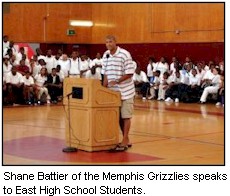 Shane Battier of the Memphis Grizzlies visited East High School to speak to the students.
Battier shared his personal story of how hard he had
to work in high school and college to achieve his dreams. He shared
that commitment and strong work ethic are keys to success.
Battier revealed that his pursuit of excellence on
and off the court involved sacrifice and may not have always been
recognized by peers as the "cool" thing.
Battier recalled many nights he spent in the gym
practicing his shot while all his friends went out and had fun. The
students were reminded that they must invest in their own future
through dedication to academics.
Battier challenged students to achieve perfect
attendance and to work hard in school. Students were promised that
those who finished out the 2004 year with perfect attendance will not
only be awarded in the classroom but will receive an incentive from the
Grizzlies.
Editorial 12/12: East gets a lift
From The Commercial Appeal, December 12, 2004
Prominent alumni of Memphis's East High School are
putting their money where their sentiments lie, by raising $3 million
for some worthwhile upgrades of the school.
Commodities trader and East High alumnus Charles D.
McVean organized the Greater East High Foundation last month with the
hope of persuading about 150 individuals and local businesses to
contribute.
The group has already installed computers and made
plans to outfit the auditorium with audio-visual equipment. One of its
most intriguing ideas is to pay students in the top 20 percent of their
class to tutor the bottom 20 percent.
It seems like a good way to make academic achievement
cool. You wouldn't want to encourage campus brains to write papers for
bullies. But if they might inspire fellow students to perform better,
the effort would be worth pursuing.
East has a proud tradition in Memphis, but it has
slipped considerably in terms of academic achievement. A concerned and
involved alumni may be the key to restoring the school to the prominent
position it once held in Memphis and inspire graduates of other Memphis
schools to follow suit. How about it, Manassas? Booker T.?
A gambler sets his sights on his alma mater, and a principal meets her match.
From The Memphis Flyer, December 10, 2004
[City Beat] Fire and Ice at East
A gambler sets his sights on his alma mater, and a principal meets her match.
Watch out, White Station High School and Central High
School. An old rival is out to "humble" you and regain its long-lost
place as one of the best schools in Memphis.
The school is East High School, and the twin driving
forces behind a new push to improve it are Principal Barbara King and
Class of 1961 alumnus Charles McVean, a commodities trader who's as
colorful as he is wealthy. This week, they launched the Greater East
High Foundation with a pep rally. Their hope is that a $14 million
renovation of the school funded by the Memphis Board of Education
combined with an eventual $3 million in pledges from graduates and
businesses will turn East around.
This is one of those fire-and-ice pairings that
should be interesting to watch. King grew up in Memphis and attended
city elementary schools before moving to Illinois for high school and
college. She was lured back to Memphis from Texas in 2003 by new
superintendent Carol Johnson to bring some stability to East, which had
run through five principals in six years. King radiates clear-eyed
calmness and toughness and won't let McVean or anyone else take up all
the oxygen in a room.
McVean, known as "Chas" to his classmates, is a
gambler/philosopher/economist/trader who made news in the 1980s when he
nearly brought legalized horseracing with parimutuel betting to
Memphis. During a visit to his high school alma mater last week, he
readily admitted that he spent more than his share of time in the
principal's office for being a bad boy. When he's determined to do
something, watch out.
"Chas is on a tear," says Gene Carlisle, East High
Class of 1960, who will lend his own considerable wealth and know-how
as CEO of a company that owns more than 100 Wendy's franchises in the
South.
"Barbara and I are 50-50 partners," says McVean. "My
part of the deal is I'm always adamant but never dogmatic."
Replies King, "I think I've met my match."
He hopes the foundation will "shame Central High
School into following suit." She wants to "move White Station down to
second place."
That could be even harder than building FedExForum or
AutoZone Park. East boasts a central location between Poplar and Walnut
Grove just east of the Central Library, strong boys and girls athletic
teams, an award-winning vocational-technical program, and a smattering
of excellent students who earn full scholarships to four-year colleges.
Overall, however, only about 25 percent of East graduates go to either
a two-year or four-year college, and 80 percent of the student body is
on free or reduced-price lunch. The optional program for college-bound
kids has taken a hit, and the main building has fallen into such
disrepair that the auditorium has been unusable for three years.
That would have been unthinkable back in McVean's
day. As an all-white school drawing students from nearby Chickasaw
Gardens and East Memphis, East routinely sent as many or more grads to
Vanderbilt and Ivy League colleges as any school in Memphis. By 1970,
East was often the focus of the busing-for-integration debate, and its
student population rapidly changed over the next decade. The bottom
fell out in the mid-1990s with a rash of shootings and principal
turnovers.
There has been talk for years among alumni such as
McVean and Spence Wilson, CEO of Kemmons Wilson Companies, about doing
something, but it took the arrival of Johnson and King to get it going.
The big picture includes new housing and retail along the north flank
on Walnut Grove, a new feeder elementary school near Sam Cooper
Boulevard, a refurbished building, and a unique operating agreement
with the school board that will allow King and the foundation to cut
red tape to fix the auditorium, wire the library for computers, and
install a security system in the parking lot.
In addition to underwriting spirit-building dinners
for students and teachers, McVean will pay student tutors $10 an hour
and up to $400 a month to work with younger and underperforming
students. He said the foundation will target median-level students and
prepare them for jobs in, say, health care, distribution, or food
service.
"Our target is to make the median graduate a person
who, with one or two additional years of training, St. Jude and FedEx
will fight to get their hands on," McVean says.
Carlisle, who grew up poor in Mississippi and
Memphis, said annual turnover in the fast-food industry is nearly 100
percent. On the bright side, though, most of his managers are promoted
from within and wind up running a $1.5 million-a-year store.
"I hire 4,000 people a year in my company," he says.
"Over the 28 years I have been in business, I have watched the quality
of education of these kids drop like a rock. The only way to make a
difference is to put your arms around them and show them somebody cares
enough to keep them in school."
Anonymous donor is a champion at East High
From The Commercial Appeal, December 9, 2004
Anonymous donor is a champion at East High
By Stephen D. Price
December 9, 2004
The man's voice sounded distant and deep from the
receiver as the East High School principal spoke with him on her office
phone.
He wouldn't give his name, he told principal Barbara King. And he didn't want to talk to a reporter.
But the man, who's given almost $100,000 to East High over the last four years, did have something to say.
"He said he believes in feeding the need," said King, relaying the message.
The only hints to the anonymous donor's identity are
that he graduated from East High in the 1950s and attended Vanderbilt
and Harvard.
"He chooses to be anonymous because he wants the
students to get the attention, not him," said Patti Smith, spokeswoman
for the Community Foundation of Greater Memphis, the agency that
handles his donations.
And the students need it.
East High, 3206 Poplar, is among the state's weakest
schools, facing takeover if it doesn't improve test scores.
The school's needs are numerous -- such as its
auditorium, in such bad shape students aren't allowed to use it.
In 2002, students and parents protested the school's mold problem.
And with a $168,000 school budget, and $121,000 going to buy textbooks, the school's buying power is limited.
Earlier this year the donor asked King for her short-term wish list.
"He said send me a list of what you want," she said.
So she did. Her list included $4,500 for the school's
yearbook, $12,000 to pay for trips for the school's Health Occupation
Students of America (HOSA) class, $7,000 for athletic uniforms and
$4,000 for athletic equipment.
In November, the school received a $41,000 check -- enough to cover everything King had asked for.
"A grant like this is a Godsend," King said. "The
donor has been a blessing and an inspiration to our faculty and
students."
The donor also paid $37,000 for the electronic sign
at the front of the school that relays scrolling messages about
upcoming events or games.
More of East High's needs may soon be met by a group
of local business leaders and East High alumni, called the Greater East
High Foundation, who are launching an ambitious effort to raise $3
million for the school.
Despite its challenges, King said there is plenty of
pride at East, an optional school that focuses on health sciences and
engineering.
"We want our kids to graduate and be productive citizens."
Hundreds Attend Foundation Kick-off Meeting at East
December 6, 2004 - Hundreds of East alumni, friends,
and some former faculty members joined East High Principal Barbara King
and The Greater East High Foundation  Chairman
Charlie McVean for the initial public meeting of the Foundation Monday
night, December 6. Both King and McVean discussed the 20/20 Vision
Student to Student tutoring program. McVean announced that the tutors
would be paid $10 an hour and that those being tutored who showed
significant improvement would be rewarded.
Chairman
Charlie McVean for the initial public meeting of the Foundation Monday
night, December 6. Both King and McVean discussed the 20/20 Vision
Student to Student tutoring program. McVean announced that the tutors
would be paid $10 an hour and that those being tutored who showed
significant improvement would be rewarded.
McVean went on to say that the night wasn't one to
pass the hat, that would come in the future. He did ask the assembled
group for volunteers. An attendance list was available as people
entered the door and the foundation may make contact in the near future
with those who gave e-mail or mailing addresses about the volunteer
opportunities.
Most details that are available about the plans are in the letter from Chairman McVean which is available at www.EastHighFoundation.org.
[Expanded photographic coverage]
Source: The East High Alumni Page
Business leaders want to revive East
From The Commercial Appeal, December 4, 2004
Business leaders want to revive East
Alum provides push for goal of $3 million aid for school
By Ruma Banerji Kumar
December 4, 2004
A group of local business leaders and East High
alumni are launching an ambitious effort to raise $3 million for the
embattled school.
The group, formed last month by prominent commodities
trader and East High alumnus Charles D. McVean, will meet Monday night
at 6 in the school library to recruit more members. The group hopes to
get about 150 alumni and local businesses to chip in and help East High
out of an academic slump. McVean wants to restore the school's
reputation as it was more than 40 years ago when he graduated.
"That was back in the stone ages," the 1961 graduate,
McVean, jokes, "but East High was arguably the best public school in
the city, and in the state. The records of East graduates who attended
Vanderbilt are proof of that."
Much has changed since 1961.
The school is now among the weakest in the state, facing state takeover if it doesn't improve test scores.
"The thought initially was to raise money for
Vanderbilt, since Mr. McVean attended the school, but Vanderbilt has a
billion dollars, maybe, in its foundation," said Bill Sehnert, interim
director of the group named Greater East High Foundation. "If you raise
a million for Vanderbilt, they say thank you and your name goes on a
wall that's about to fall over with about a hundred other names. But if
you raise a million three or four for East High, you can see a real
return on your investment."
The group plans to use the money to pay students in
the top 20 percent of their class to tutor the bottom 20 percent of
students at the school. The money also will help outfit the school's
auditorium, slated for renovation soon, with top-notch audiovisual
equipment.
Already, the Foundation has donated money to the
school to install computers in the library. Money is also being used to
motivate students and teachers: the top 225 students this semester will
be honored during halftime at the Dec. 11 Grizzlies-Pistons game, and
teachers and staff will get a Christmas party to boost morale.
While several city schools have business adopters who
donate books, school supplies and small gift certificates, the Greater
East High Foundation's efforts, should they succeed in meeting their $3
million goal, would be the most ambitious business-public school
partnership locally.
[See additional report below]
East High teachers receive meal, appreciation
From The Commercial Appeal, December 2, 2004
COMMUNITY
By Damon Remigailo,
Special to East Memphis Appeal
Recognizing the importance of the teachers at their
neighborhood city school, Mommies with a Mission from Christ United
Methodist Church partnered with Eikon Ministries to provide a Teacher's
Appreciation Luncheon.
Teachers at East High School were pleasantly
surprised to receive a hot meal and encouragement during their recent
in-service day. Faculty arrived for a meeting and were showered with
affection from Memphis parents thankful for all their hard work and
sacrifice.
The faculty lounge was fully decorated in autumn
festive decor as a giant banner proclaimed Christ Church's love for the
teachers.
East High Principal Barbara King was excited about
the event as she expressed a "need for East staff to be reminded how
important they are and applauded for the difference they are making in
students' lives."
The Mommies with a Mission group was thankful that
they could express their appreciation to the East High employees and
looked forward to events together.
Academic Improvement Seen--Progress Remains Below Guidelines
November 12, 2004 - State Eduation Report Card shows
East improving academic proficiency, but still not considered making
adequate yearly progress. See the Report Card.
Source: Tennessee Department of Education
Foundation to support East High School--Meeting planned, alumni invited
November 11, 2004 -- Alumni of East High and other
interested people have announced plans to create a foundation to
support the achievement of East High School students. It appears that
some major business leaders who graduated from East are strongly
backing the effort. A kick-off meeting is scheduled for 6 p.m. Monday,
December 6, 2004, at the East High School library. All East alumni who
have the interest, time, and/or resources to become involved in this
effort are encouraged to attend.
Update 11/24/2004: Read a letter from the Foundation's Interim Chairman about its purpose and plans.
Source: The East High Alumni Page
New Sign on East Campus

November 11, 2004 -- During the summer of 2004, a new
message sign was added to the East High campus. As we reported at the
time, it stands at the southest corner of the campus near the
intersection of Poplar Avenue and Holmes Road. The sign, probably about
12 feet tall, is being used to inform the public of parent-teacher
meetings, health fairs and other events.
Source: The East High Alumni Page
A Woman of substance
From The Commercial Appeal, October 17, 2004
'You Are My Sister' essays inspire books, publishing firm, even talk show with Boyd
By John Beifuss
October 17, 2004
In the back room of a small house on a modest street in Frayser, Anfra Boyd ['79] -- armed with a computer, a printer and a fax machine -- is plotting the growth of an inspirational multimedia empire.
In the past, such a project would have required
investors, a sales force, maybe even corporate sponsorship. But Boyd,
43, is a self-made entrepreneur, taking advantage of the democratic,
do-it-yourself possibilities of the Internet and self-publishing.
Boyd's first book, "You Are My Sister: An
Inspirational Book That Promotes Sisterhood and Spiritual Growth," has
sold close to 20,000 copies and is available in bookstores nationwide
and online through sources such as Amazon.com, where readers testify
"The book made me THINK!" and "This book has changed my life."
The book's success has led to a sequel, a Web site (youaremysister.com)
and an Internet radio program, and has created a demand for Boyd as a
motivational speaker for church groups, women's retreats and other
events.
"Anfra has gumption," said Maxine Thompson, a Los
Angeles literary agent who has befriended Boyd. "I could see Anfra
being as big as Oprah in Memphis."
What makes Boyd's success-story-in-progress
particularly interesting is that it was nurtured by word of mouth --
or, more precisely, the modern equivalent: word of E-mail.
In early 1998, Boyd, a lifelong Memphian, East High
School graduate and single mother, was working in a Schering-Plough
office while trying to interest New York agents in her dramatic,
God-centered novels.
As the process dragged on, she began writing E-mails
to a few friends and co-workers under the heading "You Are My Sister."
When she quit her job to pursue writing full time,
she stopped writing the E-mails. But her correspondents missed their
daily electronic pick-me-up.
"After I quit, a lady called me and said she had
saved those E-mails and they had helped her to get out of a bad
relationship," Boyd said. "Then I began getting testimonies from other
women who said I inspired them.
"I didn't think anything I wrote could be that powerful."
In July 1998, she started producing the weekly
E-mails again, sending them to about 20 people, who forwarded them to
their friends, and so on. "By October, my mailing list was in the
thousands and thousands."
Correspondents began clamoring for a book collection
of the E-mails. Boyd researched the possibilities and decided to
publish the book herself, with the help of a $1,400 loan from the
Opportunity Banc, a sort of low-interest "bank" run by the Metropolitan
Inter-Faith Association (MIFA).
"She had an idea, she knew where she wanted to go
with it, she had done all the research, and all she needed was a hand
to help her launch her business," said Carmen Mills, program manager of
the Opportunity Banc.
"I learned the nuts and bolts of publishing, and how
to not only publish but market, distribute and promote my own
business," said Boyd.
Taking advance orders from customers, Boyd
established her own company, F.I.G. Publishing, and had 500 of the
$12.95 oversized paperback books printed in New Jersey. (The company
acronym stands for Faith In God.)
"The books are about empowerment and spiritual growth
and most of all finding your purpose," said Boyd, who uses her first
name, "Anfra," as her Zane-like pen name. "I've been searching for my
purpose all my life, and this is it."
The first printing sold out, so Boyd printed more --
and more. Based on this success and on the burgeoning popularity of
self-help books aimed primarily at African-American women, a national
distributor began carrying the book and placing it in stores.
This past summer, Boyd printed a sequel, "You Are My
Sister: Words of Wisdom for Conscious Living." The $17 paperback is
packaged with two compact disks of Boyd's motivational messages.
The books include such chapter titles as "There's No
Right Way To Love the Wrong Man," "Addicted to Drama" and "Close Your
Legs and Open Your Mind," as well as poems about God and relationships,
and such workbook type features as "The Woman in the Mirror:
Self-Inventory Check List" and quizzes for single and married women.
Said Boyd: "I don't write about religion, and I don't
try to covert people. But I do talk about the fundamentals of God in
the sense of unconditional love and spiritual growth."
Boyd's writing led to a guest appearance on the
Maryland-based Harambee Radio Network, an Internet network at
harambeeradio.com. Boyd was so impressive she was offered her own
program, "Conscious Living," which she hosts live from 7 to 8 p.m.
every Thursday. Again, thanks to modern technology, she is able to host
the program and interview guests out of her home office, via the
Internet and the telephone.
Her biography on the Harambee Web Site describes Boyd
as: "Different. Odd. Unique. Beautiful. Unforgettable." But Boyd
describes herself as "author, poet, speaker, publisher, talk show
host." What makes her proud is that she earned these titles herself --
nobody hired her for any of these jobs, so nobody can fire her. (She
does still work a regular job, in customer service at Carrier
Mid-South, to ensure a steady income to support her 20-year-old son,
Cameron Yancey, who is studying meteorology at Western Kentucky
University.)
Self-publishing won't get Boyd on many best-seller
lists, unless a major publisher picks up and promotes her books (as
happened with Richard Paul Evans's "The Christmas Box"). But Boyd is
happy because she keeps about 60 percent of the retail price of each
book she sells, as compared to the small royalty percentage earned by
writers under contract to publishing companies.
"People used to think that the word 'self' had a
negative connotation -- that if you did something yourself, it wasn't
done right," she said. "But if you do something yourself, it's
empowering.
"I'm not waiting for someone to publish my book when
it's convenient to them, and I'm not waiting for a publisher to write
me a check. I'm making my own money. Instead of getting on someone
else's program, I'm creating my own. And I have the same challenges and
struggles as anyone else. There's nothing special about me except I
just decided to do it."
Achievements
From The Commercial Appeal, October 14, 2004
Russell Preston Grigsby, a 2000 graduate of
East High School, where he was voted "Most Likely To Succeed," has
proved his classmates' confidence in him.
Russell, a Boy Scout under scoutmaster Ron Hardin,
started working for Back Yard Burger at the Memphis Zoo when he was 16
and worked there throughout college, under the direction of Pat Booth.
In August, Russell graduated from the University of
Memphis with a bachelor's in military science and a minor in finance.
He received the University of Memphis President's Award, given to the
most outstanding senior cadet in the Army ROTC Tiger Battalion. Russell
has been commissioned second lieutenant, engineer, in the Army and
assigned to Fort Leonard Wood, Mo., through March 3. Afterward he is
assigned to Hawaii.
Russell's family includes a brother, Randolph Allen
Grigsby, a junior at the University of Memphis, and his parents,
Deborah H. Grigsby of Midtown and Randolph Preston Grigsby of
Williston, S.C.
-- Deborah Grigsby
Former East Student Takes Commission Seat
October 21, 2004 - Dr. George Flinn, M.D.,
radiologist, radio stations owner, was elected yesterday to fill a
vacancy on the Shelby County Commission. The Commission is the county's
legislative body. Flinn was chosen by other members of the Commission
to fill out the two years remaining on an unexpired term of a
Commissioner who is taking a position with the county administration.
Although Flinn transferred and graduated from another Memphis high
school, he attended East several years in the 1950's-1960's era and
lived in the East High district. He is a Republican.
Paul Hunter ('95) helps kids as recreation director for kids
From The Commercial Appeal, October 10, 2004
Arena football player scores with youths
Paul Hunter helps kids as recreation director for kids
By Donnie Snow
Special to Whitehaven Appeal
October 10, 2004
Five days a week, Paul Hunter walks into the metal
building housing Southaven's Boys & Girls Club of America and tries
to teach 75 bustling kids sportsmanship, fitness -- and not to run
indoors.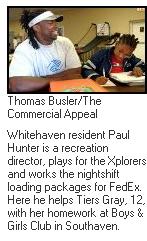
It's a tossup which one may be harder, even for a semiprofessional football player.
A month ago, director Samantha Hood scored big,
landing the four-year Memphis Xplorers Arena League veteran for the
young club's sports and recreation director.
Hunter was "was just looking in The Commercial Appeal
trying to find a part-time job," he said. "I thought, 'I always hear
about The Boys & Girls Clubs, I might as well give it a try.'"
Said Hood, to Hunter's chagrin: "He's just a great big teddy bear."
To a handful of rambunctious kids at the club Thursday, Hunter delivers a common refrain.
"Fellas, fellas, fellas," he says, "Don't run." The kids hear it countless times throughout the afternoon.
Unexpectedly softspoken for a 250-pound man who
stands 6-3, Hunter has a smile as constant as the kids' adrenaline.
The former East High School football stud and
National Honor Society member accepted a scholarship to Mississippi
State after graduating in 1995.
Hunter played four years at linebacker for Jackie
Sherrill, making it to two bowls, a losing effort to Texas in the 1998
Cotton Bowl at Dallas and a Peach Bowl victory over Clemson in 1999 at
Atlanta.
Hunter came home when he finished his bachelor's
degree in physical education and for the last four years has played
linebacker/fullback for the Xplorers.
"The kids ask me about it all the time," said Hunter.
They always ask if he's going into the NFL, he said,
like former MSU teammates Fred Smoot, Eric Moulds, J.J. Johnson and
Greg Favors, among others.
Dressed like a gym coach despite his short, skinny
dreadlocks poking out the top of his Oakland Raiders visor, he may look
unconventional for the area, but it undoubtedly works with the kids.
Hunter's making the most with a few haggard
basketball goals, jump ropes and imagination -- far from the facilities
he enjoyed in Starkville.
He coaches the kids through basketball or dodgeball
during "sports and fitness" time. When he arrived, he tried teaching
them some football, but the PE major would like to branch out to yoga
or fitness drills if he had monkey bars and a set of tires.
Hunter sounds committed to putting a good program
together at this, his third job. When not a rec director or
obliterating opponents for the Xplorers, Hunter works the nightshift
loading packages for FedEx.
He hopes he might get to a high school position,
probably coaching. The Whitehaven resident, who is single, has had some
experience coaching already, volunteering sparingly for youth league
teams around the neighborhood.
"Anything positive for the kids," he said, "I was
fortunate to have really good parents, who were really my mentors."
East Teacher-Coach Suspended After Sexual Advancement Allegations By Student
From The Commercial Appeal, September 24, 2004
Track coach suspended while complaint investigated
By Jason Smith
East High boys track coach Gary DeBerry Thursday
remained suspended indefinitely with pay as Memphis City Schools
continued to investigate a complaint filed against him of sexual
misconduct with a ninth-grade student.
DeBerry, also a physical science teacher at East, is
alleged to have made inappropriate sexual comments and contact with a
ninth-grade student who, along with her mother, filed the complaint
with East High principal Barbara King on Wednesday.
"We are investigating the situation thoroughly," Memphis City Schools spokesman Vince McCaskill said Thursday.
"We take all accusations seriously, and if they are
proven to be true and correct, this individual could face termination."
DeBerry did not return phone messages left at his
home Thursday. King also did not return a phone message left at her
home.
DeBerry's MCS personnel file, obtained Thursday by
The Commercial Appeal, indicates Wednesday's complaint isn't the first
of a sexual nature filed against DeBerry, who while at Hamilton in the
spring of 1995 was accused by a senior student of "stating to her that
he would like to have sex with her and in the process of doing this, he
proceeded to put his hand up her dress," according to a MCS memo dated
May 8, 1995.
Charges were filed, but later dropped when the
Attorney General's office found no evidence or witnesses to corroborate
the girl's story.
"Although Mr. DeBerry in the past has been involved
in some coaching irregularities, at no time has there been any behavior
on his part that would support a charge such as this," wrote James
Morse, former coordinator of secondary personnel for Memphis City
Schools. "I am recommending that Mr. DeBerry be informed of this and
told that he should be extremely careful in his dealings with female
students."
Later that May, DeBerry was suspended without pay for
three days by former Supt. Gerry House for returning to Hamilton while
still under investigation.
According to his personnel file, DeBerry has been
reprimanded for several other violations, including a 1987 incident in
which he was found to have falsified school records at Hamilton by
using an ineligible athlete under an assumed name in a regional track
meet.
DeBerry was suspended from coaching, but not teaching, but was reinstated in August of 1988.
A year later, DeBerry was accused of illegal
recruiting practices at Hamilton, and was again stripped of his
coaching duties while Hamilton's athletic program was placed on one
year's probation.
In 1991, while at Westwood, DeBerry was suspended for
his disciplining of a female basketball player in which he was alleged
to have "struck her on her buttocks during a practice, causing several
lacerations."
"It's very troubling," McCaskill said. "The current
administration was very disappointed once they were made aware of the
contents of this personnel file."
When asked how a teacher with so many apparent
violations could remain in the MCS system, McCaskill replied: "We can't
speak for why decisions were made 15 years ago. We weren't here in
1989. Supt. (Carol) Johnson just came on board in 2003.
"We can speak for what we can do now, and what we can
do now is thoroughly investigate this current allegation with the
utmost integrity."
From WREG-TV, September 22, 2004:
by Stephanie Scurlock
MEMPHIS,TN-Audrea Tillman wipes the tears from her
daughter's eyes after picking her up from East High School. 9th grader
Lakethia called her mom after she says her physical science teacher got
physical with her two days in a row. She alleges the teacher who's also
a coach put his hands down her pants and made sexual statements.
Tillman says her daughter just revealed problems with the teacher this
morning but when questioned further her daughter said since the
beginning of the year, the teacher's conversations had sexual
undertones.
Administrators at East High aren't commenting about
the incident. The teacher is now suspended with pay until human
resources for Memphis City Schools conducts an investigation. Tillman
and her daughter also gave statements to Memphis Police.
Tillman says her daughter will return to East High this week but only because the teacher won't be there.
In the neighborhood: Corner landmark gone
September 12, 2004 - Where Poplar Avenue Baptist
church used to stand is an empty lot awaiting construction of a retail
development.
 Poplar Avenue
Baptist bought the property in 1948 for $47,500. Earlier this year the
church's dwindling congregation voted to close the church, sell the
property, and donate the church's furniture and proceeds from the sale
to other churches and church related charities. During the early summer
weeks the church building was torn down (see photo).
Poplar Avenue
Baptist bought the property in 1948 for $47,500. Earlier this year the
church's dwindling congregation voted to close the church, sell the
property, and donate the church's furniture and proceeds from the sale
to other churches and church related charities. During the early summer
weeks the church building was torn down (see photo).
Loeb Properties, Inc. now owns the 1.6 acre lot,
having paid about $1.2 million for it. Announced plans call for a
15,000- to 16,000-square-foot neighborhood shopping center at that
location. Independent Bank is a major tenent already signed to locate
there. Developers have said they expect construction to be complete by
spring, however, since it has not started yet that timetable might be
questionable.
First Baptist Church was located on the southeast corner of Poplar and Holmes across from East High School.
Few ambivalent in feelings about outspoken leader: [Kirk Fordice ('52)]
From the The Clarion-Ledger, September 8, 2004:
September 8, 2004
Few ambivalent in feelings about outspoken leader
By Jerry Mitchell
Former Gov. Kirk Fordice ['52] inspired more enthusiastic fans and rabid enemies than perhaps any Mississippi governor since Theodore Bilbo.
"You either hated him or loved him," said Jack Criss,
who's finishing an authorized biography on the state's first Republican
governor since Reconstruction. "There was no ambivalence in Kirk
Fordice, and there was no ambivalence in his life, so it's rather
fitting."
Quail Ridge Press of Brandon plans to publish the book, Steel Will, in time to hit bookstores next summer.
Hardly anyone gave Fordice, a political novice, a
shot to win in 1991, first against fellow Republican Pete Johnson and
next against Democratic incumbent Gov. Ray Mabus.
But Fordice overcame the odds, and the contractor
became the first businessman to occupy the governor's chair since Hugh
White, a lumberman from Columbia who won in 1951.
In the years that ensued, Fordice became one of
Mississippi's most popular governors in modern times and easily won a
second term in 1995.
Criss said whenever he dined with Fordice across
Mississippi, "it was like dining with a rock star. People black, white,
old and young would come up and talk with him. I think he'll be
remembered as a true man of the people."
What voters liked — and what drew the ire of
some — is the governor never failed to speak his mind. "Fordice
would say, 'That's a damn stupid idea,' or say, 'To hell with that' and
gave specific ideas," Criss said. "It was none of this, 'Let's find
common ground, let's compromise.' You have to respect someone like
that, especially when there's so much flip-flopping these days."
Veteran journalist Bill Minor, whose first assignment
in Mississippi was covering the 1947 funeral of the fiery,
segregationist Bilbo, said he was saddened to hear of the death of
Fordice, whom he said lacked the loveability of Fordice's mentor,
President Ronald Reagan.
"He was a bully, no question about it," said Minor, who drew Fordice's criticism.
In 1999, a Memphis journalist snapped a photograph of
Fordice returning from France with his childhood sweetheart, Ann Garber
Creson.
When WLBT-Channel 3 veteran newsman Bert Case
confronted Fordice about the matter, Fordice threatened to whip his
"a--."
On Tuesday, Case, who has covered every governor
since 1965, said he's never seen another governor with the ability to
inspire the average Mississippian: "From the forks of the creek to the
highest corporate offices, people agreed with him."
Case said he has a lot of respect for Fordice. "I'm
very sorry I never got to reconcile our differences," he said. "He
should be remembered for leaving our state with a $350 million surplus.
Those are the things he ought to be remembered for rather than the
silly confrontation with me."
Fordice supported tort reform, aggressive law
enforcement and prison reform, increased tourism funding and set a
limit on spending. A fierce opponent of what he referred to as
tax-and-spend liberalism, he took frequent shots at Democratic and
liberal opponents.
Jim Herring, chairman of the Mississippi Republican
Party, said Fordice will probably be most remembered for the
$350-million surplus and establishing a huge rainy day fund that
Mississippi lawmakers have since raided. "I think history will smile on
Gov. Fordice's tenure," he said.
Jackson businessman Billy Mounger said record numbers
of Republicans in Mississippi can be traced back to Fordice. "He's the
one and only governor elected to a second term," he said. "That helped
that much more in building the party."
Fordice deserves the highest praise for establishing
and appointing the first Gaming Commission, he said. "He put the finest
people you could ever get on the commission ... and we haven't had one
scintilla of crookedness."
While his Gaming Commission appointments drew praise,
critics of Fordice suggested his appointment of only white men to the
state College Board showed a lack of diversity.
Critics also lambasted Fordice for welfare reform,
saying he was condemning some single mothers to low-wage jobs with no
insurance and no future.
Leslie B. McLemore, political science professor at
Jackson State University, said many liked the fact Fordice had no
hidden agenda. "One thing you had to appreciate about Fordice —
you always knew where he was coming from."
Even staunch political opponents found him formidable.
"When he did something stupid or illogical, it didn't
mean anything to the people because it looked good. 'Teflon' fit him a
lot better than Reagan," said state Sen. Johnnie Walls Jr. of
Greenville, the state Democratic Party chairman a decade ago.
Fordice ('52)remembered for what he said, not just what he did
From the The Clarion-Ledger (website), September 7, 2004:
 [Editor's note: Kirk Fordice ('52), former governor of Mississippi, died September 7, 2004. As part of it's coverage, The Clarion-Ledger published the following article on its website. Please also see the accompanying story/obituary
.]
Fordice remembered for what he said, not just what he did
The Clarion-Ledger
Gov. Kirk Fordice will be remembered for saying exactly what was on his mind. A sampling of Fordice-isms:
"I'll call out the National Guard."
— Remarking in early 1992 about what he'd do if a court
required Mississippi to spend more money on historically black
universities.
"The United States of America is a Christian
nation." —?At a Republican Governors Association meeting,
November 1992.
"... fleecing the Yankees." —
Speaking of Vicksburg's tourism economy, early in his
administration.
"... irreconcilable differences." —
Describing marital problems with his wife, Pat, in early 1993. The
couple soon said they had reconciled.
"... probably the most beautiful animal
God's ever made." — Describing a lesser kudu he
killed on an African safari, summer 1994.
"I don't believe we need to keep running
this state by Mississippi Burning and apologizing for 30 years
ago!" —?During a gubernatorial debate with Democratic rival
Dick Molpus at the Neshoba County Fair, August 1995.
"Flashbulb Moore." — His frequent jab at Attorney General Mike Moore.
"I have absolutely no memory." —
January 1997, in response to questions about what he had been doing in
Memphis before a near-fatal crash in November 1996.
""Texas executed two in one day the other
day, Arkansas has done the same thing and both of those states are
continually working down their inventory on death row and ours
continues to grow." — In naming a crime commission, June
1997.
"...tawdry little gambling town." —
Describing his hometown of Vicksburg, in The Washington Post, 1998.
"I'll whip your ass!" — To
WLBT-TV reporter Bert Case, who drove to Fordice's Madison home
to ask about the governor's marital infidelity, June 1999.
"You know it was her. Did you ever doubt
it?" — June 1999, acknowledging to reporters that the woman
he had lunch with before his near-fatal 1996 wreck was Ann Creson of
Memphis.
"Only positive Mississippi spoken here." — Slogan he posted on road signs.
An obituary is available.
There are other news items about Kirk Fordice below.
Former East Faculty Member To Lead Botanic Garden
From the Commercial Appeal, August 24, 2004:
Former Nephew exec takes over Botanic Garden
By Christine Arpe Gang
August 24, 2004
Business executive James Duncan has been named executive director of the Memphis Botanic Garden.
Duncan, 62, was introduced to the staff of the 96-acre facility Monday. He begins working Sept. 7. 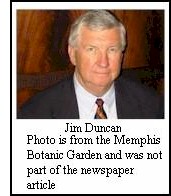
"I want to provide the leadership to build upon what is already an exciting and inviting place," Duncan said.
Duncan served as a division president for Smith &
Nephew and director of sales for Bristol-Myers-Mead Johnson.
Most recently he has been general manager of Talent
Force Staffing and before that, senior vice president of Master
Graphics Inc.
He replaces Marilyn Ligon, who resigned in January.
"Jim brings a career's worth of management experience
to the botanic garden," said Gary Wunderlich, president of the board of
Memphis Botanic Garden Foundation. "The search committee recognizes
that Jim is a natural leader, a team builder, a common-sense decision
maker and an engaging personality."
Duncan, who started his career teaching and coaching
football and basketball at East and Ridgeway High Schools, lives in
Germantown with his wife of 40 years, Elizabeth Duncan. She is director
of development for The Salvation Army.
The search committee picked Duncan, a native of Itta
Bena, Miss., over 100 other applicants from all over the Southeast.
Bob Fouche, retired deputy director for Memphis Park
Services, has been serving as interim executive director since Ligon
resigned. Ligon was the third executive director at the botanic garden
in less than 10 years.
Duncan said he isn't apprehensive about taking the
helm of an institution that has had several changes in leadership in a
short period.
"I've become good at going into places with a little instability," he said.
[Editor's note: Coach Duncan, as he was
known at East by many of the students, taught at East from about 1966
through about 1970. He lead classes in economics, government, and
American history, and coached football and basketball.]
East Remains Below Federal No Child Left Behind Benchmarks for 2004
August 12, 2004 - The
achievement benchmarks set for schools by the federal "No Child Left
Behind" educational initiative were not met at East High for 2004. The
high school failed to meet the benchmarks in most of the main
categories: math proficiency; reading, language arts, writing; and
graduation rate. See the for details.
Source: Tennessee Department of Education
Former East Principal Heads Up Charter School
From the Commercial Appeal, August 2, 2004:
Charters still face empty classes
By Wayne Risher,
Lowell Winston was
principal at East High School in the 1990s, but at City University of
Liberal Arts he's president and campus chief executive officer.
School organizer Lemoyne Robinson is chancellor, his
lead teacher serves as provost, and next year Robinson plans to add a
dean of students.
The titles are collegiate by design, to help students
make a smoother transition to higher education, Robinson said.
City University, which opened in July, is on a
mission to provide college preparatory education to more Memphis high
school students.
It's one of three new charter schools that are
expanding education options in Memphis, even as organizers complain
legislators haven't made it any easier to fill the classrooms.
The startup of three charter schools last year was marred by confusion over who could legally attend.
Sponsors of the privately run, publicly funded
schools had high hopes for more liberal eligibility rules for the
2004-2005 school year.
But proposed changes died in the General Assembly.
"The same opponents who made the charter school laws
we have on the books are still in power," said Rev. Derrick Joyce, past
president of 100 Black Men of Memphis.
"It appeared the votes were not there in the K-12
subcommittee," said House Republican Leader Tre Hargett of Bartlett.
Only students from failing schools can transfer to
charter schools, and their parents are less likely to take advantage.
City University had 100 students and 40 empty seats
on opening day at Greater Middle Baptist Church, 4982 Knight Arnold.
In a couple months the school will move to a
renovated former Presbyterian church at 4748 Winchester. It's opening
with ninth graders and will add a grade a year.
Robinson, 33, was an administrator at State
University of New York at Potsdam when his parents challenged him to
give something back to his hometown.
A doctoral student in education, he began working on
the concept three years ago through the Influence1 Foundation, the
school's sponsoring nonprofit.
He developed curriculum with help from the College Board, which administers the SAT college admission exam.
He lured Winston from Fayette-Ware High School in
Somerville, which the former East chief helped get off the state's
failing schools list. Winston left East High in 1997 amid problems with
school finances.
Winston's arrival at City University attracted former
East parent James Robinson, no relation to the school chancellor.
"I think if given a chance, three years from now, this will be the premier charter school," he said.
[Editor's note: please also see additional stories about Lowell Winston below.
Mr. Winson is the second East faculty member to lead one of
the few charter schools in Memphis. Former engineering teacher Tommie
Henderson is principal of the Memphis Academy of Science and
Engineering. See the story below.]
Bill Boyce ('67) Gets Beatles Photos Apparised
From the Commercial Appeal, August 1, 2004:
"Bill and Rikki Boyce
brought Bill's scrapbook of Beatles photos he took during a press
conference as a student at East High School when the Beatles visited
Memphis in August 1966."
[Click here for the full article
on the visit of television show "Antiques Roadshow" to Memphis, which
should be available for a few days from the newspaper's web site.
Awards for East Students, Faculty
Posted August 1, 2004
The names of area middle and high school
students inducted into the National Honor Roll were released by the
Washington organization, which recognizes students who have achieved
academic success [include]: Orterius Burnett, East High School;
Brittney Canady, East High School; Bianca Gale, East High School; Ramel
Quinea Gilliam, East High School; Latoria Henderson, East High School;
Felicia Miles, East High School; La Darrius Spencer, East High School;
Jonese Sykes, East High School; Deidre Turner, East High School;
Raynika Vann, East High School; Tameka Watson, East High School;
Tamisha Weathers, East High School. --Commercial Appeal, July 29, 2004
Students from East High and Hamilton High
attended the national conference of Health Occupation Students of
America (HOSA) June 23-26 in Orlando, Fla., having advanced to national
competition after winning recognition at the regional and state
competitive events.
...And students from East High also scored several
awards. They took first place for their Marketing/Visibility Program,
receiving the Outstanding HOSA Week Award. In addition, two East
students were top 10 finalists in the competitions: Arionna Taylor was
in the top 10 in the Medical Assisting Clinical category, and Lasandria
Ward was in the top 10 in the Medical Laboratory Assistant category.
Receiving special recognition at the conference were
Taylor, April Jones, Korron Hightower, Ward, Kharmen Gray, Amber
Baxley, Brittaney Canaday and Ceantanna Harrison in the Award of
Merit/American Cancer Society category and for their student
portfolios.
HOSA adviser-teacher at East High is Sharron Hightower.
HOSA is a national student organization available to
all secondary students who are or have been enrolled in a health
science education program, as well as postsecondary/collegiate,
associate, alumni and professional members.
Deborah W. Baker is communications manager in the
department of communications and public affairs for Memphis City
Schools. --The Commercial Appeal, July 15, 2004
The following ... students have been named to the National Honor Roll for academic achievement:
... East High School: Jeremy Todd Montgomery... --The Commercial Appeal, July 15, 2004:
The 35th annual Best of the Preps Awards Ceremony honored:
Erika Palmer, East High School, Girls Track & Field Athlete of the Year.
Danny Joe Young, East High School, Girls Track & Field, Coach of the Year --
The Commercial Appeal, June 24, 2004
The United States Achievement Academy recently announced that
Larry McAfee Jr. has been named a United States National Award Winner
in English. McAfee attends East High School and is the son of Mrs.
Freddie McAfee. -- The Commercial Appeal, June 24, 2004
Seven schools win $100,000 grants
From the
Commercial Appeal, July 21, 2004:
Seven Memphis city schools are among 18 statewide to receive $100,000 grants to improve student achievement.
Local grant winners -
East High, Fairview
Junior High, Hawkins Mill Elementary, Humes Middle, Kingsbury High,
Trezevant High and Vance Middle - competed for the grants.
The grants will be renewable for two years, as long
as adequate federal funding is available. The schools also have to
prove that student achievement has improved.
To qualify, the schools had to show 11 basic
strategies they plan to use to increase test scores, including teacher
training, parent involvement and strong curriculum and instruction.
Life as an art
Puppets, sculpture, music fill rich world
From the
Commercial Appeal, July 1, 2004:
By Larry Rea, Special to Bartlett Appeal
Some know him for his puppet shows at the Memphis Pink Palace Museum.
Some know him as a musician who has sung and played
with such legendary performers as Furry Lewis, Hammie Nixon and Sleepy
John Estes.
Some know him for his art, such as the stainless
steel bird sculpture he did for Cybill Shepherd or the tabletop Zen
compass owned by Robin Williams or the steel-and-glass decorations that
hang from the wall at the Bangkok Ally restaurant in Cordova.
There are so many facets to Jimmy Crosthwait's life it's hard to believe he's actually one person.
He's not even sure himself.
"I almost have vague memories of the Civil War,"
Crosthwait said, tongue-in-cheek, as he rubbed his shoulder-length hair
and sipped a cold beverage with Titus, one of his three dogs, curled up
at his feet. "I've always thought that if I lived before I would have
looked exactly like I look now whether it was the 12th or the 16th
Century."
You get the idea that Crosthwait has lived life to the fullest.
And he has.
At 58, he is easily one of Memphis's most
recognizable people thanks in part to his appearance ("I like to think
of myself as the last beatnik") and the countless people he has
entertained either through his art or his music or his puppetry.
"I'm a lucky man," he said.
Lucky enough to be doing something he loves to do,
whether it's making something out of "things" he finds or his puppetry
or playing the washboard with the North Mississippi Allstars.
On a recent day Crosthwait took time to talk about his life - past, present and future.
He and his wife Ulla, who is a nurse at Le Bonheur
Children's Hospital, live in a multistoried home on an 8-acre, wooded
lot near Arlington.
The home, which Crosthwait and his wife designed,
decorated and for which they did a lot of the inside work, is also the
base for his Inside and Out art studio.
Art is at the heart of Crosthwait's journey, though it was the stage where he first gained notoriety.
"I began a career - I guess you could call it - in
show biz when I was 5," Crosthwait said. "It was the first year they
started the Children's Theatre in Memphis."
Three years later he was in a pilot for a television
series about a Memphis juvenile court judge. However, the show never
was shown, he said, because the judge was implicated in a baby stealing
scheme that received national headlines.
"I had to change rackets at 8 years of age,"
Crosthwait said with a laugh. "I think I have been in show business
ever since, whether it was music, puppets or artwork. It all requires
an audience."
The puppetry evolved out of Crosthwait's artwork.
Growing up in what he calls "the briar patch of Memphis," Crosthwait attended
East High
through the 10th grade, when he transferred to the old Tech High to
take commercial art classes. He was an art major at what was then
Memphis State when he learned about a puppeteer in Florida. He decided
to go to Florida to learn about puppets.
Two years later (1967) he took his own puppet show to
New York City, where he opened the Electric Circus, which was the first
of the nation's superdisco clubs. After seven months, he was ready to
come home. "By then, I'd had my fill of New York," he said.
After several years of doing puppet shows in Memphis
area schools and art festivals, Crosthwait started working at the Pink
Palace Museum in 1975.
For the next 23 years he did about 150 shows a year
at the museum with show sizes ranging from 100 to 200 people, which
means he entertained about 1 million.
And then it ended.
In 1998, he got caught in budget cuts at the museum.
"I worked for the zoo for a year or two and then it
just became that I was doing more artwork and selling more art and one
thing led to another and now I make more of my living from the sale of
my artwork than my puppet or musical work," Crosthwait said.
One of his art pieces - a 7-foot Tambourine Totem -
is being showcased at the Dixon Gallery in its "In the Mix" show that
will run through July 18. The show, Crosthwait said, features musicians
who "just happen to do art."
Jeniffer Church, the show's curator, said Crosthwait "just oozes creativity."
Eight other pieces of Crosthwait's work are on sale at the Bangkok Alley restaurant.
However, his most cherished art work, a giant dragonfly, hangs from the ceiling at Crosthwait's home.
"People have offered me $1,000 for it and I turned
them down," he said. "I imagine I would sell it for $4,000 or $5,000
but I don't think anybody would give me that."
His art, he said, is timeless.
"I think my artwork's qualities are a bit like
Oriental or Native American," Crosthwait said. "What it really has is
timelessness. You couldn't tell me when this or that piece of work was
done. That is a quality about my work that I like the most. In a way I
guess you could say that applies to my hair, too."
You can't do a story on Crosthwait's life without mentioning his hair.
"I've had long hair since the pre-Beatle era," he
said. "In fact, there's a girl who is doing her work for a master's
degree that has something to do with hippies and she had been told by
everyone to contact me. She seemed to think of me as the first hippie."
As for his music, Crosthwait played the washboard or
sang with Jim Dickinson and the North Mississippi Allstars for years.
He and Dickinson have played music together on and off since before the
Beatles.
Now Dickinson's sons, Luther (singer/guitarist) and Cody (drummer), continue the tradition.
"What I really like about the North Mississippi
Allstars is that they are continuing that tradition," Crosthwait said.
When asked how he would like to remembered, Crosthwait said:
"That I brought a bit of joy to people's lives. I've
done that with my music, my art and my puppetry. If there's a residual
effect of what it is that I do, I would hope that joy would be noticed
first and foremost."
This article, with pictures, is available free on the web for a limited time fromThe Commercial Appeal's web site.
AARP Cover Girl: Cybill Shepherd

June 24, 2004 - The July/August issue of AARP The Magazine has a picture of Cybill Shepherd ('68)
on the cover and a feature article about her inside the magazine. The
cover blurb reads, "'I'm finally the woman my mother wanted me to be?'"
The article is available on-line at Cybill Liberties.
AARP was formerly known as the American Association of Retired Persons.
City School Board Votes to Demolish Crump Stadium
June 22, 2004 - The Memphis City School
board last night voted 8-1 to demolish and rebuild the 70-year-old
stadium because it would serve several area schools.
East High School, along with many others,
occasionally played football games at Crump stadium over the decades
and other events, like the city wide JROTC review in which East High
contingents participated were also held there.
Sources: The Commercial Appeal, The East High Alumni Page
Professors to teach teachers on PCs
From the
Commercial Appeal, June 19, 2004:
Three University of Memphis professors will
use a $1.6 million grant to improve computer programming classes in
local public schools.
U of M computer science professor Linda Sherrell and
her colleagues will train Memphis city and Shelby County teachers to
find more creative, thorough ways to spark interest in computer science
among high schoolers.
Training takes place at the U of M's FedEx Technology Institute Tuesday through Friday.
The National Science Foundation grant helps improve
instruction in six schools this fall: Bartlett High, Collierville High,
East High, Central High, Overton High and Ridgeway High.
The three-year grant will allow the professors to
expand their training to four more schools over the next two years.
East Student Obituary: DeAngelo Shaw
From the Commercial Appeal, June 9, 2004:
DeANGELO 'D'MAN' SHAW, 16, of Memphis, student at East High School,
died Tuesday at the Regional Medical Center at Memphis. Services will
be at 11 a.m. Saturday at Progressive Baptist Church with burial in New
Park Cemetery. R. S. Lewis & Sons Funeral Home has charge. He was a
former member of Greater Kerr Baptist Church. He leaves his mother and
stepfather, Tammy and Reginald White; three sisters, Ja'Lissa Hoskins,
Lah'Shanique Hoskins and La'Tesha Shaw, and his grandparents, Betty and
Robert Shaw, all of Memphis.
[See also newspaper stories below]
Three Charged with Murder in Student's Death
From the Commercial Appeal, June 9, 2004:
Witness put cops on suspects' trail
By Chris Conley
June 9, 2004
A witness who saw smoke and fire rising from the
burning body of DeAngelo Shaw helped lead police to the teenager's
killers, according to charges filed Tuesday.
Shaw was accosted, robbed, then murdered on May 26 by
two other teenagers and an adult as he walked on Edward near McLean in
North Memphis, police said.
Homicide detectives filed first-degree murder charges
against Quincie Washington, 27; Joshua Taylor, 15, and Gerraldo White,
15.
Shaw, who knew one of his attackers, was forced into
a 1980 Oldsmobile Delta 88 about 9 that night and driven to the area of
McLean and Hubert, about a block away, according to charges filed
against Washington.
The report said Shaw was forced onto a bicycle path,
robbed of money and drugs, then shot. The three suspects then carried
Shaw's body to a grassy field near the bicycle path, shot him again,
doused him with gasoline and set him on fire.
Police believe he was dead before his body was burned.
The youth's body lay in the field for three days
until a man walking his dog made the discovery. Shaw's body was burned
badly and he was identified through dental records.
Detectives found a witness who said he had heard
several shots, then saw a teenager throwing a gas can into the field,
according to the charges. The witness said he saw smoke and fire rising
from the area.
One of the juveniles was questioned Saturday, police
said, and implicated Washington, who was arrested Sunday. Washington
admitted he was there when Shaw was killed, according to the charges.
Police said Shaw had run away from home on May 21,
and was reported missing two days later. His mother told police he had
run away several times.
Taylor and White have minor criminal records in
Juvenile Court, as did Shaw. The two juveniles charged in his death
will be held without bond for a probable cause hearing next week.
Washington also is being held without bond.
Police Tuesday continued questioning possible
witnesses, and said they had located a handgun believed used in the
killing.
[see additional story below]
Body of Missing East Student Found
From the Commercial Appeal, June 5, 2004:
Neighbors contemplate reason in teen's slaying
By Stephen D. Price
June 5, 2004
Neighbors described a 16-year-old boy found burned
and shot to death in the Vollintine-Evergreen neighborhood last week as
quiet and one who kept to himself.
The body of DeAngelo Shaw was found Saturday in a
field at McLean and Hubert, where police estimate it had been a week to
10 days.
The East High School student went missing May 21.
Shaw's brother, Justin Wilson, ran away May 23, but
has since returned, said Memphis police spokesman Rhonda Lee.
His disappearance doesn't appear connected with Shaw's death, Lee said.
When Shaw's mother, Tammy White, first reported Shaw
missing from their home at 456 Glankler in Bingham ton, she told police
he had run away many times before and didn't suspect foul play.
She couldn't be reached Friday.
Police hadn't arrested any suspects late Friday but were tracing leads, Lee said.
Neighbors were surprised by Shaw's death.
"He would run away to his grandmother's house or some
thing, but he would always come home," said next-door neighbor Donald
Deaner, 35. "He didn't get into any trouble."
Deaner said his neighbor, White, is a single mother with five children.
Friend Antowan Cox, 12, said Shaw was quiet and they would sometimes go to Overton Park to play.
Deaner couldn't understand why anyone would harm Shaw.
"He couldn't have gotten robbed," Deaner said. "He didn't have any job, jewelry or money. He was a good boy."
Paper route set the stage for doctor's route in life
From the Commercial Appeal, March 13, 2004:
By Matt Woo
Special to Germantown Appeal
May 13, 2004
When he was a child, waking up and working at 3 a.m. was a typical day.
He went to school like any other child did at his
age. He always did his homework too, and almost made straight A's.
But being a newspaper delivery boy was something Cornell Faquin ['52] always wanted to do.
Although Faquin delivered for The Commercial Appeal
and the Memphis Press-Scimitar, his first opportunity was with the
Press-Scimitar when he was 7.
"When I started out, my very first experience with
the newspaper was on Dec. 7, 1941, when Pearl Harbor was attacked,"
Faquin said. "The Memphis Press-Scimitar put out an extra section, and
a friend of mine had a route and they asked me to help him sell papers
on the corner of Union and Belvedere.
"I was thrilled about that because you would always
see in old movies kids yelling 'Extra! Extra! Read all about it.' "
And by age 11, Faquin wanted his own paper route. The
paper said no at first, because of his age, but he refused to take no
for an answer.
"At 11 they wouldn't give me one, so I kept begging
them for a route," Faquin said. "I kept going up there and went to
their meetings then finally, just before I was 12, they gave me one.
And as it turned out, the route was my street."
Delivering the morning paper could be a challenge for some youngsters, but he had a system.
"I would do my homework at night and get enough sleep and go to bed when I got back."
Delivering newspapers wasn't the most glamorous job or even the best paying. Faquin made about $12 a week.
The first item he bought with his savings was a
Famous James motorcycle. Later he bought his first car, a 1941
Chevrolet convertible, for about $600.
Delivering papers wasn't always an easy job, Faquin
said. One time he accidentally threw a paper through a subscriber's
window. Another time, the brakes on his car went out and he crashed.
Faquin continued delivering newspapers until age 20,
when he enrolled in medical school at the University of Tennessee,
Memphis.
After medical school, Faquin opened his own practice
on Walker near the University of Memphis. Sixteen years later, he
opened a new practice in Germantown. He retired in December 1994.
"I really enjoyed delivering papers and it gave me a
good start in life," Faquin said. "I got to meet a lot of different
people and learn how to deal with them."
East High Student Activity Fund Again Showing Deficit
May 4, 2004 - WMC-TV,
Memphis, last night reported that 65 of the 178 Memphis Schools audited
for the 2002-2003 school year had a deficit in their student activity
funds. East High School was among those with a shortage in its account
of more than $31,000. While the report was not comprehensive, only one
other of the schools mentioned had a deficit higher than East's. At
least three city schools have assets of more than $200,000 in their
student activity funds.
Talk riverfront restoration to me
From the Commercial Appeal, Letters to the Editor, March 11, 2004:
I love my hometown and my home in Memphis. So I
studied in depth the Riverfront Development Corp.'s final draft of its
plan dated Feb. 17. It is historically and esthetically inappropriate.
The area considered between Riverside Drive, Front
Street, Union Avenue and Auction Avenue has never profited private
investors. All Memphians are its true owners.
High-rises there would radically change the look of
our city. We need restoration, not a fake lake that would alter our
historic riverfront. To imitate the Promenade Plantee in Paris or the
Embarcadero in San Francisco would be a mistake. We need a plan that
uniquely suits our city. I beg the Riverfront Development Corp. board
members, our Mayors Willie Herenton and A C Wharton, the City Council
and anyone else who cares to fight for another plan that reflects the
original look and feel of the bluff.
We need no lake. We need no other land bridge. We
should complete the Riverwalk south to the National Ornamental Metal
Museum and north to the Greenbelt Trail on Mud Island. I joined the
board of the Riverfront Development Corp. to address this issue, but it
has not been considered a priority.
I hope all Memphians can continue to enjoy our unique
riverfront in its natural, historical and esthetic grandeur.
Cybill Shepherd ('68)
Memphis
[See also the story immediately below.]
Cybill condemns promenade plan
RDC member has missed all meetings
From the Commercial Appeal, March 5, 2004:
By Tom Charlier
March 5, 2004
When the Riverfront Development Corp. board approved
a land-use plan for the Memphis promenade without dissent last week,
its most famous member wasn't present.
But that doesn't mean Cybill Shepherd endorsed the action.
The actress and native Memphian on Thursday condemned
the plan - which envisions some private development and perhaps
high-rise buildings - as "historically and aesthetically inappropriate"
for the four-block site atop the downtown bluff.
"What I didn't like about that was that it (the
promenade) has never been used by private investors. It's always
belonged to Memphians," Shepherd saidfrom her Los Angeles home.
Allowing structures as tall as 400 feet on the
promenade represents "the worst idea I've ever heard," she added. "We
might as well be Atlanta."
Her comments came eight days after fellow members of
the RDC board voted 17-0 to adopt the plan, which would transform an
area of parking garages and largely inaccessible and neglected
structures into a network of walkways and open spaces lined with shops,
restaurants and other developments.
The private developments would fund such projects as
a two-level promenade and the relocation of parking underground. In
all, the improvements could cost up to $50 million, officials say.
Shepherd, who also opposes RDC proposals for a lake
and land bridge on the riverfront, said she now will focus her efforts
on the City Council, which is expected to vote on the promenade plan in
April.
But even if the measure passes, legal questions hover
over the promenade area because the city's founders set it aside for
public use.
Informed of Shepherd's concerns, RDC president Benny
Lendermon noted that there are 21 voting board members. "We think every
board member certainly is entitled to their opinion," he said.
Lendermon said Shepherd and other critics have had
plenty of opportunity to air their concerns. The promenade plan has
been the focus of recent board meetings and three public sessions since
November that were attended by some 300 people.
Although she returns to Memphis five times a year and
has a bluff-top home, Shepherd acknowledges she has not been able to
make it to any RDC meetings in the approximately two years she's been a
board member. But she has kept in contact with Lendermon and other
officials.
"I guess I just kept thinking this plan would go
away," Shepherd said. "I think I'm to blame - I wish I could've been
more active."
[Editor's note: for more information about
the Riverfront Development Plan and the opposition to it, please see
the web sites of Friends For Our Riverfront and Riverfront Development Corporation.]
East High track athletes determined to meet goals
From the
Commercial Appeal, March 4, 2004:
By Beth Henderson
Special to Whitehaven Appeal
March 4, 2004
Whitehaven resident and head coach Gary DeBerry of
East High School recently held a fund-raising event to help his track
and field students get to the invitationals.
"We have to be able to charter buses because of the
recent accidents from riding in vans," DeBerry said. "We understand and
appreciate the new laws and we also want to ensure a safe trip down and
back for our students."
The team is attending the Dogwood Relays in
Knoxville, the Nokia Classic in New Orleans and the Tiger Relays in
Houston.
"It's expensive and we need help getting our children to and from the competitions," DeBerry said.
Brandon Henderson has been running track and participating in other sports for East for five years.
"Track is the foundation of every sport, yet it is
the sport that is least recognized and generates little revenue,"
Henderson said.
"We have washed cars and sold raffle tickets in the
past," said DeBerry. "This year, the idea of having The Market Place
was created from a similar event spearheaded by Glenda Garrison of
Whitehaven last fall."
Garrison not only organized, but encouraged friends
in business to accompany her in purchasing booths to promote the event.
DeBerry's brother, Franklin DeBerry, donated space at Tree of Life Baptist Church, where he is pastor.
The crowds came and went but the organization did not meet its goal. They'll try it again soon.
"We hope that we can get a stadium full of people to
come out and support us," DeBerry said. "But just like a true athlete,
we still have heart and look forward to the next fund-raising event."
Beth Henderson is a teacher at East High School.
Cybill Shepherd featured on A&E's Biography
Cybill Shepherd ('68)
was featured on the television program "Biography" on the A&E cable
television network on January 27, 2004. Also included were several
comments from Jane Howard ('68).
The following article appeared in the Memphis paper on the day of the cablecast.
Shine on, Cybill
Take criticism lying down? For Shepherd, no way
From the Commercial Appeal, January 27, 2004:
Shine on, Cybill
Take criticism lying down? For Shepherd, no way
By Tom Walter
January 27, 2004
What: "Biography: Cybill Shepherd"
When: 7 tonight
Where: A&E
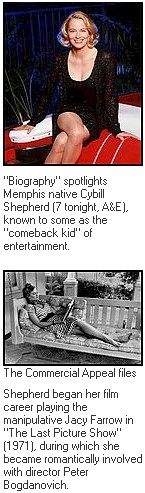 Whatever you think of her - and you won't find a discouraging word
about her anywhere in this program - Cybill Shepherd is show business's
comeback kid.
Whatever you think of her - and you won't find a discouraging word
about her anywhere in this program - Cybill Shepherd is show business's
comeback kid.
Throughout her career, she's come back again and again after numerous people have written her off as finished.
The Memphis native first was finished at a young age, after she appeared in "At Long Last Love" in 1975, when she was 25.
She was living with director Peter Bogdanovich at the time - their
affair began during filming of her first film "The Last Picture Show in
1971 - and Hollywood power types told her she never would work in that
town again.
Bogdanovich says of that time that he and Shepherd were "arrogant."
Shepherd says of that time that the two of them were "obnoxious."
Arrogant and obnoxious could be career-busters for some people. But Shepherd is unusual for her comebacks - and for her candor.
"Cybill doesn't hold back anything," said Tamara Sternoff, associate
producer of this "Biography." "The main thing is how open she is, she's
open about everything. In her book ('Cybill Disobedience') she holds
absolutely nothing back. . . . It's all out there on the table. I think
that is unique for Hollywood actors these days."
Cybill wrote extensively about her prodigious sex life in the book. If
it was R-rated, this biography is, at most, a PG-13. There are a couple
of references that might require some explaining to the average
10-year-old, but how many 10-year-olds want to watch a biography of a
woman who turns 54 next month?
But maybe they will. There's something about Shepherd. Both friend
James Cass Rogers and "Last Picture Show" co-star Jeff Bridges say most
men, once they meet her, fall in love with her.
(Personal note: Not true.)
Most Memphians are well-versed in all things Cybill: The self-described
tomboy up to and through East High School here; her modeling career;
her triumph in "The Last Picture Show" the backlash after that; the
comeback with "Moonlighting" in 1984; her being written off after
reports of bad behavior on the set of that series; her comeback with
"Cybill," the sitcom loosely based on her life; and her most recent
comeback, as Martha Stewart in last year's NBC film "Martha Inc."
Over the years, she's gotten a reputation for being "difficult," at best.
"From every person we talked to, family members, people who've worked
with her over the years, most people just say she stands up for what
she believes in. When people are at odds with her, it's because the
show or her character isn't going in the way she believes is the right
way," said Sternoff.
The documentary does not refer specifically to her love of Memphis, nor
her home here, which is curious, given how she talks up the city.
"I love living on the river, I finally got my dream come true," she
said in an interview last May. "I was always drawn to the river; I just
love it there. I have more fun in Memphis than anyplace."
But we do get to hear her sing snippets of "Talk Memphis to Me," her paean to the city.
Ah, her singing, something she's been doing for decades, in the face of reviews that would stagger other people.
"It's just something she loves to do," Sternoff said. "She's a performer."
In fact, after her interview for this program concluded, she stood up and sang for the show's producer.
There are additional articles on Cybill Shepherd in this section.
UT doctor once saved Capt.'s life
From the Commercial Appeal, January 24, 2004:
By Lawrence Buser
January 24, 2004
Dr. Charles Handorf ['69] has a long list of
professional accomplishments, but to many of his friends, he'll always
be the doctor who once saved Captain Kangaroo.
One old friend called Handorf on Friday to offer his condolences on
Captain Kangaroo's passing, and his wife still occasionally calls him
"my marsupial professor."
It was July 1981. Handorf and his wife, Miriam, had just arrived at the
Toronto International Airport for a conference, when a flight attendant
made an urgent plea for a doctor to help a stricken passenger.
"He was pulseless, and his respiration had stopped," recalled Handorf,
who is chairman of the University of Tennessee pathology department.
"One thing I know is a dead person, and he was a good candidate. He was
in bad shape."
Handorf, who was in his residency then, began performing CPR chest
compressions while two others took turns breathing air into the man's
lungs. Miriam Handorf searched the patient's belongings for any
possible medications and noticed it was Bob Keeshan.
"He was pale and blue, and he wore a toupee so nobody knew who he was,"
she said, adding that emergency procedures went on for some 45 minutes.
"I bent down to do the breathing, but a man said, 'Let me do that.' I
was willing, but someone else got to give him the kiss of life."
After Keeshan was taken to the hospital, the Handorfs heard nothing
from the star's manager or agent, but the couple always felt some
satisfaction when Captain Kangaroo made the news.
"Understandably, they were pretty closed-mouth about the incident and
that's fine, but he's gotten 221/2 years of life after that incident,"
said Handorf, 53, who also is president of Duckworth Pathology Group at
Methodist Hospital. "It's a testimony that everybody ought to know how
to do CPR because you can make such a difference."
Memphis native, U.S. envoy fights anti-Semitism
From the Commercial Appeal, January 24, 2004:
By Lawrence Buser
January 24, 2004
A former East High School standout and career foreign service officer
is linking anti-Semitism to anti-Americanism in his new role as special
State Department envoy for Holocaust Issues.
Ambassador Edward B. O'Donnell Jr. ['64] was nominated by President Bush in October and recently returned from Europe and Israel on a speaking tour.
O'Donnell, 56, went from East High School to Southern Methodist
University and later received a master's degree from American
University.
As a foreign service officer with the U.S. State Department, he has
been posted to Colombia, Paraguay, Panama, Vienna, Berlin and
Frankfurt, as well as to State Department desk jobs in Washington.
In his new duties, he will make efforts to prevent anti-Semitism by
educating the younger generations about the truth of the Holocaust and
the importance of religious tolerance, he said in testimony before the
U.S. Senate Subcommittee on European Affairs.
O'Donnell is the son of former Memphis City Schools teacher and
administrator Ruth O'Donnell of Germantown and the late Edward Baxter
O'Donnell.
Source: The Commercial Appeal
Editor's Note: Eddie O'Donnell was selected as "Best Citizen" by his senior class at East.
Outpour lifts ailing East coach
On preps
January 15, 2004 - from the Commercial Appeal, January 15, 2004:
By Jim Masilak
Relieved and emotionally overwhelmed after undergoing
a successful quadruple heart bypass, East High football coach Wayne
Randall returned home Tuesday.
Randall, 56, was admitted to the hospital Jan. 1
after experiencing chest pain. He was scheduled to undergo surgery on
Jan. 3, but a citywide shortage in the blood supply meant he had to
wait until Jan. 7 before undergoing the procedure to clear blocked
arteries around his heart.
"They split me open like a chicken," said Randall, who is on an
exercise and rehabilitation program and hopes to return to his teaching
and coaching duties at East in mid-to-late February. "Now I've just got
to heal up.
"I don't think I took two sick days since I've been (at East). I had
about six months of sick days built up, so I'll just do what the doctor
says and rehab."
While in the hospital, a stream of family members, friends and
well-wishers came to visit Randall, who has compiled a record of 84-35
in 10 years at East and led the Mustangs to the 1999 Class 4A state
title.
"I had 100 or something there just the first couple days," Randall
said. "People sent cards and had me on prayer lists. Old players and
coaches from everywhere were calling. It was really awesome. It got to
the point where the nurses shut the phones off."
Randall said he also was touched by the efforts of his colleagues at
East, who held blood drives and called local media to underline the
need for blood.
"It was overwhelming," Randall said. "What the people at East did for me, I won't ever forget. It was really something special."
Randall said doctors determined he had experienced no lasting damage to his heart, and that he had not suffered a heart attack.
"I feel very fortunate," he said. "It really is (scary) when you're
sitting there and not knowing, when you're looking at your wife and
family and you don't know if you're gonna wake back up. You think of
all the things you want to say; you give thought to a whole lot of
things."
Of course, Randall's thoughts never strayed far from football. He
expects his period of convalescence will allow him to get a head start
toward next season.
"I'll have time to do some paperwork and look at a lot of tapes," said
Randall, whose young Mustangs squad went 7-4 last season, losing in the
first round of the 4A playoffs.
Floor waits as kids drill to dunk tests
January 15, 2004 - excerpt from the Commercial Appeal, January 15, 2004:
...At East High, one of several schools cited by the
state for low academic performance, players are expected to attend an
after-school ACT tutorial program every Tuesday, Wednesday and Thursday.
"It's really working," East boys basketball coach Reginald Mosby said.
"At 2:30, as soon as they're out of school and they've walked their
girlfriends to their lockers or whatever, they know to turn right
around on Tuesdays, Wednesdays and Thursdays and come straight to the
library."
Mosby said the hour-long tutorial is broken down into three sections: English, science and math.
"If you were high on science and English on the ACT, then we're sending
you back (to the tutorial) to maximize your effort on the math part,
and vice versa," Mosby said.
"Then, after they're done with that, they can go and get dressed and get ready for me to run them."
Mosby begins to boast when talking about whether the program has helped his players so far.
"Robert Jackson, my point guard, made a 24 (on the ACT). Kevin Hughes,
another guard, made a 21. Jerrell (Houston) made a 19 and Cedric Webb,
my center, made a 19," Mosby said.
"Then those kids go back and help kids like Keron Jackson, whose
background in math has been tough, but his English has been good. They
show him pointers on how to get through this thing."
Football coach undergoes heart surgery
January 7, 2004 -
East High football coach Wayne Randall underwent heart bypass surgery
today after becoming ill new year's day.
[January 8, 2004 update - Family members say Randall is
recovering well after the surgery. Lifeblood reports 35 units of blood
were donated at the East High blood drive.]
The surgery was delayed serveral days because Memphis is undergoing a
serious blood shortage and many operations are being postponed until
enough blood is available.
A blood drive was held on the parking lot of East High School today to
help obtain enough O positive blood for Randall and others. Students,
faculty, and others donated blood to help the coach.
As Randall recovered after surgery, his family encouraged the community
to continue donating blood to help the area overcome the shortage.
Randall, who some East pupils call a "father figure," led the East High
Mustangs to the state Class 4A football championship in 1999 and
coached a team in the AXA Liberty Bowl High School All-Star Football
Game in December. He complied a 7 win, 4 loss season this past autumn.
Sources: WREG-TV, TSSAA, The Commercial Appeal
East junior going places on field, in classroom
October 18, 2003 - from the Commercial Appeal, October 17, 2003:
By Jim Masilak
On the day Charlotte Hill received her master's in
operations management from the University of Arkansas, she walked into
a reception for honorees on the Fayetteville campus.
She was bemused and touched by what she saw.
There were all the other graduates and their
families, gathered in a circle around the huge teenager with the
charismatic smile.
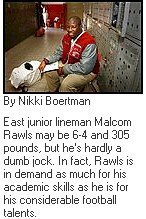 It was Charlotte's son, Malcom Rawls - all 6-4, 305 pounds of him.
"He was the tallest thing in the room," Hill said.
"Everyone was gathered around him. I was like, 'Hey, I'm the one with
the master's.' It was my day, and he stole the whole show."
It seems everyone wants a piece of Rawls, the
multitalented junior from East High School whose dreams alternate
between playing in the NFL and being a computer engineer.
Rawls visits the city's elementary and middle schools
to extol the virtues of an East education. He has been invited to an
MIT seminar. Next week, he'll have dinner with an admissions officer
from New Hampshire's Phillips Exeter Academy.
That's what happens when you have a 4.6 grade-point
average in an optional engineering program and can steamroll opposing
linemen.
"Too many times you get that great kid who isn't
doing it in the classroom," East coach Wayne Randall said. "(Malcom's)
what you dream of as a coach. He's a young man we're awfully, awfully
proud of."
And why not?
Rawls has received scholarship offers from at least
two of the nation's premier prep schools, and he receives regular
correspondence from "all the Ivy League schools and MIT."
And, during his sophomore year, both Arkansas and Mississippi State made verbal football scholarship offers.
"That's very rare," Randall said.
So it's something of a wonder Rawls has remained at East. After all, he has had plenty of chances to leave.
Education first
Rawls's knack for schoolwork was obvious long before he made his first forays into organized football.
As a fifth grader living in Grenada, Miss., he was asked to skip two grades. His mother politely declined.
As a seventh-grader, he began taking high-school
level courses. And, as part of Duke University's Talent Identification
Program, Rawls took the ACT exam.
He scored a 22.
"They always say offensive linemen are the smartest guys on the field," says Rawls, flashing his easy smile.
But it wasn't until eighth grade that Rawls was allowed to play football.
"I was focused just on academics," said Hill, a
single mother who worked a series of odd jobs, often two at a time,
while going to school. "I didn't know anything about football until he
started playing. I thought it was just a whim.
"But he came back and said he wanted to do it. I've
gotten the hang of it now, too - except for some of the calls the
referees make."
Rawls, meanwhile, showed an aptitude for football similar to that for his studies.
"He's blessed with great size, and he's an extremely
hard worker," Randall said. "He's a lock for the next level, but his
best football is still to come."
However, Hill notes, her son is far from perfect.
"He's still a typical young man, and it's an ongoing
fight with his room," she said. "That's a battle I'm not going to win."
By his mother's estimation, Rawls has spent every
summer since the sixth grade in some sort of academic program.
"Those are his breaks," Hill said. "I've always stressed reading and learning."
Last year, he attended a program at Wentworth Military Academy in Lexington, Mo.
"That's where he developed his charisma," Hill said.
"After that, I could look at him and say, 'You've changed. You've
blossomed.' "
East by Northeast
Last summer, Rawls gained admission to the
prestigious (MS)2, or Math and Science for Minority Students Program,
at Andover, a prep school near Boston.
"It was very tough. I'd always wanted to try a prep
school. It does broaden your horizons," said Rawls, who will return to
Andover next summer to complete the program.
However, he had to fight some stereotypes while there.
"They saw me and said, 'Wow. How did you get in?'
They looked at me and they didn't see the smart guy. They saw a big,
dumb jock. Once they got to know me, they saw I was pretty smart."
Rawls also felt he had a responsibility to his school to do well at Andover.
"They say Memphis students are behind. I didn't want my performance to affect other people's chances."
While at Andover, another prep school targeted Rawls.
Phillips Exeter Academy, based in Exeter, N.H.,
aggressively pursued Rawls for his football and academic talent. Exeter
offered a full scholarship worth some $30,000 a year.
But Rawls, who wants to play high-level football at a
college with high-level academics, declined - at least for now.
Some might wonder how he could turn down a school like Exeter to remain at East.
For one thing, Randall said, Exeter wanted Rawls to
repeat the 10th grade "because he came from a city system that,
according to them, had problems." But doing so would have made Rawls
ineligible to play football as a senior.
Then there was his mother.
"I was working two jobs at a time, and I just
finished school," Hill said. "Now was the only time I'd have to spend
with him before he goes on to his own life.
"He said, 'It's a good opportunity, but I'm sure of myself. I'm gonna be at the top wherever I'm at.' "
Rawls simply felt he could thrive as much at East as at Exeter.
"We still have students who can perform with any in
the country," he said. "We don't have the reputation, but the talent is
here."
Still, Rawls could yet end up at Andover or Exeter on
a full-time basis next year. Both schools have kept up regular contact.
For now, Rawls is content going to school at East and
suiting up for the Mustangs, who face Melrose on Saturday night at 7 at
Fairgrounds Stadium.
Though he missed most of summer practice while at
Andover, Rawls again showed his commitment to school and football upon
his return to East.
"When I came back, the coaches gave me a test to see if I could remember all the plays," Rawls said.
And how did he fare?
"Oh, I aced it."
Parents sue city schools, claim East mold caused son's asthma death
October 16, 2003 - from the Commercial Appeal, October 15, 2003:
By Ruma Banerji Kumar
A Memphis couple avenging the loss of their
17-year-old son are suing the Memphis City Schools for not warning them
of mold infestation at East High School.
Mold aggravated their son's asthma and caused his death, Donald Mister
Sr. and Leslie Mister allege in a wrongful death lawsuit that seeks
$250,000 in damages from Memphis City Schools.
The Misters are also seeking $4.5 million in
compensation and punitive damages from ServiceMaster, the company under
contract to keep East High School clean.
Their son, Donald Criss Mister, died Nov. 16 after
complaining he couldn't breathe and that his sides hurt. He woke his
father and stepmother at about 3 a.m., gasping for air and praying. He
died at Methodist Healthcare-University Hospital later that morning.
"His death was an agonizing death," reads the
lawsuit, which was filed last week. "His parents sat by and watched him
die, unable to help him."
The family's attorney, Glenwood Roane, said he has advised the family not to speak to the press.
"The family is still trying very hard to cope with this and get through this," Roane said.
Memphis City Schools attorney Percy Harvey said the district will challenge the lawsuit.
"We don't think we're at fault in this situation, obviously," Harvey said.
ServiceMaster officials did not return calls for comment.
Criss Mister, diagnosed with asthma at age 2, was an
ambitious and active senior at East High, involved in student
government and other groups that kept him after school for hours,
according to the suit.
His death last November sparked several weeks of controversy over mold
and environmental concerns at the urban school district's aging schools.
Parents and students rallied in front of the school.
School board member Michael Hooks Jr. moved his office to East to
assure an angry community that the 55-year-old school was safe, but
demonstrations continued.
Ultimately, a study of the school's environment resulted in its gymnasium being closed.
Scientific evidence of mold's effects on asthma and
whether it can lead to death is spotty and largely unconfirmed,
officials at the Centers for Disease Control and Prevention in Atlanta
said Tuesday.
"We have not found any direct link to say mold has an effect on asthma," CDC spokesman Bernadette Burden said.
"There's a diversity of opinions on mold and its health effects," she said.
But the center's most recent studies, Burden says,
have shown only that mold can cause symptoms like nasal stuffiness, eye
irritation or wheezing - and in more severe instances, shortness of
breath and fever.
East student finds required tests ridiculously easy
November 16, 2003 - from the Commercial Appeal, September 11, 2003:
In my opinion: One student's view
September 21, 2003
Charlisse Brooks, 16, is an 11th grade student at
East High School and a member of The Commercial Appeal's Teen Appeal
staff. She is part of the first class of Tennessee public school
students who are required to pass three Gateway exit exams before
receiving their high school diplomas.
We asked Brooks to write about her experience taking
the tests in algebra I, English II and biology, and her opinion of
whether the tests are a useful tool to measure student achievement.
I found the algebra I, English II and biology Gateway tests ridiculously easy.
I took the algebra I test while I was in the 9th
grade and made a 41, which was considered proficient on the test's
scoring scale of "not proficient," "proficient" or "advanced." The
simple questions on the test and the easy calculations it required made
me feel like a genius.
In the 10th grade, I scored 42 - also proficient - on
the English II exam and 44 - considered advanced - on the biology test.
Those two tests were a little harder; they made me take the information
I'd learned in school and apply it to different situations.
I believe tests such as the Gateway exams should be a
requirement to graduate from high school. Some students are not trying
to do their schoolwork and are failing. Standardized tests such as
these force them to learn to study for a test and then pass it. That's
not too much to ask before a student graduates from high school and
goes on to college.
It's absurd that some juniors and seniors in the
Memphis schools can't pass the Gateway exams. I think the reasons for
that vary.
The school board and school administrators are
sometimes to blame for not assuring that the content of the tests is
taught consistently. Teachers may not always do their job to help
students prepare for the tests, and some parents don't support their
children as they should.
But when students fail the tests, it's mostly their
own fault for not pushing themselves to study. They're the ones who
should be making the effort to get the job done
'62 Alumnus inducted into Memphis Amateur Sports Hall of Fame
posted February 24, 2004- from The Commercial Appeal, September 10, 2003:
Hall of fame fund-raiser Saturday
By The Commercial Appeal
September 10, 2003
The 2003 Annual Lloyd Sowell Memorial Golf Tournament
will be held at the Links at Fox Meadows on Saturday. This tournament
is the major fund-raiser for the Memphis Amateur Sports Hall of Fame,
with funds helping defray the cost of awards, decorations, and
photography at the annual banquet.
Last year's inductees were: Harold J. Swanton,
basketball; Walt Exline, team sponsor; James T. 'Jimmy' Coopwood and
Bill H. 'Doc' Richardson in men's fast-pitch softball; Glen W.Stewart Jr. ('62),
and Francis 'Frank' Chiozza in men's slow-pitch softball; Odessa
Dickens Hayes and Jimmy Wittenberg Sr., in golf; Kenny Alsup, Morris R.
'Rye' Ridblatt and C.B. 'Cob'Smith in boxing; Terry Fluker in youth
team manager/coach; Lowell Bobbitt in football; Howard Moore in adult
team manager/coach; Joellen Narrow Bland and Carolyn McGill Meton in
women's fast-pitch softball; Dana R. 'Ricky' Robbins and Ed Williams as
game
officials; Merrill D. Dan and Rev. Teddy Steele in baseball; Harold C.
Bottenfield
(posthumously), Paul Fultz and Louise George in tennis.
For more information about the golf tournament or the Hall of Fame, contact Larry Hilbun at
382-4727.
High Failure Rates at East High Middle School
August, 11, 2003 -
Statistics from the 2002-03 school year show large percentages of East
High's 7th and 8th graders failing to be promoted to the next grade
level.
An article in The Commercial Appeal cites
other Memphis schools with similar problems. The statistical review
apparently is new -- education officials say they do not know how to
interpret and/or properly analyze the figures.
It is suggested by others quoted in the article that
the ending of social promotion has resulted in similar failure rates in
other school districts. The Memphis City School system has policies to
end social promotion.
Some quotes from the article:
Indeed, 91 of the
school's 200 eighth-graders failed, and all but 18 of them were in
summer school, trying to pass tests to be promoted to ninth grade.
The 18 must repeat the eighth grade because they failed two or more subjects.
Roughly 30 percent, or 63 of 149 East
seventh-graders, also failed this year. But the numbers showed that
East wasn't an outlier.
Source: The Commercial Appeal, August 11, 2003
Storm Rips East's Trees From Ground -- Damages Gym Roof
July 30, 2003 - A severe
thunderstorm moved through Memphis about 7 a.m. Tuesday, July 22, 2003,
ripping trees from the ground, snapping others' trunks, and damaging
the newly repaired roof on the East High gymnasium. Damage was also observed to the electronic message sign in East's front yard.
The damage will cause East the loss of a number of
trees that must have been approaching the age of 100 if not exceeding
it. While it is difficult to tell, it appears some of the trees are
likely shown in photographs during the construction of East High, in
the late 1940's, as being large, mature trees.
Summer school classes were called off for at least a
couple of days at East and other Memphis schools due to the damage and
wide spread power outages. After the storm, an estimated 307,000
electric power customers were without service which is about
three-fourths of all the customers served by the Memphis Light, Gas,
and Water Division. Eight days later, tens of thousands of customers
are still without electric power. The storm damaged trees, businesses,
homes, and traffic lights all over the Memphis area. It is likely that
the homes of several East alumni or their parents were damaged by
falling trees.
Several of the very large oak trees on the front
lawn of East High School were toppled over, their root systems ripped
from the ground and standing 15-20 feet in diameter on the school
grounds. Smaller trees were also broken. Utility poles along Poplar
Avenue in front of the school were snapped in two, and electrical lines
were down across the street in front of the Krystal restaurant.
The top half of one window at East was missing,
apparently blown out by the storm. Across the street in the strip
shopping center, several second floor windows and part of the wall were
blown out, fully exposing at least one office.
The trees at East High were prominently mentioned and
shown on television video in Memphis as an example of the damage the
storm caused. As several reporters said at the time, it is fortunate
the trees were not close to the building or much more damage to East
would have occurred.
Casual observation from the ground failed to reveal
the extent of the damage to the roof of the East High gymnasium. The
newspaper indicated the damage was substantial.
A slide show is available for a limited time of a few other pictures taken shortly after the storm.
Source: The East High Alumni Page
Divorce papers filed for Fordice, second wife
from the Associated Press, June 10, 2003:
JACKSON, Miss. (AP) - Former Gov. Kirk Fordice is going through his second divorce in four years, records show.
 A
television station in Jackson obtained an 11-page divorce filing from
the Madison County chancery clerk's office Monday. Fordice and his
second wife, the former Ann G. Creson of Memphis, had been married
since Feb. 26, 2000, a few weeks after he left office and shortly after
his first divorce was completed.
A
television station in Jackson obtained an 11-page divorce filing from
the Madison County chancery clerk's office Monday. Fordice and his
second wife, the former Ann G. Creson of Memphis, had been married
since Feb. 26, 2000, a few weeks after he left office and shortly after
his first divorce was completed.
Contacted by telephone Monday, an angry Fordice, 69,
told an Associated Press reporter that he had just sent a television
news crew away from his home.
"I just ran a scum out of my front door with no business being here," he said.
"You know and I know that's absolutely none of your
business, none of AP's business, none of WLBT's business. That's the
end of it. None of your business," Fordice said before hanging up.
Fordice and his first wife, Pat, had a
well-publicized split that ended in a divorce that was completed after
he left office. He had been photographed returning from France with
Creson while he was still married. He later said Creson, a widow, had
been his childhood sweetheart.
Divorce papers citing irreconcilable differences were
filed Monday in Madison County Chancery Court. The papers said Kirk and
Ann Fordice had been separated since November, and that he was living
in Madison and she was living in Memphis.
Fordice served two terms as governor of Mississippi
from 1992-2000. He was the state's first Republican governor since
Reconstruction.
Before he wrecked his state-leased vehicle in
November 1996, Fordice had been spotted holding hands with a
blonde-haired woman during lunch in Germantown. He later acknowledged
she was Creson.
Divorce papers said Kirk and Ann Fordice have and
will keep separate estates. There were no claims for alimony.
Kirk Fordice will keep a condominium he owns in Gulf
Shores, Ala., and she will be able to use it two weeks a year.
There are additional articles about Kirk Fordice below.
Area high school valedictorians
from the Commercial Appeal, June 5, 2003:
RICTRELL LeMOND PIRTLE
EAST HIGH SCHOOL
|

|
Pirtle, 18, is the son of Deborah Roberts and Rickey Pirtle of Memphis.
- School activities: Yearbook editor as freshman; Health
Occupations Students of America - three years; National Honor Society;
Biomedical Debate Team
- Honors: William H. Sweet Award; Daughters of the American
Revolution Good Citizen Award; Volunteer Memphis Spirit of Giving
Award; Taft School Summer Academy participant; Louis Bendersky
Volunteer of the Year Award
- Extracurricular activities: United Cerebral Palsy; March of Dimes; Avon-Lennox School; Toys for Tots
- College/postgraduation plans: Dartmouth College, chemistry
East Success Story Featured in Local Newspaper
May 25, 2003 - The Commercial Appeal,
the major daily newspaper in Memphis, featured a 2003 East High
graduate,Cherelle Walls, in an article today about those who succeed
desipite being in low performing schools. The newspaper describes East
as "one of the city's worst high schools," but points out how a
motivated student can overcome such situations. The article reports
that "she's proof that the big achievers aren't just in isolated,
academically elite spots such as White Station High." Walls scored a 31
out of a maximum possible 36 on the SAT college entrance examination
and has "been accepted at nearly every school in the Ivy League."
The article can be found at The Commercial Appeal web site.
[Editor's note: the full article will likely be posted here in the coming days.]
New East Principal Named
May 24, 2003 -  The
Memphis City School system yesterday named Babara Galloway Hines to be
the new principal of East High School effective June 23, 2003.
The
Memphis City School system yesterday named Babara Galloway Hines to be
the new principal of East High School effective June 23, 2003.
Hines is currently a principal with the Allen
Independent School District in Allen, Texas. She has been there for two
years. According to information posted on the Allen school district's
web site, she previously served as principal at elementary and middle
schools in Illinois.
Hines has been employed in the educational field for
28 years and before becoming an administrator taught high school
english, speech, theatre and physical education. She also coached girls
athletics.
Hines is believed to be the first woman ever named to
be principal of the high school side of East, although when an
elementary school was colocated with older students a woman was
principal of that group.
Source: WMC-TV, The Commercial Appeal, Allen Independent School District web site.
Majority of 8th Grade May Be Failing
May 24, 2003 - Local television news and The Commercial Appeal
have reported that administrative sources at East High School have
indicated that as many as 65 percent of the 8th grade class may fail.
According to reports, the president of the Memphis PTA has told the
school board that 125 of the 200 pupils in the 8th grade will not be
promoted. The newspaper reports that a spokesperson for the school
initially confirmed that 128 of the children were in jeoprady of
failing but later refused to provide any guidance on the situation
saying that to make such judgements would be premature until after
final examinations.
Published reportes indicate that school board members and parents of
East pupils are seeking information but that the school has not
provided any further information to them.
Exit the Annex
April 12, 2003 - Fifty-two
years and two weeks. Those are the numbers. The Annex at East High
School stood for 52 years and took about 2 weeks to be torn down and
the debris removed.
The demise of the Annex was sealed when East High underwent a health
scare in late 2002 related to mold found in several parts of the
building. Prior to that, there had been discussion of renovating the
Annex, as well as other parts of the school. But when mold was found in
the Annex, the city school system quickly made the decision not to
spend money cleaning it up but to tear it down. Specialists were
brought in to oversee the cleaning of other parts of the building.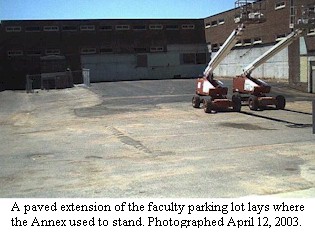
The Annex was the product of East High's early success. Crowding of
academically superior schools "out east" is nothing new. It happened on
the day East High opened in September, 1948. If one reviews the
original design capacity before the school was built one will find that
the facility was to be designed for 1,500 pupils. By the time it
opened, demand was so large that it was announced that it could hold
2,000. Still, there wasn't enough room for long. In 1951, the Annex was
built. It contained 9 classroom and restrooms for boys and girls. It
cost $91,786 to build.
The Annex has been described as a "tin roofed" structure. In reality,
the roof was most likely a combination of steel, asphalt, and glass.
Most rooms had large skylights but no windows. Large fans provided
ventilation to the hallway. It was a hot place to attend summer school.
For much of its time in use by pupils, the Annex housed junior high
classes. For those coming to East for the first time in the 7th grade,
it was the first place at the school with which they became acquainted.
For those who attended East Elementary (East used to be a 12 year
school with the elementary classes held in the east wing of the
building), the Annex was their first experience of what high school,
and impending adulthood, was to be.
The Annex was closed to students in the mid 1980's. In recent years it
had been used for storage and for offices for building engineers.
Then in March, 2003, the cranes and bulldozers came and a couple of
weeks later an extension to the faculty parking lot was all that
remained.
Many remember the Annex with criticism because it was of lesser quality
than the remainder of the school building. Others remember it fondly.
Many remember it both ways. Regardless of how one remembers it, the
East High School Annex may be gone, but it will never be forgotten by
those who attended classes there.
Source: The East High Alumni Page
East Girls Track Standout Becomes College Coach
February 12, 2003 - Rena Tate ('98) has been named as the track and field assistant coach at Arkansas State University. She will focus on working with sprinters.
"I am very, very excited," said Tate.
"It is my first job out of school and I have lots of ideas and
visions for ASU's  sprinters. I feel like a kid at Christmas. It will be exciting to switch shoes from athlete to coach."
After graduating from East, Tate attended University
of Southern Mississippi and received bachelor's a degree in
Coaching and Sports Administration in December 2002. She earned a
letter each of her four years at USM in track and field and ran a leg
on the school's 1999 4x100-meter relay school record team. Tate
also competed in the 100-meter dash, 200-meter dash, and in the
4x400-meter relay.
"We are very proud to have Rena as a member of
our coaching staff," said head coach Jay Flanagan. "Her
background in high school and on the collegiate level is one that
should allow her to utilize the information given to her."
While she was attending East, Tate finished 14th in
the Boston National Scholastic Indoor Championships in 1998. Her high
school personal-best time in the 100 meter race was 11.6 seconds.
Sources: Arkansas State University, University of Southern Mississippi
Medical Expert Says It's Safe At East
posted December 18, 2002, from the Commercial Appeal, December 18, 2002:
Forget fungus, it's safe to mold minds at East, expert says
By Aimee Edmondson
December 18, 2002
An environmental expert hired
by Memphis City Schools is calling for East High parents to rest easy
about sending their kids to the school.
Joseph Jarvis of the University of Nevada School of
Medicine in Reno told school district leaders, East parents and local
health officials Tuesday that it's safe to hold classes there.
"I would send my children to that school," Jarvis
said after touring the building and reviewing new reports from an
environmental company hired by the school district.
The school was turned on its ear last month when
protesting students and parents marched on the grounds, demanding that
school district leaders address East's mold problem. The 48-year-old
building on Poplar in East Memphis is partly underground and has needed
repairs for years.
Students complained of respiratory problems and concern grew after the death of a senior who had asthma.
The district has been working on the moisture problem for weeks and paid for schoolwide medical screenings.
Yet East parents called for the school to be closed
for a cleanup, though initial environmental tests showed the school to
be safe.
Supt. Johnnie B. Watson said he'd spend whatever was
necessary to clean up the mold and ensure safety. School officials
estimate that the district will spend hundreds of thousands of dollars,
but couldn't provide exact figures. They also haven't determined what
part of the budget they'll look to cut to make up the gap.
East's problems will help the district be prepared
should the mold problem come up at any of the district's other 175
schools, Watson said.
Jarvis said the term "toxic mold" doesn't apply to
East, though the term has gained widespread use among the news media
and East parents.
"It isn't true. 'Toxic mold' isn't the way we ought
to talk about this," Jarvis said "It's extremely rare for such molds to
cause serious disease."
Mold can trigger allergic reactions and headaches,
but most people aren't affected by it, said Jarvis, an expert on "sick
building syndrome."
And when the mold is cleaned up, Jarvis said, the symptoms go away with no long-term problems.
School maintenance crews will replace decayed wood and wipe down all surfaces over the winter break.
After hearing Jarvis's presentation, East High parent
representative Zorina Bowen maintained that the district did too
little, too late.
"He got here after they cleaned up for company," Bowen said.
See related stories below.
East High tests find little mold problem, school board is told
posted December 18, 2002, from the Commercial Appeal, December 17, 2002:
East High tests find little mold problem, school board is told
By Tom Charlier
December 17, 2002
Although numerous moisture and ventilation
problems turned up, exhaustive tests at East High School uncovered few
areas where mold levels posed a significant threat, Memphis city school
board members were told Monday night.
Of the 176 rooms and areas studied in the 54-year-old
school, only four had contamination problems that warrant being sealed
for specialized cleaning and further investigation, said Michael J.
Donohoe, director of environmental services for Pickering Environmental
Consultants Inc.
That work, along with less-intensive cleanup efforts recommended by
Pickering, will be conducted "with dispatch" over the holiday break,
Supt. Johnnie B. Watson said.
The firm's assessment represents the latest development in an issue
that arose seven weeks ago when the board heard complaints from East
parents about water-seepage problems and faculty members and students
becoming ill.
Mold, which is pervasive in the environment, can trigger allergic
reactions and a variety of respiratory problems in sensitive
individuals.
The concerns at East, which were fanned by the mid-November death of a
17-year-old senior who had a history of asthma, prompted protests by
students and parents and calls for the temporary closing of the
facility so it could be cleaned up.
Board member Sara Lewis reported that the first lawsuits have been filed regarding the mold issue.
But Donohoe said the testing, which involved taking 412 samples, turned up no evidence that the school should be closed.
"Nothing we saw indicated the need to change the status of East High School," Donohoe said.
The one new area identified as having mold dangers and now closed - the
auditorium - was the subject of some controversy at the meeting.
School board president Michael Hooks Jr., who had temporarily moved his
office to East, expressed dismay that administrators previously hadn't
closed the auditorium despite recommendations three weeks ago. He said
the water problems there were obvious.
"There was a reluctance to close the auditorium even though water was
visible literally flowing down from the ceiling to the ground and
rotted wood trim," Hooks said.
Watson responded that the auditorium wasn't closed earlier because he
lacked the "scientific information" on which to base that decision.
In addition to mold, the Pickering firm reported that in several
classrooms, temperatures or humidity levels were outside typical
"comfort zones."
In at least a few rooms, the carbon dioxide levels were too high, indicating poor ventilation, Donohoe said.
These indoor air problems aren't a serious threat,
Donohoe said, but they can cause headaches, congestion and other
problems.
See related stories below.
Environmental Firm Reports on East High Mold Problem
December 17, 2002 - A
consultant reported last night to the Board of Education that a new
survey of mold problems at East High found 4 rooms with mold problems
significant enough to close the rooms pending cleanup. The auditorium,
the weight room, the health room, and a teachers' restroom were
closed as a result. The restroom has undergone special cleaning and has
been reopened. The other rooms are scheduled to undergo the special
cleaning begining December 20.
Source: The East High Alumni Page
See related stories below.
Tour of East High eases mold fears a bit
posted November 27, 2002, from the Commercial Appeal, November 26, 2002:
Tour of East High eases mold fears a bit
By Tom Charlier
November 26, 2002
From a darkened tunnel to an
upstairs classroom, teams of school officials, health experts and
parents toured East High School Monday amid signs that fears about mold
contamination were fading.
Absenteeism at the 1,558-student school was down significantly from
last week. Only 227 students missed classes, compared with 481 six days
ago.
And a contractor reported preliminary findings indicating that out of
51 classrooms checked so far, evidence of possible mold growth was seen
in only four spots. Sampling of all 150-160 rooms at East is expected
to be finished today, with final laboratory results ready by Dec. 13.
"We're not finding much evidence of physical mold growth," said Michael Donohoe of Pickering Environmental Consultants.
Donohoe's assessment came as representatives from a half-dozen state,
federal and local agencies met with Memphis City Schools officials to
discuss East's mold problem, which came to light last month when a
parent complained to the school board.
The agency officials, along with parents and school officials, toured
portions of East where mold and other air-quality complaints had been
registered.
Although water leaks and seepage problems were seen, the officials said they found nothing to indicate the school was unsafe.
"We saw nothing that would call for an emergency," said Henry Slack,
who works with the U.S. Environmental Protection Agency's indoor air
program.
James Stephens, a parent who had helped call attention to the mold
problems, said the tour left him satisfied officials are correcting the
contamination.
"There's a lot of work to be done," Stephens said. "I'm convinced they're making progress and they're going to take care of it."
Donohoe said air samples will be taken in each room and tests involving
petri dish cultures will be done. Also, swab samples and tape samples
will be taken where possible mold growth is seen.
"The school wants to be in the position to be able to tell students and
parents and faculty that every room has been checked," Donohoe said.
Mold, which is pervasive in the natural environment, can cause allergic
reactions and breathing disorders when spores multiply rapidly indoors.
At East, classrooms in the west wing of the ground floor were cleaned
up after mold levels far exceeding outdoor concentrations were found.
Health officials conducted medical screenings of students to check for
possible mold-related ailments. More than 100 will be referred for
further treatment.
A 17-year-old East senior who had a history of asthma died earlier this month, although no link to the mold has been determined.
The classrooms remain closed, as does a building annex that had been
used for storage. The annex will be torn down. EPA officials and
representatives from the federal Centers for Disease Control and
Prevention are advising school officials on the mold issue.
Clive Brown, a medical epidemiologist with CDC, said there are no
federal standards for mold concentrations because individual tolerances
vary greatly.
"Even when the results are in, we may not be able to say for certain
whether these molds were responsible for health problems," Brown said.
See related stories below.
Board members: Annnex Likely Will Have to be Demolished
November 22, 2002 - The
annex of East High School will likely have to be torn down to remedy
the mold problem it has, some city school board members say.
The annex and several classrooms in the main building have been closed
to students, staff, and faculty for several days after possibly toxic
black mold was found in them. The rooms in the main part of the
original building have been cleaned and tests indicate the air quality
in them is acceptable. However, further tests of the whole school are
being conducted starting today. School system officials say the mold
has grown inside the school because of leaks and undone or incomplete
maintenance.
Bids were taken for the construction of the 9-classroom Annex in 1951
as capacity at the then 3-year old school was quickly outgrown by the
baby boom and the growing east Memphis area. The addition was built for
under $92,000. It was closed to classes sometime in the 1984 to 1986
time period. It was rumored to be headed for demolition in the
following years. Then in the mid to late 1990's there were plans to
renovate it. East is scheduled for a 14-17 million dollar renovation in
the next few years but it is not immediately known by The East High
Alumni Page if the Annex was to be renovated during that construction
project.
In recent years the Annex has been used for storage, including text book storage, and for offices for building engineers.
Now with the mold problem and state of disrepair of the Annex, board members suspect it will be targeted for destruction.
Source: WMC-TV, The East High Alumni Page
See related stories below.
Editorial 11/21: Shed more light, less heat, at East High
From the Commercial AppealNovember 21, 2002:
IS EAST HIGH School safe for its 1,550
pupils to attend?
Objective studies of air quality and other environmental conditions at
the school have concluded the answer is yes. But that hasn't stopped a
large contingent of East High parents and pupils, backed by several
Memphis Board of Education members, from boycotting classes over
reports of mold contamination in the building.
The sincerely expressed concerns of parents for the health of their
children demand respect. A public consensus on the true state of East
High's safety, though, will demand more light and a lot less heat. That
isn't likely to occur as long as some parties to the controversy appear
more intent on posturing before TV cameras than on talking to each
other.
And counseling students to skip classes - at a school that remains on
state-imposed probation because of low test scores and a high dropout
rate - seems a strange way for adults to promote the welfare of young
people. Nearly 500 East High pupils were absent on Wednesday.
District officials have acknowledged elevated levels of mold in parts
of East High. After complaints emerged at a school board meeting last
month, officials closed several classrooms and restricted access to an
annex.
The district began medical screenings of East High students last week.
Some parents have characterized the school as a "mold-infested hazard"
that has made their children sick with breathing problems, skin rashes
and related ailments. But a report to the district this week by an
outside environmental consultant concluded the mold did not pose a
general health threat.
Three East Tennessee schools have closed, at least temporarily, this
year because of mold problems. Similar conditions have led to school
closings and litigation in several other states. It's hard to imagine
that Memphis school officials would knowingly place children in a toxic
environment - if not out of altruism, then at least out of fears of
legal liability.
But the weekend death of an East High student after an asthma attack
heightened apprehension among parents. No link has been established
between that death and conditions at the school.
At an emergency school board meeting on Wednesday, Schools Supt.
Johnnie Watson and several board members appropriately appealed for
calm, restraint and mutual respect in lieu of hysteria, even as the
board directed Watson to accelerate the district's investigation and
cleanup efforts. Board member Patrice Jordan Robinson has continued to
send her son to classes at East High.
Board members Sara Lewis and Wanda Halbert, however, used the dispute
as an occasion to resume their campaign against Watson. Whatever that
was intended to accomplish, it won't hasten a solution to East High's
problems.
In retrospect, district officials might have been more forthcoming in
their response to parental concerns, even those that were seemingly
overblown. As board members generally defended the superintendent, the
board unanimously approved a resolution that claimed the district's
handling of the matter had created a "crisis of confidence."
But the controversy still requires perspective. As nearly a third of
East High's student body skipped classes on Wednesday, a statewide
"report card" noted continuing academic deficiencies at the school,
including poor performance on standardized tests and a dropout rate
that amounts to one of every four pupils.
East High parents, and their grandstanding advocates on the school
board, need to devote more attention to that school emergency. Hundreds
of parents have attended meetings to decry the district's response to
the mold problem. How many of them plan to show up for the school's
next Parents Night?
See related stories below.
School Day Begins Without Protest
November 21, 2002 -
Parents who last night said they would continue the protest this
morning regarding their doubts of air quality safety at East High
School apparently did not do so at the beginning of the school day.
According to broadcast news reports, "no one showed up."
Source: WMC-TV
See related stories below.
Assurances Based on "Science" Fail to Satsify Parents and Students
November 20, 2002 - The
Memphis School Board met at noon today for a special called meeting to
discuss the problems of mold at East High School and the parent and
student protests.
 The School
Board auditorium was nearly filled with students and parents, however,
most of those in attendance appeared to be school age. At the urging of
some parents, hundreds of students refused to enter the school today
and remained on the school grounds as classes began in protest of what
they say are health dangers caused by mold in the school.
The School
Board auditorium was nearly filled with students and parents, however,
most of those in attendance appeared to be school age. At the urging of
some parents, hundreds of students refused to enter the school today
and remained on the school grounds as classes began in protest of what
they say are health dangers caused by mold in the school.
During the meeting, which lasted a little more than one hour,
Superintendent Johnnie B. Watson reported that a follow up inspection
by National Econ Corporation showed that there was no poor air
filtration and that mold spores were not greater in the tested areas of
the building as compared to the outside air. Watson also reported that
the follow up showed that "the cleanup of the original rooms has
adequately addressed the air quality problem, and the remaining rooms
are safe for classroom  use. The superintendent also announced that a second environmental
testing firm has been hired to conduct a complete test of the entire
building of East High School.
use. The superintendent also announced that a second environmental
testing firm has been hired to conduct a complete test of the entire
building of East High School.
Also handed out to the audience was a copy of the report, made public
earlier, in which the National Econ firm had determined that on dates
of testing of November 15 and 18, air samples collected in the selected
areas in East High did not exhibit poor air filtration or greater mold
spore presence compared with outside air. The report also indicated
that rooms in which a problem was detected earlier no longer had any
visible mold growth.
One Board member inquired about any need to close East High for the
rest of the week. Superintendent Watson responded that based on all
scientific evidence available, there was not a continuing problem with
the air quality within East High. The board member, Carl Johnson, said
he had a motion prepared but based on the information provided by the
superintendent, he would not offer it. Several in the crowed booed.
Despite the assurances from Watson, many in the audience and some Board
members appeared unconvinced of the safety of the air within East High.
Board members Sara Lewis and Wanda Halbert were critical of Watson.
Lewis said that she went to East High only to find a classroom
considered contaminated being occupied by students and a teacher after
the time the school administration said the room was not being used.
Lewis went on to say that parents and children could also tell the
Board that 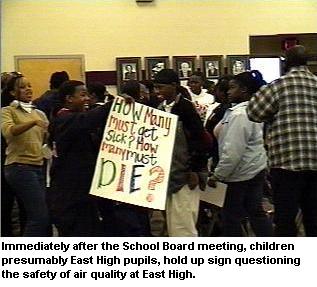 the
room was still in use at that time and that someone was lying. She left
little doubt that she did not believe the time line the superintendent
and school staff presented which, she said, indicated the room was
vacant at the time of her visit.
the
room was still in use at that time and that someone was lying. She left
little doubt that she did not believe the time line the superintendent
and school staff presented which, she said, indicated the room was
vacant at the time of her visit.
Parents and students seemed mostly dissatisfied. After Lewis moved to
adjourn the meeting, parents began shouting wanting to know if the
school would be closed tomorrow. Many stayed around for a considerable
time after the meeting talking with each other, the media, and school
board members. Several adults called for parents to keep their children
out of East. At least one was heard to imply a threat to Superintendent
Watson, saying he didn't need to resign, he needed "to come
to the hood without his bodyguards."
One member of the audience called for parents to meet at the Central
library, near East High, at 6 o'clock tonight to
"resolve" the matter.
Source: The East High Alumni Page.
Additional and extensive coverage is
expected from the mass media in Memphis and for further reports on the
school board meeting, interested parties are invited to give those
attention.
See related stories below.
Mold Alarms: Protest at East, School Board Meets at Noon
November 20, 2002 - Hundreds of students led by parents refused to go to classes at East High School this morning and gathered on the grounds of the school instead.
Parents called for the protest last night at a PTSA meeting saying they
feared for the health of their children who attended East because of
the black mold that has been found in part of the school.
The city school board has called a special meeting for noon today to discuss the mold issues at East High.
While most of the students appeared to remain on the school grounds, at
least initially, small groups wandered off campus, and some then
returned, as time passed.
Five classrooms, and the annex, a storage area which also contained the
offices for building engineers but has not been used for classes in
many years, were found to have black mold and closed while cleaning
worked to disinfect the affected areas.
A air quality study earlier in the month had shown a problem in the
areas that have been closed and reported that respiratory infections
and asthma might be aggrivated in sensitive individuals by presence of
the mold. The rest of the school was found not to have the problem,
according to the study.
A 17-year old student, Criss Mister, died early Saturday morning from
an asthma attack. According to parents, he had suffered from asthma
since the age of 2. His death has increased the alarm of the parents of
children attending East.
Source: The East High Alumni Page
See related stories below.
Student Obituary (updated)
From The Commercial Appeal,November 21, 2002
DONALD CRISS MISTER Jr., 17-year-old son
of Donald Criss Mister, died Saturday at Methodist
Healthcare-University Hospital. Services will be at noon Saturday at
Progressive Baptist Church with burial at 9 a.m. Monday in West
Tennessee Veterans Cemetery. N. J. Ford & Sons Funeral Home has
charge. He was a member of the Healing Center and a student at East
High School. He also leaves his stepmother, Leslie Mister, and a
brother, Deon Mister, both of Memphis; his grandparents, Charles
Jackson of Chicago, Ernest Mister and Bertha Cunningham, both of
Memphis, and Ruby Sturdivant of Earle, Ark., and a stepgrandfather,
Jerome Sturdivant of Earle.
See related stories below.
East Girls Basketball Team Talented
From The Commercial Appeal, November 17, 2002
Lady Mustangs have experience
East loaded with talented seniors
By Brian Douglas
November 17, 2002
Wanda Jones didn't know
what she was seeing at the time, but she can still remember the day
three years ago when she first got a look at what is now her senior
class of girls basketball players at East High.
"It wasn't long ago," Jones said. "I really didn't know they would be
this good or what to expect. Even when you know they're talented, you
never know how hungry a group is going to be.
"These (kids) have proven to be very hungry."
Last season as juniors this class got the chance to lead the team as it
chomped down on title after title. First the Lady Mustangs captured the
Class AAA city championship, then went on to win the district and
region tournaments.
The season ended with a loss to Lawrence County in the semifinals of the Class AAA state tournament.
All of this presents just one problem: There's not a whole lot of room
for improvement, but that's exactly what will be expected of this group.
"Everyone knows us now," said senior guard Jarryn Cleaves. "They know
what we're going for. Each year we've gone up a step. This year our
goal is to win it all."
Three starters return as Cleaves is joined by fellow seniors Tamera
Sims, who has signed with Arkansas State, and Whitney Woodard. All
three are proven commodities on the court.
Sims, a guard, was a finalist for Best of the Preps player of the year
last season when she averaged 13.1 points, 4.7 assists and 3.6 steals.
Cleaves averaged 9.9 points, 3.9 assists and 2.8 steals at the point.
Woodard, a forward, scored 10.2 points but more importantly averaged 10.6 rebounds.
Along with a host of supporting players ready to emerge to fill in the
blanks left by the graduation of Keva Robinson (11.7 points per game)
and Arean Alston (10.8 rebounds), there is little reason for East not
to carry high expectations.
But that doesn't make them any easier to deal with.
"Now, no matter what team we're playing, if there's just one East Lady Mustang on the floor we'll see their best," Jones said.
The days are gone when East could shock someone, or lurk in between big
games on a schedule. The Lady Mustangs have become the big game on most
team's schedules, and the pressure did distract the team last year
during the regular season.
"I'd rather play as the last-place team," Cleaves said. "Now starting
at No. 1 you've got to stay there and live up to those expectations."
Coming in, few in this class had experienced success on the level East has now achieved, and it was hard to comprehend at times.
"It's very weird," Woodard said. "We started in ninth grade as the
underdogs, no one knew about us. Now we're the best team in the city.
We try not to let it go to our heads."
Yet East players will also tell you this team has all it needs to get
the job done, and it starts with the unity in the senior class.
"Some of us have been together at school and on summer teams for five,
six years now," Woodard said. "We know where each player will be and
when she'll be there, and we will use that to our advantage."
The Lady Mustangs also earned the benefits of all those tough games
last season where they prospered under extreme pressure, most notably
in the opening round of state against traditional powerhouse Oak Ridge.
It led Jones to make a comment following the Lawrence County loss last
season on a day she can also remember quite well, only this time she
knows what it's meaning will have.
"This is not the end for East," Jones said at the time. "That's for sure."
Student's Death Raises More Questions About Toxic Mold
November 16, 2002 - A 17 year old senior at East High
School died in the early morning hours today after an asthma attack. He
was identified as Criss Mister. A television station described the Mr.
Mister as having been a "model student."
News media reports are saying the student's death
raises more question about the allegedly toxic black mold. Five rooms
at east, in the Annex and southwest wing of the school, have been
closed to students and faculty after it was announced last week that
the mold had been found in the rooms.
News reports say no solid evidence has been found to
relate the mold to the death of the student. WMC-TV reports an autopsy
will be performed in an effort to determine what caused Mr. Mister's
death and if the black mold found at East contributed to it.
WMC-TV quotes the student's parents as saying, "we
don't know if him being a student at East with the mold spores that
they were talking about contributed to it. We don't know." They said
their son had suffered from asthma since the age of two but it was
controlled with medication.
WREG-TV said that the discovery of the mold and the
death are serving to expose "a cold dark corner" at East High.
A faculty member at East, Dennis DeMarco, who is also
a representative of the teacher's union, was shown saying he "didn't
know if they are doing enough" to address the possible health problems
at East because of the mold. DeMarco reportedly says he has had a
respiratory infection for three months and taught in one of the
classrooms now closed because of the mold.
The television station reports an investigation is
underway to determine if Mr. Mister's death was connected with the mold
at the school.
Source: WREG-TV, The Commercial Appeal,WMC-TV.
See additional stories below.
East Teacher Chosen To Head Proposed Charter School
From The Commercial Appeal, November 15, 2002
Charter science academy could be a part of medical research park
By Aimee Edmondson
edmondson@gomemphis.com
November 15, 2002
Some of Memphis's biggest movers and shakers want a new public high
school in the Medical Center area, pulling in academic big guns in
science and technology from across the country.
They'd call it the Memphis Academy of Science and Engineering (MASE)
and open it next fall in the new research park being developed where
the old Baptist Memorial Hospital used to be.
It's not yet a done deal, but the Memphis Biotech Foundation could hold
one of the first permits to operate a charter school in Tennessee.
Today is the deadline to apply for charter schools opening next fall.
Charters will get taxpayer money in the same per-pupil allotment as
regular school districts - almost $6,000 per student - plus federal
money.
Charter schools represent a big shift in how public schools can be
governed, calling for more autonomy and waivers of many regulations
placed on traditional public schools.
The idea is to build incubators of creativity for teaching and boosting student achievement.
In Tennessee, they can be new schools or existing ones converted to charters run by independent nonprofit operators.
Memphis City Schools officials were guessing earlier this week that
they'd get as many as 10 applicants to start new schools here next
fall. They weren't expecting yet any requests for conversions, which
require that 60 percent of a school's faculty or parents give the OK
beforehand.
Steve Bares, the Memphis Biotech Foundation's president and executive
director, said the plan calls for an 850-student high school to be a
key element in the city's new research park, which will be a hub of
startup biotech companies on the 6.5-acre Baptist site between Union
and Jefferson.
"The school is exactly what the community needs. There's nothing like
it in Memphis," said Bares, a former International Paper executive who
has a doctorate in chemistry.
The school would likely start in a former Baptist physicians building
with about 10 classrooms of seventh-graders, phasing in a grade each
year until it's a 7-12 school.
Bares, and the foundation's board of trustees, including founder and
chairman J. R. 'Pitt' Hyde III, have tapped a local public school
teacher to be the school's leader in their 100-plus page application.
East High School engineering teacher Tommie Henderson now wants to conduct a national search for science and technology teachers.
Henderson plans to attract them with a base salary of about $47,000.
The average teacher salary in Memphis City Schools is around $41,000.
Henderson also wants to give teachers more than $10,000 a year to use
for classroom instruction, plus other financial incentives for
performance.
"The idea is to bring in the best people, let them make the decisions
in the classroom, then hold them wholly accountable for how well they
teach their students," said Henderson, eager to be free of the red tape
that comes with working for a large school district.
Henderson, a 1991 East High graduate, holds chemical engineering and
computer science degrees from the Massachusetts Institute of Technology.
By law, charters must draw the bulk of their students from
low-performing public schools in the area, or they must be geared
toward special education kids.
Because of that, Memphis is poised to have a bigger number of charter
schools since the district has the most state-identified low-performing
schools - 46 of which are on probation, including East High.
The law allows for 10 new schools to open as charters in a single
school district the first year. After that the number can jump much
higher based on the number of failing schools a district has.
The state's education commissioner, Faye Taylor, put her political
weight behind charters and wants to see low performers converted as
soon as 2004, when the state is scheduled to take over long-time
failing schools.
Henderson wants to start a year early.
He wants kids in school from 8 a.m. to 5:30 p.m. and on Saturdays, and
wants to hold summer research institutes as part of MASE - should the
school be approved.
His kids would spend part of the day in class and part learning real-world applications from experts in the research park.
"Students will be behind when they get here," said Henderson, who has
spent his summers teaching at college prep powerhouse Phillips Exeter
Academy in New Hampshire. "But the school will be tough enough that
even the most advanced students will be challenged."
Academic performance of charter schools has been mixed, with both pro-
and anti-charter sides claiming the research supports their own
arguments for or against them.
About 2,700 charter schools are open in 36 states, many outperforming
traditional public schools and others logging student achievement
scores in the basement.
In Tennessee, charters will be granted for five-year periods, but local
school boards can revoke them after year 2 for mismanagement or poor
student performance.
According to the state law passed last summer, local school boards have 60 days to review and grant charters.
Interestingly, charters represent direct competition to traditional
public schools, and local school boards are the grantors of that
competition.
"Competition makes everybody better," Bares said. "And that has been one of the key arguments for charter schools."
If local boards say no, though, applicants can appeal in most cases to the state Board of Education in Nashville.
In Memphis, city school Supt. Johnnie B. Watson will recommend to the
school board which applications get the thumbs-up. "I've accepted the
fact that it's the law now," Watson said.
From The Commercial Appeal, November 15, 2002
East High contaminated by mold
By Tom Charlier
charlier@gomemphis.com
Nurses began screening students and several classrooms remained closed
Thursday as officials worked to protect East High School from a
contaminant normally associated with tile grout: mold.
Seventh- through ninth-graders answered queries on whether they've
experienced flu-like symptoms, allergies, rashes or other problems
associated with possible mold exposure. Today, 10th- through
12th-graders will be screened.
Officials don't know yet how many students and faculty members might
have suffered ill effects, said Jeane Chapman, director of the division
of health and social support for Memphis City Schools.
In the meantime, five classrooms remained closed pending tests to
determine whether recent cleanup work has eliminated mold problems.
"We want to make sure that portion of the building is safe before we
let the students back in," said Eric Thomas, safety and health officer
for the school system.
The imposing 1,550-student school between Poplar and Walnut Grove just
west of Holmes has been the focus of concern since late October, when a
parent spoke at a Memphis school board meeting about possible
environmental problems at East.
Subsequent air-sampling and surface "tape lifts" revealed excessive
mold levels in three classrooms in the southwest wing of the school and
in a building annex containing storage and custodial areas, Thomas said.
A report by National Econ Corp. of Memphis said the mold could cause reactions among "sensitized or allergy-prone people."
Molds usually aren't a problem unless spores land on a wet or damp spot
and begin growing. Then, they can produce allergens and, in some cases,
toxic substances that cause allergic reactions, asthma attacks and
skin, nose, throat and lung irritation in even nonallergic people,
according to the U.S. Environmental Protection Agency.
Thomas said the mold problem apparently is traceable to water seeping into the school through tunnels beneath it.
Crews have worked to eliminate the seepage and, in the contaminated
areas, have removed floor and ceiling tiles, shelving, paper and other
porous material on which mold can grow, Thomas said.
See related stories below.
Environmental Hazard Shuts 5 Classrooms at East
November 13, 2002-It is
reported today that five classrooms at East High have been closed to
students and faculty because of a health hazard. According to the
reports, black mold has been discovered in the classrooms. Black mold
is known to cause a variety of human health problems, most similar to
influenza. Cleanup of black mold typically can be very expensive.It is
the first time the mold has been found in a Memphis City School,
although it has been found in other schools around the country and
clean up has run in the millions of dollars. Some homes which have had
the problem have been abandoned and demolition has been considered the
likely option because of the cost of clean up.
According to reports, an air quality study was
conducted at East after complaints about illnesses. Basketball coach
Reginald Mosby was the first to complain about illness possibly being
caused by something at the school.
The results of the air quality study was given to the
school system November 5. Today the school system notified parents of
the problem and will make free medical checkups available to East
students.
The school system reports that water damage which was left unrepaired was the cause of the mold.
Source: WMC-TV, The East High Alumni Page
Former East Principal Finds Smooth Sailing at Different School
From The Commercial Appeal, November 7, 2002
Love Connection: Despite early grumblings, Raleigh-Egypt is won over
PRINCIPAL PROFILE
Love: 'It's been great'
By Stephen D. Price
When it was first
announced that Dr. Oscar Love would be the new principal at
Raleigh-Egypt High School last summer, a group of parents didn't
exactly put the welcome mat out for him.
In fact, they urged City Schools Supt. Johnnie B. Watson to reconsider the appointment.
Watson didn't.
Some complained Love was known to be gruff, had improper discipline
procedures and was accused of misappropriating funds while principal at
East High School. The latter accusation is being investigated by
Watson's office.
So how have the first three months at Raleigh-Egypt High been for Love?
"It's been great," said a smiling Love, reclining in his office chair
with a small radio receiver clipped to his sports coat. "I've been well
received by the community, staff and students."
No parents have come to him and complained about his administration style, for which he makes no apologies.
"I'm straightforward," said Love, 60. "I don't see that as being gruff,
just honest. I expect a child to come to school on time to do their
work."
Love's style is evident as he walks down the halls and eyes two boys horsing around. "OK, boys, roll on, roll on."
The Raleigh area school has 970 students.
Love, who is married to Fannye Love, decided to leave East High because of the controversy surrounding him.
"I never woke up one morning not wanting to come to East High," said
Love, who has been in the Army and Air Force. "Because of the
controversy, I didn't think I could be effective."
Before coming to Raleigh-Egypt, Love heard of the school's reputation for gangs, but he said he hasn't found it to be a problem.
"All schools have the wannabes," he said. "If you asked is there any
students out there that call themselves Vice Lords or GD's (Gangster
Disciples)? Yes. But are they gang members? I don't know. I do know
there are some good students at this school."
Raleigh-Egypt High School is on the district's probation list. Love has a plan to get the school off that list.
"We have identified all of our students who are failing," said Love.
"We have set up a safety net program to get them help in the afternoon,
in the morning before school and on Saturdays."
Love also started a student recognition program and leadership camp at the school. "We want to groom leaders," he said.
He plans to reach out to thecommunity with a series of forums. "I want
to inform parents and the community-at-large about the programs and
needs at Raleigh-Egypt High School. We are trying to inundate this
community with information and create opportunities for the students."
Love knows improving the school will be hard.
"I can't predict what will happen," he said. "We are not waiting for
change, we're doing something. How effective it will be, I don't know."
Durham's interim principal again, this time at East
From The Commercial Appeal, October 17, 2002
By Lela Garlington
Harry Durham has more juice
than the Energizer Bunny when it comes to filling in as a principal for
the Memphis City Schools system.
Durham, 66, is serving as East High's interim
principal after the voluntary departure of principal Oscar Love. It's
Durham's third such appointment since he officially retired as Fairley
High's principal in 2000 for health reasons.
Previously, Durham filled in as interim principal at
Lester Elementary for 4 d months in 2001 and as acting principal at
LaRose Elementary for 2 d months this spring.
Now Durham is adding a sense of transition and
stability at East High, which has had a series of tumultuous times over
the years.
"He was definitely always well-respected as a
principal," said Associate Supt. Bob Archer, who asked Durham to fill
in again for the district. "At East, we needed an interim principal who
was capable and well-qualified."
Archer described Durham's talents as being highly
organized but not a micro-manager. "He gives people the freedom to do
their job," he added.
Archer said he's not sure how long Durham will be at
the school but it likely will be for the rest of the school year.
The school has 1,574 students in grades 7-12. It is a
mixture of optional students taking engineering courses, traditional
students taking vocational training and middle school students.
Durham, who loves to fish for crappie at Tunica
Cutoff and other fishing holes, doesn't mind taking on a challenge such
as East High.
He's working hard at getting the school off the
state-identified low-performing list by continuing the after-school
tutoring programs and keeping distractions from instruction time to a
minimum.
So far, he's allowed only one in-school pep rally and the homecoming court coronation to cut into class time.
"I felt like the system needed me at East," said
Durham. Before coming to East, Durham said he met and listened as
parents voiced their concerns.
His ability to troubleshoot with an easygoing but no-nonsense style seems to be working.
"They know I'm firm but fair," he said. "I get onto
them when they're wrong, and I praise them when they're right."
Martha Jackson likes how Durham seems to get things
done when the school's Parent, Teacher, Student Association points out
problems, such as when PTSA meetings or other school functions weren't
being announced on the school's new marquee.
Still, Jackson would like to see a permanent
replacement soon so that the teachers, staff and students aren't
constantly being re-introduced to a new principal.
"My children started at East in '98 and this is the
third principal. It's getting kind of old," said Jackson of the
constant principal turnover.
East High senior class president Tarrik Mabon, 17,
hopes the soft-spoken and accessible Durham stays for the rest of the
school year. "He knows how to handle students and situations," said
Mabon. "He sets a real good example."
When Durham has chastised him for being too loud in
the hallways, Mabon said Durham can almost whisper his disapproval and
get results. "When he says it, we listen," said Mabon.
Student Council president Jordan Robinson likes how
Durham pushes academics but also urges students to attend the school's
athletic events. "For me, this is the first time we ever had this much
school spirit," said Robinson, 18, who transferred to East in the ninth
grade and is a linebacker for the Mustangs.
Since coming to East, Durham has three goals he wants to accomplish:
Over the past several years,
the students have been living under a cloud of financial debt that
curtailed many of their activities.
East's finances were depleted when Lowell Winston
arrived as principal in 1995 and spent funds on new band uniforms and
other extras.
Winston was later suspended and removed as principal
for mismanaging the school funds in 1997. An internal audit showed the
school owed more than $100,000 but only had about $20,000 in the bank.
A number of lean years followed as Winston's successors, Milton Burchfield and Love, paid down the debt.
At the end of the 2001-2002 school year, district
internal auditor Randy Streeter said East has more than enough money in
its accounts to finish paying off its debts.
The school still has about $21,000 in bills to
outside vendors. Once those are paid, East will have about $59,000 as a
surplus.
Durham has just started two after-school tutoring
programs and is tweaking the algebra program so that students will be
better prepared when they take the state's achievement tests again.
So far, he's recruited a half-dozen volunteer
teachers and a dozen students. He's hoping they'll be tutoring 40
students in math and language arts.
Looking at the Gateway testing results, Durham
pointed out, "East was very, very close" in not being named as a
low-performing school.
The school scored 3.64 on its writing assessment when
the minimum acceptable score was 3. The school improved its ACT
scholastic testing with a 16.5 when the minimum acceptable score was
17.
The school needed a 40 percent score on the Gateway tests but reached 35.98.
When the school held its open house, Durham said, "My
faculty indicated to me that we had more parents participate than they
could remember. I think we're headed in the right direction. The people
in the community have total confidence in what I'm doing. I have a
history of getting things done right."
Publicist Disputes Tabloid Story About Cybill's Health
August 27, 2002 -
On the cover of the September 3 issue of "The Star" magazine being
placed on newsstands today, a headline reports, "Cybill Shepherd
battles deadly cancer."
The East High Alumni Page has no independent
information on this subject. However, E! Online reports that the
publicist for Cybill Shepherd ('68) says that the entertainer
does not and did not have cancer. "Cybill did not have melanoma. She
had a benign growth in her back," publicist Heidi Schaeffer is quoted
as saying.
The E! Online article may be read at www.eonline.com/News/Items/0,1,10428,00.html
Source:The Star, E! Online
East Alumnus Marries Frugally
August 25, 2002-The Commercial Appeal, Memphis, ran a story on August 24, 2002, pointing out that a number of
people appear to be falsifying a document indicating they have had
pre-marital counseling in order to save $60 on their marriage fee in
Tennessee. The article points out there is no penalty for doing that.
The article's headline is "Fib starts marriage for some in Shelby."
Memphis, ran a story on August 24, 2002, pointing out that a number of
people appear to be falsifying a document indicating they have had
pre-marital counseling in order to save $60 on their marriage fee in
Tennessee. The article points out there is no penalty for doing that.
The article's headline is "Fib starts marriage for some in Shelby."
"Ron Isbell ['68], 52, was married this week but didn't cotton to the higher fee.
"The law is so easy to circumvent, he said, that
'it's an absolute joke. Only some slow-minded person would ever have
paid the higher fee. I'm not slow-minded. I got married. I didn't pay
mine (the higher fee).'"
A large photograph of Isbell and his bride
appears on page one of the Metro section of the newspaper. The cutline
is, "The toothless premarital counseling law is "an absolute joke."
says Ron Isbell, united by Pastor Roy Sessom with Carol Manning at the
Mall of Memphis's Candlelight Chapel."
Source: The Commercial Appeal
Home of East Alumni in Gulf Shores Featured
The Home and Garden section of The Commercial Appeal, Memphis, June 29, 2002, featured the Gulf Shores, Alabama, home of Lundy Pridgen ('68) and Harry Wilder ('67)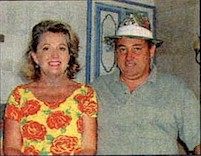
The article begins, "Lundy and Harry Wilder fell in
love with Italian architecture when they bicycled from Venice to Pisa a
few years ago on a vacation."
It goes on to explain that when the Memphis couple
decided to build their vacation home at Gulf shores, they incorporated
Italian design elements into the avant-garde hurricane-resistant house.
The article has several photographs of the home, as
well as a photo of the Wilder's. Pictures of the house can be seen at Lundy's web site.
Lundy Wilder is credited with helping with the design
from start to finish, including designing and installing mosaic walls
in the shower. Details about the mosaic tile can be found at another of Lundy's web sites.
The article begins on page F1 of the June 29,2000, Memphis newspaper and concludes on page F6.
Source: The Commercial Appeal
Harry Durham listed as East's new principal
July 23, 2002 - Information on
the Memphis City Schools website now lists Harry Durham as principal of
East High School. Other immediately available information about Mr.
Durham is limited. Mr. Durham began working with the city schools in
1968 and served as principal of Fairley High School for a long period,
beginning in 1985. He apparently missed the 1998-99 school year due to
illness.
More information will be provided as it becomes available.
East Principal Oscar Love Transferred as Unsubstantiated Complaints Fly
July 21, 2002 - July 21, 2002
- The City School System reports it cannot verify that any of the
complaints against East Principal Dr. Oscar Love are true. Despite
those findings, Love has
asked for a transfer and been named principal of Raleigh-Egypt High
School.
Complaints against Love by parents and faculty included putting
children in closets to discipline them and
financial mismanagement. School system administrators say the
investigation did not
substantiate the discipline charges and that the school appears to be
better financially
managed than in recent years. Some say Love was simply disliked because
he attempted to focus school activities on academics and tried to hold
students accountable.
Prior to his assignment at East High, Dr. Love was
principal of the Trezevant Career and Technology Center, which received
the Memphis Education Association's School of the Year award in Love's
last year there.
This latest situation is continuing evidence of a
school in serious trouble. East High is already on the state's list of
underperforming schools and if it does not improve could be taken over
by the state in a few years. Love was the third principal East has had
in the past 4 years. While East reports some impressive scholarship
offers for a few top
students, the overall academic evaluation is that, on average, students
are not learning
and applying the knowledge for which high schools exist to convey. The
average ACT
score at East, based on 2000-2001 school year statistics, is 17.
The following is from The Commercial Appeal, July 21, 2002:
Love's gone, but parents in a lather at East
Disciplinarian now leading Raleigh-Egypt
By Aimee Edmondson
July 21, 2002
Principal Oscar Love was the hero or the enemy at East High School, depending on whom you ask.
Facing financial troubles and named to the
state-identified low-performing list last summer, East needed a
no-nonsense military man to help turn the school's tattered image
around.
That was Memphis Supt. Johnnie B. Watson's plan when he appointed Love last August.
But when classes started, complaints about Love began
rolling in. The rumble started low and has grown to a roar in recent
weeks.
Angry parents demanded Love's dismissal. Stories
surfaced of kids being locked in closets along with allegations that
funds were misappropriated along with a host of other complaints.
School board members became embroiled in the
controversy, primarily Sara Lewis, who yelled at Watson in an open
meeting, insisting that parents get satisfaction amid the sea of
complaints.
But after a lengthy investigation of the parents'
various charges, Memphis City Schools officials say they can't find any
reason to reprimand Love, much less fire him.
During the controversy, Watson stood steadfastly by
Love, whom he transferred from the head job at Trezevant Career and
Technology Center.
Love, 60, asked earlier this month to be transferred
again, this time to Raleigh-Egypt High School where he took the helm
July 15.
"Dr. Love felt like he reached a point where he
couldn't be effective and turn things around if parents continued to
come at him at East," Watson said.
Given the fervor to get rid of him and the lack of
wrongdoing Watson's staff found, the question remains: Was Love a
no-nonsense principal bent on rescuing a drowning school? Or did he
mismanage East and fumble the job?
Of the complaints, perhaps the most shocking is the
allegation that students who misbehaved were locked in a closet.
Investigators from the central office said they could not substantiate the allegations.
The teacher involved denied wrongdoing, and several
students said the incidents never happened, according to a staff report
to the school board. Students who were put in timeout were placed in
the classroom's adjacent office, which has windows, investigators
reported.
When East guidance counselor Marilyn Williams
complained before the board that she knew the allegations were true,
Watson assigned a member of his security staff to look into the matter.
The investigation continues.
Early in the year, Love asked Williams to transfer
from East because the school had one too many counselors after
projected enrollment turned out to be too high. She remained when
another counselor volunteered to leave.
Parents led by James G. Robinson also charged that
Love was financially mismanaging the school. The group appeared before
the board repeatedly, demanding that Love be fired.
But according to internal audit reports, the opposite is true.
Over several years, East's finances faced additional
scrutiny after then-principal Lowell Winston was suspended in 1997 for
mismanaging student funds after an audit revealed that the school owed
$100,000 but had only about $20,000 in the bank.
The audit showed a pattern of overspending and poor
record-keeping, though Winston was wildly popular with students. The
school bought new band uniforms and other extras the school couldn't
afford.
Questions continued under principal Milton
Burchfield, financial records show. Though the situation had improved
since Winston's tenure, the athletic department showed a $34,277 loss
after the 2000-01 school year, Burchfield's last year at the school.
An audit this year showed that Love recouped $29,000 of that deficit in one year.
Internal auditor Waldon Gooch said in his report:
"The increase in the financial position can be attributed to better
controls established on school purchases made by teachers and staff."
Some Love supporters said his heart was in the right
place, but his manner was sometimes too gruff and militaristic, which
put some parents off and angered others.
Love makes no apologies for his style.
"I believe in order and structure and
accountability," Love said. "I don't believe that's unreasonable. I
believe in what I do . . . with a passion."
Love, a Vietnam veteran and former education
specialist for the Navy in Millington, has a doctoral degree in
education leadership from Kansas State University and joined the system
as assistant principal at the Trezevant Career and Technology Center in
1995.
Because East faces state takeover if it doesn't
improve, Love cut back on activities that ate into class time,
including talent shows and pep rallies, making him unpopular with many
students.
School board member Patrice Jordan Robinson's son
attends East. And because of her position, she said she decided to
remain quiet on the issue. She said last week that some parents
respected the changes Love was trying to make in the school climate.
"He wanted the teachers to do their jobs," said
Robinson, who is not related to James Robinson. "My observation was
some of the teachers weren't being as cooperative as they should have
been.
"He is more task-oriented, and the teachers wanted
someone more amiable with better people skills. But just because you
don't have those skills doesn't mean you aren't effective."
James Robinson's most recent complaint involved the
high number of students enrolled in East's optional program that
received letters telling them that they weren't eligible to return to
East without a principal's conference.
"Something is wrong. So many kids are being denied an opportunity to come back," Robinson said.
The largest number are juniors, 24 of whom were approved and 22 were classified as "pending approval."
The latter either had conduct or attendance problems
or grades below a "C." Since these 22 students didn't meet optional
school minimum standards, the intent of the letter was to bring
students and their parents in for an attention-getting conference,
school officials said.
After hearing East parents complain about Love in
television reports, Raleigh-Egypt parents told the board last week that
they didn't want somebody else's "tainted leadership."
Coleman Garrett, whose son graduated from East,
defended Love and chastised the school board for failing to support
Watson's decision.
"The problem is not the principal. It's got to do
with petty politics and turf wars," Garrett said. "Now Raleigh-Egypt
says they don't want him over there, and they don't even know the man."
East High teacher Kristie Ruddick, who followed Love
from the Career and Technology Center to East, said Love raised the
standards among students and teachers at his first post.
And the Memphis Education Association, the teachers'
union, named the Technology Center the MEA High School of the Year for
2000-01, Love's last year there.
Ruddick said at one point she pondered a job offer with a software company and went to Love for advice.
"I'll never forget his response," Ruddick said. "He
just looked at me and said, 'Who will teach the children?' East has
suffered a great loss, but Raleigh-Egypt has gained a strong leader."
Source: The Commercial Appeal, The East High Alumni Page, Tennessee Department of Education
Student Obituary
From The Commercial Appeal, July 12, 2002
CHRISTINA LASHAY JOHNSON, 18, student at East
High School, died Tuesday [July 9, 2002] at Methodist
Healthcare-University Hospital. Services will be at noon Saturday [July
13, 2002] at St. Paul Missionary Baptist Church in Olive Branch
[Mississippi] with burial in the church cemetery. Gillespie Funeral
Home of Olive Branch has charge. She leaves a son, Zion Q. Moore of
Memphis; her mother, Dollie Oliver, her father, Frederick Johnson,
three sisters, Jaleesa Lofton, Fredericko Johnson and Jemika Johnson, a
brother, Frederick L. Johnson, and her grandparents, Jennell and Walter
Oliver and Mary and Eston Johnson, all of Memphis.
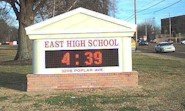 Alumnus Provides for Sign
March 6, 2002, updated April 23, 2002 - An East High
alumnus funded the new $37,000 electric message board on the front lawn
of East High School. The donor has asked to remain anonymous. The sign
features the school's name engraved above the message lights and the
street address below. Installed over the winter and turned on a few
weeks ago, the sign sits directly in front of the school very close to
Poplar Avenue. It should be easy to read for people traveling west on
Poplar. Its visibility for those headed east will depend on how much
traffic there is in the westbound lanes which may block the line of
sight. Initially the sign was simply displaying the time of day,
however after a few weeks messages began to appear on it routinely.
Owner of Bobbit-Doerr Drug Store Dies
March 6, 2002 - Dr. Clarence
Aldivan Doerr, 88, of Memphis, retired pharmacist, died Monday, March
4, 2002, at Lakewood Plaza Nursing Center, North Little Rock, Arkansas.
Dr. Doerr was owner of Bobbit-Doerr Drugs in Memphis which was located
across from East High School in the 1950's, '60's, 70's and possibly
later. It was one of the businesses of which most East students knew
and at which many shopped. Though it would not likely qualify
physically as a landmark, the Bobbit-Doerr Drug store does qualify as a
memory landmark for those who attended East during its first three
decades. Dr. Doerr's store was also a good patron of East High School,
routinely buying ads in the Annuals and student newspaper.
Dr. Doerr's son, Steve, is a 1960 graduate of East High School.
Visitation will be from 7:00-9:00 p.m., on Wednesday,
March 6, 2002, and services will be at 10:00 a.m., March 7, 2002, at
Memorial Park Funeral Home, with entombment in Memorial Park Mausoleum
in Memphis.
East needs qualified tutors to helps students
February 3, 2002 - In a
conversation recently with an East High Faculty member, the editor of
The East High Alumni Page learned that East High would welcome
qualified individuals to volunteer to tutor current East students. If
you are interested in tutoring a Mustang, it is suggested you call the
East High office and inquire if you can help.
New State Report Card on East High Continues Bleak Evaluation
November 26, 2001 -
The Tennessee Department of Education has issued report cards on all
state school systems and individual schools. The report cards are based
on standardized test scores, attendance, displine problems, and
promotional rates. Despite the occasional gem in acedemic performance
at East High, as reported in the story immediately below, students at
the school generally perform significantly below state and national
averages in most categories.
View the report by clicking here.
Academic Achievers in At Risk School Demonstrate Student Dichotomy
The following is from The Commercial Appeal, October 15, 2001
East's physics aces quantum-leap over 'achievement gap'
By Aimee Edmondson
The Commercial Appeal
High school seniors Blaine Lee and Barry Vanderable sport sky-high grade-point averages and great SAT scores.
As juniors, they both passed the Advanced Placement
physics exam, officially placing them with a small fraternity of the
academic elite.
Blaine wants to go to Stanford University next year.
Barry has his sights set on the Massachusetts Institute of Technology.
And they go to a high school that's been dubbed one of the worst in the state.
Memphis's East High School was named last month to
the Tennessee Department of Education's "On-Notice" list of the 98
lowest-performing schools in the state.
East and 63 other Memphis schools on the list could
face a state takeover in 2004 if test scores don't improve
substantially.
Yet the students in the building on Poplar Avenue in
East Memphis are proving that you can't use a single brush to paint a
school.
Barry and Blaine were part of a five-student group
trudging quietly all of last year with teacher Tommie Henderson,
working nights and weekends to prepare for the AP physics exam.
The result: All five passed.
Not something you'd expect from a low-performing school? Well, there's more.
Historically, black students in Tennessee have not fared all that well in AP physics.
Last year, 291 Tennessee students took the test. About 60 percent - or 175 - passed it.
Of that number, only 25 of the students attempting
the test were black. Ten students passed it, for a 40 percent passing
rate.
Five of those were the students from East, which is more than 95 percent black.
"Though it was a small class, it was the way you
begin things," said Henderson, a 1991 East graduate who also has a
degree from MIT.
"The first thing you need to do is have the kids
believe that they can do," said Henderson, who returned to Memphis four
years ago to revamp his alma mater's engineering program.
Yet Barry is afraid East's low-performing designation
will serve as his scarlet letter, reducing his chances of getting into
MIT.
"It just hurt to know I have to apply to all these
colleges and they're thinking, 'How hard can our school really be if
it's one of the worst schools in Tennessee?'|" Barry said.
Indeed, there are students across the city in the same situation.
Only six of the city's 29 high schools are not listed
as low performers: Central, Craigmont, Kirby, Overton, Ridgeway and
White Station.
John F. Jennings wasn't all that surprised to see so many Memphis high schools put "on notice" by the state.
The director of the Washington-based Center on
Education Policy is an expert on what's called the "achievement gap."
He and others study why minority children in general do not score as
well as their white peers on standardized tests.
Memphis's student body is about 86 percent black.
Seventy percent qualify for free or reduced-priced meals, a common
indicator of poverty.
During the 1970s and '80s, minority students narrowed
the achievement gap significantly. However, since 1998, the achievement
gap has stayed the same for some subjects and grades and has actually
widened for others.
It's not that minority students aren't improving. But
they have to improve at a faster rate than others for the gap to close,
Jennings pointed out.
"You are dealing with some serious social issues,"
Jennings said. "In Memphis you have such poverty and racial isolation.
It's not easily going to get away from this problem."
In a recent report, the Center on Education Policy outlined its to-do list for educators to close the gap.
It included more teacher training, smaller class
sizes, more high-quality preschool and strengthening community and
parental support.
Two big items are extended learning time and more advanced classes to challenge students.
The last two make up the bulk of Henderson's formula.
Said Barry, "Everybody else was at home, and I was here doing physics."
Source:The Commercial Appeal
Our Failing Schools
Can anything be done?
By MARY CASHIOLA,
Memphis Flyer
OCTOBER 10, 2001
East High School doesn't look like a
school that's "failing." There are no metal detectors guarding the
front doors, no broken windows, no graffiti tagging the lockers. If
anything, East carries itself with the air of a private school. Classes
are in session and the marble-walled halls are ghostly empty and shined
to a high gloss. Seeing the high vaulted ceilings in the entry hall and
the lush campus and sprawling sportsplex, one wouldn't ordinarily give
a second thought to the quality of education within these walls.
But East, located between Poplar and Walnut
Grove only a mile- and-a-half from the Memphis City Schools Board of
Education building, is failing. It is one of 64 Memphis City Schools
the Tennessee Department of Education put "On Notice" last month when
it released its list of 98 low-performing schools statewide. Of Memphis
schools, 23 of the low-performers were high schools, 14 were middle and
junior highs, and 27 were elementary schools. If any one of these
schools doesn't show enough improvement, they -- or, in a worst-case
scenario, even the entire school district -- could risk being taken
over by the state as early as 2004.
Last year the state named 48 elementary and
middle schools statewide to a "Heads Up" list, their way of saying:
We're not enforcing anything this year, but if we were, you'd be in
trouble. But few expected that when high schools were added to the list
this year that only a handful in the city -- Central, Craigmont,
Overton, Ridgeway, Kirby, and White Station -- would avoid the state's
list.
Dr. Oscar Love has been the principal at
East since the beginning of the school year. "Since I've been in this
system," he says, "East has always been one of the premier schools from
an outsider's perspective. When I had a chance to come to East and
work, I was pleased with that opportunity. I was surprised. I really
didn't expect [to be listed]."
Built in 1948, East has long been a showplace
for the district. These days it serves about 1,450 students; 97 percent
African-American, 2 percent Asian, and 1 percent Caucasian. Sixty-three
percent are on free or reduced lunch plans, indicating they are from
low-income families.
Love says he would have been less surprised at
the listing if he had been at East longer. Despite its stately facade,
East simply doesn't have the test scores.
"It would have been my responsibility to monitor
test scores and have a feel for the academic direction of the school,"
says Love, "and to provide support to maintain that standard, so I
would have to know."
For the 1998-1999 school year students at East
High had an average score of 17 on the ACT. On the school's
state-issued report card for 2000, the school didn't fare much better.
ACT scores were ranked as "Deficient" while SAT scores were "Below
Average." On the TCAP Writing Assessment taken last February, 7 percent
of 11th graders (excluding special education) scored a 5/strong.
Forty-seven percent scored a 4/competent and 38 percent scored a
3/limited. No one scored a 6/excellent or a 1/deficient.
The Making of a List
"In every one of the schools on the [K-8] list,
48 to 73 percent of the kids were below average in reading, language
arts, and mathematics," says Dr. Connie Smith, executive director of
accountability for the state department of education. "These are
significant problems."
Between issuing the "Heads Up" and the "On
Notice" lists, the state board of education changed the criteria as to
what qualifies as a low-performing school. This year, as last, the
department of education used the schoolwide achievement averages as one
of the indicators of a failing school, only they made the guidelines
stricter. The department also looked at individual student test scores
to see the progress being made by each school's lowest-performing
students.
State board of education member Cherrie Holden
says the criteria were changed in an effort to make the standards more
equitable across the state. It was a similar concern that led to the
initial conception of the list.
After a lawsuit was brought by smaller school
districts in the state asking for a fairer funding formula, the state
legislature enacted the Basic Education Program (BEP) in 1992. The law
guaranteed equitable funding for both small and larger school districts
and mandated smaller class sizes. The legislation obligated the state
to help pay for the funding but put in place measures to require
positive results.
Kathy Christie, vice president for knowledge
management in the Education Commission of the States Clearinghouse,
says that in the late '80s and early '90s legislators around the
country decided they should handle school-system accountability because
under their state departments of education very little seemed to be
getting done to correct the problems.
"The big thing is now the process is public,"
she says. "Before, there were a number of low-performing schools that
no one really knew about. You only knew when you stepped into them and
saw there wasn't much going on."
Increasingly, local and state governing bodies
have wanted clearer information about how their public schools were
performing. In July 2000, two years before the BEP legislation required
a low-performing schools list, the state of Tennessee released one.
"Based on what the commissioner's office told
us," says Bob Archer, associate superintendent of school administration
and student support for the Memphis City Schools, "there were
continuing requests from the legislators to identify schools even
though the law did not require it until the summer of 2002."
But releasing the list wasn't the only thing
that got fast- tracked. So did the other steps of the process. Holden
says the state board considered a four-year "On Notice" plan, but
legislators thought that was too long.
Playing Catch-up
Although state and local educators have asserted
that the new criteria will inevitably place more urban schools on the
list, only Memphis had more than 20 schools named. Other districts
weren't even close. Davidson County (Nashville) had 9; Hamilton County
(Chattanooga) had 11. Some other smaller districts had one failing
school.
"When we put together the different line items
[of the new criteria], no one knew that was how it would end up," says
Holden. A separate set of criteria with lower standards was even
suggested for the Memphis district but not supported by much of the
state board.
Superintendent Johnnie B. Watson explains it
this way: "When we look at the demographics of the schools on the
low-performing list and we look at the demographics of the schools in
Shelby County, that tells the story of why we have more schools on the
low-performing list."
The city schools have had a 25 to 27 percent
mobility rate over the past three years, meaning that more than 1 out
of 4 students changed schools at least once during the school year.
About 70 percent of city school students are on free or reduced lunch
plans. Over 100 of Memphis' schools are designated as Title I, a
federally funded program for high poverty-level schools. Of the city's
64 failing schools, 47 are under Title I. Most of the failing schools
not designated Title I are high schools.
Although board and staff members are quick to
say that poverty is not an excuse, they acknowledge that it does play a
part in making their jobs even harder.
Last year, in an effort to halt the problem,
Archer directly supervised each of the low-performing schools. This
year, since there are so many, the schools are once again reporting to
one of three zone directors.
"We have a significant number of our students
who come to us without the readiness skills that you would expect
students to come to kindergarten with traditionally," says Archer. "We
have significant numbers who come to school and don't know their
colors; they don't know their numbers; some of them don't know their
name." While such handicaps might not be insurmountable, it means the
kindergarten teacher has to start teaching material at an earlier level
and cover twice as much ground.
"When you start behind," says Archer, "you're always in a mode of trying to catch up."
Unfortunately, the problem isn't always corrected
at the kindergarten level. Failing lower-level schools are feeding
failing upper- level schools. For example, according to 1998-1999
feeder patterns, 60 percent of students at state-listed Fairley High
School come from Geeter Middle School, 30 percent come from Lanier
Junior High, and 6 percent come from Chickasaw Junior High. Each of
those middle schools is also on the state list. Only 4 percent of
Fairley's students come from Westwood Junior High, a school not on the
list.
Following the feeder pattern further back shows
that Geeter Middle School students come from four elementary schools.
Of those, Fairley Elementary and Westhaven are both listed and make up
53 percent of the students at Geeter. At Lanier Junior High, 74 percent
of the student body comes from failing elementary schools. At Chickasaw
that figure is 56 percent.
This is not to say that the elementary schools
are necessarily to blame. The feeder pattern doesn't always hold.
Hamilton Middle School has five feeder elementaries; Fairview Junior
High has six. None of their feeder schools is on notice, but both of
the middle schools are. And Fairview Junior High feeds into Central and
White Station, both non-list high schools. Hamilton Middle, on the
other hand, feeds Hamilton High and Southside High, both of which are
on the list. There are no simple answers. The problem is widespread,
and since the more upper-level schools are on the list, students are
more likely to enter a failing school as they progess through the
system.
Even more disturbing is that the problem extends
citywide. "It's almost an even distribution geographically," says
Archer. "There's not a pocket in Midtown or a pocket in North Memphis
or South Memphis where these schools are located. They're pretty evenly
distributed throughout the city."
Of the seven geographic school board districts
within the system, only District 2 had no schools on the list. That
district, which includes Richland Elementary and Overton High, has only
one Title I school, which suggests that the real problem is poverty.
At a meeting last Saturday, school board members
discussed the city's culture of poverty, where parents aren't concerned
with their children's education and students do not understand that
learning is their responsibility.
"It starts at home," says board member Michael
Hooks Jr. He tells of going to a school and seeing a parent trying to
check a child out of school for a medical appointment. "The parent
couldn't tell the school secretary one of the child's teacher's names,"
Hooks says. "Not one."
Even Watson, who holds himself as an example of
someone who's overcome poverty, says, "The public school system cannot
solve all the ills of society. The public school system did not create
this problem. Poverty helped create this problem."
On Notice, On Probation, On Reconstitution?
When Watson addressed a group of reporters the
morning the state announced its failing school list, he wouldn't say
that all the schools would be off the list by 2004. What he said,
instead, was that the district was optimistic that in a few years many
of the schools would no longer be on the list.
With so many district schools listed and so many
obstacles to overcome, it would be miraculous if all 64 Memphis schools
were off the list in three years. Only six of the district's schools
were removed from the 26 named last year.
The state department of education is legally
bound to produce a list of low-performing schools every year before
September 30th. Schools listed then have a year "On Notice" to show
improvement. If they don't, they are cited as "On Probation." Schools
that don't improve in two years are then supposedly subject to a state
takeover.
State department of education commissioner Faye
P. Taylor and state school board members have all said publicly and
privately that there is little likelihood of a takeover. "Our intent is
not a state takeover," says Holden. "We're taking the data saying,
'Hey, ya'll have a problem.' Each of those problems is a child."
"We're just going year to year," says Smith, of
the state's accountability office. "We don't have specifics yet."
The first version of the law was so strongly
worded that even a district with only one failing school would
automatically get taken over by the state after the three-year
probationary period. But an amendment that took effect July 1st gives
the state some discretion as to what path it chooses to take with a
district. It can still take over at the system level -- whether as a
simple takeover or as a total reconstitution -- or it can take over an
individual school. If a district takeover occurred, the state would
have the right to force the district to use funding for certain things
and would have control over many of the district's decisions. Total
reconstitution, on the other hand, means that some, or all, of the
school board and the superintendent would be removed from their
positions and a state-appointed district manager put in place.
Right now, there are no plans either way. And at
a recent Memphis board and staff conference on the failing schools,
even board members seemed frustrated by the state's lack of a clear
plan.
"Last year, I asked [then state education
commissioner] Vernon Coffey to tell me what I'm not doing as a board
commissioner to get our schools off this list," Hooks said. "I asked,
'What are you, as the state, going to do?' He said, 'We don't have a
plan.'"
If the state is wary of taking over a system, or
even a school, it might have good reason. There hasn't been much
research done of the subject; what little there is is mostly anecdotal.
"You hear things like 'We like it because the
atmosphere is better' or 'It's terrible,' because people resent having
someone else come in and make their decisions for them," says Christie.
Proponents of state takeovers say it provides an
opportunity for the state and local governments to combine resources to
improve education and that it allows a competent executive staff to
guide the implementation of school improvement efforts. Those who
oppose state intervention say that a takeover implies that the state
has the answers and that the process can produce showdowns between
state and local groups that actually slow student improvement.
One of the success stories was a takeover in
Logan County, West Virginia, where local officials collaborated with
the state government. Students showed some improvement in test scores,
and parents were in support of the process. Doubters say that such a
case isn't hard evidence.
One of the problems is that there is no standard
timetable for state takeovers. Many can go on for years. In California,
the Compton Unified School District was taken over by the state,
primarily for fiscal reasons. But once there, state legislators decided
they needed to address the district's test scores as well. That was in
1993. The district only very recently regained partial control of its
functions.
"That's the argument behind reconstitution,"
says Christie. "If you don't change the entire staffing of a
dysfunctional school, you can't move ahead very quickly. On the flip
side, there's the criticism which says that process doesn't move very
quickly either."
An Education Commission of the States study done
on the subject in July 1998 and updated in March of this year, suggests
that state takeovers tend to be more effective at curing unwieldy
bureaucracies than improving low test scores. Some states have seen
modest improvement in student achievement after a takeover, but there
can also be some chilling side effects.
"Despite these positive results," reads the
study, "state takeovers have produced results to the contrary, such as
the $70 million deficit incurred by the state-appointed administrators
in Newark, New Jersey, and the 10-day teacher strike in Detroit,
Michigan, which occurred six months after the mayor assumed control of
the school district."
The Team Plan
While the threat of a state takeover doesn't seem
a likely possibility anytime soon, the intent behind that threat is
very real.
"We're going to be in serious trouble in about
15 years," says Memphis school board commissioner Sara Lewis. "These
[students] are the people that are going to be making the decisions."
Last year, after the first group of schools was
put on notice, Dr. Marieta Harris, associate superintendent of
curriculum, instruction, and school effectiveness for Memphis City
Schools, got together with her staff and developed a plan.
"They developed an instructional improvement
initiative [III] that involved teaming groups of district-level people
with a team of teachers from within each school," says Archer. In
October of last year, the state sent staff members from the department
of education to assist the district, and they too were incorporated
into the team.
Each team member spends time in the
low-performing schools, observing classes and taking down observed
data. The original 26 schools will receive 20 classroom visits every
six weeks; at the newly identified schools, that number is 30. During
each visit, the team looks at everything from instruction to technology
to the paint on the walls.
"I don't think there's a school that's been
named where the people in that school haven't worked extremely hard,"
says Archer. "Whatever we've been doing has not been effective."
The data from the observations will then be
disseminated to the principal to share with the school's staff. It's
hoped that the data will help strengthen weaknesses in the schools and
reinforce positive methods.
"One of the problems with this whole process ...
is the limited resources. Nobody has funded additional money to deal
with low- performing schools," says Archer. "Everybody has had to
scramble for resources." The team members from the district were not
hired especially for this project; they are people who already worked
for the district and now have an added responsibility.
"The state's problem was that they developed
this list of low-performing schools and identified them, and then they
had to figure out how they were going to assist the districts they
identified," says Archer.
What they came up with were grants where the
criteria have been shifted toward low-performing schools and "Exemplary
Educators" -- retired, "highly successful" educators sent into the
schools to help.
"I think the Exemplary Educators were envisioned
to go into the more rural school districts that maybe don't have the
level of resources that we have here and actually become the reform
person. They would go into a school and work with the principal and
say, 'I'm going to show you how to fix this school,'" says Archer.
Because Memphis already had a plan, the Exemplary Educator's role
became that of a mentor or coach for some of the district's younger and
more inexperienced teachers.
"When you start trying to point out why the
students are not achieving at the level they're supposed to, it's a
very complicated and complex question. That's one of those where if you
had an answer, you could write a book, retire, forget it, and cure
everything," says Archer. "The state doesn't have the silver bullet
either."
But in every conversation on how to fix failing
schools, there's an element of teamwork. The state is committed to
working with the individual districts. The city school system is
committed to working with the state. Even at East, Love says one of his
goals is for the school staff to work better as a team.
"What I look for first of all," he says, "is building a team and creating team spirit."
Love might as well be speaking for the district.
In the coming weeks the superintendent and his staff are hoping to
unveil their plan to make the entire community part of the team.
"We can't do it by ourselves. We can't," says
Archer. "I admit that up front. We need the support of the entire
community to get this job done."
Memphis' Failing Schools
Airways Middle
Booker T. Washington High
Brookmeade Elementary
Carver High*
Chickasaw Junior High
Corning Elementary
Cypress Junior High
Denver Elementary
Dunbar Elementary
East High
Fairley Elementary
Fairley High
Fairview Junior High
Frayser Elementary
Frayser High*
Geeter Middle
Georgian Hills Elementary
Georgian Hills Junior High
Graceland Elementary
Hamilton High
Hamilton Middle
Hawkins Mill Elementary
Hillcrest High*
Hollywood Elementary
Humes Middle
Kingsbury High
Lanier Junior High
Larose Elementary
Lester Elementary
Levi Elementary
Lincoln Elementary
Locke Elementary
Longview Middle
Manassas High
Melrose High
Middle College High
Mitchell High
Northside High
Oakhaven High*
Orleans Elementary
Raineshaven Elementary
Raleigh Egypt High
Raleigh Egypt Middle
Riverview Middle
Shannon Elementary
Sharpe Elementary
Sheffield Elementary
Sheffield High*
Sherwood Middle
Southside High
Spring Hill Elementary
Springdale Elementary
Treadwell Elementary
Treadwell High*
Trezevant High*
Vance Middle
Westhaven Elementary
Westside High*
Westwood Elementary
Westwood High
Whitehaven High
Whitney Elementary
Winchester Elementary
Wooddale High
* denotes schools on notice at both high and junior high levels
East Among Schools Unable to Schedule Classes for Students
September 26, 2001 - The Commercial Appeal
revealed that East High was one of several Memphis City Schools in
which students have gone weeks without being assigned a locker or been
issued textbooks. The report indicates one East girl sat in the
auditorium for four periods of the class day for the first few days of
school because the school system could not get her schedule worked out.
After she finally got her class schedule, she said it was wrong. School
system administrators blamed a new computer program. However, school
board members are alarmed and have asked school system administrators
to report on the problems at the next regular board meeting.
Source: The Commercial Appeal
East Put On Notice for poor performance
September 22, 2001 -
The Tennessee Department of Education identified East High School as
being among 64 other Memphis City Schools for low performing schools
and has recommended that it be placed "on notice." Pending approval of
the recommendation by the State Board of Education later this month,
state education specialists will begin working closely with the school.
East will have one year to improve or it will be placed on probation.
Should East remain on probation for two years, it could be subject to
state "takeover." The placement of East and 97 other schools statewide
of which 64 are in Memphis, on notice results from the analysis of 3
years of data showing the schools' performance in math, language arts,
reading, writing, and for high schools, the dropout rate.
More information, including excerpts from the latest
state "report card" for East will be made available on this web site
shortly.
Source: Tennessee Department of Education, The Commercial Appeal
East 1993 Grad Shot Dead Downtown
August 28, 2001 - Tederick Dawson ('93) was shot to death early Sunday morning, August 26, 2001, outside of a downtown Memphis restaurant.
Police have charged John Edward McClee, 19, with
voluntary manslaughter, aggravated assault, possession of a controlled
substance (marijuana), and the unlawful possession of a weapon in
connection with the shooting of Dawson and of another man during the
altercation. The other man was treated and released from a local
hospital.
Police say two groups were standing outside of
Jillian's restaurant shortly before 2 a.m. when an argument started
between Dawson and a woman in the other group. Investigators say the
dispute turned physical but the two were separated by others, but
Dawson began arguing with another woman. Homicide detectives say when
Dawson tried to choke the woman, McClee shot Dawson in the chest
several times. Dawson died after being taken to the Med.
According to The Commercial Appeal, Dawson's family disputes McClee's claim of self-defense.
Tederick Dawson reportedly was president of the senior class of 1993 at East High School.
An obituary for Tederick Dawson is available. Click here to read the obituary.
Prior to his death, Tederick Dawson was a participant
with our alumni page. The last profile he submitted may be read on the Class
of 1993 page.
Sources: The Commercial Appeal, WREG-TV, WMC-TV, WHBQ-TV, schoolmate(s).
Alumnus Leader in 5K Runs
[posted November 3, 2001] - Glen Stewart ('62)
placed first in the age 55 to 59 division of the Elvis 5K Run in
Memphis August 8, 2001. It was Stewart's fourth race he has entered
during 2001 and the fourth first place finish in his division
Source: The East High Alumni Page
New Principal Assigned to East
July 24, 2001 - A new principal
has been assigned to East High School by the administration of Memphis
City Schools.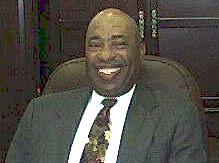 Dr. Oscar Love has taken over the leadership role at East from Mr.
Milton Burchfield. Dr. Love was about to begin his seventh year as
principal at Trezevant Career and Technology Center/Trezevant Career
Academy when he got the call to come to East High. Dr. Love says that
if anything of the "mystique" of East High School has been lost he
wants to be part of helping to restore that. In addition, Dr. Love
expressed a desire to energize alumni to again become associated with
the school.
Dr. Oscar Love has taken over the leadership role at East from Mr.
Milton Burchfield. Dr. Love was about to begin his seventh year as
principal at Trezevant Career and Technology Center/Trezevant Career
Academy when he got the call to come to East High. Dr. Love says that
if anything of the "mystique" of East High School has been lost he
wants to be part of helping to restore that. In addition, Dr. Love
expressed a desire to energize alumni to again become associated with
the school.
Mr. Burchfield takes over the position formerly held by Dr. Love as principal of Trezevant Vo-Tech.
Source: The East High Alumni Page
East's Most Famous Alumnus
July 16, 2001 - Some alumni
of East High School have gone on to be in high profile positions:
professional athletes, politicians, including a governor of a southern
state, business executives, writers, and actors. Perhaps our most
famous alumnus, though, went into a broad range of show business. The
name Cybill Shepherd ('68) is surely recognized by more people
than the other high profile alumni across the nation and worldwide. It
would be difficult to compete for publicity with a weekly television
program titled only by one's distinctive first name (Cybill, CBS, 1995-98).
While this "In the News" section of The East High
Alumni Page attempts to note events in which alumni are featured
publicly, it would be impossible to list all of the publicity Shepherd 
 has
generated during the past 30 and more years. She has starred in
numerous movies and on stage, appeared on the cover of many magazines,
starred in television series, recorded several albums and CD's, written
a book, and hosted a television talk show. It is beyond the ability of
the editor to note each time Shepherd makes entertainment news, so it
is hoped this entry will serve as a report on Cybill's cumulative
publicity over the years.
has
generated during the past 30 and more years. She has starred in
numerous movies and on stage, appeared on the cover of many magazines,
starred in television series, recorded several albums and CD's, written
a book, and hosted a television talk show. It is beyond the ability of
the editor to note each time Shepherd makes entertainment news, so it
is hoped this entry will serve as a report on Cybill's cumulative
publicity over the years.
Cybill Shepherd walked into the national spotlight
when she was selected Model of the Year in 1968. Soon she added acting
to her career, starring in her first movie The Last Picture Show
in 1971. While her modeling and movie career continued, she hit it big
in another medium, television, as co-star with Bruce Willis in Moonlighting (1985-1989). Shepherd resumed her television series work as the star and executive producer of the aforementioned Cybill.
Cybill Shepherd has won four Golden Globe awards for her work and been an Emmy nominee.
One of Shepherd's most recent highlights evokes
memories of her original "cover girl" days. She and daughter Clementine
appeared on the cover of McCall's magazine (March, 2001) and were the
subject of a featured article.
Also in March, Shepherd was in Memphis to host events surrounding the showing of her recent film Marine Life
at the Memphis International Film Festival. She was interviewed on
Memphis television at that time from which the photograph on the left
was obtained.
As noted previously on this page, Cybill Shepherd has a web site at www.cybill.com from which one can learn more about her current and past achievements and buy her book and recordings.
Source:Photograph: WHBQ-TV
[Editor's note: Sept. 23, 2004--The website www.swinginchicks.com/cybill_shepherd.htm has an interesting biography of Cybill Shepherd.]
Attempted Armed Robbery Across from East
June 8, 2001 - A customer leaving a video
rental store across Poplar Avenue from East High School was accosted by
armed with a pistol Monday evening, June 4, 2001. The manager of the
store rushed to help the customer when he saw the criminal blocking the
customer from closing the door on her automobile. The 6'1", 205 pound
manager could not see that the assailant had a gun pointed at the
customer and was demanding her purse and ring. The manager grabbed the
robber from behind only then to discover the gun. The two struggled for
a few seconds before the manager was able to take the gun away from the
criminal. The robber, described as being between 16 and 19 years old,
slipped out of his raincoat allowing him to get free and escape on
foot.
The manager unloaded the two bullets that were in the
pistol. He later said he would have handled the situation much
differently if he had known the assailant had a gun.
Source The Commercial Appeal
East Alumni Among Faculty Featured in Series
On Memphis Schools Performance
June 3, 2001 - The Commercial Appeal
is running a series of stories on the performance of Memphis City
Schools. It is focusing on two schools, both in poor neighborhoods. One
does well on standardized test scores, the other has done so poorly it
is cited as one of the worst schools in the state and risks state
takeover if improvments are not forthcoming.
One of the articles appearing in the June 3, 2001,
issue of the newspaper examined the use of various methods of disipline
in school. In that story, East alumnus Gary Bolton ('64) was
one of the faculty highlighted. Bolton was a faculty member at East
before his current assignment. The following are excerpts from that
story.
Most any day, a few students
get caught yelling or throwing food and find themselves in a line with
their trays in front of the cafeteria's stage waiting for one lick from
administrative assistant Gary Bolton. 
"It's embarrassing," Constance says.
But it's necessary, insist Bolton and many Cherokee teachers.
Corporal punishment is a hotly debated issue here
and across the country, but many Cherokee parents and teachers line up
on the same side: paddle. Memphis City Schools allows it under specific
guidelines.
While some Cherokee teachers don't need to paddle and haven't for
years, it's how many others maintain control.
Bolton, whom everybody calls "Coach," carries his
foot-long wooden paddle wrapped in duct tape in his back pocket and his
spankings are uniform, resulting in one resounding pop. Children look
like they're grimacing from dread and shame more than pain.
Many Cherokee parents adamantly tell teachers to spank their children
if they misbehave.
. . .
Coach
Bolton, 54, Cherokee's chief disciplinarian, is also its hero.
Most kids don't know about the shocking accident in 1991 when a
speeding van killed two students.
They'd just been dismissed for Christmas break and carried gifts and
goodies from class Christmas parties when they got the OK from the crossing guard to cross the street.
Bolton pushed several kids out of the way before the van ran a red
light and plowed into him.
Hailed as a hero for an act he remembers little
about, he was out for months with internal injuries and broken bones.
Now he stalks the halls and is the go-to guy if a teacher needs help
with a discipline case.
You'd think children would despise him. Instead, they hug him in the
hallways.
Children know when they are loved, teachers say.
Ask any child.
"He's our father," says Adrian with a big grin.
"He's funny. He's our daddy."
That last remark came from a second-grade girl named Justice.
From The Commercial Appeal, May, 18, 2001:
School videotape is alibi in robbery case
Police drop charges against East student
By Yolanda Jones
Charges have been dropped
against an East High School student after a videotape showed he was in
school at the time of an attempted robbery last month of a car rental
agency.
But police said Thursday 17-year-old David Draine is still a suspect and they may refile charges against him.
Draine was captured on school cameras eating lunch at
East at the same time that two men tried to rob the Avis Car rental
agency on Poplar near Colonial, said his attorney, Juliet Hill-Akines.
The videotape was a key piece of evidence at a hearing Wednesday when the charges against Draine were dropped.
"He is happy to be home, and now we will see where we will go from here," said Hill-Akines.
Draine had been in custody at Juvenile Court for more
than two weeks in connection with the April 30 attempted robbery. A
bystander was wounded during an exchange of gunfire between a rental
agency customer and the robbers.
Police assert that they had enough probable cause to
charge Draine, and they said Thursday that charges may be refiled.
"We don't feel like we had the wrong person in
custody," said Deputy Chief Robert Wright. "But during the hearing the
evidence presented cast a doubt in the judge's mind and now we have to
meet with the Attorney General's Office to see what is the next step in
this case."
Terre Fratesi, lead Juvenile Court prosecutor, said,
"This is an ongoing investigation and I can't comment on the evidence
that has been presented because we are still investigating and charges
could be refiled."
Draine and his family declined to be interviewed Thursday by The Commercial Appeal.
"They have just been through so much with all of
this," said Hill-Akines. "I mean the police rushed to make a judgment
and did not take their time to investigate the facts. The videotape
showed this to be the case."
Hill-Akines said she and East High's assistant
principal spent five hours reviewing videotape from the school's 12
surveillance cameras.
She said tapes presented in court showed Draine in
the school cafeteria between 11:30 a.m. and 11:45 a.m. when the robbery
was taking place.
After lunch, Draine left school without permission and was headed home.
Draine was arrested after a plainclothes officer
spotted the stolen getaway vehicle abandoned in the driveway of a house
at 3176 N. Waynoka Circle, a few hours after the robbery.
Draine was seen running from police in the area of Waynoka, which is near East High.
"He thought the police were truancy officers,"
Hill-Akines said. "When he was arrested, he thought he would be
released and not charged because he had faith in the system."
Draine had been charged with theft of property over $1,000 and criminal attempt felony (aggravated robbery).
Police said Draine was charged because they believed
he and an unidentified accomplice stole a pickup, went to the
car-rental agency and attempted to rob it.
Customer Anthony Dewayne Davis pulled out a gun and fired shots at the suspects.
The robbers fled. Davis chased them. Curtiss Kraemer,
57, was injured after he was caught in the crossfire between the
robbers and the car rental customer.
"We have shots from the video of Mr. Draine walking
down the hall at 10:30 a.m. and in the cafeteria at 11:30 a.m. and
11:45 a.m. so there is no way he could've been at the car rental,"
Hill-Akines said. Hill-Akines said the only thing her client did wrong
was skip school after lunch.
Messages left for East High School administrators Thursday were not returned.
Student Obituary
From The Commercial Appeal, May 16, 2001:
CORY ADAMS, 17, of 1630 Ellsworth, student at East High School, died of
an aneurysm Saturday at Methodist Healthcare-Central. Services will be
at 11 a.m. Saturday at Greater Pleasant Hill Baptist Church on Johnson
with burial in Memorial Park. N. H. Owens & Son Funeral Home has
charge. He was a member of New First Baptist Church on Norman. He
leaves his parents, Fannie Adams and Cecil Adams; two brothers, Cecil
Bradford of Dallas and Davwante Davis of St. Louis, and his
grandparents, Lenalls Neal of Memphis and Patsy Johnson of Pearl, Miss.
Retired History Teacher Still Checking Spelling
April 28, 2001 - Mrs. Ruth
Cobb, retired East High School history teacher, was part of the
Intergenerational Spelling Bee held in Memphis April 25, 2001. Eleven
teams of two, one elder and one child, teamed up for the competition.
Mrs. Cobb's partner was 12-year old Telese Williams from Immaculate
Conception Elementary School.  They were featured in a photograph published in The Commercial Appeal April 26. The newspaper reported, "Ruth Cobb, 86, representing St. Peter Villa, seemed to never stop smiling."
Mrs. Cobb taught senior high American History at
East, from about 1965 to about 1972. She was born in Ripley, Tennessee
and attended Stephens College in Columbia, Missouri, and later Memphis
State University. She taught in Somerville, Tennessee, before coming to
Memphis. The 1971 East High yearbook, the Mustang, was dedicated to her. Children Joe Cobb ('61) and Carol Cobb ('62) graduated from East.
Source: The Commercial Appeal and the 1971 East High School Mustang
Editor's note: Having had the
privledge of studying American History under the guidance of Mrs. Cobb
in the 11th grade, this alumnus is very happy to see Mrs. Cobb active
and enjoying herself these 34 years later. It also reminds one of how
grateful those who have had good teachers should be.
[Update: It is with sadness we report the death of Mrs. Cobb. An obituary is available. Click here to read the obituary.
Student Obituary
From
The Commercial Appeal, April 8, 2001
JESSICAL SMITH, 17, student at East High School and an
employee of Burger King, died Friday in Memphis of wounds received in a
stabbing. N. J. Ford & Sons Funeral Home has charge. She was a
member of Prince of Peace Baptist Church. She leaves her parents,
Cheryl Mix Turner and Robert L. Hardrick; four sisters, Lillishia Mix,
Ashley Mix, Ebony Kerr and Tayannia Kerr; three brothers, Matthew
Turner, Deion Kerr and Robert Kerr, and a grandmother, Jessie Mix, all
of Memphis.
Former East Coach Ammer Televised Remembering College Basketball
Former East High faculty member Coach Oscar Ammer was featured on television newscasts March 27, 2001, recalling when the
Memphis State College basketball team he was on played in the National
Invitational Tournament in New York City in 1957. The occasion for the
report was the University of Memphis returning to the NIT tournament in
New York for the first time since Ammer's team came in second in the
contest. For a limited time, you may watch & listen to the video
clip of Coach Ammer by clicking here.
was featured on television newscasts March 27, 2001, recalling when the
Memphis State College basketball team he was on played in the National
Invitational Tournament in New York City in 1957. The occasion for the
report was the University of Memphis returning to the NIT tournament in
New York for the first time since Ammer's team came in second in the
contest. For a limited time, you may watch & listen to the video
clip of Coach Ammer by clicking here.
Coach Ammer was a faculty member at East High from
about 1961 through about 1971. During his tenure at East, he taught
physical education, coached basketball, baseball, and junior high
football.
Source: WMC-TV
Dyersburg halts East in AAA sectional
By Brian Douglas
The Commercial Appeal, March 4, 2001
When the spotlight got hot, so did Reginette Maddox.
Never one for stage fright, Maddox took control
during the climax of the Class AAA Sectional game against East and led
Dyersburg to a 59-49 victory and a berth in the Class AAA girls state
tournament this week in Murfreesboro.
Maddox scored 11 points in the final quarter as the Lady Trojans (26-7) held back a vicious rally by East.
"I am an emotional player. When the crowd gets into
it, so do I," said Maddox, a 5-10 junior. "When emotions are high
there's going to be some drama for somebody."
If she were an actor, Maddox would only do action
films. She's fast, daring and willing to shoot off the dribble, but
she's almost always under control despite those things.
It was that poise that kept her calm as East (29-4)
came charging back from a 42-32 deficit to start the fourth period to
trail by three, 46-43, when guard Jarryn Cleaves found Tamera Sims for
an open jumper at the 3:30 mark.
Cleaves kept East in striking distance for the next
two minutes by connecting on two three-pointers. But that's when Maddox
went off, hitting a driving layup with 52 seconds left to start a
personal 8-0 run to end the game that included a 4-of-4 performance at
the free-throw line.
She was equally adept on defense, helping Dyersburg
hold back East leading scorer Keva Robinson, who finished with 12
points though she averages nearly 16. Robinson was unable to find many
shots in the final quarter, when she was scoreless.
"(Maddox) is gifted with great athletic ability, but
her work ethic has put a harness on that," said Lady Trojans coach
Randy Coffan, who noted this will be the team's first trip to state in
10 seasons. "We could showcase her. Late in the game, when we were up
seven, I thought about going four down and letting her take her girl
one-on-one."
But he opted instead to try and melt the clock,
keeping in mind it's been balance that has gotten the Lady Trojans this
far.
Leading scorer Qiana Mitchell finished with a
game-high 22 points and 10 rebounds, while Maddox had 14 points, nine
rebounds and seven assists. Three others scored six or more points.
Coffman was also relying on his team's experience to
prevail over East, a team that starts mostly sophomores and has just
two seniors on the roster.
"Half our team is sophomores," said Cleaves, a
sophomore who led the team with 17 points, seven rebounds and five
assists. "That's basically what we're made of."
Cleaves said that her young team lost a little
confidence in the closing moments when the lead they had worked so hard
to trim started rising again.
"We started to get down," she said. "We just didn't think we could do it anymore.
"But we did get this far. At the beginning (of the
season) we were so young we weren't together. Everyone wanted to shoot.
But now everyone was passing, rebounding, everything. We really came
together."
Coffman said he doesn't want to catch East at this
point in the season next year, when the Lady Mustangs will have much
more experience to draw from.
"They'll be deadly next year," he said.
East won't be pushed around
Girls overcome White Station
By Brian Douglas
The Commercial Appeal, March 2, 2001
Jarryn Cleaves was like any sophomore guard
might be. Her small frame and lack of experience made her alter her
shots when the contact from the defense got too rough.
East coach Wanda Jones knew the solution — beat it out of her.
Jones put her guard through rigorous practices where
she had to take her shots while taking shots from Jones and a large
foam-rubber pad.
"We take that pad and wear her out with it," Jones said. "She's not afraid of contact anymore."
And she wasn't afraid against one of the area's
stiffest defenses on Thursday night, scoring a game-high 20 points as
the Lady Mustangs defeated host White Station, 56-48, in the finals of
the Region 8-AAA tournament.
The victory means East (293) will play host to
Dyersburg on 7:30 Saturday night in its sectional game, while White
Station (28-6) will play at Jackson North Side. Cleaves hit 6 of 11
shots and 3 of 4 three-point attempts as well as hitting 5 or 6 free
throws. It was a big performance for the slightly built point guard,
especially considering the Lady Spartains' empasis on defense.
"The first day I was in practice I saw it (the pad)
and
then coach just hit me with it," said Cleaves, laughing about her shock
at the time. "She said, 'Yes, I've got to hit you with it, because they
will hit you in the games, also.' "
No, the pad doesn't hurt, but it is a not-so-gentle
reminder that has helped Cleaves progress in the one area in which
sophomores usually lack — toughness in crunch time.
"I think I need to shoot to open the game up for
everyone else," Cleaves said. "Once I started hitting, we all just
settled, and everyone took good shots and no one rushed it."
It was important considering East hit just 42
percent from the field when Cleaves's stats are included in the math.
The Spartans, led by Tiffani Roberson's 18 points and Tiffany
McCollins's 17, never trailed by more than seven points until the final
minute.
"We depend on our defense," Roberson said. "Our goal
is to hold teams under 40, and we were just a little short on that
tonight." East's defense made the final difference with 1:09 left in
the game, forcing a turnover that resulted in Tamera Sims being fouled.
Sims hit both shots for a 50-44 lead, and White Station couldn't
convert at the other end.
East Alumnus on Who Wants To Be A Millionaire
March 1, 2001 - East High
Class of 1970 alumnus Jack Bowers continued his appearance on ABC
television's hit television game show tonight in an effort to win the
show's jackpot which was raised to two-million dollars for the evening.
 Bowers had
answered a preliminary question from a panel of prospective contestants
in the last episode of the program and had answered a couple of
questions successfully as he progressed up the winnings ladder.
Bowers had
answered a preliminary question from a panel of prospective contestants
in the last episode of the program and had answered a couple of
questions successfully as he progressed up the winnings ladder.
His appearance tonight, however, was short lived. He answered a few
questions correctly before being asked what the "V" stood for in the
television chip known as the "V-chip." Unlike the previous answers,
Bowers clearly was not confident of this one and used the studio
audience polling method as a help. He said he was leaning toward the
same answer that more than 50% of the studio audience chose. Though
appearing still unsure, he made his final answer "viewer control." It
was not the case. Host Regis Philbin identified the correct answer that
the "V" in "V-chip" was an abbreviation for the word "violence."
Bowers was attempting to get the $8,000 question when
he got the answer wrong. He left the show with a winning of $1,000.
Germantown slips by East
Treys are Red Devils' to weapon
By Pavid Healy
Special to The Commercial Appeal, February 28, 2001
"You got to dance with the girl you
brought with you," said Germantown fourth-year coach Trey Suddarth
after his boys basketballteam had just beaten East, 64-60, in the
quarterfinals of the Region 8AAA tournament at White Station.
Suddarth wasn't talking about the prom, but the
threepointer. The Red Devils, he said, must live and die by it if they
wish to do any damage in the state playoffs.
On Tuesday night, the Red Devils, who finished
fourth in the District 15-AAA tournament, made enough threes —
especially in the final quarter — to upset the 16-AAA tourney
champion Mustangs.
Germantown (19-11) survives to play Raleigh-Egypt in
a region semifinal tonight at 6:30 with a sectional berth on the line.
The Red Devils, who split with the Pharaohs, are the only team other
than White Station to beat Raleigh-Egypt this season.
On Tuesday, the Red Devils made 11 of 21 three
pointers in the game. They made four of these in a red-hot
fourthquarter comeback that dug them out of a 14-point hole.
Two of those fourth-quarter threes were hit by
junior Tony Rudzena on his only two shot attempts of the game.
Rudzena's second three got the Red Devils to within one point, 60-59,
with 1:43 to play.
"We just didn't give up," said Rudzena, who also had
six assists for the Red Devils. "We've been hitting threes all season.
"This win feels good. We've been trying to earn respect and prove that we can play with anybody."
The other two fourth-quarter threes were hit by,
Germantown's main three-point weapon this evening, junior Sam Bradley.
In the game, Bradley made six of his eight three-point attempts and
finished with a game-high 22 points.
Junior point guard Jerry Dover had Germantown's three other three pointers. Dover finished with 14 points.
After a brief first-quarter lead, the Red Devils
trailed for the rest of the game until Bradley's two free throws gave
Germantown a 61-60 lead with 1:22 left to play.
After another Red Devil made free throw, the
Mustangs would have one last chance to win the game, but East junior
Brian Lathum's three bounced long off the rim with 3 seconds left.
East, which hit 14 of its 28 shots in the first
half, took control of the game in the second quarter by taking the ball
inside against the smaller Red Devils. The Mustangs (19-11) got seven
second-quarter points from senior Cameron Towles, who finished the
night with 12 points on 5 of 12 shooting.
Marcus Hammond led all Mustang scorers with 14 points. Freshman Keron Jackson added 13.
The Mustangs' frustration was evident after the
game. East coach Reginald Mosby and a disappointed Mustang fan needed
to be restrained from each other by security and coaches of both teams.
"They hope to live forever." Alumnus leads "Transhumanist" movement
 Could that be East's Nancie Clark ('68) on the front of the LA Weekly magazine? No, of course not, she's Natasha Vida-More, now. The January 19-25, 2001, issue of LA Weekly featured More on the front cover with an extensive article about the Transhumanist movement. You can read the article by clicking here.
More took exception to some of the reporting in the article, saying
"with most articles either the pictures are good or the article is
good. In this case it's a toss up." Her comments may be read if you click here.
the article not only gives some hint of the pursuits with which the
woman previously known as Nancie Clark is involved, it also provides
some interesting insight to her lifestyle. The pictures are fun, too.
Could that be East's Nancie Clark ('68) on the front of the LA Weekly magazine? No, of course not, she's Natasha Vida-More, now. The January 19-25, 2001, issue of LA Weekly featured More on the front cover with an extensive article about the Transhumanist movement. You can read the article by clicking here.
More took exception to some of the reporting in the article, saying
"with most articles either the pictures are good or the article is
good. In this case it's a toss up." Her comments may be read if you click here.
the article not only gives some hint of the pursuits with which the
woman previously known as Nancie Clark is involved, it also provides
some interesting insight to her lifestyle. The pictures are fun, too.
Sources: LA Weekly, www.extropic-art.com.
Many Memphis Athletes Scholoarship Ineligible
January 14, 2001 - Many athletes in Memphis
City Schools are ineligible for big college scholarships despite their
athletic skills. In an articled published in The Commercial Appeal
January 14, 2001, it is revealed that only about 20 percent of the
1,600 athletes have grades and ACT scores to qualify for NCAA
scholarships in the 1998-99 school year.
To qualify for a NCAA scholarship at a Division 1 college, such as the
universities of Memphis, Tennessee, Arkansas, Mississippi, a 2.5 grade
point average and a minimum of a 17 on the ACT college entrance exam
are required.
"Schools all over the city are in the same situation.
" East High School's Mustangs, for example, were TSSAA Class 4A champs
in 1999 and runner-up in 2000 in football. But of the six NCAA Division
1 prospects on East's team, only Kyle Dickerson has qualified so far,
said East coach Wayne Randall,
"Once Senior year rolls around, it's too late in the game for players
to start worrying about qualifying, he said.
"'We try to get them to understand in the ninth grade the importance of
doing well in school,' said a frustrated Randall. 'But they generally
wait to get concerned their senior year.'"
Recruiting hectic for high school coach
by Gary Parrish
The Commercial Appeal
January 7, 2001 - Amongst the jumbled
documents, empty cigarette boxes and little notebooks scattered all
over his desk, Wayne Randall had a piece of paper with every statistic
a college coach could imagine.
He knew it was there somewehre. Now he just had to find it.
"Hold on a second. I've got it here. I just saw it,"
Randall, the East High football coach, mumbled to a college assistant
who had called to inquire about three of his star seniors. "I've
already rattled off these things so many times today you'd think I'd
know them by heart."
"Just hold on for one second."
That one second turned into a few minutes, and then
— after shuffling through virtually everything he had with a
needle-in-a-haystack mentality — Randall finally found what he
was looking for.
"OK. Here it is," he said. "Grab a pen, and I'll tell you all about them."
And what followed was a 30-minute conversation, which was followed by another and another and another.
This is what it's like this time of year for a high school coach who has a few major college prospects.
Forget about playing golf or watching TV or reading a
book or spending time with the wife. For at least the next month or so,
it's all about recruiting.
The previously mentioned phone call came Thursday
around 1 p.m. from a West Virginia assistant, ad it was literally the
12th of its kind Randall had received since 7 a.m.
He barely had gotten settled into his office that
morning before Nebraska rang, and then Penn State, Alabama, Ole Miss,
Middle Tennessee State, Arkansas, Kentucky, Tennessee Tech, Lane
College, Lambuth and Carson-Newman all followed suit.
Some wanted highlight tapes. Some wanted copies of
transcripts. Some just wanted to say hello, for the fifth time in five
days.
And what they all wanted was to know if they had a
shot at East seniors LaDarious Price, Keith Shelton and Kyle Dickerson.
And if they did, they wanted to know how they could convince them to come to their respective school.
"It's a never-ending nonstop cycle," Randall said
between calls. "The phone starts ringing at 7 a.m. and it doesn't stop
until I leave for the day.
"It's tiring, but it's part of the job," he added.
"If you're going to be a high school coach who cares about his kids and
does everything he can to help them, then this is what you do."
East High pulls book with sex, profanity
From The Commercial Appeal, December 5, 2000
by Aimee Edmondson
The Commercial Appeal
Littered with profanity and graphic sexuality, the book Pushy by Ramona Lofton Sapphire has been pulled from an assigned reading list at East High School.
When they learned about the book's content Monday night, several
Memphis school board members called for more careful screening of
assigned student reading..
"I apologize," school board president Sara Lewis told a parent who
complained about the book and the apparent lack of school district
oversight..
Lewis had taken a moment to read excerpts provided by parent Jerri
Jolet-McKinley, whose 16-year-old daughter attends East and was
assigned the book in English class..
The critically acclaimed book tells the story of Precious Jones, a
Harlem girl impregnated by her father and abused by her mother, who
nonetheless tries to get an education..
Some educators have avoided using the book, written by an adult
education teacher in Harlem, because of its coarse language and sexual
content..
The incident has prompted Supt. Jonnie B. Watson to call for a closer
look at school policies on assigned readings. A committee at each
school must approve books before they are assigned, Watson said..
After she showed the book to East principal Milton Burchfield, he told
the teacher the book was unacceptable and ordered that it not be used,
Jolet-McKinley said.
East Bid To Repeat Championship Falls Short
December 3, 2000 - From the front page of The Commercial Appeal, December 3, 2000:
East's chance at history slips away
Maryville trips up Mustangs' title hopes
By Gary Parrish

By Lance Murphey
East High School players
Keith Shelton (left) and Jeremiah Woodard console one another after
losing the Class 4A state championship football game to the Maryville
Rebels 33-14 Saturday in Murfreesboro
MURFREESBORO, Tenn. - As the final seconds
ticked off the clock and both teams made their way onto a Middle
Tennessee State University football field that was quickly being
covered with snow, East High quarterback LaDarius Price stood on the
sideline with his head in his hands, contemplating what could have been.
A chance at history. Gone.
A chance at another state title. Gone.
A chance at doing something that had never been done. Gone.
All of it gone, seemingly as fast as it came.
East ended what has been an
amazing three-year run Saturday afternoon with a 33-14 loss to
Maryville in the TSSAA Class 4A BlueCross Bowl before an estimated
crowd of 3,000.
If the Mustangs had been able
to pull out a victory, they would have won their second-consecutive
state championship and become the first Memphis City School to
accomplish such a feat. And considering they've been playing these
state title games since 1969, it would have been quite a feat, which is
why Price couldn't help but think about the opportunity that he and his
team were unable to seize.
It hurts. It hurts a lot,"
whispered Price, the soft-spoken senior who's been an integral part of
an East team that's won 37 games over the past three seasons while
dropping only five. "We had a chance to make history and become the
first-ever Memphis school to win back-to-back state titles. When I
focus on that, and that we didn't get it done, it hurts."
Even with all the talent that
has come through the city over the past 31 years, only three Memphis
Interscholastic Athletic Association (MIAA) schools have ever won
state football titles. Melrose has two (1996 and 1998), while East
(1999) and Hillcrest (1985) each have one.
The Shelby-Metro area as a whole
isn't much better, though Christian Brothers (1977), Catholic (1982),
Germantown (1983) and Memphis University School (1985) all have
one apiece in their respective classifications. Evangelical Christian
School has won an area-high three, the first coming in 1983 and
latter two during the past couple of seasons. Covington had a chance
to join that elite list Saturday afternoon, but the Chargers were
beaten in the Class 3A final, 43-0, by Portland.
"Somebody has to go away disappointed,
and tonight it's us," said East coach Wayne Randall. "We've had
our day in the sun, and I can't say the sun isn't shining on us
(ight now), but it's just a little lower in the sky than high noon.
We'll be fine."
Minor Fire Disturbs Show-business Alumnus
Household
November 28, 2000 -
Update to the story below: Memphis Fire Department officials say the
fire at actress Cybill Sheperd's Memphis home was caused by a starter
log being used in a fireplace which was too small for the size of the
log. Damages were estimated at $70,000.
November 26, 2000 - A fire at the Memphis home of actress Cybill
Shepherd ('68) routed her and family members from the home Saturday, November 25, 2000.
Firefighters say it appears the fire started in a gas fireplace, but the cause was not immediately
known. No one was injured, damage was described as minimal and was confined to a
bedroom.
Ms. Shepherd maintains a home in Memphis in an area called the South
Bluffs, which overlooks the Mississippi River from downtown.
Source: WMC-TV
East, other City Schools, Make Poor Grades in State
Evaluation
November 18, 2000 - East High School, along with many other schools in
the Memphis City Schools district and the district itself, is rated below average to deficient in
most categories reported by the Tennessee Department of Education in its 2000 School Report
Card released in mid-November.
The state's report card is a new method of presenting evaluation
data, which is designed to be easier for the public to understand than the percentile categorization
used in previous years.
The report card indicates performance in the areas of reading,
language arts, math, science, social studies, attendance, promotion rate, writing, and college
admission test scores.
Of these areas of evaluation, East High School gets only three
grades which are not below average or worse. The eleventh grade writing score is the positive
highlight of the report, giving East an "above average" in that category. On the Competency Test
Language Arts section, East is able to earn an "average" rating. Seventh grade writing is reported
as "average."
"Below average" ratings are assigned to East for Language Arts in
grades 7-8, attendance, SAT scores, and Competency Test math.
The worst evaluation category, "deficient," is often given to East in
the various areas studied. Falling within the "deficient" rating for grades 7-8 are reading, math,
science, social studies, and promotion rate. In grades 9 through 12, the "deficient" rating is given
in ACT scores and the "both" category (apparently combining the Language Arts and Math
sections) of the Competency Test.
East High School opened its doors 52 years ago. For about the first
half of that time, East was considered among the top few Memphis high schools in college
preparatory academics. By the late 1970's however, East was noted as being a problem school in
its performance. While East reports a significant value amount of scholarships being offered to
its graduates yearly, the state's report card indicates a large number of the approximately 1,550
students are not achieving even average academic success in most categories.
The data from the Tennessee Department of Education's year 2000
School Report Card for East can be viewed at www.easthigh.org/grade00.html.
Source: The East High Alumni Page
New Book from East Alumnus
September 15, 2000 - Shelley Fraser Mickle ('62) has a new
book in the stores. The Kids Are Gone; the Dog's Depressed & Mom's on the Loose is
published by Alachua Press. The book is a collection of essays about her childhood in Arkansas
and her life after childhood.
Mickle moved to Memphis from McCory, Arkansas, when she was in the
seventh grade. She now lives in Florida.
Ms. Mickle has written two other books, The Queen of October
and Replacing Dad. A made-for-television movie was made from Replacing Dad
last year. She also is a commentator for Florida Public Radio, where many of the essays in the
new book were first aired.
Source: The Commercial Appeal
Former East leader still blames self
Principal now in Calif.
By Keona Gardner
The Commercial Appeal
posted September 15, 2000 - Lowell Winston left East High School as he
came - surrounded by controversy.
First, in the fall of 1995, he irked some students when he informed
them that boys couldn't wear braids or earrings. For the girls, shortshorts and hats were out.
Winston wouldn't budge on the change, and the students adjusted.
In 1997, he was suspended for mismanaging student funds.
Now, nearly three years later, Winston says he has put behind him
the financial mistakes that ended his tenure at East.
 Today, he's principal of
2,100-student Inglewood High School in Inglewood, Calif. When left East, the enrollment was
around 1,550 students.
Today, he's principal of
2,100-student Inglewood High School in Inglewood, Calif. When left East, the enrollment was
around 1,550 students.
His first feat at Inglewood was to help end two years of fighting
between Hispanic and black students.
"Before I came, there were lots of fights between blacks and
Hispanics, mainly during Cinco de Mayo and Black History Month," said Winston, a graduate of
Booker T. Washington High School in Memphis.
He created peace through a multicultural education plan that
includes cultural discussions every day.
His goals are to make Inglewood a strong, comprehensive high
school and to prepare all stuaents for college and the 21st Century.
He didn't get to achieve those goals at East. Despite a proud
heritage, before Winston's arrival, the East High Mustangs had become a group known for their
lack of school spirit.
"East was four schools, optional, non-optional, vo-tech, and middle
school, in one," said Ann Lemon, a retired East votech teacher.
Lemon taught in the Memphis City Schools for more than 30 years,
17 of them at East.
"He set the tone that all teachers were equal, no matter what subject
they taught," she said.
Prior to Winston, students in the optional program were advised
against taking vo-tech classes, such as Lempn's typing class.
Winston revived many extra' curricular activities. He bought new
uniforms for the band, cheerleaders and sports teams and robes for the choir. He also brought
back the school's majorette squad.
Under his leadership, the school held dances, and students set up
concession stands to replenish the spent funds.
Winston said the proceeds were going back into the student activity
account.
But an audit revealed the school owed $100,000 - with only
$20,000 in the bank.
Although former Supt. Gerry House found no evidence of
malfeasance on Winston's part, school system investigators said the school's finances were
"grossly mismanaged."
Winston was reassigned to the city schools' central office. One of
the school's financial secretaries was fired; another resigned. The school's athletic director also
resigned.
Winston still blames himself for the debt.
"I deeply regret what happened to the students, faculty and parents
at East. I let down my family, friends, students and staff members as principal," he said.
Because he was well-liked, East students loudly protested his
suspension.
They held a sit-in, a walkout and finally a march. Fifty students
marched from the school at 3206 Poplar to the Board of Education at 2597 Avery. During the
march, a storm blew in, but the students stayed until adults made them take cover.
The protests didn't win Winston's job back, but they left him with
something he says he'll never forget.
"The student protests affected me in ways that I can't describe. That
was the result of a school creating thinkers and leaders who were able to express their opinions
through the democratic process," he said.
In Ininglewood, Winston is trying to create more leaders and
thinkers by obtaining a $600,000 California Department of Education digital technology grant to
put computers in every classroom.
He is also working to add eight Advanced Placement classes and
reduce the student teacher ratio in math and English classes to 20 to 1.
In addition, Winston has made Inglewood a "college going culture"
by instituting a program that lets students take classes, at El Camino and West Los Angeles
community colleges for high school and college credit.
Finally, he has scrapped all remedial math courses.
"The math courses we had weren't college-acceptable and therefore
weren't helping the students to succeed," he said. "They had to go."
Despite everything that happened at East, Winston enjoyed his
tenure and says he's not closed to the idea of returning to Memphis.
He wants his former students to know they hold a special place in
his heart. An some advice for them.
"Keep God in your don't be afraid to m takes, because without
mistakes you don't learn. Remember that tough times last for a short time, but tough Mustangs
last a lifetime."
Source: The Commercial Appeal, August 14, 2000
East High students learn engineering skills in PEEP
posted September 15, 2000 - Ten East High School students recently
completed a six week program in which they were paid while learning engineering skills.
The PEEP (Pre-Engineering Enrichment Project) was organized by
University of Memphis chemistry professor Dr. Larry Houk, who was assisted by Ranee Reagan,
a teacher at Kirby Middle School. The program was funded by the city's Public Works Division.
The students participating in PEEP took work assignments at public
works sites, including at maintenance facilities, with surveying crews and at the North
Wastewater Treatment Plant. The students were paid a salary for their work.
Students participating were Casey Ambrose, Kimberly Brady,
Skyler Burton,Renesha Griffin, Justin Jamerson, Taneshia Leavy, Tarrik Mabon, Elvin O'Neal,
Mia Stephenson and Ramond Walker.
Houk also facilitated two other educational projects for area
high-school students this summer.
The REAP (Radon Energy and Air Project) program gave students
an opportunity to learn more about chemistry and erivironmental issues and about the production
and transi mission of energy.
To be eligible for REAP, the 25 10th-graders who participated had
to have good grade point averages, good conduct records, good math and science test scores, and
be recommended by teachers in their home schools.
The students in REAP met for six weeks in classrooms in the
university's chemistry building.
Houk was assisted in REAP by Peggy Armstrong, a chemistry
teacher at Whitehaven High School, and by Anthony Brooks, a chemistry teacher a White Station
High School.
The students attended class room lectures and then conducted
related college-level lab experiments.
The students also went on a number of field-trips. They visited four
Memphis Light, Gas & Water Division work sites tolearn about the transmission of natural gas,
liquefying natural gas, the use of alternative fuels, and electricity.
The students also visited the Health Department to learn about air
pollution. They took a tour of the North Wastewater Treatment Plant.
Students also performed home radon tests with kits supplied by the
Tennessee Department of Environment and Conservation.
REAP is funded by the Memphis Department of Housing and
Community Development.
Participants included Dimitri Alekos, a student at White Station
High School; Nathaniel Draper III, Brandi Gardner, Phoeun Khan, Donald Mister, Inglish Peete
and Tasha Smith, who are students at East High; Kingsbury High School student Taha Jan; and
Phung Ngo, a student at Treadwell High School.
The other summer project organized by Houk was SWEEP (Solid
Waste Environmental Enrichment Project). The 10 students who participated in the SWEEP
program earned a stipend by visiting a number public works sites, assisted by U of M student
Joel Bradley.
The students visited LG&W work sites, the Health Department, the
Corps of Engineers and Browning-Ferris Industries.
The students were also given job training and counseling by
representatives of the Metropolitan Inter-Faith Association.
SWEEP was funded by the Memphis Department of Housing and
Community Development.
Source: The Commercial Appeal, August 17, 2000
Alumnus Cybill Sheperd Promotes Book
June 18, 2000 - East High School alumnus Cybill Sheperd ('68)
has been on numerous television talk shows over the past couple of months promoting her new
book, Cybill Disobedience, which was published in March. A reviewer in People
Magazine wrote that in the book Sheperd "delivers not only one of the most hilarious
kiss-and-tell memoirs to come out of Hollywood in years but so moving account of her journey
to self-discovery." If you are interested in buying the book or learning more about Cybill
Sheperd, she has a web site at www.cybill.com. She is
among those listed in the Memphis Board of Education's "Hall of Fame," with her picture in the
auditorium of the school system administration building.
Officer at East Injured -
Student Arrested
March 21, 2000 - A Memphis Police officer was slightly injured yesterday
when he stopped a student at East High School and the student jerked away from him.
Seventeen year old Malcom Ford was arrested a short time later in a
drainage ditch a couple of blocks north of East High after fleeing from the school.
Police say Partrolman Donald Garrett had stopped the suspect to question him about a
strong-arm robbery last week. The officer was treated for a shoulder injury and released from a
local hospital after the incident.Garrett is assigned to East as the school officer.
Source: The Commercial Appeal
Donor Gives East Stock
March 18, 2000 - The East High Alumni Page has just learned that East
High School was the recipient of a gift of corporate stock last year valued at $118,940. The gift
was made on condition that the donor remain anonymous and that the stock be sold. During the
September 13, 1999, Board of Education meeting, members voted to accept the 600 shares of
MCI Worldcom, Inc. and 900 shares of Medtronic, Inc., to sell it, and designated the proceeds for
East High School.
Source: The East High Alumni Page
New or Expanded Gym Sought
Conditions at Gym Called "Deplorable"
Alumni and Others Support Improvements
March 7, 2000 - Several speakers, including at least two alumni and one
current student of East, last night asked the Board of Education to please expand or replace the
current gymnasium, physical education dressing rooms, and restroom facilities at East High
School.
The requests came before the Board during the period for speakers
to address the Board on issues that were not on the agenda for the evening's meeting.
Included among those making presentations were alumni
Charles Boone ('53) and Robert Brown ('53).
The comments by Charles Boone ('53) did not specifically
address the gym's expansion, but he
appeared to be speaking to that issue. He said East was one of the most
beautiful schools in existence, to which one board member interrupted to
agree. Boone called East a "gem," and called on the Board to keep it a gem.
Robert Brown ('53) told the Board that during his years at
East he got a
solid, well-rounded education, something that was much needed after World War II and during
the Korean conflict. He said he and the other students got that because the then-Board of
Education provided facilities and excellent faculty for East. Brown said he called East "the
parthenon on the hill, beautiful and gleaming." He said he had met principal Birchfield and other
staff and faculty at East and "they are as inspirational, and competent, and capable as any
teachers you can have anywhere." Brown said he was embarrassed as an East alumni to hear of
the conditions in the East gymnasium. He said it was time for this Board to come to the aid of
the school. Brown displayed his confidence by providing a shovel to principal Birchfield for a
future ground-breaking for a new or expanded gym.
The current student who spoke identified himself as a student
athlete at East. He took note that East's teams are highly rated and related how the gym is much
too small to hold the crowds that want to see basketball games when East plays competitive
teams.
In Board members' discussions of a matter not directly related to the
gymnasium at East but with other construction projects pending in the school system,
Commissioner Jim Brown made reference to the comments from the public seeking construction
or other funding. He called the conditions described at East and another school "deplorable," and
went on to describe his own experience. "Just walk into the gym at East High School. That's
enough to gag a maggot, bar none."
When the initial construction of East was completed in 1948, the
current gym was described as a "huge gymnasium." It has been pointed out that in those days it
was common to see basketball courts as part of the stage in school auditoriums.
Talk of expanding the gymnasium has been circulated within the
East
administration and faculty for many months. In discussions with The East High Alumni Page last
summer, a proposal to tear out the northern wall and
northwestern corner of the gymnasium was mentioned. Replacing those sections would be a
deeper and rounded corner and an expanded gym floor stretching to the north, increasing the
seating and providing for more buffer zone between the playing court and the audience.
Source: The East High Alumni Page
Alumus Gets Award for Word and Deed
February 28, 2000 - East Alumnus James B. Jalenak ('57) is a
recipient of a Year 2000 Humanitarian Award from the National Conference for Community and
Justice.
Jalenak is a partner with the Memphis law firm of Hanover, Jalenak and
Blair. He is also a graduate of Yale University. Over the years he has been involved with the
Volunteer Center, the Urban League, Memphis City Schools, and the Memphis Jewish
Foundation.
The Conference for Community and Justice may be better known by
alumni by its former name, The National Conference of
Christians and Jews. It changed its name in 1998.
The Humanitarian Awards are given to recognize those who have, by
word and deed, made a commitment to improve the community. The four recipients of this year's
awards will be recognized at ceremonies at The Peabody May 4.
Source: The Commercial Appeal
Fordice - Garber Creson Vows to be in Virgin Islands
February 9, 2000 - It has been reported the marriage of former Mississippi
Governor Kirk Fordice ('52) and Ann G. Creson [Ann Garber ('52)] will be at
the Ritz-Carlton Hotel on St. Thomas Island in the Virgin Islands February 26. Additional stories
on the impending marriage of these two East alumni and on Mr. Fordice are below.
Source: The Commercial Appeal
There are additional stories about Kirk Fordice below.
Former Coach Invests in Apartments for
Low Income
Tenents
February 10, 2000 - Former East Coach Hubbard Alexander is joining
with an associate in the National Football League to invest in new apartments in a south
Memphis neighborhood.
Alexander, now the research and development assistant for the Minnesota
Vikings, and Dallas Cowboys receiver Michael Irvin are putting up $1.76-million dollars to build
the new apartments in an area that officials say has not seen a development like this in 30 years.
The area for the new construction is described as being extremly run down and it is hoped the
new apartments will serve as a pilot project to revitalize the McLemore neighborhood. Rents are
expected to range in from $350 to $400 per month.
Alexander, who was at East for the approximate years of 1972-75, left
Memphis to coach college football and later went to the Dallas Cowboys where he worked with
Irvin as a receivers coach.
A spokesperson for Irvin and Alexander's company handling the
investment says Memphis was chosen because Alexander has deep roots in the city and is very
fond of it.
Source: The Commercial Appeal
MAN CHARGED IN 2 FATAL SHOOTINGS IN EAST MEMPHIS
From the Commercial Appeal, January 13, 2000:
January 13, 2000
Author: Chris Conley
Memphis police Wednesday charged a 20-year-old man in
the shooting deaths of two men inside an East Memphis apartment.
Just after 2 p.m. Sunday, Memphis police were called to 5444 Meadowlake, Apt. 3A. They found the bodies of Cedric Moering ['97], 20, and Tyler Jones, 19. Each had been shot in the head.
After interviewing witnesses, police arrested Arthur
George Buford, of 3565 Tall Oaks Circle. According to police, Buford
admitted killing the two men.
Wednesday, police charged him with two counts of second-degree murder. They gave no motive for the killings.
An obituary is available.
The following article about prominent East alumnus Kirk Fordice ('52) and classmate
Ann Garber ('52) was published January 12, 2000.
Wedding plans take mind off politics, Fordice says
The Associated Press
JACKSON, Miss. - Outgoing Gov. Kirk Fordice conceded Tuesday that
he has "mixed emotions" about leaving the governor's office after eight years, but preparing for a
wedding is taking his mind off politics.
Fordice, 65, was on hand for Ronnie Musgrove's inauguration as was his estranged wife, Pat
Fordice.
Fordice said he feels his achievements after eight years as Mississippi's first modern era
Republican governor are not being recognized.
He said comments by detractors that the state's economic boon should not be credited to him are
"baloney."
Fordice, whose divorce is expected to be final in February, said he is scheduled to marry
childhood sweetheart Ann Creson [Ann Garber ('52)] on Feb. 26. He would not say
where the wedding would take place.
There is another story about Kirk Fordice immediately below.
The following article about prominent East alumnus Kirk Fordice ('52) appeared in
The Commercial Appeal January 11, 2000.
Fiery Fordice leaves a near recluse
His 8 years will be remembered for gaffes, lurches
By Reed Branson
The Commercial Appeal Jackson, Miss., Bureau
JACKSON, Miss. - Gov. Kirk Fordice's eight-year siege on Mississippi
government, one that led
him to both acclaim and embarrassment, ends at noon today.
Fordice touched down with the fury of a Texas twister in 1992, foreshadowing a Republican
insurgency in the South, railing about the size of government and mystified by its internal
politics. He
went on to lurch between ideological battles and personal gaffes, decorated with only occasional
policy victories.
``I am a staunch conservative in the midst of an extremely liberal Legislature, extremely liberal
press," Fordice told The Commercial Appeal last year. ``I do my thing because my internal moral
compass tells me what is right, and that is what I do."
He leaves today almost a recluse, beleaguered by Republicans and Democrats alike for filing to
divorce first lady Pat Fordice in order to marry a childhood sweetheart.
Friend and foe alike - and there are few left in between - agree the
65-year-old chief made a difference, of some kind. And he almost certainly
will benefit in history from the state's booming economy
``He will go down for being a business governor and for creating an
environment in this state, a pro-business environment that saw the
greatest economic growth in the history of the state," said Jimmy
Heidel, who was Fordice's director of the Department of Economic and
Community Development. ``He would call corporations and talk to CEOs,
and visit with them and recruit them."
If many aspects of his job frustrated Fordice, Heidel said working with businesses was one task
Fordice, a former CEO and engineer, relished. ``I've never seen anybody get on the phone, on a
cold call, and before they got through, he knew someone they
knew."
In 1991, per-capita income in Mississippi was $13,376. In 1998, the latest year for which data are
available, it was $18,998, a rise of nearly 42 percent. Still last in the nation, it was still one of the
most impressive growth rates.
To what degree Fordice was responsible will be debated because the regional and national
economy were booming as well. Arkansas's per capita income grew by 38 percent to $20,393,
and Tennessee's grew by 39 percent to $23,615. Per capita income in the United States grew by
35 percent to $26,482.
Moreover, in the time in question, a $2 billion-a-year gaming industry rose out of Delta cotton
fields and on the Mississippi Gulf Coast, all from a bill signed into law by Fordice's
predecessor.
Although he said he opposed gambling, Fordice nevertheless urged the Gaming Commission he
appointed to lay off excessive regulation and let the market work its
magic.
Fordice was born and raised in Memphis. He followed his father's construction company to
Vicksburg, Miss. He was a lifelong activist in the GOP. President Reagan is his hero. His
inspiration
for seeking the governor's office was a speech by late Republican strategist Lee Atwater, who
was lamenting the state's Democratic streak that extended to the
1800s.
He was just about the only person in Mississippi who thought he would win. But such was his
bravado. Running an underdog campaign from his construction company office in Vicksburg,
Fordice managed to unseat incumbent Gov. Ray Mabus during the recession of
1991.
He was the first Republican since Reconstructionist Adelbert Ames, who served from 1868 to
1870. In 1995, despite a series of gaffes that would sink other politicians - indeed, perhaps
because of his
unapologetic brashness - his fiery style drew cheering crowds and inspired record turnouts of
supporters and opponents alike.
Consider: 60,000 more Mississippians went to the polls in 1995 than in this past November's
civility contest between Democrat Ronnie Musgrove and Republican Mike Parker. And he was
popular, for a time, on the Republican speaking circuit, rallying delegations of disheartened
loyalists at the
1992 GOP convention in Houston, Texas.
Two things are certain: He will not miss the media. The media will miss
him.
While he was often contemptuous with reporters and editorial writers, he nevertheless supplied
them with an unending stream of seemingly over-the-top comments and behavior. It was not
uncommon for him to simply shout down and bully reporters for even innocuous questions. Most
recently, he
stared into a camera and threatened a Jackson reporter with his "whip your ass" comment, and
lately he would walk through downtown here with a pistol on his
hip.
He came into office blasting a younger generation of Democrats who had won national acclaim
by acknowledging Mississippi's terrorism against civil rights workers. He plastered ``Only
Positive Mississippi Spoken Here" on personal stationery and the state's highway welcome
signs.
At a national conference in Washington, he told a room full of reporters that the United States
was a ``Christian nation" and ignited the wrath of Jews and others. He called Secretary of the
Interior Bruce Babbit ``a nut."
He first tried to leave his wife in 1993, but she refused to go. The couple, at least publicly,
appeared to have reconciled. But Fordice, traveling alone, nearly died in a fiery crash on
Interstate 55 in
November of 1996 after dining in Memphis with a woman. He denied any memory of the
meeting. After he was photographed returning from France with her, Fordice later acknowledged
that Memphis widow Ann G. Creson [Ann Garber ('52)] was his childhood sweetheart.
He said he hopes to marry her when
his divorce is final in February.
But if he was successful at attracting headlines, he often failed on public policy
issues.
Fordice believed in returning the school systems to local control and giving bonuses to the
teachers whose performance could be measured. His ideas frightened and, indeed, inspired other
public
education advocates to block his proposals and helped build momentum for record funding
increases.
``He was completely irrelevant," said Sen. Hob Bryan (D-Amory), a frequent critic and player in
legislative maneuvering that often undid Fordice. ``Had he been more effective, he probably
could have prevented a lot of the progress."
Musgrove last week first tried to avoid commenting on the Fordice administration but ultimately
found something to praise: The governor's backing of a law that requires the Legislature to save 2
percent of tax revenues in a rainy day fund. And the two men worked together, along with House
leaders, to pass a tax cut for married couples.
Otherwise, this governor rarely grasped the concept of compromise or coalition-building, often
berating fellow Republicans as much as or more than Democrats, and finding himself
increasingly isolated.
Fordice came into office calling for smaller government, lower taxes and less debt. But he went
on to propose and sign ever-growing spending plans. He was convinced voters would embrace
term limits for legislators. In November, they defeated it.
His only power lay in his veto. He exercised it more than anyone in recent history, vetoing more
than
120 bills. It came to define his administration as much as anything. Fordice vetoed a one-percent
sales tax, campaign finance reforms that limited party activism and the 1997 adequate education
act.
All were ultimately overridden.
Perhaps most annoying were the accusations that he played racial politics in nominating an
all-white slate of individuals to the state's College Board and later in vetoing motor-voter
legislation.
Time and again, Fordice pushed the envelope on what a chief executive could legally do,
attempting to rewrite bills, seat his nominees and, most recently, keep open a private hospital in
Jackson the
state ordered closed. The courts undid his reach nearly every time.
Despite it all, Fordice said as recently as July that being governor was ``the greatest honor of my
life."
``There may be lot of negative things to write about. I'm the kind of person who looks at the
positive," said Rep. Robert Clark (D-Lexington), who in 1968 became the first African-American
elected to the Mississippi Legislature. ``You won't see folks sitting around not going to
vote.
``For the last eight years," said Clark, ``when I walked into a church, or a store or a meeting,
somebody had something to say about the state's governor."
There are additional stories about Kirk Fordice below.
East Wins State Football Championship
December 4, 1999 - East High School is the 1999 Tennessee state Class
4A high school football champion. The Mustangs took the title today when they beat Knoxville's
Central High 20-14 in a game played at Vanderbilt Stadium in Nashville.
Knoxville scored first with a touchdown and extra point with 3:43
remaining in the first quarter. As the first quarter ended, East completed a 52-yard pass play to
score, but the point after touchdown, a run, failed. The quarter ended with Knoxville Central
leading 7-6.
Knoxville Central responded to East's threat in the second period by
putting together a 9 play 63 yard drive culminating in a touchdown and kicked extra point.
The Mustangs weren't about to wait to challenge Knoxville again. After
Central's score, they kicked off to East. Brandon Wright took the kickoff and returned it 95 yards
for an East touchdown. This time the extra points run was good. That completed the scoring for
the half with the game tied 14-14.
The final score of the game came with 17 seconds left in the third quarter,
and while East got the points, they didn't come without a scare. Kyle Dickerson ran the ball from
the 3-yard line toward the goal line but fumbled. East's Chris Anderson recovered at the endzone,
giving East the touchdown. The run for the extra point failed, but the 20 to 14 lead was to hold
for the rest of the game.
East ends it's 1999 football season with a 13-win, 2-loss season record and
the state Division I, Class AAAA championship.
Source: Tennessee Secondary School Athletic Association
Note: A reader submits the following information: "Chris Anderson was not
the player that recovered the ball at the endzone, giving East the touchdown. Arthaniel Bailey,
III was the young man who gave East the touchdown. Because of the wrong name listed on
East's roster which was
used for the games, Arthaniel Bailey was not identified correctly in the
media, but was correctly identified in the newspapers."
From The Commercial Appeal, October 20, 1999:
 |
| The face in the back of this class of East
High School sophomores isn't a student, it's engineering teacher Tommie
Henderson. (Photograph by A. J. Wolfe) |
MIT grad builds esteem while re-engineering East's program
By Aimee Edmondson
The Commercial Appeal
When East High School engineering teacher Tommie Henderson approached a local
computer support company about hiring some of his students as interns, he didn't get the
reception he expected.
They asked him to take a battery of exams and an IQ test on the spot.
The 25-year-old teacher figured they just weren't taking him seriously because he looks like
a teenager. But he took the exams, aced them, then got a job offer himself from company
officials.
"I don't want a job, I want you to hire my students," Henderson said.
That's his mission these days as he works to find Memphis companies willing to help
students in what East officials say is the only public high school engineering program in the
South.
A 1991 East graduate who looks like he could still be in high school, Henderson graduated
with honors in 1995 from the Massachusetts Institute of Technology.
Last year he gave up a lucrative engineering career and began working to jump-start his
alma mater's foundering engineering program.
Henderson makes a little more than
$30,000 a year. He could easily triple his teaching salary working as an engineer. He chose the
kids instead of the money.
"It was East that made it possible for me to be where I am right now," said
Henderson.
When he left MIT, Henderson went to work at Oak Ridge National Laboratories in East
Tennessee, where he studied the environmental effects of pollutants. He was pondering a degree
in environmental law when East principal Milton Birchfield asked him to revitalize the ailing
department.
"It made good sense to bring him in to overhaul it because he went through it,"
Birchfield said. "We're trying to make an indelible impression on our students, and he's
done a profound job of whetting their appetites for the next level."
Henderson is overhauling the curriculum, upgrading standards and requirements to make
sure the engineering program keeps its honors designation.
He and Birchfield recently lobbied for and received about $75,000 to upgrade the school's
engineering lab with new computers and work stations.
The work appears to be paying off.
The number of freshmen enrolling in engineering has nearly doubled since Henderson's
return, from 11 last year to 21 this year. He hopes to double it again next year. The total
enrollment is 56 in grades nine through 12.
"The department really seemed dead gone when I got back," Henderson said.
"There was no character or pride, just `Oh, I'm here.' "
These days the students are sporting T-shirts they designed and Henderson financed that
read: "There are engineers like us, then there are the rest of you."
Most of his sophomore class donned them for their routine visit to the living lab down the
street, the rising Public Library and Information Center on Poplar.
Henderson is using the library's construction site to teach architectural engineering.
Students see what goes into a building in real life rather than on paper alone.
"It's helping me make up my mind if I really want to do this," said sophomore
Cortez Watkins, wearing a hard hat as he walked around the site with Henderson. "I want
to see more about biomedical and chemical engineering, but architectural is looking pretty fun
right about now."
While city engineers explained the intricacies of waterproofing the library's basement, the
students listened attentively and stuck close to Henderson.
Though he looks hip with his baggy blue pants and Tommy Hilfiger tennis shoes,
Henderson makes sure his students don't forget who's in charge.
"Young people, I expect you to act like you do in class," he admonished them
during the field trip.
He's stern, but students know they can call him any time. Henderson handed out his home
phone number and E-mail address at the beginning of the semester.
"He's not like normal teachers," said student Barry Vanderable. "At 2:15,
most teachers are like, `I don't want to deal with you anymore.' "
The day of the field trip, Henderson also drove a carload of students to an MIT recruiting
meeting in Nashville. He's usually at school from 6:30 a.m. to 5 p.m., teaching and planning for
his physics and four engineering classes, as well as advising the Knowledge Bowl team.
He tutors his students in classes, such as French and geometry, and checks up on them with
other teachers.
"I hear you're not doing your reading," Henderson barked at Cortez as the
student passed his room between classes a few days after the field trip.
"I wasn't, but I am. I promise I am," Cortez said with a grin, holding his
literature book and toting his backpack.
"I'm cut from the same cloth these guys
are," Henderson said. "Intelligent kids get lazy in high school if they are not
challenged. I know how lazy I was."
He also knows what it's like to deal with the issues these kids have to manage. About half
of East's students qualify for free and reduced lunch, a common indicator of poverty.
Henderson can relate. His mom never made more than $11,000 at her job as a presser for a
Memphis dry cleaner while he was in high school.
He always felt like he had the
cheapest shoes, the cheapest shirt, the cheapest jeans at East.
And although he's put his big paychecks on hold, he wants his students to have that
chance.
Next month, Henderson is taking his students on a five-day, 14-college tour. The number
that signed up is twice the available seats, so he may try to get another bus for next year.
Henderson promised his principal he'd stay for four years, then go for that law degree.
It will be hard to leave, he knows that already. But he reminds himself and the kids that
people are like cars, they need routine maintenance.
Henderson tells his students they need routine maintenance through education.
"I'll still feel empty when it's time to go," he said.
Source: The Commercial Appeal, October 20, 1999
TEEN FOLLOWED BIG BROTHER TO THE END
From
The Commercial Appeal, October 4, 1999
Author: Marc Perrusquia The Commercial Appeal
As brothers, they were inseparable.
Jason Carson [associated with the class of 2001]
followed his big brother Bryan everywhere, and Saturday was no
exception.
Driving in separate cars, Jason tailed Bryan on a
weekend trip to the University of Tennessee at Martin, where sophomore
Bryan had just leased an apartment, complete with an extra room for his
kid brother.
It was a big step, and the Memphis brothers were upbeat.
Then the accident happened.
"Bryan looked in his rear-view mirror. Jason was
smiling. Jason smiled a lot," said his mother, Gale Jones Carson.
Jason A. Carson, 17, was killed when his 1991 Eagle
Premier ran off Interstate 40 in Haywood County near Brownsville.
The car, traveling east, left the roadway about 1:33
p.m. for "unknown reasons" and struck a tree, said a Tennessee Highway
Patrol spokesman. There was no evidence of drinking or drugs, the
highway patrol reported.
No official explanation was given.
"He may have veered to avoid something," said City
Councilman Myron Lowery, a family friend. Active in local politics,
Gale Jones Carson is secretary of the Tennessee Democratic Party and a
member of the Memphis Housing Authority board.
Jason Carson, a junior at East High School, had gone
to summer school with hopes of graduating early next spring to join
Bryan, 19, at UT-Martin.
"He wanted to get up there with Bryan," Ms. Carson said. "They were so very close."
Funeral services will be at noon Friday at
Mississippi Boulevard Christian Church. Harrison's Orange Mound Funeral
Home has charge.
In addition to his mother and brother, Jason Carson is survived by his father, Walter G. Carson Jr.
Ms. Carson said she hopes to set up a scholarship at UT-Martin in Jason's memory.
At East High, Jason had served on the student council
and also was active at Mississippi Boulevard Christian Church.
"He was an excellent role model," Lowery said. "I think he would have had a great future in this city."
Student Obituary
From The Commercial Appeal,October 5, 1999:
JASON ALAN CARSON [associated with the class of 2001], 17, of Memphis,
student at East High School, died in an auto accident Saturday [October
2, 1999] in Haywood County near Brownsville, Tenn. Services will be at
noon Friday [October 8, 1999] at Mississippi Boulevard Christian
Church, where he was a member. Harrison's Funeral Home Orange Mound
Chapel has charge. He was a member of East High School Student Council.
He leaves his parents, Walter Gene Carson and Gale Jones Carson; his
brother, Bryan Christopher Carson, and his grandparents, Walter G.
Carsonand Lorean E. Jones, all of Memphis, and his great-grandfather,
Charlie Jones of Zion, Ill. The family requests that, in lieu of
flowers, any memorials be sent to Jason A. Carson Scholarship Fund at
UT-Martin.
Student Obituary
From The Commercial Appeal, September 1, 1999:
MARIO POWERS, 13, of Memphis, student at East High Middle School,
died Friday [August 27, 1999]in Memphis of an apparent homicide. Services will be at noon
Wednesday [September 1, 1999] at Greater Calvary Baptist Church with burial in West
Tennessee Veterans Cemetery. N. H. Owens & Son Funeral Home has charge.
He leaves his parents, Jacqueline Anderson and Michael Powers; three
sisters, Natarsha Peete, Portia Colbert and Danyelle Powers; two
brothers, Steve Nelson and Michael Powers, and his grandmother, Willie
Price, all of Memphis.
August News Briefs August, 1999 - East Alumnus Cedric Henderson ('93) has signed a
new three year contract with the Cleveland Cavaliers of the National Basketball Association. A
Cleveland newspaper reported the team was offering $8-million and Henderson had asked for
$10-million. Details of the final agreement were not released.
Source: The Commercial Appeal and the Associated Press
In an article about concerns for school safety, it was reported that East High is among several
Memphis City Schools using surveillance cameras as a security feature. As with other schools,
East also has metal detectors available for use and a city police officer assigned to work at the
school.
Source: The Commercial Appeal
Former East High assistant principal Evelyn Mosley takes the reigns at Ross Elementary School
as principal. She served one year as interim principal at Brookemeade Elementary after leaving
East. Ms. Mosley has been in the education field for 27 years. Ross Elementary used to be in the
Shelby County school system, but has been transferred to the Memphis City Schools as part of
the city's annexation of the school's neighborhood.
Source The Commercial Appeal
Graduation Site To Be Demolished
July 3, 1999 - The Auditorium in downtown Memphis, known for many
years as Ellis Auditorium, has been the site of many East High School graduation
ceremonies. Just as the time for
high school ended for many hundreds of East students there, time has come to a close for Ellis
Auditorium and it's Music Hall and North Hall, too. This week, demolition of the building which
served the city for nearly 75 years began to make way for a new performing arts center
associated with the Cook Convention Center.
Just as the time for
high school ended for many hundreds of East students there, time has come to a close for Ellis
Auditorium and it's Music Hall and North Hall, too. This week, demolition of the building which
served the city for nearly 75 years began to make way for a new performing arts center
associated with the Cook Convention Center.
On the stage floors many a foot of East High graduates took one of the
biggest steps in their lives to that point, the receiving of their East High School diploma. Pieces
of the stage(s) are to be cut up and sold over the internet as memorabilia.
Source: The Commercial Appeal, WREG-TV, Memphis
Cook Convention Center
Note: The purposes of The East High Alumni Page are several. Reporting on
private lives of alumni is not among them. However, it is our purpose to relay news of East and
prominent East alumni if such stories are published or broadcast in credible fashion by legitimate
media.
Gov. Fordice Faces Press in Wake of Controversy
June 23, 1999 - Mississippi Governor and East High Class of 1952
alumnus Kirk Fordice answered questions for the news media for the first time since he
announced earlier this month he would seek a divorce from his wife of nearly 44-years and plans
to marry his East High sweetheart, Ann Garber Creson.
Fordice announced he was resigning as national co-chairman of Dan
Quale's presidential campaign. He said he and Quale discussed the matter and decided it was best
that he step down, partly because of the controvery over his love life. However, the governor said
he would not be resigning as Mississippi's chief executive, as some have called for him to do.
Fordice has about six months remaining in office and is not eligible for another term as
governor.
Governor Fordice said there was no chance at reconciliation with
his wife, Pat Fordice, and the only question remaining was how ugly the divorce might be. Mr.
Fordice says he has pleaded with his wife for a divorce but that she has refused.
Governor Fordice rejected criticism he has been hypocritical
because of his harsh comments about President Clinton's affair with Monica Lewinsky when he,
the governor, had a relationship outside of his marriage. He said family values meant a husband
and wife raising and providing for a family together and that he and his wife did so. All of their
children are adults now.
Governor Fordice said he still advocates family values, that he sees
no contradiction in that advocacy and his situation, and that there is little comparison between his
behavior and President Clinton's. Fordice said he has not lied under oath or to the public about
his relationships. The govenor continued saying, "I'm not a "womanizer of much renown."
Sources: WREG-TV, AP
An additional story about Kirk Fordice and Ann Garber Creson is immediately below.
Politics, Divorce, and Former Junior High School Sweethearts Stir Controversy
June 10, 1999 - Mississippi Governor Kirk Fordice, an East High School
graduate of the Class of 1952, announced he plans
to divorce his wife of 43 years and marry his junior high sweetheart.
announced he plans
to divorce his wife of 43 years and marry his junior high sweetheart.
The news was the top two stories on at least one Memphis
television station's evening news the day it broke, and remained the top story the following day.
News wires and newspapers in Mississippi and nearby areas gave significant placement to the
story also.
The announcement indicated that when Fordice's divorce is final he
will marry Ann G. Creson, a Memphis widow. Ms. Creson is the former Ann Garber, also
graduated from East in 1952.
WREG television's news coverage included a live broadcast with
the reporter standing in front of East High (see graphic) and the showing  of Ms. Creson's picture from the 1952 Annual.
From the political perspective, the controversy rises from two
issues. If he is divorced before his term ends in January, he will be the first governor in
Mississippi to be divorced while in office. Additionally, Fordice was highly critical of President
Bill Clinton's affair with Monica Lewinsky.
Some people are calling on Fordice to resign as governor, but
through a spokesman the Governor has said he has no such intentions.
It has generally been known or suspected that Fordice has been
involved with a woman other than his wife. Three years ago the Governor was critically injured
in a one car accident while driving from Memphis back to Jackson, Mississippi. Reports were
that he had been seen earlier holding hands with a woman in a Memphis area restaurant. WREG
reports it has confirmed that the woman in the restaurant with Fordice was Creson.
Governor Fordice has maintained that his private life should remain
private. This week he appeared to threatened physical harm to a reporter if the reporter did not
leave his private life alone.
In 1993, Fordice announced he and his wife were having
irreconcilable differences. Mrs. Fordice said at the time she intended to continue service as the
state's first lady unless forced out. She and Governor Fordice live in the governor's residence,
though he spends weekends at his new home in a suburb.
This spring Mrs. Fordice said the Governor had purchased a
$230,000 home outside of Jackson, Mississippi, and never invited her to see it. She said she
knew the home was not for her.
There were indications Mrs. Fordice may not acquiesce in a
divorce, at least not while her husband remains governor.
There are reports Governor Fordice has recently returned from a
European vacation with Ms. Creson.
Fordice is 65 years old and prohibited by law from serving a third
term as governor. He has indicated he does not intend to hold another public office after leaving
the governorship. Fordice is a national co-chairman for former vice-president Dan Quale's
presidential bid. The governor announced late last year that tests indicated he may be suffering a
reoccurrence of cancer, although the location of the disease was not known. He had his prostate
removed in 1993 for cancer. (story further below)
Mrs. Creson is the widow of Roy Franklin Creson Jr.,who died last
November.
Sources: WREG-TV, Associated Press, The Daily Journal
There is an additional story about Kirk Fordice below.
East High's debt taught students economics
By Lela Garlington, The Commercial Appeal
May 3, 1999 - Two years ago, East High School was in a jam: It had
$20,000 in the bank and $112,000 in unpaid bills and had written bouncing checks.
The school system central office paid the bills, and now East is repaying
the debt, which an audit at the end of the 1997-98 school year reported was still $66,000.
"In about two years, we are going to be back solvent," said principal
Milton Birchfield.
Birchfield inherited the debt from principal Lowell Winston, who
was suspended, then reassigned to the central office before he resigned.
"Students understand everything has to support itself," said
Birchfield, who is repaying the debt with money raised from a 10 percent "surcharge" on East
High fund-raisers.
With 1,300 to 1,500 students in grades 7-12, East has tackled the
school's money problems in several ways. Birchfield allows only one two-week fund-raiser at a
time.
"Now nobody is competing against each other," he said.
"When we have any money left, it primarily goes to our debt."
Once the East High Sportsplex is open for track meets and baseball
games, Birchfield hopes to capitalize on having school clubs and organizations alternate
operating a concession stand.
East High chemistry teacher Laura Coleman says the school district
should simply erase the debt.
"It's unfair, I think, to make these students pay the money back,"
said Coleman. "The students who are there now had absolutely nothing to do with the deficit, and
they're the ones who are having to
suffer. If we're going to get bailed out, we need to be bailed out."
Even Birchfield wouldn't object to the debt's going away, but he's
not waiting for that to happen. When he took the job, he said, "I realized my back was against the
wall. You do what you have to
do."
The East High audit of the 1996-97 school year revealed a pattern
of overspending and poor record-keeping.
Among the findings: Money raised by some student groups was
used to pay the bills of other groups who spent beyond their means. The money raided from
those accounts has been restored, officials
say.
The past two years have been a challenge and, at times, have cost
Birchfield sleep.
"People need to know we have overcome some things, and we're
moving forward," he said.
And one day, he said, the school will celebrate when the last dollar
is paid back.
East High Sportsplex Completed and Open
(See additional story below for photographs of specific
features)

April 24, 1999 - The East High Sportsplex construction is complete and
the park is open for public use. While the $864,500 joint project of the Memphis Park
Commission and Memphis City Schools was advertised before construction as providing four
soccer
fields, a softball field, a baseball diamond, a fitness trail, a 400-meter running track, and a
playground, the end result appears to be considerably less. Only one soccer field is evident, and
that is the same facility as the football field. There are open areas which could be used for
additional soccer fields, but there is no obvious indication that is intended. The two
softball/baseball fields are in the approximate position the old ball diamonds occupied, the
football field and new track are also in the same place as the old ones. A playground has been
added in the northwest corner of the campus, the same general area where the Park Commission
used to have some recreational facilities when they maintained a summer park program on the
campus in the 1960's. The fitness trail, a blacktopped path, winds its way around the western part
of the campus and meanders among the trees along the northwestern section.
Construction took about eight months to complete.
No lighting was provided for the new facilities, but underground drainage
was added to the western part of the campus.
The completed facilities leave almost as much green space as the campus
had before the construction, alleviating some fears the esthetic appeal of the western part of the
campus would be destroyed by the new park. However, a number of trees were removed near the
creek on the western edge of the campus.
The East High Sportsplex is for joint use of the public and the school. The
public is invited to use it when such use does not interfere with the school's use of the
facilities.
Sources:
The Commercial Appeal and The East High Alumni
Page
Student Obituary
From The Commercial Appeal, April 10, 1999:
THOMAS HERBERT BRANCH, 15, of Memphis, student at East High School,
died of meningitis and pneumonia Thursday [April 8, 1999] at Methodist
Hospital. M. J. Edwards & Sons Funeral Home has charge. He was a
member of Springdale Baptist Church. He leaves his parents, Thomas H.
Branch Jr. and Linnie Branch; four sisters, Sonya Branch, Linjeanna
Branch, Tracey Davis and Lois Branch, all of Memphis; a brother, Darryl
Branch of Chicago, and his grandparents, Thomas H. and Katie Branch,
both of Chicago andArdenia Stewart of Memphis.
East Selected as a New American High School
January 25, 1999 - East High School has been chosen as one of 25 schools
in the nation to be a "New American High School."
New American High Schools are selected to participate in a
program with the goal of fully preparing students to meet the challenges of a changing
technological and global economy. These schools expose students to information about careers
while adhering to challenging academic standards. They help students acquire the
communications, problem-solving, computer and technical skills necessary to pursue college or
other opportunities. The schools develop partnerships with the community, parents and
postsecondary institutions and are expected to demonstrate sustained student academic
performance.
Schools participating in this initiative have committed to monitor
their academic activities in order to better gauge their improvement in a number of areas. These
include raising student achievement by focusing on specifics such as curriculum, teaching
methods, after-school help, accountability, and effective relationships with middle schools and
postsecondary institutions.
Each school will develop a goal-oriented, three-year action plan in
conjunction with Southern Regional Education Board (SREB) staff. A summer institute for
school staff will provide additional support.
Gail Schwartz, director of the department's New American High
Schools office said, "New American High Schools have proven themselves with high graduation
rates, very few dropouts, and enviable college enrollment rates."
A $1.5 million dollar grant from the U.S. Department of Education's
Office of Vocational Education has been awarded to SREB in Atlanta for the 18-month effort to
transform the 25 high schools to meet the goals of the program.
Source: United States Department of Education
East Boys Return Favor -- Beat #1 Ranked Team
January 28, 1999 - After being embarrassed by being defeated 92-68 by
number 1 ranked Hamilton High School, the East High boys basketball team returned the favor
two nights later.
Before a standing room only crowd in the East High gym, the Mustangs ended Hamilton's
unbeaten streak winning by a score of 78-71. Hamilton's record drops to 19 wins and 1 loss
overall, while East's stands at 18 wins and 3 losses for the season and is second in the
metropolitan basketball rankings.
Source: The Commercial Appeal
Number 2 Meets Number 1 in Basketball
January 26, 1999 - The East High boys basketball team, ranked number 2
in the city and number 5 statewide, challenged metro number 1 Hamiton tonight at Hamilton. It
was not a good night for the Mustangs, who lost the game 92-68. Hamiltion is ranked number 4
in the state Class AAA ratings. The Wildcats were never behind in the game. East coach
Reginald Mosby said his team didn't play well and Hamiton played "super". He called the game a
good learning experience. East best take the lesson to mind. They face Hamiton again in just two
nights, this time at East.
Source: WREG-TV and The Commercial Appeal
Cold Closes School
December 5, 1998 - East High and four other Memphis City School
closed early December 4, because of heating problems. Workers at East blamed an apparent
power surge for knocking out the school's boilers. Temperatures were in the teens for overnight
lows and the highs were only in the lower to mid 20's. The boilers at East were repaired, but
another failure occurred December 5. Classes were not dismissed early on the second day,
students were moved to warmer classrooms from the one's affected by the problem.
East Raises Funds for Charity
Decebmer 12, 1998 - East High students in the Health Occupations
Students of America (HOSA) club presented a $1,114 check Friday to the Make-A-Wish
Foundation, which helps seriously ill children realize their dreams. The students raised the
money by getting donations for the Walk Against Violence.
Source: The Commercial Appeal
Sportsplex Begins To Take Shape
You may click on a picture in this story for a larger
picture
November 28, 1998 -  The East High Sportsplex on the western half of the East High campus is
beginning to become recognizable as to some of its final form. After six months of work,
including the installation of underground drainage, several features of the joint Park Commission
and Memphis City Schools project are nearing completion. The East High Sportsplex on the western half of the East High campus is
beginning to become recognizable as to some of its final form. After six months of work,
including the installation of underground drainage, several features of the joint Park Commission
and Memphis City Schools project are nearing completion.
The first element to be completed was the play area featuring a variety of
slides and swings. While the foundation is a slab of concrete, a rubberized surface provides a
softer landing should a child fall. The play area is in the extreme northwest corner of the campus,
the one area in which several trees were left standing.
 Another new feature on the campus is the fitness/walking trail, which
meanders around the entire circumference of the western side of the campus. The asphalt path is
shown here as it enters the grove of oak trees near the playground at the southwest corner of the
campus.
Another new feature on the campus is the fitness/walking trail, which
meanders around the entire circumference of the western side of the campus. The asphalt path is
shown here as it enters the grove of oak trees near the playground at the southwest corner of the
campus.
The next area nearing completion is the running track.  Many an East alumnus will strongly feel his/her race times would have
been significantly improved if they had the opportunity to run on the modern rubberized surface
instead of the old "cinder" track, which served the students for decades. The beautiful oval track
is in the school color of red and has four running lanes. Impressively, it is banked on the
curves. Many an East alumnus will strongly feel his/her race times would have
been significantly improved if they had the opportunity to run on the modern rubberized surface
instead of the old "cinder" track, which served the students for decades. The beautiful oval track
is in the school color of red and has four running lanes. Impressively, it is banked on the
curves.
 The Sportsplex is to have a soccer field, several
softball fields, and a baseball diamond. Two backstops for softball/baseball have been erected.
One is at the site that always was the East High baseball diamond not too far from the west side
of the school. The Sportsplex is to have a soccer field, several
softball fields, and a baseball diamond. Two backstops for softball/baseball have been erected.
One is at the site that always was the East High baseball diamond not too far from the west side
of the school.
The East High Alumni Page will periodically provide updates on the
progress of the East High Sportsplex on these pages.
|
Eighth-Grader Allegedly Brings Gun into School
November 18, 1998 - Shelby County Juvenile Court has decided to hold
in detention an East High eighth grader after she was allegedly found to have a gun in the school.
A week ago two students reported the girl had a firearm in her possession. A gun was found, the
student suspended and taken into custody. The court will hold the girl in detention until her next
hearing.
Source: WREG-TV
Mississippi Gov. Fordice Says Cancer Back
November 12, 1998 - Prominent East High Alumnus Kirk Fordice
('52), Governor of Mississippi, told the news media that tests indicate the cancer he had
treated five years ago is back.
The sixty-four year old Fordice said he thought it was his duty to
report on his personal health to the people of the state while he is governor.
Fordice underwent surgery for removal of his prostate in 1993 after
tests indicated it was cancerous. He has undergone routine tests over subsequent years to check
for any recurrence. In his announcement, Governor Fordice said recent test results indicate he has
residual cancer somewhere in his body. He plans to undergo radiation treatments.
Prostate cancer is the second most common cancer death in men
but has a good rate of cure if discovered and treated early.
The Governor said that his doctor has told him that many men have
experienced similar situations and lived a normal life span and that is what he and his doctor
expect.
The governor was injured in a near-fatal one-car automobile
accident in 1996 as he returned to Jackson from Memphis. He was hospitalized for about three
weeks and took several more weeks of recovery in the Governor's mansion before resuming full
time work.
Fordice's announcement about his health came during a news
conference in which he presented his budget proposal, in which he suggests a ten percent tax
rebate.
Source:The Commercial Appeal, WREC-TV
Annex Saved from Wrecking Ball
October 31, 1998 - The Annex, an early 1950's nine classroom addition to
East High School, was to have been torn down, but The East High Alumni Page has learned that
a sizeable portion of the school system's 1999 renovation funds will go to convert the Annex into
offices for school staff.
East was overcrowded at or soon after it opened in 1948. The first
addition, even before the auditorium which had been cut from the original construction to save
money, was the Annex. It was built as a permanent addition off the west wing of the main
hallway. The single story structure has skylights and a metal roof. Large fans blowing air in from
its hallway was the architect's alternative to windows. For most of its use as classrooms, which
extended for more than 20 years, the Annex was used for junior high students. Most junior high
homerooms and many classes were held there. The exact date of the closing of the Annex to
students is not known to The East High Alumni Page, but some believe it to have occurred in the
late 1970's or early 1980's. Upon inspection in the summer of 1998, The East High Alumni Page
found the Annex in surprisingly good shape, being used as office space for the building engineers
and as storage space. Several of the classrooms had stacks of textbooks in them, others were
completely empty. Damage to the walls and markings on them, as well as missing and damaged
ceiling tiles, indicated the Annex may not been significantly renovated since it was closed to
students.
The planned major renovation of the Annex is planned for the
summer of 1999.
Source: The East High Alumni Page
East High celebrates 50 years
by Jody Callahan, The Commercial Appeal
[September 10, 1998, East Memphis
Neighbors section]
Milton Burchfield believes East High was opened on Sept. 3, 1948.
News clippings, however, indicate the school actually opened on Sept. 7
of that year.
But whichever date is the true opening, Burchfield and the East faculty
met after school on an afternoon last week to recognize the 50th birthday of the school at 3206
Poplar.
In its 50 years, the school has produced many prominent graduates,
including Cybill Shepherd (her yearbook quote: "Charms strike the sight and merits win the
soul"), Mississippi Gov. Kirk Fordyce and NBA player Cedric Henderson.
"It's just a major landmark in town. For years, this was the premier school
in Memphis. We would like to honor that," said guidance counselor Charlotte Sanders, who's
spent the past 10 years at the school.
It was also refreshing for the East faculty to see media members asking
questions about something other than financial problems at the school, which, with more than
1,600 students, is one of the largest in the city system.
Former East principal Lowell Winston was suspended last year after an
audit found East High had unpaid bills totaling $112,000 with only $20,000 in the bank, although
there was no indication that Winston had profited from the mismanagement.
"I came in as administrator to make sure some things that happened did
not happen again," said Burchfield, who is starting his first full year at the school.
Librarian Erma Williams has worked at East for 15 years, making her one
of the faculty members who has been at the school the longest.
As a librarian, Williams has an interesting perspective on the school's
history.
"Most of the things in this library are the originals," Williams said,
pointing toward the wooden desks and chairs that still fill the large room.
Does that include the ancient Apple IIe computer sitting on the desk, a
machine that certainly looks as if it were decades old, a machine that's -- improbably -- still in
use?
"The computer? No," Williams said with a chuckle. "I called one day for
repairs on it and the girl said, 'What? What is that?'"
East gets lift from Texas import
by Kevin Gorman The Commercial Appeal
September 4, 1998
The last time a Texas-bred football player arrived at Wayne Randall's
doorstep, the East coach had to be convinced by the kid's mother that he would be a special
player.
His name was Derrick Harmon. He became one of the top layers in
Shelby-Metro and one of East's all-time greats.
This time, Randall needed no convincing when a Texan arrived at East. He knew right away. On
Thursday night, Randall got confirmation that his initial instincts about the kid were on the
mark.
His name is Ladarius Price. And the 5-10, 175-pound sophomore fielded
the opening kickoff in East's Region 8-4A opener and raced 95 yards for a touchdown. It was a
play that turned out to be the difference for the Mustangs, who upset No. 5 Trezevant, 24-22, at
Greenhill Stadium.
"It didn't take the village idiot to figure out that this kid is a great player,"
Randall said. "He's got great speed. We felt that if we can get the ball in his hands on the kickoff
he could score on the first play."
Price's touchdown gave the Mustangs a 6-0 lead in the game's first 11
seconds. East (2-0,1-0) relied on its running game, rushing for 220 yards behind William
Grandberry, senior fullback, and Kyle Dickerson, a sophomore tailback who scored on a 6-yard
run to make it 12-0 with 7:01 left in the first quarter.
Grandberry suffered an ankle injury against Trezevant last year that forced
him to miss six games, so he was looking for some payback. And he got it, rushing for a
game-high 137 yards on 15 carries.
The Bears (1-1, 0-1), who knocked off Germantown last Friday, recovered
in the second quarter when Leonard Burress scored on a 1-yarder, then ran for the conversion to
make it 12-8 with 5:04 left in the half. Burress scored again as the clock expired on another
1-yarder three plays later to give Trezevant a 16-12 halftime lead.
East Quarterback William Webb scored on a 1-yard sneak to give the
Mustangs an 18-16 lead with 6:55 left in the third quarter. The Bears would regain the lead when
East, on a fourth-and-2 at its own 10, had a series of mishaps. First, Price, the punter, bobbled a
low snap. He recovered and tossed a pass to receiver Jeremy Burkes for a first down, but Burkes
was hit by Trezevant's Larry Lurry and fumbled at the 13.
Trezevant scored on a 2-yard run by Jordan to take a 22-18 lead with
10:05 left in the game, but Jordan's conversion run fell short.
The Mustangs drove from their own 23, handing the ball to either
Grandberry or Dickerson. On fourth-and-4 at the Trezevant 15, Grandberry went up the middle
on a trap for 6 yards and a first down. Five plays later, he scored the game-winner on a
1-yarder.
In other top games ...
Campus Park Begins to Take Form
August 30, 1998 -  The East High Sportsplex, as the
park on the western side of the East High campus is to be called, has been under construction for
two months and finally surface work that begins to show the park's form is now underway. For
the first two months most of the work has been in land preparation, especially the addition of
underground drainage pipes. In the past two weeks, construction workers have begun pouring a
foundation for a structure to be located in the extreme northwest section of the campus (see photo
right), and poles are being erected which appear to be supports for the fencing that protects
spectators from baseballs/softballs.
The East High Sportsplex, as the
park on the western side of the East High campus is to be called, has been under construction for
two months and finally surface work that begins to show the park's form is now underway. For
the first two months most of the work has been in land preparation, especially the addition of
underground drainage pipes. In the past two weeks, construction workers have begun pouring a
foundation for a structure to be located in the extreme northwest section of the campus (see photo
right), and poles are being erected which appear to be supports for the fencing that protects
spectators from baseballs/softballs.
Charges Against Alumnus Tony Harris Dismissed
August 3, 1998 - An assault charge against high profile alumnus Tony Harris has been dismissed
in a Knox County (Knoxville) Court. The action was taken when Shayla Green, another East
alumnus who was reportedly Harris' long time girlfriend, failed to show up for the court session.
Green was the alleged victim of the assault, having claimed Harris had struck her during a
domestic dispute in an automobile outside a campus building May 11, 1998, at the University of
Tennessee, where both were students. Harris was a standout guard on the East basketball team
and as a freshman at UT during the 1988-89 season he made the All-SEC Conference Freshman
team.
Milton Burchfield Named Principal
Summer, 1998 - East High's acting principal, Milton Burchfield, was named this summer as the
regular principal of East. Burchfield assumed the principal's position last autumn when the
former principal was removed from the position due to serious financial irregularities at the
school. Prior to his being moved to East, Burchfield was principal at Kingsbury Vocational
Technical School.
West Campus Converted to Dirt and Dust
 June 27, 1998 - Almost the
entire western part of the East High campus is now just dirt and dust as heavy equipment has
moved in force to begin construction on the new "prototype park."
June 27, 1998 - Almost the
entire western part of the East High campus is now just dirt and dust as heavy equipment has
moved in force to begin construction on the new "prototype park."
The East High Alumni Page hopes to keep this page updated on the
progress of the work.
Omega General Contractors Inc. is the contractor on the "East High
Sportsplex" which will change the area into four soccer fields, a softball field, a baseball
diamond, a fitness trail, a 400-meter running track, and a playground. The plans also call for
improvements to the existing football field and other athletic facilities. As noted in an earlier
story (below), a number of trees were felled to make room for the park. A number of other trees
are being preserved.
Park officials say the new facilities will meet a pressing need for
youth ball fields in midtown as well as provide a recreational area for students.
Yes, for those of you who have been away from Memphis for some
time, the real estate industry has now designated the area in which East is as part of "midtown."
Pastoral and Woodsy Campus Gives Way to Urban
Park
June 17, 1998 - On June 12, 1998, earth moving equipment began clearing
trees from the
western most part of the East High School campus. It is the beginning of the end of a
small woodsy part of the school grounds as well as the end of the pastoral setting created by the
remainder of the western part of the campus.
from the
western most part of the East High School campus. It is the beginning of the end of a
small woodsy part of the school grounds as well as the end of the pastoral setting created by the
remainder of the western part of the campus.
Over the past five decades, thousands of children have played happily on
the
western part of the East High School campus. It was the playground for the
older elementary school students for the first half of East's history. It was
the site of a summer park run by the park commission for a few years in the 1960's. Football and
baseball games, organized and sandlot, were played on the grounds. It has not been uncommon to
see a golfer out hitting practice shots on the open spaces of the western part of the campus.
Now, in a cooperative effort, the city school system and the park
commission have begun to build an urban park on that part of the campus which will host
four soccer fields, a softball field, a baseball diamond, a fitness trail, a 400-meter running track,
and a playground. The plans also call for improvements to the existing football field and other
athletic facilities on the East grounds.
The Park Commission has called the planned facility a prototype park
which may be developed at several sites in the city.
Paper publishes summaries of arrests for guns on
campus
The Commercial Appealon June 3, 1998, published articles about
guns on high school campuses. One of the articles included summaries of the past school year's
arrests for such incidents, through April 30th, at East High. The following is taken from the
newspaper's account.
In September, 1997, two 10th graders were arrested in connection with the
possession of a handgun and the shooting of it on a school bus. There were no injuries. The 15
year old who brought the gun was charged with possession of a prohibited handgun, which was
taken under advisement. The charge may be dismissed if he stays out of trouble. A 16 year old
friend who, according to reports, actually fired the gun on the bus, was found guilty of
possession of a prohibited handgun and reckless endangerment and was sent to a juvenile
training facility.
In October, 1997, a .25 caliber semi-automatic handgun was found in the
possession of a 17 year old junior. He claimed he was having a problem with a gang regarding a
girl he used to date. The case was taken under advisement.
High Profile Alumnus Faces Assault Charge on Fellow
Alumnus
May 11, 1998 - A high profile East alumnus, Tony Harris ('97), has been
charged with simple assault in connection with an alleged assault on his girlfriend, who is also a
graduate of East.
The complaint alleges that Harris and Shayla Denise Green had an
argument which turned into a scuffle Monday outside a dormitory at the University of Tennessee
at Knoxville, where they are both students. Harris is a member of the Volunteers basketball
team.
Green said she only filed the charges so that a similar incident never
happens to anyone else and to keep Harris away from her.
According to his attorney, Harris considered filing charges against Green,
but decided not to do so.
UT basketball coach Jerry Green, when asked about the charges, said he
will wait to see how the situation comes out before deciding if any action against Harris is
warranted. He spoke highly of Harris' character.
Last year Harris, as a freshman at UT, averaged 14.2 points and 11.3
assists a game. At the time of his graduation from East, many considered him the best basketball
player to come out of Memphis high schools since Penny Hardaway.
Source: AP
'Model' student ahead of times
Your April 16 article about honors courses in Memphis schools referred to
standard and honors English, with the preferred honors activity listed as creating a Globe Theatre
model instead of writing an essay. That brought back a vivid memory.
In 1954-55, I taught 10th- and 11th- grade English at East High School.
There was no such thing as an honors course, bet I had many brilliant students who became Phi
Beta Kappas in college and who are now leaders of our city.
Most of my students had received excellent English instruction before
they reached my classes. For a special assignment we all studied and discussed Shakespeare's
Julius Caesar. At the end of that study I assigned a paper of at least 250 words on various
topics inspired by the play.
A young man in the class came up to my desk at the bell and said: "Miss
Hinds, you know I can't write a paper. Why do I have to do this? I'm just going to pump gas for
my daddy's filling station. I don't need to write essays. Please let me build a model of the Globe
Theatre."
After consultation with one of my mentors on the staff and the principal, I
relented. Since the student was a skilled craftsman, the model was excellent, and it stayed around
the school for decades. Nevertheless, it was not an essay, and for years I felt guilty about my
lapse of judgement.
Recently I learned that this student has become a successful banker and
business leader in a small town in a neighboring state. I hope he has a good secretary.
Katherine Hinds Smythe [Faculty, 1954-1955]
Memphis
From The Commercial Appeal Letters to the Editor, April 28, 1998
Former East Principal Winston To Become Principal In
California
April 19, 1998 - Dr. Lowell Winston is resigning his position as a hearing
officer for Memphis City Schools to become principal of Inglewood High School in
California.
Winston was removed as principal of East High last autumn after an
investigation revealed the school's activities budget had bills of more than $100,000 and only
about $20,000 in the account. The school system concluded East's finances had been grossly
mismanaged. Winston was reassigned as a hearing officer at another school system facility. One
school financial secretary was fired and another resigned.
In his letter of resignation, Winston said he did not think the would be
given another high school principal's job in Memphis. He indicated he had enjoyed working at
East and felt he left the school in better condition than he found it when he had started the job in
1995. Winston went on to indicate that the whole story of the money situation at East was never
revealed and seemed to question whether, as a consequence, he had been treated properly.
Winston came to Memphis in 1995 to take the principal's job at East after
retiring from the Inglewood California school system, the same one to which he is returning. His
resignation from the Memphis City Schools is effective June 1.
Source: The Commercial Appeal
East Teacher Says Chronic Misbehavior Is Worst Problem
March 10, 1998 - The Memphis City School Board has released it's
proposed 1988-98 fiscal year budget and took questions and comments about it from the public
at last night's meeting. Among those was a member of the East High Faculty.
East High chemistry teacher Laura Coleman, one of several to ask for
better funding of in-school suspension programs and alternative schools,
questioned district officials' contention that there is no backlog of students
waiting for assignment to alternative schools.
"We don't have anybody to place because we have such low standards for
who has to go," she said. Coleman added that students committing the worst
offenses aren't the biggest problem plaguing teachers. The worst problem,
she said, is chronic misbehavior.
"Where there is disruption, you cannot have learning," she said.
Source:The Commercial Appeal
Recreational Facilities to be Built on East High Campus
The campus of East is to be the site of a major development of
recreational facilities by the Memphis Park Commission and City Schools. The East High
Athletic Complex will consist of four soccer fields, a softball field, a baseball diamond, a fitness
trail, a 400-meter running track, and a playground. The plans also call for improvements to the
existing football field and other athletic facilities on the East grounds.
Park Commission officials believe the new park will be a prototype
for future developments across the city.
Source: The Commercial Appeal, Sept. 11, 1997, April 24,
1997, March 27, 1997.
From The Commercial Appeal, on or about October 17, 1997
Bounced checks alerted Winston to East High trouble
By Lela Garlington
The Commercial Appeal
Former East High School principal Lowell Winston says he did not
know
his school was in financial trouble until last spring when its checks started
bouncing.
He said he relied on his financial secretaries to give him an accurate
picture
of the school's finances, and they never alerted him to trouble. One of the
secretaries was fired and the other resigned.
Winston, 58, spoke publicly this week for the first time since before
his
suspension last month after an internal audit at East found the school with
$112,000 in unpaid bills and $20,000 in the bank.
"I take responsibility for what happened," Winston said as he sat in
the law
library of his attorney, A C Wharton. Still, he added, "My job is to
oversee. . . . People are supposed to be professional and do their jobs.
No one should try to beat the system or try to see how much they can get
away with. Tell me if you have a problem. If you don't come to me, I'm
assuming you're doing what you're supposed to be doing."
A four-page report prepared by personnel director Ricks Mason Jr.
did
not draw a conclusion about when Winston first knew about the
overspending. It did say that school money was "grossly mismanaged"
when he was principal, but it found no evidence Winston profited
personally.
Mason was out of the office Thursday and won't be back until
Tuesday.
City schools spokesman Janice Crawford said Supt. Gerry House could
not be reached for comment.
Winston acknowledged he was not a hands-on manager when it
came to
finances. He said he used the philosophy of "I do not want my boss to
babysit me."
"I was not receiving any signals that they were not doing their job,"
said
Winston.
When asked if he was a principal who couldn't say no, Winston said
that
wasn't the case. If the financial secretary said, " `Mrs. So-and-So doesn't
have the money,' then I would say, give her back her purchase order. We
did that a lot of times. The girls basketball team wanted some new
uniforms but we didn't have the money. There were several field trips that
were canceled because the sponsors didn't raise the money," said
Winston.
Winston said he was seeing financial statements prepared by the
financial
secretary. And based on those statements, he thought the school had
money in its student activity accounts. He said that when he realized in
May that the school was deeply in trouble, he went to the district's
business office and froze all requisitions.
He said he learned then that his financial secretaries had not
requested
reimbursements from the district for classroom instructional supplies. He
also discovered that funds were being credited to the wrong accounts.
Crawford said the school board's attorney is discussing whether the
central
office's investigation warrants possible criminal charges through the District
Attorney's Office. A personnel report indicated district officials believe a
secretary may have kept $5,800 in student activity funds.
School officials also plan to try to make a claim on the missing
funds
through the district's bonding company. District employees are bonded for
$500,000, with a $25,000 deductible.
Winston reported to work Thursday in the district's Pupil Services
Division. Dr. Jim Paavola, who heads the office, said Winston will be one
of 10 hearing officers who annually handle an estimated total of 12,000
student board suspensions. Winston also will be the highest paid. The top
pay for the 11-month position is about $43,728. Winston is keeping his
principal's salary of $70,356. Under board policy, anytime a person is
moved within the school system, their pay is protected for a year after the
transfer date. After that, Winston's pay will be reduced to the top scale for
that position, Crawford said.
From The Commercial Appeal, on or about October 15, 1997
'KEEP YOUR EYE ON THE PRIZE'
East High principal says bye via video
By Lela Garlington
The Commercial Appeal
"Life is good," former East High School principal Dr. Lowell
Winston told
students by videotape Tuesday, saying he loved them and exhorting them
to study hard to prepare themselves for the next century.
It was Winston's first message to the students since Supt. Gerry
House
suspended him Sept. 4 after an internal audit revealed that East had
$112,000 in unpaid bills and only about $20,000 in student activity funds.
House could have fired Winston, who is not a tenured employee and
would have had no appeal to the School Board, but she reassigned him to
the central office's Pupil Services Center with no change in pay - $70,356
a year.
He accepted the reassignment, but his duties are still undefined and
so is
the date he'll report to work.
House said she reassigned him because of his affinity for students
and the
lack of evidence that he benefited personally.
The school's financial problems cost at least three people their jobs -
two
financial secretaries and the school's former athletic director.
Memphis City School officials filmed Winston at the school's
Channel 19
studios Tuesday morning. Starting at 12:30 p.m., several assemblies were
held in the school's auditorium so that all students from grades seventh to
12th could view Winston's message.
In the tape, Winston did not try to defend his actions or blame
others for
his transfer. Only once did he mention finances.
He gave his three-minute speech in a near monotone. "Students, life
is
good," he said. "Sometimes we must make necessary adjustments in life in
order to deal with the challenges that faces us. Mustangs, keep your eye
on the prize which is study hard and be prepared academically and
financially and socially for the 21st Century."
Winston urged the students to work with the school's interim
principal,
Milton Burchfield, who earlier had told the students, "Give me a chance to
help me complete what Dr. Winston has started. Dr. Winston is one of
my best friends. If you do your part, I'm going to do mine."
After meeting Burchfield after the assembly, eighth grader Portia
Carr
said, "He seems like a nice man, but I still want Dr. Winston back."
Others, however, felt differently.
"Looks like we have another good principal," said ninth grader
Keith
Shelton. "He spoke to me like a friend." Shelton, who just started at East
this year, said he was more upset at the way students have been acting
since Winston left.
"They were trying to take advantage of the teachers because Dr.
Winston
was gone," he said.
Some parents are still unhappy with the decision to move Winston
from
East High.
"If he's worthy of a position this should be it - East High School. I
don't
intend to drop it. The voice of the parents have to be important," said
Barbara Wright.
Wright's daughter, Angela Wright, a senior, has been one of the
leaders
among the student body in last month's walk-out, protest march to the
school board and sit-in on behalf of Winston.
Wright blamed those under Winston's leadership for his problems.
"People under him should have done their jobs," she said. If
Winston has
any faults, Wright said, "I guess it's trust. If he's guilty of anything, it's trust
and love."
In spite of the school's financial problems, Wright's daughter also
learned
a valuable lesson. Angela Wright gave one of the financial secretaries
about $1,800 in cash from a student council activity and didn't get a
receipt. "I told her next time, slow down. Write out who you gave it to,
the date, the time and the amount. It's called covering yourself," said Mrs.
Wright.
Meanwhile the problems at East have resulted in changes in how
schools
will be doing business in the future.
When principals report deficits in student activity funds, they must
explain
in writing why they're overdrawn and how they plan to eliminate the
deficit, said Waldon Gooch, director of the district's internal audits.
And when schools are audited during the school year, Gooch said
school
officials will be required to supply a list of any unpaid bills.
East Principal Ousted
October 13, 1997 - East High School Principal Lowell Winston has been removed from his
position and reassigned a job at the Memphis City School's Pupil Services Center. The decision
was announced late today by the school superintendent. For the past month, Winston has been
suspended with pay pending the decision after an audit of school finances earlier in the year
found the school had overspent and was in debt for about $98,000. There were also reports the
school had issued some checks that bounced. Vendors had begun to complain to the city school
administration about unpaid bills.
Winston was starting his third year as principal at East. The Memphis
native had a career in public schools in California before returning to Memphis to take the East
job. He made news from the beginning school day two years ago by issuing new rules outlining a
dress code and other guidelines for the students and parents of students to follow. (see stories
below). The students were unsure of Winston at first, some even confrontational, because of the
new rules. But by the time the financial scandal erupted this year, students felt strongly enough
that they rallied for him, twice skipping classes, to march outside the school once and then
staging a sit-in inside the school. Winston was credited by students and parents with beginning to
restore discipline and higher expectations of the students.
The superintendent today said that the investigation found no personal
gain by Winston in connection with the money problem but that the financial situation at East
was "not adequately managed during his tenure."
There were two financial secretaries at East when the problems were
discovered. One has resigned, the other has been fired.
The principal from Kingsbury Vocational
Technical School, Milton Burchfield, been named interim principal of East to serve for the
remainder of the school year.
If Winston accepts his reassignment, he will continue to receive a salary
of $70,356.
Source: WREG-TV and The Commercial Appeal
Former East Athletic Director Resigns as Teacher
October 11, 1997 - Former East Athletic Director Lonnie Williams quit his teaching job. His
letter of resignation does not give any reasons for his action. Williams had resigned the athletic
director's job in August after it was revealed East had played an academically ineligible
basketball player last season forcing the team to forfeit 11 games and two championship titles.
However he had continued his teaching work in social studies and biology classes. Source:
The Commercial Appeal
Students Stage Sit-In -- Skip Classes
Sept. 22, 1997 - Television reports describe a student protest at East High School this morning in
which hundreds of students refused to attend class and
staged a 3 hour sit-in in the halls of the school. The actions were said to be an expression of
support for suspended principal Lowell Winston. Several students were interviewed in which
they called for Winston to be returned to his job at the school.
and
staged a 3 hour sit-in in the halls of the school. The actions were said to be an expression of
support for suspended principal Lowell Winston. Several students were interviewed in which
they called for Winston to be returned to his job at the school.
However there were a few interviews with pupils' parents who said that
the students need to be in class, not protesting and expressing dismay the students' protest has
continued for 18 days.
Different newscasts reported differently as to whether the students that
skipped classes would be disciplined, however one report indicated that school officials admitted
any discipline would be minor.
Several students appeared before the regular school board meeting
tonight, asking and demanding that principal Winston be reinstated. One student seemed to
threaten the board with unknown actions saying that if Dr. Winston was not returned he would
leave it to the board's imagination what might happen. Source: WPTY-TV,
WREG-TV
From The Commercial Appeal, page 1, September 21, 1997:
Debts may be felt for years at East High
By Lela Garlington
The Commercial Appeal
An audit of East High School finances triggered by complaints that the
school was not paying its bills reveals a pattern of overspending and poor
record keeping that may still be felt when today's freshmen are seniors.
Among the findings was one that money raised by some groups of
students
had been used to pay the bills of other student groups who spent beyond
their means.
Last June, for example, 32 East High School students attended the
national
conference of the Health Occupations Students of America, and brought
back from California more awards and recognition than ever before. But
they overspent by $3,000, and the money came out of the treasuries of one
or more other groups.
As their graduation approached last year, the East senior class spent
money
on a prom, keepsakes, caps and gowns and yearbooks. It cost $7,100
more than the class had to spend. Money taken from other student groups
made up the difference.
And last fall, after the school sold only 1,654 of 3,000 restaurant
coupon
books in a fund-raiser, the school gave away the unsold books to students,
teachers, staff and parents. That violated policy, the audit said, because
student fund-raisers can benefit only students.
The school system knew last spring that something was wrong at
East, but it
didn't surface until late August when school system officials confirmed that
East owed thousands of dollars in unpaid bills and had bounced checks.
School system investigators began an audit that covered Jan. 19
through
June 30. On July 31, the district ordered East to get approval from auditors
before making any purchases or paying any bills.
In his Aug. 18 report, internal audit director Waldon Gooch wrote
that
some vendors called him "around May" complaining that East would not
pay what it owed and they were refusing to do more business with it. "This
situation was discussed with the principal and financial secretary," he wrote.
"However, some of the vendors still have not been paid."
According to the audit, East ended the 1996-97 school year with
$20,000
in the bank and $112,000 in unpaid bills, and had violated school board
policies, accounting procedures and sound business practices.
In 24 months, the audit said, the school's balance sheet swung from
$80,786.10 in the black to $86,439.91 in the red.
On Sept. 4, schools Supt. Gerry House suspended East principal
Lowell
Winston with pay while the system's personnel department investigated how
and why East's finances got into such shape. She announced the school
system would pay $98,000 of the unpaid bills and will consider paying
some others.
Many teachers, parents and students leaped immediately to the
defense of
the popular principal, whom they credited with restoring pride and spirit to
the 1,600-student Poplar Avenue school when he came there in the fall of
1995.
Several hundred people attended an assembly at the school. On
another
day most of the student body walked out briefly to protest the suspension.
Later, at a school board meeting, a group asked House to return Winston
to his job.
Winston supporters started raising money to repay the school
system.
Winston has proposed that East repay the system at a rate of $3,000 a
month, so future East High students and their parents may be faced with
raising money for several years to pay for things other students enjoyed.
`We're stuck'
"Every dime I spent, every nickel I spent, went to the school," Winston
told
a cheering, clapping audience of students, teachers, parents and alumni at
the school two days before his suspension.
He accused people he did not name of stealing records from the
school and
leaking information to the news media. He likened it to family members
hurting each other.
He did not tell them what he had told the school system days earlier
in a
written response to the audit: that school finances were improperly managed
during the 1996-97 school year and he would do a better job.
He has declined interviews since the Sept. 2 assembly.
The reaction at East from people willing to be identified has been
overwhelmingly supportive of Winston and his desire to make East a better
place, while acknowledging that things may not have been done by the
numbers.
-- "If there has been any funds mismanaged, it was for the
betterment of the
student. I think if he's guilty of anything, it's he trusted professionals to do
their jobs. And they didn't do their job." - Booster Club president Eddie
Hayes, Sept. 2
-- "Maybe he did overspend the money, but he's worried about our
future."
-East senior Shunterance Hopson during a Sept. 5 walkout to protest
Winston's suspension.
-- "Dr. Winston came in here cutting a check . . . I think it got him
in
trouble, but like I said, it had to be done." - Realtor Ken Tate, president of
the school's Leadership Council.
It is important to note that the audit looked only at the school's
handling of
student activity funds, which include athletic department money. It is raised
in myriad ways, including event tickets, donations and all manner of
fund-raisers, from car washes to concession stand sales, and is kept in a
bank account on which the school can write checks.
When Winston started his second school year as East in 1996, the
school
was already in the hole financially, the audit showed. An $80,000 cushion
left by the previous principal, Ronnie Bynum, was gone. Its general fund
was in the red by $20,000. Its athletic fund was in arrears by almost
$7,000.
One account had money in it: the "restricted club and class account"
in
which is kept the money raised by clubs (the health occupations students,
for example) and classes (the senior class, for example). Money raised by
clubs and classes can be spent only by the club or class it belongs to,
according to school regulations. Hence the "restricted" label.
East High had about 100 club and class accounts, but like other
schools, all
the money is pooled into one checking account. Each check required two
signatures, usually the principal's and the financial secretary's. The school's
financial secretary keeps track of the money coming and going from the
accounts.
The audit found that some student groups in the restricted club and
class
account owe a total of $14,000 in unpaid bills, and administrators are
looking at paying off that debt too.
"The $14,000 may be paid from money in the restricted account, if
it's
there. If it's not there, then the Memphis City Schools will pay it. We would
never leave a vendor hanging out," said Dr. Dennis Hirsch, the district's
associate superintendent overseeing business operations.
Hirsch said some clubs and classes may have to raise the money and
replace what they spent from other accounts. "It depends on the reason as
to what caused it," he said. Auditors will be trying to find out if clubs or
class sponsors had good information about what was in their accounts.
Hirsch said all principals face the same problem when it comes to
meeting
the school's needs. "Principals have the option of going to the community
and seeking benefactors, getting parental help and raising the money through
fund-raisers," he said. And whatever a principal buys, "You have to buy it
within your resources."
Fred Dorse, a Memphis businessman and husband of City Court Judge
Earnestine Hunt Dorse, has $5,125 in pledges including $500 each from the
Waynoka Circle Neighborhood Watch group and the Shelby County
Young Democrats. He's confident that once his debt retirement committee
is up and running, East High alumni, business leaders, churches and parents
can raise the money to return East to solvency.
"The debt is going to have to be retired no matter what happens to
Dr.
Winston," said Dorse, who lives near the school. His daughter graduated
from East last year and his son is currently a junior at East and is on the
school's new golf team that Winston formed. "Whether he stays or not,
we're stuck with retiring that debt."
In his response to the special audit findings, Winston at first blamed
the
school's former principal, Ronnie Bynum, for leaving $35,000 to $40,000 in
unpaid bills dating back to the 1994-95 school year. But Winston didn't
back up his accusation, and an audit done after Winston arrived at East
found nothing out of the ordinary.
Bynum left East on firm financial footing with funds totaling
$80,786,
according to the Aug. 18 audit.
Sharing blame
Dorse said East High parents shoulder part of the blame for the
school's
overspending. It was the parents and the students who wanted a band,
band uniforms and new uniforms for all the school's teams, including golf
and soccer teams that were added under Winston's direction.
In his first year as principal, the basketball program alone spent
$50,000
and topped the list among city high school spending for that program. The
Memphis City Schools' student activity funds audit for 1995-96 school year
showed East High athletics running a $33,000 deficit. Because the school
had a cushion of $26,000, the department was able to end the year with a
deficit of only $6,970.
Parents also backed Winston's philosophy of "one for all and all for
one."
For an example, Dorse said yearbooks were ordered for all the students -
even for the ones who didn't pay for them. When the Senior High Honor
Society wanted college sweaters with the school's letter on it, Dorse said,
"Out of 49 kids, we only had 12 kids that were willing to pay the $28."
Forty-nine sweaters were bought.
"We did not do our part to pay off the debt," he said. Still he
defends what
Winston did as being worth the cost. The means justified the end, he said,
because the school's academics improved, crime was reduced and student
morale climbed.
He also thinks internal auditors have some culpability for not
catching the
problem sooner.
Each month East, like other schools, sends the auditing division its
monthly
financial transactions. But school administrators say East wasn't sending
auditors a complete picture of the school's finances because they didn't
include information about unpaid bills, said Hirsch.
At times, the controversy at East has had racial overtones. That was
the
case during a Winston support rally at the school only days before his
suspension.
Former East student Mia King said none of these problems surfaced
under
the previous principal. Bynum is white. Winston is black. "When he
(Bynum) was here, he wasn't an `us.' They (district officials) wasn't messin'
with `us.' I'm just tired of them messin' with `us.' "
Dorse said the reason why it's taken on a racial overtone is that the
parents
and students don't feel that Bynum cared about the predominantly black
student population at East.
Bynum, who is now principal at Central, declined to comment
about the
racial overtones: "I have very fond memories of East, and I hope everything
works out for the best."
Dorse said he expects Winston will be punished for his
overspending, but
he hopes he isn't fired. By helping retire the debt, Dorse is hoping it will help
Winston keep his job. "Most educators are not financial people."
What is happening at East is similar to what happened at Colonial
Junior
High in 1994. Donna Essary was removed as principal after two special
audits revealed the school had a $36,000 deficit and more than $13,000
missing.
It took district officials several months before a decision was
reached in
Essary's case. Hirsch and others have refused to say how long it will be
before a decision is reached on what, if anything, will happen to Winston or
others at East High.
Source: The Commercial Appeal, September 21, 1997
East students rally for Winston
By Lela Garlington
The Commercial Appeal, September 6, 1997
Hundreds of students filed out of East High School Friday for a
peaceful
35-minute protest of the suspension of their principal, Dr. Lowell
Winston.
Between 80 and 90 percent of the school's 1,612 students
participated
in the 12:15 p.m. walkout and all returned to class, school officials said.
Winston, who makes $70,000 a year, was suspended with pay
Thursday
and was not at the rally. A special audit showed the school had more
unpaid bills than money in its student activity coffers. The audit revealed
East had about $20,000 in the bank and almost $112,000 in unpaid bills.
Supt. Dr. Gerry House has agreed to pay about $98,000 in unpaid
bills
as the personnel department investigates to find out how things got so out
of hand and who is to blame. Other bills totaling about $14,000 that
certain clubs and classes owe will be looked at individually to see if they
will be paid.
Acting Principal Evelyn Mosley, who has been an assistant
principal
at
East, said none of the students will be punished for the walkout: "We're
not going to address this in a punitive way. They are showing their
support to Dr. Winston. We encouraged them to not embarrass
themselves or Dr. Winston."
Mosley found out about the plan and reached an agreement with the
student leaders before the scheduled walkout. She said the students
agreed they would only be out for 45 minutes and would return to their
seventh-period class.
Students waving placards supporting their "Doc" ran toward news
media
cameras on the public sidewalks on the school's Poplar entrance. Later
students joined together in chants, cheers and sang Lean on Me and the
school song.
Many of the faculty also joined the students and helped control the
crowds and ensure none of the students got too close to Poplar Avenue
traffic.
"We want our principal back in school. Without Dr. Winston, there
is no
East. He's changed East tremendously," said senior Shunterance
Hopson, who was holding a sign saying, "We want Doc."
Before Winston arrived two years ago, Hopson said there was no
ROTC and no majorettes or band. "There wasn't any school spirit," she
said. And Winston changed all that. "Maybe he did overspend the
money, but he's worried about our future," she said.
When Winston moved to Memphis, some students were calling him
Memphis's Joe Clark, the bat-wielding principal from New Jersey whose
legendary exploits were chronicled in the film Lean on Me. Winston
wanted boys to wear their pants at the waist and not on the hips. Male
students were not to wear braids or earrings. Female students were
barred from wearing short-shorts or baring their midriffs.
Despite his hard tactics, he won over most of his faculty, his
students
and
parents. He rewarded students with free frozen yogurt in the school's
cafeteria, and had dances - sometimes during the school's seventh
period. He started soccer and golf teams at the school.
"The more we do our work, the more he awards us," said East High
Junior Quinisia Hill. "If we be good, we get a lot of things. It's like a
paycheck."
But parents and students may be feeling the pinch of not having
money
now. "We, as parents, are prepared to help Dr. Winston to relieve this
school of its financial debt," said Ruthie Hayes, a vice president of the
school's booster club and secretary of the site-based Leadership
Council. Hayes was among the parents who helped with crowd control.
Clubs that have overdrawn accounts like the junior high
cheerleaders
who have overspent by almost $1,900 or the choir and choral whose
account is overdrawn by $6,100 won't be allowed to spend any more.
"The clubs that have deficits, they cannot have activities that require
money," said Memphis City Schools spokesman Janice Crawford. They
will have to raise the necessary funds to pay off their existing debts
before they are allowed to spend for anything else.
Crawford said teachers and staff also will have to figure out how to
repay $2,800 spent on them for such items as hams for faculty and staff,
pizza for secretaries, and gifts. The audit said student activity's general
fund money "benefited the staff rather than the students that raised the
money."
During the protest, Memphis Police squad cars blocked the school's
entrance to avoid outsiders from possibly causing problems.
Ken Tate with Tate Realty is president of the school's Leadership
Council. He told a Winston rally earlier this week at the school: "Dr.
Winston came in here cutting a check."
When asked on Friday if he thought that's why Winston is in trouble
now, Tate replied, "I think it got him in trouble, but, like I said, it had to
be done."
Whatever unpaid bills there are, Tate said, "I know East can raise
the
money from the neighborhood, the churches and business people. We
just need to know what we need to do . . . I just hope the school board
spanks him on the hand and punishes him, because East and Memphis
City Schools don't need to lose Dr. Winston."
EAST HIGH PRINCIPAL SUSPENDED AMIDST FINANCIAL
IRREGULARITIES
September 6, 1997 - East High Principal Lowell Winston has reportedly been suspended with
pay
pending completion of an investigation of financial irregularities at the school. It is reported the
investigation has found evidence of serious financial mismanagement at East involving bounced
checks and a debt of $100,000 to vendors. Source: WMC-TV
PARENTS AT MEETING SUPPORT PRINCIPAL
September 2, 1997 - A meeting at East High school of concerned parents is reported to have
ended with the group expressing support of East Principal Lowell Winston and criticism of the
news media. Despite an audit showing a $100,000 debt and bounced checks from the school,
those attending the meeting spoke highly of Winston and what he has done for the children in the
past two years as principal. They said the media was to blame for the problems by publicizing the
problems East has had recently with an ineligible player causing the forfeiture of numerous
basketball games from last season and now the financial problems. Source: WREG-TV
INVESTIGATION OF DEBT AT SCHOOL TO FIND RESPONSIBLE
PARTY
August 30, 1997 - Results of an investigation into nearly $100,000 in unpaid bills at East High
School is being turned over to schools personnel director Ricks Mason. A decision about the
responsibility is expected to follow shortly. It is anticipated that Mason will make a
recommendation about the case to schools Superintendent Gerry House. School district officials
declined to say how many individuals might be involved and East Principal Lowell Winston did
not return a reporters calls.
A spokesperson for the school system said that the decision to turn the matter over to the
personnel department indicated that the findings may not be limited to procedural
mistakes.
The problem became known when vendors called to complain about it. District officials
conducted an audit and found bounced checks and a debt of nearly $100,000. Apparently the
problem involves the school activity fund, the money for which comes mostly from school fund raisers
such as car washes and concession sales at athletic events.
In late July, East was ordered to halt all financial transactions and to get approval from auditors
before making any purchases or paying bills with money from the school's activity fund.
An audit of East's finances from June 1995 until July 1996 showed no significant irregularities,
according to records. Source: The Commercial Appeal
SCANDAL OUSTS EAST HIGH ATHLETIC
DIRECTOR
August 22, 1997 - It appears East High Athletic Director Lonnie Williams may have been
removed from that position
after the state athletic regulatory authority forfeited 11 games and took 2 championship titles
from
the 1996-97 Mustang boys basketball team because an ineligible player participated in the
games.
David Smart, the attorney for basketball coach Reginald Mosby said it was his understanding
that
Williams had been relieved of his duties as athletic director.
East Principal Lowell Winston would not confirm or deny the report, saying it was a personnel
matter about which he could not talk. He did tell The Commercial Appeal that Williams
remained a teacher at East High School.
The Tennessee Secondary Scholastic Athletic Association ordered 11 of East games last season
and
two tournament titles because of the play of an academically ineligible student. Source:The
Commercial Appeal
East Made To Forfeit Games and Titles
August 20, 1997 - The Tennessee Secondary Scholastic Athletic Association (TSSAA) has
declared
11 basketball games from last season forfeited by East High School and has stripped East of it's
two
tournament titles for playing an ineligible student. The school is also being fined $250, the
minimum fine allowed under the rule. The TSSAA ruled that Antonio Stevenson had failed to
pass
the required 5 subjects and he was ineligible in all the games he played for East after the first of
the
year. In addition to forfeitures, the district 16-AAA and Region 8-AAA championship titles were
taken away. Before the TSSAA action, East boys had posted a 32-6 record for the 1996-97
season.
Basketball Coach Reginald Mosby referred all questions to his attorney. East Principal Lowell
Winston did not return a newspaper's calls.
Earlier Mosby said that Stevenson had "slipped through the cracks" in the safeguards
against
such occurrences. He said the student had gotten an "I" in math with an understanding he would
receive a passing grade if he performed extra work but that the additional work was never
done.
A Memphis City School spokesperson said they were pleased the TSSAA had commended East
for
its cooperation during the investigation which began after a series of anonymous letters which
included copies of report cards were sent in. The grades included in the letters showed Stevenson
had
failed to pass the required 5 courses and had excessive absences.
To read the letter from the TSSAA to East: click here
Source:
WREG-TV,
The Commercial Appeal, and the Tennessee Secondary School Athletic Association.
New Athletic Facility Proposed for Campus
August 20, 1997 - The proposed East High Athletic Complex won council approval for the
completion of plans and taking of bids. For an estimated $889,500, the project
is to be built by the city through the Park Commission and jointly
controlled by the Park Commission and Memphis City Schools. Source:The Commercial
Appeal
posted November, 2001, story believed to be from a Nashville, TN. newspaper, June, 1997:
Christian TV executive Gary E. Hill ['68] dies at 46
By DANNY BROOKHART, Staff Writer
Gary E. Hill, 46, 2025
Woodmont Blvd., Nashville, president and chief
executive officer of Odyssey, a national religious- and value-based
cable network in New York, N.Y., died Monday [June 23, 1997], St.
Vincent's Hospital, Manhattan, of cancer.
A memorial mass will be conducted at 9 a.m. Tuesday, at the Cathedral of the
Incarnation, Nashville. Frankie-Campbell Funeral Home, New York, is in charge of arrangements.
A Memphis native. Hill was the son of the late
Woodrow Hill and Mildred Hill Miranne, and a graduate of East High
School. He attended Memphis State University and Rockhurst College in
Kansas City.
Before joining Odyssey in 1996, he worked for several
years at Contel Cellular Inc., where he served in various executive
positions before becoming the vice president and general manager of its
Southern region.
He was later named executive vice president and
general manager of the Nashville-based music video network Z Music
Television.
While in Nashville, he served on the boards of the
Boys & Girls Club of Middle Tennessee, the Hillwood Country Club
and the board of directors of the American Cancer Society.
In addition to his mother, he is survived by his
wife, Peggy Hill; a stepfather, Wilbur Miranne, Memphis; three sons,
Jonathan, Brian and Gary Hill Jr all Atlanta; and two daughters,
Maureen Docker, Bowling Green, Ky., and Tiffany Antosek, Kansas City,
Mo.
The family asked that, in lieu of flowers, memorial
contributions be made to the American Cancer Society, 1315 Eighth Ave.
S., Nashville 37203; Boys & Girls Club of Middle Tennessee, P.O.
Box 110268 Nashville 37211; or the Pierre Toussaint Guild, c/o St.
Peter's Church, 16 Barclay St., New York, N.Y. 10007-2705.
[An additional obituary for Garry Hill ('68) is available on the obituary page. There are additional stories and pictures of Hll in this news section, including a story about his position with Odyssey cable television.]
Teen socks teacher five times; both lose
By Angie
Craig
The Commercial Appeal May 31, 1997
The first punch that slammed into Linda George's face was followed
by
four
more painful blows.
"They were very calculated, deliberate punches," says George, 33, a
seventh-grade science teacher assaulted in an East High hallway in April.
Her assailant, Demetrius White, 14, admits he wasn't supposed to be
at the
lockers at that time of the day. But he needed the science textbook near the
bottom of the pile.
Now George and White both are living through an incident each
wishes
never had happened. Student assaults on school personnel have ranged
from 10 to 36 a year since the 1989-90 school year. And while they aren't
sure yet, officials say those numbers appear to be increasing.
For George and White, the incident has had disruptive
repercussions.
White, who told his side of the story flanked by his mother and
father,
says
George provoked him. He is charged with aggravated assault. George
hasn't returned to East High School, or teaching, since the incident.
"The teacher come up to me and slam my hand in the lockers. She
had
thrown me against the lockers, so I hit her," said the five-foot, six-inch,
140-pound teenager. "Then I reared back, and I hit her again. I didn't want
to hit her. But my mind just went blank."
George, who is in her fifth year at East, says the locker door
brushed
against White. It's the second time she's been assaulted. About two years
ago, she was punched in the stomach by a student. She was a little over
three months pregnant at the time.
The encounter with White left George, who spent eight years in the
Army,
with a bruise under her left eye, a "deep laceration" on her face, a swollen
lip and a bruised jaw. In addition, she has seen an ear, nose and throat
specialist.
"We are just tired of everybody verbally and physically abusing us
every
day and acting like it's just part of the job," said George.
"We're not a prison warden or a probation officer. What has to
happen?
Does one of us have to be killed?"
White's parents, Leanna and Calvin, both 36, said their son was
expelled
until April 1998 under the district's zero tolerance policy. He will get
homebound instruction three hours per week as an instructional resource
student.
Instructional resource students get special instruction because of a
learning
disability, said school spokesman Janice Crawford. By law, the school
system must provide that instruction to a student even if he or she is
expelled.
Crawford said providing White instruction at home over the next
year
will
cost the district at least $1,695 unless space becomes available at an
alternative school.
The district's alternative schools for expelled students are currently
full, and
in mid-May, about 250 students were on a waiting list for one of about 350
slots.
There are no records indicating White has had previous trouble.
"The teacher really had to do something for him to hit her," says his
mother,
Leanna.
His father, Calvin, said: "They (school officials) know it's all her
fault.
He
don't disrespect no one."
East Girls Win State Track Championship - Again
May 23, 1997 - For the second year in a row and the fifth time in the past 9 years, the East High
girls track team has won the state track and field meet. It was a controversial win. Going into the
final event, the 1600 meter relay, East and Whites Creek were tied. But the Whites Creek team
was
disqualified before the race. Then Kirby, which finished first in the relay was disqualified for
interference, making East the victor in the event and in the championship. Earlier in the meet,
East
was far behind after the field events, but the girls made up for it in the races, especially the
relays.
The only relay that East did not win was one in which they did not have a team. A state meet
record
was set by the Mustangs in the 800-meter relay with a time of 1:40.09.
EAST'S HARRIS TO PLAY BASKETBALL AT TENNESSEE
November 14, 1996 - East High star point guard Tony Harris, has apparently changed his mind a
second time and reportedly will announce at noon tomorrow he will sign a letter of intent to play
basketball at the University of Tennessee. Earlier in the week, Harris said he'd decide which
college
to attend by Friday, then reversed himself and said he would not make a decision during this
early
signing period. Harris reportedly chose UT because Volunteer coach Kevin O'Neil was the only
recruiter who told him he needed to improve. Some analysts believe Harris is among the top 10
basketball recruits in the nation. Source: WREG-TV and The Commercial
Appeal
East Student Charged with Murder
August 28, 1996 - Police have charged 16 year old Chaurice Bagley with
first degree murder and
especially aggravated robbery in connection with the murder and robbery of
Binghampton grocery Young Chon.
More suspects are expected to be charged, according to the police.
Grocer Young Chon, 46, was shot and killed Friday during a
holdup
at the
grocery he had owned since 1983 at Mimosa and Scott.
"My son stood at the door" as a lookout, said the suspect's mother,
Melvinnie Bagley, 31. She said her son told police he accompanied two older
neighbors to the sore.
"It took them so long to come out, he came in and looked in," she
said. "He saw
(one of the men) shoot Mr. Young in the head" as he lay on the floor.
Bagley said her son, a ninth-grade student at East High School,
has
been
"a good child," but was influenced by older neighbors.
Meanwhile, about 50 neighborhood residents turned out at the
store
Monday for a memorial for Mr. Chon. Mrs. Chon said the store would reopen
soon. Mr. and Mrs. Chon had a reputation of mutual appreciation with the
people of the neighborhood. In announcing the store would reopen before too
long, Mrs. Chon said "The community and the store, they love each other."
Source: The Commercial Appeal August 27 and 28, 1996
posted November, 2001, story from Crain's New York Business, August 12, 1996:
You gotta have faith and values and television
CEO of interfaith channel aims to triple size, add original programs
BY ALICE LIPOWICZ
As the new head of the Faith & Values Channel, Garry E. Hill ['68]
faces a challenge of biblical proportions. While Jesus determined that
his mission was to cast out the money-lenders and peddlers of commerce
from the temple, Mr. Hill must put out the welcome mat for them.
Judiciously, of course.
But Mr. Hill has set a tough goal for himself: to double or even triple the  girth
of the midsized, $20-million interfaith cable TV channel, to be renamed
Odyssey next month, which reaches 26 million homes nationwide. And to
accomplish this, he knows, he must solicit more dollars from
advertisers and business corporations without incurring the wrath of
any higher powers.
girth
of the midsized, $20-million interfaith cable TV channel, to be renamed
Odyssey next month, which reaches 26 million homes nationwide. And to
accomplish this, he knows, he must solicit more dollars from
advertisers and business corporations without incurring the wrath of
any higher powers.
"What are we going to do for our broadcasts? Say,
'Presenting the Eucharist to you today, here's our sponsor, Nabisco
crackers?' "he asks jokingly.
Judeo-Christian Jeopardy
Sitting at his desk in a building owned by Trinity
Church next to the American Stock Exchange, Mr. Hill, who became chief
executive last month, is ready to take on the challenge. He thinks he
can offer viewers and advertisers a haven of Christian and Jewish
programming oriented to spiritual values and topics.
The lineup includes The Frugal Gourmet Keeps the Feast, a cooking show with biblical themes; Inspiration, Please!, a religious game show; such movies as Sounder and sitcoms such as The Courtship of Eddie's Father. The Catholic Mass is broadcast weekday mornings without commercial interruption and remains one of the most popular programs.
"We're a place to go without seeing condoms and
extramarital sex," says Mr. Hill. "There's a large group in America
that doesn't want to watch Friends."
The channel was created eight years ago by the
National Interfaith Cable Coalition Inc., a nonprofit group of 64
mainline denominations that retains 51% ownership, and
Liberty Media Corp., a subsidiary of Denver based cable giant
Tele-Communications Inc.
The station became for-profit a year ago through the
creation of a new ownership subsidiary, and all profits are being
funneled back into operations. Mr Hill hopes to
increase viewership to 65 million U.S. households by 2000 and to boost
revenues and profits correspondingly.
He also has big plans to shoot more original
programming increasing the number of programs from two each week to
somewhere between 12 and 15 and inviting such celebrities as actor
Christopher Reeve or comedienne Brett Butler to appear on talk shows to
discuss their spirituality. Mr. Hill might eventually address more
volatile topics, such as abortion. He also wants to build a studio in
New York; currently, he uses one owned by
Trinity Church.
Pinstriped proselytizer
Mr. Hill eagerly embraces his dual mission, catering
to both church leaders and business people. He wears pinstriped suits
and Brooks Brothers ties, like any other chief executive in lower
Manhattan, but one of his first major business appointments happened to
be with John Cardinal O'Connor. Those calling his office are treated to
choral music instead of Muzak when they are put on hold.
 First
on Mr. Hill's list of things to do is a plan to demystify the stations
holier-than-thou image. The channel's name change is part of this
process, positioning it precariously between pure religious content and
those subjects better identified as personal growth.
First
on Mr. Hill's list of things to do is a plan to demystify the stations
holier-than-thou image. The channel's name change is part of this
process, positioning it precariously between pure religious content and
those subjects better identified as personal growth.
"We want to be a preview channel for going to
church," he says. "People these days are very focused on personal
growth and development."
Mr. Hill, 46, himself a Catholic, comes to the
religious broadcasting banquet relatively late. He was in sales and
marketing at MCI Telecommunications for 10 years,
followed by seven years at Contel Cellular Inc., a cellular phone
company, where he was promoted to vice president and general manager of
its Southern region. His last post was
as general manager of Z Music Television, a religious channel owned by
Gaylord Entertainment in Nashville. "I'm basically a guy who manages
rapidly growing companies," Mr. Hill says.
He hopes the Faith & Values channel soon will fit
that description. But he acknowledges that there may be a tug-of-war
between prophets and profits. It will be difficult to sell advertising
for programming like the Catholic Mass, which is broadcast primarily
for the elderly and disabled. But he's also convinced that the
channel's overall demographics will prove favorable for advertisers.
"People used to associate religious programming with
little old ladies," he says. "But a lot of people in their 30s and 40s
are watching it now."
[Garry Hill ('68) is deceased. An obituary is available.]
The following is from The Commercial Appeal, June 5, 1996
East, principal are now family
by Christina Connor
For East High School students, lunchtime on the last day of classes for Memphis City Schools
Tuesday was a final chance to take pictures of friends, sign yearbooks and flirt one more time
with
that cute girl from math class.
Dr. Lowell Winston surveyed the social scene in the school courtyard with a smile and a sigh of
relief that his first year as principal was coming to an end.
It was a year marked by controversial rule changes for appearance and conduct and the tragic
shooting death of a student in a parking lot behind the school. But the school also won a
multitude of
hard-fought triumphs, large and small.
Thomas Malone II, a 17-year-old senior, put it this way: "We've been through so much this year,
and it's brought us together. East is a family now."
Many students, teachers and parents credit Winston with bringing them together. They weren't
sure
at first whether they liked him. But when they cheered him at graduation ceremonies last week, it
seemed his amiable manner and sincere concern had won them over.
Winston looks back on it all with this simple philosophy: "Emphasize the positive and the
negatives
disappear."
East was not the only city school ending a year of adjustment. Throughout the school system, the
changes that students, teachers and parents dealt with included:
Officials often brace for misbehavior on the last day of classes, but there were no unusual
incidents
reported Tuesday, said Larry Hill, city schools security supervisor. Extra police patrols helped,
he
said.
At East, students took exams and said goodbye for the summer. Winston took one last
opportunity to
lock names and faces into his memory for next year.
As he stood in the courtyard during lunch, several students shook his hand with a friendly "Hey,
doc."
"How are you doing?" Winston responded. "What are you doing this summer?"
Relations between Winston and the students weren't always so congenial.
The Memphis native and Booker T. Washington High School graduate took the principal's job at
East last summer after retiring from Inglewood Unified School District in Los Angeles County,
California. When the school year started, he immediately instituted changes.
Rules about attendance and tardiness were tightened. Boys were banned from wearing earrings
and
braids. Girls were banned from wearing revealing clothes.
Use of liquid correction fluid was banned because Winston said some people sniff it to get high.
Students initially were upset, although many parents supported the changes. Winston said he
briefly
wondered why he decided to come back to Memphis.
"I asked myself, 'Did I make a mistake?'"
But in addition to new rules, Winston also started new activities that students welcomed. He
scheduled more dances. Every six weeks, he held awards ceremonies to give prizes for
academics,
attendance and citizenship. The started using an in-school television network to make daily
announcements about the achievements of individuals and athletic teams.
"Once he stared doing for us, we started doing for him," said Marje Lambert, and 18-year-old
senior.
After negotiating with students, Winston relaxed some of the rules, allowing liquid correction
fluid,
for instance.
Jason Shotwell, who was at the center of the controversy because he refused to take out his
braids,
graduated last week. Winston said Shotwell took out the braids two weeks before school ended.
Shotwell's home phone number was unlisted.
Winston said throughout the year he tried to improve communication among students, faculty,
and
parents with frequent newsletters and by asking their opinions.
"The interest demonstrated by Dr. Winston in the students -- I haven't seen that before," said
parent
Eddie Hayes Jr.."There seems to be a much better working relationship between the
administration
and faculty. Everybody just seems to be happier. There's an air of excitement."
The upward turn in school spirit suffered a setback in January, when 15-year-old Glenn Taylor
Jr.
was killed. But students said Winston helped them deal with the loss of their schoolmate. "He
was
comforting," said Meah King, a 16-year-old junior.
By the end of the year, students said they appreciated the new rules and their new principal for
making everyone take more pride in coming to school. Faculty members said they were looking
forward to next year.
"Everybody's pretty pumped up," said Melissa Burnett, a Spanish teacher and student council
adviser.
Winston said that was all part of his strategy.
"The main thing is showing the students at East High that we care about them," Winston said.
Next, he wants to strengthen the curriculum and toughen academic standards.
"We have to stay focused," Winston said. "Schools must be fun, but they have to emphasize
academics."
March 4, 1996 - East's Tony Harris says his coach called for him to take
the game winning shot but he was reacting to another Voice when he did so.
With East trailing by 2 points with eight seconds left in a sub-state
tournament, Harris took an off balance jump shot from three point range.
The shot appeared perfect as it went through the goal to give East High
(26-7) a 64 to 63 victory over Bartlett (31-4). The win grants East
admission to the eight-team class AAA state tournament in Murfreesboro on
March 13-16.
"I was supposed to be the go-to guy," said Harris. "He
(East coach Reginald Mosby) said get the
ball to Tony Harris. And when I heard that, it made me think highly of
myself...I've got so much confidence. That's what you've got to have.
You've got to have confidence and love for the Lord...I give Him all the
credit."
All the credit?
"I know He has confidence in me; He told me to take that shot."
Souce: The Commercial Appeal
East Alumni and basketball fans should take note of the name of Tony Harris.
Although he is only a junior, he is being described as one of the best
pure guards to ever come out of the city.
February 14, 1996 - Dozens of fathers reportedly showed up at the basketball
game at East High School . Their attendance was believed to be in response
to the principal's call for fathers to attend the games to help control the
behavior of the crowd. Principal Lowell Winston made the request after
disturbances following a basketball game at East last month, including
the fatal shooting of an East student in the parking lot of the school (see
below). (Source: WREG-TV)
February 10, 1996 - A group calling itself Students Against Violence
Everywhere (SAVE) held an organizational meeting at East High School . About
200 students and parents attended. The event was organized by an East student
as a response to the fatal shooting in the school parking lot last month.
The students say it is time they do something on their own to curb violent
behavior. Other students from far away as Frayser and Germantown schools
attended. Newspaper reports indicate the discussion centered around showing
caring and love for one another as a means of making life seem more valuable
to those who may not have a nurturing atmosphere at home. A Germantown High
School student who works near East said, "I think students who don't feel
loved and don't feel valued are probably more prone to undervalue life."
Other suggestions were for more guidance counsellors, recruiting volunteer
counselors, and anonymous telephone lines for students to call when
they have problems at home. Another meeting is planned for March 9th. (Source:
The Commercial Appeal, February 11, 1996)
February 6, 1996 - East is one of several Memphis schools getting
walk-through metal detectors installed this week. The installation of these
metal detectors is unrelated to last week's fatal shooting on the school
grounds.
The following is compiled from The Commercial Appeal, January 27 and 28, 1996
The East Junior High School basketball squad practiced Saturday.
But the session was somber and brief...
They were thinking about Glenn Taylor, Jr., a smooth, rangy forward on
the team who was shot to death Friday night on the parking lot behind East
High School...
His mother said she was in the East gymnasium Friday when a young girl
rushed in and shouted: "Little Glenn's been shot!"
"I was looking for him," said Icy Mae Franklin...
The ... shooting happened about 9:45 p.m. as a 15-year-old boy was trying
to break up a fight between several women in the parking lot behind East
High School after a basketball game with Central High.
She said the suspects had been threatening his 20-year-old sister. When
the suspects saw her and two cousins in the parking lot, a fight broke out...
Police who were at the basketball game at East for security were escorting
the visiting team out following the game when a scuffle broke out...
While that was happening, a second fight broke out, and when police went
to quell that disturbance, they heard four or five shots ring out...
Police placed two women -- ages 20 and 22 -- in custody for the slaying
of Glenn, a ninth-grade student, starting basketball player and member of
the choir at East Junior.
Student obituary: Terrence Sutherland
From The Commercial Appeal, January 15, 1996
TERRENCE SUTHERLAND [associated with the Class
of '97], 16, of Memphis, student at East High School, died of heart
failure Saturday at Methodist Hospital North. M. J. Edwards & Sons
Funeral Home has charge. He leaves his mother and father, Barbara
Sutherland and Henry Sutherland; two brothers, Terrell Sutherland and
Henry Sutherland Jr., all of Memphis; his grandparents, Elese Dorsey,
Margie Sutherland and Shed Sutherland, and his great-grandmothers,
Lucinda Randall of Camden, Miss., and Irene McMorris of Alabama.
September 8, 1995 - (Quoted from The Commercial Appeal)
Tough Stuff
Dress code, rules shake up East High
by Lela Garlington
East High principal Lowell Winston's new rules that keep boys from wearing earrings and girls
from
baring their midriffs have gained wide support but angered some students and parents.
When the 2,300 students from grades seven though 12 strolled onto the 33-acre campus on
Poplar
this semester, they were greeted with a three-page code of conduct contractual agreement
prepared
by the new principal.
While many of the rules had been around, but not enforced, a few of them have students rolling
their
eyes in disgust.
Boys can't wear braids or earrings.
Girls can't wear short shorts, sandals without a back strap, high heel shoes or hats.
And students are forbidden to have at school Liquid Paper correction fluid, Magic Markers or
any
items that might be used to deface school property.
"What's next?" grumbled a girl who was wearing strapless shoes that didn't meet the new code's
standards. "Uniforms?"
Winston, a tall, slim man with a disarming smile, also has rules he wants parents to follow: Don't
keep students home to babysit or leave town for vacation during the school year.
The price of failing to follow the rules is high, including possible Saturday school, night class or
detention for both students and parents.
Along with the rules, Winston also is trying to revive the school's spirit. He's reinstituted pep
rallies,
a school band and majorettes. He wants more dances, plays and other activities.
He even offered free frozen yogurt in the school cafeteria one day.
And he's providing incentives. If 800 parents attend open house next week, the students will be
rewarded with a dance.
While some students are trying to convince Winston to ease up on a few of the rules, many
parents
and some students say they fully support the principal's efforts.
Winston has agreed to discuss the students' concerns about the rules on Sept. 20-21 with Student
Council representatives. They will select five and offer suggestions for changes.
"I want to see what rules they are going to challenge," he said. "I may be flexible on some of the
rules."
One mother whose son was suspended for three days for wearing braids has called the
administration
and complained about the school's code of conduct.
The matter remains unresolved at this point.
At 56, Winston is returning to Memphis after living in the Los Angeles area for 31 years. He was
a
teacher, principal and assistant superintendent for the Compton and Inglewood, Calif., public
school
systems. While there, he saw how the growing gang influence within the community spread to
the
schools. He doesn't want to see that happen here.
Winston, who grew up in La Grange and graduated from Booker T. Washington High here, is
one
of three new principals who were hired from outside the district this year when 25 positions
opened
up.
His aim for the students is simple: He wants to build character, responsibility, good working and
study habits among the students, including the vocational and optional students who attend
classes
there.
"We are preparing students for the future," he said.
When East High students leave the school. Winston wants them to be ready for a global job
market
that could leave some students behind if they dress inappropriately for an interview.
"He's been in L.A. too long. He thinks if we have braids and wear earrings, we're in gangs," said
junior Devin Fason Jr., 17, who was wearing two small hoop earrings.
Knowing he was violating the rule, Fason added, "I'm going to wait until he says something to
me."
And when he does? Fason replied, "I'm going to take them off."
That's what several young men are doing. Many have begun wearing their stud earrings on their
shirt tails or sleeves during school.
About 50 parents trying to reorganize the East High Booster Club recently backed Winston's
efforts.
"I love them," said Sylvia Norfleet, a 35-year-old nurse with a son in the 11th grade and a
daughter
in the 8th grade. "I'm just wondering where he's been. I'm all for getting the troublemakers out
and
the ones who want to learn in."
"This is what East High needs," said Juanita Eason who has two sons at East. For the students
who
are upset, Eason added, "If they don't like it, they can go to another school."
"They need structure. They need discipline. They need some parameters," added parent Crystal
Porter. "The school has been too lax in what it allows."
Student Daniel Walton can live with the new rules, especially the one that prevents girls from
wearing short shorts. "It's distracting. Trust me. I know."
But a few students say Winston is following in the footsteps of another principal who garnered
national attention and even a movie about himself with a baseball bat and a bullhorn -- Joe
Clark.
"He thinks he's going to be the next Lean on Me Dr. Clark," said junior Brian Brooks.
"He's
a good principal; his rules are just too strict."
----------------------------------------
The Rules At East
by Lela Garlington
East High School students and their parents must follow a new set of rules imposed this year by
the
school's new principal, Dr. Lowell Winston. Rules causing the most concern among students are
those focusing on hair and clothing.
- Any gang apparel, jewelry, hair nets or other items that suggest gang affiliation are
forbidden
and will be confiscated.
- Shoes must be worn at all times. High heel shoes, thongs, bedroom slippers, sandals
without
back straps are unsafe and are prohibited.
- Items that suggest identification with the drug culture, clothing or buttons with lewd,
vulgar
or
suggestive statements or pictures, or racist slurs are prohibited.
- Spaghetti straps, see-though blouses, shorts, short tops, bare midriffs, muscle shirts and
shirts
without proper undergarments are not allowed as school wear.
- Hats, caps or bandannas are to be left at home or they will be confiscated.
- Pants are to be worn at the waist and not at the hips.
- Male students will not be permitted to wear braids and earrings.
- Female students will not be permitted to wear hair rollers to school.
Winston also has other general rules, and even rules for parental responsibilities:
- No student should be kept home to babysit.
- Leaving town for vacation while your child's school is in session is not an acceptable
excuse
for absence.
- Dropping a student off late at school does not excuse tardiness. Classes begin at 7:30am.
Students should be dropped off by 7:15am.
- Magic Markers, spray paints, Liquid Paper correction fluid or any items that might be used
to
deface school property are not to be brought to school. They will be confiscated.
The penalties are stiff for those who don't follow the new rules.
In addition to suspension or expulsion for such violations as fighting or bringing weapons to
school,
the penalties include possible Saturday school, night classes or detention.
Winston also is involving parents: "Parents will be requested to attend Saturday school or night
class
with their son/daughter. Our school rules and procedures are designed to ensure that every
student
have equal access to the curriculum and leave East prepared academically for the 21st
Century."
East High School Lost White Status As Busing Began
By Terry Keeter and Peggy McCollough
[posted July 14, 2018]
The Commercial Appeal
Sunday, February 28, 1982
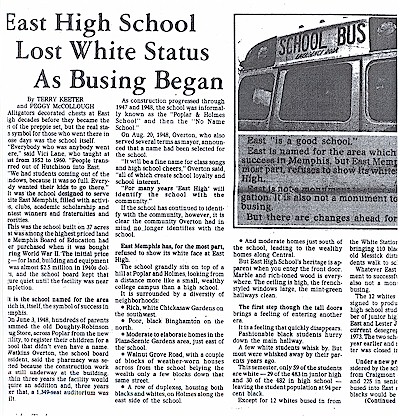
Alligators
decorated chests at East High decades before they became the pet of the
preppie set, but the real status symbol for those who went there in
those days was the school itself.
"Everybody who was anybody went
there," said Vici Lane, who taught at East from 1952 to 1960. "People
transferred out of Hutchinson into East.
"We had students coming out of the
windows, because it was so full. Everybody wanted their kids to go
there."
It was the school designed to serve
white East Memphis., filled with activities, clubs, academic
scholarship and contest winners and fraternities and sororities.
This was the school built on 37
acres that was among the highest priced land the Memphis Board of
Education had ever purchased when it was bought during World War II.
The initial price tag – for land, building and equipment – was almost
$2.5 million in 1940s dollars, and the school board kept that figure
quiet until the facility was near completion.
It is the school named for the area which is, itself, the symbol of success in Memphis.
On June 3, 1948, hundreds of parents
crammed th old Daughty-Robinson Drug Store, across Poplar from the new
facility, to register their children for a school that didn't even have
a name.
Watkins Overton, the school board
president, said the pharmacy was selected because the construction work
was still underway at the building. Within three years the facility
would require an addition and three years after that, a 1,349-seat
auditorium was built.
As construction progressed through
1947 and 1948, the school was informally known as the "poplar &
Holmes School" and then the "No Name School."
On Aug. 20, 1948, Overton, who also
served several terms as mayor, announced a name that had been selected
for the school.
"It will be a fine name for class
songs and high school cheers," Overton said, "all of which create
school loyalty and school interest.
"For many years 'East High' will identify the school with the community."
If the school has continued to
identify with the community, however, it is clear the community Overton
had in mind no longer identifies with the school.
East Memphis has, for the most part, refused to show its white face at East High.
The school grandly sits on top of a
hill at Poplar and Holmes, looking from a distance more like a small,
wealthy college campus than a high school.
It is surrounded by a diversity of
neighborhoods:
Rich, white Chickasaw Gardens on the southwest.
Poor, black Binghamton on the north.
Moderate to elaborate homes in the Plaza-Scenic Gardens area, just east
of the school.
Walnut Grove Road, with a couple of blocks of weather-worn houses
across from the school belying the wealth only a few blocks down that
same street.
A row of duplexes, housing both blacks and whites, on Homes along the
east side of the school.
And moderate homes just south of the school, leading to the wealthy
homes along Central.
But where East High School's heritage is apparent when you enter the
front door. Marble and rich-toned wood is everywhere. The ceiling is
high, the french-styled windows large, the mint-green hallways clean.
The first step through the tall doors brings a feeling of entering another era.
It is a feeling that quickly disappears.
Fashionable black students hurry down the main hallways.
A few white students whisk by. But most were whisked away by their parents years ago.
This semester, only 59 of the
students are white – 20 of the 483 in junior high and 30 of the 482 in
high school – leaving the student population at 94 per cent black.
Except for 12 whites bused in from
the White Station area and two buses bring 110 black students from the
old Messick district, most of the students walk to school.
Whatever East is, it is not a
monument to successful desegregation. It is also not a monument to
successful busing.
The 12 whites are from an area
designed to produce about 150 senior high school students, and a like
number of junior high school students, for East and Lester Junior High,
when the current desegregation plan began in 1973. The two schools had
been paired a year earlier and remained so until Lester was closed in
1981.
Under a new proposal now being
considered by the school board, 425 whites from Craigmont – 200 in
junior high and 225 in senior high – would be bused into East and a
like number of blacks would be bused from the East area to Craigmont in
the Raleigh area.
The busing proposal – coupled with
similar plans for other Raleigh area schools – has brought a wave of
protests from Raleigh parents. Many in th East area also would not
welcome it with open arms.
But though students, parents, and
faculty members at East may disagree on whether busing is the answer
for desegregation, they all agree on one thing – that East is "a good
school."
Tim Billings, a white 8th grader,
said, "It's freer at East. You can go to the store (for lunch). You can
go to Vo-Tech."
Billing said he is quite comfortable as a minority in the junior high program.
"It doesn't bother me. . .I went to Lester one year. I liked it. The sports were good."
Before Billings finished his thought,
several of his black classmates chimed in with, "We're good friends."
Patting Billings on the back, Tony
Gentry, 13, said, "We like him. He's all right. He's good at basketball
and football."
Billings, who lives, at 533 North Holmes, said he likes being able to walk to school.
"I wouldn't like to go way out to
Craigmont," he said, after being told many of his fellow students may
be bused there.
Gentry, who lives within walking
distance of the school, agreed. If the students are bused, East will
"lose our most valuable players," he said.
"I don't want to go to Craigmont. It
doesn't have windows . . . I like the activities (at East) – the sports
games and the shows in the auditorium."
Gentry has attended Frayser Elementary and the old Lester Junior High. "I walked to Lester, too."
Billings' mother, Mrs. Betty Billings, has lived in the neighborhood for 15 years.
After having "three children in three different schools one year," she "dislikes busing."
"I think brothers and sisters should go to school together – not be separated."
Busing "hinders them from school activities," she added.
Along with the changes at East, Mrs. Billings also has seen her neighborhood change.
"There are more blacks. I've gotten
some living right behind me that I would rather have there than the
ones (whites) that used to be there.
"They (the blacks) are super nice. They're wonderful neighbors. I couldn't ask for any better."
Lavada Dowdy of 337 Eastview has three children attending East. She has
lived in the area 12 years and has seen her children switched from East
Elementary to Lester Junior High and back to East.
However, unlike Ms. Billings, she doesn't mind.
"It is not whether or not I like busing. I do want my children to be
equally educated. I want them to have equal privileges . . . If it
takes busing to do it, that is what I want. "
She thinks "very highly of East," but "Craigmont doesn't bother me."
Mrs. Dowdy, who graduated from
Melrose High School in 1960, remembers her own city bus rides to
school. "I had some white friends and we rode the bus together."
Her friends attended a different
school, but "I knew that while we were in the same grade, taking the
same subjects, our school books were different."
She believes the books used by whites were more advanced.
Her daughter, Vera, who is a junior at East, doesn't mind being bused.
"I believe Dr. (Willie W.) Herenton
knows what he's doing. If he feels that he needs to desegregate the
students then I'm all for it."
Dr. Tom Stern, president of the
school board, said that he, Herenton, and other school officials have
been discussing improvements at East for some time, including plans to
make it an optional school with emphasis on medical services and
engineering.
Of the pre-med part of the proposal,
Stern said the "University of Tennessee is very interested in having
such a school here."
"There's a school like it in Dallas,
and it is really tremendous. And I think East is the perfect location.
. .in a good section, with easy access.
"I think East has a chance to be an
outstanding school – a chance to be the best school in the city, but I
think other schools will be working hard to see that it isn't."
"Willie (Herenton) is committed to
making this a top-notch school," Stern said. "If this proposal is
approved he's going to do whatever it takes to make it work. I believe
he's going to feel that this whole thing is going to hang on East."
Stern said he would continue to push to have the school board vote on the new proposal tomorrow night.
He said he was fully aware of the feeling of the Raleigh parents concerning busing.
"Whether the people will go (to East)
or not, I don't know, but we certainly hope so. We're sure going to
work at it.
"If I was given my choice, I don't
want anyone bused. I want them to go to the neighborhood schools or the
schools of their choice. But we have to act under what options we have
and we don't have an alternative that would make everyone happy.
Stern said he was also aware that
there are many East students who will not want to be switched to
Craigmont.
"Oh, I know that. There's no reason
for them to be happy. Of course, they're going to a good school, but
they're leaving their neighborhood school."
He said he had not visited East
recently, but felt it was a good facility and "the fact that it's
predominantly black doesn't mean a thing" about whether it is a good
school providing quality education.
Stern's daughter, Susan Stern, was
bused to East with the first group brought in from White Station in
1973. She graduated from East in 1976.
Ms. Stern, now living in Washington,
said the racial makeup of the school changed greatly while she was a
student.
"It seemed about half-and-half when
I first started, and I know there were lots less three years later. I
would guess 65-35 black, my senior year.
"It (white enrollment) went down a
lot. It never seemed like that much of a thing. I just knew it was
going down. But I never felt like I was in that great a minority."
The percentage at East were actually
56-46 black in 1973-74, then 62-38 in 1974-75 and 70-30 in 1975-76.
"There were fewer kids in the white
areas than in the black areas. . .and the figures the school was
supposed to have were based on people there before desegregation," Ms.
Stern said. "A lot of them left because they didn't want to go to
school with blacks. Whites did leave the system because of that."
There were also other factors that school officials should have been able to anticipate.
Many of the white neighborhoods in
the area had become older neighborhoods with older residents and fewer
children. And, through the years, some of the more affluent sections,
such as Chickasaw Gardens, had moved toward private education for their
children.
Black neighborhoods in the area had
expanded and many of the new residents were younger and had school-age
children.
East had opened in 1948 with grades
10 through 10, added grade 11 the following year and by 1950 offered
all 12 grades. Through the years, it was its own feeder school – moving
students from first to second grade, and on through the senior year –
and for many Memphis children it was th only public school they would
ever know.
Under the parings, East would have
only grades 4 through 6 and 10 through 12. It would no longer raise its
own students through each grade.
And the junior high feeder school –
Lester – was a previously all black facility that had not enjoyed
funding equal to East and some of the all-white schools. It was in a
black, rather than mixed, section, only a short distance from East.
So, while the first-year results of
the 1972 pairings may have looked encouraging at East – with 415 whites
and 405 blacks – the outlook for successful desegregation at Lester was
never good.
In 1972, Lester had 500 blacks and
123 whites, meaning about 150 whites who would graduate from East the
following spring would be replaced by less than 50 whites moving over
from the ninth grade at Lester.
Under Plan Z, school officials
assigned 313 white students to Lester in 1973, but less than half that
number enrolled.
Ms. Stern was on one of the first buses to arrive at East.
Asked how she felt about being bused, she replied:
"I really had mixed emotions. In a
personal way, I think it added a great deal to my personal growth. I
think I benefitted from the busing. It was good for me to live in the
real world, with all types of people . . . That was one of the most
positive things about East.
"Some academic courses were top-notch and some weren't. It really depended on the teacher."
She said she would never have left the school because of race.
"Not because of the numbers of black
or white – no, that wold not have been a consideration, the white and
black would not."
Ms. Stern said there was no
discipline problem at the school "any worse than any other school" but
that there was also little real integration.
"In terms of the races, there was
clearly a separation. It was sort of like segregation within
desegregation.
"If you walked into the cafeteria,
for example, there were whites at one end and the blacks at the other,
with a couple of table in the middle that were mixed. But very few that
were mixed."
She said she enjoyed her years at East, before attending Washington University in St. Louis.
"I was very happy there. I was very
involved, had a good time and felt like it was my high school."
"I guess what we didn't see bother
us . . . We just didn't see other people who were there to take our
place and that was kinda disappointing. White or black, we didn't
really care, but we didn't see them moving up behind us to take over,"
said Ms. Stern, who was active in the student council, yearbook and the
school newspaper.
The courts didn't have to order Beth Gooch to East when she started
high school in 1972. She had been there since she entered the first
grade in 1963. She was at East when the first black enrolled in 1966,
and she was there for Plan A and Plan Z.
"The biggest change was a lot of our
old teachers left . . . and then our old principal left, and we got the
principal from Lester. So, it wasn't just the makeup of the students,
the faculty changed a lot too.
"There weren't so much problems
between the kids like getting along . . . not racial problems," Miss
Gooch said. "But, like when you merge any two schools, there were not
the same activities.
"Those problems would have arisen if they had merged two white schools or two black schools.
"While I was there the emphasis
shifted a lot from academics to athletics . . . due to (the school)
administration ...
"This is just a personal grip with
me., when you think about the money it takes to fund a football team
and none of those kids would go on to athletics. And then think how
much less it takes to fund a high school newspaper and lots of kids
would go on and work on a newspaper.
"There were other areas and other
things like that. They eventually quit having a Thespian Society, a
Quill and Scroll, a newspaper . . . and became just real hung up on
sport," Miss Gooch said. "They did do well there.
"I feel like having gone to a
racially integrated school enriched my life in some ways that it
couldn't have if the school had been all-white, but I feel that I
missed out on some things academically.
"It seemed like we were in more of a
minority than we were. Probably most of the white kids still in school
were in my class, because most of the classes behind me had less and
less white students.
"My second year some of them got
shipped in from White Station, but most of them didn't stay very long.
They couldn't hack it.
"I'd say by the time I graduated in
1975 . . . it seems like it was 75 or 80 per cent black, but I think it
was probably more like 70," Miss Gooch said. The black percentage that
year was actually 62.
"I'd say student activities were
pretty even, like the president of my class was black, but the
president of the student council was Judge (Robert) McRae's son, Tock,"
Miss Gooch said.
She said she felt adequately
prepared for college at Memphis State University, but could not say
whether East was a good school "because I went there all 12 years and
don't have anything to compare it to."
But she would select East again if she had a choice.
"Yes, I would. The only change is
that I think I would have just worked harder to get more out of the
learning and teaching that was available.
"I had fun. But I think a lot of the
blacks felt like they were kind of getting gyped [sic] out of
something, because they had to change schools. We got to stay where we
were."
Jacqueline Davis Tyson said you can mark her down in that category.
"I was moved from Lester, when they
made Lester a junior high – moved to East for my junior and senior
years." said Mrs. Tyson, who graduated in 1974.
She said it was both a big change and a big disappointment.
"Yes it was. I was just greatly
disappointed because I had looked forward to graduating from Lester. I
didn't like the idea of being forced to go to a school where I didn't
want to go.
"As compared to Lester some of the
things were better, but I think basically, I just liked Lester better.
Most of my brothers and sisters had gone to Lester. East was really too
large. Too many people, as far as closeness is concerned. But I'm a
private sort of person which is why I feel that way.
"I was an honor student," Miss Tyson
said. "I didn't have much contact with them (whites) really. I just
didn't associate with any people that much.
"It may have helped other students
more. I did learn a lot of things I didn't know about people – let me
say, the white people. I learned a lot of things about them I didn't
know. But, academically, no.
"I don't think I learned any more at East than I would have learned at Lester.
"East High was an all right school, it was just not my choice."
Theodore "Ted" Johnson Jr. Saw East
from another view. He was the only black East graduate in the spring of
1971 and among the first half dozen in its history.
"I picked that school. My father at
that time was at Lester (as principal of Lester Elementary) so it was a
bit more convenient for me to come to that school. Indeed it was an
unusual experience. But I was received pretty well.
"I didn't get ovations when I waled
through the door, but then I wasn't treated very rudely," Johnson said.
"I lived with the situation, I guess.
"It was a far better school than I
had attended – it was far less crowded. It was a better learning
atmosphere because of the crowd. At Hamilton there was something like
4,000 and East had like 1,800 in the same number of grades."
Asked if he would select East again,
Johnson replied: "Probably not. I would choose a school with a better
racial balance. Academically, I was prepared to come to East, so there
is no reason to assume that, had I not left Hamilton, I would have been
any less prepared to attend college."
He said he would "not necessarily" select a predominantly black school.
"But I'd like better odds than 1-in-800."
Johnson said the feeling of not
wanting to stand out in the crowd was one of the reasons he chose
LeMoyne-Owen College.
"And I certainly stood out at East."
Blanchard E. Tual was also a standout
at East High. But he was there years before the first black student.
Tual, now a Memphis lawyer, was an
all-city basketball player who was active on the East sports scene
before he graduated in 1963 and became a nationally known swimmer at
the University of Florida.
"It was the East Memphis school
then. A few went to MUS (Memphis University School) and Hutchinson, but
most came to East High because it offered a good education. The schools
then were East, Central and White Station."
Tual said he has no illusions about his basketball honors.
"That was before blacks came in. If I
was playing with the blacks, I'd have been about 20th team. And that's
the truth.
"I think back, and I was prepared
for college. The emphasis then at East was on college. We were amply
well-prepared for college, because all the courses were oriented toward
college. I'll bet 80 to 90 per cent of the students went on to college
– maybe not finish, but at least started.
"Looking back at the teachers, well,
when you're there, you know, you hate them all. But, looking back, I
believe they were all concerned about the students and did anything
they could to help us. Back then, I think the teachers intimidated the
students, rather than vice versa."
Tual said he was pleased with the
plans to make East a pre-medical and pre-engineering optional school.
"Now, I think it's just as important
to have people who can fix your car as it is to have doctors and
lawyers. But if there is an emphasis on this you may see more whites
send their kids to public schools.
"I was lucky enough to walk to
school. I grew up on Central, and I walked about three blocks to East
every day for 12 years. I was really lucky.
"I can't imagine having any happier experience than going to East High."
There are a lot of people at East today who will quickly agree.
Many familiar with East are puzzled
over the uproar Herenton's proposal created among Raleigh residents.
"A lot of the parents who are
criticizing say they don't want to send their kids from Craigmont. And
they don't know anything about East," said Patty Toarmina, a special
education teacher at East.
"Not one parent has asked to come over," she said Wednesday.
Betty Apple, an art teacher, is a
"military wife" who has taught school in other states and in Japan. She
has been at East since last October.
"I like the school. There is a freer atmosphere and nice windows."
And the students?
"Kids are just kids. If you assert yourself, they will cooperate. Kids are the same everywhere."
About Herenton's proposal, she said,
"When there are changes, people are going to be unhappy – when their
neighborhood schools are broken up."
Although her children are grown, she said she wouldn't mind if they were bused.
She finds the students at East
dedicated and cooperative. Last week, when a talent show was blasting
away in the auditorium, several of her junior high school students came
to class to finish painting banners for a Youth Art Month dinner.
"There are three or four children in
my sixth period class" who volunteer to "stay and clean up and pick up
trash" after school, she said.
Adorning the wall leading to the library is a bulletin board declaring
Black History Month. The white faces of John F. Kennedy, Abraham
Lincoln and George Washington are mixed among notable blacks such as
Crispus Attucks, Harriet Tubman and Dr. Martin Luther King Jr.
The large library had few students in it because it was the lunch hour.
Shirley Barber, a soft-spoken woman
who has been librarian at the school for 14 years stood behind the
checkout counter.
She has seen many changes at the school.
"Of course we were grades 7 through
12. Then when Lester and East paired, we were no longer a junior and
senor high school. The enrollment was cut because we lost three
grades."
When the school was paired with
Lester, many of the white students transferred to Central High School,
she said.
She welcomed the school getting back
grades 7-9 this year because it "doubled the enrollment. And of course,
when the enrollment doubles it means more teachers and a second
librarian."
Most of the students walk to school, she said – an idea that she likes.
"There are so many activities after
school. Students who are bused can't participate in sports activities
and club meetings which are held after school instead of during."
Miss Barber is pleased with the prospect of East becoming an optional school.
"Maybe then they'll (Raleigh students) be happy to come to us from Craigmont."
Tom Scruggs, an English and government teacher at East, said the plan
to offer pre-health and pre-engineering courses at the school is "one
of the most innovative plans in the country and many very well make
East High one of the most attractive schools in town."
"It will be the school of the future."
Bill Kobeck, principal at East for
two years, sat in his large office and proudly talked about the
"beautiful" school. "It's a beautiful building," he said.
"Just walk and see how the kids are taken care of. I think we have something to offer."
He described the school as
conventional. "We offer a regular high school program with some
accelerated classes."
He said "anyone who has a youngster
assigned to the school next year is most welcome to come and visit and
see the program we do have.
"Given a chance, we'll provide students attending East High School with an excellent education."
Cool Officers Outsmart Man
[posted August 17, 2008]
The Commercial Appeal
Friday, April 11, 1980
A man who was upset apparently because he was
refused admittance to Memphis Veterans Hospital late Wednesday returned
to the hospital about an hour later and took a hospital policeman
hostage for several minutes before surrendering to police.
Chief Inspector Tom Marshall, Uniform Patrol
Commander, credited the coolness of Patrolmen Patricia Lovett and
Georgia Gantt and hospital policeman
Kathryn Malone ['68] with preventing serious injury to persons inside the hospital.
Police charged Roger Dale Hart, 30, of 579
Orchard, with assault with intent to commit murder and carrying a sawed
off shotgun in connection with the incident.
Miss Malone, a former cruelty investigator for
the Memphis Humane Society, said she was talking to a patient in a
corridor of the hospital at 12:40 a.m. yesterday when she noticed a man
whom she had seen at the hospital earlier walking toward her with a
sawed off shotgun.
"He was coming toward me with this shotgun
pointed toward me. I was walking with a patient. When I saw him I
stopped so he wouldn't think I was going to try anything. He seemed
afraid at first and told me to place my radio on the floor ..."
Police said the man told her that he had been
at the Hospital earlier and that officials wouldn't admit him. He told
her that he wanted to see a doctor.
Meanwhile, bystanders notified Patrolman Gantt
and Lovett who were in the hospital investigating a stabbing incident,
and Ms. Gantt later found the suspect.
Ms. Gantt said when she saw that he was armed
she drew her pistol and ordered him to lay the shotgun on the floor.
Instead, he pointed the shotgun at Miss Malone's neck and threatened to
shoot her if Ms. Gantt didn't drop her gun. She backed around the
corner and pretended to lay her gun down and then signaled Ms. Lovett.
Ms. Gantt and Miss Malone continued to talk to the man while Ms. Lovett circled around him.
"That shotgun was loaded and cocked," Miss Malone
said. "We continued to walk toward the emergency room. He kept telling
them he would shoot me, but he told me he wouldn't.
She said she was moving away from him and the
police were "getting in position to shoot if they had to. I don't know
if he realize this or if he just decided to give up but he asked me if
I wanted the gun then handed it to me."
Police said the man had come to the hospital
about 11 p.m. Wednesday to "have his stomach pumped." He was treated
and sent home. He returned with a shotgun about an hour later. Ray
Adams, a spokesman for the hospital, said the man was schedule to be
admitted to the hospital yesterday.
Hart was being held in the City Jail last night.
Gun-Toting Suspect Surrenders at Hospital
[posted August 17, 2008]
The Press-Scimtar
April 10, 1980
By Ken Garland
Press-Scimitar Staff Writer
Two women police officers and a woman security
officer at the Veterans Administration Hospital at 1030 Jefferson
disarmed a man who entered the hospital earlier today and held the
security officer at gunpoint, police said.
The man was arrested after he voluntarily
lowered a shotgun he had been pointing at the head of the security
officer,
Kathryn A. Malone ['68], shortly before 1 a.m. today, police said.
The man was arrested by Patrolwomen Georgia A.
Gantt and Pat A. Lovett, who were attempting to talk the man into
surrendering, officials said.
The 30 year old suspect, who police said had
been at the hospital as a patient yesterday, is being held in City Jail
today, said Lt. Jerry Webb of the General Investigation Bureau.
The incident began at 12:47 a.m. when a man
walked into the emergency room area and approached security officer
Malone, police said. The man pulled a sawed-off 12 gage shotgun which
he had concealed and pointed it security officer Malone's head, police
said.
Meanwhile, officers Gantt and Lovett were at
the hospital gathering information on a stabbing victim, were
approached in the emergency room area by a nurse who had seen the
incident begin, said Capt. Sam Martz, headquarters watch commander.
After hearing what had happened, the two officers went looking for the security officer.
Officer Gantt said she spotted the suspect
standing near the guard with his shotgun pointed toward the floor. She
said she pulled her service revolver and ordered the man to drop the
shotgun, police said.
At that point, the man raised the shotgun and
pointed it at security officer Malone's head, Officer Gantt said. The
man told Officer Gant to drop her pistol, threatening to kill the
security officer if she did not, the police report said.
Officer Gantt said she pretended to drop her
weapon, but stepped behind a wall and out of the line of fire. She said
she found Officer Lovett and told her what was happening.
The two officers said they could see the gunman
walking the security down the hallway with the gun at hear head.
Then, while Officer Lovett circled through
nearby corridors to get behind the gunman and hostage, Officer Gantt
began talking to the suspect, the officers said.
At that point, the suspect lowered the shotgun and handed it to the security officer, police said.
Martz said that when other officers arrived, the two women officers had the suspect in custody.
Alumnus talked suspect holding gun on her to surrender
[posted August 17, 2008]
Ken Welch, Editor, The East High Alumni Page
August 17, 2008
At the memorial service for
Kathie Malone ('68)
yesterday, the former Chief of Security at the Veterans Administration
Medical Center in Memphis provided additional details of Miss Malone's
laudable actions when faced with a gunman who threatened to shoot her.
This is the story he told about the events of April 9/10, 1980.
The Emergency Room was full. A man came into the
ER wanting to see a doctor, but because it was full no doctor was
immediately available.
There was a long hall in the VA Hospital which
monitored by a security camera. An officer in the security office
monitored that camera and others. He saw Kathie walk down that hall and
turn into a short connecting hall, which was not covered by security
cameras.
It was then she came face to face with the man who was armed with a shotgun.
At that time, VA Hospital officers did not carry
firearms. They did wear radios on their belts. Either thinking the
radio was a gun or just was a threat to call for help, the armed man
demanded that Kathie remove it. She took it off, put it on the floor
and pushed it away from her. Facing an armed and angry man, she had the
calmness of mind to push the radio away from her, right out into the
hall because she knew that area was monitored by the security camera.
The officer in the security office saw the radio
being pushed out into the hall and called the security chief. The chief
knew something was wrong and told the duty officer to assemble the
security staff and call the Memphis Police Department.
Kathie lead the armed man to a small room
adjacent to the Emergency Room and began talking with him. He demanded
to see a doctor. Kathy told him no, she was not going to help him see a
doctor as long as he had the gun. Kathie went on to tell him if he put
the gun down, she would help him to see a doctor. She talked him into
putting the gun down then he was immediately subdued by other officers
and taken into custody. He also was later allowed to see a doctor
later.
The Chief of Security says a little while later
he later asked Kathie if she had been scared. She said "no, not at the
time, but now I'm about to collapse. I'm scared to death."
People who came to know Kathie later, if they
learned of her actions on that day, didn't learn about the incident
from her. She wasn't the type of person to publicize her extraordinary
actions.
East Alumnus Nurse Debra Boone Murdered
Summarized from stories in The Commercial Appeal
[posted August, 2001, based on news stories of 1976-1977] - The body of nurse Debra Anne Boone ('72)
was found about 2:30 a.m. in her car on a parking lot near the City of
Memphis Hospital's Jefferson Pavilion by hospital security guards early
Saturday morning, September 18, 1976. They were drawn to the vehicle by
a small fire.
Police determined that Miss Boone had left her home
about 9 p.m. and planned on visiting friends before reporting to her
night shift nursing job which began at 11 p.m. Shortly before she was
to begin work, she called the hospital and reported she would be late
because of a flat tire on her car. Police say she was visiting friends
in the medical center area and did not have a flat tire. She called
again about 1 a.m. to say she would be in to work shortly. She never
arrived.
The police investigation indicated Miss Boone had
parked her car in front of the Jefferson Pavilion when she was
approached, pushed back into the vehicle and abducted. Police say she
was driven to an area north of the medical center where she was beaten
and raped. The attacker or attackers then drove her car, with Miss
Boone in it, to the parking lot and attempted to set it on fire by
pouring gasoline on it and igniting the fuel. The fire attracted the
attention of hospital security officers who found the body when they
investigated.
An autopsy revealed Miss Boone died of strangulation from a belt wrapped around her neck.
Miss Boone had just received notification on Friday
that she had passed the examination by the state Board of Nursing and
was a registered nurse, just hours before her Saturday morning murder.
Within three days after the crime, two juveniles were
charged with murder in the death of Miss Boone. Eddie James Lawson, 14,
of 814 Looney and Nathaniel "Bobo" Young, 16, of 230 East Red Oak #1,
were accused. Nathaniel Young was a 10th grade student at East High at
the time of his arrest, though he was reported to have missed 8 of the
first 17 days of school. Lawson was reported to be on probation for a
previous felony. Investigators say Lawson told family members he had
some knowledge of the crime and a family member notified police. When
questioned, Lawson told police he had witnessed the abduction and
described the assailant so that a police sketch could be made.
Investigators became suspcicious when they realized Lawson was telling
more than a witness should have known. Officers said he was questioned
further and implicated Young. Police said both confessed to being
involved with the crimes against Miss Boone. As a 14-year old, Lawson,
if convicted in Juvenile Court, faced possible incarceration until his
twenty-first birthday, the maximum that he could be held under
Tennessee law. Nathaniel Young was tried as an adult on murder charges
and faced a possible lengthy sentence but was acquitted by a criminal
court jury. Police said they would not reopen the investation of the
murder because they were convinced they knew all of those responsbile
for the murder and had charged them with the crime.
The following account of Miss Boone's funeral is from The Commercial Appeal, September 22, 1976:
Services for Miss Boone were held yesterday [September 21, 1976] at Memphis Funeral Home Poplar Chapel.
About 350 persons attended the services — mostly young people.
Many of those present apparently were medical students and nurses.
About 100 persons had to stand during the services, lining the outside
walls of the chapel and filling the foyer at its entrance.
Rev. Dale Palmer, assistant pastor at Bellevue Baptist Church where Miss Boone was a member, gave the eulogy.
"Debra's life touched so many, many others," he said. He said Miss
Boone will be remembered for her Christian faith, her love of people
and her "dedication to serving others."
She was buried in Memorial Park, with about 150 persons attending services there.
Many lingered at graveside well after the conclusion of services hugging each other and weeping quietly.
| posted August, 2001, story and picture circa 1976 from
a Memphis newspaper - A grinning watermelon with black olive eyes and a
pineapple for a topknot added a touch of humor to Colonial Country
Club's popular seafood buffet last night. Dishing up salads are Mr. and
Mrs. H. F. Glover, left, and Mr. and Mrs. Garry Hill.
[Editor's note: Gary Hill ('68) died in 1997. An obituary is available.] |
 |
St. Petersburg Times, Friday, June 27, 1975
FORT WALTON BEACH (UPI) — A vacationing
banker's daughter, whose nude body was found on an isolated military
beach, may have been sexually assaulted before she was beaten and
apparently drowned., Medical Examiner Edmund Kielman said Thursday.
 FBI agents,
who took charge of the investigation because it happened on government
property, said the young woman, identified as Lynn Pyeatt, 19, of
Memphis, Tenn., appears to have been murdered, but refused to elaborate.
FBI agents,
who took charge of the investigation because it happened on government
property, said the young woman, identified as Lynn Pyeatt, 19, of
Memphis, Tenn., appears to have been murdered, but refused to elaborate.
OKALOOSA COUNTY Sheriff's deputies said
the body was found Wednesday afternoon on a lonely section of Eglin Air
Force Base beach adjoining a Gulf-front condominium where the victim
was staying with Marian Dickerson, 20, Memphis, whose family owns the
vacation complex.
Paul Quinn, 18, Smyrna, Tenn., another
vacationer, found the body on the open beach 20 feet from the water.
Her writs were tied with nylon cord.
He told the FBI he did not know her or her friends.
A PRELIMINARY autopsy report, Kielman said, indicates that the death was due to drowning.
FBI agents said Miss Pyeatt was seen
sitting with a group of friends beneath a beach umbrella, about 35 or
40 minutes before the body was found.
The friends, according to the FBI, said the bikini-clad woman left them for a walk by herself along the beach.
"My speculation is there was foul play
and then she was drowned," said Kielman. "There was definite evidence
she was hit about the skull, with bruises the size of a 25 cent piece.
There were no fractures, just bruises. There were marks over the right
eye, left cheek and upper eyelids. She was attacked in or near the
water. There is no preliminary evidence of a struggle."
MISS PYEATT WAS the daughter of Wayne
Pyeatt, chairman of the board of the National Bank of Commerce in
Memphis. Law officers said that Miss Pyeatt had been vacationing for
two weeks in Fort Walton Beach. FBI officials said they have no
suspects.
Okaloosa Deputy Sheriff Hank Little
said Miss Pyeatt's body was found about 4:30 p.m. Wednesday and that
her hands were tied behind her back. Miss Pyeatt's swimming suit was
found on another section of the beach, which directly adjoins a public
swimming area, said Little, the first law officer at the scene.
Kielman says he located no lacerations
on the writs from a nylon cord. Because no signs of abrasion exist,
Kielman said, Miss Pyeatt's wrists could have been tied after she died
and she may have been sexual assaulted later. Test for sexual abuse are
incomplete, he said.
SHE WOULD HAVE struggled if her writs
were tied before she died," said Kielman. "There were no abrasions
whatsoever. I would think her writs were tied after she died."
Kielman said that body temperature
tests indicate that Miss Pyeatt, a former high school honor student and
cheerleader, died Wednesday afternoon. He said her lungs were filled
with water, indicating the attack occurred in or near the ocean.
Little said "quite a few" people were
on the beach when the body was found but FBI officials said they have
not located witnesses to the incident. Little said no fence exists
between the public and military beaches and vacationers frequently
sunbathe and swim on the military property.
HE SAID THE body was found in an open area but away from the beach's main swimming and sunbathing section.
FBI officials say they are questioning
Miss Pyeatt's friends abut the incident but declined to reveal details
of the inquiry. An agent described the investigation as "very
sensitive."
[Editor's note: see also a
2013 artcile about this muder not having been solved.]
posted August, 2001, story and picture 1972 from the Memphis Press-Simitar
David Mayo ['67] Coming Out With 3 New Albums
By MARY ANN LEE
Press-Scimitor Staff Writer
Come January, David Mayo will have out three new albums at once and if
that isn't some kind of record in itself, it must be close.
 He will be featured on his own TMI album, "Mayo": the new "Washrag"
album (Washrag being the group that has the hit-ranking "Bang") and
"Acrobat," which he co-produced with R. J. Williams, younger brother of
Trans-Maximus president Jerry Williams.
He will be featured on his own TMI album, "Mayo": the new "Washrag"
album (Washrag being the group that has the hit-ranking "Bang") and
"Acrobat," which he co-produced with R. J. Williams, younger brother of
Trans-Maximus president Jerry Williams.
David is one of the producers of the Washrag album,
along with Steve Cropper and Ronnie Capone, and on the disc he plays
keyboard and guitar.
"Acrobat" is a group from Atlanta, and it's really
different-sounding, David said. "The album will have everything on it,
including electric bass, congas and the Memphis Strings," he said. The
latter, of course, are from the Memphis Symphony and, yes, "Acrobat"
does seem "different-sounding." But interestingly -- I, for one, can
hardly wait.
The album just missed being called "Mayonnoise,"
David said. It was a joke, but maybe it had negative connotations - who
wants to deliberately label his own music "noise"? So the title is
"Mayo."
All the tunes on the "Mayo" album are new. David and
co-producer Steve. Cropper wrote a couple of the songs and they dug out
a never-recorded tune, "Crazy Eyes," by Richie Furay of the Poco group.
Furay, who lives in Boulder, Colo., gave his permission for the song to
go on the album and everyone is so pleased with the result, "Crazy
Eyes" may also end up as a single.
David' will be singing on "Mayo," an album which
will feature neither strings nor horns, he said. Primarily he seems to
think of himself as a singer, although he has so many talents, it is
hard to dig in and place any definite label on him. He plays organ,
guitar, bass and even a little drums - all without benefit of formal
training. His mother had sung on the radio when she was a teenager, but
that's about the only musical heritage in David's background. Still,
the talent and the drive were there and, as he put it, "I progressed
from sheer 'want.' "
In high school, 10 years ago, David began his
musical career by singing with a group called The Coachmen in
LittleRock. He co-wrote
their hit single, "Tears ot Blue," No. I on local charts. When his
family moved back to Memphis, where David had been born, he attended
East High, but flew back to Arkansas every weekend to keep appearing
with the Coachmen.
After they split up, David went with a Memphis group
called Load of Mischief, later renamed Paris Pilot when they recorded
an album at Stax with producer Don Nix. The group was a musical
success, but a financial flop, and next David joined the then
popular-local group-Village Sound. In July of l970, that group also
divided.
Next up was an album collaboration with writer
Wayrie Crook and then David was asked to join Caboose ("Black Hands,
White Cotton") as lead singer. Although that group was doing well, it,
too, split up. That's when David landed at Trans-Maximus and became
part of still another group, Edgewater, which broke up in May.
It has been a long, busy haul over the last 10 years
for a young man who is still only 24 - he has had eight singles and two
albums on four different labels, graduated from East High and put in
three years as a speech and drama major at Memphis State. You get the
feeling that the past is only a pale prologue for a glittering future.
Likeable, easy-going, but serious about his music, David may have
started something in his family. His 16-year-old brother, Doug, has
taken up drums and is so good at it, David says, "He never ceases to
amaze me." Doug hasn't turned pro yet, but with David in the family,
it's probably only a matter of time. Meanwhile, three new albums in one
month ought to be enough for any household for a while.
2 Memphis Students Are Killed in Crash
Memphis Press Scimitar, March 14, 1972:
Tennessee Highway Patrol today was still investigating an auto crash in
which two Memphis students on their way home from the University of
Tennessee at Knoxville were killed on rain-slick I-40 near the
Gordonsville exit.
Troopers said it was still uncertain what caused Helen L. Tully ['68], 22, to lose control of her car and collide with another on the interstate, killing her and a passenger, Reid W. DuBard ['67], 23.
She was the daughter of Mr. And Mrs. Bartlett C.
Tully, Jr., 2218 Kirby Road. His parents are Dr. And Mrs. Horton G.
DuBard, 6460 Strathspey.
Both students were pronounced dead on arrival at Carthage, Tenn., hospital.
Trooper R. C. Overstreet of Carthage said Miss
Tully's small foreign car went out of control about 4:55 p.m.
yesterday, crossed a 50-foot wide median stip and collided headon with
an oncoming car occupied by four persons from Hickory, N.C.
The four North Carolinians are in fair condition in Carthage hospital.
The two victims had attended East High School
together. He graduated in 1967 and she in 1968. He was majoring at U.T.
in business administration, with special emphasis on real estate.
Miss Tully's father is vice president of
Anderson-Tully Co., lumber mill. Besides her parents she leaves two
sisters, Frances, a student at University of Alabama, and Virginia, at
home; a brother, Bart Tully III of the home; her grandparents, Mr. And
Mrs. E.D. Bozeman of Memphis.
Mr. DuBard also leaves a sister, Carol DuBard of
Memphis, and his grandparents, Mrs. Logan Reid of Knoxville and Mrs.
Bruce G. DuBard of Memphis.
Both Miss Tully and Mr. DuBard were members of First Evangelical Church and very active in youth work there.
Joint services will be held at the church at 2 p.m.
tomorrow with burial in Memorial Park Cemetery. Tredwell-Norris Funeral
Home is in charge.
The Commercial Appeal, March 14, 1972:
Traffic Claims 2 UT Students on Way Home
Two young Memphians, both students at the University
of Tennessee at Knoxville, were killed late yesterday afternoon in a
two-car accident near Carthage, Tenn., while driving to Memphis for
spring vacation.
They were identified as Miss Helen L. Tully ['68], 22, daughter of Mr. And Mrs. Bartlett C. Tully of 2218 Kirby Road and Reid W. DuBard ['67] of 6460 Strathspey. Both were pronounced dead at a Carthage hospital.
Trooper O.C. Overstreet of the Tennessee Highway
Patrol said a Volkswagen driven by Miss Tully was going west on
Interstate 40, which was slick with rain. He said about two-tenths of a
mile from the Carthage exit, the car crossed the median and hit an
eastbound Oldsmobile in which four persons from Hickory, N.C., were
riding.
The North Carolinians were not seriously injured, he said.
Tredwell-Norris Funeral Home has charge of arrangements for both victims.
Miss Tully also leaves two sisters, Miss Francis
Tully, who is attending the University of Alabama at Tuscaloosa, and
Miss Virginia Tully of the home; and her grandparents, Mr. And Mrs. E.
D. Bozeman of Memphis. Her father is vice president of Anderson-Tully
hardwood flooring company.
Mr. DuBard also leaves a sister, Miss Carol Dubard of
Memphis, and his grandparents, Mrs. Logan G. Reid of Knoxville and Mrs.
Bruce G. DuBard of Memphis.
Woman Drowns In Bathtub
[The Commercial Appeal, October 28, 1971]
A foot stopping up the drain of a bathtub that was being
filled could have caused the water to rise and drown 22-year-old Mrs.
Karen Sue [Trusler ('67)] Walsh at her new home at 4655 Oak Forrest Way in Perkins Woods, police reported today.
Police Capt. Claude Watts said the body was discovered by
her husband, John P. Walsh, after she did not return from the bathroom
and the water kept running shortly before midnight.
The body was under water when found. Police quoted Walsh
as saying he called a neighbor, who is a nurse, to give artificial
respiration but that it was too late.
Autopsy results are being awaited.
Mrs. Walsh, a member of St. Luke's Methodist Church and
alumna of Memphis State University, was secretary at Bluff City
Distributing Co. and a member of Delta Sigma Phi, Business girls'
sorority.
Survivors besides her husband include her parents, Jack E.
and Mrs. Martha Trusler of 184 Palisade, three aunts and five uncles.
National Funeral Home is in charge.
A news style obituary is also available on the
obituary page.
GI, Wondering 'Where All Have Failed,' Is War Victim
From
The Commercial Appeal, March 23, 1969
Army Pfc. Jackie Joe Webb, son of
Mr. and Mrs. Clifford Webb of 97 S. Humes, was killed Thursday [March
20, 1969] while on patrol in Vietnam.
The father, a foreman for Memphis
LIght, Gas and Water Division, was notified Friday of the death of his
son, who was stationed at Tien Phue with the 196th infantry.
Private Webb, who was 20, was
graduated from East High School and worked at Agrico Chemical Co.,
until he was drafted. He entered the Army in June and left for a year's
duty in Vietnam in December.
He wrote a poem while in Vientam, which he mailed home shortly before
his death. In it he said the day he left for Vietname he felt more
curiosity about his new life than fear.
He described Vietnam as a "land of confusion." He said the war was not "too bad," but it was not "what I thought it would be."
He ended the poem by saying he could not help wondering "where all the good men have failed."
He also leaves two brothers, the Rev. Wayne Webb of Mansfield, Tenn.,
and Mike Webb of the home address, and a sister, Mrs. Joyce Baker of
2362 Arlington.
Memphis Funeral Home on Union has charge.
Editor's note: The Vietnam Veterans Memorial
Wall lists Mr. Webb as having been a corporal and having been killed on
March 19, 1969.
Wreck kills J. P. Snider, East High's Only Principal
[posted April 21, 2006]
From
The Commercial Appeal, July 31, 1964:
Joel P. Snider of 1058 Peabody, longtime
Memphis educator and the first and only principal of East High School,
died at Campbell Clinic and Hospital at 7:40 last night from injuries
received in a car-truck crash near Savannah, Tenn. about 3:30 p.m. He
was 60.
Mr. Snider's car collided with a pickup truck eight miles west of Savannah on a rain slick highway.
He was taken to Hardin County General Hospital
for emergency treatment then moved to Campbell Clinic in Memphis where
he died.
State Troopers said Mr. Snider's car collided
on a curve with the truck driven by Franklin Perry Hill, 38, of Olive
Hill, Tenn. Mr. Hill was treated at Savannah Clinic for minor injuries.
No charges were filed pending further investigation.
Born in Hampton Roads, Va., Mr. Snider was
educated at the University of Virginia where he received his bachelor's
and master's degree and was chosen to Phi Beta Kappa.
He came to Memphis in 1926 and taught at
Memphis University School until 1934. From 1934 to 1936 he taught at
Tredwell Junior High School and from 1936-1939 at Humes High School.
IN 1939 he was named principal of Leroy Pope
School where he remained until 1943. From 1943-1948 he was principal at
Snowden School.
In 1948 he was named the principal of East High
School when it opened. Summer classes at the school will be suspended
today in Mr. Snider's memory.
Mrs. Arthur Sessel, a member of the Board of
Education whose son studied under Mr. Snider said, "I'm shocked. This
is certainly a tragic loss to the community."
"My son went to high school under him and I
hold Mr. Snider in high professional regard as well as having a deep
personal feeling for him. Excuse me, please, but I am shocked."
Morgan Christian, assistant superintendent of
education of the Memphis Schools, said, "J.P. Snider was one of the
leading scholars of Memphis. His contribution to the youth of Memphis
has been great and his absence will be sorely felt.
Mr. Snider was a member of St. Mary's Cathedral (Episcopal).
He leaves a daughter, Mrs. Coyle Shea Jr. of
5669 Gwynne Cove; a nephew, Lester Moody, of Ft. Lauderdale, Fla., and
six grandchildren.
Services will be at 10:30 a.m. tomorrow at St.
Mary's Cathedral. Burial will be in Forest Hill Cemetery with Memphis
Funeral Home in charge.
 Also see Mr. Snider's entry in The East High Alumni Page Hall of Honor.
Student Prankster Sought As Bomb Call Empties East
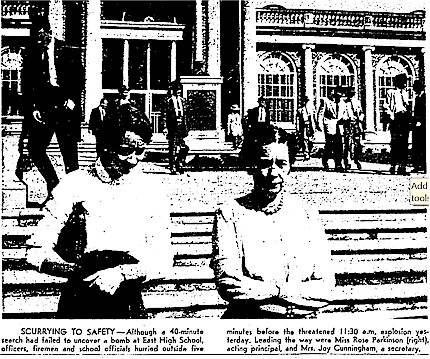
By Wesley Pruden Jr.
[
[posted August 2, 2021]
From The Commercial Appeal, October 25, 1958:
A student prankster is being sought as the
“soft-voiced man” who emptied East High School yesterday with a
telephone threat that a bomb would explode at 11:30 a.m.
Three dozen officers and firemen searched the
spawling school building on Poplar and Holmes soon after the tipster
called police at 10:44 a.m.
Miss Rose Parkinson, acting principal, aid the 2,250
students left the building within three minutes after police called
her. She said neither teachers nor their classes knew it was anything
but a routine fire drill until they guessed or were told about it at
noon.
Several Students Quizzed
Classes were dismissed at noon by Schools
Supt. E. C. Stimbert on the advice of Police Capt. W. W.
Wilkinson, who directed the search of the building.
Officers talked with several students after the
student body was dismissed but made no arrests. Captain Wilkinson said
“my first reaction is that it was a prank although we don’t intend to
dismiss it as a prank, if you get what I mean.”
Cheers thundered from the students, massed on the
school’s spacious lawns, when Miss Parkinson dismissed them for the
week end. She spoke from a sound truck. But not everyone was happy.
No Week-End Homework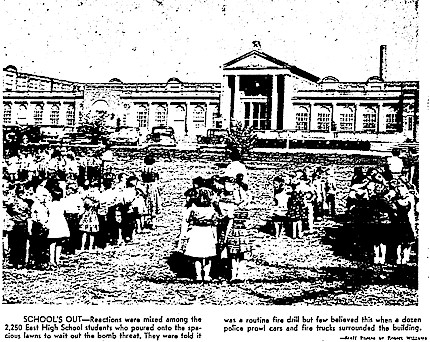
“I don’t care if we do get out of school,”
said Eugenia Dowling of 3372 Highland Park Place, an 11th grade
student. “I’m still scared something might happen to my school.”
Teachers were told to go back into the buildings for coats and other belongings. But not books.
“There will be no homework this week end,” Miss
Parkinson told her students, who ranged from 6 to 17 years old. East
includes all 12 grades.
Mr. Stimbert said the thoughtfulness of parents
account for the lack of confusion, although premature radio broadcasts
around 11 a.m. were alarming.
“I guess they trusted us to take care of their
children,” he said. “We could have been swalloed up by panicky parents.”
It was a long afternoon for kitchen help. They had
to dispose of kettles of spaghetti and pounds of easily spoiled food.
All counted, Mr. Stimbert estimated the incident cost Memphis taxpayers
“at least $2,000.”
East High’s Mustang Band played a concert at 4 p.m.
for a store opening in Poplar Plaza and its junior football team played
a football game. But police vetoed any activities in the building until
Monday morning.
September 9, 1948 - Street Crossing Deemed Danger (The Commercial Appeal)

September 3, 1948 - Big Boys to Assist Younger Students at Dangerous Street Crossings (The Commercial Appeal):

August 21, 1948 - Front Page News: New School Named East High School (The Commercial Appeal):
August 17, 1948 - Three Weeks Before Students Arrive School Still Has No Name
June 12, 1948 - School Baord President Predicts Stop Lights for Poplar Avenue at New School (The Commercial Appeal):
June 4, 1948 - Students Begin Registering to Attend New School (The Commercial Appeal)
May 30, 1948 - Petitioins Call for Naming New School After William J. Prescott (The Commercial Appeal):
May 29, 1948 - Naming of New School Delayed (The Commercial Appeal):
May 23, 1948 - New School Opening Set For Fall (The Commercial Appeal):
March 3, 1948 - City Schools Hope to Open New School at Poplar and
Holmes for 1948-1949 School Year (The Commercial Appeal):
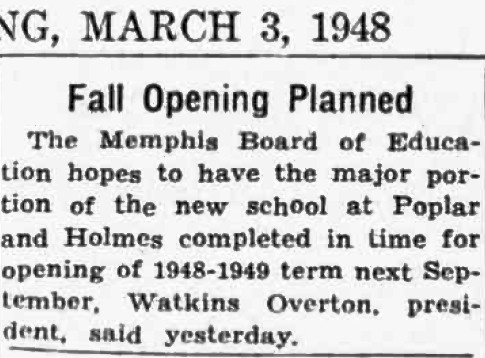
August 16, 1946 - Construction of East High School Begins - from The Commercial Appeal:
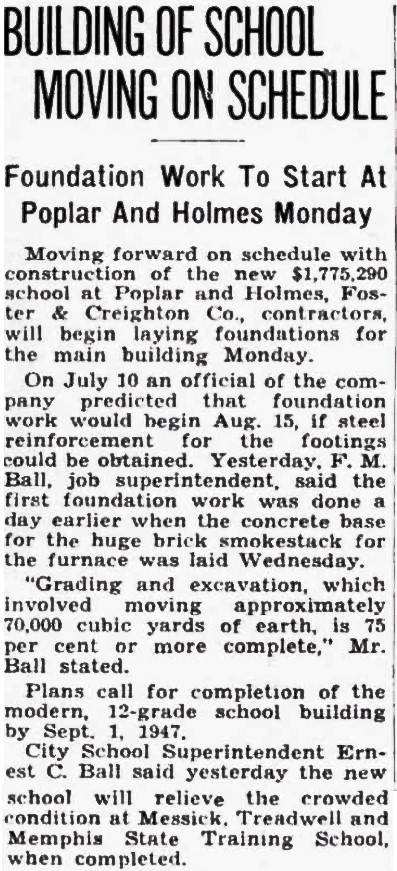
[Editor's note: The school actually opened September 7, 1948. It cost $2,485,397.07.]
August 28, 1945, Plans for new east Memphis high school
The following excerpt is from page 13 of The Commercial Appeal, August 28, 1945:

[Editor's note: The school actually opened September 7, 1948. It cost $2,485,397.07.]
Most of the stories for this section originate with the major Memphis
media outlets:
The Commercial Appeal,
Daily Memphian,
WMC-TV,
WREG-TV, WHBQ-TV, WPTY-TV, WLMT-TV,
the Memphis Business Journal, the
Memphis Daily News
and WREC-AM.

 What
was not clear was that Barrett would be executive principal of both
East and the Maxine Smith STEAM Academy, for which she was the founding
principal and was still in that role when SCS superintendent Dorsey
Hopson placed her over East High, too. Maxine Smith is a grade six
through eight fully optional middle school where academic achievement
has impressed the school district. It is located in the building which
once was Fairview Junior High. STEAM is like STEM but adds the A for
arts.
What
was not clear was that Barrett would be executive principal of both
East and the Maxine Smith STEAM Academy, for which she was the founding
principal and was still in that role when SCS superintendent Dorsey
Hopson placed her over East High, too. Maxine Smith is a grade six
through eight fully optional middle school where academic achievement
has impressed the school district. It is located in the building which
once was Fairview Junior High. STEAM is like STEM but adds the A for
arts. Nevertheless, Barrett now has responsibility for
both schools. "I believe you can have someone who kind of embraces the
middle school and high school piece and sees that there should be more
of a bridge there. That's the vision he [Hopson] had for it and I'm
just trying to run with it." she says.
Nevertheless, Barrett now has responsibility for
both schools. "I believe you can have someone who kind of embraces the
middle school and high school piece and sees that there should be more
of a bridge there. That's the vision he [Hopson] had for it and I'm
just trying to run with it." she says. 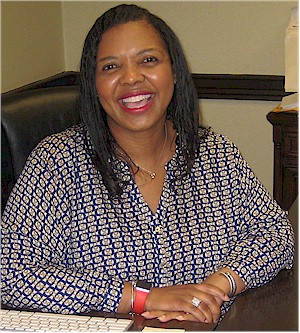
 The
use of computers was not new to Barrett. She grew up with a computer in
her home and she, along with all the other students at Dartmouth, were
required to have one. "So technology has always been part of my
educational experience and it has always been an expectation that I
would use it and that I would make it a part of what I did... Because I
had some exposure to technology I saw how it could really transform a
classroom. And at the time I was one of the few teachers that wanted to
use technology..."
The
use of computers was not new to Barrett. She grew up with a computer in
her home and she, along with all the other students at Dartmouth, were
required to have one. "So technology has always been part of my
educational experience and it has always been an expectation that I
would use it and that I would make it a part of what I did... Because I
had some exposure to technology I saw how it could really transform a
classroom. And at the time I was one of the few teachers that wanted to
use technology..."


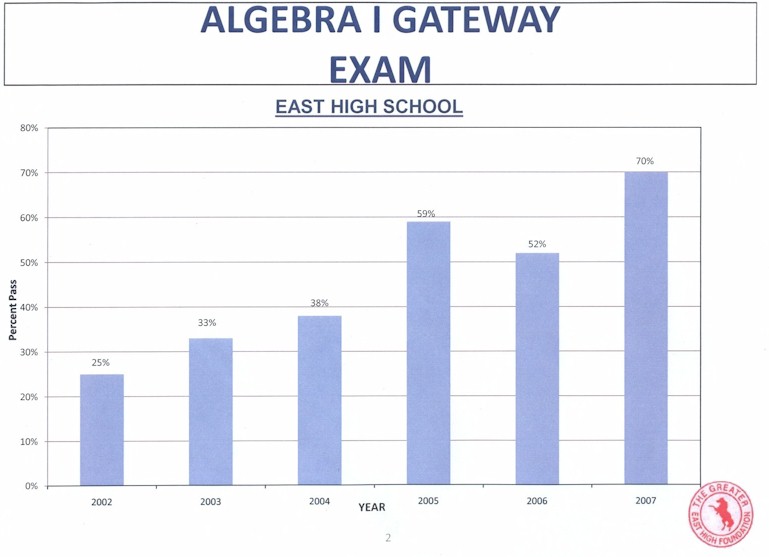
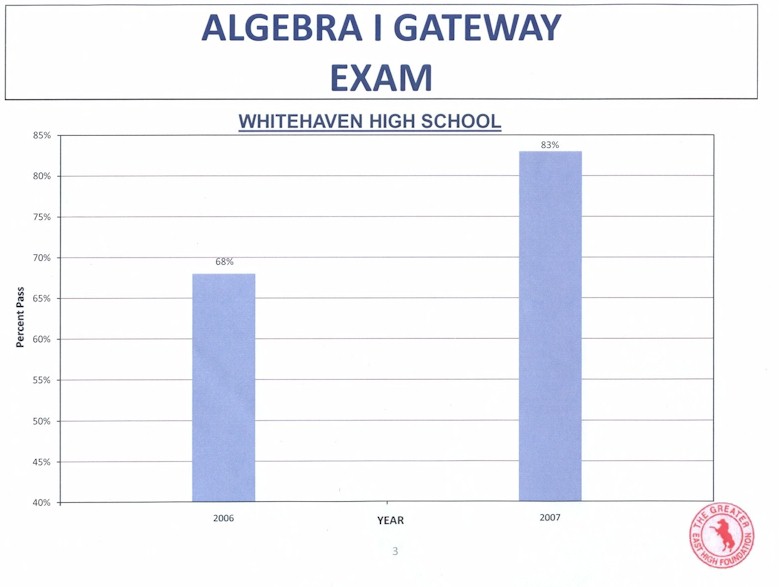


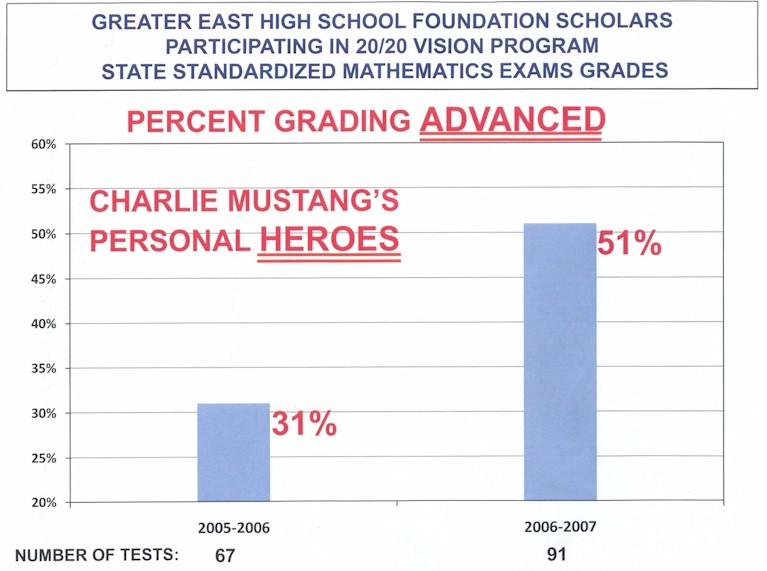


 Return to The East High
Alumni Home Page
Return to The East High
Alumni Home Page
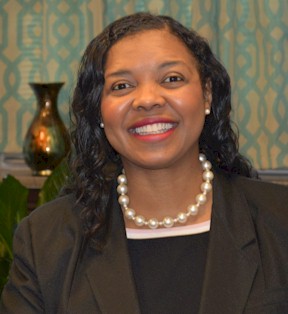 April 7,
2017 - "Of course, right now, when I look at the data, when I
look at the numbers, it's daunting, downright scary. But those numbers
aren't people. So I put the numbers to the side then I just look at the
people, " says East High's Executive Principal Lischa Barrett ('91),
now Lischa Brooks.
April 7,
2017 - "Of course, right now, when I look at the data, when I
look at the numbers, it's daunting, downright scary. But those numbers
aren't people. So I put the numbers to the side then I just look at the
people, " says East High's Executive Principal Lischa Barrett ('91),
now Lischa Brooks. Despite
her relating to the children as people instead of numbers, Barrett
admits, "There's a lot of work to be done but I can't forget we're
talking about people and we're talking about a community."
Despite
her relating to the children as people instead of numbers, Barrett
admits, "There's a lot of work to be done but I can't forget we're
talking about people and we're talking about a community."